
English Notes – Grammar, Vocabulary & Verbal Ability for Competitive Exams – Grammar & Sentence Structure
Showing 23 posts tagged Grammar & Sentence Structure in English.

NewNouns: Form, Number, Case and the Apostrophe Rules
This article is a complete, exam-ready guide to nouns for SSC, banking, insurance, railway, defence and State PSC exams. Noun questions are almost never about what a word means. They are about its form, and four form questions cover nearly everything asked: is the plural right, is the possessive right, does the word take a plural at all, and does the gender matter. The highest-value section is the possessive system, because a verified SSC answer key marks a phrase such as the table's legs as wrong. It also covers compound and foreign plurals, nouns that change meaning in the plural, personification, collective noun vocabulary and the Indian English noun habits examiners target. Ten solved questions, common traps and a fifteen-question practice set with a full answer key are included.

NewNouns: Form, Number, Case and the Apostrophe Rules
This article is a complete, exam-ready guide to nouns for SSC, banking, insurance, railway, defence and State PSC exams. Noun questions are almost never about what a word means. They are about its form, and four form questions cover nearly everything asked: is the plural right, is the possessive right, does the word take a plural at all, and does the gender matter. The highest-value section is the possessive system, because a verified SSC answer key marks a phrase such as the table's legs as wrong. It also covers compound and foreign plurals, nouns that change meaning in the plural, personification, collective noun vocabulary and the Indian English noun habits examiners target. Ten solved questions, common traps and a fifteen-question practice set with a full answer key are included.

NewParts of Speech: The Eight Classes and How to Tell Them Apart
This article is the hub for the eight parts of speech, written for SSC, banking, insurance, railway, defence and State PSC exams. It starts from the fact that decides most questions in this topic: a part of speech is not a property of a word but of the job the word is doing in a particular sentence. The word fast is a noun, a verb, an adjective and an adverb depending on where it sits. So instead of asking you to memorise lists, this guide gives a position test for each of the eight classes, a list of the words that shift class most often, the noun and verb pairs examiners reuse, and the suffix map that reveals word class at a glance. Every class links to its full article, and ten solved questions, common traps and a fifteen-question practice set with a full answer key are included.
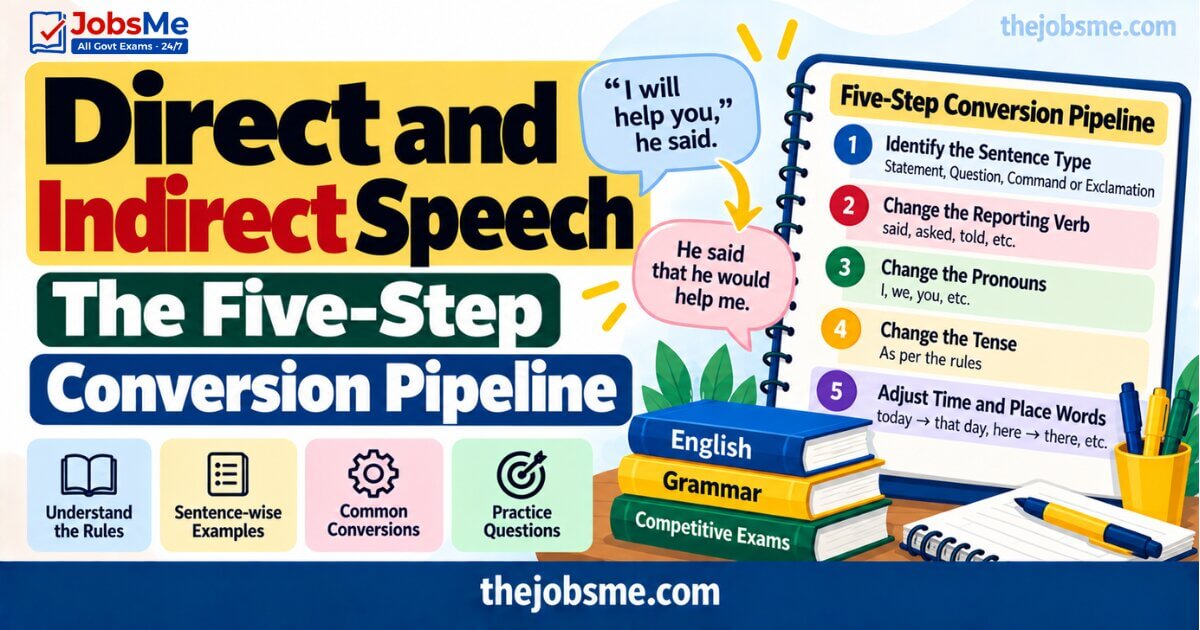
NewDirect and Indirect Speech: The Five-Step Conversion Pipeline
This article is a complete, exam-ready guide to direct and indirect speech for SSC, banking, insurance, railway, defence and State PSC exams. Narration is the most mechanical topic in the syllabus, and the reason candidates lose marks is not that the rules are hard but that they are applied in the wrong order or one stage is skipped. So this guide sets the conversion out as a five-step pipeline that runs in a fixed sequence, beginning with the reporting verb, which decides whether any tense shift happens at all. It then works through each of the six sentence types with its own template: assertive, interrogative, imperative, exclamatory, optative and let. Ten solved questions built on verified previous-year answers, common traps and a fifteen-question practice set with a full answer key are included.
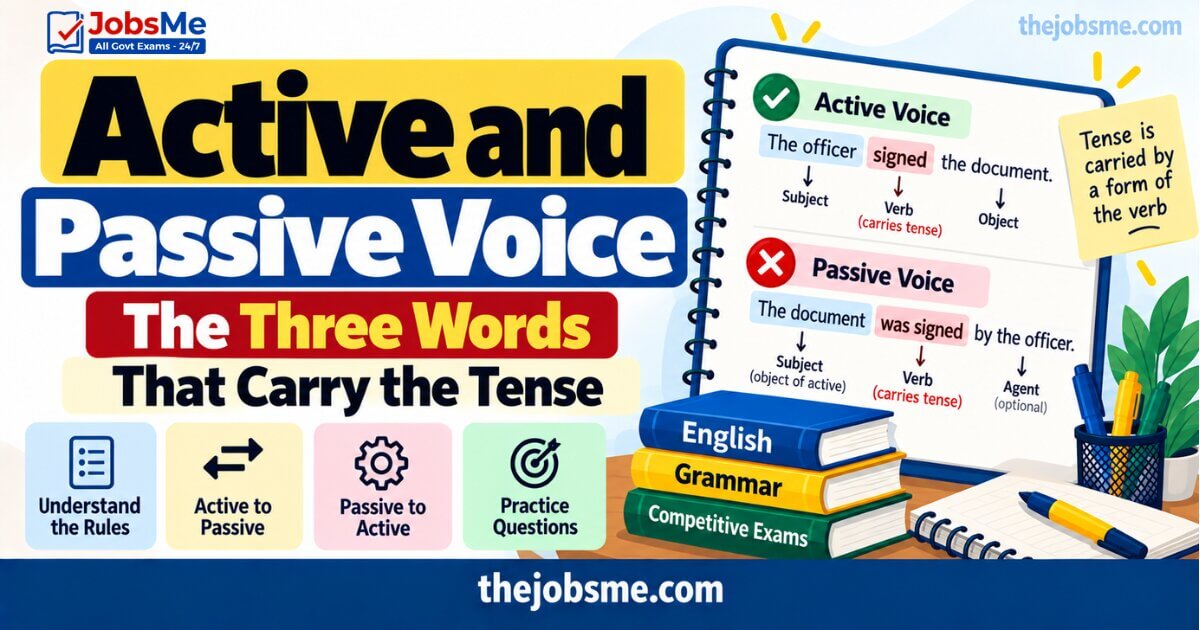
NewActive and Passive Voice: The Three Words That Carry the Tense
This article is a complete, exam-ready guide to active and passive voice for SSC, banking, insurance, railway, defence and State PSC exams. Most guides hand over a chart of eight tense formulas to memorise. This one shows that the chart is unnecessary, because in every passive sentence the tense lives entirely in the form of be, the word being marks a continuous tense, the word been marks a perfect tense, and the main verb is always the third form and carries no tense at all. Learn those three words and you can build any passive without a chart. It also covers the transitivity gate, conversions for imperatives, questions, modals and double objects, the by-with-to rule, and reverse conversion. Ten solved questions, common traps and a fifteen-question practice set with a full answer key are included.
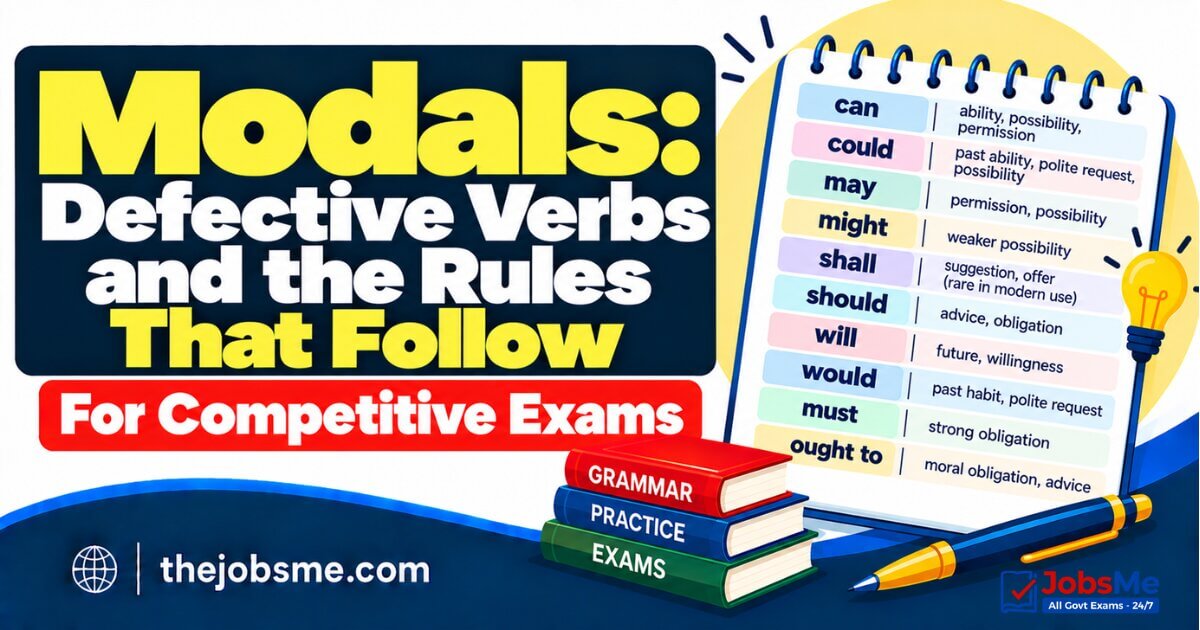
NewModals: Defective Verbs and the Rules That Follow
This article is a complete, exam-ready guide to modal verbs for SSC, banking, insurance, railway, defence and State PSC exams. It starts from the single fact that explains every rule and every trap in the topic: pure modals are defective verbs. They have no third-person s, no -ing form, no past participle and no infinitive, which is why they take a bare verb after them, why they never appear two at a time, and why English needs substitutes such as be able to and have to. It then covers the meaning of each modal with its strength on the obligation and possibility scales, the borderline group of ought to, used to, need, dare and had better, the perfect modals, and the six traps examiners reuse. Ten solved questions, common traps and a fifteen-question practice set with a full answer key are included.
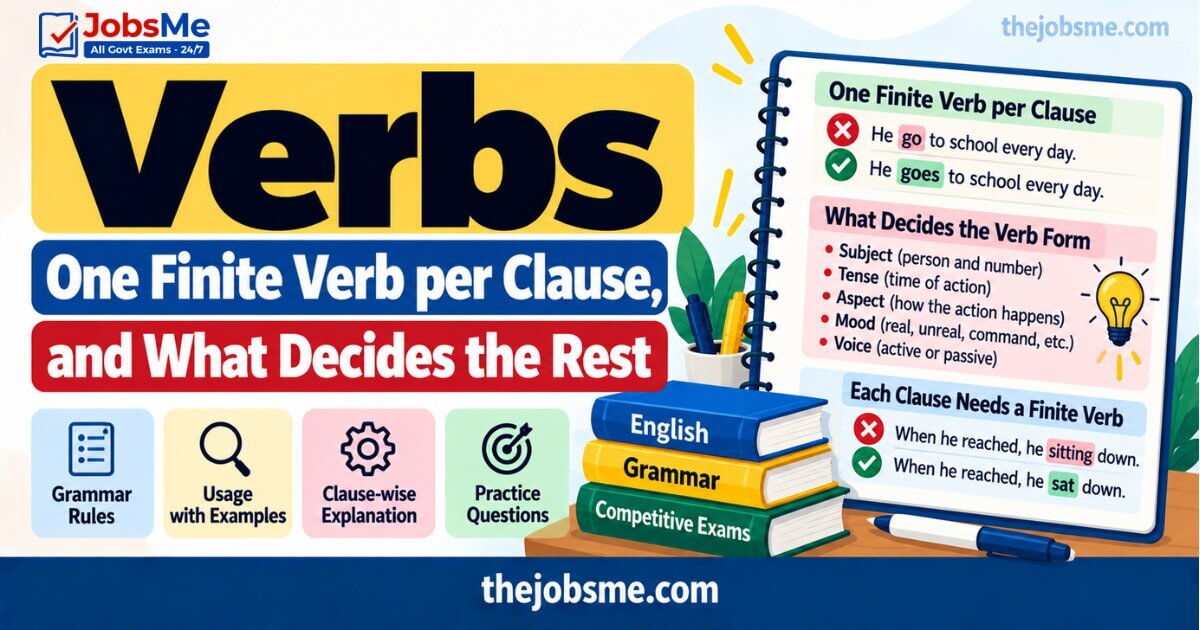
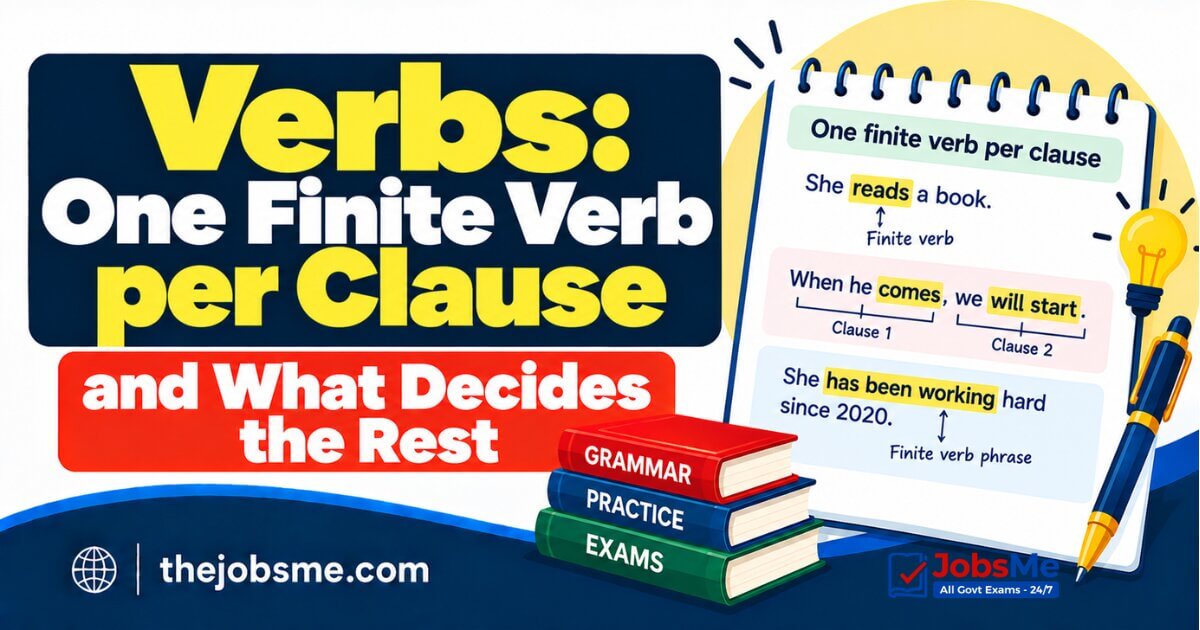
NewVerbs: One Finite Verb per Clause, and What Decides the Rest
This article is a complete, exam-ready guide to verbs for SSC, banking, insurance, railway, defence and State PSC exams. It is built on the rule that generates nearly every verb error in the paper: a clause contains exactly one finite verb, and every other verb in it must be non-finite. Once you count the finite verbs, a second question decides everything else, because the form of a non-finite verb is fixed by the word immediately in front of it. A preposition demands a gerund, a modal or a causative demands a bare infinitive, and specific verbs demand one or the other. It also covers the five verb forms, the causative and perception patterns, stative verbs that resist the continuous, and the pairs whose meaning changes with the form. Ten solved questions, common traps and a fifteen-question practice set with a full answer key are included.
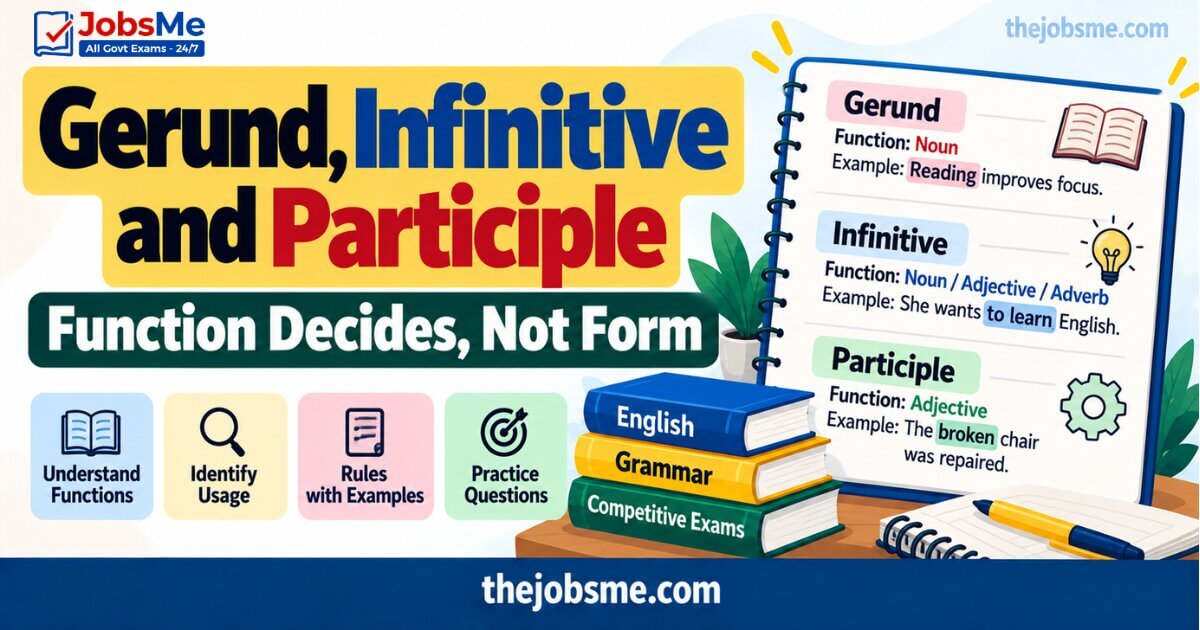
NewGerund, Infinitive and Participle: Function Decides, Not Form
This article is a complete, exam-ready guide to gerunds, infinitives and participles for SSC, banking, insurance, railway, defence and State PSC exams. It rests on a fact that most guides state and then work around: a gerund and a present participle are the same word. Both are the verb plus -ing, so the form tells you nothing and only the job the word is doing can identify it. A gerund works as a noun, a participle works as an adjective or a connector, and an infinitive works as all three. So this guide teaches the function test first, then the jobs each form performs, the perfect and passive versions of all three, the participle connector rules, and the dangling participle error. Ten solved questions, common traps and a fifteen-question practice set with a full answer key are included.
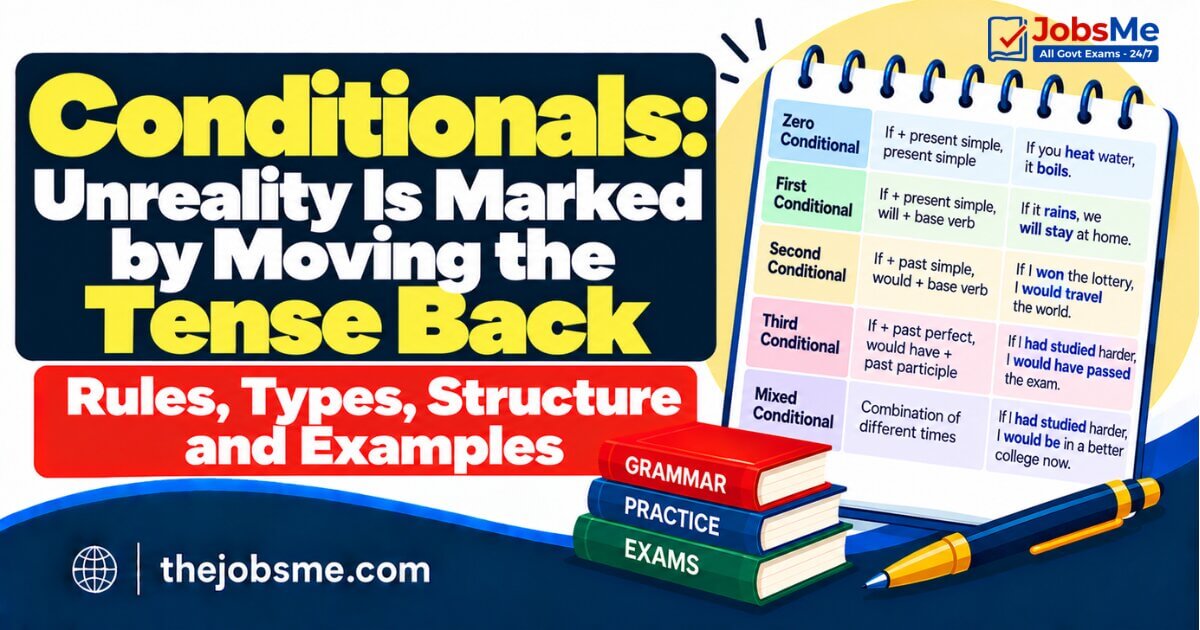
NewConditionals: Unreality Is Marked by Moving the Tense Back
This article is a complete, exam-ready guide to conditional sentences for SSC, banking, insurance, railway, defence and State PSC exams. The names of the four types tell you nothing, and memorising four formulas is why candidates confuse them. One idea explains all of them: English marks unreality by moving the tense backwards. A real condition takes the present, an unreal present condition takes the past, and an unreal past condition takes the past perfect. So the past tense in if I won the lottery is not about the past at all; it measures distance from reality. That single principle makes the four types derivable, explains mixed conditionals, and settles the were question. Inverted conditionals, the no-will rule and the unless traps are covered too, with ten solved questions and a fifteen-question practice set.
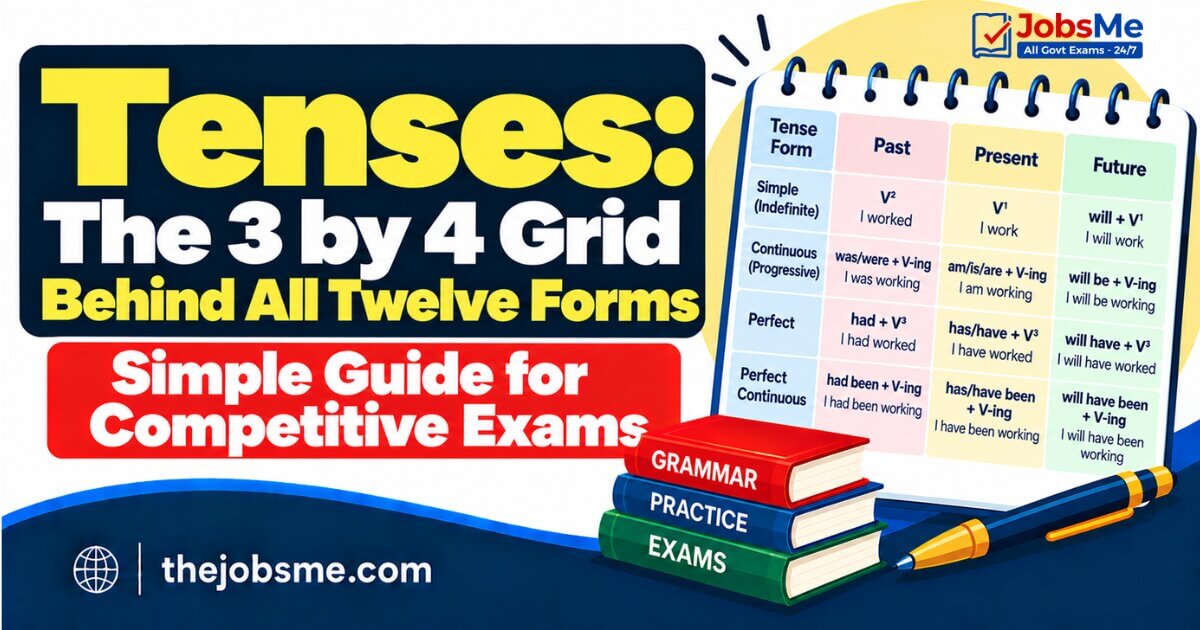
NewTenses: The 3 by 4 Grid Behind All Twelve Forms
This is the hub for tenses, the single highest-weighted grammar topic in SSC, banking, insurance, railway, defence and State PSC exams. Every guide presents twelve tenses as twelve formulas to memorise. That is unnecessary, because the twelve are a three by four grid, and the two axes do different jobs. Time says when the action happens, and aspect says how the action relates to that time. The aspect markers never change across the three times: continuous is always be plus -ing, perfect is always have plus the third form, and perfect continuous is always have been plus -ing. So twelve forms come from seven pieces. This guide sets out the grid, the time-marker words that fix the tense, the sequence-of-tenses rule with its exceptions, and links to every related topic.
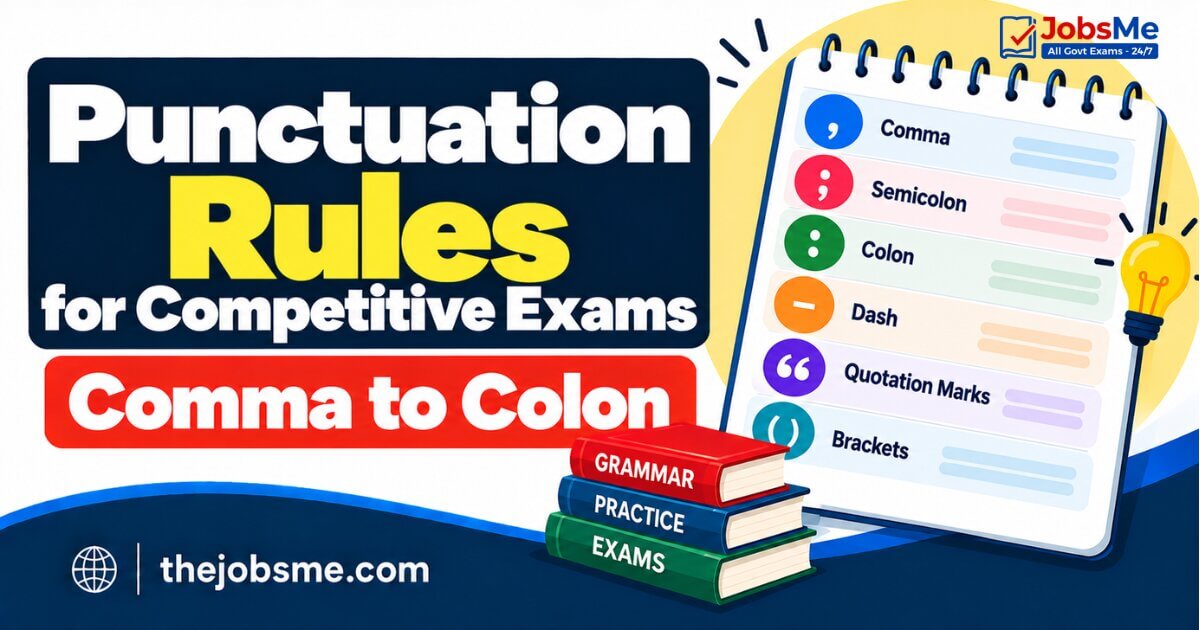
Punctuation Rules for Competitive Exams: Comma to Colon
This article is a complete, exam-ready guide to punctuation for SSC, banking, insurance, railway, defence and State PSC exams. It starts with something most guides miss: punctuation earns very few direct questions but silently affects every mark in a descriptive paper, so it deserves attention for a different reason than other grammar topics. It then ranks the marks by exam value, gives the eight jobs of the comma, the four legal ways to join two sentences, the apostrophe rules including its and it's, the direct speech conventions, and a decision table for choosing between the semicolon, colon and dash. It also covers capitalisation, ten solved questions, common traps and a fifteen-question practice set with a full answer key.
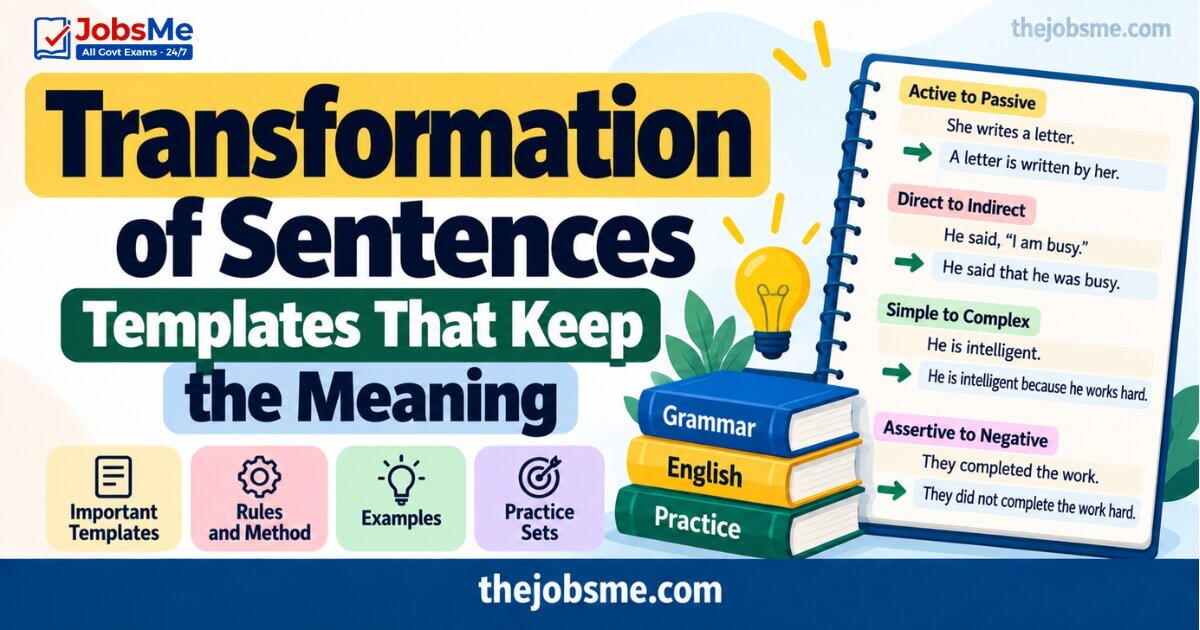
Transformation of Sentences: Templates That Keep the Meaning
This article is a complete, exam-ready guide to the transformation of sentences for SSC, banking, railway, defence, State PSC and teaching exams. It is built around the one rule the topic actually rests on: the meaning must survive the change exactly. It gives ready templates for each transformation type, including the three degrees of comparison, affirmative and negative pairs, assertive and interrogative conversions, exclamatory forms and the simple, complex and compound ladder. It also explains where the marks really are, since transformation is rarely a named topic but shows up inside voice, narration, error spotting and sentence improvement questions. Ten solved questions, common traps and a fifteen-question practice set with a full answer key are included.
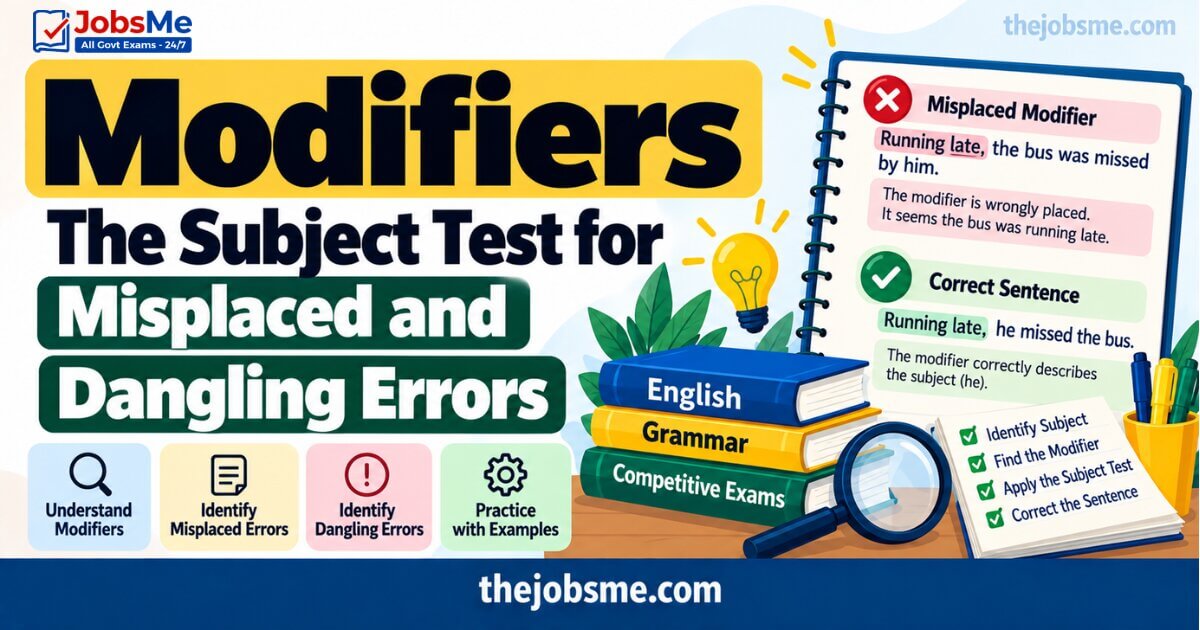
Modifiers: The Subject Test for Misplaced and Dangling Errors
This article is a complete, exam-ready guide to modifiers for SSC, banking, insurance, railway, defence and State PSC exams. It is built around a single question that resolves almost every modifier error: who or what is actually performing the action described in the modifier. It then shows why diagnosing the error correctly matters, since a misplaced modifier is repaired by moving it while a dangling modifier is repaired by supplying the missing subject. It also covers limiting modifiers such as only and just, squinting modifiers, the four traps examiners reuse, and the idiomatic constructions that look dangling but are perfectly correct. Ten solved questions, common traps and a fifteen-question practice set with a full answer key are included.
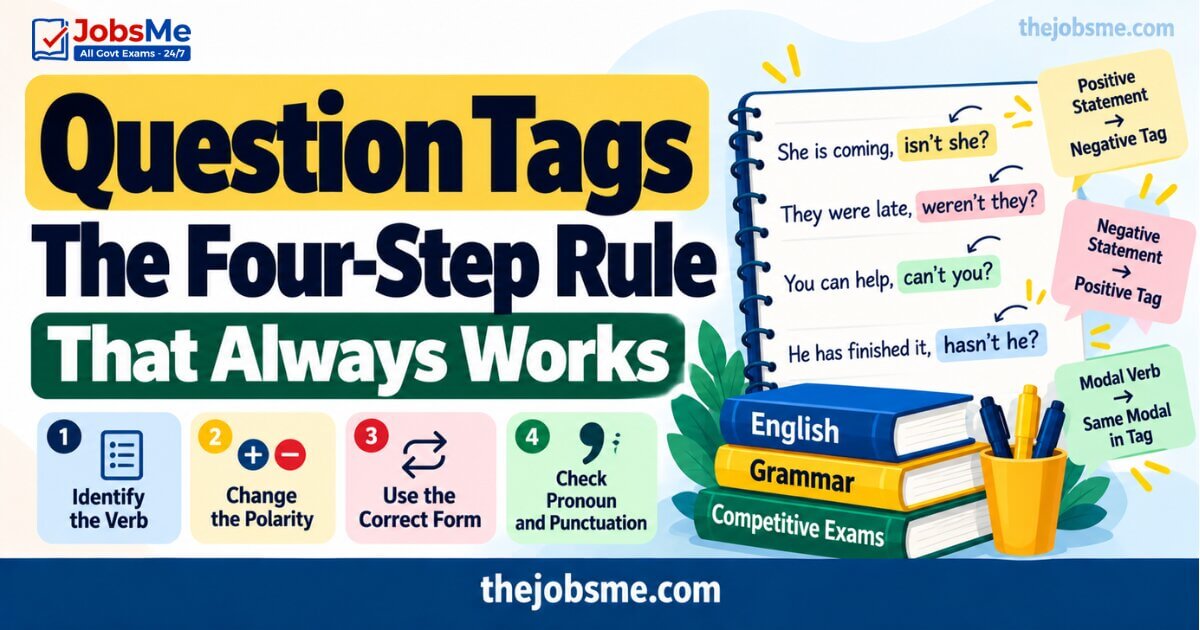
Question Tags: The Four-Step Rule That Always Works
This article is a complete, exam-ready guide to question tags for SSC, banking, railway, defence, State PSC and teaching exams. Unlike most English topics, this one is entirely mechanical, so it teaches a four-step procedure that produces the correct tag every time rather than a list to memorise. It covers finding the operator, flipping the polarity, choosing the pronoun and contracting the negative, along with the hidden negatives that catch most candidates, the full exception table including I am and imperatives, and the advanced cases where the tag follows a subordinate clause. Ten solved questions, common traps and a fifteen-question practice set with a full answer key are included.
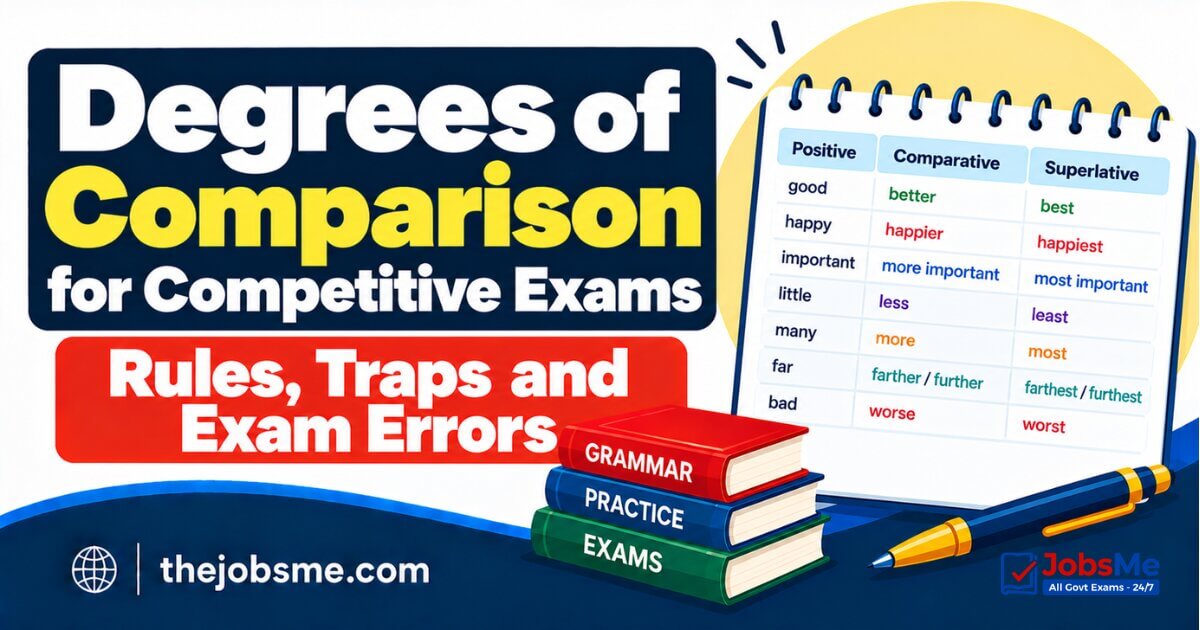
Degrees of Comparison: Rules, Traps and Exam Errors
This article is a complete, exam-ready guide to degrees of comparison for SSC, banking, insurance, railway, defence and State PSC exams. It separates the two halves of the topic that most study material runs together: forming comparative and superlative words, which is easy and barely tested, and the logic of comparison, which is where every exam mark actually sits. The formation rules are compressed into one efficient section, and the rest of the article works through the comparison traps examiners return to, including Latin comparatives that take to rather than than, absolute adjectives that cannot be compared, and the any against any other distinction. Ten solved questions, common traps and a fifteen-question practice set with a full answer key are included.
Interjections: Where the Exam Marks Actually Are
This article is a complete, exam-ready guide to interjections for SSC, banking, railway, defence, State PSC and teaching exams. Most guides treat the topic as a list of emotional words to memorise, which is not what papers ask. The marks lie elsewhere: in converting sentences containing interjections into indirect speech, in changing exclamatory sentences into assertive ones, in punctuating them correctly, and in identifying when a familiar word is working as an interjection rather than as an adverb or noun. It covers the reporting-verb table for narration, the deletion rule, the very and great insertion rule, the punctuation conventions, and the full functional catalogue. Ten solved questions, common traps and a fifteen-question practice set with a full answer key are included.
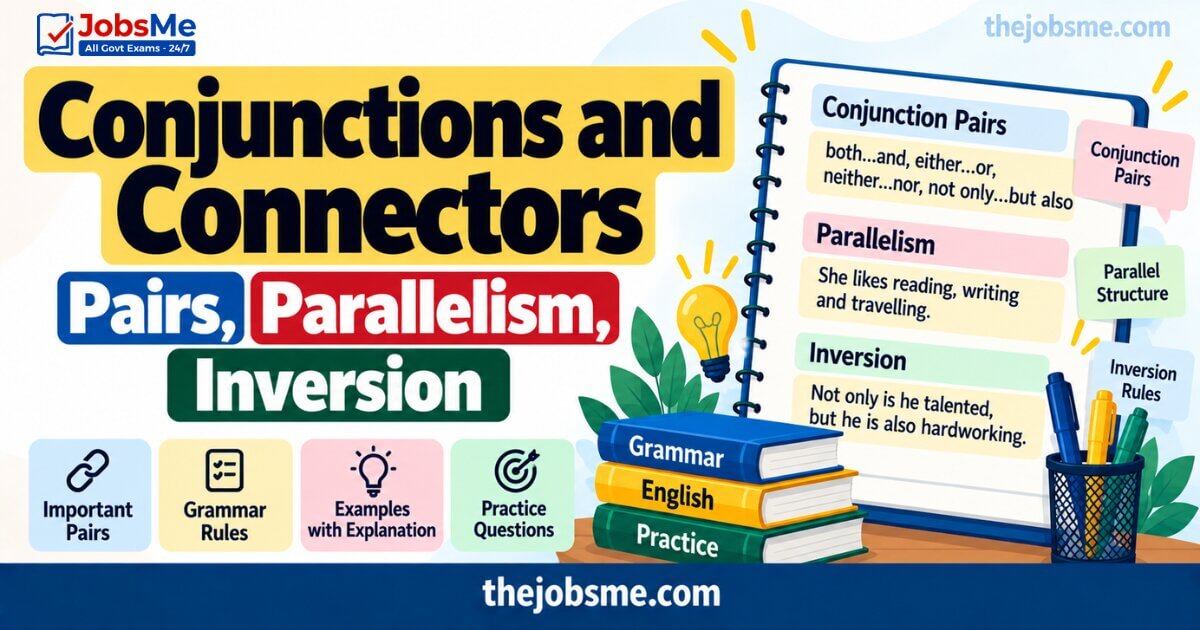
Conjunctions and Connectors: Pairs, Parallelism, Inversion
This article is a complete, exam-ready guide to conjunctions and connectors for SSC, banking, insurance, railway, defence and State PSC exams. It is organised around the point that decides most questions: which family a joining word belongs to, because the family determines the punctuation, the word order and whether a fixed partner word is required. It covers the four families and how each behaves, the full correlative pair table with the wrong partners examiners plant, the three laws governing correlatives, the negative words that must never take another negative, and the difference between a conjunction and a connector. Ten solved questions, common traps and a fifteen-question practice set with a full answer key are included.
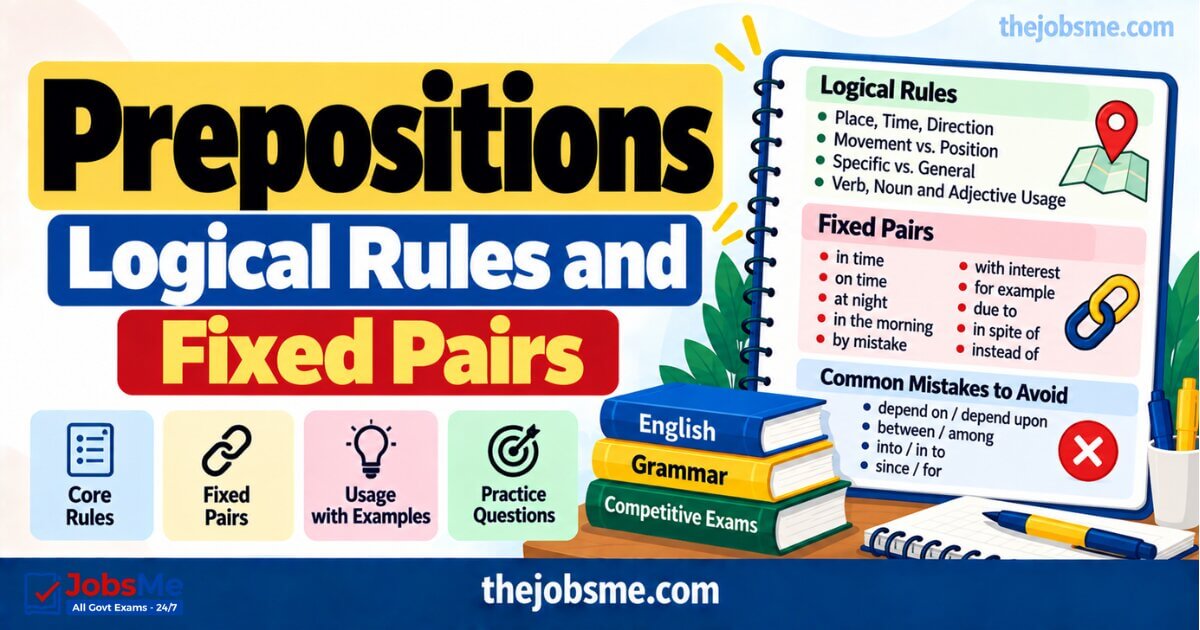
Prepositions: Logical Rules and Fixed Pairs
This article is a complete, exam-ready guide to prepositions for SSC, banking, insurance, railway, defence and State PSC exams. It is built on a distinction most guides mention and then ignore: prepositions split into two groups that need two entirely different study methods. Logical prepositions such as in, on, at, since and between follow rules you can reason out. Fixed prepositions such as comply with, abstain from and senior to follow no rule at all, and reasoning about them is exactly how candidates get them wrong. It covers the logical system in full, the categorised fixed-pair lists, the verbs that change preposition for a person or a thing, the verbs that take no preposition at all, and the gerund rule. Ten solved questions, common traps and a fifteen-question practice set with a full answer key are included.
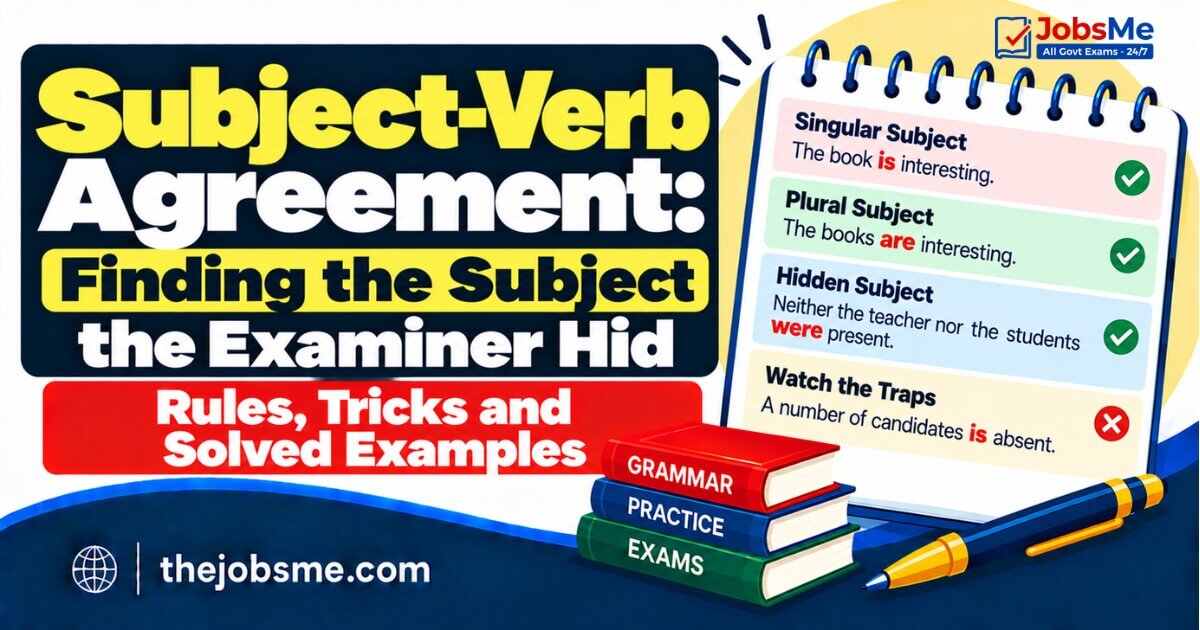
Subject-Verb Agreement: Finding the Subject the Examiner Hid
This article is a complete, exam-ready guide to subject-verb agreement for SSC, banking, insurance, railway, defence and State PSC exams. It is the second-highest-weight grammar topic in the paper and the single most tested area in error spotting, yet almost nobody loses marks on the basic rule. Marks are lost because the examiner hides the real subject, usually by placing a noun of the wrong number right beside the verb. So this guide teaches one method for finding the true subject and then catalogues the structures used to disguise it: intervening phrases, inversion, deceptive noun forms, compound subjects, quantifier-headed phrases, collective nouns and relative clauses. Ten solved questions, common traps and a fifteen-question practice set with a full answer key are included.
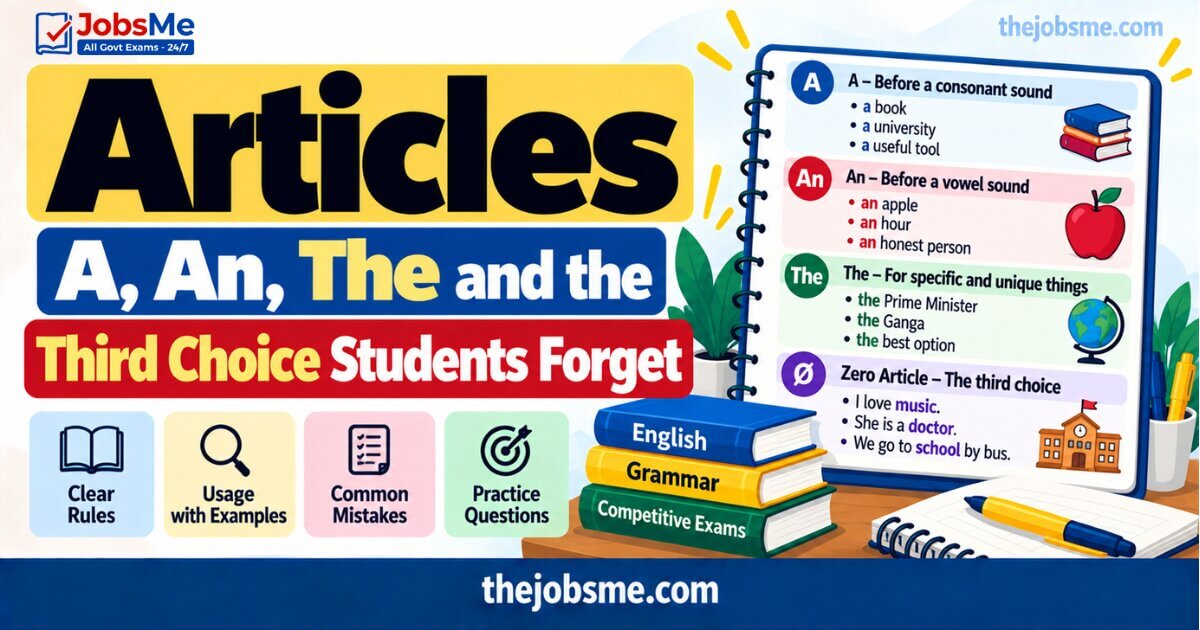
Articles: A, An, The and the Third Choice Students Forget
This article is a complete, exam-ready guide to articles for SSC, banking, insurance, railway, defence and State PSC exams. It rests on a point most guides bury: every article question has three possible answers, not two, because leaving the article out is often the correct choice. Omission carries the highest error-spotting yield in the whole topic, so the zero-article cases get a full catalogue here rather than a footnote. It also covers the sound rule and its four trap groups, the structural formulas that force the, the primary and secondary purpose rule for institutions, and the fixed expressions where an article is compulsory. Ten solved questions, common traps and a fifteen-question practice set with a full answer key are included.
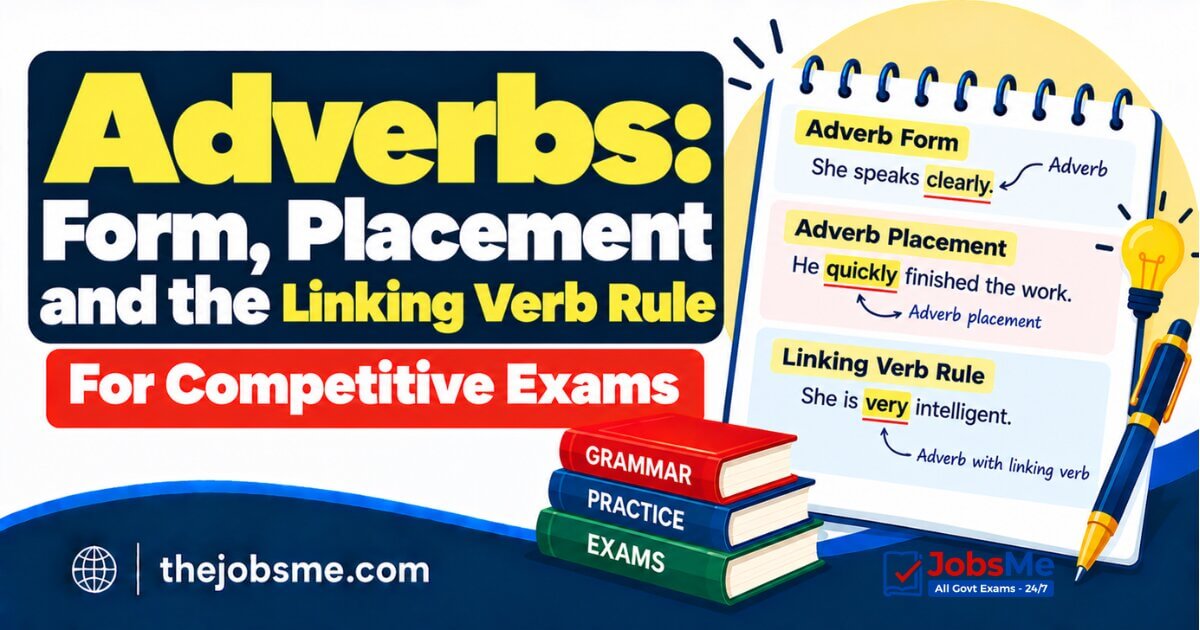
Adverbs: Form, Placement and the Linking Verb Rule
This article is a complete, exam-ready guide to adverbs for SSC, banking, insurance, railway, defence and State PSC exams. Papers rarely ask you to identify an adverb. What they ask is whether the adjective or the adverb form belongs in a sentence, and where the word should sit, because both decisions change either the correctness or the meaning. It covers the linking verb rule that settles the form question, the words ending in -ly that are not adverbs at all, the pairs such as hard and hardly that mean different things, the placement rules for enough, only, also and even, the royal order of adverbs, and the inversion required after a negative opener. Ten solved questions, common traps and a fifteen-question practice set with a full answer key are included.
Phrasal Verbs: The Particle Carries the Meaning
This article is a complete, exam-ready guide to phrasal verbs for SSC, banking, insurance, railway, defence and State PSC exams. It rejects the usual advice that phrasal verbs must simply be memorised in hundreds, and shows instead how each particle carries a consistent core sense that lets you infer meanings you have never seen. It covers the particle map, the separability rules that make this a grammar topic as well as a vocabulary one, the pronoun test that decides word order, the formal equivalents needed for descriptive papers, and the high-frequency verb families that exams return to. Ten solved questions, common traps and a fifteen-question practice set with a full answer key are included.
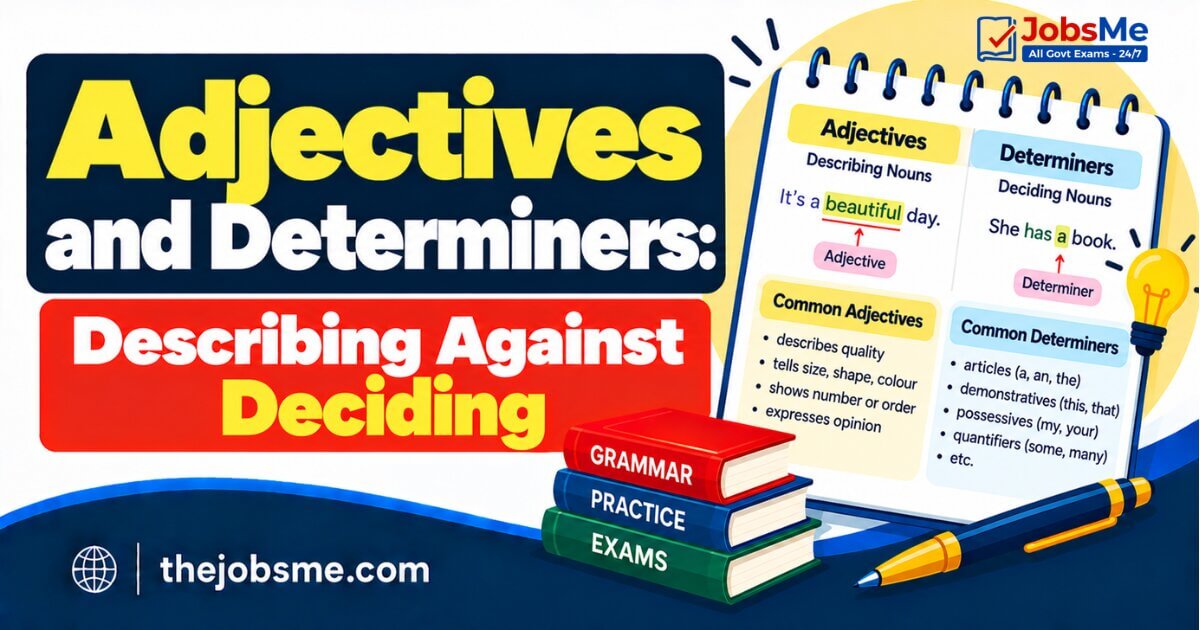
Adjectives and Determiners: Describing Against Deciding
This article is a complete, exam-ready guide to adjectives and determiners for SSC, banking, insurance, railway, defence and State PSC exams. It starts from the distinction that makes the whole topic mechanical: an adjective describes a noun while a determiner decides which noun is meant. That single difference explains why two determiners cannot sit together, why determiners change with number and adjectives do not, and why determiners always come first. It covers the slot system behind a noun phrase, the seven determiner types, the countable and uncountable scale including few, a few and the few, the distributive rules, the OSASCOMP order of adjectives, and the adjectives that work in only one position. Ten solved questions, common traps and a fifteen-question practice set with a full answer key are included.
Recent posts
Latest quizzes



New job notifications

Introduction
JobsMe's English posts are topic-wise study notes written for aspirants preparing for the English Language sections of IBPS, SBI, SSC, RRB, RBI, and all other competitive examinations. Each post covers one English topic in full - with clear rules, structured examples, common error patterns, exam-specific question types, previous year question (PYQ) analysis, and memory aids for rules that are easy to forget under pressure. After reading any post, go immediately to the corresponding quiz in the English quiz archive and test your retention with free interactive MCQs. Logged-in users can track their scores across every attempt.
Want to pair your English preparation with comprehensive current affairs practice? Visit daily current affairs - regular newspaper-quality reading also builds your reading speed and comprehension for exam passages.
What Makes JobsMe English Posts Different
Rules + Examples + Exam Patterns - All Three Together
Many aspirants read grammar rules but still get error spotting questions wrong. Many learn vocabulary but still struggle with Cloze Tests. The reason is that knowing a rule and knowing how that rule is tested in an MCQ are two different things. JobsMe's English posts bridge this gap explicitly - every rule is followed by exam-style examples showing how it appears as a question, and every post includes a section on common exam traps and wrong-answer patterns for that specific topic.
PYQ Analysis in Every Post
Each post includes examples from previous year papers of SSC CGL, IBPS PO, SBI Clerk, and RRB NTPC where that topic was tested. This shows you the exact difficulty level, question framing, and distractor patterns relevant to your target exam. Aspirants who study with PYQ awareness answer questions faster and more accurately than those who study rules in isolation.
Error-Pattern Focus
For grammar topics especially, each post dedicates significant space to the specific error patterns that examiners use - the common mistakes that test-takers make that question setters deliberately exploit. Knowing that "neither...nor" takes a singular verb, that "between" is for two and "among" is for more than two, or that present participle can cause dangling modifier errors - these are the precise rules that appear in error spotting sections. JobsMe posts cover these exam-critical patterns directly.
Vocabulary with Context, Not Lists
Vocabulary posts on JobsMe go beyond simple word lists. Every synonym, antonym, idiom, or one word substitution is presented with its meaning, usage in a sentence, common exam context, and memory association where applicable. This contextual approach produces significantly better long-term retention than memorising standalone lists.
Complete Topic Coverage
Grammar Posts
Tenses - All 12 tenses with timeline diagrams, signal words, common errors (have/has confusion, past perfect vs simple past), and exam-specific question patterns. Special focus on the present perfect and past perfect, which are the most heavily tested tenses in error spotting.
Subject-Verb Agreement - Rules for collective nouns, indefinite pronouns (everyone, no one), compound subjects, inverted sentences, and intervening phrases. These rules produce the most frequent error spotting questions in both SSC and Banking exams.
Articles (A, An, The) - Rules for definite and indefinite article usage, zero-article contexts (proper nouns, languages, meals, abstract nouns), and the most common article errors in exam questions.
Active and Passive Voice - Conversion rules for all tenses, modal passive, and the handling of intransitive verbs (which cannot be passivised). Exam traps involving incorrect passive formation are covered with examples.
Direct and Indirect Speech - Rules for reporting verb changes, backshift of tenses, pronoun transformations, and time/place expression conversions. Questions on reported speech appear frequently in SSC CGL error spotting and sentence improvement.
Parts of Speech - Detailed posts on each part of speech: nouns (types, countable/uncountable), pronouns (reflexive, relative, interrogative), adjectives (types, order, degrees), adverbs (types, position), prepositions (common prepositions with correct usage), and conjunctions (coordinating, subordinating, correlative).
Modifiers - Dangling modifiers, misplaced modifiers, and squinting modifiers - the three types most commonly tested. Exam questions present sentences with modifier errors and ask candidates to identify the problem or choose the corrected version.
Clauses and Sentences - Types of clauses, compound vs complex sentences, proper use of subordinating conjunctions (although, because, while, since), and common sentence structure errors.
Prepositions - Correct preposition usage with common verbs (look at, listen to, good at, interested in), correct preposition after adjectives, and commonly confused preposition pairs (in/on/at for time and place).
Degrees of Comparison - Comparative and superlative formation, irregular forms (good/better/best), common errors with "more" and "most", and double superlative errors.
Vocabulary Posts
Synonyms and Antonyms - Organised by frequency of appearance in SSC CGL and banking exams. High-difficulty word pairs that repeatedly appear are covered with memory associations.
One Word Substitution - Comprehensive coverage of the 300+ OWS pairs most commonly asked in SSC and banking exams, grouped by theme (government, science, behaviour, relationships, literature, etc.) for easier memorisation.
Idioms and Phrases - Complete guide to the idioms and phrases most frequently tested in SSC CGL, SSC CHSL, banking exams, and RRB NTPC. Each entry includes meaning, usage in a sentence, and origin context where memorable.
Confusable Words (Commonly Confused Pairs) - Affect/Effect, Principal/Principle, Complement/Compliment, Stationary/Stationery, Discreet/Discrete, and 100+ other pairs. These appear directly as fill-in-the-blank and sentence improvement questions.
Spelling Correction - Commonly misspelled words that appear in competitive exam options - aspirants who recognise correct spelling patterns eliminate wrong options faster.
Phrasal Verbs - Meaning and usage of 100+ high-frequency phrasal verbs (come across, break down, set off, look into, carry out) with exam-focused examples.
Root Words, Prefixes, and Suffixes - Understanding word roots (Greek and Latin) helps decode unfamiliar words in RC passages and vocabulary questions. Common prefixes (un-, dis-, mis-, pre-, re-) and suffixes (-tion, -ous, -ful, -less, -ity) are covered with word families.
Question-Type Skill Posts
Reading Comprehension Strategy - How to approach RC passages: skimming for structure, scanning for specific information, identifying topic sentences, recognising the author's tone, and answering inference vs direct questions. Passage types (factual, analytical, opinion-based) and their specific question patterns are covered separately.
Cloze Test Strategy - Grammar-based cloze (where the missing word is determined by grammatical rules) vs vocabulary-based cloze (where context determines meaning). Step-by-step approach for both types, with practice passages.
Error Spotting / Error Detection - A systematic approach: check subject-verb agreement first, then tense consistency, then article usage, then preposition, then modifier placement. This order matches the probability distribution of error types in exam questions.
Sentence Improvement and Sentence Correction - How to evaluate underlined or bold parts of a sentence for grammatical correctness, clarity, and conciseness - and how to quickly eliminate options that introduce new errors.
Fill in the Blanks / Fillers - Single blank strategy (part of speech identification, grammatical constraint, contextual fit), double filler strategy (eliminating pairs based on the first blank, then confirming with the second). High-difficulty double filler questions from banking exams are covered in depth.
Para Jumbles - Identifying the mandatory first and last sentences, using connecting words (however, therefore, moreover, consequently) as sequence clues, identifying pronoun-antecedent links, and the elimination strategy for 5-sentence jumbles.
Odd Sentence Out - Identifying the sentence that disrupts the topical or grammatical coherence of a paragraph. Strategy for both theme-based and grammar-based odd-one-out questions.
Descriptive English Posts
Letter Writing - Formal letter format (complaint, request, enquiry, application), informal letter format, dos and don'ts, common themes in IBPS PO Mains descriptive papers, and sample letters with examiner's comments.
Essay Writing - Essay structure (introduction, body paragraphs, conclusion), common essay themes for banking and government exams (economic growth, financial inclusion, digital India, environment, education, social issues), vocabulary and phrases for essay writing, and common errors to avoid.
How to Use English Posts for Maximum Score
Grammar First, Vocabulary Second
Start your English preparation with grammar. Grammar rules are finite and learnable in 4-6 weeks of consistent study. Once you have a solid grammar foundation, error spotting, sentence improvement, and fill in the blanks questions become significantly easier. Then shift to vocabulary - which benefits from a longer 3-4 month horizon.
Topic-to-Question Drill
After reading any grammar post, immediately attempt 15-20 exam-style questions on that specific topic. The goal is not variety - it is deep practice on a single rule until you can apply it automatically without consciously recalling the rule. This automaticity is what enables fast, accurate answers under time pressure.
Active Reading for Comprehension
To improve Reading Comprehension and Cloze Test performance, read every day - editorials, opinion pieces, magazine articles. This is preparation that cannot be replaced by any study notes. The daily current affairs posts on JobsMe are written in a clear, analytical style that doubles as RC practice material.
Always Follow with the Quiz
After reading any post, go to the English quiz archive and attempt the corresponding topic quiz. Immediate testing after reading converts short-term comprehension into long-term exam memory - the testing effect is well-established in learning science.