
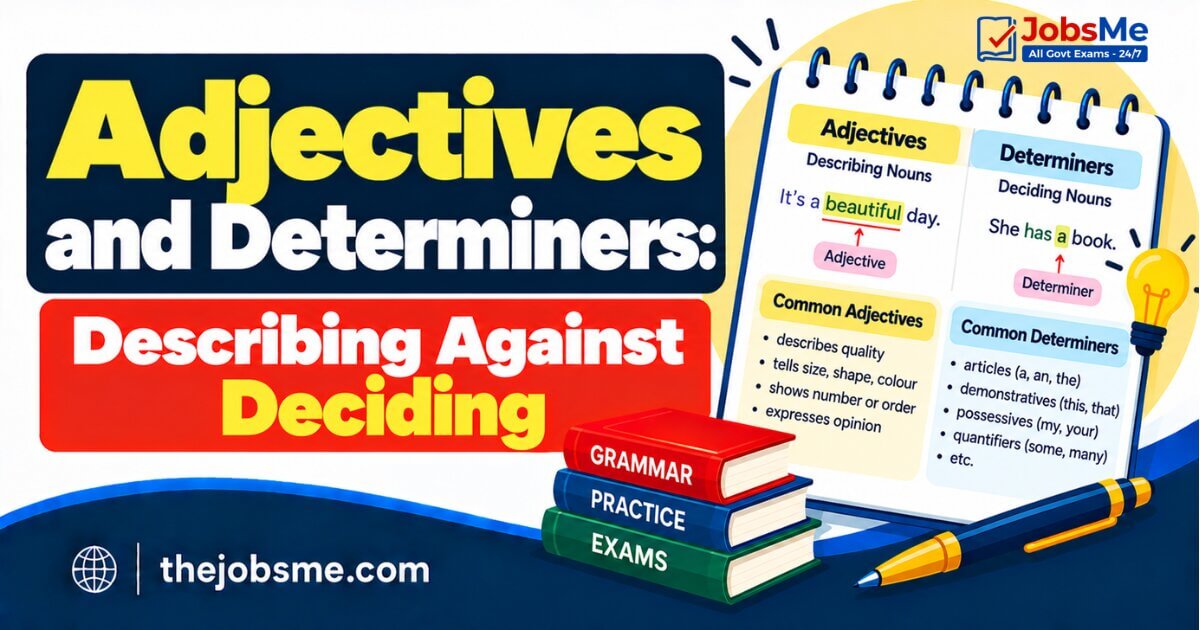
Adjectives and Determiners: Describing Against Deciding
This article is a complete, exam-ready guide to adjectives and determiners for SSC, banking, insurance, railway, defence and State PSC exams. It starts from the distinction that makes the whole topic mechanical: an adjective describes a noun while a determiner decides which noun is meant. That single difference explains why two determiners cannot sit together, why determiners change with number and adjectives do not, and why determiners always come first. It covers the slot system behind a noun phrase, the seven determiner types, the countable and uncountable scale including few, a few and the few, the distributive rules, the OSASCOMP order of adjectives, and the adjectives that work in only one position. Ten solved questions, common traps and a fifteen-question practice set with a full answer key are included.
Introduction
These two topics are usually taught together, and most guides then blur them into one long list of words that go before nouns. The distinction between them is worth stating clearly, because it makes the whole topic mechanical.
An adjective describes a noun. A determiner decides which noun is meant. In those young boys, the word young tells you something about the boys, while those tells you which boys and how many.
Five consequences follow, and every one of them is testable.
- Adjectives do not change with number; determiners do. Big boy and big boys, but this boy and these boys.
- Adjectives stack freely; determiners do not. A long red sticky pipe is fine, but the my book is not, because only one central determiner is allowed.
- Determiners come first. Never beautiful the flower, always the beautiful flower.
- Most adjectives are gradable; most determiners are not. Tall, taller, tallest, but there is no comparative of this.
- Many determiners double as pronouns. This book is mine uses a determiner; this is mine uses a pronoun.
So when a question involves a word before a noun, ask first whether it describes or decides. The answer tells you which set of rules applies.
Where This Topic Is Asked
| Exam | How This Topic Appears | Rough Weight | Difficulty |
|---|---|---|---|
| SSC CGL and CHSL | Determiner and adjective faults inside error spotting, usually in the second segment. | Around 4 per cent for adjectives and 2 per cent for determiners | Easy to moderate. |
| IBPS PO and SBI PO | Error detection and fillers, especially few against a few. | 1 to 2 questions | Moderate. |
| RRB NTPC and Group D | Straightforward much against many items. | 1 question | Easy. |
| State PSC and police exams | Adjective order and distributive agreement. | 1 to 2 questions | Moderate. |
| Cloze test and fillers | A determiner is often the correct option in a blank. | Indirect | Moderate. |
| Descriptive papers | Wrong quantifiers are highly visible to an examiner. | Indirect | Worth the care. |
Taken together these are worth roughly two to four marks across a paper. That places them in the supporting band, so the sensible plan is one focused session rather than a week of lists. Check your own pattern in the exam-wise syllabus hub.
The Slot System
A noun phrase fills its slots in a fixed order, and knowing the slots explains most determiner errors without memorising them separately.
| Slot | What Goes There | How Many Allowed | Example |
|---|---|---|---|
| 1. Predeterminer | all, both, half, such, rather, quite, double | One. | all the three young students |
| 2. Central determiner | Articles, demonstratives, possessives. | Only one, which is the key rule. | all the three young students |
| 3. Postdeterminer | Numbers and quantity words. | One or two. | all the three young students |
| 4. Adjectives | Describing words, in OSASCOMP order. | Several. | all the three young students |
| 5. Noun | The head word. | One. | all the three young students |
The central determiner slot holds exactly one word, which is why the my book and every his book are wrong while all the students and both the teams are perfectly correct. Students often learn the prohibition as a bare rule and then wonder why all the is allowed. The slot system answers it: all is a predeterminer, so the two words are not competing for the same place.
The repair for a double central determiner is to convert one into an of phrase. The my book becomes this book of mine.
The Seven Types of Determiners
| Type | Words | Example |
|---|---|---|
| Articles | a, an, the | a car, an orange, the moon |
| Demonstratives | this, that, these, those | this book, those mountains |
| Possessives | my, your, his, her, its, our, their | my phone, their house |
| Distributives | each, every, either, neither | each student, every child |
| Interrogatives | what, which, whose | which subject, whose bag |
| Numerals | one, two, first, second | three pens, first prize |
| Quantifiers | some, any, many, much, few, little, several, enough, all | many students, little water |
One correction belongs here. A widely used table marks Which do you prefer? as incorrect, on the ground that interrogative determiners must be followed by a noun. That sentence is perfectly good English. Which is simply working as a pronoun there rather than as a determiner, and being a pronoun is not an error. The same words serve both roles, which is one of the five consequences noted above.
Formula Box
- Adjectives describe; determiners decide.
- Only one central determiner per noun phrase, though a predeterminer may precede it.
- Few and fewer count; little and less measure.
- Without a the meaning is negative; with a it is positive.
- Many and few take countable nouns; much and little take uncountable ones.
- Each, every, either and neither take a singular noun and a singular verb.
- Adjective order is OSASCOMP, and in practice opinion, size, age and colour decide most questions.
The Countable and Uncountable Scale
This is where most determiner marks are won and lost, and the whole system rests on two questions: can the noun be counted, and is there an article in front of the quantifier?
Countable Against Uncountable
| Meaning | Countable Nouns | Uncountable Nouns |
|---|---|---|
| A large quantity | many students | much water |
| A small quantity | few books | little sugar |
| A smaller quantity | fewer applicants | less time |
| Asking about quantity | how many photographs | how much money |
| Either type | a lot of trees, some books, plenty of chairs | a lot of food, some water, plenty of time |
Two notes complete the picture. Much and many sit most naturally in questions and negatives, while a lot of works everywhere, so do you drink much coffee but she has a lot of friends. And one source states that much goes with uncountable nouns in the plural, which cannot be right, since an uncountable noun has no plural form at all.
The Three-Step Scale
The presence or absence of a reverses the meaning entirely, which is the point examiners test.
| Countable | Uncountable | Meaning | Example |
|---|---|---|---|
| few | little | Almost none, and the sense is negative. | He has few friends, so he is lonely. There is little hope of recovery. |
| a few | a little | Some at least, and the sense is positive. | I have a few friends who can help. A little knowledge is a dangerous thing. |
| the few | the little | Not many, but all that was available. | The few friends he has are loyal. He spent the little money he had. |
The exam test is the surrounding mood. If the sentence expresses satisfaction, relief or sufficiency, the article is needed. If it expresses shortage or disappointment, it is not. So I was happy that a few students volunteered is right, while few students volunteered would contradict the happiness.
Less Against Fewer
This is a standing favourite in both SSC and bank papers.
- Fewer modifies plural countable nouns and denotes a smaller number. Fewer than twenty people attended.
- Less modifies uncountable nouns and denotes a smaller amount. We have less sugar left in the jar.
- The common trap: No less than fifty students were absent should read no fewer than fifty students, because students can be counted.
- Watch supermarket English. Less items and less people are widespread and are marked wrong in exams.
The Types of Adjectives
Adjectives are grouped by the kind of information they add. The categories matter less than the rules attached to them, so read this once for recognition.
| Type | What It Shows | Example |
|---|---|---|
| Descriptive or qualitative | Quality, colour, size, shape or condition. | a beautiful flower, a tall building |
| Quantitative | An approximate amount. | some milk, little water, enough time |
| Numeral | A definite count or order. | three pens, the first prize |
| Demonstrative | Which one is meant. | this book, those houses |
| Possessive | Ownership. | my bag, their house |
| Interrogative | Asks about a noun. | which book, whose bag |
| Proper | Formed from a proper noun and always capitalised. | Indian cuisine, Victorian architecture |
Notice that the last four types are the words modern grammar calls determiners. Traditional grammar counts them as adjectives, and both systems appear in study material, which is why one page can look inconsistent with the next. For exam purposes the label matters far less than the rule attached to the word.
The Ordinal and Cardinal Rule
When a word of order and a word of number sit together, the ordinal comes first.
- Right: The first two chapters are introductory.
- Wrong: The two first chapters are introductory.
- Right: The last three candidates were called.
This is a small rule that examiners genuinely use, and it is easy marks once seen.
Distributives: Each, Every, Either and Neither
| Word | Meaning | Rule | Example |
|---|---|---|---|
| each | Every member considered one at a time. | Singular noun and singular verb. Suits a small, known group. | Each student of the class answered. |
| every | All members seen as a whole, without exception. | Singular noun and singular verb. Suits a larger group. | Every Indian was proud of the win. |
| either | One of two. | Singular noun and singular verb. | Either option is acceptable. |
| neither | Not one of the two. | Singular noun and singular verb. | Neither answer was correct. |
| each of, either of, neither of | The same meanings before a plural noun. | Plural noun follows, but the verb stays singular. | Each of the students has submitted the form. |
Two extras are worth knowing. Every plus a singular noun equals all the plus a plural noun, so every house in the street is the same means the same as all the houses in the street are the same. And for more than two items, either and neither give way to any and none.
Some, Any, No and None
- Some goes in affirmative sentences, and in questions that make an offer or a request. I have some friends. Would you like some tea?
- Any goes in questions and negatives. Have you got any cheese? He hasn't got any friends here.
- Any in an affirmative sentence is correct when the underlying sense is negative. She finished the test without any difficulty.
- No replaces not any before a noun. There are no cars in the park equals there aren't any cars.
- None stands alone without a noun. How many are left? None.
- Never combine two negatives. Without obtaining none of the documents should read without obtaining any of the documents.
The Two-Noun Rule
When two nouns of different types are joined by a conjunction, each needs its own determiner.
- Wrong: Can you tell me how many eggs and milk he brought?
- Right: Can you tell me how many eggs and how much milk he brought?
One quantifier cannot serve a countable noun and an uncountable noun at the same time, so both must be written out. This appears regularly in error spotting and is missed by almost everyone.
Key Highlights
- One question sorts the topic: does the word describe, or decide?
- Only one central determiner fits the slot, though a predeterminer may precede it.
- The article in a few is not decorative; it reverses the meaning.
- Fewer counts and less measures, which is a standing exam favourite.
- Over-correction is the real risk here, since all the and both the are perfectly correct.
The Order of Adjectives
When several adjectives describe one noun, English fixes their sequence. The standard acronym is OSASCOMP.
| Position | Category | Typical Words |
|---|---|---|
| O | Opinion | beautiful, ugly, lovely, terrible, excellent |
| S | Size | big, small, large, tiny, huge, long, short |
| A | Age | old, young, new, ancient, modern |
| S | Shape | round, square, oval, flat |
| C | Colour | red, blue, black, golden, pale |
| O | Origin | Indian, Italian, French, eastern |
| M | Material | wooden, leather, silk, plastic |
| P | Purpose | dining, sleeping, running, writing |
- Wrong: She bought a leather black beautiful jacket.
- Right: She bought a beautiful black leather jacket.
- Wrong: Her black long hair adds to her looks.
- Right: Her long black hair adds to her looks.
In practice, four of the eight categories decide almost every exam question: opinion before size, and age before colour. Learning those two pairs covers more than memorising all eight.
Two refinements. Determiners and numbers come before the whole sequence, so these two naughty young kids. And when adjectives belong to the same category, they are separated by commas, as in a handsome, confident and thoughtful man, while adjectives from different categories take no commas at all.
Where an Adjective Can Sit
Most adjectives work in both positions, but a small group works in only one, and that group appears in error spotting.
| Position | Rule | Words | Example |
|---|---|---|---|
| Before the noun only | These cannot follow a linking verb. | main, mere, only, elder, former, latter, sheer, utter, inner, outer | The main reason. Never the reason is main. |
| After a linking verb only | These cannot sit before the noun. | asleep, awake, afraid, alone, alive, ashamed, aware, content, glad | The child is asleep. Never the asleep child. |
| Either position | Most adjectives. | tall, beautiful, useful, difficult | A tall man. The man is tall. |
The repair for the second group is a different word or a phrase. The asleep child becomes the sleeping child, and the afraid boy becomes the frightened boy.
Remember also that a linking verb takes an adjective rather than an adverb, which is covered in adverbs.
Degrees of Comparison in Brief
Comparison belongs to adjectives and carries real weight, so it has its own article. The four rules that appear most often are these.
- Never double a comparison. More taller and most unique are both wrong.
- Absolute adjectives take no degree. Unique, perfect, complete, universal, extreme, eternal and chief.
- Use any other inside the group. Iron is more useful than any other metal.
- Latin adjectives ending in -ior take to. Senior, junior, superior, inferior, prior.
The full treatment, including the conversion templates and the like-with-like rule, is in degrees of comparison.
A Warning About Study Material on This Topic
- A correct sentence marked wrong. One table lists He is the better player as an error requiring the best player. When two people are being compared, the better player is exactly right, and no context is given to justify the change.
- A pronoun mistaken for an error. Which do you prefer? is marked incorrect on the ground that interrogative determiners need a noun. The sentence is correct, and which is simply functioning as a pronoun.
- An impossible category. One guide states that much is used with uncountable nouns in the plural. Uncountable nouns have no plural.
- Determiners called adjectives and then distinguished from them. The same document insists that determiners are not adjectives and later describes little and few as adjectives. Traditional grammar does call them adjectives, but a single page should pick one system.
So check every example against the rule it claims to show, and be particularly wary of tables that mark correct sentences wrong for want of context.
Exam Alert
- Read the mood of the sentence before choosing between few and a few.
- Check no less than whenever it is followed by a plural countable noun.
- Distributives stay singular even when a plural noun follows an of.
- Scan multiple adjectives for colour placed before size or age.
- A countable and an uncountable noun joined together need one quantifier each.
Ten Solved Questions
1. Find the error. I was pleased to see (a) / that few students had (b) / volunteered for the drive. (c) / No error (d)
Working: The speaker is pleased, so the sense must be positive. Few without the article means almost none. Answer: (b), which should read a few students.
2. Find the error. No less than fifty candidates (a) / were absent from (b) / the examination hall. (c) / No error (d)
Working: Candidates can be counted, so the comparative of number is required. Answer: (a), which should read no fewer than.
3. Find the error. She bought a leather (a) / black beautiful jacket (b) / from the new store. (c) / No error (d)
Working: Opinion comes before colour, and colour before material. Answer: (a) and (b) together are misordered, and the correct phrase is a beautiful black leather jacket. The marked error is (a).
4. Find the error. Every students in the batch (a) / was asked to submit (b) / the completed form. (c) / No error (d)
Working: Every takes a singular noun. Answer: (a), which should read every student.
5. Find the error. The my colleague from Chennai (a) / will join the department (b) / next Monday. (c) / No error (d)
Working: Two central determiners cannot share a slot. Answer: (a), which should read my colleague.
6. Find the error. Can you tell me (a) / how many eggs and milk (b) / he brought home? (c) / No error (d)
Working: One quantifier cannot serve a countable and an uncountable noun together. Answer: (b), which should read how many eggs and how much milk.
7. Find the error. The account was opened (a) / without obtaining none of (b) / the necessary documents. (c) / No error (d)
Working: Without already carries the negative, so none creates a double negative. Answer: (b), which should read any of.
8. Find the error. Whole the chapter (a) / is full of printing errors (b) / caused by careless proofreading. (c) / No error (d)
Working: Whole follows the article while all precedes it. Answer: (a), which should read the whole chapter.
9. Choose the correct sentence. (a) The asleep child was carried inside. (b) The sleeping child was carried inside. (c) The child asleep was carried inside quietly. (d) The afraid child was carried inside.
Working: Asleep and afraid follow a linking verb and cannot sit before a noun. Answer: (b).
10. Find the error. There is very little water (a) / in the tank, so we must (b) / use it carefully. (c) / No error (d)
Working: Water is uncountable and takes little, the sense is one of shortage, and the verb agrees. The scan comes up clean. Answer: (d), no error.
Quick Facts
- Countable: many, few, a few, fewer, how many.
- Uncountable: much, little, a little, less, how much.
- Negative sense: few, little. Positive sense: a few, a little.
- Singular always: each, every, either, neither.
- Order: opinion, size, age, shape, colour, origin, material, purpose.
- After the verb only: asleep, awake, afraid, alone, alive, ashamed.
Worked Examples: Wrong to Right
Example 1 (few against a few)
Sentence: A student writes I was happy that few people came to help.
Trap: Few and a few look like the same word with an optional article, so the article seems decorative. Dropping it reverses the meaning from some at least to almost none, and the sentence now contradicts the happiness.
Correct Answer: I was happy that a few people came to help.
Rule in Simple Words: With the article the sense is positive; without it, negative.
Example 2 (less with a countable noun)
Sentence: A student writes No less than fifty candidates were absent.
Trap: No less than is a fixed-sounding phrase heard constantly in speech and in signage. Candidates can be counted, so the comparative of number is required rather than the comparative of amount.
Correct Answer: No fewer than fifty candidates were absent.
Rule in Simple Words: Fewer counts; less measures.
Example 3 (two central determiners)
Sentence: A student writes The my colleague will join next week.
Trap: Both words point at the noun, so using both feels like adding precision. Only one central determiner fits the slot, and stacking two is ungrammatical however clear the meaning.
Correct Answer: My colleague will join next week, or this colleague of mine.
Rule in Simple Words: One central determiner per noun phrase.
Example 4 (assuming all the has the same fault)
Sentence: Having learnt the last rule, a student marks all the students were present as an error.
Trap: The phrase has two determiner-looking words in a row, which is exactly the shape just learnt. All is a predeterminer and sits in an earlier slot, so the two words are not competing.
Correct Answer: No error. All the students, both the teams and half the cake are all correct.
Rule in Simple Words: A predeterminer may precede a central determiner.
Example 5 (adjective order)
Sentence: A student writes Her black long hair adds to her looks.
Trap: Both words describe the hair accurately and the sentence is perfectly clear, so nothing sounds broken. English fixes the sequence, and size comes before colour.
Correct Answer: Her long black hair adds to her looks.
Rule in Simple Words: Opinion before size, size before age, age before colour.
Example 6 (every with a plural)
Sentence: A student writes Every students participated in the drill.
Trap: Every refers to a whole group, so a plural noun feels logically right. Grammatically every considers members one at a time and takes a singular noun and a singular verb.
Correct Answer: Every student participated in the drill.
Rule in Simple Words: Each, every, either and neither are singular.
Example 7 (one quantifier for two nouns)
Sentence: A student writes Tell me how many eggs and milk he bought.
Trap: Repeating the question word feels clumsy and redundant, so one seems enough for both. Eggs are countable and milk is not, so a single quantifier cannot serve both.
Correct Answer: Tell me how many eggs and how much milk he bought.
Rule in Simple Words: Two noun types need two determiners.
Example 8 (an adjective in the wrong position)
Sentence: A student writes The asleep child was carried inside.
Trap: Most adjectives work happily before a noun, so the position looks unremarkable. A small group beginning with a works only after a linking verb.
Correct Answer: The sleeping child was carried inside, or the child, who was asleep, was carried inside.
Rule in Simple Words: Asleep, awake, afraid, alone and alive follow the verb.
Common Traps Students Fall Into
These are the habits that most often cost marks. Each one is a common trap, not a silly mistake, and each has a one-line fix.
- Trap: Treating the article in a few as optional. Fix: It reverses the meaning from negative to positive.
- Trap: Using less with a countable noun. Fix: Fewer counts, less measures.
- Trap: Using much with a countable noun. Fix: Many students, much water.
- Trap: Stacking two central determiners. Fix: Convert one into an of phrase.
- Trap: Marking all the wrong after learning that rule. Fix: A predeterminer sits in an earlier slot.
- Trap: Giving every a plural noun. Fix: Distributives are singular.
- Trap: Ignoring adjective order. Fix: Opinion, size, age, colour is enough for most questions.
- Trap: Using one quantifier for two noun types. Fix: Write both.
- Trap: Putting asleep or afraid before a noun. Fix: Use sleeping or frightened instead.
- Trap: Combining without with none. Fix: Two negatives cancel, as in error spotting.
- Trap: Writing whole the chapter. Fix: Whole follows the article; all precedes it, a distinction worth noting in commonly confused words.
Memory Tricks and Formulas
1. Describes or decides?
Ask this first. If the word tells you what the noun is like, it is an adjective. If it tells you which one or how many, it is a determiner, and a different set of rules applies.
2. One central slot
Articles, demonstratives and possessives all compete for the same position, so only one may appear. That is why the my book fails while all the students succeeds, since all occupies an earlier slot.
3. Count or measure?
If the noun can be counted, use many, few and fewer. If it can only be measured, use much, little and less. This one question resolves the majority of determiner questions in a second.
4. The article flips the sign
Few and little are negative, while a few and a little are positive. So read the mood of the sentence: satisfaction calls for the article, and shortage does not.
5. OSASCOMP, but really OSAC
The full order is opinion, size, age, shape, colour, origin, material, purpose. In exams, opinion before size and age before colour settle almost every question, so drill those two pairs first.
6. Distributives are singular
Each, every, either and neither take a singular noun and a singular verb, whatever plural noun may follow an of. So each of the students has submitted, never have submitted.
7. Two nouns, two determiners
When a countable and an uncountable noun are joined, each keeps its own quantifier. How many eggs and how much milk, never one word doing both jobs.
8. Budget the time honestly
Adjectives are worth about 4 per cent of grammar marks and determiners about 2 per cent, so together roughly 2 to 4 marks a paper. That is one session on the scales and the order, not a week.
Exam Patterns and High-Yield Facts
Frequently Confused Pairs
| Pair | How They Differ | Mini Trick |
|---|---|---|
| Few vs A few | Almost none against some at least. | The article makes it positive. |
| Little vs A little | The same distinction with uncountable nouns. | Little hope against a little sugar. |
| Less vs Fewer | Amount against number. | Less sugar, fewer bottles. |
| Much vs Many | Uncountable against countable. | Much water, many books. |
| Each vs Every | Individually against as a whole, both singular. | Each of two or more; every of a larger set. |
| Either vs Any | Either for two; any for more than two. | Count the options. |
| Some vs Any | Affirmative against question and negative, with the offer exception. | Would you like some tea? |
| All the vs The my | Predeterminer plus central is fine; two centrals are not. | Check the slot, not the count. |
| Whole vs All | Whole follows the article, all precedes it. | The whole chapter, all the chapters. |
| Adjective vs Determiner | One describes, the other decides. | Big boys against these boys. |
Repeating Question Patterns
- Few used where a few is meant, signalled by a positive mood elsewhere in the sentence.
- Less used with a plural countable noun, especially in a no less than phrase.
- Two central determiners together, such as the my or every his.
- A distributive given a plural noun or a plural verb.
- Adjective order violated, most often colour placed before size or age.
- One quantifier serving two different noun types.
Practice Set: Fifteen Questions
Correct each sentence, or mark it correct as it stands.
- Much students attended the orientation programme.
- All the candidates were asked to report by nine.
- I was relieved that few colleagues had offered to help.
- There is little hope of his recovery after the accident.
- No less than forty applicants were rejected at the first stage.
- Every officer in the division has submitted the report.
- She wore a beautiful black leather jacket to the function.
- The my supervisor approved the leave application yesterday.
- Each of the participants were given a certificate.
- How much sugar and biscuits should I buy for the meeting?
- He wasted the little money he had saved for the fees.
- Whole the report has to be rewritten before Friday.
- The awake baby was smiling at everyone in the room.
- Neither of the two proposals was acceptable to the board.
- She has a few reliable friends who help her regularly.
Quick Facts
Answer key, with the rule named in each case.
- 1. Many students. Students are countable.
- 2. Correct as it stands. All is a predeterminer and may precede the.
- 3. a few colleagues. The relief signals a positive sense.
- 4. Correct as it stands. Hope is uncountable and the sense is one of shortage.
- 5. No fewer than forty applicants. Applicants can be counted.
- 6. Correct as it stands. Every takes a singular noun and a singular verb.
- 7. Correct as it stands. Opinion, then colour, then material.
- 8. My supervisor. Two central determiners cannot share a slot.
- 9. was given a certificate. Each of keeps a singular verb.
- 10. how much sugar and how many biscuits. Two noun types need two quantifiers.
- 11. Correct as it stands. The little means all that was available.
- 12. The whole report. Whole follows the article.
- 13. The waking baby or the baby, who was awake,. Awake cannot sit before a noun.
- 14. Correct as it stands. Neither of takes a singular verb.
- 15. Correct as it stands. A few correctly carries the positive sense.
Seven of those fifteen were already correct, which is the highest proportion in this series and entirely deliberate. This topic invites over-correction more than any other, because once the one-determiner rule is fresh a student begins marking all the and both the as errors. Practise the same restraint with the free English MCQ quizzes and full papers from the mock test archive.
Quick Revision
Quick Revision
- The distinction that runs through the topic. An adjective describes a noun while a determiner decides which noun is meant.
- Adjectives do not change with number but determiners do, so big boy and big boys, but this boy and these boys.
- Adjectives stack freely while determiners do not, and determiners always come before adjectives.
- Many determiners double as pronouns, so this book is mine uses a determiner and this is mine uses a pronoun.
- A noun phrase has fixed slots. Predeterminer, central determiner, postdeterminer, adjectives, noun.
- Only one central determiner is allowed, which is why the my book fails while all the students succeeds.
- The repair for two central determiners is to turn one into an of phrase, so the my book becomes this book of mine.
- Many, few and fewer take countable nouns; much, little and less take uncountable ones.
- The article flips the meaning. Few and little are negative, while a few and a little are positive.
- The few and the little mean not many but all that was available.
- Read the mood of the sentence to choose, since satisfaction calls for the article and shortage does not.
- Fewer counts and less measures, so it is no fewer than fifty students.
- Much and many suit questions and negatives while a lot of works in every kind of sentence.
- Each, every, either and neither take a singular noun and a singular verb, even when a plural noun follows an of.
- Every plus a singular noun equals all the plus a plural noun.
- For more than two items, either and neither give way to any and none.
- Some goes in affirmatives and in offers, while any goes in questions and negatives.
- Never combine two negatives, so without any of the documents rather than without none of them.
- Two noun types need two determiners, so how many eggs and how much milk.
- The order of adjectives is opinion, size, age, shape, colour, origin, material, purpose.
- In practice, opinion before size and age before colour decide almost every exam question.
- Adjectives of the same category take commas while adjectives of different categories take none.
- Some adjectives sit only before a noun. Main, mere, only, elder, former, latter, sheer and utter.
- Some adjectives sit only after a linking verb. Asleep, awake, afraid, alone, alive, ashamed and aware.
- Whole follows the article and all precedes it, so the whole chapter but all the chapters.
- For comparison rules, never double a comparison, absolutes take no degree, use any other inside a group, and Latin -ior adjectives take to.
Adjectives and determiners reward one clear idea more than any amount of list learning. Decide whether the word describes or decides, and the right rule set follows automatically. After that, three things carry the marks: the countable and uncountable scale with its article that flips the meaning, the single central determiner slot, and the opinion before size and age before colour order. The topic feeds directly into error spotting and sentence improvement, connects to degrees of comparison for the comparative rules and to adverbs for the linking verb question, and supplies frequent answers in fill in the blanks and cloze test. The wider set is in the topic-wise English notes.
Frequently Asked Questions
What is the difference between an adjective and a determiner?
Why can I write all the students but not the my book?
What is the difference between few and a few?
What do the few and the little mean?
When should I use less and when fewer?
Why is every students wrong?
What is the correct order of adjectives?
Why is the asleep child wrong?
Why do how many eggs and milk need two determiners?
How much weight does this topic carry in exams?

About the author





