
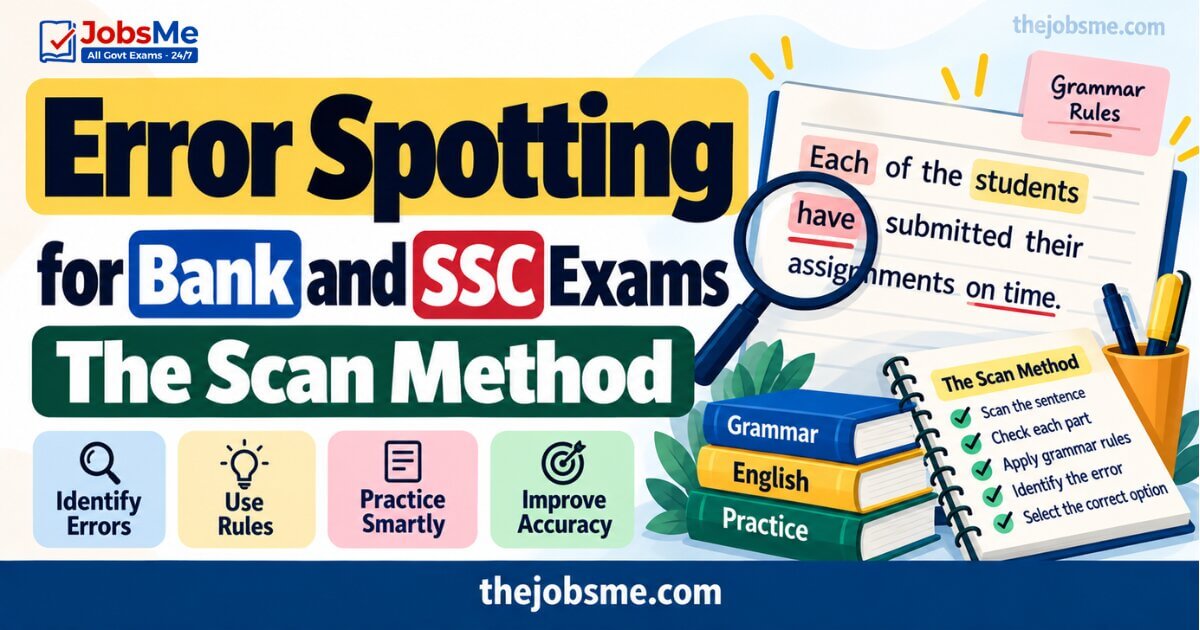
Error Spotting for Bank and SSC Exams: The Scan Method
This article is a complete, exam-ready guide to error spotting and error detection for banking, insurance, SSC, railway, defence and State PSC exams. It starts from the point most guides miss: you only have to find the fault, never fix it, which changes how you should read. It then gives the fixed scan order that beats reading by feel, the verb-first rule, the segment positions where errors usually hide, the strike-out technique for finding the true subject, and a table of trigger words that announce their own error. It also covers the full rule catalogue by part of speech, ten solved questions, common traps and a fifteen-question practice set with a full answer key.
Introduction
Error spotting gives you a sentence split into four or five parts. One part contains a grammatical error, and you name that part. If no part is faulty, you choose no error.
Here is the point that changes how you should work, and most guides never state it. You only have to find the fault. You never have to fix it.
That sounds obvious and it has a real consequence. In sentence improvement you must know the correct version, so you need the full rule. In error spotting you only need to know that a rule has been broken. Seeing that each of the students have is wrong is enough to mark part B, and you can move on without deciding between has and has been.
The second point follows from the first. The worst method is reading the whole sentence and waiting for something to feel wrong, because exam sentences are written to sound acceptable. The best method is scanning in a fixed order, checking the places where errors actually hide.
Where This Topic Is Asked
| Exam | How This Topic Appears | Rough Weight | Difficulty |
|---|---|---|---|
| Bank PO prelims and mains | A sentence in four or five parts, with no error as the last option. | 3 to 5 questions | Moderate. It is a named high-priority topic in the bank English syllabus. |
| Bank clerk prelims | The same format on shorter sentences. | 5 to 7 questions | Easy to moderate. |
| Bank clerk mains | Longer sentences with more intervening phrases. | 4 to 6 questions | Moderate. |
| SSC CGL and CHSL | Error spotting in both tiers, counted with sentence improvement in the grammar block. | 6 to 8 questions combined | Easy to moderate, and the rules repeat heavily. |
| Railway and defence exams | Short sentences testing basic rules. | 2 to 4 questions | Easy. |
| State PSC and police exams | The same format, sometimes including narration and voice errors. | Varies by state | Moderate. |
Add those together and this is one of the largest grammar blocks in any English paper. It is also the most predictable, because the same twenty or so rules are tested year after year. Confirm the pattern for your own paper in the exam-wise syllabus hub and the latest notifications.
Two Facts About the Format
- No error is a real answer. It is correct in roughly 15 to 20 per cent of questions, and students under-choose it because they assume a fault must exist.
- The verb is the culprit far more often than anything else. Analysis of previous papers puts it at around 60 per cent of questions, counting agreement, tense and voice together.
Those two facts alone should reshape your approach. Check the verb first, every time, and be willing to mark no error when the scan comes up clean.
The Scan Method
Do not read for meaning and hope a fault jumps out. Work through the sentence in this fixed order.
| Step | What to Check | Why It Comes Here | Time |
|---|---|---|---|
| 1. Read the sentence once for meaning | Read all the parts, so you know what the sentence is about and what tense it is in. | Some errors, such as a wrong pronoun reference or a dangling modifier, only appear once you know who is doing what. | 10 seconds |
| 2. Find the verb and test it | Does it agree with the subject? Is the tense right for the time marker? Is the voice correct? | The verb carries the error in about three questions out of five, so this is where the odds are. | 10 seconds |
| 3. Scan for trigger words | Look for no sooner, hardly, scarcely, lest, though, unless, one of, each of, between, both, such and kind of. | These words announce their own error, because each has a fixed partner or a fixed structure. | 10 seconds |
| 4. Check the small words | Articles and prepositions. | They are easy to skip while reading and are a favourite hiding place for errors. | 10 seconds |
| 5. Check structure last | Parallelism in lists, modifier placement, comparatives and redundancy. | These are the least frequent, so they come last rather than first. | 10 seconds |
If the scan finishes clean, mark no error and move on. A clean scan is evidence, not a failure to find something. Students who distrust the scan go round again, and a second pass is where invented errors come from.
Where Errors Usually Sit
Errors are not evenly spread across the parts. Knowing the usual positions saves several seconds a question.
| Error Type | Usual Position | What to Look For |
|---|---|---|
| Subject-verb agreement | Usually the second or third part. | A phrase sitting between the subject and the verb, put there to distract you. |
| Correlatives and inversion | Usually the first or second part. | A sentence opening with no sooner, hardly, scarcely, not only or neither. |
| Tense sequencing | Spread across two parts. | Two clauses whose verbs do not match in time. |
| Prepositions and articles | Anywhere, and often in a short part. | A part that is only three or four words long is frequently a preposition trap. |
| Pronouns | Usually a later part. | A pronoun whose number or case does not match what it refers to. |
| Parallelism | The part containing a list. | Three items where one has a different grammatical form. |
The Strike-Out Technique
Most agreement errors are built the same way: a phrase is inserted between the subject and the verb so that a noun of the wrong number sits next to the verb. The cure is mechanical.
Strike out everything between commas, everything after as well as, along with, together with or besides, and everything inside a relative clause. What remains is the real subject. Test the verb against that.
- The list of selected candidates have been published. Strike out of selected candidates. What remains is the list, so the verb must be has.
- The captain, along with the players, were felicitated. Strike out the phrase between commas. What remains is the captain, so the verb must be was.
- A number of colourful glass vases was displayed. Here the subject phrase means several, so the verb must be were. Note that the number of works the opposite way and takes a singular verb.
Formula Box
- Find, do not fix. You need only see that a rule is broken.
- Scan order: meaning, verb, trigger words, small words, structure.
- Verb first, because it carries the error in roughly three questions out of five.
- Strike out the middle to find the true subject.
- Trigger words announce themselves: no sooner, hardly, lest, though, unless, one of, between, both.
- No error is right about one time in six, so trust a clean scan.
- Time: 30 to 45 seconds a question, and never a second full pass.
Key Highlights
- Find, do not fix. Seeing that a rule is broken is the whole job.
- Scan, do not listen. Exam sentences are built to sound acceptable.
- The verb is the likeliest culprit, so test it before anything else.
- Trigger words hand you the answer, because each demands a fixed partner.
- No error is correct about one time in six, so a clean scan is a result rather than a failure.
Trigger Words: The Fastest Route to the Error
Some words cannot appear alone. Each one demands a fixed partner or a fixed structure, so the moment you see it you know exactly what to test. Learning this table is the single highest-return hour you can spend on this topic.
| Trigger | What It Demands | Wrong | Right |
|---|---|---|---|
| No sooner | Pairs with than, and the auxiliary inverts. | No sooner had we started when the power failed. | No sooner had we started than the power failed. |
| Hardly, scarcely | Pair with when, and the auxiliary inverts. | Hardly had the teacher left than the pupils began talking. | Hardly had the teacher left when the pupils began talking. |
| Though, although | Take yet or nothing, never but. | Though he is poor but he is honest. | Though he is poor, yet he is honest. |
| Because | Cannot be paired with therefore in the same sentence. | Because he was ill, therefore he did not come. | Because he was ill, he did not come. |
| Unless, until | Already carry a negative, so never add not. | Unless you do not work hard, you will not succeed. | Unless you work hard, you will not succeed. |
| Lest | Takes should or the bare verb, and never not. | Work hard lest you should not fail. | Work hard lest you should fail. |
| Neither | Pairs with nor, never with or. | The phone neither worked properly or rang. | The phone neither worked properly nor rang. |
| Not only | Pairs with but also, placed around the parallel items. | He not only comes for swimming but also for coaching. | He comes not only for swimming but also for coaching. |
| One of, each of, none of | Take a plural noun and a singular verb. | One of the player was absent. | One of the players was absent. |
| More than one | Takes a singular noun and a singular verb, despite the plural sense. | More than one students completed the project. | More than one student completed the project. |
| Between | Used for two things and followed by and, never to. | He will arrive between 7 pm to 8 pm. | He will arrive between 7 pm and 8 pm. |
| Both | Is not used in a negative structure. | Both of these options are not correct. | Both of these options are wrong. |
| Such | Takes as, not that, when introducing examples. | Such fruits that apples and pears. | Such fruits as apples and pears. |
| No other | Takes than, not but. | I like no other film but that one. | I like no other film than that one. |
| Know | Needs how, what or when before an infinitive. | I know to speak English. | I know how to speak English. |
| Kind of, sort of, type of | Take no article after them. | What sort of an animal is that? | What sort of animal is that? |
| Superlative degree | Takes the relative pronoun that, not who or which. | This is the best which she could do. | This is the best that she could do. |
| As fast as, as good as | Need as on both sides in a double comparison. | I can run as fast, if not faster than you. | I can run as fast as, if not faster than, you. |
| A positive question tag sentence | Takes a negative tag, and the reverse. | She has returned home, has she? | She has returned home, hasn't she? |
| Hardly, barely, scarcely in the main clause | Carry a negative force, so the tag stays positive. | Their actions are hardly reasonable, aren't they? | Their actions are hardly reasonable, are they? |
Twenty triggers, and each one gives away the answer the moment you see it. So a sentence beginning with No sooner or Hardly should send you straight to two checks: is the auxiliary inverted, and is the partner word correct.
The Rule Catalogue
Nouns
- Singular in form, plural in sense. Police, cattle, peasantry, gentry, people, clergy and vermin take plural verbs. The cattle were grazing, not was grazing.
- Always plural in form. Scissors, trousers, spectacles, premises, thanks and tidings take plural verbs.
- Nouns of measure stay singular before another noun. A nine-metre cloth, a five-year plan, a ten-rupee note.
- Uncountable nouns take singular verbs and no plural form. Information, furniture, luggage, advice, news, equipment and machinery. Much information, never many informations.
- Collective nouns take a singular verb as one unit and a plural verb when the members disagree. The jury was unanimous against the jury were divided in their opinions.
- Two roles held by one person take a singular verb. The secretary and treasurer is Mr Sharma, when one person holds both posts.
Pronouns
- One must be maintained. One must do one's duty, never one must do his duty.
- After like, unlike and let, use the object form. A woman like her, let me do it, let him and me go.
- After a preposition, use the object form. Between you and me, never between you and I.
- Everyone, everybody, each and nobody are singular, so the pronoun is his or her by the rule Indian exams follow, though modern usage increasingly accepts the plural form.
- A collective noun with a singular verb takes a singular pronoun. The team has completed its project.
- Who is for people and which for things, including institutions such as a ministry or a committee.
Verbs
- Purpose takes an infinitive. He went to the mall to watch a film, not for watching a film.
- An irritating repeated action takes the present continuous. He is always hitting me conveys the annoyance that he always hits me does not.
- Two future actions. The conditional clause takes the simple present and the main clause takes the future. As soon as he enters the room, we will start.
- Impossible past conditions. Use the past perfect in the if clause and would have plus the third form in the result. If Joan had invited me, I would have gone. Never if Joan would have invited me.
- Two past actions. The earlier one takes the past perfect. By the time we reached, he had left.
- Some verbs take only an infinitive — want, wish, expect, hope, decide, agree, refuse. Others take only a gerund — enjoy, avoid, finish, mind, suggest, consider. I enjoy reading, never I enjoy to read.
- After a preposition, always a gerund. Fond of reading, interested in learning.
- Wish takes the past subjunctive, not the future. Ram wishes he were richer, never Ram wishes he will be richer.
Adjectives and Adverbs
- Fewer counts, less measures. Fewer than twenty people, less water.
- An adverb modifies a verb. He runs quickly, he performed well, never he performed good.
- Never double a comparative or superlative. Better, never more better. Tallest, never most tallest.
- Use a comparative for two and a superlative for more than two. The better of the two, the best of the three.
Articles, Prepositions and Structure
- Superlatives take the, while abstract nouns generally take no article. The best student, but honesty is the best policy.
- A or an is decided by sound, not spelling. A university, an hour, an heir.
- No preposition before upstairs, downstairs, inside, outside, uptown or downtown. He went upstairs, never went to upstairs.
- Fixed pairs. Good at, interested in, depend on, different from, consist of, comprise nothing, married nothing, die of a disease and die from an injury.
- Parallelism. Items in a list share a form. Reading, writing and swimming, never reading, writing and to swim.
- Modifiers sit beside what they modify. Walking down the street, I saw beautiful trees, because the trees were not walking.
- No double negatives. I did not do anything or I did nothing, never I did not do nothing.
- No redundancy. Return back, repeat again, more superior, past history and free gift all say the same thing twice.
Exam Alert
- Check the verb first. It carries the error in roughly three questions out of five.
- Strike out the middle phrase before testing agreement, since that phrase exists to mislead you.
- A short part is often a preposition or article trap, so never skip a three-word segment.
- Trust a clean scan. A second full pass is where invented errors come from.
- Comparisons such as taller than I against taller than me are disputed even among grammarians, so do not choose that part as the error unless nothing else is wrong.
The No-Error Decision
Run the five-step scan once. If the verb agrees and matches the time marker, no trigger word is unpaired, the articles and prepositions are standard, and the structure is parallel with modifiers in place, then choose no error and move on.
Two warnings apply in opposite directions. Students who never choose it lose the one question in six where it is correct. Students who choose it whenever they are unsure lose the questions where a rule really was broken. The scan, not your confidence, should decide.
Ten Solved Questions
1. Ram wishes (a) / he will be (b) / richer. (c) / No error (d)
Working: Wish expresses an unreal situation and takes the past subjunctive, not the future. The correct form is he were richer. Answer: (b).
2. The associate gave us (a) / much informations (b) / which we needed. (c) / No error (d)
Working: Information is uncountable and has no plural form. Answer: (b). Note that much is correct, which is what makes the error easy to miss.
3. No sooner did I leave home (a) / when it started raining heavily (b) / which drenched me completely. (c) / No error (d)
Working: A trigger word opens the sentence. No sooner pairs with than, while hardly and scarcely pair with when. Answer: (b).
4. She was (a) / quite amusing (b) / at that story. (c) / No error (d)
Working: A person who finds a story funny is amused, not amusing, and the preposition is by or at depending on the sense. The participle is the fault. Answer: (b).
5. After a complaint was filed (a) / police teams was given the photograph (b) / of the accused (c) / recorded at the hotel. (d) / No error (e)
Working: Teams is plural and takes were. Answer: (b). The verb was the first thing to check and it settled the question in a few seconds.
6. Shahjahan was (a) / an heir at (b) / the Mughal throne. (c) / No error (d)
Working: One is an heir to a throne, not at it. The article an before heir is correct, since the h is silent and the word begins with a vowel sound. Answer: (b).
7. The government is still in the (a) / process of finalized new policy (b) / guidelines for the allocation of land. (c) / No error (d)
Working: The preposition of must be followed by a gerund, so it should read process of finalising. Answer: (b).
8. The fight for liberation (a) / brings out the best and (b) / a noblest quality in mankind. (c) / No error (d)
Working: A superlative takes the, never a. It should read the noblest quality. Answer: (c).
9. Each of the students (a) / have submitted (b) / their assignments (c) / on time. (d) / No error (e)
Working: Each is singular whatever noun follows it, so the verb must be has. Part (c) also invites suspicion, but a question has one intended answer and the verb error is the clearer one. Answer: (b).
10. The committee (a) / has decided (b) / to postpone (c) / the annual meeting. (d) / No error (e)
Working: The collective noun is acting as one unit and takes a singular verb, which it has. The infinitive is correct and the article is correct. The scan comes up clean. Answer: (e).
Quick Facts
- No sooner takes than; hardly and scarcely take when.
- Unless, until and lest already carry a negative, so never add not.
- Though takes yet or nothing, never but.
- One of, each of and none of take a plural noun and a singular verb.
- Information, furniture, luggage, advice and news never take an s.
- Police, cattle and people are singular in form but take plural verbs.
Worked Examples: Wrong to Right
Example 1 (reading by feel)
Sentence: A student reads the whole sentence twice, waiting for something to sound wrong, and finds nothing.
Trap: Exam sentences are written to sound acceptable, so the ear is the tool the examiner is defeating. A fixed scan checks the places where errors actually hide, rather than waiting for one to announce itself.
Correct Answer: Scan in order: verb, trigger words, small words, structure.
Rule in Simple Words: Hunt in the likely places rather than listening for a wrong note.
Example 2 (agreement with the nearest noun)
Sentence: A student accepts the list of selected candidates have been published.
Trap: Candidates is plural and sits directly beside the verb, so the plural form sounds natural. The subject is list, and everything between the subject and the verb is decoration.
Correct Answer: Has been published.
Rule in Simple Words: Strike out the middle phrase before testing the verb.
Example 3 (missing a trigger word)
Sentence: A student reads No sooner had we started when the power failed and finds it acceptable.
Trap: When feels natural after a time expression, and the inversion looks correct. No sooner has exactly one partner, which is than.
Correct Answer: No sooner had we started than the power failed.
Rule in Simple Words: Certain words announce their own error, so learn their partners.
Example 4 (skipping a short part)
Sentence: For an heir at the Mughal throne, a student passes over the two-word segment and checks the longer parts instead.
Trap: Short parts look too small to hold a mistake, and the eye skips them. Prepositions and articles are exactly where examiners hide errors, precisely because they are skipped.
Correct Answer: An heir to the Mughal throne.
Rule in Simple Words: A three-word part deserves the same attention as a ten-word part.
Example 5 (uncountable nouns)
Sentence: A student accepts much informations because much is correctly used.
Trap: Half the phrase is right, which makes the whole phrase feel right. Information has no plural form at all, along with furniture, luggage, advice and news.
Correct Answer: Much information.
Rule in Simple Words: Learn the uncountable list, because these words never take an s.
Example 6 (going round a second time)
Sentence: A student completes a clean scan, distrusts it, reads again and marks a part that was actually correct.
Trap: Choosing no error feels like giving up, so a second pass feels responsible. On a second pass every part starts to look suspicious, and that is where invented errors come from.
Correct Answer: Trust the scan and mark no error.
Rule in Simple Words: One scan, one decision.
Example 7 (would in the if clause)
Sentence: A student accepts if Joan would have invited me, I would have gone.
Trap: Both halves use would have, so the sentence looks internally consistent. The if clause of a past conditional takes the past perfect, and would belongs only in the result clause.
Correct Answer: If Joan had invited me, I would have gone.
Rule in Simple Words: No would after if.
Example 8 (spending too long)
Sentence: A student cannot settle between two parts and works on the question for two minutes.
Trap: The answer always feels one reading away, and abandoning a question feels wasteful. Two minutes on one mark costs three other questions in a timed section.
Correct Answer: Give the question forty-five seconds, decide between the two survivors, and move on.
Rule in Simple Words: Scan once, choose, and go.
Common Traps Students Fall Into
These are the habits that most often cost marks. Each one is a common trap, not a silly mistake, and each has a one-line fix.
- Trap: Reading by feel. Fix: Scan in a fixed order, since sentences are written to sound acceptable.
- Trap: Not checking the verb first. Fix: The verb carries the error in roughly three questions out of five.
- Trap: Matching the verb to the nearest noun. Fix: Strike out the middle phrase and test against what remains.
- Trap: Skipping short segments. Fix: Prepositions and articles hide in exactly those parts.
- Trap: Ignoring trigger words. Fix: No sooner, hardly, lest, though, unless, one of and between each demand a fixed partner.
- Trap: Never choosing no error. Fix: It is correct in roughly one question in six.
- Trap: Choosing no error whenever unsure. Fix: Let the completed scan decide, not your confidence.
- Trap: Making a second full pass. Fix: One scan, one decision, because a second pass invents faults.
- Trap: Trying to work out the correction. Fix: You only have to find the error, never repair it.
- Trap: Hunting for exotic rules. Fix: Most errors are agreement, tense, preposition or article, so check the common ones first, as covered in subject-verb agreement.
- Trap: Practising without recording the rule. Fix: After each wrong answer, write the rule you missed, exactly as in sentence improvement practice.
Memory Tricks and Formulas
1. Find, do not fix
You are asked which part is wrong, not what the right version is. Seeing that a rule is broken is enough, and working out the correction is time you did not need to spend.
2. Verb first, always
Agreement, tense and voice together account for around 60 per cent of errors. So find the verb before you look at anything else, and ask three questions: does it agree, is the tense right, is the voice right.
3. Strike out the middle
Cover everything between commas, everything after along with or as well as, and everything inside a relative clause. What remains is the real subject. This single move solves most agreement questions.
4. Trigger words give themselves away
No sooner takes than. Hardly and scarcely take when. Though takes yet. Unless and lest never take not. Neither takes nor. Between takes and. Learn twenty of these and a whole class of questions becomes instant.
5. Small parts, big errors
A segment of three or four words is usually there for a reason. Articles and prepositions are the easiest things to read past, which is exactly why examiners put the fault there.
6. One scan, one decision
Complete the five steps once and commit. A second full pass makes correct parts look doubtful, and most invented errors are found on the second reading rather than the first.
7. Skip the disputed rules
Some rules are contested even among grammarians, such as taller than I against taller than me, or whether an infinitive may be split. Never choose such a part as the error unless every other part is clean.
8. The 45-second clock
Allow 30 to 45 seconds a question: ten seconds to read, twenty-five to scan, ten to decide. With 3 to 7 questions in a paper, the block should take about four minutes.
Exam Patterns and High-Yield Facts
Frequently Confused Pairs
| Pair | How They Differ | Mini Trick |
|---|---|---|
| Error spotting vs Sentence improvement | Spotting names the faulty part. Sentence improvement supplies the correct version. | Find against fix. |
| Error spotting vs Word swap | Spotting finds a broken rule. A word swap finds a correct word in the wrong slot. | Broken rule against wrong place. |
| No sooner vs Hardly | No sooner takes than, hardly takes when. | Sooner than, hardly when. |
| The number of vs A number of | The first takes a singular verb, the second a plural one. | The number has, a number have. |
| Less vs Fewer | Less measures quantity, fewer counts items. | Less water, fewer bottles. |
| Between vs Among | Between is for two, among for more than two. | Between two, among many. |
| Amused vs Amusing | A person is amused; a thing is amusing. | The same holds for bored and boring, interested and interesting. |
| Die of vs Die from | Die of a disease, die from an injury. | Illness takes of. |
| Good vs Well | Good describes a noun, well describes an action. | A good performance, performed well. |
| Much vs Many | Much goes with uncountable nouns, many with countable ones. | Much information, many files. |
Repeating Question Patterns
- The proximity trap, where a plural noun is placed beside a singular subject to attract the wrong verb.
- Trigger-word mismatches, especially no sooner with when and though with but.
- Uncountable nouns given a plural form, such as informations, furnitures and advices.
- A preposition or article hidden in a very short segment.
- Conditional mixing, with would appearing in the if clause.
- No-error questions, which students under-choose because they assume a fault must exist.
Practice Set: Fifteen Questions
Name the part containing the error, or choose no error. Give each item forty-five seconds.
- The cattle (a) / was grazing quietly (b) / in the field (c) / near the canal. (d) / No error (e)
- Each of the officers (a) / were informed (b) / about the transfer (c) / last week. (d) / No error (e)
- Hardly had the bell rung (a) / than the students (b) / rushed out of (c) / the classroom. (d) / No error (e)
- He has been working (a) / in this department (b) / since eight years (c) / without a break. (d) / No error (e)
- She gave me (a) / many useful advices (b) / before the interview (c) / last Monday. (d) / No error (e)
- Though he was tired (a) / but he completed (b) / the assignment (c) / before midnight. (d) / No error (e)
- The committee (a) / has submitted its report (b) / to the ministry (c) / this morning. (d) / No error (e)
- One of the candidates (a) / who were shortlisted (b) / has withdrawn (c) / the application. (d) / No error (e)
- He is not interested (a) / in to learn (b) / a second language (c) / this year. (d) / No error (e)
- The captain along with (a) / the other players (b) / were felicitated (c) / at the function. (d) / No error (e)
- Unless you do not (a) / submit the form (b) / by Friday, your application (c) / will be rejected. (d) / No error (e)
- This is the best (a) / which the department (b) / could manage (c) / in the circumstances. (d) / No error (e)
- The meeting will be held (a) / between four (b) / to six (c) / in the conference hall. (d) / No error (e)
- He performed (a) / very good (b) / in the qualifying (c) / examination. (d) / No error (e)
- The manager asked (a) / the trainees to submit (b) / their reports (c) / before the deadline. (d) / No error (e)
Quick Facts
Answer key, with the rule named in each case.
- 1. (b). Cattle is singular in form but plural in sense, so it takes were grazing.
- 2. (b). Each is singular whatever noun follows, so the verb is was informed.
- 3. (b). Hardly pairs with when, not than.
- 4. (c). Eight years is a duration, so it takes for rather than since.
- 5. (b). Advice is uncountable, so it should read much useful advice.
- 6. (b). Though takes yet or nothing, never but.
- 7. (e) no error. The collective noun takes a singular verb and a singular pronoun, and both match.
- 8. (e) no error. Who were shortlisted correctly refers to the plural candidates, while one takes the singular has withdrawn.
- 9. (b). A preposition takes a gerund, so it should read in learning.
- 10. (c). Along with does not change the subject, so the verb is was felicitated.
- 11. (a). Unless already carries a negative, so not must go.
- 12. (b). A superlative takes the relative pronoun that, not which.
- 13. (c). Between is followed by and, never to.
- 14. (b). An adverb modifies the verb, so it should read very well.
- 15. (e) no error. The reporting structure, the infinitive and the pronoun are all correct.
Three of those fifteen had no error, which is close to the real proportion. Notice too how many were settled by a trigger word: items 3, 6, 11, 12 and 13, a third of the set. Practise the same scan with the free English MCQ quizzes and full papers from the mock test archive.
Quick Revision
Quick Revision
- What the question is. A sentence is split into four or five parts, and you name the part containing the grammatical error.
- The key difference from other grammar topics. You only have to find the fault, never repair it, so seeing that a rule is broken is enough.
- The worst method. Reading the whole sentence and waiting for something to sound wrong, because exam sentences are written to sound acceptable.
- The best method. Scan in a fixed order: read for meaning, check the verb, check trigger words, check the small words, then check structure.
- Check the verb first. Agreement, tense and voice together carry about three errors out of five.
- Strike out the middle. Cover everything between commas, after along with or as well as, and inside relative clauses, then test the verb against what remains.
- The number of takes a singular verb while a number of takes a plural one.
- Each, every, either, neither and one of are singular, whatever plural noun follows them.
- More than one takes a singular noun and a singular verb, despite its plural sense.
- Some nouns are singular in form but plural in sense. Police, cattle, peasantry, people and clergy all take plural verbs.
- Some nouns exist only in the plural. Scissors, trousers, spectacles and premises take plural verbs.
- Uncountable nouns never take an s. Information, furniture, luggage, advice, news and equipment.
- Collective nouns take a singular verb as one unit and a plural verb when the members disagree, as when a jury is divided.
- Nouns of measure stay singular before another noun, so a nine-metre cloth and a five-year plan.
- No sooner pairs with than, while hardly and scarcely pair with when.
- Though and although take yet or nothing, and never but.
- Unless, until and lest already carry a negative, so never add not to them.
- Neither pairs with nor and not only pairs with but also, placed around the parallel items.
- Between is used for two things and takes and, never to.
- Kind of, sort of and type of take no article after them.
- A superlative takes the relative pronoun that, not who or which.
- Question tags reverse the sentence, and words such as hardly and barely already carry a negative, so their tags stay positive.
- Would never appears in the if clause of a conditional.
- A preposition is always followed by a gerund, so interested in learning rather than interested in to learn.
- Wish takes the past subjunctive, so he wishes he were richer.
- Fewer counts and less measures, and an adverb modifies a verb, so he performed well rather than good.
- Never double a comparative or superlative, so better and tallest rather than more better and most tallest.
- Short segments deserve full attention, because articles and prepositions are the easiest things to read past.
- Trust a clean scan. No error is correct in roughly one question in six, and a second full pass is where invented errors come from.
- Timing. Allow thirty to forty-five seconds a question, and skip the disputed rules unless every other part is clean.
Error spotting is the most systematic topic in the English paper, because the same twenty rules return every year and each one can be checked mechanically. So scan rather than listen, take the verb first, learn the trigger words until they announce themselves, and trust the scan when it comes up clean. Build the rules underneath through subject-verb agreement and tenses, then convert detection into correction through sentence improvement and phrase replacement. Reading editorials keeps the ear tuned to correct usage, so ten minutes of daily current affairs reading helps here too. The wider set is in the topic-wise English notes.
Frequently Asked Questions
What is error spotting?
How is error spotting different from sentence improvement?
What is the best method to solve these questions?
Why should I check the verb first?
What is the strike-out technique?
What are trigger words?
How often is no error the correct answer?
Should I read the sentence a second time if I find nothing?
Are voice and narration errors asked in this topic?
How much time should one question take?

About the author





