
Sentence Improvement: Six Error Types and How to Fix Them
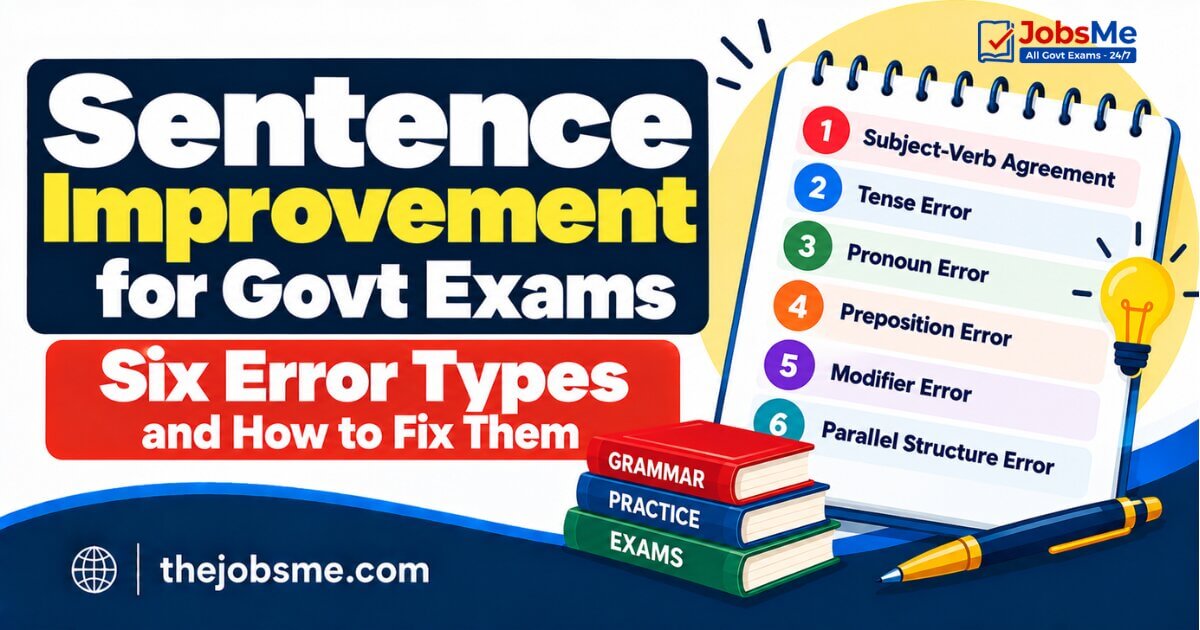
This article is a complete, exam-ready guide to sentence improvement for SSC, banking, insurance, railway and defence exams. Rather than repeating a general method, it works through the six error families that examiners actually use: tense and conditionals, subject-verb agreement, pronouns, prepositions and fixed usage, redundancy, and sentence structure. Each family comes with the rule, wrong and right versions, and the traps built on it. It also gives the decision rule for choosing no improvement, the elimination techniques that survive close options, ten solved questions across all six families, common traps and a fifteen-question practice set with a full answer key.
Introduction
Sentence improvement gives you a sentence with one part underlined. You choose the option that improves that part, or you decide it needs no change.
Bank papers call the same format phrase replacement and offer no correction required as the last option. SSC papers call it sentence improvement and offer no improvement. The task is identical, and the method is covered in phrase replacement.
This article takes a different angle. Instead of the general method, it works through what actually goes wrong. Examiners do not invent new errors each year. They rotate the same six families, and a student who knows all six can name the fault within a few seconds.
That naming step is what separates fast solvers from slow ones. A student who thinks something sounds off here will compare four options and hope. A student who thinks this is a redundancy error already knows what the corrected version must look like.
Where This Topic Is Asked
| Exam | How This Topic Appears | Rough Weight | Difficulty |
|---|---|---|---|
| SSC CGL Tier 1 | Sentence improvement with no improvement as the last option. | 6 to 8 questions together with error spotting | Easy to moderate. The grammar is basic and repeats heavily. |
| SSC CGL Tier 2 | The same format on harder sentences, in a paper that decides the merit list. | 8 to 10 questions in the grammar block | Moderate, and the marking is severe. |
| SSC CHSL, CPO and MTS | Straightforward improvement questions on everyday sentences. | 3 to 5 questions | Easy. |
| Bank PO prelims | Called phrase replacement, often inside the error-detection block. | 2 to 5 questions | Moderate. |
| Bank PO mains | Several formats together, including contextual improvements. | 5 to 10 questions | Moderate to hard. |
| Defence and State PSC exams | Sentence improvement on formal sentences. | Up to 10 questions in some papers | Easy to moderate. |
The Marking Arithmetic You Should Know
This matters more here than in most topics, because of the no improvement option.
- SSC Tier 1 deducts 0.50 marks for a wrong answer, and Tier 2 Paper 1 deducts a full 1 mark.
- Bank papers deduct one-fourth of a mark.
- An unanswered question costs nothing in every one of them.
- A question should take 25 to 30 seconds.
So the strategy follows directly. In SSC Tier 2, a wrong answer costs a full mark while a skipped one costs nothing, which means a guess between two options is a losing bet over a full paper. Answer when you can name the error or confirm the sentence is clean, and skip when you can do neither. Confirm the pattern for your own exam in the exam-wise syllabus hub.
The Six Error Families
| Family | What Goes Wrong | A Typical Example | How Often |
|---|---|---|---|
| 1. Tense and conditionals | The verb form does not match the time marker, or a conditional structure is broken. | He is working here since 2010. | Very frequent. |
| 2. Subject-verb agreement | The verb matches the nearest noun instead of the real subject. | The number of applicants have increased. | The single most tested family. |
| 3. Pronouns | The pronoun disagrees with what it refers to, or its reference is unclear. | Between you and I, this is wrong. | Frequent. |
| 4. Prepositions and fixed usage | The wrong preposition is attached to a word that takes only one. | She is good in mathematics. | Frequent and easy to prepare. |
| 5. Redundancy | The same idea is expressed twice. | Please return back the book. | Common, and often missed entirely. |
| 6. Structure | Parallelism, modifier placement, correlatives, comparatives or articles. | She only not speaks English but also French. | Common in bank papers. |
Two of those six carry most of the marks. If your preparation time is short, put it into agreement and tense, then into the redundancy list, which is the fastest family to learn from scratch.
Formula Box
- Name the family first. Tense, agreement, pronoun, preposition, redundancy or structure.
- Read the unmarked part, because it is guaranteed correct and it sets the tense and the subject.
- Predict the correction before you read the options.
- Shorter is usually right. Longer options are padded to create confusion.
- Reject any option that changes the meaning, however correct its grammar.
- No improvement appears in roughly one question in six, so verify rather than assume.
- Time: 25 to 30 seconds a question.
Family 1: Tense and Conditionals
Time Markers Fix the Tense
| Marker | Tense It Demands | Wrong | Right |
|---|---|---|---|
| since | A point in time, with the present perfect or present perfect continuous. | He is working here since 2010. | He has been working here since 2010. |
| for | A duration, with a perfect tense. | She has been living in Mumbai since five years. | She has been living in Mumbai for five years. |
| ago, yesterday, last month | The simple past, and never a perfect tense. | The report has been published two years ago. | The report was published two years ago. |
| yet, already, just | The present perfect. | Did you finish it yet, in formal writing. | Have you finished it yet. |
| A time clause with when, until, before | The present tense for future meaning, not will. | I will tell you when he will come. | I will tell you when he comes. |
| A past reporting verb such as said or warned | The reported verb shifts back, so will becomes would. | He said that he will come. | He said that he would come. |
The Four Conditionals
| Type | Structure | When It Is Used | Example |
|---|---|---|---|
| Type 0 | If plus present, then present. | A general truth. | If you heat water, it boils. |
| Type 1 | If plus present, then will plus base verb. | A real future possibility. | If it rains, I will stay at home. |
| Type 2 | If plus past simple, then would plus base verb. | An unreal present or future situation. | If I had the money, I would buy a car. |
| Type 3 | If plus past perfect, then would have plus past participle. | An unreal past situation. | If I had studied, I would have passed. |
One error appears more than any other here. If I would have money, I will buy a car mixes two types and puts would in the if clause, where it does not belong. The word would never appears in the if clause of a standard conditional. Learn that single line and a whole class of questions becomes easy. The full set is in tenses.
Family 2: Subject-Verb Agreement
| Rule | Wrong | Right | Why |
|---|---|---|---|
| The number of | The number of applicants have increased. | The number of applicants has increased. | The head noun is number, which is singular. The phrase after it does not decide the verb. |
| A number of | A number of officers was present. | A number of officers were present. | Here the phrase means several, so the verb is plural. |
| Collective nouns | The committee have decided to postpone it. | The committee has decided to postpone it. | A committee acting as one body takes a singular verb in Indian exam usage. |
| Each, every, either, neither | Each of the students have submitted the work. | Each of the students has submitted the work. | These are singular, whatever plural noun follows them. |
| One of the | One of the officers were transferred. | One of the officers was transferred. | A plural noun follows, but the subject is one. |
| Along with, as well as, besides | The captain along with the players were felicitated. | The captain along with the players was felicitated. | These phrases add information without changing the subject. |
| Either or, neither nor | Neither the manager nor the clerks was available. | Neither the manager nor the clerks were available. | The verb agrees with the nearer subject. |
| A long phrase between subject and verb | The list of selected candidates have been published. | The list of selected candidates has been published. | The head noun is list. Ignore everything between it and the verb. |
The last row is the general principle behind most of the others. Cover the phrase between the subject and the verb with your finger, and the correct form becomes obvious. This is covered further in subject-verb agreement.
Family 3: Pronouns
| Rule | Wrong | Right | Why |
|---|---|---|---|
| After a preposition, use the object form | Between you and I, this is wrong. | Between you and me, this is wrong. | Between is a preposition, so it takes me, not I. |
| Everyone, everybody, someone are singular | Everyone should do their best. | Everyone should do his or her best. | Indian exams follow the traditional rule here, though modern usage increasingly accepts the plural form. |
| Collective nouns take it and its | The team has completed their project. | The team has completed its project. | If the verb is singular, the pronoun must be singular too. |
| Who for people, which for things | The ministry, who has issued the order. | The ministry, which has issued the order. | An institution is a thing, however many people work in it. |
| A pronoun needs a clear antecedent | The officer told the clerk that he had erred. | The officer told the clerk, admitting that he himself had erred. | Two possible referents make the pronoun ambiguous, which is itself an error. |
| Each other and one another | The three brothers helped each other. | The three brothers helped one another. | Strictly, each other is for two and one another for more than two. |
Family 4: Prepositions and Fixed Usage
| Wrong | Right | Note |
|---|---|---|
| good in mathematics | good at mathematics | Skills take at. |
| he married with her | he married her | Marry takes no preposition, though married to is correct as an adjective. |
| comprises of ten chapters | comprises ten chapters | Comprise takes no of, while consist does. |
| senior than me | senior to me | Senior, junior, superior, inferior and prior all take to. |
| discuss about the report | discuss the report | Discuss takes no preposition. |
| despite of the delay | despite the delay | Despite never takes of, but in spite of does. |
| capable to do the work | capable of doing the work | A preposition takes a gerund, not an infinitive. |
| insisted to pay | insisted on paying | Same rule as above. |
| abide with the rules | abide by the rules | A fixed pairing. |
| entrusted the work with him | entrusted him with the work | The order matters as much as the preposition. |
| different than the original | different from the original | Indian and British usage prefer from. |
| prefer tea than coffee | prefer tea to coffee | Prefer takes to. |
Family 5: Redundancy
This family is the easiest to prepare and the most often missed, because the sentence contains no grammatical fault at all. The error is that an idea has been stated twice.
| Redundant Phrase | Correct Version | Why It Repeats |
|---|---|---|
| return back | return | Return already means to go or give back. |
| repeat again | repeat | Repeat already means to say again. |
| revert back | revert or reply | Revert already contains the sense of going back. |
| more superior | superior | Superior is already comparative. |
| more better | better | The same double-comparative fault. |
| past history | history | History is always of the past. |
| free gift | gift | A gift is by definition free. |
| new innovation | innovation | An innovation is new by definition. |
| final conclusion | conclusion | A conclusion is already final. |
| join together | join | Joining is already a coming together. |
| reason is because | reason is that | Reason and because both express cause. |
| advance planning | planning | Planning is done in advance. |
| each and every | each or every | Use one, not both. |
| close proximity | proximity | Proximity already means closeness. |
| sufficient enough | sufficient or enough | Both words carry the same idea. |
Family 6: Structure
- Parallelism. Items in a list must share a grammatical form. I enjoy stopping at the bank, mow the lawn and to talk to my neighbour becomes stopping at the bank, mowing the lawn and talking to my neighbour.
- Correlative placement. Not only pairs with but also, and both must sit directly around the parallel items. She speaks not only English but also French, and never She only not speaks English.
- Dangling modifiers. An opening participle phrase must describe the subject that follows it. Delighted with their work, it was decided to honour them is wrong, because it was not delighted. Write Delighted with their work, she decided to honour them.
- Comparatives and superlatives. Use a comparative for two things and a superlative for more than two, and never double them. He is the best of the two becomes the better of the two.
- Articles with superlatives and abstract nouns. He is best student in the class needs the best. The honesty is best policy becomes Honesty is the best policy.
- Consistent voice and tense in a compound sentence. Jane drove to the mall and will buy jeans becomes drove to the mall and bought jeans.
Exam Alert
- Name the family before you read the options. A named error tells you what the fix must look like.
- The unmarked part is guaranteed correct, so use it to fix the tense and identify the subject.
- Count the faults. A sentence may carry two, and an option that repairs only one is wrong.
- Redundancy errors break no grammar rule, which is exactly why students mark them as needing no improvement.
- With a full mark deducted in SSC Tier 2, skipping beats guessing whenever you cannot name the error.
Key Highlights
- Diagnose before you choose. Naming the error family is faster than comparing four options.
- Agreement and tense carry most of the marks, so revise those two families first.
- Redundancy breaks no grammar rule, which is why it is the most frequently missed family.
- Count the faults. A sentence may carry two, and a half-fix option is still wrong.
- Because a blank costs nothing and a wrong answer costs half a mark or a full one, skipping beats guessing here.
The No-Improvement Decision
Roughly one question in six needs no change at all, and students under-choose that option because they assume every question hides a fault. Run this checklist before deciding.
- Does the verb match the head noun? Cover any phrase sitting between them.
- Does the tense match the time marker? Look for since, for, ago, yet and any time clause.
- Does every pronoun agree and refer clearly? Check number first, then reference.
- Is each preposition the fixed one? Check against the list above.
- Is any idea stated twice? This is the check students skip most often.
- Is the structure parallel and are modifiers correctly placed?
If all six pass, choose no improvement with confidence. And remember the reverse warning too: a sentence can pass all six grammar checks and still be wrong contextually, as when a gap is covered rather than bridged.
Elimination Techniques
- The shorter option usually wins. Longer alternatives are padded to create confusion, so between two correct options choose the leaner one.
- Read all the options before choosing. The first acceptable option is frequently not the best one.
- Substitute and read back. Put your choice into the full sentence and read it once, which catches the case where a fix creates a new fault.
- Treat similar-looking options carefully. When three options differ by one word, that word is the point of the question.
- Watch options built on -ing forms. They are frequently offered where a finite verb is needed.
- Watch correlative pairs. Options often place not only, no sooner or either wrongly on purpose.
Ten Solved Questions
1. Tense with a time marker. He is working here since 2010. Options: (a) has been working here since 2010 (b) works here since 2010 (c) worked here since 2010 (d) no improvement.
Working: Since marks a point in time and requires a perfect tense. Answer: (a).
2. Since against for. She has been living in Mumbai since five years. Options: (a) from five years (b) for five years (c) since five year (d) no improvement.
Working: Five years is a duration, not a point in time, so it takes for. Answer: (b).
3. Agreement with a long phrase. The number of applicants have increased significantly. Options: (a) has increased (b) are increasing (c) were increased (d) no improvement.
Working: The subject is the number, not applicants, and it is singular. Answer: (a).
4. Conditional structure. If I would have money, I would buy a car. Options: (a) If I have money (b) If I had money (c) If I would had money (d) no improvement.
Working: This is a Type 2 conditional, which takes if plus the past simple. Would never appears in the if clause. Answer: (b).
5. Redundancy. Please repeat again what you just said. Options: (a) repeat once again (b) repeat (c) say once more again (d) no improvement.
Working: Repeat already means to say again, so again is redundant. Option (a) repeats the same fault. Answer: (b).
6. Pronoun agreement. Everyone in the office completed their assigned tasks. Options: (a) his or her assigned tasks (b) his assigned task (c) their assigned task (d) no improvement.
Working: Everyone is singular by the traditional rule that exams follow. The plural tasks is fine, since each person had several. Answer: (a).
7. No improvement needed. The committee has decided to postpone the annual meeting. Options: (a) have decided (b) had decided (c) was decided (d) no improvement.
Working: Committee is a singular collective noun, the verb matches, and the present perfect suits a recent decision. Nothing is wrong. Answer: (d).
8. Preposition. The book comprises of ten chapters and an appendix. Options: (a) comprises ten chapters (b) is comprised ten chapters (c) comprise of ten chapters (d) no improvement.
Working: Comprise takes no preposition, while consist takes of. Answer: (a).
9. Structure and correlatives. She only not speaks English but also French. Options: (a) She speaks not only English (b) She does not only speak English (c) She not only speak English (d) no improvement.
Working: The two parallel items are the languages, so not only must sit directly before English. Answer: (a).
10. Two faults at once. The team has been worked hardly to meet the deadline. Options: (a) working hard (b) work hard (c) worked hard (d) no improvement.
Working: Two things are wrong. Has been worked makes the team the receiver of the action, and hardly means scarcely, which reverses the meaning. Only one option repairs both. Answer: (a). Option (c) is the half-fix trap, correcting the adverb and leaving the voice wrong.
Quick Facts
- Since takes a point in time; for takes a duration; ago takes the simple past.
- The number of takes a singular verb; a number of takes a plural one.
- Each, every, one of the are singular whatever noun follows.
- Would never appears in the if clause.
- Between takes the object form, so between you and me.
- Comprise takes no preposition; consist takes of.
Worked Examples: Wrong to Right
Example 1 (not naming the error)
Sentence: A student senses that something is wrong, reads all four options twice, and picks the one that sounds best.
Trap: Sounding right feels like a reliable test, and under time pressure it is the only tool left. The options are written to sound plausible, so this method wins about half the time.
Correct Answer: Name the family first: tense, agreement, pronoun, preposition, redundancy or structure.
Rule in Simple Words: A named error tells you what the corrected version must look like.
Example 2 (missing a redundancy)
Sentence: For please return back the book, a student finds no grammar fault and marks no improvement.
Trap: Every word is correct and the sentence is perfectly clear, so the grammar check passes. Redundancy breaks no rule of grammar, which is precisely why it is missed.
Correct Answer: Return the book, since return already means to give back.
Rule in Simple Words: Add a redundancy check to your routine, because grammar alone will never catch it.
Example 3 (agreement with the nearest noun)
Sentence: A student accepts the list of selected candidates have been published.
Trap: Candidates is plural and sits right beside the verb, so the plural form sounds natural. The subject is list, and everything between the subject and the verb is irrelevant.
Correct Answer: Has been published.
Rule in Simple Words: Cover the phrase between the subject and the verb with your finger.
Example 4 (would in the if clause)
Sentence: A student accepts if I would have money, I would buy a car because both halves use would consistently.
Trap: The consistency looks deliberate and even elegant. In a standard conditional, would belongs only in the result clause and never in the if clause.
Correct Answer: If I had money, I would buy a car.
Rule in Simple Words: No would after if.
Example 5 (forcing an improvement)
Sentence: For a sentence that is already correct, a student chooses the least implausible alternative.
Trap: Students assume every question hides an error, so the no-improvement option looks like a trick. It is the intended answer in roughly one question in six.
Correct Answer: Run the six-point checklist, and if all six pass, choose no improvement.
Rule in Simple Words: A correct sentence is still a valid question.
Example 6 (accepting a half-fix)
Sentence: For has been worked hardly, a student picks worked hard, having spotted the adverb problem.
Trap: The adverb correction is real, which makes the option feel like the answer. The passive voice is still wrong, because the team is acting rather than being acted upon.
Correct Answer: Working hard, which repairs both faults.
Rule in Simple Words: Count the faults before you choose.
Example 7 (a longer option that looks thorough)
Sentence: Between two correct options, a student picks the longer and more elaborate one.
Trap: Length reads as care and precision, especially in formal English. Examiners pad wrong options deliberately, so extra words are usually a warning rather than a merit.
Correct Answer: The shorter option, provided it is fully correct.
Rule in Simple Words: Shorter and correct beats longer and correct.
Example 8 (guessing under heavy negative marking)
Sentence: In SSC Tier 2, a student cannot decide between two options and marks one anyway.
Trap: Attempting more questions feels like the way to a higher score. Tier 2 deducts a full mark for a wrong answer and nothing for a blank, so a coin toss loses marks across a paper.
Correct Answer: Skip when you cannot name the error or confirm the sentence is clean.
Rule in Simple Words: Know the error or leave the question.
Common Traps Students Fall Into
These are the habits that most often cost marks. Each one is a common trap, not a silly mistake, and each has a one-line fix.
- Trap: Working from feel rather than diagnosis. Fix: Name the error family before reading the options.
- Trap: Reading only the underlined part. Fix: The unmarked part is guaranteed correct and sets the tense and the subject.
- Trap: Skipping the redundancy check. Fix: Ask whether any idea appears twice, since grammar will not flag it.
- Trap: Matching the verb to the nearest noun. Fix: Find the head noun and ignore the phrase in between.
- Trap: Putting would in the if clause. Fix: Learn the four conditional structures as fixed patterns.
- Trap: Accepting an option that fixes one of two faults. Fix: Count the faults first.
- Trap: Accepting an option that changes the meaning. Fix: The improved sentence must say the same thing as the original, exactly as in phrase replacement.
- Trap: Choosing the longest option. Fix: Between two correct options, take the shorter.
- Trap: Never choosing no improvement. Fix: Run the six-point checklist and trust it.
- Trap: Guessing under negative marking. Fix: A blank costs nothing while a wrong answer costs half a mark or a full one.
- Trap: Practising without recording the rule. Fix: After each wrong answer, write the rule you missed, exactly as in error spotting practice.
Memory Tricks and Formulas
1. TAP-PRS: the six families
Tense, Agreement, Pronoun, Preposition, Redundancy, Structure. Run through the six in that order and you will locate almost any fault within a few seconds. The first two carry most of the marks.
2. Cover the middle
For agreement questions, put a finger over the phrase between the subject and the verb. The list of candidates has, each of the students has, one of the officers was. The middle phrase is there to mislead you and never decides the verb.
3. Since is a point, for is a stretch
Since takes a point in time, so since 2010 or since Monday. For takes a duration, so for five years or for two hours. Both call for a perfect tense, and ago takes the simple past instead.
4. No would after if
In a standard conditional, would belongs in the result clause only. So it is if I had money, I would buy, and never if I would have money. One line, one whole family of questions.
5. The redundancy sweep
Before deciding on no improvement, ask whether any idea appears twice. Return back, repeat again, more superior, past history, free gift, final conclusion. These break no grammar rule, which is why they slip past.
6. Count the faults
Ask how many things are wrong before you choose. If two, then any option repairing only one is out. The has been worked hardly pattern exists purely to catch students who stop at the first fault.
7. Shorter is wiser
Examiners lengthen wrong options to create doubt. So when two options both look correct, the leaner one is nearly always intended.
8. The 30-second clock
Allow 25 to 30 seconds a question. Diagnose in ten, eliminate in ten, read back in ten. With 6 to 8 questions in an SSC paper, the whole block should take about four minutes.
Exam Patterns and High-Yield Facts
Frequently Confused Pairs
| Pair | How They Differ | Mini Trick |
|---|---|---|
| Sentence improvement vs Error spotting | Error spotting asks which part is faulty. Improvement asks what the correct version is. | One finds, the other fixes. |
| Sentence improvement vs Word swap | Improvement supplies a new phrase. A word swap moves existing words. | Substitute against exchange. |
| Since vs For | Since marks a point in time, for marks a duration. | Since 2010, for five years. |
| The number of vs A number of | The first takes a singular verb, the second a plural one. | The number has, a number have. |
| Comprise vs Consist | Comprise takes no preposition, consist takes of. | Comprises ten chapters, consists of ten chapters. |
| Hard vs Hardly | Hard means with effort, hardly means scarcely. | Works hard against hardly works. |
| Each other vs One another | Each other is for two, one another for more than two. | Two brothers help each other. |
| Senior to vs Senior than | Latin comparatives take to, not than. | Senior, junior, superior, inferior, prior. |
| Despite vs In spite of | Same meaning, but despite takes no of. | Despite the delay, in spite of the delay. |
| Between vs Among | Between is for two, among for more than two. | Between the two options, among the five. |
Repeating Question Patterns
- Agreement with a long noun phrase, where a plural noun is placed next to a singular head noun.
- Since and for confusion, which is the commonest single tense error in this topic.
- Conditional mixing, especially would appearing in the if clause.
- Redundancy questions, where the sentence is grammatically perfect and students mark no improvement.
- Half-fix options, which repair one of two faults and leave the other.
- Correlative misplacement, with not only, no sooner and either put in the wrong position.
Practice Set: Fifteen Questions
Choose the best improvement for the underlined part, or decide that no improvement is needed. Give each item thirty seconds.
- Each of the candidates have been informed by email. (a) has been informed (b) were informed (c) have informed (d) no improvement
- He has been teaching at the college since eight years. (a) for eight years (b) from eight years (c) since eight year (d) no improvement
- The manager said that he will review the file the next day. (a) would review (b) will be reviewing (c) reviews (d) no improvement
- Please return back the register to the office. (a) return (b) return again (c) give back again (d) no improvement
- The committee has submitted its report to the government. (a) have submitted their report (b) has submitted their report (c) had submitted its report (d) no improvement
- This proposal is more superior than the earlier one. (a) superior to (b) more superior to (c) superior than (d) no improvement
- If he would come early, we would start the meeting. (a) If he came (b) If he will come (c) If he would have come (d) no improvement
- Between you and I, the decision was unfair. (a) me (b) myself (c) mine (d) no improvement
- The scheme comprises of four separate components. (a) comprises (b) is comprising of (c) comprise of (d) no improvement
- The captain along with the players were felicitated at the function. (a) was felicitated (b) have been felicitated (c) are felicitated (d) no improvement
- She is the better of the two candidates. (a) no improvement (b) the best (c) more better (d) better most
- He enjoys reading, swimming and to cycle on weekends. (a) cycling (b) cycle (c) he cycles (d) no improvement
- The department has issued the circular last Monday. (a) issued (b) had issued (c) has been issuing (d) no improvement
- Everyone in the class submitted their assignment on time. (a) his or her assignment (b) theirs assignment (c) their assignments (d) no improvement
- The workers have been working since early morning without a break. (a) no improvement (b) have been worked (c) has been working (d) are worked
Quick Facts
Answer key, with the error family named in each case.
- 1. (a) has been informed. Agreement. Each is singular whatever noun follows.
- 2. (a) for eight years. Tense. Eight years is a duration, so it takes for.
- 3. (a) would review. Tense. The past reporting verb said shifts will to would.
- 4. (a) return. Redundancy. Return already means to give back.
- 5. (d) no improvement. The collective noun takes a singular verb and a singular pronoun, and both match.
- 6. (a) superior to. Redundancy and preposition together. Superior is already comparative and takes to.
- 7. (a) If he came. Conditionals. Would never appears in the if clause.
- 8. (a) me. Pronoun. Between is a preposition and takes the object form.
- 9. (a) comprises. Preposition. Comprise takes no of.
- 10. (a) was felicitated. Agreement. Along with does not change the subject.
- 11. (a) no improvement. A comparative is correct for two things, and the better of the two is standard.
- 12. (a) cycling. Structure. The list must be parallel, so all three items take the -ing form.
- 13. (a) issued. Tense. Last Monday is a finished past period and cannot take a perfect tense.
- 14. (a) his or her assignment. Pronoun. Everyone is singular by the rule exams follow.
- 15. (a) no improvement. Since early morning correctly takes the present perfect continuous, and the workers are acting.
Three of those fifteen needed no improvement, which is close to the real proportion. Students who force a change on all fifteen lose three marks they already had. Practise the same restraint with the free English MCQ quizzes and full papers from the mock test archive.
Quick Revision
Quick Revision
- What the question is. One part of a sentence is underlined, and you choose the option that improves it or decide that it needs no change.
- The same topic has two names. SSC calls it sentence improvement and banks call it phrase replacement, but the format and the rules are identical.
- The first move. Name the error family before you read any option, because a named fault tells you what the correction must look like.
- The six families. Tense and conditionals, subject-verb agreement, pronouns, prepositions, redundancy, and structure.
- Where the marks are. Agreement and tense together carry most of the questions, so revise those first if time is short.
- The unmarked part is your reference. It is guaranteed correct, so it fixes the tense and identifies the real subject.
- Cover the middle phrase. In agreement questions, put a finger over the words between the subject and the verb.
- The number of takes a singular verb, while a number of takes a plural one.
- Each, every, either and neither are singular, whatever plural noun happens to follow them.
- Along with and as well as do not change the subject, so the captain along with the players was felicitated.
- Collective nouns take a singular verb and a singular pronoun, so the team has completed its project.
- Since marks a point in time and for marks a duration, and both call for a perfect tense.
- Ago, yesterday and last month force the simple past and can never take a perfect tense.
- A past reporting verb shifts will to would in the clause that follows it.
- Would never appears in the if clause of a standard conditional.
- Type 2 conditionals use if plus the past simple, then would plus the base verb.
- Type 3 conditionals use if plus the past perfect, then would have plus the past participle.
- Between takes the object form, so it is between you and me.
- Everyone and everybody are singular by the traditional rule that Indian exams follow.
- Who refers to people and which to things, including institutions such as a ministry or a committee.
- Fixed prepositions must be memorised. Good at, senior to, comprises nothing, discuss nothing, abide by, capable of, entrusted with.
- Despite takes no of, though in spite of does.
- Redundancy breaks no grammar rule, which is exactly why students mark those sentences as needing no improvement.
- The redundancy list to memorise. Return back, repeat again, revert back, more superior, past history, free gift, new innovation, final conclusion and each and every.
- Lists must be parallel, so reading, swimming and cycling rather than reading, swimming and to cycle.
- Correlatives sit around the parallel items, so she speaks not only English but also French.
- An opening participle phrase must describe the subject that follows it, or the modifier dangles.
- Count the faults before choosing. If a sentence carries two errors, an option repairing only one is still wrong.
- Between two correct options, take the shorter one, since wrong options are padded to create doubt.
- No improvement is the answer in roughly one question in six, so run the six-point checklist before assuming a fault exists.
- Timing and marking. Allow twenty-five to thirty seconds a question, and remember that a blank costs nothing while a wrong answer costs half a mark in SSC Tier 1 and a full mark in Tier 2.
Sentence improvement is the most learnable grammar topic in any English paper, because the same six families come back cycle after cycle and each one has a short, fixed set of rules. So diagnose before you choose, add a redundancy check to your routine, and let the marking scheme decide whether to attempt or skip. Build the rules underneath through subject-verb agreement, tenses and direct and indirect speech, and sharpen the diagnosis through error spotting. For the contextual questions, the word pairings come from formal journalism, so ten minutes of daily current affairs reading and some collocations practice will cover them. The wider set is in the topic-wise English notes.
Frequently Asked Questions
What is sentence improvement?
Is sentence improvement the same as phrase replacement?
Which error types are tested most often?
Why should I name the error before reading the options?
What is the difference between since and for?
Can would be used after if?
Why are redundancy errors so easy to miss?
How often is no improvement the correct answer?
What if an option fixes only one of two errors?
Should I guess when I am unsure?

About the author





