Parts of Speech: The Eight Classes and How to Tell Them Apart
This article is the hub for the eight parts of speech, written for SSC, banking, insurance, railway, defence and State PSC exams. It starts from the fact that decides most questions in this topic: a part of speech is not a property of a word but of the job the word is doing in a particular sentence. The word fast is a noun, a verb, an adjective and an adverb depending on where it sits. So instead of asking you to memorise lists, this guide gives a position test for each of the eight classes, a list of the words that shift class most often, the noun and verb pairs examiners reuse, and the suffix map that reveals word class at a glance. Every class links to its full article, and ten solved questions, common traps and a fifteen-question practice set with a full answer key are included.

Introduction
The parts of speech are the eight classes into which every English word falls: noun, pronoun, verb, adjective, adverb, preposition, conjunction and interjection.
Most guides then hand you eight definitions and eight lists of examples. That approach fails on the first real question, and it is worth understanding why.
A part of speech is not a property of a word. It is a property of the job the word is doing in a particular sentence. Consider one short word.
- This is a fast car. Here fast describes the noun car, so it is an adjective.
- She runs fast. Here it tells you how she runs, so it is an adverb.
- Many people fast during festivals. Here it is the action itself, so it is a verb.
- He broke his week-long fast. Here it names a thing, so it is a noun.
One word, four classes, and nothing about the word changed. So the question "what part of speech is X?" has no answer without a sentence, and any method built on memorising word lists will fail.
This article therefore does two things. It gives you a test for identifying each class from its position and behaviour, and it points you to the full article on each class once you know which one you are dealing with.
Where This Topic Is Asked
| Exam | How This Topic Appears | Rough Weight | Difficulty |
|---|---|---|---|
| SSC CGL and CHSL | Direct identification of an underlined word, and wrong word forms in error spotting. | 1 to 2 direct questions, and it underlies the whole grammar block | Easy. |
| IBPS PO and SBI PO | Choosing the right word form in a filler, as in hope against hopeful against hoping. | 1 to 2 questions | Moderate. |
| RRB NTPC and Group D | Straightforward identification items. | 1 question | Easy. |
| State PSC and police exams | Identification, plus noun and verb pairs such as advice and advise. | 1 to 2 questions | Easy to moderate. |
| Cloze test and fillers | The blank almost always needs a particular word class. | Indirect but constant | Moderate. |
| Every other grammar topic | You cannot check agreement without finding the verb, or placement without knowing the adverb. | Foundational | Worth the time. |
The direct return is small and the indirect return is the whole English section. Every rule in every other article assumes you can look at a sentence and see which word is doing which job. Check your own pattern in the exam-wise syllabus hub.
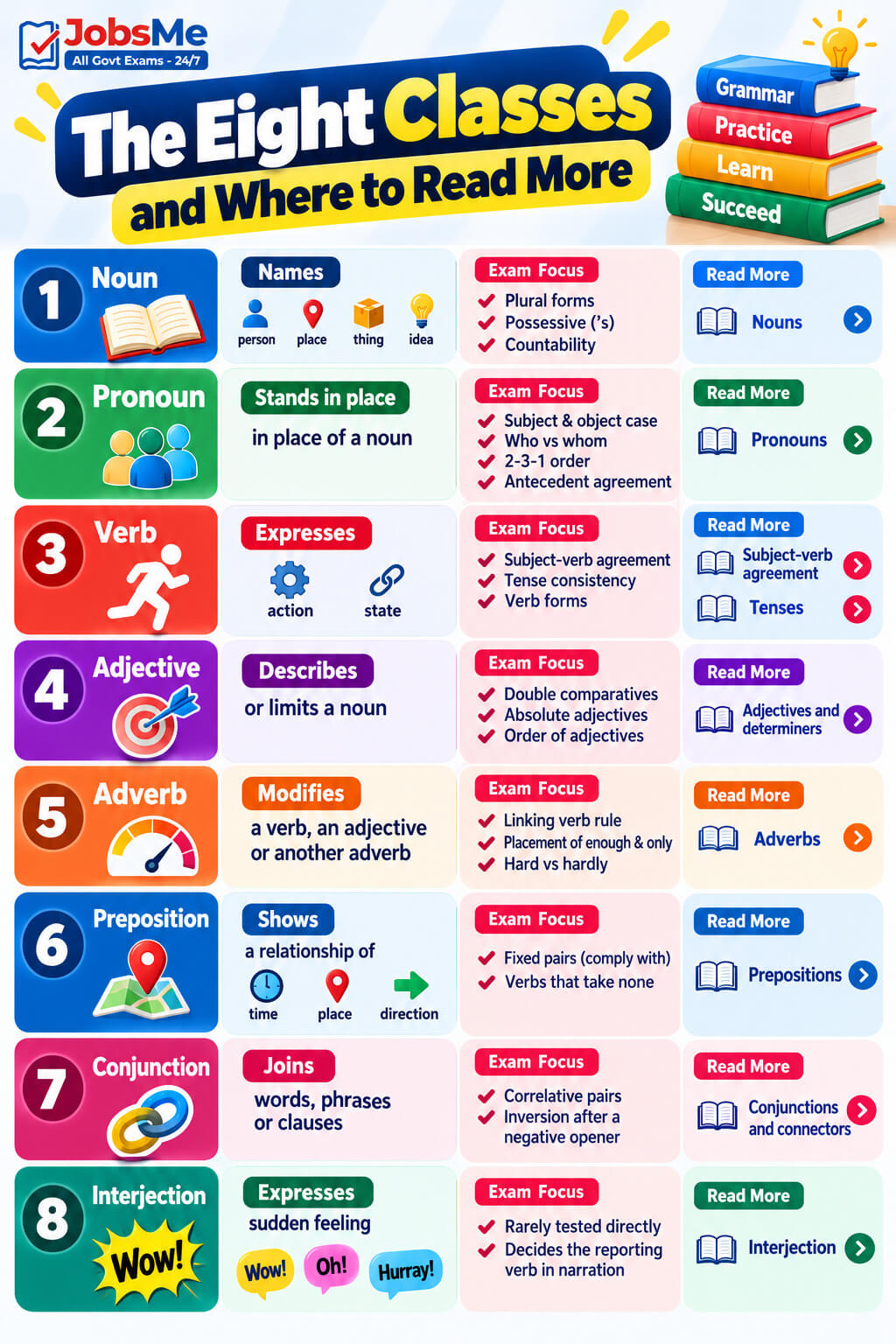
The Eight Classes and Where to Read More
| Class | Core Function | What Exams Test | Full Article |
|---|---|---|---|
| 1. Noun | Names a person, place, thing or idea. | Plural forms, the possessive apostrophe, and countability. | Nouns |
| 2. Pronoun | Stands in place of a noun. | Subject and object case, who against whom, the 2-3-1 order, antecedent agreement. | Pronouns |
| 3. Verb | Expresses an action or a state. | Agreement with the subject, tense consistency, and verb forms. | Subject-verb agreement and tenses |
| 4. Adjective | Describes or limits a noun. | Double comparatives, absolute adjectives, and the order of adjectives. | Adjectives and determiners |
| 5. Adverb | Modifies a verb, an adjective or another adverb. | The linking verb rule, the placement of enough and only, and hard against hardly. | Adverbs |
| 6. Preposition | Shows a relationship of time, place or direction. | Fixed pairs such as comply with, and the verbs that take none. | Prepositions |
| 7. Conjunction | Joins words, phrases or clauses. | Correlative pairs, and the inversion after a negative opener. | Conjunctions and connectors |
| 8. Interjection | Expresses sudden feeling and stands apart from the sentence. | Rarely tested directly, but it decides the reporting verb in narration. | Interjection |
Two classes are often listed separately in modern grammar and are worth knowing about. Articles and determiners once counted as adjectives, and now form their own category: see articles and the determiner half of adjectives and determiners.
Formula Box
- Read the sentence before naming the class. Function decides, not the word.
- Noun test. Can the go before it, or can it be made plural?
- Verb test. Can you change its tense?
- Adjective test. Can very go before it, and does a noun follow?
- Adverb test. Does it answer how, when, where or how often?
- Preposition test. Is a noun or pronoun sitting right after it?
- Conjunction test. Are there two units on either side of it?
- Interjection test. Can you delete it and leave a whole sentence?
How to Identify the Class From the Sentence
Each class has a behaviour you can test. Apply the test rather than trusting recognition.
Noun: The The Test
A noun accepts the, a or a possessive in front of it, and most nouns can be made plural.
- He broke his fast. You can say the fast, so it is a noun.
- Her walk was brisk. The walk works, so walk is a noun here.
- A noun also fills the subject or object slot, which is the surest sign of all.
Verb: The Tense Test
Only a verb changes its form for time.
- They walk every morning becomes they walked, so walk is a verb.
- Her walk was brisk cannot become her walked was brisk, so there walk is a noun.
- This is the single most reliable test in the topic, because tense belongs to verbs alone.
Adjective: The Very Test
An adjective usually accepts very before it, and it sits either before a noun or after a linking verb.
- A fast car. A very fast car works, and a noun follows.
- She is tall. Very tall works, and it follows the linking verb is.
- Note the correction needed here, since one guide states that an adjective appears before the noun. It also appears after a linking verb, as in the soup tastes good, and that position is exactly where exams test it.
Adverb: The Question Test
An adverb answers how, when, where, how often or to what extent, and it can usually be moved without breaking the sentence.
- She runs fast. How does she run? Fast. So it is an adverb.
- He speaks fluently. How does he speak? Fluently.
- Adverbs also modify adjectives and other adverbs, as in quite often and extremely difficult.
Preposition Against Adverb: The Object Test
This pair causes the most confusion, and one question settles it. A preposition always has a noun or pronoun immediately after it. The same word standing alone, with nothing following, is an adverb or a particle.
| Sentence | Is a noun following? | Class |
|---|---|---|
| He climbed up the ladder. | Yes, the ladder. | Preposition |
| He looked up. | No. | Adverb |
| She walked past the office. | Yes, the office. | Preposition |
| She walked past without stopping. | No. | Adverb |
| He waited since morning. | Yes, morning. | Preposition |
| Since he was late, he took a cab. | A whole clause follows. | Conjunction |
Conjunction: The Two-Units Test
A conjunction has a unit on each side, and it joins them.
- Sheela and Reena are sisters. Two nouns joined, so a conjunction.
- She was ill, so she could not write the exam. Two clauses joined.
- Compare since in the table above. With a noun after it, it is a preposition. With a clause after it, it is a conjunction. The same is true of before, after, until and but.
Pronoun: The Name Test
If you could replace the word with a name or a noun without changing the structure, it is a pronoun.
- She is an outstanding student becomes Priya is an outstanding student.
- Anyone can join becomes any candidate can join.
Interjection: The Deletion Test
An interjection is grammatically independent, so removing it leaves a complete sentence.
- Alas! We lost the match. Delete it and the sentence survives intact.
- That independence is why interjections are dropped entirely in indirect speech, a rule covered in interjection.
Words That Do More Than One Job at Once
Three word forms straddle two classes at the same time, and they account for a steady share of exam questions.
| Form | What It Is | How to Spot It | Example |
|---|---|---|---|
| Gerund | An -ing form working as a noun. | It fills a subject or object slot and accepts the. | Swimming is good exercise. He enjoys reading. |
| Participle | An -ing or -ed form working as an adjective. | It describes a noun sitting beside it. | The sleeping child. A broken promise. |
| Infinitive | To plus the base verb, working as a noun, adjective or adverb. | The to is part of the verb, not a preposition. | To err is human. He came to help. |
The exam consequence is that a gerund takes a singular verb and a possessive pronoun before it, so swimming is and he objected to my going. The to in look forward to is a preposition rather than an infinitive marker, which is why it takes -ing, and that distinction is worked through in prepositions.
The Words That Shift Class Most Often
These are the words examiners choose for identification questions, precisely because recognition fails on them.
| Word | As a Noun | As a Verb | As an Adjective or Adverb |
|---|---|---|---|
| fast | He broke his fast. | They fast on Tuesdays. | A fast car. She runs fast. |
| well | They dug a well. | Tears welled up. | She sings well. He is not well. |
| light | Turn on the light. | Light the lamp. | A light bag. |
| book | Read the book. | Book a ticket. | A book shop. |
| water | Drink the water. | Water the plants. | A water tank. |
| round | The final round. | Round off the figure. | A round table. He turned round. |
| back | His back hurts. | They backed the plan. | The back door. Come back. |
| right | It is my right. | Right the wrong. | The right answer. Turn right. |
| hard | Not used as a noun. | Not used as a verb. | Hard work. He works hard. |
| kind | A kind of fruit. | Not used as a verb. | A kind person. |
Four more words shift between the grammatical classes rather than the descriptive ones, and those are the ones that trip candidates in error spotting.
- But. A conjunction in he tried but failed, a preposition in nobody but me knew.
- Like. A preposition in he sings like his father, a verb in I like mangoes.
- That. A demonstrative in that book, a relative pronoun in the book that I read, a conjunction in he said that he would come.
- Since, before, after, until. Prepositions before a noun, conjunctions before a clause.
Key Highlights
- Class is a job, not a label attached permanently to a word.
- Eight tests replace eight definitions, and the tense test is the strongest.
- Look for the object to separate a preposition from an adverb.
- Look for the clause to separate a preposition from a conjunction.
- The direct marks are few, but every other grammar topic depends on this skill.
Noun and Verb Pairs Examiners Reuse
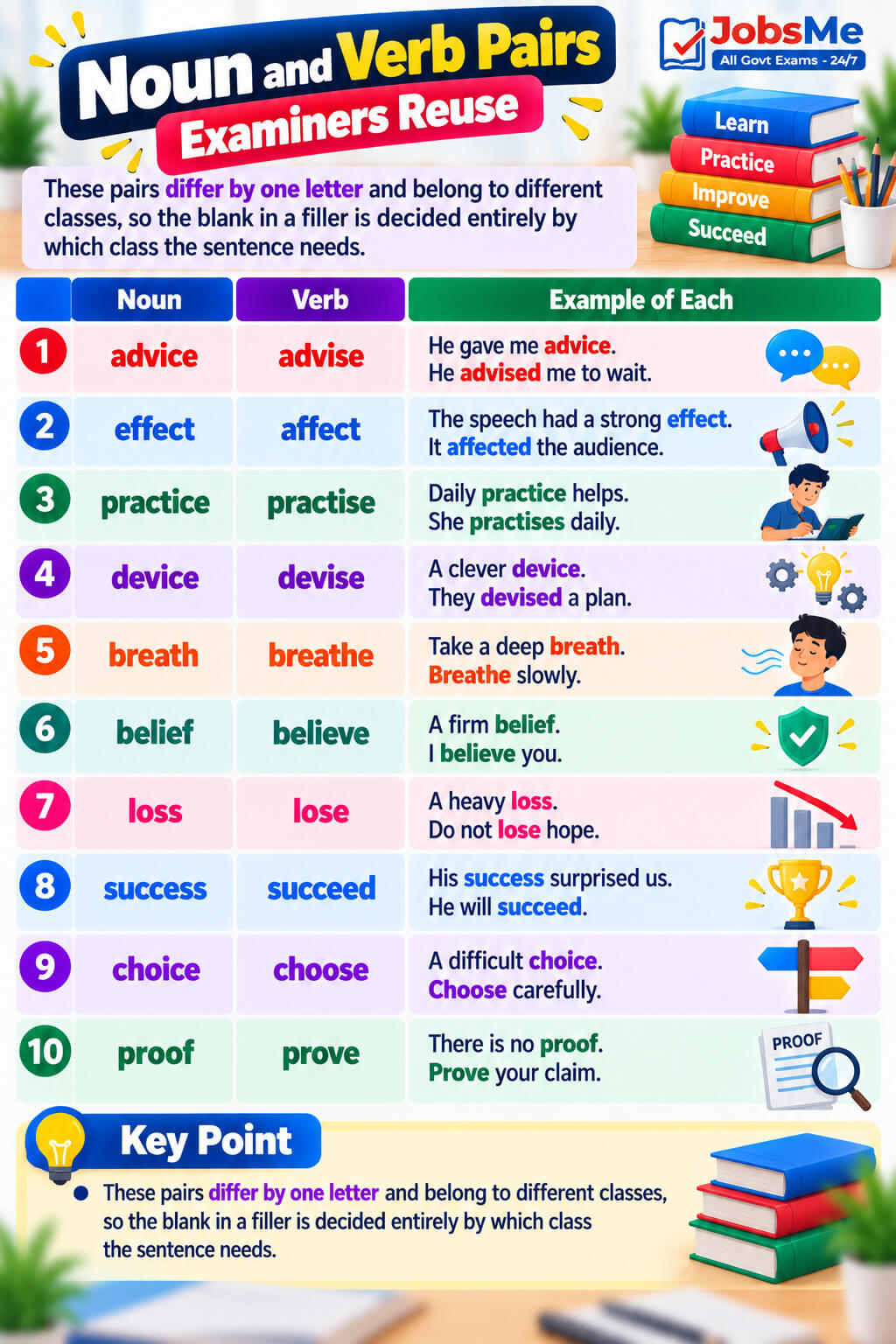
These pairs differ by one letter and belong to different classes, so the blank in a filler is decided entirely by which class the sentence needs.
| Noun | Verb | Example of Each |
|---|---|---|
| advice | advise | He gave me advice. He advised me to wait. |
| effect | affect | The speech had a strong effect. It affected the audience. |
| practice | practise | Daily practice helps. She practises daily. |
| device | devise | A clever device. They devised a plan. |
| breath | breathe | Take a deep breath. Breathe slowly. |
| belief | believe | A firm belief. I believe you. |
| loss | lose | A heavy loss. Do not lose hope. |
| success | succeed | His success surprised us. He will succeed. |
| choice | choose | A difficult choice. Choose carefully. |
| proof | prove | There is no proof. Prove your claim. |
The trick for the first two is spelling. Advice and practice with a c are nouns, while advise and practise with an s are verbs. For effect and affect, remember that the noun begins with e for end result. The wider list is in commonly confused words.
The Suffix Map
Word endings reveal class often enough to be useful, especially in fillers where four forms of the same root are offered.
| Class | Typical Endings | Examples |
|---|---|---|
| Noun | -tion, -sion, -ment, -ness, -ity, -ance, -hood, -ship, -dom | decision, judgement, kindness, ability, appearance, childhood, friendship |
| Verb | -ise, -ize, -ify, -en, -ate | realise, clarify, strengthen, activate |
| Adjective | -ous, -ful, -less, -able, -ible, -ive, -al, -ic, -ish | famous, hopeful, careless, readable, active, natural, heroic |
| Adverb | -ly, usually | quickly, carefully, hopefully |
The last row carries a warning worth repeating from the adverb article. The -ly ending does not guarantee an adverb. Friendly, lively, costly, timely and cowardly are all adjectives formed from nouns, and many adverbs such as fast, hard and late carry no ending at all. So use the suffix as a hint and the position test as the decision.
Open and Closed Classes
Linguists divide the eight into two groups, and the division has a practical consequence for exams.
- Open classes: nouns, verbs, adjectives and adverbs. New words enter these constantly, which is why they have few fixed rules and are mostly governed by meaning.
- Closed classes: pronouns, prepositions, conjunctions and interjections, along with articles and determiners. No new words join these, so their behaviour is fixed and rule-governed.
That is why most planted errors sit in the closed classes. A fixed set of words with fixed rules is exactly what a paper can test reliably, which is why comply with, between you and me and neither nor appear year after year.
Note that sources disagree on whether articles and determiners belong in the closed list or count as adjectives. Both classifications appear in study material, and the label makes no difference to any rule you will be tested on.
A Warning About Study Material on This Topic
- A category that does not exist. One guide lists verbs as finite and infinite. The pair is finite and non-finite, and an infinite verb is not a grammatical term.
- Another invented category. The same source lists five kinds of preposition and names the fifth prepositional prepositions. The standard fifth type is the phrase preposition, as in in addition to.
- A garbled definition. Another guide states that the indefinite article begins with a consonant sound. The article does not; the word after it does, which is what decides between a and an.
- An overstated position rule. The same source says an adjective appears before the noun. It also appears after a linking verb, as in she is tall, and that is precisely where exams plant the adjective and adverb confusion.
- A non-error listed as a mistake. One list warns against misplacing prepositions at the end of a sentence. Ending a sentence with a preposition is not an error, and the old rule against it came from Latin grammar.
So verify every category name against a standard grammar, because invented labels such as infinite verbs and prepositional prepositions are copied between sites without checking.
Exam Alert
- An underlined shifting word such as fast, up, since or but is the standard identification item.
- Four forms of one root in a filler is really a question about word class.
- The word very before a blank means an adjective or adverb belongs there.
- An article or a before a blank means a noun belongs there.
- Errors cluster in the closed classes, because their membership and rules are fixed.
Ten Solved Questions
1. Identify the part of speech of the underlined word. He speaks fluently in three languages.
Working: It answers how does he speak, so it modifies the verb. Answer: adverb.
2. Identify the part of speech of the underlined word. He broke his week-long fast on Sunday.
Working: Apply the the test. The fast works, and the word follows a possessive, so it names a thing. Answer: noun.
3. Identify the part of speech of the underlined word. She climbed up the narrow staircase.
Working: A noun phrase follows it directly, so it links that noun to the verb. Answer: preposition. In she looked up, with nothing following, the same word is an adverb.
4. Identify the part of speech of the underlined word. Since he was unwell, he skipped the meeting.
Working: A full clause follows, with its own subject and verb, so the word is joining two clauses. Answer: conjunction. In he has waited since morning, a noun follows and it is a preposition.
5. Fill the blank. The manager was very ___ about the results. Options: hope, hopeful, hoping, hoped.
Working: The word follows the linking verb was and describes the manager, so an adjective is needed. The very test confirms it. Answer: hopeful.
6. Fill the blank. His speech had a strong ___ on the audience. Options: effect, affect, effective, affected.
Working: A strong signals that a noun follows, and the noun of this pair is spelt with an e. Answer: effect.
7. Find the error. My teacher gave me (a) / a valuable advise (b) / before the interview. (c) / No error (d)
Working: A valuable requires a noun, and the noun is spelt with a c. Answer: (b), which should read a valuable piece of advice, since advice is also uncountable.
8. Identify the part of speech of the underlined word. Nobody but me knew about the change.
Working: A pronoun follows it and takes the object form, which only happens after a preposition. Answer: preposition. In he tried but failed the same word is a conjunction.
9. Fill the blank. ___! We lost the match by a single run. Options: Alas, Sadly, Sorrow, Sad.
Working: The deletion test applies. The word stands outside the sentence and expresses sudden feeling, and only one option does that. Answer: Alas.
10. Identify the part of speech of the underlined word. The company decided to water down the proposal.
Working: Apply the tense test. Watered down works, and the word follows to, so it is the action. Answer: verb.
Quick Facts
- Noun test: can the precede it, or can it be pluralised?
- Verb test: can you change its tense?
- Adjective test: can very precede it, and does it describe a noun?
- Adverb test: does it answer how, when, where or how often?
- Preposition test: is a noun immediately after it?
- Conjunction test: is there a unit on each side?
Worked Examples: Wrong to Right
Example 1 (naming the class without the sentence)
Sentence: Asked what part of speech fast is, a student answers "adjective" without reading the sentence.
Trap: Fast is an adjective in the commonest phrase most people know, so recognition supplies an answer instantly. Class depends on the job the word is doing, and fast can be any of four classes.
Correct Answer: Read the sentence first, then apply the test.
Rule in Simple Words: The word does not carry its class; the sentence assigns it.
Example 2 (preposition against adverb)
Sentence: A student calls up a preposition in both he climbed up the ladder and he looked up.
Trap: Up appears on every list of prepositions, so the label seems settled by the word itself. A preposition needs an object, and in the second sentence nothing follows it.
Correct Answer: Preposition in the first, adverb in the second.
Rule in Simple Words: No noun after it means no preposition.
Example 3 (advice against advise)
Sentence: A student writes My teacher gave me a valuable advise.
Trap: The two words sound identical in Indian English, so speech gives no clue at all. A valuable requires a noun, and the noun of the pair is spelt with a c.
Correct Answer: My teacher gave me a valuable piece of advice.
Rule in Simple Words: C for the noun, s for the verb.
Example 4 (trusting the -ly ending)
Sentence: A student labels friendly an adverb because of its ending.
Trap: The -ly ending is the standard adverb signal and works for hundreds of words. It is also a noun-to-adjective suffix, which is why friendly, costly and timely are adjectives.
Correct Answer: Friendly is an adjective, and there is no adverb form of it.
Rule in Simple Words: Use the suffix as a hint and the position as the answer.
Example 5 (since as two classes)
Sentence: A student calls since a preposition in since he was unwell, he skipped the meeting.
Trap: Since is genuinely a preposition in the sentences most students have drilled, such as since morning. Here a whole clause follows rather than a noun, which makes it a conjunction.
Correct Answer: Conjunction here, preposition in he has waited since morning.
Rule in Simple Words: Noun after it means preposition; clause after it means conjunction.
Example 6 (choosing a word form by sound)
Sentence: Faced with the manager was very ___ about the results, a student picks hoping.
Trap: Was hoping is a real and common construction, so the two words together sound entirely natural. The word very sits between them, and very cannot modify a verb form.
Correct Answer: The manager was very hopeful about the results.
Rule in Simple Words: Very before a blank means an adjective or adverb belongs there.
Example 7 (an adjective for an adverb)
Sentence: A student writes She sings beautiful.
Trap: Beautiful is the word most people reach for first, and the meaning is perfectly clear. The word is describing how she sings, which is the verb's job description, so an adverb is required.
Correct Answer: She sings beautifully.
Rule in Simple Words: Modifying a verb calls for an adverb, unless the verb is linking.
Example 8 (a gerund read as a verb)
Sentence: A student treats swimming as a verb in swimming is good exercise and writes swimming are good exercise.
Trap: The -ing ending marks a verb form in every continuous tense, so the word looks verbal. Here it fills the subject slot and takes the comfortably, so it is working as a noun.
Correct Answer: Swimming is good exercise.
Rule in Simple Words: An -ing word in the subject slot is a noun and takes a singular verb.
Common Traps Students Fall Into
These are the habits that most often cost marks. Each one is a common trap, not a silly mistake, and each has a one-line fix.
- Trap: Naming a word's class without reading the sentence. Fix: Function decides, so read first.
- Trap: Calling up, past or in a preposition wherever it appears. Fix: Check whether a noun follows.
- Trap: Calling since, before or after a preposition before a clause. Fix: A clause makes it a conjunction.
- Trap: Trusting the -ly ending. Fix: Friendly and costly are adjectives.
- Trap: Confusing advice with advise. Fix: C for the noun, s for the verb.
- Trap: Confusing effect with affect. Fix: The noun starts with e for end result.
- Trap: Using an adjective where an adverb belongs. Fix: Ask what the word is modifying.
- Trap: Reading every -ing word as a verb. Fix: In the subject slot it is a gerund, so a noun.
- Trap: Marking a sentence-final preposition as an error. Fix: That is not a rule of English.
- Trap: Learning eight definitions instead of eight tests. Fix: Definitions do not identify; tests do.
- Trap: Trusting invented category names. Fix: Verify against a standard grammar, as in error spotting.
Memory Tricks and Formulas
1. Read the sentence, then name the class
No word carries a fixed part of speech. Every identification question is a question about position and function, so the sentence is the whole of the evidence.
2. The tense test is the strongest
Only verbs change form for time. If you can put the word into the past and the sentence survives, it is a verb. They walk becomes they walked, but her walk was brisk cannot.
3. The the test finds nouns
If the, a or a possessive can go in front of it, the word is working as a noun. That catches gerunds too, since the swimming works.
4. The very test finds adjectives and adverbs
Both classes accept very. To separate them, ask what the word is modifying: a noun means adjective, a verb means adverb.
5. Look for the object
A preposition always has a noun or pronoun right after it. Nothing following means an adverb or particle, and a whole clause following means a conjunction.
6. Count the units
A conjunction has something on each side that it joins. If only one unit is present, the word is doing a different job.
7. Use suffixes as hints, not answers
Endings such as -ment, -ness and -tion point to nouns, -ise and -ify to verbs, and -ous and -ful to adjectives. -ly usually means an adverb and sometimes an adjective, so confirm it by position.
8. Budget the time honestly
Direct questions here are worth 1 to 2 marks, so one session on the eight tests is enough. The real payoff is that every other grammar topic becomes faster once you can see the structure of a sentence at a glance.
Exam Patterns and High-Yield Facts
Frequently Confused Pairs
| Pair | How They Differ | Mini Trick |
|---|---|---|
| Adjective vs Adverb | Modifies a noun against modifies a verb. | Ask what it is describing. |
| Preposition vs Adverb | Has an object against stands alone. | Look for the noun after it. |
| Preposition vs Conjunction | Noun after it against clause after it. | Since morning; since he was late. |
| Advice vs Advise | Noun against verb. | C for noun, s for verb. |
| Effect vs Affect | Noun against verb. | E for end result. |
| Practice vs Practise | Noun against verb. | The same c and s rule. |
| Gerund vs Verb | An -ing noun against an -ing verb form. | Check the subject slot. |
| Friendly vs Quickly | Adjective against adverb, both in -ly. | The ending proves nothing. |
| That as pronoun vs conjunction | Refers back against introduces a clause. | The book that I read; he said that he would come. |
| Open vs Closed classes | Meaning-governed against rule-governed. | Errors are planted in the closed ones. |
Repeating Question Patterns
- An underlined shifting word such as fast, up, since, but or well, asking for its class.
- Four forms of one root offered in a filler, as in hope, hopeful, hoping and hoped.
- A noun and verb pair, most often advice and advise or effect and affect.
- An adjective used where an adverb belongs, as in she sings beautiful.
- An interjection to be identified from a set of near-synonyms.
- A gerund treated as a verb, producing a plural verb with a singular subject.
A Sensible Study Order
If you are starting the grammar block from scratch, the sequence below moves from highest weight to lowest and never asks you to use a rule before you have met it.
- This hub, for the eight tests.
- Tenses, the heaviest single topic.
- Subject-verb agreement, which needs the verb test above.
- Nouns and pronouns, which supply the subjects.
- Articles and prepositions, equal in weight and both list-based.
- Adjectives and determiners, adverbs and degrees of comparison.
- Conjunctions and connectors, modifiers and punctuation rules.
- Then the question formats: error spotting and sentence improvement.
Practice Set: Fifteen Questions
Name the part of speech of the word in capitals, or correct the sentence where marked.
- She arrived LATE for the morning briefing.
- He suffers from a chronic BACK problem.
- The train ran PAST the station without stopping.
- We waited SINCE eight in the morning.
- SINCE the road was blocked, we took a detour.
- Nobody BUT the manager had the key.
- He tried hard BUT could not qualify.
- Correct if needed: The committee gave us a useful advise.
- Correct if needed: She plays the violin beautiful.
- Correct if needed: Swimming are the best exercise for the back.
- WOW! That was an extraordinary catch.
- Please WATER the plants before you leave.
- Correct if needed: The new policy will effect thousands of workers.
- He is a FRIENDLY neighbour who helps everyone.
- Correct if needed: The manager was very hoping about the results.
Quick Facts
Answer key, with the test named in each case.
- 1. Adverb. It answers when she arrived.
- 2. Adjective. It sits before the noun problem and describes it.
- 3. Preposition. The noun the station follows it.
- 4. Preposition. The noun eight follows it.
- 5. Conjunction. A full clause follows it.
- 6. Preposition. A noun follows, and the object case would apply to a pronoun.
- 7. Conjunction. It joins two units of the sentence.
- 8. a useful piece of advice. The noun is spelt with a c, and it is uncountable.
- 9. plays beautifully. The word modifies a verb, so an adverb is needed.
- 10. Swimming is the best exercise. A gerund in the subject slot is singular.
- 11. Interjection. Delete it and a complete sentence remains.
- 12. Verb. The tense test works, since watered is possible.
- 13. will affect thousands. A verb is needed, so the spelling with an a.
- 14. Adjective. It describes the noun neighbour despite the -ly ending.
- 15. very hopeful. Very cannot modify a verb form.
Notice how many of those were answered by one question about position rather than by recognising a word. That is the whole method. Practise it with the free English MCQ quizzes and full papers from the mock test archive.
Quick Revision
Quick Revision
- The eight classes. Noun, pronoun, verb, adjective, adverb, preposition, conjunction and interjection.
- The one idea that matters. A part of speech is not a property of a word but of the job the word is doing in a particular sentence.
- So the word fast is all four main classes, a noun in he broke his fast, a verb in they fast on Tuesdays, an adjective in a fast car and an adverb in she runs fast.
- Never name a class without reading the sentence.
- The noun test. Can the, a or a possessive go in front of it, and can it be made plural?
- The verb test. Can you change its tense? This is the most reliable test of all, since tense belongs to verbs alone.
- The adjective test. Can very go before it, and does it sit before a noun or after a linking verb?
- The adverb test. Does it answer how, when, where, how often or to what extent?
- The preposition test. Is a noun or pronoun sitting immediately after it?
- With nothing after it, the same word is an adverb or particle, so he climbed up the ladder but he looked up.
- With a clause after it, the same word is a conjunction, so since morning but since he was late.
- The conjunction test. Is there a unit on each side that the word is joining?
- The pronoun test. Could a name or noun replace it without changing the structure?
- The interjection test. Can you delete it and still have a complete sentence?
- Words that shift class most often. Fast, well, light, book, water, round, back, right, but, like, that, since, before, after and until.
- Noun and verb pairs that differ by a letter. Advice and advise, practice and practise, device and devise, breath and breathe, belief and believe, choice and choose, proof and prove.
- The spelling trick. C marks the noun and s marks the verb, while effect with an e is the noun meaning end result.
- Noun endings. Words in -tion, -ment, -ness, -ity, -ance, -hood and -ship are nouns.
- Verb endings. Words in -ise, -ify, -en and -ate are verbs.
- Adjective endings. Words in -ous, -ful, -less, -able, -ive, -al and -ic are adjectives.
- The -ly ending proves nothing, since friendly, costly and timely are adjectives while fast, hard and late are adverbs with no ending at all.
- An -ing word in the subject slot is a gerund, so it is a noun and takes a singular verb.
- Open classes are nouns, verbs, adjectives and adverbs, and they keep acquiring new words.
- Closed classes are pronouns, prepositions, conjunctions, interjections and determiners, and because their membership is fixed their rules are fixed, which is why most planted errors sit there.
The eight parts of speech are usually taught as eight definitions to memorise, and that is the least useful form the material can take. Definitions tell you what a noun is; they do not tell you whether water is one in the sentence in front of you. So learn the eight tests instead, and treat the word's position as the evidence rather than the word itself. Once that habit is in place, every other article in this series becomes faster to use, because finding the subject, the verb or the modifier stops being guesswork. From here, the highest-weight next step is tenses, followed by subject-verb agreement. The complete set of topics is in the topic-wise English notes, and you can check your progress against the English quizzes.
Frequently Asked Questions
What are the eight parts of speech?
Can one word belong to more than one part of speech?
How do I identify the part of speech of an underlined word?
How do I tell a preposition from an adverb?
How do I tell a preposition from a conjunction?
What is the difference between advice and advise?
Do all words ending in -ly count as adverbs?
What are open and closed classes?
Why do most exam errors involve the closed classes?
In what order should I study the grammar topics?

About the author