
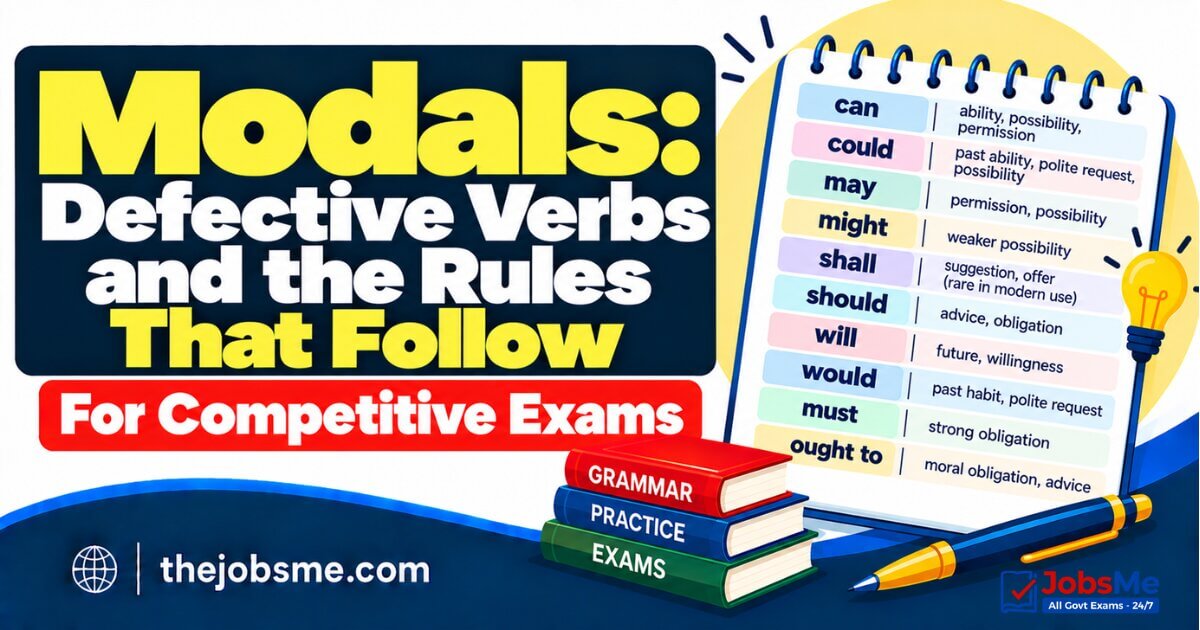
Modals: Defective Verbs and the Rules That Follow
This article is a complete, exam-ready guide to modal verbs for SSC, banking, insurance, railway, defence and State PSC exams. It starts from the single fact that explains every rule and every trap in the topic: pure modals are defective verbs. They have no third-person s, no -ing form, no past participle and no infinitive, which is why they take a bare verb after them, why they never appear two at a time, and why English needs substitutes such as be able to and have to. It then covers the meaning of each modal with its strength on the obligation and possibility scales, the borderline group of ought to, used to, need, dare and had better, the perfect modals, and the six traps examiners reuse. Ten solved questions, common traps and a fifteen-question practice set with a full answer key are included.
Introduction
A modal is a helping verb that adds the speaker's attitude to the main verb: ability, permission, possibility, obligation or advice. The nine pure modals are can, could, may, might, will, would, shall, should and must.
Most guides list them with a meaning each and move on. That leaves the topic looking like nine words to memorise, when in fact every structural rule and every exam trap in it follows from one fact.
Pure modals are defective verbs. They have no third-person s, no -ing form, no past participle and no infinitive. Almost everything else in this topic is a consequence of that.
- No s form, so she cans swim is impossible.
- No infinitive of their own, so they take a bare verb: you must go, never must to go.
- No infinitive means they cannot follow another modal, so he will can clear it is impossible.
- They act as their own auxiliaries, so questions and negatives need no do: can he come?, not does he can come?
- Because they lack forms, English supplies substitutes such as be able to and have to to fill the gaps.
So the useful question in an exam is not what a modal means but whether the word in front of you is a pure modal. If it is, four structural rules apply without exception.
Where This Topic Is Asked
| Exam | How This Topic Appears | Rough Weight | Difficulty |
|---|---|---|---|
| SSC CGL and CHSL | Structural faults in error spotting, and the right modal in a filler. | Around 7 per cent of grammar marks, with 1 to 2 questions | Easy to moderate. |
| IBPS PO and SBI PO | Nuance questions, choosing between must, should and ought to. | 1 to 2 questions | Moderate. |
| RRB NTPC and Group D | Straightforward ability and permission items. | 1 question | Easy. |
| State PSC and police exams | The lest and should rule, and semi-modals such as need and dare. | 1 to 2 questions | Moderate. |
| Cloze test and fillers | The blank often needs a particular strength of obligation or possibility. | Indirect | Moderate. |
| Descriptive papers | Modals carry hedging, so a report needs may and could rather than will. | Indirect | Worth knowing. |
Modals sit just below prepositions and articles in weight, and above narration. The structural half is worth learning first, because those questions are decided by rule rather than by judgement. Check your own pattern in the exam-wise syllabus hub.
The Four Structural Rules
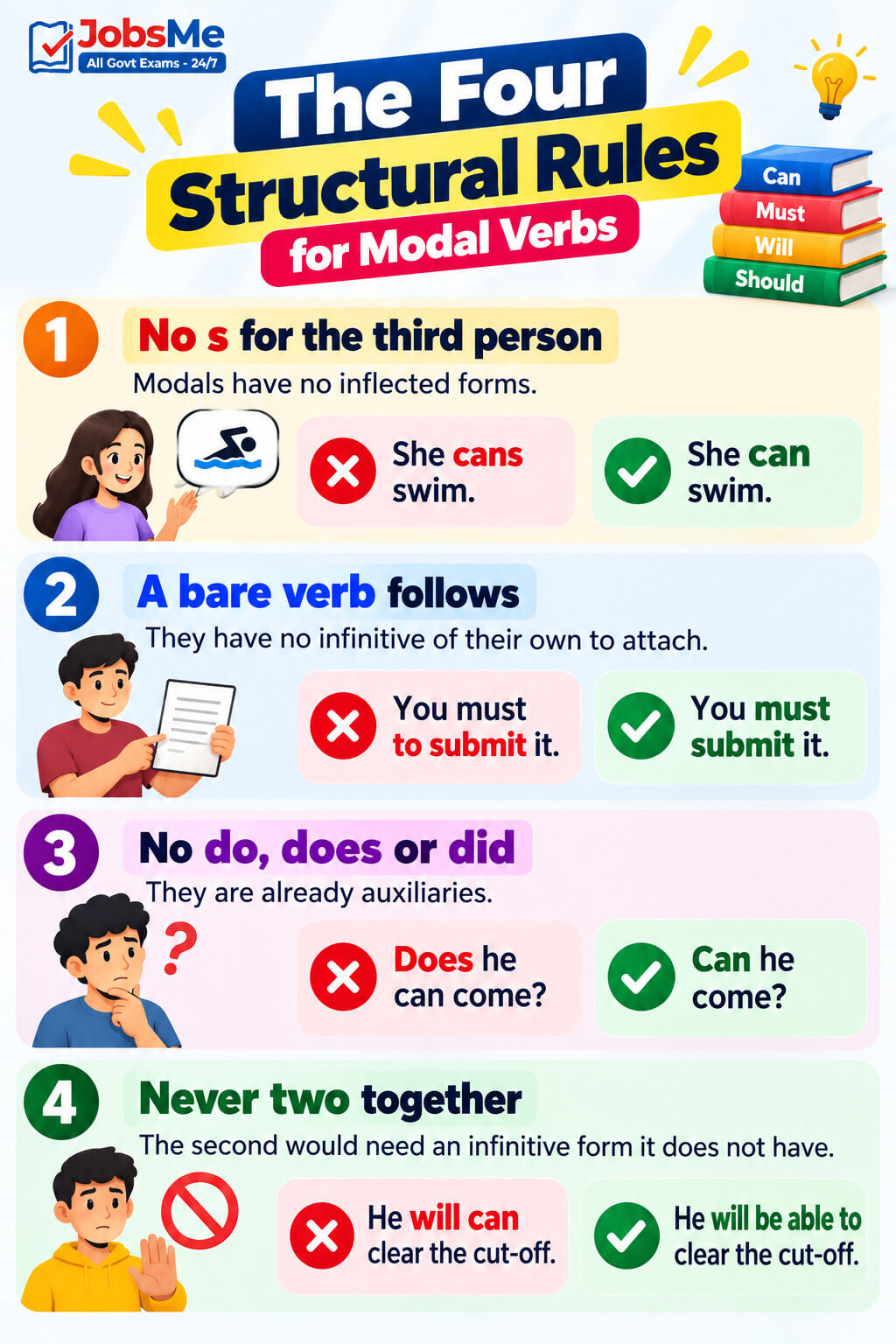
| Rule | Why | Wrong | Right |
|---|---|---|---|
| No s for the third person | Modals have no inflected forms. | She cans swim. | She can swim. |
| A bare verb follows | They have no infinitive of their own to attach. | You must to submit it. | You must submit it. |
| No do, does or did | They are already auxiliaries. | Does he can come? | Can he come? |
| Never two together | The second would need an infinitive form it does not have. | He will can clear the cut-off. | He will be able to clear the cut-off. |
That last row is the commonest structural trap in the topic, and the repair is always the same: replace the second modal with its substitute.
The Substitutes
Because modals lack most verb forms, English keeps a parallel set of phrases that can be conjugated freely. These are not modals, so they take s, they take do and they can follow another modal.
| Modal | Substitute | Use It When | Example |
|---|---|---|---|
| can | be able to | Another modal or a tense form is needed. | He will be able to attend. He has been able to attend. |
| must | have to, has to, had to | A past or future obligation is meant. | She had to leave early. They will have to reapply. |
| may, for permission | be allowed to | Any tense other than the present is needed. | We were allowed to enter. |
| should | be supposed to | An expectation rather than advice is meant. | He is supposed to report at nine. |
| could, for one achievement | managed to, was able to | A single completed past success is meant. | He managed to finish the paper in time. |
The last row is a genuine distinction. Could describes a general past ability, so I could run fast when I was younger is right. For one specific past success, English prefers was able to or managed to, so he was able to catch the last train rather than he could catch it.
The Meaning Map
The Obligation Scale
This is the most tested nuance in the topic, and it runs from strongest to weakest.
| Modal | Strength | What It Signals | Example |
|---|---|---|---|
| must | Strongest | A rule, a law or an absolute necessity, with no choice. | Candidates must bring their admit card. |
| have to | Strong | An obligation imposed from outside. | I have to submit the form by Friday. |
| had better | Strong advice with a warning | Something bad follows if you do not. | You had better study, or you will fail. |
| ought to | Moral | A duty that is right rather than compulsory. | We ought to respect the Constitution. |
| should | Weakest | Advice or a recommendation, and optional. | You should revise daily. |
One correction belongs here, because a widely used table defines should as showing obligation. It does not. Should is advice, and the obligation modal is must. The same document elsewhere describes should correctly as a soft recommendation, so the page contradicts itself on the very distinction exams test.
The Possibility Scale
| Modal | Strength | Example |
|---|---|---|
| will | Near certainty | They will reach by eight. |
| must, for deduction | Confident inference | The lights are off, so he must be asleep. |
| can | General or theoretical possibility | It can get very cold here in January. |
| may | Real possibility | The cut-off may rise this year. |
| might | Remote possibility | He has not prepared, but he might pass by luck. |
| could | Remote possibility, or a polite suggestion | This figure could indicate seasonal demand. |
A caution about this scale. Several guides attach percentages to it, saying that may means fifty to sixty per cent and might twenty to thirty. No grammar authority assigns numbers to these words. The ordering is real and useful, but the figures are invented, so treat the scale as a ranking rather than a measurement.
The Other Meanings
| Modal | Main Uses | Example |
|---|---|---|
| can | Ability, informal permission, general possibility. | She can solve it. You can go now. |
| could | Past ability, polite request, conditional. | Could you pass me the file? |
| may | Formal permission, possibility, a wish. | May I come in? May you prosper. |
| might | Remote possibility, very tentative suggestion. | You might want to check the notification. |
| will | Future, willingness, promise, habit, request. | I will help you. He will always argue. |
| would | Past habit, hypothetical, extreme politeness. | We would play there every evening. |
| shall | Offers and suggestions with I and we; formal rules. | Shall I open the window? The tenant shall pay the rent. |
| should | Advice, expectation, and after lest. | You should apply early. Hurry lest you should miss it. |
| must | Obligation, prohibition in the negative, deduction. | You must not smoke here. |
Formula Box
- Modals are defective, so no s, no -ing, no infinitive.
- A bare verb follows, except after ought to and used to.
- Never two modals together; use a substitute for the second.
- No do, does or did in a modal question or negative.
- Lest always takes should, and never a further negative.
- Must not means prohibited; need not means unnecessary.
- Modal + have + third form means a past action that did not happen.
The Borderline Group
Six items behave like modals in some ways and like ordinary verbs in others. Every one of them appears in error spotting.
Ought To
The only pure modal that keeps to. So you ought to work hard, and the negative is ought not to, as in we ought not to cheat anyone.
Used To
- Meaning a past habit, it takes to and needs did for questions and negatives. I used to swim every morning. Did you use to swim? He did not use to smoke.
- Meaning accustomed, it is an adjective phrase after be or get, and takes a gerund. She is used to living alone.
- The two are constantly confused. I used to live there reports a past habit; I am used to living there reports being accustomed. Only the second takes an -ing form.
Need and Dare: Two Forms Each
These are the true semi-modals, and each has a modal use and a main-verb use with different grammar.
| Word | As a modal | As a main verb |
|---|---|---|
| need | No s, bare verb, only in negatives and questions. You need not work hard. Need he come? | Takes s and to. He needs to work hard. Does he need to come? |
| dare | No s, bare verb, mainly negative and interrogative. He dare not speak. How dare you interrupt? | Takes s and to. He dares to speak. I dare you to try it. |
The trap is mixing the two patterns. You need not to work hard and he dares not speak both borrow half of each. Pick one pattern and keep it.
Had Better, Had Rather and Would Rather
- All three take a bare infinitive despite containing had or would. You had better go now, never had better to go.
- Would rather shows preference and pairs with than, which also takes a bare infinitive. I would rather study than watch a movie.
- The negative is had better not, so you had better not argue.
Other Places a Bare Infinitive Is Required
The same bare form appears in four more structures, and each is a standing exam item.
- After than in a comparison of actions. He had better read than write, not than to write.
- After but when a form of do precedes it. He did nothing but wander, not but to wander.
- After rather than. She chose to resign rather than apologise.
- After cannot but. I cannot but admire his courage.
Key Highlights
- One fact explains the topic: modals are defective verbs.
- Four structural rules follow, and those are the certain marks.
- Must is a rule; should is advice. This is the most tested nuance.
- Substitutes exist precisely because modals lack most verb forms.
- Study the structural half first, since it is decided by rule rather than judgement.
The Perfect Modals
Structure: modal + have + third form. This refers to the past, and each combination carries a distinct meaning.
| Form | Meaning | Example |
|---|---|---|
| should have | An obligation that was not fulfilled, often with regret. | You should have studied harder, but you did not. |
| ought to have | The same, with a moral edge. | He ought to have informed the office. |
| must have | A confident deduction about the past. | The gate is open, so he must have arrived. |
| may have | A real possibility about the past. | She may have missed the bus. |
| might have | A remote possibility, or a narrow escape. | You might have been hurt in that fall. |
| could have | An unused past ability or opportunity. | He could have topped the list but did not apply. |
| would have | The result of an unfulfilled condition. | If he had studied, he would have passed. |
| needn't have | It was done, but it was unnecessary. | You needn't have waited; the office was shut. |
The last row hides a real distinction. You needn't have waited means you did wait and it was pointless. You didn't need to wait means the necessity never arose, and usually implies you did not wait. Papers test the pair directly.
Modals in Conditional Sentences
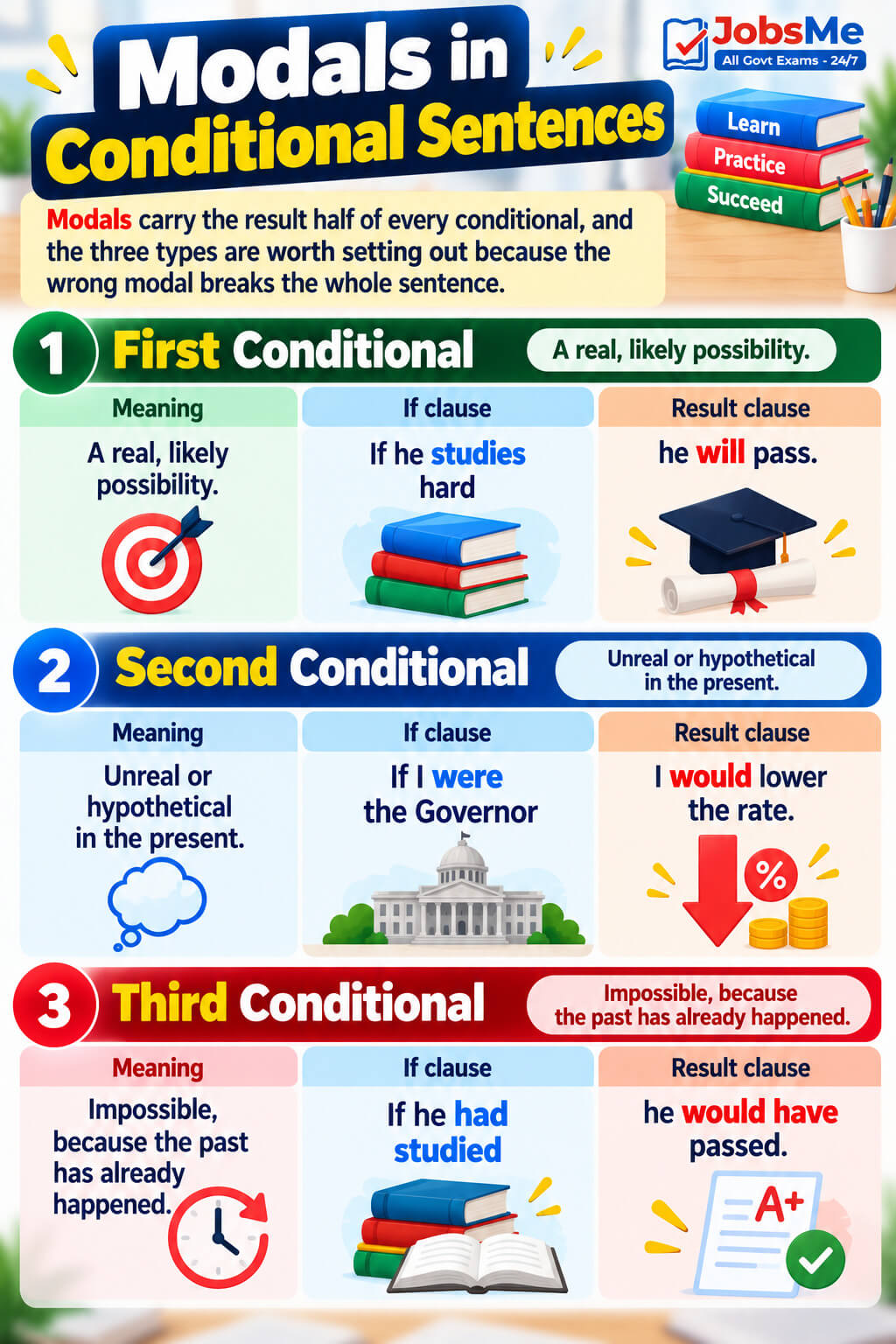
Modals carry the result half of every conditional, and the three types are worth setting out because the wrong modal breaks the whole sentence.
| Type | Meaning | If clause | Result clause |
|---|---|---|---|
| First | A real, likely possibility. | If he studies hard | he will pass. |
| Second | Unreal or hypothetical in the present. | If I were the Governor | I would lower the rate. |
| Third | Impossible, because the past has already happened. | If he had studied | he would have passed. |
Two rules govern all three. A modal never appears in the if clause of a standard conditional, so if he will study is wrong. And the result clause of a third conditional needs would have plus the third form, never would alone.
Note also that could and might can replace would in the result clause to soften it. If he had applied, he might have been selected is weaker than would have been selected, and both are correct.
Six Traps Examiners Reuse
- The double modal. He will can clear it is impossible; use will be able to.
- Lest without should. Lest means for fear that, so it always takes should, and it is already negative, which means lest you should not miss the train is wrong. The correct form is run fast lest you should miss the train.
- Redundant possibility. May and might already mean possibility, so it may possibly rain repeats itself. Write it may rain.
- To after a pure modal. You must to submit it and he can to speak English are both wrong, and so is you had better to go.
- Must not against need not. Must not means prohibited and need not means unnecessary. So you need not pay, it is free, and you must not smoke here.
- Could for a single past success. He could catch the train should read he was able to catch the train when one specific occasion is meant.
Trap two is the one to memorise word for word, because the same sentence pattern appears year after year. Its conjunction side is covered in conjunctions and connectors.
Shall and Will: The Traditional Rule
Traditional grammar, which Indian exams still follow, divides the two by person and by intention.
| Purpose | First person | Second and third person |
|---|---|---|
| Plain future | shall. I shall go to Delhi tomorrow. | will. He will arrive by noon. |
| Determination, promise or threat | will. We will clear this exam. | shall. You shall be punished. |
| Offers and suggestions | shall. Shall I open the window? | Not used this way. |
One honesty note. Modern English has largely abandoned this distinction, and will now serves every person for plain future. Answer by the traditional rule in a direct question, but do not select a shall or will segment as the error in an error spotting item unless every other part is clean.
A Warning About Study Material on This Topic
- A table that contradicts its own document. One guide defines should as showing necessity or obligation, while a later table in the same document correctly calls it a soft recommendation that is optional. The obligation modal is must, and this is exactly the distinction exams test.
- Invented percentages. Several sources state that may carries fifty to sixty per cent possibility and might twenty to thirty. No grammar authority assigns figures to these words. The ranking is genuine; the numbers are not.
- Have to listed as a modal. One list includes have to, has to and had to among the modals. They are substitutes, and they behave like main verbs, since they take s and need did for questions. Calling them modals contradicts the no-s rule on the same page.
- An incomplete exception list. Another states that modals are never followed by to except ought to. Used to also takes it, and so do all the substitutes.
- A mislabelled example. Your sister will have to apply for a leave request is offered as a modal showing necessity. The sentence is correct, but will have to is a substitute rather than a modal.
So check the structural claims against the four rules above. A source that lists have to as a modal has not applied its own definition.
Exam Alert
- Scan for two modals in a row, which is an automatic error.
- Scan for to after a modal or after had better.
- Any sentence containing lest needs both the should check and the negative check.
- Watch possibly or perhaps sitting beside may or might.
- On the shall and will distinction, answer by the traditional rule but do not pick it as the error unless the rest is clean.
Ten Solved Questions
1. Find the error. He will can clear (a) / the cut-off this year (b) / if he keeps up this pace. (c) / No error (d)
Working: Two modals cannot stand together, because the second would need an infinitive form it does not have. Answer: (a), which should read he will be able to clear.
2. Find the error. Run fast lest you (a) / will miss the train (b) / waiting at platform three. (c) / No error (d)
Working: Lest always takes should. Answer: (b), which should read lest you should miss the train.
3. Find the error. It may possibly rain (a) / this evening, so carry (b) / an umbrella with you. (c) / No error (d)
Working: May already expresses possibility, so possibly repeats it. Answer: (a), which should read it may rain.
4. Choose the correct sentence. (a) You need not to worry about the result. (b) You need not worry about the result. (c) You needs not worry about the result. (d) You do not need worry about the result.
Working: As a modal, need takes no s, no to and no do. Answer: (b). The main-verb version would be you do not need to worry.
5. Find the error. You had better to (a) / consult a specialist (b) / before starting the course. (c) / No error (d)
Working: Had better takes a bare infinitive despite containing had. Answer: (a), which should read you had better consult.
6. Fill the blank. You ___ pay for the meal; the company has already settled the bill. Options: must not, need not, should not, cannot.
Working: Nothing is being prohibited; payment is simply unnecessary. Answer: need not. Must not would mean payment is forbidden.
7. Fill the blank. Candidates ___ bring their admit card to the examination hall. Options: should, might, must, could.
Working: This is a rule with no choice attached, which is the strongest point on the obligation scale. Answer: must. Should would make it optional advice.
8. Find the error. He did nothing but (a) / to wander through the (b) / lanes of the old city. (c) / No error (d)
Working: When a form of do precedes but, a bare infinitive follows. Answer: (b), which should read but wander.
9. Choose the sentence meaning that the waiting turned out to be pointless. (a) You didn't need to wait. (b) You needn't have waited. (c) You need not wait. (d) You don't have to wait.
Working: A perfect modal reports something that did happen and was unnecessary. Answer: (b). Option (a) means the necessity never arose.
10. Find the error. She is used to (a) / live alone since (b) / her transfer last year. (c) / No error (d)
Working: Be used to meaning accustomed takes a gerund, unlike used to for a past habit. Answer: (b), which should read used to living alone.
Quick Facts
- The nine pure modals: can, could, may, might, will, would, shall, should, must.
- Substitutes: be able to, have to, be allowed to, be supposed to, managed to.
- Obligation, strongest first: must, have to, had better, ought to, should.
- Possibility, strongest first: will, must, can, may, might, could.
- Bare infinitive after: all modals, had better, would rather, than, rather than, cannot but.
- Keeps to: ought to, used to, and every substitute.
Worked Examples: Wrong to Right
Example 1 (stacking two modals)
Sentence: A student writes He will can clear the cut-off this year.
Trap: Both words are needed for the meaning, since one supplies the future and the other the ability, so putting them together looks logical. The second modal would need an infinitive form, and modals have none.
Correct Answer: He will be able to clear the cut-off this year.
Rule in Simple Words: Replace the second modal with its substitute.
Example 2 (adding to after a modal)
Sentence: A student writes You must to submit the assignment and you had better to go now.
Trap: Most verbs that govern another verb do take to, as in want to go and decide to leave, so the pattern transfers. Modals take a bare verb, and the only pure modal keeping to is ought to.
Correct Answer: You must submit the assignment. You had better go now.
Rule in Simple Words: Bare verb after a modal, and after had better too.
Example 3 (lest with a negative)
Sentence: A student writes Run fast lest you should not miss the train.
Trap: The intended meaning is to avoid missing the train, so a negative feels required to express it. Lest already means for fear that, so it carries the negative itself and adding another reverses the sense.
Correct Answer: Run fast lest you should miss the train.
Rule in Simple Words: Lest takes should, and never a second negative.
Example 4 (must not for need not)
Sentence: A student writes You must not pay for the food; it is free.
Trap: Both phrases are negative and both concern payment, so they feel interchangeable. Must not forbids the action, while the sentence means the action is merely unnecessary.
Correct Answer: You need not pay for the food; it is free.
Rule in Simple Words: Must not is prohibited; need not is unnecessary.
Example 5 (should for must)
Sentence: A student writes Candidates should bring their admit card to the hall.
Trap: A study table defined should as showing obligation, so the choice follows the material faithfully. Should gives advice that may be declined, while an examination rule allows no choice.
Correct Answer: Candidates must bring their admit card to the hall.
Rule in Simple Words: Must is a rule; should is a recommendation.
Example 6 (mixing the two forms of need)
Sentence: A student writes You need not to worry about the result.
Trap: Both the modal pattern and the main-verb pattern are correct English, so half of each still sounds familiar. The modal takes no to and the main verb needs do, so the halves cannot be combined.
Correct Answer: You need not worry, or you do not need to worry.
Rule in Simple Words: Pick one pattern for need and dare, then keep it.
Example 7 (used to against be used to)
Sentence: A student writes She is used to live alone.
Trap: Used to live is a perfectly good phrase in its own right, so nothing looks broken. Adding is changes the construction entirely, and be used to meaning accustomed requires a gerund.
Correct Answer: She is used to living alone, or she used to live alone for a past habit.
Rule in Simple Words: With be, use the -ing form.
Example 8 (could for one past success)
Sentence: A student writes He could catch the last train after running to the station.
Trap: Could is drilled as the past of can, so it seems the natural choice for any past ability. It describes a general capacity over time, not one completed achievement on a single occasion.
Correct Answer: He was able to catch the last train, or he managed to catch it.
Rule in Simple Words: Could for general ability, was able to for one success.
Common Traps Students Fall Into
These are the habits that most often cost marks. Each one is a common trap, not a silly mistake, and each has a one-line fix.
- Trap: Putting two modals together. Fix: Use a substitute for the second.
- Trap: Adding to after a modal. Fix: Only ought to and used to keep it.
- Trap: Adding s to a modal. Fix: Modals never inflect.
- Trap: Using do in a modal question. Fix: Invert the modal instead.
- Trap: Forgetting should after lest. Fix: It is compulsory, and no second negative follows.
- Trap: Writing may possibly. Fix: The modal already means possibility.
- Trap: Confusing must not with need not. Fix: Prohibited against unnecessary.
- Trap: Using should where a rule is meant. Fix: A rule takes must.
- Trap: Mixing the two patterns of need or dare. Fix: Choose the modal form or the main-verb form.
- Trap: Writing is used to live. Fix: After be used to, use the gerund, as in prepositions.
- Trap: Trusting a table that calls have to a modal. Fix: Test it against the four structural rules.
Memory Tricks and Formulas
1. Defective, so four rules follow
Modals have no s, no -ing, no participle and no infinitive. From that single fact come the bare verb, the ban on two modals, the absence of do, and the need for substitutes.
2. Is it a pure modal?
Nine words are: can, could, may, might, will, would, shall, should and must. Everything else, including have to, be able to and be allowed to, behaves like an ordinary verb.
3. Rank the obligation
Must is a rule, have to is an outside obligation, had better carries a warning, ought to is a moral duty, and should is advice. Read the sentence for how much choice the person has.
4. Rank the possibility
Will is near certainty, may is a real chance, might and could are remote. Treat this as a ranking, since the percentages printed in some guides are invented.
5. Lest takes should, once
Write it on a card. Lest plus should, with no further negative, because lest already means for fear that. This one sentence pattern repeats every year.
6. Prohibited or unnecessary?
Must not forbids and need not excuses. So you must not smoke here, but you need not pay, it is free. Ask which of the two the sentence means before choosing.
7. Modal + have + third form means it did not happen
Should have studied means you did not. Could have topped means you did not. Must have arrived is the exception, since it is a deduction that something did happen.
8. Budget the time honestly
At around 7 per cent of grammar marks with 1 to 2 questions, this deserves one session on the four structural rules and a second on the nuances. The structural half is where the certain marks are.
Exam Patterns and High-Yield Facts
Frequently Confused Pairs
| Pair | How They Differ | Mini Trick |
|---|---|---|
| Must vs Should | A rule against advice. | Ask how much choice there is. |
| Must not vs Need not | Prohibited against unnecessary. | Forbidden or excused? |
| May vs Might | Real against remote possibility. | A ranking, not a percentage. |
| Can vs May | Informal against formal permission. | May I come in is the polite form. |
| Could vs Was able to | General ability against one success. | Was the achievement a single event? |
| Used to vs Be used to | Past habit against accustomed. | Only the second takes -ing. |
| Need as modal vs main verb | Need not go against needs to go. | Never mix the halves. |
| Should have vs Must have | Unfulfilled duty against confident deduction. | Did not happen, or certainly did. |
| Needn't have vs Didn't need to | It happened and was pointless, against the necessity never arose. | Check whether the action occurred. |
| Ought to vs Must | Moral duty against compulsion. | Right, or required? |
Repeating Question Patterns
- Two modals stacked, usually with will can or must can.
- Lest followed by will, would or a second negative.
- May or might paired with possibly or perhaps.
- An unwanted to after a modal or after had better.
- Must not offered where need not is meant.
- The two patterns of need or dare mixed in one clause.
Practice Set: Fifteen Questions
Correct each sentence, or mark it correct as it stands.
- She cans solve the most difficult problems in the set.
- He will be able to join the office from Monday.
- Hurry up lest you will miss the last bus.
- You had better consult a doctor before continuing.
- It might possibly snow in the higher reaches tonight.
- Candidates must carry a valid photo identity card.
- You need not to submit the form again.
- We ought to respect the rights of others.
- He is used to work late into the night.
- You must not pay the fee; the scholarship covers it.
- Does he can attend the meeting tomorrow morning?
- He was able to catch the last train after a long run.
- I would rather walk than to take an auto.
- You should have informed us before making the booking.
- How dare you interrupt the proceedings like that?
Quick Facts
Answer key, with the rule named in each case.
- 1. She can solve. Modals take no s.
- 2. Correct as it stands. Be able to is the substitute after will.
- 3. lest you should miss. Lest always takes should.
- 4. Correct as it stands. Had better takes a bare infinitive.
- 5. It might snow. Might already carries the possibility.
- 6. Correct as it stands. A rule takes must.
- 7. You need not submit, or you do not need to submit. Do not mix the patterns.
- 8. Correct as it stands. Ought to keeps its to.
- 9. is used to working. Be used to takes a gerund.
- 10. You need not pay. Nothing is prohibited; payment is unnecessary.
- 11. Can he attend. Modals need no do in a question.
- 12. Correct as it stands. One specific past success takes was able to.
- 13. than take an auto. Than after would rather takes a bare infinitive.
- 14. Correct as it stands. Should have reports an unfulfilled obligation.
- 15. Correct as it stands. Dare as a modal takes a bare verb in a question.
Six of those fifteen were already correct, and three of them contain forms students learn to distrust. Be able to after will, had better consult without a to, and how dare you interrupt all look like the errors just studied. Practise with the free English MCQ quizzes and full papers from the mock test archive.
Quick Revision
Quick Revision
- What a modal is. A helping verb that adds the speaker's attitude, covering ability, permission, possibility, obligation and advice.
- The nine pure modals. Can, could, may, might, will, would, shall, should and must.
- The one fact that explains everything. Pure modals are defective verbs, with no s form, no -ing, no participle and no infinitive.
- So they take no s, and she cans swim is impossible.
- So a bare verb follows, with ought to as the only pure modal keeping its to.
- So no do, does or did appears in a modal question or negative; invert the modal instead.
- So two modals can never stand together, and the second must be replaced by a substitute.
- The substitutes. Be able to for can, have to for must, be allowed to for may, be supposed to for should.
- The obligation scale, strongest first. Must, have to, had better, ought to, should.
- Must is a rule with no choice; should is advice that may be declined.
- The possibility scale, strongest first. Will, must for deduction, can, may, might, could.
- Treat the possibility scale as a ranking, since the percentages printed in some guides are invented.
- Could describes general past ability, while one specific past success takes was able to or managed to.
- Used to for a past habit takes to and needs did for questions and negatives.
- Be used to meaning accustomed takes a gerund, so she is used to living alone.
- Need and dare have two patterns each. As modals they take no s and no to; as main verbs they take both.
- Never mix the halves, so you need not worry or you do not need to worry, but not you need not to worry.
- Had better, had rather and would rather take a bare infinitive, despite containing had or would.
- A bare infinitive also follows than, rather than, cannot but, and but after a form of do.
- Lest always takes should and never a second negative, because lest already means for fear that.
- May and might already mean possibility, so possibly and perhaps are redundant beside them.
- Must not means prohibited while need not means unnecessary.
- Modal plus have plus the third form refers to the past, and usually means the action did not happen.
- Should have is unfulfilled duty, could have is an unused opportunity, and must have is a confident deduction.
- Needn't have done means it happened and was pointless, while didn't need to do means the necessity never arose.
Modals divide neatly into a structural half and a nuance half, and they should be studied in that order. The structural half is decided entirely by rule, and every one of its rules follows from the fact that modals are defective verbs with no infinitive to offer. Learn that and the double-modal trap, the bare verb rule and the substitutes all fall into place at once. Then work on the two scales, keeping in mind that must is a rule while should is advice, whatever some study tables claim. The topic connects to direct and indirect speech, where modals shift, and to active and passive voice, where they do not, and it draws on tenses for the perfect forms and on conjunctions and connectors for the lest rule. It shows up throughout error spotting and sentence improvement. The wider set is in the topic-wise English notes.
Frequently Asked Questions
What are modal verbs?
Why do modals never take an s or a to?
Why is he will can clear it wrong?
What is the difference between must and should?
What is the difference between must not and need not?
Why does lest always take should?
Is may possibly rain correct?
How do need and dare behave?
What is the difference between used to and be used to?
What does should have studied mean?

About the author





