
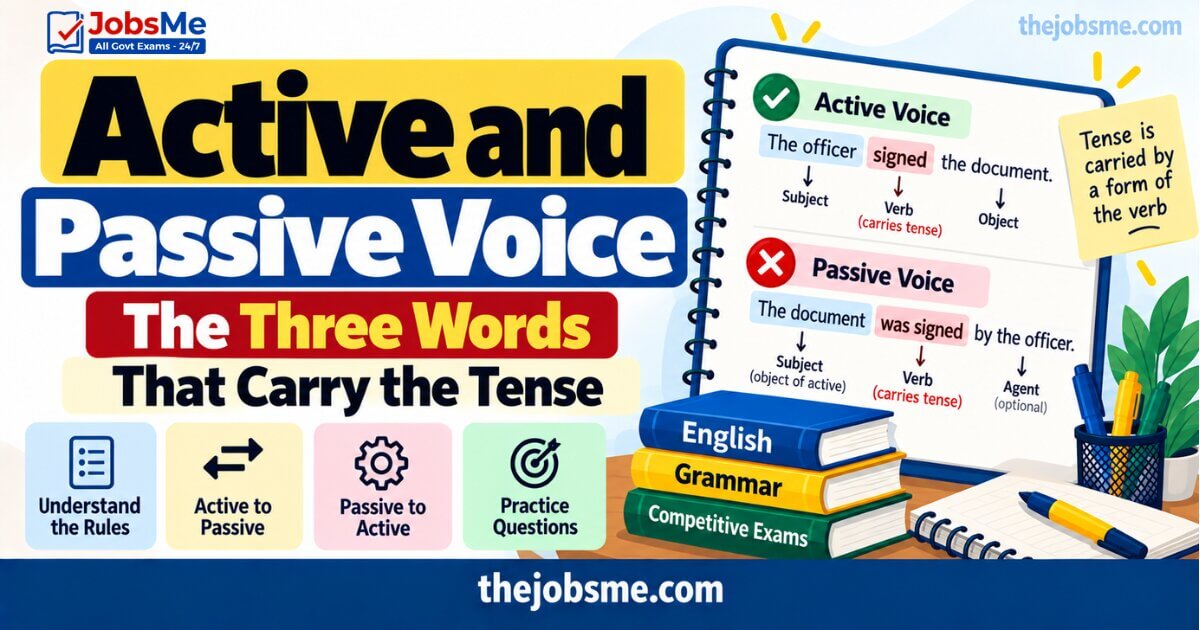
Active and Passive Voice: The Three Words That Carry the Tense
This article is a complete, exam-ready guide to active and passive voice for SSC, banking, insurance, railway, defence and State PSC exams. Most guides hand over a chart of eight tense formulas to memorise. This one shows that the chart is unnecessary, because in every passive sentence the tense lives entirely in the form of be, the word being marks a continuous tense, the word been marks a perfect tense, and the main verb is always the third form and carries no tense at all. Learn those three words and you can build any passive without a chart. It also covers the transitivity gate, conversions for imperatives, questions, modals and double objects, the by-with-to rule, and reverse conversion. Ten solved questions, common traps and a fifteen-question practice set with a full answer key are included.
Introduction
Voice tells you whether the subject of a sentence is doing the action or receiving it.
- Active: The manager approved the funds. The doer comes first.
- Passive: The funds were approved by the manager. The receiver comes first.
Every guide then supplies a chart of eight tense formulas and asks you to memorise it. That chart is why candidates get the tense wrong, because eight formulas are easy to confuse and hard to check under time pressure.
There is no need for it. In a passive sentence the tense lives entirely in the form of be. The main verb is always the third form and carries no tense at all. So the tense is copied across from the active sentence, never recalculated.
Three words do all the work.
- Be, in whichever form the tense requires. Is, am, are, was, were, will be, has been.
- Being appears only in a continuous tense.
- Been appears only in a perfect tense.
So is written is simple, is being written is continuous, and has been written is perfect. Once those three words are automatic, every passive form can be built rather than recalled.
Where This Topic Is Asked
| Exam | How This Topic Appears | Rough Weight | Difficulty |
|---|---|---|---|
| SSC CGL and CHSL | Select the option that expresses the sentence in passive voice, or the reverse. | 1 to 2 questions | Easy, since the rules never vary. |
| IBPS PO and SBI PO | Conversion options, and passive forms in a filler or cloze test. | 1 to 2 questions | Moderate. |
| RRB NTPC and Group D | Straightforward single-tense conversions. | 1 question | Easy. |
| State PSC and police exams | Imperatives, questions and modals. | 1 to 2 questions | Moderate. |
| Error spotting | An intransitive verb in a passive structure, or a mismatched auxiliary. | Indirect | Moderate. |
| Descriptive papers | Reports and formal writing need the passive; overusing it weakens prose. | Indirect | Worth knowing. |
This is among the most reliably scoring topics in the paper. Nothing here depends on vocabulary or judgement, so accuracy close to total is realistic once the three-word system is automatic. Check your own pattern in the exam-wise syllabus hub.
The Transitivity Gate
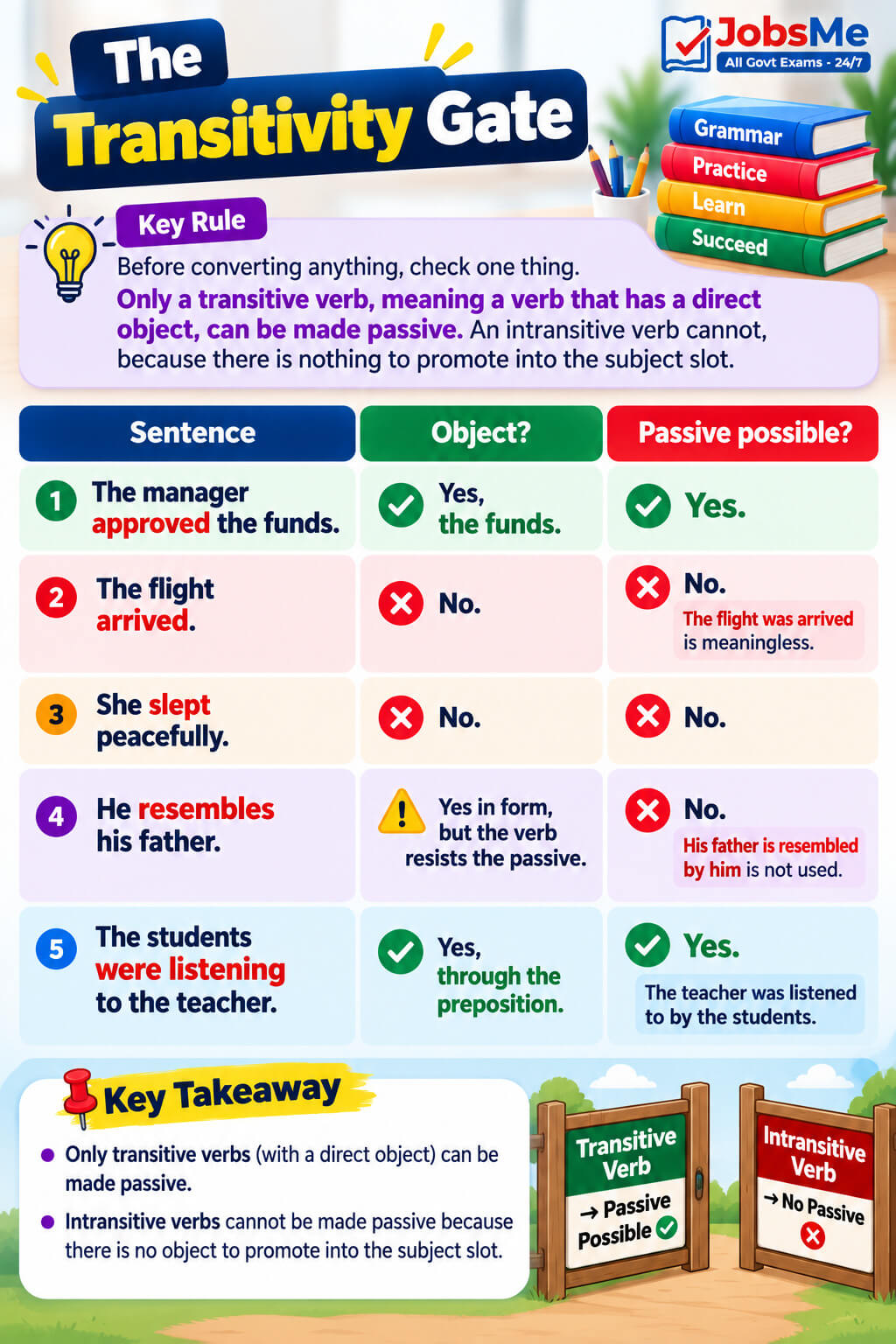
Before converting anything, check one thing. Only a transitive verb, meaning a verb that has a direct object, can be made passive. An intransitive verb cannot, because there is nothing to promote into the subject slot.
| Sentence | Object? | Passive possible? |
|---|---|---|
| The manager approved the funds. | Yes, the funds. | Yes. |
| The flight arrived. | No. | No. The flight was arrived is meaningless. |
| She slept peacefully. | No. | No. |
| He resembles his father. | Yes in form, but the verb resists the passive. | No. His father is resembled by him is not used. |
| The students were listening to the teacher. | Yes, through the preposition. | Yes. The teacher was listened to by the students. |
This gate is itself an exam question. If an error spotting sentence puts an intransitive verb into a passive structure, that is the error, and no other check is needed. A small group of verbs including resemble, lack, suit, befit and have take objects but have no passive form in normal use.
The Four-Slot Rebuild
Rather than swapping words around, build the new sentence in four slots.
| Slot | What Goes There | Applied to The girls are solving the problems |
|---|---|---|
| 1. New subject | The object of the active sentence. | The problems |
| 2. Form of be | Matching the original tense and the new subject. | are, since the tense is present and problems is plural |
| 3. Being or been, if needed | Being for a continuous tense, been for a perfect one. | being, since the tense is continuous |
| 4. Third form, then by plus the old subject | The main verb never changes, and the agent may be dropped. | solved by the girls |
The result is the problems are being solved by the girls. Notice that slot two did the only thinking, and it did it by copying the tense rather than working it out.
Formula Box
- Only transitive verbs go passive. No object means no conversion.
- Be carries the tense; the third form carries none.
- Being means continuous. Been means perfect.
- The auxiliary agrees with the new subject, not the old one.
- Modals stay put: modal + be + third form.
- Imperatives take Let + object + be + third form.
- The four perfect continuous and future continuous tenses have no exam passive.
The Eight Tenses, Derived Rather Than Memorised
| Tense | Passive Pattern | Example |
|---|---|---|
| Simple present | is, am, are + third form | He writes a letter. A letter is written by him. |
| Present continuous | is, am, are + being + third form | He is writing a letter. A letter is being written by him. |
| Present perfect | has, have + been + third form | He has written a letter. A letter has been written by him. |
| Simple past | was, were + third form | He wrote a letter. A letter was written by him. |
| Past continuous | was, were + being + third form | He was writing a letter. A letter was being written by him. |
| Past perfect | had + been + third form | He had written a letter. A letter had been written by him. |
| Simple future | will, shall + be + third form | He will write a letter. A letter will be written by him. |
| Future perfect | will, shall + have been + third form | He will have written a letter. A letter will have been written by him. |
Read the middle column downwards and the pattern is visible. The be form changes with the tense, being appears exactly where the tense is continuous, and been appears exactly where it is perfect. Nothing else moves.
Four tenses have no passive form used in exams: present perfect continuous, past perfect continuous, future continuous and future perfect continuous. If an option offers one, it is wrong.
The Pronoun Changes
When the old subject moves after by, it takes the object form.
| Active subject | Becomes | Active subject | Becomes |
|---|---|---|---|
| I | by me | we | by us |
| he | by him | she | by her |
| they | by them | you | by you |
| it | by it | who | by whom |
One correction is needed here, because a widely used guide states in its prose that I becomes by myself. That is wrong, and it changes the meaning. By me names the agent, while by myself means alone or unaided. The same guide's own table correctly gives me, so its prose contradicts its table. The case rules behind this are in pronouns.
When the Agent Is Dropped
The by phrase is optional, and leaving it out is often better English than including it.
- The doer is unknown. Cash was stolen from the register.
- The doer is obvious. The thief was arrested, since police make arrests.
- The doer is general. English is spoken all over the world, rather than by people.
- The doer is irrelevant. The samples were tested in the laboratory.
In a multiple-choice question, an option that drops the agent is not automatically wrong. Judge it by whether the agent was general or unknown in the original.
Structures That Look Passive but Are Not
A small group of forms carries a passive sense while staying active in structure. These appear in error spotting, where the temptation is to "correct" something already right.
| Structure | Example | Why It Is Not Passive |
|---|---|---|
| Quasi-passive verbs | The book reads well. The cloth feels soft. The mangoes taste sweet. | The verb is active in form, and there is no auxiliary or third form at all. |
| Infinitive with a passive sense | This house is to let. The work is yet to do. | Fixed expressions that resist conversion, so leave them alone. |
| A past participle as an adjective | She is tired. He seemed worried. The gate is closed. | The third form is describing the subject, not reporting an action. |
| Get plus the third form | He got injured in the match. | Informal but correct; it means the same as was injured. |
The test for the third row is whether an agent could sensibly follow. The gate is closed by the guard reports an action, so it is passive. She is tired admits no agent, so tired is simply an adjective. That distinction matters because a past participle after a linking verb is an adjective, a point covered in adverbs.
Imperative Sentences
Commands have no subject at all, so the passive needs a different opening. Three patterns cover every case.
| Tone | Pattern | Active | Passive |
|---|---|---|---|
| Command | Let + object + be + third form | Open the door. | Let the door be opened. |
| Negative command | Let + object + not be + third form | Don't beat the dog. | Let the dog not be beaten. |
| Advice or suggestion | Object + should be + third form | Help the poor. | The poor should be helped. |
| Request | You are requested to + rest of the sentence | Please sit down. | You are requested to sit down. |
| Order to a person | You are ordered or asked to + rest | Tell the maid to prepare tea. | You are asked to tell the maid to prepare tea. |
| Prohibition | You are asked not to + rest | Never disobey your elders. | You are asked not to disobey your elders. |
Notice that the tone decides the pattern. A bare command takes Let, while anything addressed to a person as advice, request or instruction takes the you are opening instead.
Key Highlights
- Three words run the topic: be, being, been.
- The tense is copied, never recalculated, since voice does not change the time frame.
- No object means no passive, which settles a whole class of error spotting questions.
- Modals never change during conversion, unlike in narration.
- Accuracy here should approach total, because nothing depends on vocabulary or judgement.
Questions
The question stays a question, so the auxiliary keeps its place in front of the new subject.
- Has he done the work? Becomes: Has the work been done by him?
- Did she write the letter? Becomes: Was the letter written by her?
- Who stole your bike? Becomes: By whom was your bike stolen?
- Why did they reject the plan? Becomes: Why was the plan rejected by them?
- What do you want? Becomes: What is wanted by you?
The who conversion is the one candidates miss. Who becomes by whom, and it moves to the front of the sentence, so by whom was your bike stolen rather than your bike was stolen by whom.
Modals and Infinitives
| Structure | Pattern | Example |
|---|---|---|
| Present modal | modal + be + third form | We must respect our elders. Our elders must be respected by us. |
| Past modal | modal + have been + third form | You should have helped him. He should have been helped by you. |
| Have to and has to | has, have to be + third form | I have to do it. It has to be done by me. |
| Going to | is, am, are going to be + third form | They are going to sell the house. The house is going to be sold by them. |
| Infinitive after a verb | to be + third form | He wants to finish the work. He wants the work to be finished. |
The modal itself never changes. Can, could, may, might, shall, should, will, would, must and ought to all stay exactly as they are, and only the words after them move.
Sentences With Two Objects
Verbs such as give, send, award, offer, teach, tell and promise take two objects, so two passives are possible.
Active: The school awarded Bhavana the first prize.
- Promoting the thing: The first prize was awarded to Bhavana by the school.
- Promoting the person: Bhavana was awarded the first prize by the school.
When the thing becomes the subject, a preposition appears before the person, usually to or for. Both versions are correct, so in a multiple-choice question read all four options before deciding.
Verbs Followed by a Preposition
Where the verb needs a preposition to reach its object, the preposition travels with the verb and stays in place.
- The students were listening to the teacher. Becomes: The teacher was being listened to by the students.
- They laughed at his suggestion. Becomes: His suggestion was laughed at by them.
- She looks after the children. Becomes: The children are looked after by her.
- Someone has broken into the house. Becomes: The house has been broken into.
The passive here ends with two prepositions in a row, as in looked after by her. That looks odd and is entirely correct, so do not reject an option for that reason. The pairs themselves are in phrasal verbs.
The By, With and To Rule
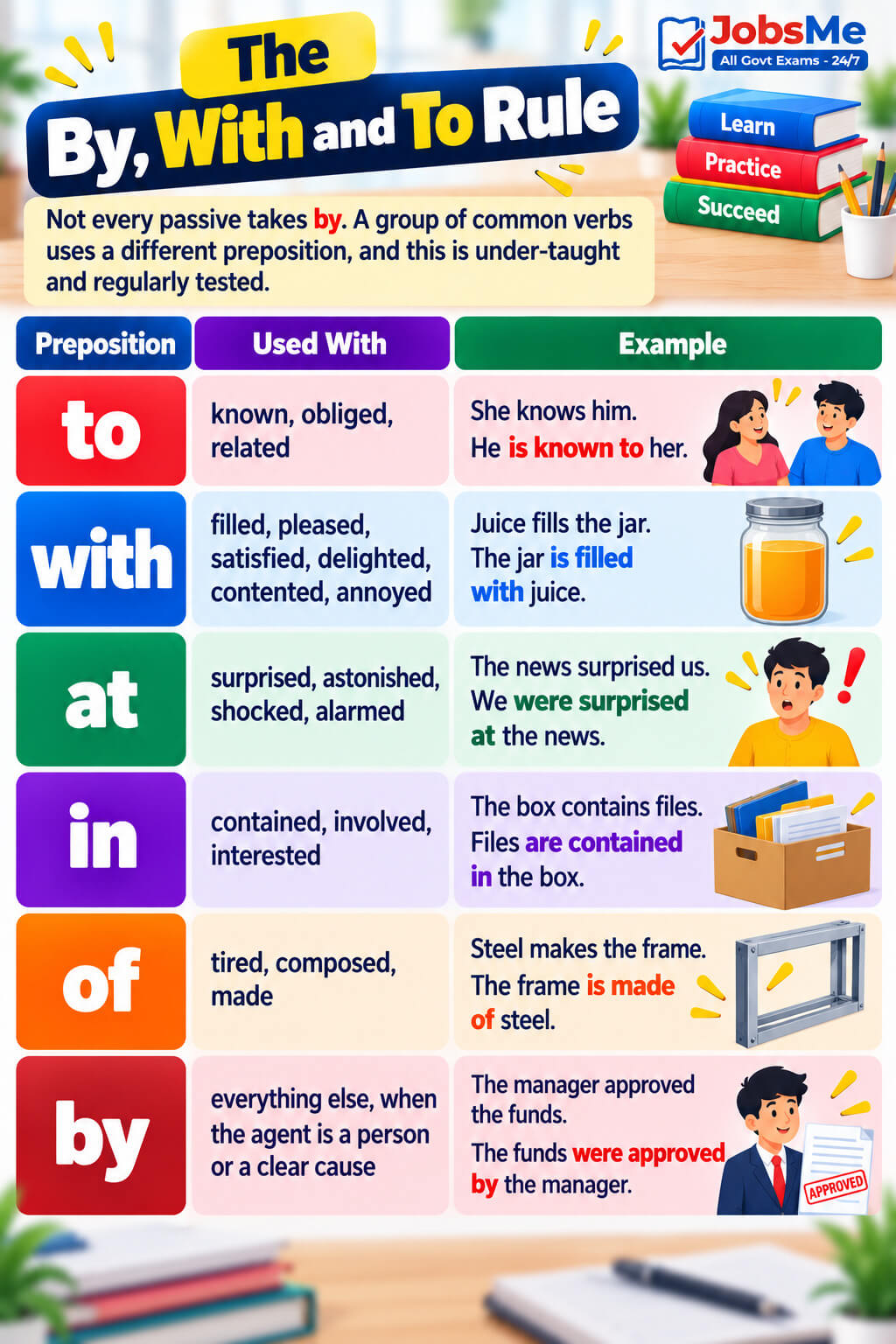
Not every passive takes by. A group of common verbs uses a different preposition, and this is under-taught and regularly tested.
| Preposition | Used With | Example |
|---|---|---|
| to | known, obliged, related | She knows him. He is known to her. |
| with | filled, pleased, satisfied, delighted, contented, annoyed | Juice fills the jar. The jar is filled with juice. |
| at | surprised, astonished, shocked, alarmed | The news surprised us. We were surprised at the news. |
| in | contained, involved, interested | The box contains files. Files are contained in the box. |
| of | tired, composed, made | Steel makes the frame. The frame is made of steel. |
| by | everything else, when the agent is a person or a clear cause | The manager approved the funds. The funds were approved by the manager. |
The general test is whether the doer is genuinely acting. A person who acts takes by. A state of being, a feeling or a substance takes one of the others. So the letter was written by her, but the jar was filled with juice. The fixed-pair logic is the same as in prepositions.
Passive Back to Active
The reverse conversion is usually easier, and the same three words guide it.
- Find the agent. It follows by, and becomes the new subject. If no agent is given, supply a general one such as someone, people or they.
- Read the tense off the be form. Is being means present continuous, had been means past perfect.
- Rebuild the verb in that tense, dropping be, being and been entirely.
- Move the old subject into the object slot, changing its pronoun case.
- The ball was kicked by the boy. Becomes: The boy kicked the ball.
- English is spoken all over the world. Becomes: People speak English all over the world.
- The problems are being solved by the girls. Becomes: The girls are solving the problems.
- Let the door be opened. Becomes: Open the door.
When the Passive Is the Right Choice
The passive is not a weaker form of the active. It is the correct form in four situations, and knowing them helps in reading comprehension and in descriptive papers.
- The doer is unknown or irrelevant. Cash was stolen from the register.
- The report should sound objective. The samples were tested in the laboratory.
- The result matters more than the cause. These emissions are produced by diesel engines.
- The doer is being deliberately shielded. Mistakes were made, which is worth recognising as a rhetorical move.
Outside those cases the active is shorter and clearer, so a descriptive answer packed with passives reads as evasive rather than formal.
A Warning About Study Material on This Topic
- A pronoun rule that changes the meaning. One guide states in its prose that I becomes by myself. It becomes by me, since by myself means unaided. The same guide's table gives the correct form, so the page contradicts itself.
- A conversion that changes the tense and the sense. The same source offers I am preparing dinner as becoming the dinner is to be prepared by me. The active is present continuous, so it should read dinner is being prepared by me. The version given means the dinner has not been started.
- A simple past turned into a continuous. Another guide lists he read the newspaper as becoming the newspaper is being read by him. The correct form is was read by him, and the example also sits in a present perfect table where it does not belong.
- A simple past turned into a past perfect. The same table gives she won the match as becoming the match had been won by her. A simple past becomes was won; the past perfect would need had won in the active.
- A simple past turned into a present. He created this masterpiece appears as this masterpiece is created by him, where it should be was created.
Three of those five are tense errors inside model conversion tables, which is exactly what the three-word system protects against. Read the tense off the active sentence and copy it, and a wrong table cannot mislead you.
Exam Alert
- Check for an object first, before reading any of the options.
- Compare the tense of each option against the original, since that is the usual difference.
- Check the auxiliary against the new subject, not the old one.
- Read all four options when the verb has two objects, since two answers may be correct.
- A missing by phrase is not an error, so do not eliminate an option for that alone.
Ten Solved Questions
1. Choose the passive form. The teacher praised the students.
Working: Simple past, and the new subject students is plural. Answer: The students were praised by the teacher.
2. Choose the passive form. The manager will review the report.
Working: Simple future, so will plus be plus the third form. Answer: The report will be reviewed by the manager.
3. Choose the passive form. People speak English all over the world.
Working: Simple present, and the agent is general enough to drop. Answer: English is spoken all over the world.
4. Choose the passive form. I have to do it.
Working: Have to becomes has to be, agreeing with the new singular subject it. Answer: It has to be done by me. Options such as it is be done and it should to be done are the distractors.
5. Choose the passive form. The students were listening to the teacher.
Working: The preposition travels with the verb. Answer: The teacher was listened to by the students. An option reading was listening to by keeps the active form of the verb and is wrong.
6. Choose the passive form. Who stole your bike?
Working: Who becomes by whom and moves to the front, and the question order is kept. Answer: By whom was your bike stolen?
7. Choose the passive form. Never disobey your elders.
Working: A prohibition addressed to a person takes the you are opening with not to. Answer: You are asked not to disobey your elders.
8. Choose the passive form. Open the door.
Working: A bare command takes Let plus the object plus be plus the third form. Answer: Let the door be opened.
9. Choose the passive form. You should have helped him.
Working: A past modal takes have been after it. Answer: He should have been helped by you.
10. Find the error. The flight was arrived (a) / at the airport (b) / an hour behind schedule. (c) / No error (d)
Working: Arrive is intransitive and has no object, so it cannot take a passive form at all. Answer: (a), which should read the flight arrived.
Quick Facts
- Simple: is, am, are, was, were + third form.
- Continuous: add being. Perfect: add been.
- Future: will be + third form. Future perfect: will have been + third form.
- Modals: modal + be, or modal + have been for a past modal.
- Imperatives: Let + object + be + third form, or you are requested to.
- Not by: known to, filled with, surprised at, contained in, made of.
Worked Examples: Wrong to Right
Example 1 (recalculating the tense instead of copying it)
Sentence: A student converts He read the newspaper into The newspaper is being read by him.
Trap: Read is spelt identically in the present and the past, so the eye supplies a present tense. The tense must be copied from the active sentence, and here the context makes it simple past.
Correct Answer: The newspaper was read by him.
Rule in Simple Words: Read the tense off the active sentence, never recalculate it.
Example 2 (passivising an intransitive verb)
Sentence: A student accepts The flight was arrived at the airport.
Trap: The structure looks like a textbook passive, with an auxiliary and a third form in the right places. Arrive has no object, so there is nothing to promote into the subject slot and no passive exists.
Correct Answer: The flight arrived at the airport.
Rule in Simple Words: No object means no passive.
Example 3 (agreeing the auxiliary with the old subject)
Sentence: A student writes The problems is being solved by the girls.
Trap: The eye is still on the girls, which was the subject a moment ago, and the singular feels attached to the singular-looking phrase. The auxiliary agrees with the new subject, and problems is plural.
Correct Answer: The problems are being solved by the girls.
Rule in Simple Words: The auxiliary follows the new subject, as in subject-verb agreement.
Example 4 (dropping being or been)
Sentence: A student writes A letter is written by him for He is writing a letter.
Trap: The conversion is structurally complete, with the right auxiliary and the right third form, so nothing looks missing. The active was continuous, and a continuous passive needs being.
Correct Answer: A letter is being written by him.
Rule in Simple Words: Being marks continuous, been marks perfect.
Example 5 (changing the modal)
Sentence: A student converts We must respect our elders into Our elders had to be respected by us.
Trap: Narration teaches that must becomes had to, and the rule transfers by habit. Voice conversion changes no modal at all, since only the words after it move.
Correct Answer: Our elders must be respected by us.
Rule in Simple Words: The modal stays; add be and the third form after it.
Example 6 (by myself for by me)
Sentence: A student writes The work was completed by myself.
Trap: A study guide printed the rule that way, and myself sounds more careful than me. By myself means unaided, so the sentence now claims something the original never said.
Correct Answer: The work was completed by me.
Rule in Simple Words: The agent takes the plain object form.
Example 7 (keeping who instead of by whom)
Sentence: A student converts Who stole your bike? into Your bike was stolen by whom?
Trap: The words are all correct and the question mark survives, so the option looks acceptable. English moves the question phrase to the front, and the auxiliary must precede the new subject.
Correct Answer: By whom was your bike stolen?
Rule in Simple Words: The question phrase leads, and the auxiliary follows it.
Example 8 (that clause for an imperative)
Sentence: A student converts Open the door into The door should be opened by you.
Trap: The passive is well formed and the meaning is close, so it feels like a fair answer. A bare command takes the Let pattern, while should be belongs to advice rather than an order.
Correct Answer: Let the door be opened.
Rule in Simple Words: Match the pattern to the tone of the original.
Common Traps Students Fall Into
These are the habits that most often cost marks. Each one is a common trap, not a silly mistake, and each has a one-line fix.
- Trap: Recalculating the tense instead of copying it. Fix: Read it off the active sentence.
- Trap: Passivising an intransitive verb. Fix: Check for an object first.
- Trap: Agreeing the auxiliary with the old subject. Fix: It follows the new one.
- Trap: Forgetting being in a continuous passive. Fix: Being marks continuous.
- Trap: Forgetting been in a perfect passive. Fix: Been marks perfect.
- Trap: Changing the modal. Fix: Modals never move in voice conversion.
- Trap: Writing by myself for by me. Fix: The agent takes the plain object form.
- Trap: Leaving who at the end. Fix: It becomes by whom and moves to the front.
- Trap: Using by where the verb needs another preposition. Fix: Known to, filled with, surprised at.
- Trap: Rejecting an option because the agent is missing. Fix: The by phrase is optional.
- Trap: Trusting a printed conversion table. Fix: Three of five errors found in one source were tense errors inside such tables, as with the material warnings in error spotting.
Memory Tricks and Formulas
1. Be, being, been
Three words carry the whole system. Be in some form holds the tense, being appears only in a continuous tense, and been only in a perfect one. The third form never changes and never carries tense.
2. Copy the tense, do not compute it
Voice conversion never changes the time frame. So identify the tense of the active sentence and reproduce it in the be form, which removes the commonest source of error in the topic.
3. Check for an object before anything else
No object means no passive. That one check answers a whole category of error spotting questions on its own, and it also rules out resemble, lack, suit and befit.
4. The auxiliary follows the new subject
Once the object moves to the front it is the subject, so the auxiliary agrees with it. The problems are being solved, not is being solved, however singular the old subject was.
5. Modals do not move
Can, could, may, might, shall, should, will, would, must and ought to all stay exactly as written. Add be for a present modal and have been for a past one.
6. Match the imperative to its tone
A bare command takes Let the door be opened. Advice takes the poor should be helped. A request takes you are requested to. Read the tone, then pick the pattern.
7. Not every passive takes by
A person who acts takes by. A feeling, a state or a substance takes something else: known to, filled with, surprised at, contained in, made of.
8. Budget the time honestly
With 1 to 2 questions in almost every paper and rules that never vary, one session on the three-word system and a second on the special types is enough. Accuracy here should approach 100 per cent.
Exam Patterns and High-Yield Facts
Frequently Confused Pairs
| Pair | How They Differ | Mini Trick |
|---|---|---|
| Is written vs Is being written | Simple against continuous. | Being marks continuous. |
| Is written vs Has been written | Simple against perfect. | Been marks perfect. |
| Was written vs Had been written | Simple past against past perfect. | Copy the active tense. |
| By me vs By myself | Agent against unaided. | Use the plain object form. |
| Must be vs Had to be | Voice keeps the modal; narration changes it. | Different topics, different rules. |
| Let it be done vs It should be done | Command against advice. | Read the tone. |
| Known to vs Known by | A state takes to. | He is known to her. |
| Made of vs Made by | Material against maker. | Made of steel, made by him. |
| By whom was it stolen vs It was stolen by whom | Only the first is standard. | The question phrase leads. |
| Transitive vs Intransitive | Has an object against none. | Only the first goes passive. |
Repeating Question Patterns
- A tense mismatch offered among the options, usually a continuous passive for a simple active.
- An intransitive verb in a passive structure, planted in error spotting.
- The auxiliary agreed with the wrong subject.
- A modal changed during conversion.
- Who left unconverted instead of becoming by whom at the front.
- An imperative given the wrong pattern, using should be for a bare command.
Practice Set: Fifteen Questions
Convert each sentence into the other voice, or mark it as impossible to convert.
- The carpenter built the house.
- The girls are solving the maths problems.
- Softtech has developed a new program.
- The accident happened near the crossing.
- We must respect our elders.
- Who broke the window?
- Please post this letter.
- Shut the window at once.
- The board had rejected the proposal.
- They laughed at his suggestion.
- The essay was written by Salim.
- English is spoken all over the world.
- You should have informed the office.
- Juice fills the jar.
- The school awarded Bhavana the first prize.
Quick Facts
Answer key, with the rule that decides each one.
- 1. The house was built by the carpenter. Simple past takes was.
- 2. The maths problems are being solved by the girls. Continuous needs being, and the auxiliary is plural.
- 3. A new program has been developed by Softtech. Perfect needs been.
- 4. Cannot be converted. Happen is intransitive.
- 5. Our elders must be respected by us. The modal does not change.
- 6. By whom was the window broken? The question phrase moves to the front.
- 7. You are requested to post this letter. A request takes the you are opening.
- 8. Let the window be shut at once. A bare command takes Let.
- 9. The proposal had been rejected by the board. Past perfect keeps had been.
- 10. His suggestion was laughed at by them. The preposition travels with the verb.
- 11. Salim wrote the essay. Reverse conversion, simple past.
- 12. People speak English all over the world. Supply a general agent.
- 13. The office should have been informed by you. A past modal takes have been.
- 14. The jar is filled with juice. A substance takes with, not by.
- 15. The first prize was awarded to Bhavana by the school, or Bhavana was awarded the first prize by the school. Two objects allow two passives.
Note items four, fourteen and fifteen. One cannot be converted at all, one takes a preposition other than by, and one has two correct answers. Those three account for most of the marks lost in this topic, and none of them is about tense. Practise with the free English MCQ quizzes and full papers from the mock test archive.
Quick Revision
Quick Revision
- What voice is. Whether the subject does the action, which is active, or receives it, which is passive.
- The passive structure. Object becomes the new subject, then a form of be, then the third form of the verb, then optionally by and the old subject.
- The three words that run the system. Be carries the tense, being marks a continuous tense, and been marks a perfect one.
- The third form never changes and carries no tense, which is why the tense is copied from the active sentence rather than recalculated.
- Only transitive verbs can go passive, so a verb with no object has no passive at all.
- An intransitive verb in a passive structure is itself the exam error, as with the flight was arrived.
- Resemble, lack, suit, befit and have take objects but have no ordinary passive.
- The auxiliary agrees with the new subject, not the one it replaced.
- Simple present becomes is, am or are plus the third form, and simple past becomes was or were plus the third form.
- Continuous tenses add being, so is being written and was being written.
- Perfect tenses add been, so has been written and had been written.
- Simple future becomes will be plus the third form, and future perfect becomes will have been plus the third form.
- Four tenses have no exam passive. Present perfect continuous, past perfect continuous, future continuous and future perfect continuous.
- The agent takes the object form, so by me and by him, never by myself.
- The by phrase may be dropped when the doer is unknown, obvious, general or irrelevant.
- Modals never change. Add be after a present modal and have been after a past one.
- Have to becomes has to be or have to be, agreeing with the new subject.
- A bare command takes Let plus the object plus be plus the third form, and the negative is Let it not be done.
- Advice takes should be plus the third form, and a request takes you are requested to.
- A question stays a question, so the auxiliary comes before the new subject.
- Who becomes by whom and moves to the front, so by whom was your bike stolen.
- A preposition travels with its verb, so his suggestion was laughed at by them.
- Two objects allow two passives, and promoting the thing adds to or for before the person.
- Not every passive takes by. Known to, filled with, surprised at, contained in, made of.
- Use the passive deliberately, when the doer is unknown, the tone must be objective, or the result matters more than the cause.
Active and passive voice should be one of the highest-accuracy topics in the paper, because nothing in it depends on vocabulary or judgement. The trouble comes from treating it as eight formulas to memorise, which invites exactly the tense errors that appear even in published conversion tables. So work from the three words instead. Copy the tense into the be form, add being for continuous and been for perfect, leave the third form alone, and check for an object before you begin. The topic rests on tenses for the time frames and on subject-verb agreement for the auxiliary, sits beside direct and indirect speech as the other great conversion topic, and feeds into transformation of sentences and sentence improvement. The wider set is in the topic-wise English notes.
Frequently Asked Questions
What is the difference between active and passive voice?
What is the quickest way to remember all the passive forms?
Does the tense change when I convert the voice?
Which sentences cannot be made passive?
Which subject does the auxiliary agree with?
What happens to modal verbs?
How are commands converted?
How do I convert a question beginning with who?
Does every passive sentence use by?
Is it wrong to leave out the by phrase?

About the author





