Nouns: Form, Number, Case and the Apostrophe Rules
This article is a complete, exam-ready guide to nouns for SSC, banking, insurance, railway, defence and State PSC exams. Noun questions are almost never about what a word means. They are about its form, and four form questions cover nearly everything asked: is the plural right, is the possessive right, does the word take a plural at all, and does the gender matter. The highest-value section is the possessive system, because a verified SSC answer key marks a phrase such as the table's legs as wrong. It also covers compound and foreign plurals, nouns that change meaning in the plural, personification, collective noun vocabulary and the Indian English noun habits examiners target. Ten solved questions, common traps and a fifteen-question practice set with a full answer key are included.

Introduction
A noun is a naming word: a person, a place, an animal, a thing, or an idea. Ram, Chennai, tiger, laptop and honesty are all nouns.
Most guides then spend pages on the twelve types of noun. That is the least examinable part of the topic, and it is worth saying why.
A noun question is almost never about what a word means. It is about the word's form. Nobody is asked whether furniture names a physical object. They are asked whether furnitures exists, whether the plural of son-in-law is son-in-laws, and whether the table's legs is acceptable English.
So four questions cover nearly everything examiners ask.
- Number. Is the plural form correct, and does this word even have one?
- Case. Is the possessive built correctly, and should it use an apostrophe at all?
- Countability. Does the word take a, many and a plural, or not?
- Gender. Which pronoun stands for it, which matters only in a small set of cases.
Where This Topic Is Asked
| Exam | How This Topic Appears | Rough Weight | Difficulty |
|---|---|---|---|
| SSC CGL and CHSL | Wrong plurals and misplaced apostrophes in error spotting. Recent papers have used son-in-laws, the table's legs and country population. | 1 to 2 questions | Easy once the forms are known. |
| IBPS PO and SBI PO | Countability faults in error detection and in a cloze test. | 1 question | Moderate. |
| RRB NTPC and Group D | Straightforward plural and collective noun items. | 1 question | Easy. |
| State PSC and police exams | Possessive case and gender rules. | 1 to 2 questions | Moderate. |
| Subject-verb agreement questions | Every deceptive noun form becomes an agreement question. | Indirect but large | Moderate. |
| Descriptive papers | Apostrophe errors are among the most visible faults in written English. | Indirect | Worth a final check. |
The indirect weight is the larger half. Every noun whose number is deceptive turns into a subject-verb agreement question, and that topic carries twelve per cent of the grammar marks on its own. So learning noun forms pays twice. Check your own pattern in the exam-wise syllabus hub.
The Types, Once and Compactly
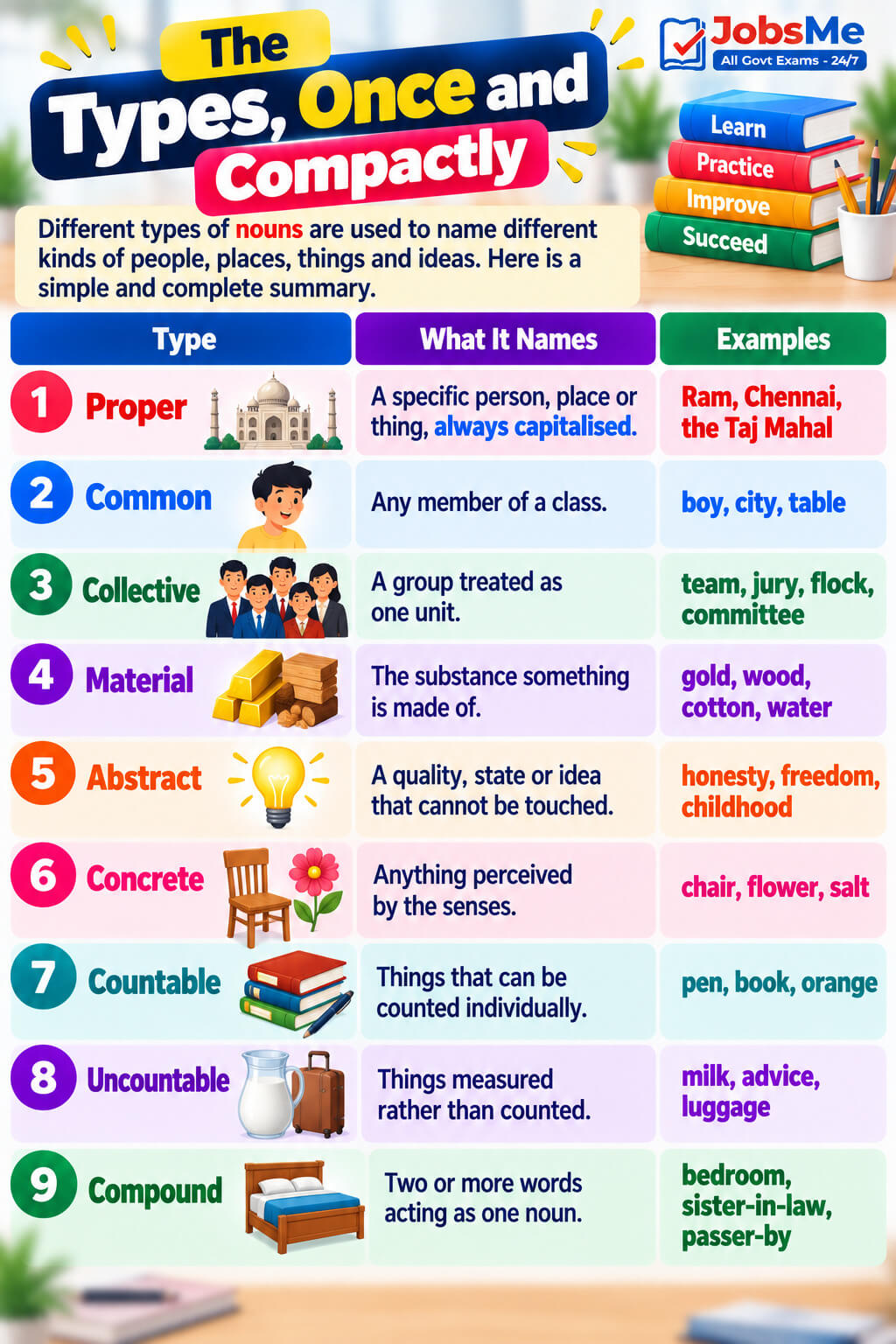
| Type | What It Names | Examples |
|---|---|---|
| Proper | A specific person, place or thing, always capitalised. | Ram, Chennai, the Taj Mahal |
| Common | Any member of a class. | boy, city, table |
| Collective | A group treated as one unit. | team, jury, flock, committee |
| Material | The substance something is made of. | gold, wood, cotton, water |
| Abstract | A quality, state or idea that cannot be touched. | honesty, freedom, childhood |
| Concrete | Anything perceived by the senses. | chair, flower, salt |
| Countable | Things that can be counted individually. | pen, book, orange |
| Uncountable | Things measured rather than counted. | milk, advice, luggage |
| Compound | Two or more words acting as one noun. | bedroom, sister-in-law, passer-by |
Read that once. The categories that generate exam questions are the last three, because countability decides the verb and compound nouns have an irregular plural.
Formula Box
- Compound nouns pluralise the main word. Sons-in-law, commanders-in-chief, passers-by.
- Non-living things take of, not an apostrophe. The legs of the table.
- Time, space, weight and heavenly bodies do take the apostrophe. A day's leave, the sun's rays.
- A numeral before a measure keeps the noun singular. A five-year plan, three dozen bananas.
- Uncountable nouns have no plural. Advice, not advices.
- Some nouns change meaning in the plural. Good and goods, air and airs, work and works.
- Joint ownership takes one apostrophe; separate ownership takes two.
Number: The Plural Traps
Compound Nouns
The plural goes on the main word, not automatically on the last one. This is a verified previous-year error, and son-in-laws has appeared in an SSC paper as the planted fault.
| Singular | Wrong | Right |
|---|---|---|
| son-in-law | son-in-laws | sons-in-law |
| sister-in-law | sister-in-laws | sisters-in-law |
| commander-in-chief | commander-in-chiefs | commanders-in-chief |
| passer-by | passer-bys | passers-by |
| looker-on | looker-ons | lookers-on |
| step-son | steps-son | step-sons, since son is the main word |
| maid-servant | maid-servants only | maid-servants or maids-servants, both accepted |
| man-servant | man-servants | men-servants |
The test is to ask which word carries the meaning. In son-in-law the person is a son, so son takes the plural. In step-son the person is also a son, but step is merely a prefix, so the plural falls at the end.
Foreign Plurals
| Singular | Plural | Singular | Plural |
|---|---|---|---|
| criterion | criteria | phenomenon | phenomena |
| erratum | errata | memorandum | memoranda |
| datum | data | medium | media |
| syllabus | syllabi | radius | radii |
| thesis | theses | crisis | crises |
| oasis | oases | analysis | analyses |
| index | indices | appendix | appendices |
| formula | formulae | hypothesis | hypotheses |
The commonest exam item here is criteria used as a singular. This criteria is important should read this criterion is important. The same applies to a phenomena and an errata.
Same Form in Singular and Plural
Deer, sheep, fish, aircraft, series, species, offspring, salmon, trout, swine, dozen, score, hundred, thousand, million.
- I saw one deer and I saw many deer, never deers.
- A series of lectures and two series of lectures.
- Note that fishes exists but means different species of fish rather than several individual fish.
A Numeral Before a Measure
When a definite number precedes a noun of length, measure, money, weight or quantity, and the phrase is working as an adjective, the noun stays singular.
- Wrong: It is a five years degree course. Right: It is a five-year degree course.
- Wrong: I have seven dozens of shoes. Right: I have seven dozen shoes.
- Wrong: He bought a ten-rupees note. Right: He bought a ten-rupee note.
- Right: A nine-metre cloth, a three-hour meeting, a two-kilogram packet.
The rule reverses when the noun is not acting as an adjective. So a five-year plan but the plan will run for five years, and dozens of shoes when no definite number precedes it.
Nouns Whose Number Deceives
Three groups matter, and each one becomes a subject-verb agreement question.
- Look plural, take a singular verb. News, mathematics, physics, economics, politics, ethics, statistics, innings, summons, measles, mumps, rickets, billiards, draughts.
- Look singular, take a plural verb. Cattle, police, people, gentry, peasantry, clergy, vermin, poultry, infantry. None of these takes an s, so cattles and childrens do not exist.
- Exist only in the plural. Trousers, scissors, spectacles, goggles, tongs, pliers, premises, alms, amends, thanks, tidings, annals, proceeds, assets, goods.
Uncountable Nouns Have No Plural
Advice, information, furniture, luggage, baggage, machinery, scenery, stationery, poetry, knowledge, work, evidence, traffic, music, equipment, bread, weather.
To count them, use a measuring phrase: a piece of advice, two items of luggage, a bit of information, a loaf of bread. So advices, informations, furnitures and sceneries are not words, and each appears regularly as a planted error. The quantifier side of this is covered in adjectives and determiners.
How Abstract Nouns Are Formed
This appears in one word substitution and fill in the blanks more often than in grammar questions, and the patterns are regular enough to be worth ten minutes.
| Formed From | Ending | Examples |
|---|---|---|
| Adjectives | -ness, -ty, -th, -cy | kind becomes kindness, cruel becomes cruelty, long becomes length, accurate becomes accuracy |
| Verbs | -ment, -ion, -ance, -al | judge becomes judgement, decide becomes decision, appear becomes appearance, arrive becomes arrival |
| Common nouns | -hood, -ship, -dom, -age | child becomes childhood, friend becomes friendship, king becomes kingdom, bond becomes bondage |
Two of these are worth memorising because exams use them: strong becomes strength, broad becomes breadth, wide becomes width and high becomes height, none of them by a regular rule. Note also that an abstract noun takes no article in a general sense, which is covered in articles.
Case: The Possessive System
This is the highest-value section of the topic, because the central rule is one that fluent speakers break constantly.
The Living and Non-Living Rule
An apostrophe shows possession for living beings. Non-living things take an of phrase instead. A verified SSC answer key marks the table's legs as the error in its sentence, with the legs of the table as the correction.
- Wrong: The table's legs have been carved. Right: The legs of the table have been carved.
- Wrong: The room's window was open. Right: The window of the room was open.
- Wrong: The book's cover is torn. Right: The cover of the book is torn.
- Right: The boy's bag, my sister's house, the officer's decision.
The Exceptions That Do Take an Apostrophe
| Category | Examples |
|---|---|
| Time | a day's leave, a week's notice, two years' experience, tomorrow's meeting |
| Space and distance | at arm's length, a stone's throw, at a hair's breadth |
| Weight and measure | a kilogram's weight, a litre's capacity |
| Heavenly bodies | the sun's rays, the moon's light, the earth's surface |
| Countries and personified things | India's history, nature's beauty, duty's call, fortune's favourite |
| Fixed phrases | for goodness' sake, at death's door, a bird's-eye view, out of harm's way |
So a country, a planet or a period of time behaves like a living thing for this purpose. Everything else that cannot act takes of.
Where the Apostrophe Goes
| Situation | Rule | Example |
|---|---|---|
| Singular noun | Apostrophe then s. | the boy's bag, the officer's report |
| Plural ending in s | Apostrophe after the s. | the boys' hostel, the students' union |
| Plural not ending in s | Apostrophe then s. | children's park, men's room, women's college |
| Compound noun | On the last word only. | my sister-in-law's house, the commander-in-chief's order |
| Name ending in s | Either form is accepted. | Jesus' teachings or Jesus's teachings |
| Joint ownership | One apostrophe, on the last name. | Karan and Arjun's mother, meaning they share one mother |
| Separate ownership | An apostrophe on each name, and a plural verb. | Shyam's bat and Ram's ball are needed |
Two Further Rules
- Avoid a double possessive. Write the wife of my friend's brother rather than my friend's brother's wife.
- After of, use the possessive pronoun. A friend of mine, never a friend of me. Similarly that book of yours, not that book of you.
- No apostrophe in a plain plural. Fresh mangoes, the 1990s, three MPs. This overlaps with punctuation rules.
Key Highlights
- Form, not meaning, is what every noun question actually tests.
- Compound nouns pluralise the main word, and this is a verified previous-year error.
- Non-living possessors take of, with six standing exceptions.
- Uncountable nouns have no plural, so use a measuring phrase.
- The indirect payoff is larger than the direct one, since every deceptive noun form becomes an agreement question.
Nouns That Change Meaning in the Plural
This group is distinctly a noun topic and appears in both error spotting and vocabulary questions.
| Singular | Plural | Singular | Plural |
|---|---|---|---|
| advice, counsel | advices, information or reports | air, atmosphere | airs, affected manners |
| good, benefit | goods, merchandise | iron, the metal | irons, chains or fetters |
| force, strength | forces, an army | content, satisfaction | contents, what is inside |
| respect, regard | respects, compliments | work, a job | works, factories or compositions |
| quarter, one fourth | quarters, lodgings | manner, method | manners, behaviour |
| letter, of the alphabet | letters, literature | custom, habit | customs, import duty |
| ground, earth | grounds, reasons | arm, a limb | arms, weapons |
| minute, sixty seconds | minutes, a written record | number, a figure | numbers, poetry or verses |
| physic, medicine | physics, the science | spectacle, a sight | spectacles, eyeglasses |
| water, the liquid | waters, a sea or territory | premise, an assumption | premises, a building |
The two most tested are advice and advices, and good and goods. Note that advices is a real word meaning formal notifications, which is why he gave me many advices is wrong for a different reason than students expect.
Gender and Personification
English has four genders: masculine, feminine, common and neuter. Most of this is straightforward, and two points are worth exam attention.
- Collective nouns and young children take the neuter pronoun when no individual is in view. The army is preparing for its exercise. The baby is crying because it is hungry.
- Personification follows a literary convention. Strong or violent things take masculine pronouns, and graceful or nurturing things take feminine ones. Sun, summer, death, war, time and winter are masculine; moon, earth, spring, nature, ships and countries are feminine.
One honesty note on the second point. Modern English mostly ignores personification, and a competent writer would use it throughout. Some state and teaching papers still test the convention, so know it, but do not choose a personification segment as the error in an SSC error spotting item unless every other part is clean.
Collective Noun Vocabulary
These appear in fill-in-the-blank items and in one word substitution questions.
| Group Word | Used For | Group Word | Used For |
|---|---|---|---|
| a flock | sheep, birds, geese | a herd | cattle, deer, elephants |
| a swarm | bees, ants, flies, locusts | a pack | hounds, wolves, cards |
| a shoal | fish | a litter | puppies, kittens |
| a fleet | ships, vehicles | a gang | robbers, labourers |
| a bunch | grapes, keys, flowers | a bundle | sticks, hay |
| a choir | singers | a band | musicians |
| a board | directors | a bench | judges |
| a galaxy | stars | a range | mountains |
| a sheaf | corn, arrows | a volley | shots, bullets |
| a caravan | merchants, travellers | a troop | scouts, horses |
Indian English Noun Habits
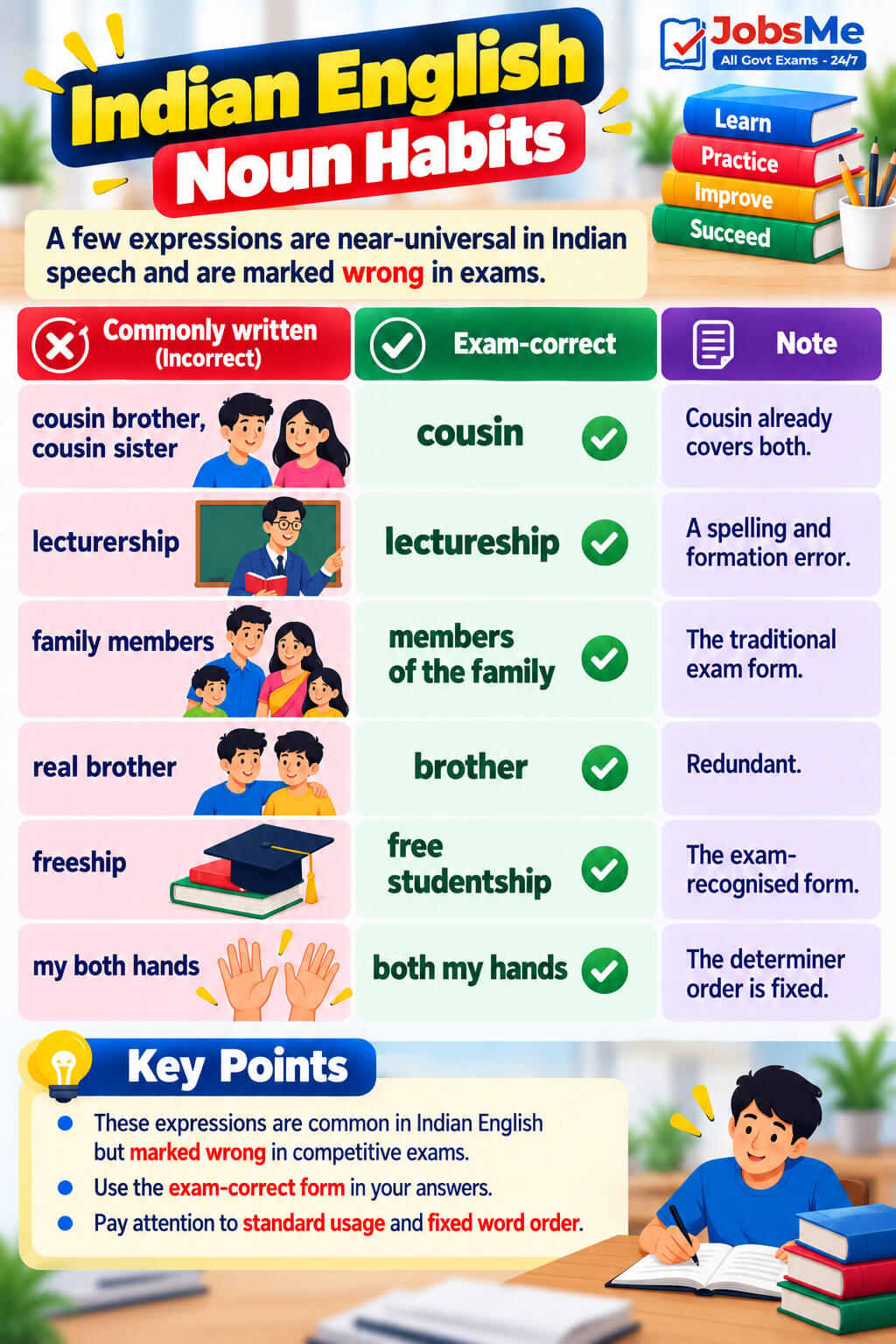
A few expressions are near-universal in Indian speech and are marked wrong in exams.
| Commonly written | Exam-correct | Note |
|---|---|---|
| cousin brother, cousin sister | cousin | Cousin already covers both. |
| lecturership | lectureship | A spelling and formation error. |
| family members | members of the family | The traditional exam form. |
| real brother | brother | Redundant. |
| freeship | free studentship | The exam-recognised form. |
| my both hands | both my hands | The determiner order is fixed. |
One caution about this list, because study material overstates it. A widely used note claims that English teacher is wrong and only the teacher of English is correct. English teacher is perfectly standard, and the only real concern is a rare ambiguity about whether the teacher is English or teaches English. Do not treat it as an error.
A Warning About Study Material on This Topic
- A correct sentence marked wrong. One guide gives the history of S.K. Pandey is good as incorrect and the history of S.K. Pandey are good as correct, arguing that past events are plural. The first version is right, and the explanation is not grammar.
- A mislabelled sentence element. The same source offers he scored another goal as an example of an indirect object. Goal is the direct object, and the sentence contains no indirect object at all.
- An agreement error inside a possessive example. Shyam's bat and Ram's ball is needed to start the game appears as a model of separate possession. Two separate items make a plural subject, so it should read are needed.
- Wrong and right inverted. Another list states that little means hardly any, then marks there is little hope of his recovery as incorrect and there is a little hope as correct. That is the reverse of its own rule.
- A garbled always-singular list. The same list includes issue, repair, business and class among nouns that never take a plural. All four have ordinary plurals: issues, repairs, businesses, classes.
So check every example against the rule it claims to illustrate, and be especially careful with lists of always-singular nouns, which are frequently copied between sites without checking.
Exam Alert
- Scan every hyphenated noun for a plural on the wrong word.
- Scan every apostrophe and ask whether the possessor is living.
- Check numerals followed by year, dozen, rupee or metre.
- Check comparisons for a thing measured against a person.
- Several correct forms look exactly like the errors, so verify before marking.
Ten Solved Questions
1. Find the error. His son-in-laws (a) / have enhanced his business (b) / within a short period. (c) / No error (d)
Working: A compound noun pluralises its main word, and the people in question are sons. Answer: (a), which should read sons-in-law.
2. Find the error. The table's legs (a) / have been elaborately (b) / carved by the artisan. (c) / No error (d)
Working: A table is not a living being, so possession takes an of phrase. Answer: (a), which should read the legs of the table.
3. Find the error. She gave me (a) / many useful advices (b) / before the interview. (c) / No error (d)
Working: Advice is uncountable in this sense and takes no plural. Answer: (b), which should read much useful advice.
4. Find the error. It is a five years (a) / degree course offered (b) / by the university. (c) / No error (d)
Working: A numeral before a measure keeps the noun singular when the phrase modifies another noun. Answer: (a), which should read a five-year degree course.
5. Find the error. My house is more (a) / spacious than my sister (b) / in the same locality. (c) / No error (d)
Working: A house is being compared with a person. The possessive supplies the missing noun. Answer: (b), which should read than my sister's.
6. Choose the correct sentence. (a) This criteria is very important. (b) This criterion is very important. (c) These criterion are important. (d) This criterions is important.
Working: Criteria is the plural; the singular is criterion. Answer: (b).
7. Find the error. The cattles were grazing (a) / peacefully in the field (b) / near the canal. (c) / No error (d)
Working: Cattle is already plural and never takes an s. Answer: (a), which should read the cattle were grazing.
8. Find the error. He has two years (a) / experience in the (b) / accounts department. (c) / No error (d)
Working: A period of time takes the apostrophe, and this is a plural ending in s. Answer: (a), which should read two years' experience.
9. Find the error. The boys hostel (a) / was renovated during (b) / the summer vacation. (c) / No error (d)
Working: The hostel belongs to the boys, so a plural possessive is needed. Answer: (a), which should read the boys' hostel.
10. Find the error. The scenery of Kashmir (a) / has enchanted visitors (b) / for generations. (c) / No error (d)
Working: Scenery is uncountable and correctly takes a singular verb, and the of phrase is right for a non-living thing. Answer: (d), no error.
Quick Facts
- Compound plurals: sons-in-law, sisters-in-law, commanders-in-chief, passers-by, lookers-on, men-servants.
- Foreign singulars: criterion, phenomenon, erratum, datum, medium, thesis, crisis, index, formula.
- No plural at all: advice, information, furniture, luggage, machinery, scenery, poetry, evidence.
- Already plural: cattle, police, people, gentry, peasantry, clergy, children.
- Apostrophe exceptions: time, space, weight, heavenly bodies, countries, personified nouns.
- Meaning shifts: good and goods, air and airs, work and works, iron and irons, custom and customs.
Worked Examples: Wrong to Right
Example 1 (pluralising the last word)
Sentence: A student writes His son-in-laws have joined the business.
Trap: English almost always puts the plural at the end of a word, so the pattern transfers automatically to a hyphenated phrase. A compound noun pluralises whichever word carries the meaning, and these people are sons.
Correct Answer: His sons-in-law have joined the business.
Rule in Simple Words: Ask which word is the real noun, then pluralise that one.
Example 2 (an apostrophe on a non-living thing)
Sentence: A student writes The table's legs have been carved.
Trap: The phrase is shorter, sounds natural, and is common in everyday writing. Indian exams apply the traditional rule that an apostrophe shows possession only for living beings, and a verified answer key marks this as the error.
Correct Answer: The legs of the table have been carved.
Rule in Simple Words: If it cannot act, it takes of.
Example 3 (applying that rule too widely)
Sentence: Having learnt the last rule, a student rewrites two years' experience as the experience of two years and marks the sun's rays as wrong.
Trap: Neither a year nor the sun is a living being, so the rule seems to apply. Time, space, weight, heavenly bodies and personified nouns are the standing exceptions and keep the apostrophe.
Correct Answer: Two years' experience and the sun's rays are both correct.
Rule in Simple Words: Learn the exception list alongside the rule.
Example 4 (a plural on an uncountable noun)
Sentence: A student writes She gave me many useful advices.
Trap: The meaning is plainly plural, since several separate suggestions were given, so a plural form feels logically required. Advice is uncountable and has no plural in that sense, so the count must be carried by a phrase.
Correct Answer: She gave me much useful advice, or several pieces of advice.
Rule in Simple Words: Count an uncountable noun with a measuring phrase.
Example 5 (comparing a thing with a person)
Sentence: A student accepts My house is more spacious than my sister.
Trap: The intended meaning is obvious and nobody would genuinely misread it, so the fault feels pedantic. Grammatically a house is being compared with a person, and the possessive supplies the missing noun.
Correct Answer: My house is more spacious than my sister's.
Rule in Simple Words: An apostrophe can stand in for a repeated noun.
Example 6 (a foreign plural used as singular)
Sentence: A student writes This criteria is very important and a strange phenomena occurred.
Trap: Both words end in a vowel and look singular to an English ear, and both are used this way constantly in speech. They are Latin and Greek plurals, and the singulars are criterion and phenomenon.
Correct Answer: This criterion is very important. A strange phenomenon occurred.
Rule in Simple Words: Learn the singular forms, not just the plurals.
Example 7 (an s on an already plural noun)
Sentence: A student writes The cattles were grazing and the childrens have arrived.
Trap: Both nouns take plural verbs, so a plural form seems consistent with the rest of the sentence. Both words are already plural, and neither has an s form at all.
Correct Answer: The cattle were grazing. The children have arrived.
Rule in Simple Words: Cattle, police, people and children never take an s.
Example 8 (misplacing a plural apostrophe)
Sentence: A student writes the boy's hostel when several boys live there.
Trap: The apostrophe is present and correctly attached, so the sentence looks properly punctuated. Its position carries the number, and placing it before the s says the hostel belongs to one boy.
Correct Answer: The boys' hostel.
Rule in Simple Words: Count the owners before placing the apostrophe.
Common Traps Students Fall Into
These are the habits that most often cost marks. Each one is a common trap, not a silly mistake, and each has a one-line fix.
- Trap: Pluralising the last word of a compound noun. Fix: The main word takes the plural.
- Trap: Using an apostrophe for a non-living thing. Fix: Use an of phrase instead.
- Trap: Applying that rule to time and heavenly bodies. Fix: Those are the standing exceptions.
- Trap: Adding a plural to an uncountable noun. Fix: Advice, information and furniture have none.
- Trap: Adding an s to cattle, police or children. Fix: Those words are already plural.
- Trap: Using criteria or phenomena as singulars. Fix: The singulars are criterion and phenomenon.
- Trap: Keeping the plural after a numeral. Fix: A five-year plan, three dozen shoes.
- Trap: Placing a plural apostrophe wrongly. Fix: Boys' hostel for many, boy's bag for one.
- Trap: Comparing a thing with a person. Fix: Add a possessive or that of, as in degrees of comparison.
- Trap: Writing a double possessive. Fix: The wife of my friend's brother.
- Trap: Trusting a copied always-singular list. Fix: Test each word against the rule.
Memory Tricks and Formulas
1. Form, not meaning
Noun questions ask whether the form is right, not what the word denotes. So the four checks are number, case, countability and, occasionally, gender. Nothing here depends on knowing definitions.
2. Which word is the real noun?
For a compound noun, ask which part carries the meaning. A son-in-law is a son, a passer-by is a passer, a commander-in-chief is a commander. That word takes the plural, and the rest of the phrase does not move.
3. Can it act?
If the possessor is alive or can be treated as acting, use the apostrophe. If it cannot, use of. So the boy's bag but the leg of the table, with time, space, weight, heavenly bodies and countries as the exceptions.
4. Count the owners
The apostrophe's position carries the number. Boy's is one boy and boys' is several. For a plural that does not end in s, such as children, the apostrophe comes before the s.
5. One apostrophe for shared, two for separate
Karan and Arjun's mother means they share one mother, and the verb is singular. Shyam's bat and Ram's ball are needed means two separate items, and the verb is plural.
6. Measuring phrases for uncountables
A piece of advice, an item of luggage, a bit of information, a loaf of bread. Whenever the meaning needs a count and the noun refuses one, the phrase carries it.
7. Learn the singular of a foreign plural
Criterion, phenomenon, erratum, datum, medium, thesis, crisis, analysis, index, formula. Most students know the plural and guess the singular, which is exactly the wrong way round for exams.
8. Budget the time honestly
Direct noun questions are worth 1 to 2 marks a paper, but the indirect return is far larger because every deceptive noun form becomes an agreement question. Give the possessive rules and the plural traps one session each.
Exam Patterns and High-Yield Facts
Frequently Confused Pairs
| Pair | How They Differ | Mini Trick |
|---|---|---|
| Sons-in-law vs Son-in-laws | The main word takes the plural. | They are sons. |
| The boy's bag vs The boys' hostel | One owner against several. | Count before you place it. |
| The table's legs vs The legs of the table | Non-living things take of. | Ask whether it can act. |
| A day's leave vs The room's window | Time is an exception; a room is not. | Learn the six exception categories. |
| Criterion vs Criteria | Singular against plural. | This criterion, these criteria. |
| Advice vs Advices | Counsel against formal notifications. | Both exist, with different meanings. |
| Good vs Goods | Benefit against merchandise. | The plural changes the meaning. |
| Work vs Works | A job against factories or compositions. | Same pattern. |
| Cattle vs Cattles | Only the first exists. | Already plural. |
| Five-year plan vs Five years' experience | Adjective use against possessive use. | Ask whether the phrase modifies a noun. |
Repeating Question Patterns
- A compound noun pluralised at the end, most often son-in-laws or passer-bys.
- An apostrophe on a non-living possessor, such as the table's legs or country population with the apostrophe missing.
- A plural added to an uncountable noun, usually advices, informations or furnitures.
- An s on cattle, police or children.
- A numeral followed by a plural measure, as in a five years course.
- A comparison between a thing and a person, repaired by a possessive.
Practice Set: Fifteen Questions
Correct each sentence, or mark it correct as it stands.
- Both my sister-in-laws attended the wedding last month.
- The window of the hall was left open overnight.
- He has three years experience in the marketing division.
- The sun's rays were unusually strong that afternoon.
- The teacher gave us several informations about the syllabus.
- This criteria was not mentioned in the notification.
- The cattles were driven towards the river at sunset.
- She completed a six-month training programme in Bengaluru.
- The girl's hostel accommodates two hundred students.
- Karan and Arjun's mother teaches at the local school.
- My car is faster than my neighbour.
- The police have registered a case against the accused.
- He bought two dozen bananas from the market yesterday.
- The chair's legs were repaired by the carpenter.
- Many passers-by stopped to watch the procession.
Quick Facts
Answer key, with the rule named in each case.
- 1. sisters-in-law. The main word takes the plural.
- 2. Correct as it stands. A non-living possessor takes an of phrase.
- 3. three years' experience. Time takes the apostrophe, placed after the s.
- 4. Correct as it stands. Heavenly bodies are an exception and keep the apostrophe.
- 5. much information or several pieces of information. The noun is uncountable.
- 6. This criterion was not mentioned. Criteria is the plural.
- 7. The cattle were driven. Cattle never takes an s.
- 8. Correct as it stands. A numeral before a measure keeps the noun singular.
- 9. The girls' hostel, since it houses two hundred students.
- 10. Correct as it stands. Joint ownership takes one apostrophe and a singular verb.
- 11. than my neighbour's. A car cannot be compared with a person.
- 12. Correct as it stands. Police looks singular but takes a plural verb.
- 13. Correct as it stands. A numeral keeps dozen singular.
- 14. The legs of the chair. A chair cannot act.
- 15. Correct as it stands. Passer is the main word, so it takes the plural.
Seven of those fifteen were already correct, and four of them contain forms students learn to distrust. The sun's rays, a six-month programme, two dozen bananas and Karan and Arjun's mother all look like the errors just studied and are all right. Practise the same restraint with the free English MCQ quizzes and full papers from the mock test archive.
Quick Revision
Quick Revision
- What exams test. Not what a noun means but what form it takes, so check number, case, countability and gender.
- Compound nouns pluralise the main word, giving sons-in-law, sisters-in-law, commanders-in-chief, passers-by and lookers-on.
- Ask which word carries the meaning, so step-sons pluralises at the end because step is only a prefix.
- Learn the singulars of foreign plurals. Criterion and criteria, phenomenon and phenomena, erratum and errata, thesis and theses, index and indices.
- Some nouns keep one form. Deer, sheep, fish, aircraft, series, species, offspring, dozen, score and hundred.
- A numeral before a measure keeps the noun singular when the phrase modifies another noun, so a five-year plan and three dozen bananas.
- Some nouns look plural but take a singular verb. News, mathematics, physics, economics, politics, innings, summons, measles and billiards.
- Some nouns look singular but take a plural verb. Cattle, police, people, gentry, peasantry, clergy and vermin, and none of them takes an s.
- Some nouns exist only in the plural. Trousers, scissors, spectacles, premises, alms, thanks, proceeds and goods.
- Uncountable nouns have no plural at all, so advices, informations, furnitures and sceneries are not words.
- Count an uncountable noun with a phrase, such as a piece of advice or two items of luggage.
- An apostrophe shows possession for living beings; non-living things take an of phrase, so the legs of the table.
- Six categories keep the apostrophe anyway. Time, space, weight, heavenly bodies, countries and personified nouns, plus fixed phrases.
- A singular noun takes apostrophe then s, a plural ending in s takes the apostrophe after it, and a plural without s takes apostrophe then s.
- A compound noun takes the apostrophe on its last word, so my sister-in-law's house.
- Joint ownership takes one apostrophe and a singular verb; separate ownership takes two apostrophes and a plural verb.
- Avoid a double possessive, so write the wife of my friend's brother.
- After of, use the possessive pronoun, so a friend of mine rather than a friend of me.
- An apostrophe can stand in for a repeated noun, so my house is more spacious than my sister's.
- Some nouns change meaning in the plural. Good and goods, air and airs, work and works, iron and irons, respect and respects, custom and customs, minute and minutes.
- Collective nouns and babies take the neuter pronoun when no individual is in view.
- Personification is a literary convention that modern English mostly ignores, so know it but do not pick it as the error unless everything else is clean.
- Watch the Indian English habits. Cousin rather than cousin brother, lectureship rather than lecturership, members of the family rather than family members.
Nouns look like the easiest topic in the syllabus and quietly supply some of its most reliable planted errors. Nothing here needs reasoning, and everything needs the right form: which word in a compound takes the plural, whether a possessor can hold an apostrophe, and whether a noun has a plural at all. So learn the compound rule, the six apostrophe exceptions and the uncountable list, and remember that a great deal of this pays out again in subject-verb agreement. The topic also connects to error spotting and sentence improvement, to articles for the material and abstract noun rules, and to pronouns for the antecedent it must agree with. The wider set is in the topic-wise English notes.
Frequently Asked Questions
What is a noun?
What do exams actually test about nouns?
What is the plural of son-in-law?
Why is the table's legs considered wrong?
Which non-living things do take an apostrophe?
How do I place an apostrophe in a plural?
Why is advices wrong?
What is the singular of criteria?
Why is a five years degree course wrong?
Which nouns change meaning in the plural?

About the author