
Direct and Indirect Speech: The Five-Step Conversion Pipeline
This article is a complete, exam-ready guide to direct and indirect speech for SSC, banking, insurance, railway, defence and State PSC exams. Narration is the most mechanical topic in the syllabus, and the reason candidates lose marks is not that the rules are hard but that they are applied in the wrong order or one stage is skipped. So this guide sets the conversion out as a five-step pipeline that runs in a fixed sequence, beginning with the reporting verb, which decides whether any tense shift happens at all. It then works through each of the six sentence types with its own template: assertive, interrogative, imperative, exclamatory, optative and let. Ten solved questions built on verified previous-year answers, common traps and a fifteen-question practice set with a full answer key are included.
Introduction
Narration is the reporting of what someone said. Quote the exact words and you have direct speech; report the sense in your own words and you have indirect speech.
- Direct: Ravi said, "I am busy now."
- Indirect: Ravi said that he was busy then.
Most guides present this as twenty numbered rules. That is why candidates lose marks on it, because the rules are not independent and they cannot be applied in any order you like.
Narration is a pipeline. Five changes run in a fixed sequence, and the first one decides whether the fourth happens at all. Nearly every lost mark comes from running the sequence out of order or skipping a stage.
Consider the trap that catches the most people. A student memorises "present tense becomes past tense" and applies it faithfully to Nusrat says, "I am never late." The reporting verb is says, in the present, so no tense shift happens at all. Checking the reporting verb first would have saved the whole calculation.
So this article gives you the sequence, then the template for each of the six sentence types.
Where This Topic Is Asked
| Exam | How This Topic Appears | Rough Weight | Difficulty |
|---|---|---|---|
| SSC CGL Tier 1 | Select the option that expresses the sentence in indirect speech, or the reverse. | Around 5 per cent of grammar marks, with 1 to 2 questions | Easy to moderate. |
| SSC CGL Tier 2 | A named topic in the syllabus, with several questions in the English module. | 2 to 3 questions | Moderate. |
| IBPS PO and SBI PO | Conversion options, and reported speech inside a cloze test. | 1 question | Moderate. |
| RRB NTPC and Group D | Straightforward assertive and interrogative conversions. | 1 question | Easy. |
| State PSC and teaching exams | All six sentence types, including optative and exclamatory. | 1 to 2 questions | Moderate. |
| Descriptive papers | Reporting a conversation in a report or letter needs the same rules. | Indirect | Worth the care. |
The attraction of this topic is that it is almost entirely rule-based. Nothing here depends on vocabulary, judgement or feel, so the accuracy you can reach is close to total once the pipeline is automatic. Check your own pattern in the exam-wise syllabus hub.
The Five-Step Pipeline
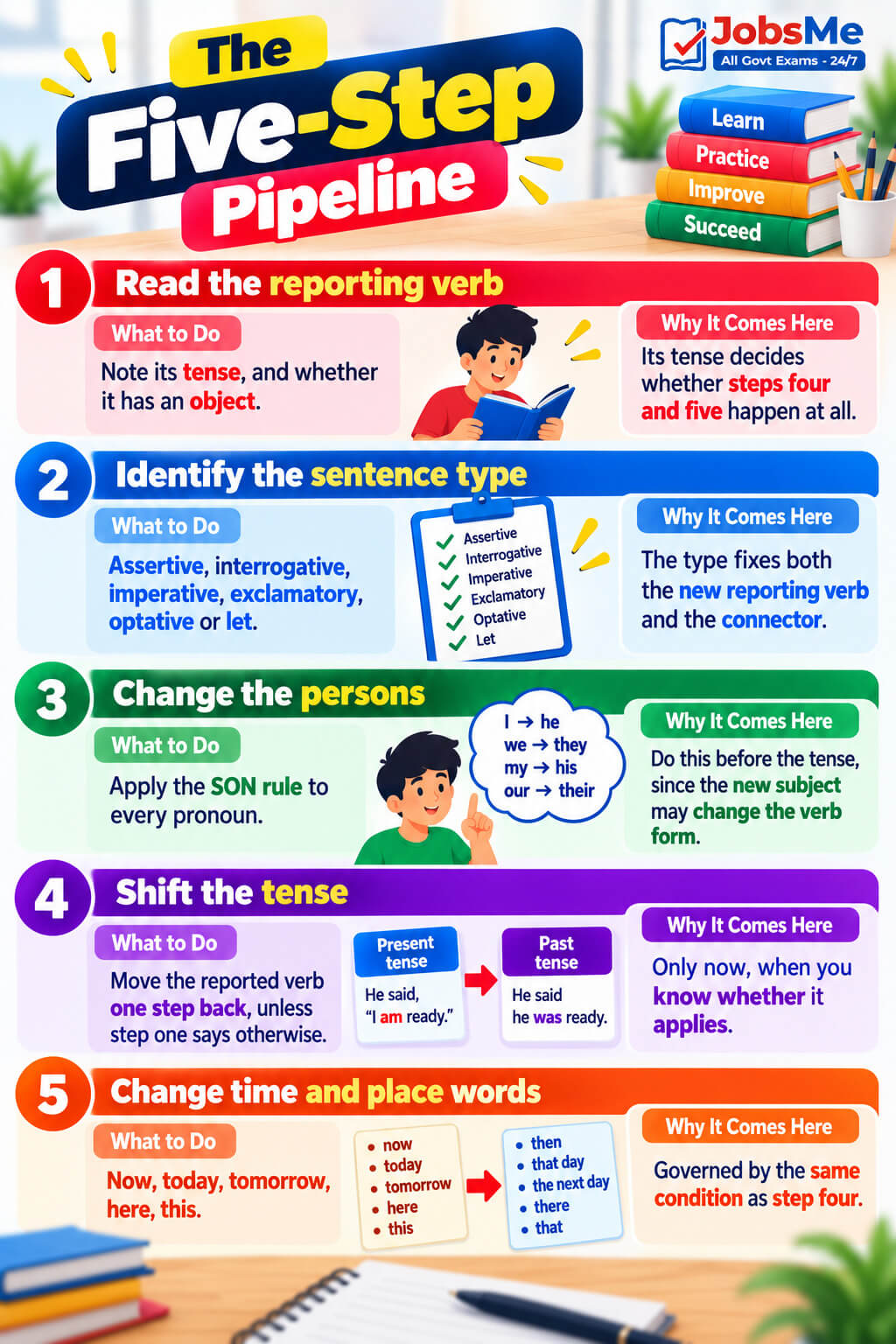
| Step | What to Do | Why It Comes Here |
|---|---|---|
| 1. Read the reporting verb | Note its tense, and whether it has an object. | Its tense decides whether steps four and five happen at all. |
| 2. Identify the sentence type | Assertive, interrogative, imperative, exclamatory, optative or let. | The type fixes both the new reporting verb and the connector. |
| 3. Change the persons | Apply the SON rule to every pronoun. | Do this before the tense, since the new subject may change the verb form. |
| 4. Shift the tense | Move the reported verb one step back, unless step one says otherwise. | Only now, when you know whether it applies. |
| 5. Change time and place words | Now, today, tomorrow, here, this. | Governed by the same condition as step four. |
Then remove the inverted commas, drop the question mark or exclamation mark, and end with a full stop.
Formula Box
- Check the reporting verb first. Present or future means no tense shift and no time-word change.
- Said to becomes told; said alone stays said.
- SON rule. First person follows the Subject, second person follows the Object, third person does Not change.
- Backshift is one step, and past perfect cannot go further back.
- A question becomes a statement. Subject before verb, and no question mark.
- An imperative takes the infinitive, so to plus the base verb, or not to.
- Four things never backshift: universal truths, habitual facts, historical events, and the past perfect.
Step One: The Reporting Verb Is the Master Switch
If the reporting verb is in the present or future tense, nothing shifts. The tense of the reported words stays as it is, and so do the time and place words.
| Reporting verb | Direct | Indirect |
|---|---|---|
| Present | Nusrat says, "I am never late." | Nusrat says that she is never late. |
| Present | He says, "I am ill now." | He says that he is ill now. |
| Future | She will say, "I am ready." | She will say that she is ready. |
| Past | He said, "I am ill now." | He said that he was ill then. |
The reporting verb also changes form according to whether it has an object.
- Said with no object stays said. He said that he was busy.
- Said to becomes told. I said to you becomes I told you.
- Says to becomes tells.
That last rule is a verified previous-year answer. I said to you, "He cannot be trusted completely" converts to I told you that he could not be trusted completely, and options keeping said you were the distractors.
Step Two: The Connector Depends on the Sentence Type
| Sentence Type | New Reporting Verb | Connector |
|---|---|---|
| Assertive | said, told, informed, replied | that |
| Interrogative with a question word | asked, enquired, wondered | the question word itself |
| Interrogative with an auxiliary | asked, enquired | if or whether |
| Imperative, an order | ordered, commanded | to, or not to |
| Imperative, a request | requested, begged | to, or not to |
| Imperative, advice | advised, suggested | to, or not to |
| Exclamatory | exclaimed with joy, sorrow, applause | that |
| Optative | prayed, wished | that |
| Let us | proposed, suggested | that, with should |
Step Three: The SON Rule for Pronouns
Three letters cover every pronoun change.
- S for Subject. A first person pronoun changes to match the subject of the reporting verb.
- O for Object. A second person pronoun changes to match the object of the reporting verb.
- N for No change. A third person pronoun stays as it is.
| Direct | Which rule applies | Indirect |
|---|---|---|
| He said, "I am tired." | First person, so follow the subject he. | He said that he was tired. |
| She said to me, "You were wrong." | Second person, so follow the object me. | She told me that I had been wrong. |
| Ray says, "He sings well." | Third person, so no change. | Ray says that he sings well. |
| She said to me, "Don't worry about me." | First person, so follow the subject she. | She told me not to worry about her. |
That last row is another verified previous-year answer, and the wrong options all kept about me or mangled the infinitive into to not worry.
Key Highlights
- Five steps in a fixed order, and step one decides whether step four runs.
- SON covers every pronoun: Subject, Object, No change.
- A reported question is a statement, so the subject comes first.
- Imperatives take the infinitive, never a that clause.
- The correct answer is sometimes to change almost nothing, and those are the questions most candidates lose.
Step Four: The Tense Backshift
| Direct Tense | Becomes | Example |
|---|---|---|
| Simple present | Simple past | "She wears a blazer" becomes she wore a blazer. |
| Present continuous | Past continuous | "He is looking" becomes he was looking. |
| Present perfect | Past perfect | "He has written" becomes he had written. |
| Present perfect continuous | Past perfect continuous | "She has been working" becomes she had been working. |
| Simple past | Past perfect | "My sister gave me a book" becomes his sister had given him a book. |
| Past continuous | Past perfect continuous | "We were living in Delhi" becomes they had been living in Delhi. |
| Past perfect | No change | "The food had gone stale" stays had gone stale. |
| Past perfect continuous | No change | Already as far back as English goes. |
The Modals
| Changes | Does Not Change |
|---|---|
| will becomes would | would stays would |
| shall becomes should | should stays should |
| can becomes could | could stays could |
| may becomes might | might stays might |
| have to becomes had to | ought to stays ought to |
| must becomes had to, for obligation | must may stay, for a strong duty or a general rule |
The Four Exceptions to Backshift
Four kinds of statement keep their original tense even after a past reporting verb.
- Universal truths and scientific facts. The teacher said that the earth moves round the sun.
- Habitual facts that are still true. He said that he takes a walk every morning.
- Historical events with a fixed date. He said that India became independent in 1947.
- The past perfect, which has nowhere further back to go.
Step Five: Time and Place Words
| Direct | Indirect | Direct | Indirect |
|---|---|---|---|
| now | then | here | there |
| today | that day | this | that |
| tonight | that night | these | those |
| yesterday | the previous day | hence | thence |
| tomorrow | the next day | hither | thither |
| last night | the previous night | ago | before |
| next week | the following week | thus | so |
One correction is needed here, because a widely circulated chart gives today as becoming this day. That is wrong, and the same error then spreads through the chart's own examples, producing phrases such as he might get a flight this day. The word this points to the speaker's present, which is exactly what indirect speech moves away from, so today becomes that day.
Converting Indirect Back to Direct
Papers ask for the reverse conversion too, and the pipeline simply runs backwards. Two things make it slightly harder, so it is worth practising separately.
| Step | What to Do | Example |
|---|---|---|
| 1. Read the reporting verb for the sentence type | Ordered or requested means an imperative. Asked means a question. Exclaimed means an exclamatory sentence. | He requested her to wait must become an imperative. |
| 2. Restore the punctuation | Add inverted commas, a capital letter, and a question or exclamation mark where the type demands it. | He said to her, "Please wait." |
| 3. Move the tense forward one step | Past perfect becomes present perfect or simple past, depending on sense. | He had written becomes "I have written." |
| 4. Restore the persons and time words | Then becomes now, that day becomes today, there becomes here. | He was busy then becomes "I am busy now." |
The reporting verb is again the master switch, because it is the only clue to the original sentence type. Requested tells you the words were an imperative with please, and exclaimed with sorrow tells you an interjection has to be restored.
One ambiguity is worth accepting. Step three cannot always be resolved with certainty, since a past perfect in indirect speech may have come from either a present perfect or a simple past. In a multiple-choice paper the options settle it, so read them before deciding.
The Six Sentence Types
1. Assertive Sentences
Template: subject + said or told + object + that + the reported clause.
- He said, "I am unwell." Becomes: He said that he was unwell.
- Raj said to Sheela, "The sun rises in the east." Becomes: Raj told Sheela that the sun rises in the east. The universal truth keeps its tense.
- She said, "My uncle came yesterday." Becomes: She said that her uncle had come the previous day.
2. Interrogative Sentences
The single most important rule in this whole topic: a question becomes a statement. The subject moves in front of the verb, the auxiliary used only for questioning disappears, and the question mark becomes a full stop.
| Direct | Wrong, keeping question order | Right |
|---|---|---|
| The girl asked, "Where is my grandmother?" | The girl enquired where was her grandmother. | The girl enquired where her grandmother was. |
| He said to me, "Where are you going?" | He asked me where was I going. | He asked me where I was going. |
| The boy asked, "Where do you live?" | The boy enquired where did I live. | The boy enquired where I lived. |
| She said, "What is your name?" | She asked what was my name. | She asked what my name was. |
The connector depends on how the question opens.
- Opens with a question word such as who, what, where, when, why or how: use that word as the connector. She asked when I was leaving.
- Opens with an auxiliary such as is, do, did, will or can: use if or whether. She asked if I had seen the film.
- Never use both. He asked me that where I was going is wrong, because that and a question word cannot both appear.
3. Imperative Sentences
Template: subject + a verb of instruction + object + to + base verb.
| Tone | Reporting Verb | Direct | Indirect |
|---|---|---|---|
| Order | ordered, commanded | He said to me, "Go away." | He ordered me to go away. |
| Request | requested, begged | He said to her, "Please wait." | He requested her to wait. |
| Advice | advised, suggested | She said to him, "Work hard." | She advised him to work hard. |
| Warning | warned, cautioned | He said, "Don't touch the wire." | He warned me not to touch the wire. |
| Negative | any of the above | She said to me, "Don't worry about me." | She told me not to worry about her. |
| Never | advised, warned | He said, "Never tell a lie." | He advised me never to tell a lie. |
Three details matter here. Words such as please and kindly are dropped, because the reporting verb requested already carries their tone. The negative is not to, never to not. And the connector that is never used with an imperative.
4. Exclamatory Sentences
Template: subject + exclaimed with a named emotion + that + the reported clause as a statement.
- He said, "Alas! I am ruined." Becomes: He exclaimed with sorrow that he was ruined.
- She said, "Hurrah! We have won." Becomes: She exclaimed with joy that they had won.
- The captain said, "Bravo! We won the match." Becomes: The captain exclaimed with applause that they had won the match.
Two mechanical points complete this type.
- The interjection is deleted. Alas, hurrah, oh and bravo do not appear in the indirect form, because the reporting verb has absorbed their meaning. This is covered further in interjection.
- What and how become intensity words. What becomes a great or a very great, and how becomes very. So He said, "What a fool I am!" becomes he exclaimed that he was a great fool, and She said, "How beautiful the scene is!" becomes she exclaimed that the scene was very beautiful.
5. Optative Sentences
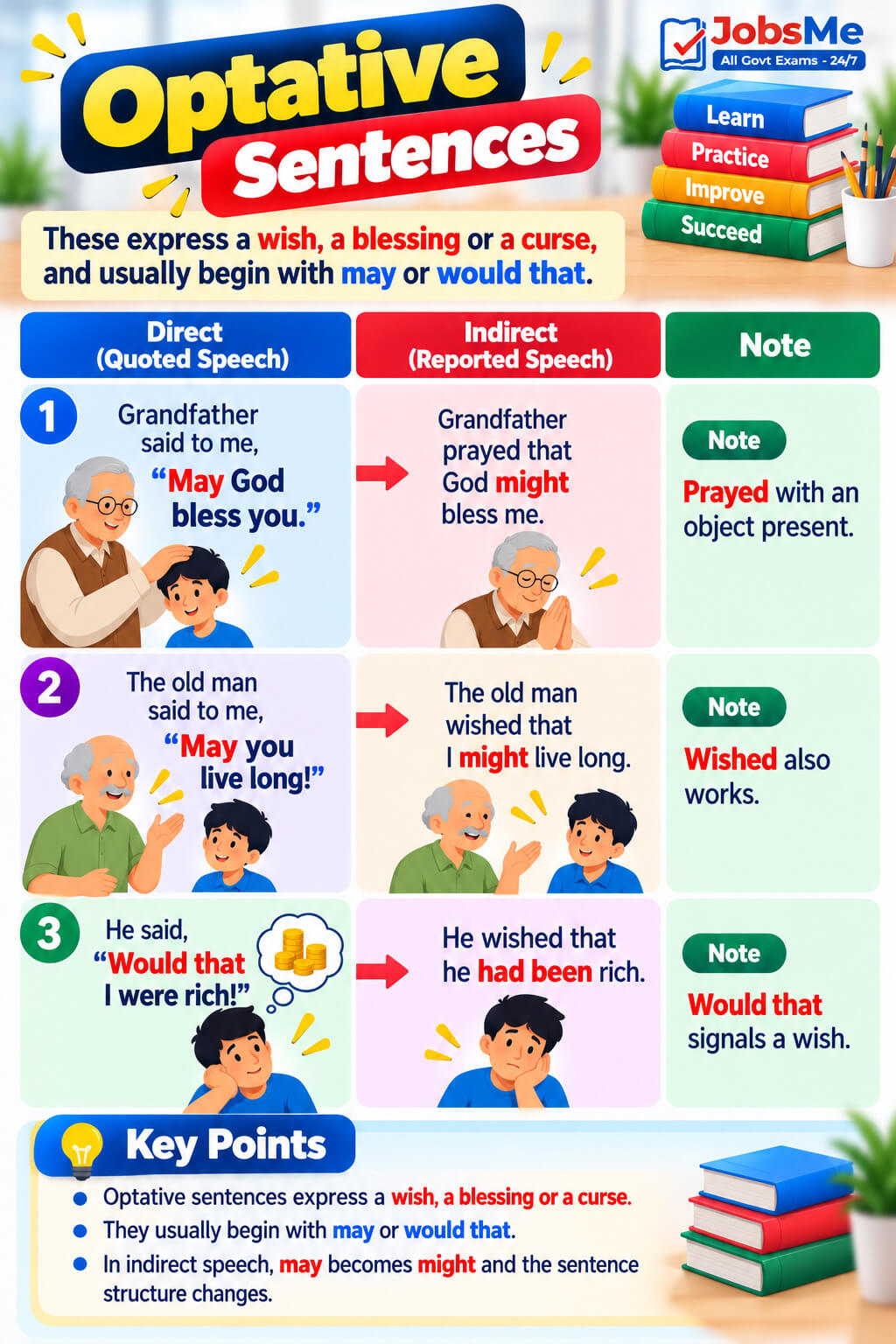
These express a wish, a blessing or a curse, and usually begin with may or would that.
| Direct | Indirect | Note |
|---|---|---|
| Grandfather said to me, "May God bless you." | Grandfather prayed that God might bless me. | Prayed with an object present. |
| The old man said to me, "May you live long!" | The old man wished that I might live long. | Wished also works. |
| He said, "Would that I were rich!" | He wished that he had been rich. | Would that signals a wish. |
The pattern is fixed: may becomes might, the reporting verb becomes prayed or wished, and the connector is that.
6. Sentences Beginning With Let
This type has two branches, and they are entirely different.
- Let us, meaning a proposal. The reporting verb becomes proposed or suggested, and the clause takes should. He said, "Let us wait for the award" becomes he proposed that they should wait for the award. This is a verified previous-year answer, and the distractors used said instead of proposed or kept he instead of they.
- Let him or let it, meaning permission. The clause takes might be allowed to. He said, "Let him come in" becomes he said that he might be allowed to come in.
Note the pronoun in the first branch. Let us includes the speaker and the listener, so with a reporting subject of he, the indirect form takes they, not he.
A Warning About Study Material on This Topic
This topic attracts more errors in study material than any other, because a conversion has five moving parts and a writer can get four of them right.
- Question order retained in the answer. One guide converts the girl asked, "Where is my grandmother?" into the girl enquired where was her grandmother. A question becomes a statement, so it must be where her grandmother was. This is the most important rule in interrogatives and the answer breaks it.
- Today given as this day. A widely copied chart lists today as becoming this day. It becomes that day, and the same chart then produces he might get a flight this day in its own example.
- A reporting verb that changes tense by itself. The same source converts He said, "I am in a hurry" into He says that he was in a hurry. The reporting verb has silently moved from past to present, and the backshift has been applied anyway.
- A rule contradicted by its own example. A tense chart states that past continuous becomes past perfect continuous, then gives they told me that they were living in Delhi, leaving the tense unchanged.
- A wrong tense label. The same chart puts the food has gone stale in its past perfect row. Has gone is present perfect.
- Content invented in the answer. One conversion turns "Will you come tomorrow?" into she asked whether I would come to the party. No party appears anywhere in the original.
- The person dropped entirely. Another gives "Please help me," he said as becoming he requested assistance. The correct form is he requested me to help him.
So work every model answer through the five steps yourself. In this topic more than any other, a printed answer key is not evidence.
Exam Alert
- Check the reporting verb's tense before reading anything else.
- Scan the options for retained question order, which is the commonest distractor.
- Watch for to not offered against the correct not to.
- Check whether the time word was changed, since options often differ only there.
- Study material on this topic is unusually unreliable, so verify every model answer yourself.
Ten Solved Questions
1. Choose the indirect form. I said to you, "He cannot be trusted completely."
Working: Said to becomes told, the third person does not change, and cannot becomes could not. Answer: I told you that he could not be trusted completely.
2. Choose the indirect form. She said to me, "Don't worry about me."
Working: An imperative takes the infinitive, the negative is not to, and me is a first person pronoun following the subject she. Answer: She told me not to worry about her.
3. Choose the indirect form. He said, "Let us wait for the award."
Working: Let us is a proposal, so the reporting verb becomes proposed and the clause takes should. Us includes the listener, so the pronoun is they. Answer: He proposed that they should wait for the award.
4. Choose the indirect form. He said to me, "Where are you going?"
Working: The question word is the connector, the order becomes subject then verb, and you follows the object me. Answer: He asked me where I was going. The option using that where I am going is wrong twice over.
5. Choose the indirect form. She said, "I am busy today."
Working: The reporting verb is past, so the tense shifts and so does the time word. Answer: She said that she was busy that day, not busy today.
6. Choose the indirect form. Nusrat says, "I am never late."
Working: The reporting verb is in the present, so step four does not apply at all. Answer: Nusrat says that she is never late.
7. Choose the indirect form. The teacher said, "The earth moves round the sun."
Working: A universal truth keeps its tense despite the past reporting verb. Answer: The teacher said that the earth moves round the sun.
8. Choose the indirect form. The captain said, "Bravo! We won the match."
Working: An exclamatory sentence names the emotion in the reporting verb, drops the interjection, and takes that. Answer: The captain exclaimed with applause that they had won the match.
9. Choose the indirect form. Grandfather said to me, "May God bless you."
Working: An optative sentence takes prayed, may becomes might, and you follows the object me. Answer: Grandfather prayed that God might bless me.
10. Choose the indirect form. He said, "What a beautiful scene it is!"
Working: What becomes an intensity phrase and the clause becomes a statement. Answer: He exclaimed with delight that it was a very beautiful scene.
Quick Facts
- Connectors: that for assertive, exclamatory and optative; a question word or if for interrogative; to for imperative.
- Reporting verbs: said, told, asked, enquired, ordered, requested, advised, warned, exclaimed, prayed, proposed.
- Backshift: present to past, present perfect to past perfect, simple past to past perfect.
- Modals: will to would, shall to should, can to could, may to might, have to to had to.
- No shift: universal truths, habitual facts, dated history, the past perfect.
- Time words: now to then, today to that day, tomorrow to the next day, here to there.
Worked Examples: Wrong to Right
Example 1 (backshifting after a present reporting verb)
Sentence: A student converts Nusrat says, "I am never late" into Nusrat says that she was never late.
Trap: The rule "present becomes past" has been learnt as unconditional, and it works for the great majority of questions. The condition sits in the reporting verb, and says is present, so no shift applies.
Correct Answer: Nusrat says that she is never late.
Rule in Simple Words: Read the reporting verb before touching the tense.
Example 2 (keeping question order)
Sentence: A student converts The girl asked, "Where is my grandmother?" into The girl enquired where was her grandmother.
Trap: The words have been faithfully carried across and the pronoun has been changed correctly, so four of the five steps are right. A reported question is no longer a question, so the subject must precede the verb.
Correct Answer: The girl enquired where her grandmother was.
Rule in Simple Words: A question becomes a statement, so subject first.
Example 3 (using both connectors)
Sentence: A student writes He asked me that where I was going.
Trap: That is the connector drilled hardest, because assertive sentences are practised most, so it gets added by habit. A question word is already the connector, and two connectors cannot occupy one slot.
Correct Answer: He asked me where I was going.
Rule in Simple Words: Use that, or a question word, or if, never two together.
Example 4 (that with an imperative)
Sentence: A student writes He ordered that I should go away.
Trap: The clause is grammatical and the meaning survives, so nothing sounds broken. An imperative converts through the infinitive, not through a that clause.
Correct Answer: He ordered me to go away.
Rule in Simple Words: Commands and requests take to plus the base verb.
Example 5 (splitting the negative infinitive)
Sentence: A student writes She told me to not worry about her.
Trap: The negative has been placed logically, right before the verb it negates. English fixes the order of the negative infinitive as not to, and this exact distractor appeared in a previous-year paper.
Correct Answer: She told me not to worry about her.
Rule in Simple Words: Always not to, never to not.
Example 6 (backshifting a universal truth)
Sentence: A student converts The teacher said, "The earth moves round the sun" into the teacher said that the earth moved round the sun.
Trap: The reporting verb is past, the rule says shift, and the conversion is mechanically flawless. Backshifting a fact that is still true implies it has stopped being true, so universal truths are exempt.
Correct Answer: The teacher said that the earth moves round the sun.
Rule in Simple Words: A permanent fact keeps its present tense.
Example 7 (forgetting the time word)
Sentence: A student converts She said, "I am busy today" into she said that she was busy today.
Trap: The tense has been shifted correctly, which feels like the hard part of the job, so the sentence looks finished. Step five is a separate stage, and today points to the speaker's present rather than the reporter's.
Correct Answer: She said that she was busy that day.
Rule in Simple Words: Shift the time words whenever you shift the tense.
Example 8 (let us treated as a plain statement)
Sentence: A student converts He said, "Let us wait for the award" into he said that he should wait for the award.
Trap: Said that is the default template and should has been correctly supplied, so it looks close. Let us is a proposal, which needs proposed, and us covers speaker and listener, which needs they.
Correct Answer: He proposed that they should wait for the award.
Rule in Simple Words: Let us becomes proposed that they should.
Common Traps Students Fall Into
These are the habits that most often cost marks. Each one is a common trap, not a silly mistake, and each has a one-line fix.
- Trap: Shifting the tense before checking the reporting verb. Fix: A present or future reporting verb means no shift.
- Trap: Keeping question word order. Fix: A reported question is a statement.
- Trap: Leaving the question mark in. Fix: Indirect speech ends with a full stop, a point covered in error spotting too.
- Trap: Using that with a question word. Fix: One connector only.
- Trap: Using that with an imperative. Fix: Imperatives take the infinitive.
- Trap: Writing to not. Fix: The form is not to.
- Trap: Keeping please in a request. Fix: The verb requested carries that tone already, as with the sentence improvement principle of not repeating a sense twice.
- Trap: Backshifting a universal truth. Fix: Permanent facts keep their tense, as noted in tenses.
- Trap: Forgetting the time and place words. Fix: Treat step five as its own stage.
- Trap: Keeping the interjection in an exclamatory conversion. Fix: The named emotion replaces it.
- Trap: Trusting a printed answer key. Fix: Run all five steps yourself, since this topic's material is unusually unreliable.
Memory Tricks and Formulas
1. Reporting verb first, always
Its tense is the master switch. Present or future means steps four and five do not run, and reading it first saves the entire calculation.
2. SON for the pronouns
First person follows the Subject, second person follows the Object, third person does Not change. Three letters cover every pronoun in the topic.
3. Said to becomes told
With an object, said to becomes told and says to becomes tells. Without an object, said stays said. Distractors in real papers rely on this.
4. Statements, not questions
A reported question loses its question order, its questioning auxiliary and its question mark. So where her grandmother was, never where was her grandmother.
5. One connector only
That for assertive, exclamatory and optative sentences. A question word or if for interrogatives. To for imperatives. Never two at once, and never that with an imperative.
6. Four things never shift
Universal truths, habitual facts still true, dated historical events, and the past perfect. Everything else moves one step back.
7. Name the emotion
For an exclamatory sentence, the interjection disappears and the reporting verb names what it expressed. Joy, sorrow, applause, delight, regret or surprise. And what becomes a great while how becomes very.
8. Budget the time honestly
At about 5 per cent of grammar marks and 1 to 2 questions in Tier 1, with more in Tier 2, this topic repays two sessions fully. Because it is entirely rule-based, near-total accuracy is achievable.
Exam Patterns and High-Yield Facts
Frequently Confused Pairs
| Pair | How They Differ | Mini Trick |
|---|---|---|
| Said vs Told | No object against an object. | Said to becomes told. |
| That vs If | Assertive against a yes-or-no question. | Check how the quote opens. |
| If vs a question word | Auxiliary opening against WH opening. | Does or where? |
| That vs To | Statement against command. | Imperatives always take to. |
| Not to vs To not | Only the first is correct. | Negative goes before to. |
| Today vs That day | This belongs to the speaker's present. | Never this day. |
| Must vs Had to | Obligation shifts; a general rule may stay. | Read the sense. |
| Let us vs Let him | Proposal against permission. | Proposed that they should; might be allowed to. |
| Prayed vs Exclaimed | Optative against exclamatory. | May signals a wish. |
| Backshift vs no backshift | The reporting verb's tense decides. | Check it first. |
Repeating Question Patterns
- An interrogative with the question order retained in one or more options.
- Said to left as said you instead of becoming told you.
- To not worry offered as a distractor alongside the correct not to worry.
- A time word left unchanged, most often today or tomorrow.
- Let us converted with said instead of proposed.
- A universal truth wrongly backshifted.
Practice Set: Fifteen Questions
Convert each sentence into indirect speech.
- He said, "I am busy now."
- She said to me, "I will help you tomorrow."
- Rahim said, "I have finished my work."
- The teacher said, "Water boils at a hundred degrees."
- They said to us, "We went to school yesterday."
- He said to me, "Are you happy?"
- She said to him, "Where do you live?"
- The stranger said to me, "What is your name?"
- Mother said to me, "Have you taken your meal?"
- He said to me, "Go away at once."
- She said to the peon, "Please post this letter."
- He said, "Alas! I have lost my purse."
- The old man said to me, "May you prosper!"
- He said to me, "Let us go for a walk now."
- He says, "I am leaving today."
Quick Facts
Answer key, with the step that decides each one.
- 1. He said that he was busy then. Tense shift plus time word.
- 2. She told me that she would help me the next day. Said to becomes told.
- 3. Rahim said that he had finished his work. Present perfect becomes past perfect.
- 4. The teacher said that water boils at a hundred degrees. A universal truth does not shift.
- 5. They told us that they had gone to school the previous day. Simple past becomes past perfect.
- 6. He asked me if I was happy. An auxiliary opening takes if.
- 7. She asked him where he lived. Statement order, and the third person does not change.
- 8. The stranger asked me what my name was. Subject before verb.
- 9. Mother asked me if I had taken my meal. Auxiliary opening plus backshift.
- 10. He ordered me to go away at once. Imperative takes the infinitive.
- 11. She requested the peon to post that letter. Please is dropped, and this becomes that.
- 12. He exclaimed with sorrow that he had lost his purse. The interjection is replaced.
- 13. The old man wished that I might prosper. Optative takes wished and might.
- 14. He proposed to me that we should go for a walk then. Let us becomes a proposal.
- 15. He says that he is leaving today. A present reporting verb blocks both shifts.
Note items four and fifteen, where the correct answer is to change almost nothing. Those are the two questions most candidates get wrong, and both are decided at step one rather than by any rule about tense. Practise the sequence with the free English MCQ quizzes and full papers from the mock test archive.
Quick Revision
Quick Revision
- What narration is. Reporting someone's words either exactly, which is direct speech, or in your own words, which is indirect speech.
- Treat it as a pipeline, not a rule list. Five changes run in a fixed order, and the first decides whether the fourth happens at all.
- Step one is the reporting verb. If it is present or future, the tense and the time words do not change at all.
- Said with no object stays said, while said to becomes told and says to becomes tells.
- Step two is the sentence type, since the type fixes both the new reporting verb and the connector.
- Step three is the SON rule. First person follows the Subject, second person follows the Object, third person does Not change.
- Step four is the backshift, moving the reported verb one step back.
- Simple present becomes simple past, present perfect becomes past perfect, and simple past becomes past perfect.
- Will becomes would, shall becomes should, can becomes could and may becomes might, while would, should, could, might and ought to stay as they are.
- Four things never shift. Universal truths, habitual facts still true, dated historical events, and the past perfect.
- Step five is the time and place words. Now becomes then, today becomes that day, yesterday becomes the previous day, tomorrow becomes the next day, here becomes there and this becomes that.
- Today becomes that day, never this day, whatever some charts say.
- Assertive sentences take that, and the inverted commas are removed.
- A reported question becomes a statement, so the subject comes before the verb and the question mark becomes a full stop.
- A question opening with a question word uses that word as the connector, and one opening with an auxiliary uses if or whether.
- Never use two connectors, so not that where or that if.
- Imperatives take the infinitive, so to plus the base verb, and never a that clause.
- The negative is not to, never to not.
- Please and kindly are dropped, because requested already carries the tone.
- The reporting verb names the tone. Ordered, requested, advised, warned or forbade.
- Exclamatory sentences name the emotion and drop the interjection, so exclaimed with joy, sorrow or applause.
- What becomes a great and how becomes very in an exclamatory conversion.
- Optative sentences take prayed or wished, with may becoming might.
- Let us becomes proposed that they should, while let him becomes might be allowed to.
Narration is the most mechanical topic in the English syllabus, which makes it one of the few where near-total accuracy is realistic. The catch is that it punishes disorder: apply the tense rule before reading the reporting verb and you will answer a question that was never asked. So run the five steps in sequence every time, learn the six sentence templates as templates rather than as prose rules, and remember that the correct answer is sometimes to change almost nothing. The topic draws on tenses for the backshift and on pronouns for the SON rule, connects to interjection for the exclamatory type and to punctuation rules for the inverted commas, and overlaps with transformation of sentences, where the same meaning-must-survive discipline applies. The wider set is in the topic-wise English notes.
Frequently Asked Questions
What is the difference between direct and indirect speech?
What should I check first in a conversion?
What is the SON rule for pronouns?
How does the tense shift work?
Which sentences do not change tense?
Why is where was her grandmother wrong?
When do I use if and when do I use a question word?
How are commands and requests converted?
What happens to Alas and Hurrah?
How do I convert Let us go?

About the author





