
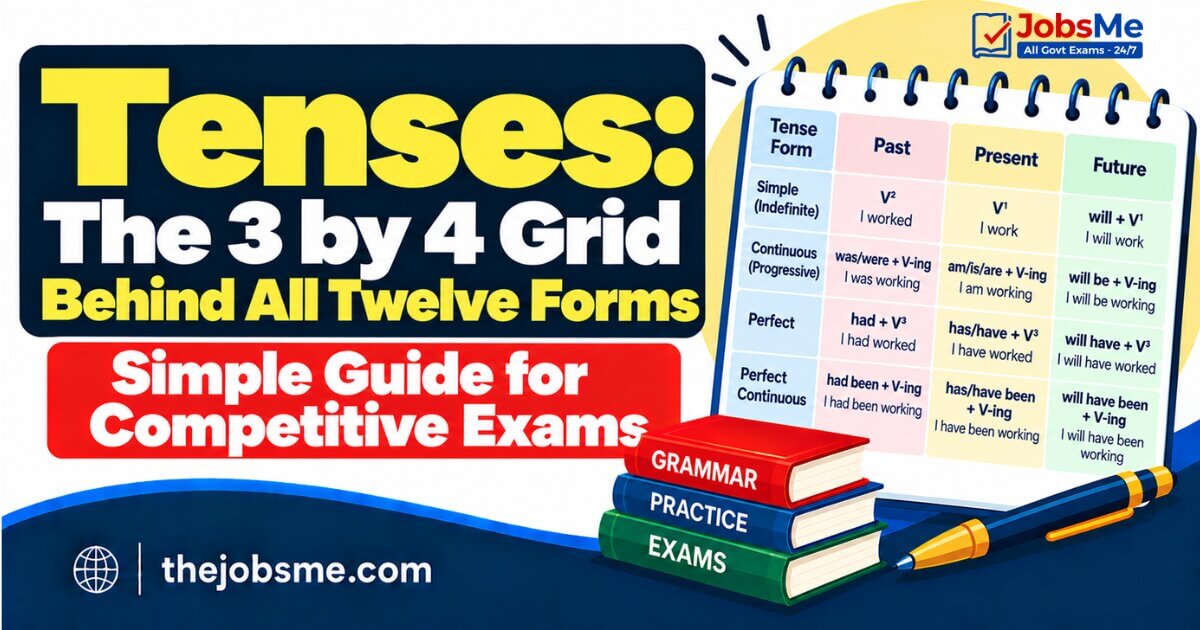
Tenses: The 3 by 4 Grid Behind All Twelve Forms
This is the hub for tenses, the single highest-weighted grammar topic in SSC, banking, insurance, railway, defence and State PSC exams. Every guide presents twelve tenses as twelve formulas to memorise. That is unnecessary, because the twelve are a three by four grid, and the two axes do different jobs. Time says when the action happens, and aspect says how the action relates to that time. The aspect markers never change across the three times: continuous is always be plus -ing, perfect is always have plus the third form, and perfect continuous is always have been plus -ing. So twelve forms come from seven pieces. This guide sets out the grid, the time-marker words that fix the tense, the sequence-of-tenses rule with its exceptions, and links to every related topic.
Introduction
Tense is the form a verb takes to show the time of an action, and also how that action relates to its time.
Almost every guide lists twelve tenses with twelve formulas. That is twelve things to memorise and twelve chances to confuse them, and it is unnecessary.
The twelve tenses are a three by four grid. Three times, present, past and future, tell you when. Four aspects, simple, continuous, perfect and perfect continuous, tell you how the action relates to that time.
The reason this matters is that the aspect markers never change.
- Continuous is always be plus -ing. Only the form of be changes: is, was, will be.
- Perfect is always have plus the third form. Only have changes: has, had, will have.
- Perfect continuous is always have been plus -ing. Only have changes.
So twelve forms come from seven pieces. Learn three time markers and four aspect markers, and every tense can be built rather than recalled.
Where This Topic Is Asked
| Exam | How This Topic Appears | Rough Weight | Time to Allow |
|---|---|---|---|
| SSC CGL and CHSL | Tense faults in error spotting, especially past time adverbs and mixed tenses. | Around 18 per cent of grammar marks, the highest of any topic | 12 to 15 seconds a question |
| IBPS PO and SBI PO | Since and for phrases, stative verbs inside continuous clauses, and past perfect alignment. | 3 to 4 questions | 20 seconds a question |
| RRB and defence exams | Direct rules such as before and after with the past perfect. | 1 to 2 questions | 10 seconds a question |
| UPSC and State PSC | Subtle shifts between main and subordinate clauses, and universal truth exceptions. | 1 to 2 questions | 30 seconds a question |
| Cloze test and fillers | The blank almost always needs a particular tense. | Indirect but constant | Part of the question |
| Every conversion topic | Voice, narration and conditionals all move tenses. | Foundational | Worth the time |
Nothing else in the grammar block comes close. Tenses carry roughly eighteen per cent of the marks on their own, and mixed tenses within a single sentence account for a further share of error spotting items. Check your own pattern in the exam-wise syllabus hub.
The Master Grid
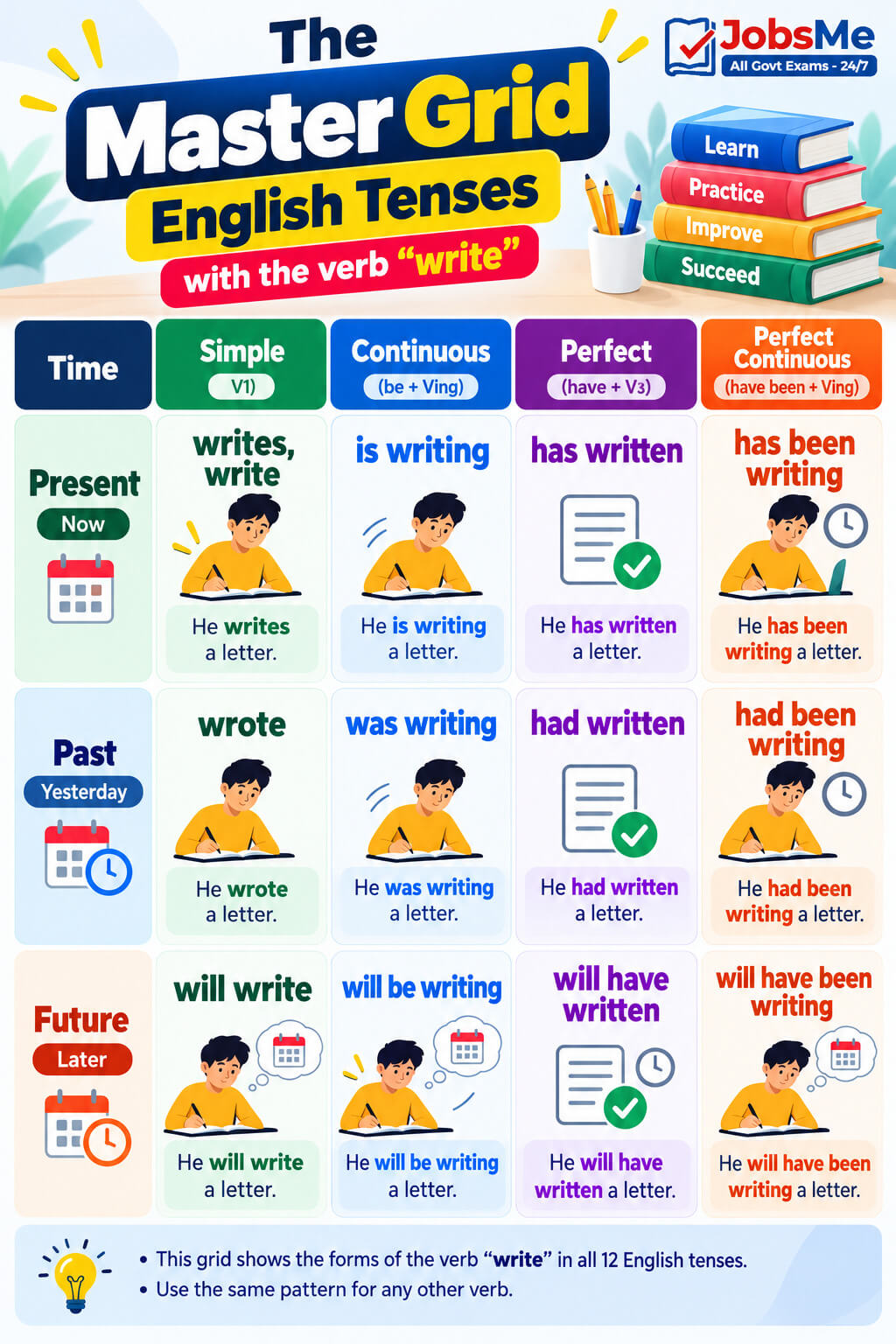
| Time | Simple | Continuous, be + ing | Perfect, have + V3 | Perfect continuous, have been + ing |
|---|---|---|---|---|
| Present | writes, write | is writing | has written | has been writing |
| Past | wrote | was writing | had written | had been writing |
| Future | will write | will be writing | will have written | will have been writing |
Read the table down each column and the pattern is visible. The aspect word stays fixed and only the tense of the auxiliary changes. Continuous keeps -ing throughout, perfect keeps the third form throughout, and perfect continuous keeps been plus -ing throughout.
What Each Aspect Actually Means
The names are unhelpful, so here is what each aspect does, independent of time.
| Aspect | Views the action as | Typical use | Signal words |
|---|---|---|---|
| Simple | A whole, without regard to its progress. | Habits, facts, and single completed events. | always, usually, every day, yesterday, tomorrow |
| Continuous | In progress at a point in time. | Something under way, temporary, or unfinished. | now, at the moment, at that time, this time tomorrow |
| Perfect | Completed, with its result mattering at the reference time. | Linking one time to an earlier one. | already, just, yet, ever, never, by the time |
| Perfect continuous | Ongoing right up to the reference time, with the duration emphasised. | Stressing how long something has run. | since, for, all day, how long |
So the aspect answers a question the time cannot. He wrote, he was writing, he had written and he had been writing all sit in the past. They differ in whether the writing is treated as one event, as in progress, as finished before something else, or as running up to that point.
Formula Box
- Twelve tenses equal three times by four aspects.
- Continuous is be plus -ing, always.
- Perfect is have plus the third form, always.
- Perfect continuous is have been plus -ing, always.
- Only the auxiliary's tense changes as you move between present, past and future.
- Since takes a point in time, for takes a duration.
- A past time marker blocks the present perfect.
The Twelve, One by One
Present Tenses
| Tense | Structure | Main uses | Example |
|---|---|---|---|
| Simple present | Subject + base verb, adding s for a third person singular subject | Habits, universal truths, timetables, and running commentary. | The earth revolves round the sun. The train leaves at nine. |
| Present continuous | Subject + am, is, are + -ing | Something happening now, a temporary situation, and a fixed future arrangement. | She is preparing for the exam these days. We are watching a film tonight. |
| Present perfect | Subject + has, have + third form | A finished action whose result matters now, an experience at an unstated time, and an unfinished period. | I have finished the syllabus. He has visited Japan twice. She has read five books this month. |
| Present perfect continuous | Subject + has, have been + -ing | An action begun in the past and still running, with the duration stressed. | He has been studying since morning. |
Two corrections belong here, because published notes narrow these definitions in ways that cause errors.
- The present perfect is not only for the recent past. Several sources define it that way. It also carries experience at an unspecified time, as in I have visited Japan, and an unfinished time period, as in I have visited the museum this month. Learning only the recent-past sense produces the commonest tense error of all.
- The present continuous covers planned future arrangements. One source defines it as the moment of speaking only, and then offers we are watching a movie tonight as an example. That sentence is correct, but it is a future arrangement rather than something happening now.
Past Tenses
| Tense | Structure | Main uses | Example |
|---|---|---|---|
| Simple past | Subject + second form | A completed action at a stated past time, and past habits. | The government launched the scheme in 2024. |
| Past continuous | Subject + was, were + -ing | An action in progress at a past point, often interrupted by another. | While they were revising, the lights went out. |
| Past perfect | Subject + had + third form | The earlier of two past actions, so the past of the past. | The train had left before I reached the station. |
| Past perfect continuous | Subject + had been + -ing | An action running up to a past point, with the duration stressed. | She had been practising for months before she cleared the exam. |
Future Tenses
| Tense | Structure | Main uses | Example |
|---|---|---|---|
| Simple future | Subject + will, shall + base verb | A plain future action, a promise, or a prediction. | The commission will release the admit cards next week. |
| Future continuous | Subject + will be + -ing | An action in progress at a future point. | This time tomorrow, I will be taking my exam. |
| Future perfect | Subject + will have + third form | An action to be completed before a future point. | By next December, he will have completed his graduation. |
| Future perfect continuous | Subject + will have been + -ing | An action running up to a future point, with a duration given. | By 2027, she will have been working here for five years. |
The last row needs a duration to make sense. One source offers she will have been going to school tomorrow, which has no duration and no end point, so it means nothing. The future perfect continuous requires a phrase such as for five years or since 2022. The traditional shall and will distinction is covered in modals.
Talking About the Future Without Will
English has several future forms beyond will, and choosing between them is a standard filler question.
| Form | Used for | Example |
|---|---|---|
| will + base verb | A decision made now, a prediction, a promise or an offer. | I will help you with the form. |
| going to + base verb | A prior intention, or a prediction based on present evidence. | She is going to apply for the post. Look at those clouds, it is going to rain. |
| Present continuous | A fixed arrangement with a time and place settled. | We are meeting the officer at four tomorrow. |
| Simple present | A timetable or a scheduled event. | The train leaves at nine tomorrow. |
| be about to | The immediate future. | The results are about to be announced. |
The distinction that appears most often is will against going to. A decision taken at the moment of speaking takes will, while an intention already formed takes going to. Note also that a subordinate clause of time never takes a future form, so when he comes tomorrow and never when he will come tomorrow.
The Time-Marker Map
Most tense questions are decided by a single word in the sentence. Certain time expressions lock the tense, and spotting them is faster than reasoning about the meaning.
| Marker | Forces | Example |
|---|---|---|
| always, usually, every day, generally, often | Simple present | He goes for a walk every evening. |
| now, at present, at the moment, currently | Present continuous | She is reading at the moment. |
| already, just, yet, ever, never, so far, recently | Present perfect | He has just left the office. |
| since, for, how long | Perfect or perfect continuous | He has been ill since Monday. |
| yesterday, ago, last week, in 2024, then | Simple past, and never the present perfect | She joined the office in 2024. |
| while, when, at that time | Past continuous, usually with a simple past | While I was cooking, the bell rang. |
| before, after, by the time | Past perfect for the earlier action | By the time I arrived, he had gone. |
| tomorrow, next week, soon | Simple future | They will announce the result next week. |
| this time tomorrow, at ten tomorrow | Future continuous | I will be travelling this time tomorrow. |
| by next year, by the time you arrive | Future perfect | She will have submitted the form by Friday. |
Since Against For
- Since takes a point in time. Since Monday, since two o'clock, since 2019, since morning.
- For takes a duration. For three days, for five years, for two hours.
- Both need a perfect or perfect continuous tense. He has been ill since Monday, not he is ill since Monday.
- From does not replace since in a perfect tense unless an end point is given.
The preposition side of this is developed in prepositions.
Simple Past Against Present Perfect
This is the highest-frequency tense error in the paper, and one question settles it. Is a definite past time stated? If yes, the simple past is required and the present perfect is impossible.
| Wrong | Right | Why |
|---|---|---|
| I have met him yesterday. | I met him yesterday. | Yesterday is a definite past time. |
| She has joined the office in 2024. | She joined the office in 2024. | A stated year blocks the perfect. |
| He has come two hours ago. | He came two hours ago. | Ago always points to a definite past. |
| Did you ever visit Japan? | Have you ever visited Japan? | Ever asks about experience at an unstated time. |
| I finished my work already. | I have already finished my work. | Already links the past to now. |
Key Highlights
- Twelve tenses come from seven pieces, not twelve formulas.
- The aspect word never changes; only the auxiliary's tense moves.
- Most questions are settled by one time-marker word.
- A definite past time blocks the present perfect, which is the commonest error of all.
- At eighteen per cent of grammar marks, no other topic repays study time as well.
The Sequence of Tenses
When a sentence has a main clause and a subordinate clause, the tense of the main verb governs the other. The general rule is that a past main clause takes a past subordinate clause.
- Right: He said that he was unwell.
- Wrong: He said that he is unwell.
- Right: She told me that she had finished the work.
The Four Exceptions
Four kinds of subordinate clause keep their own tense whatever the main clause does.
- Universal truths and scientific facts. The teacher said that the earth moves round the sun.
- Habitual facts still true. He said that he takes a walk every morning.
- Historical events with a date. He said that India became independent in 1947.
- Comparisons after than. He respected me more than he does you.
Two further points. A clause opening with if, lest or as if follows its own rules rather than the sequence rule. And a past perfect is compulsory in the subordinate clause after before, after, when and by the time whenever one past action clearly precedes another. The reporting side of this is in direct and indirect speech, and the if side in conditionals.
Verbs That Refuse the Continuous
Some verbs describe a state rather than an activity, and states do not progress, so they resist every continuous form.
Know, believe, understand, remember, forget, mean, belong, own, possess, contain, consist, comprise, seem, appear, resemble, prefer, like, love, hate, want, need, doubt, deserve, hear, see, smell, taste.
- Wrong: I am knowing the answer. Right: I know the answer.
- Wrong: He is having a car. Right: He has a car.
- Right: He is having lunch, because there have means eat rather than possess.
Several of these verbs carry a second, active meaning that does permit the continuous, so ask which sense the sentence uses before deciding. The full list sits in verbs.
The Four Tenses With No Passive
Present perfect continuous, past perfect continuous, future continuous and future perfect continuous have no passive form used in exams. If an option offers one, it is wrong. The eight that do convert are set out in active and passive voice.
Where to Go From Here
Tenses feed every other grammar topic, so this hub links out rather than trying to cover them.
| Topic | How tenses matter there | Article |
|---|---|---|
| Conditionals | Unreality is marked by moving the tense one or two steps back. | Conditionals |
| Gerund, infinitive and participle | Non-finite forms carry no tense, and the perfect form marks an earlier action. | Gerund, infinitive and participle |
| Subject-verb agreement | The auxiliary carrying the tense is also the word that must agree. | Subject-verb agreement |
| Active and passive voice | The tense is copied across, never recalculated. | Active and passive voice |
| Direct and indirect speech | A past reporting verb pushes the reported tense one step back. | Direct and indirect speech |
| Verbs | Only the finite verb carries tense, and there is one per clause. | Verbs |
| Modals | Modals have no tense of their own and need substitutes to fill the gaps. | Modals |
A Warning About Study Material on This Topic
- A formula that adds two things at once. One guide gives the simple present as subject plus verb in the base form plus s or es for the third person singular. You use one or the other, never both.
- A future perfect continuous with no duration. She will have been going to school tomorrow appears as a model example. The tense requires a duration and an end point, so without one the sentence means nothing.
- The present perfect defined too narrowly. Several sources describe it as recent completion only. It also covers experience at an unstated time and an unfinished period, and teaching only the first sense produces the commonest tense error in the paper.
- A definition that its own example contradicts. The present continuous is defined as the moment of speaking, and then illustrated with we are watching a movie tonight, which is a future arrangement.
- Contradictory Hindi labels. One bilingual set of notes names the present perfect continuous with terms meaning completed and continuing at once, and labels all four continuous tenses with a Sanskrit compound term unrelated to continuous aspect.
So test every definition against the examples printed beside it. In this topic more than most, a definition that is merely incomplete will still lead you to the wrong answer.
Exam Alert
- Scan for a time marker before anything else, since one word usually decides the answer.
- Check every since and for against the tense of the main verb.
- Two past actions in one sentence need the earlier-action check.
- Any continuous form should be tested against the stative list.
- In error spotting, roughly two-thirds of planted errors sit in the middle segments, and the verb is the likeliest element.
Ten Solved Questions
1. Find the error. I have met him (a) / at the conference (b) / in Delhi yesterday. (c) / No error (d)
Working: Yesterday is a definite past time, which blocks the present perfect. Answer: (a), which should read I met him.
2. Find the error. She is ill (a) / since last Monday and (b) / has not attended office. (c) / No error (d)
Working: Since requires a perfect or perfect continuous tense. Answer: (a), which should read she has been ill.
3. Find the error. The train left (a) / before I reached (b) / the railway station. (c) / No error (d)
Working: Of two past actions, the earlier takes the past perfect. Answer: (a), which should read the train had left.
4. Find the error. The teacher told us (a) / that the earth moved (b) / round the sun. (c) / No error (d)
Working: A universal truth keeps the present tense despite a past main clause. Answer: (b), which should read the earth moves.
5. Find the error. He is having (a) / a large house and (b) / two cars in the city. (c) / No error (d)
Working: Have meaning possess is stative and takes no continuous form. Answer: (a), which should read he has.
6. Fill the blank. By the time you reach the office, the meeting ___. Options: will end, will have ended, ends, is ending.
Working: By the time plus a future reference calls for the future perfect. Answer: will have ended.
7. Find the error. She has been working (a) / in this department (b) / for five years now. (c) / No error (d)
Working: For plus a duration with the present perfect continuous is exactly right, and the meaning is that she still works there. Answer: (d), no error.
8. Find the error. While I was cooking (a) / dinner, the doorbell (b) / was ringing twice. (c) / No error (d)
Working: A short completed interruption takes the simple past, not the continuous. Answer: (c), which should read rang twice.
9. Fill the blank. He said that he ___ a walk every morning. Options: took, takes, had taken, is taking.
Working: A habitual fact that is still true is one of the four exceptions to the sequence rule. Answer: takes.
10. Find the error. She had been practising (a) / for months before she (b) / finally cleared the examination. (c) / No error (d)
Working: A past perfect continuous with a duration, followed by a simple past for the later event, is the correct pairing. Answer: (d), no error.
Quick Facts
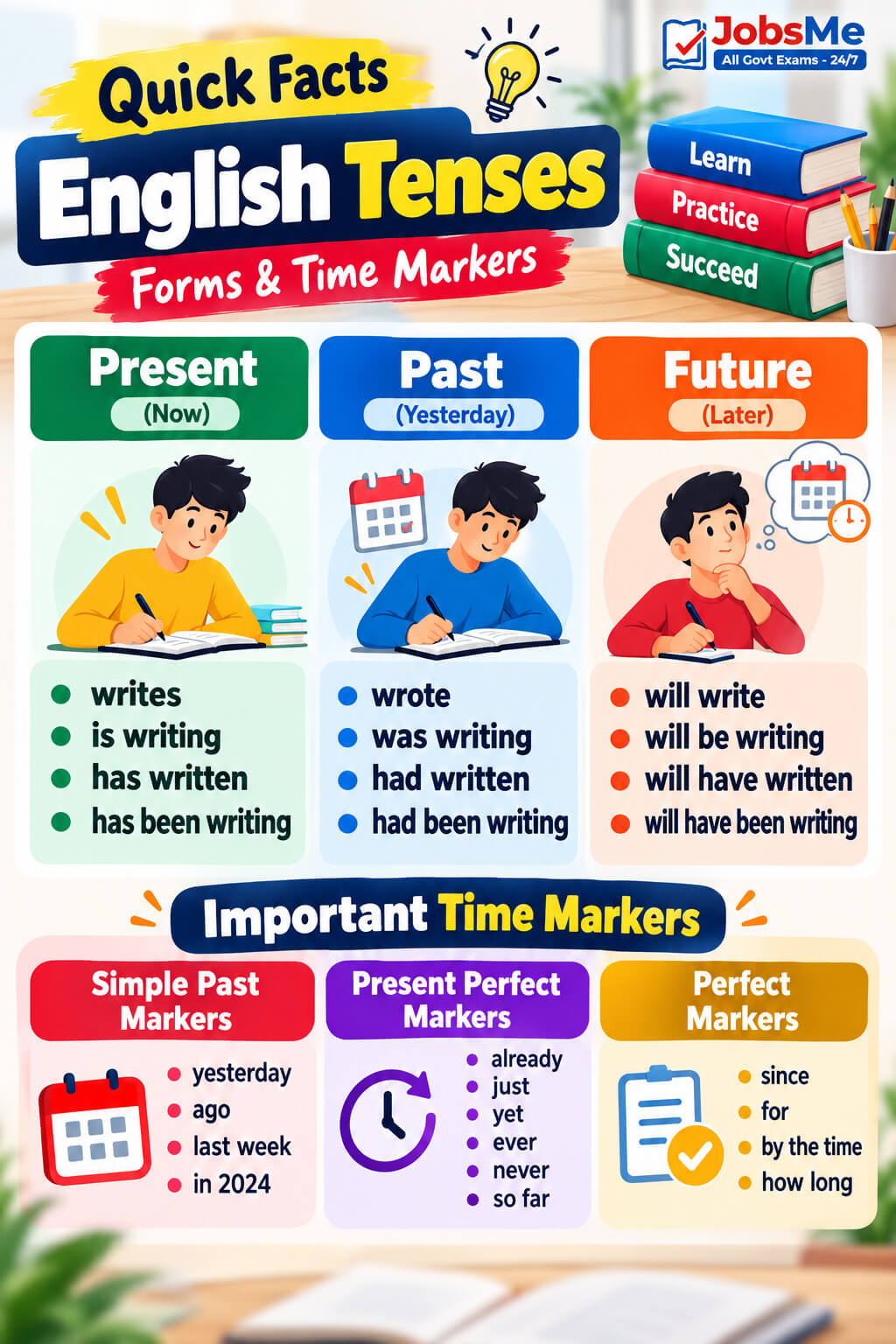
- Present: writes, is writing, has written, has been writing.
- Past: wrote, was writing, had written, had been writing.
- Future: will write, will be writing, will have written, will have been writing.
- Simple past markers: yesterday, ago, last week, in 2024.
- Present perfect markers: already, just, yet, ever, never, so far.
- Perfect markers: since, for, by the time, how long.
Worked Examples: Wrong to Right
Example 1 (present perfect with a past time marker)
Sentence: A student writes I have met him yesterday at the conference.
Trap: The meeting is over and its relevance feels present, which is exactly what the present perfect is for. A stated past time fixes the event in the past, and the present perfect cannot take one.
Correct Answer: I met him yesterday at the conference.
Rule in Simple Words: A definite past time blocks the present perfect.
Example 2 (a simple present with since)
Sentence: A student writes She is ill since last Monday.
Trap: She is ill now, so the present tense seems to report the situation accurately. Since introduces a starting point and a stretch of time, which only a perfect form can carry.
Correct Answer: She has been ill since last Monday.
Rule in Simple Words: Since and for demand a perfect or perfect continuous tense.
Example 3 (two simple pasts where one should be perfect)
Sentence: A student writes The train left before I reached the station.
Trap: Both events are past, and before already shows which came first, so the tenses feel adequate. English marks the earlier of two past actions with the past perfect, and before is one of the words that make it compulsory.
Correct Answer: The train had left before I reached the station.
Rule in Simple Words: The earlier past action takes had plus the third form.
Example 4 (backshifting a universal truth)
Sentence: A student writes The teacher told us that the earth moved round the sun.
Trap: The main clause is past and the sequence rule says a past main clause takes a past subordinate clause, so the conversion is mechanically flawless. Backshifting a fact that is still true implies it has stopped being true.
Correct Answer: The teacher told us that the earth moves round the sun.
Rule in Simple Words: A permanent fact keeps its present tense.
Example 5 (a stative verb in the continuous)
Sentence: A student writes He is having a large house and two cars.
Trap: The continuous is the form used for anything true right now, and the possession is true right now. A state does not progress, so verbs of possessing, knowing and believing take the simple form.
Correct Answer: He has a large house and two cars.
Rule in Simple Words: States use the simple form; actions use the continuous.
Example 6 (a continuous for a brief interruption)
Sentence: A student writes While I was cooking, the doorbell was ringing twice.
Trap: Both clauses describe the same stretch of time, so matching their tenses looks consistent. The longer background action takes the continuous and the brief completed interruption takes the simple past.
Correct Answer: While I was cooking, the doorbell rang twice.
Rule in Simple Words: Background continuous, interruption simple.
Example 7 (a future perfect continuous with no duration)
Sentence: Following a printed model, a student writes She will have been going to school tomorrow.
Trap: The formula was applied correctly and every piece is in the right place. The tense measures a duration running up to a future point, so without a phrase such as for five years the sentence has nothing to measure.
Correct Answer: By next month, she will have been going to that school for a year.
Rule in Simple Words: The perfect continuous needs a stated duration.
Example 8 (mixing tenses across a sentence)
Sentence: A student writes He came into the room, sits down and opened the file.
Trap: Each verb on its own is a real form, and nothing in the middle of a list draws attention. A sequence of actions in one time frame must keep one tense throughout.
Correct Answer: He came into the room, sat down and opened the file.
Rule in Simple Words: One time frame, one tense, unless the meaning demands a shift.
Common Traps Students Fall Into
These are the habits that most often cost marks. Each one is a common trap, not a silly mistake, and each has a one-line fix.
- Trap: Using the present perfect with a past time marker. Fix: Yesterday, ago and a stated year all demand the simple past.
- Trap: Using a simple tense with since or for. Fix: Both need a perfect form.
- Trap: Confusing since with for. Fix: A point takes since, a duration takes for.
- Trap: Two simple pasts where one is earlier. Fix: The earlier action takes the past perfect.
- Trap: Backshifting a universal truth. Fix: Facts, habits and dated events keep their tense.
- Trap: Putting a stative verb in the continuous. Fix: I know, not I am knowing.
- Trap: Matching the tense of an interruption to its background. Fix: Background continuous, interruption simple.
- Trap: Using a perfect continuous with no duration. Fix: Supply a since or for phrase.
- Trap: Mixing tenses inside a list of actions. Fix: Hold one tense through the sequence.
- Trap: Recalculating the tense during a voice conversion. Fix: Copy it, as noted in active and passive voice.
- Trap: Learning twelve formulas. Fix: Learn three times and four aspect markers.
Memory Tricks and Formulas
1. Three by four, not twelve
Time says when and aspect says how. Learn three time markers and four aspect markers, then combine them, because the aspect word never changes as the time changes.
2. The three aspect words
Continuous is be plus -ing. Perfect is have plus the third form. Perfect continuous is have been plus -ing. Only the auxiliary's tense moves.
3. Scan for the time marker first
Most tense questions are settled by one word. Yesterday forces the simple past, already forces the present perfect, since forces a perfect form, and by the time forces a perfect too.
4. Definite past time blocks the perfect
If a sentence states when something happened, the present perfect is impossible. So I met him yesterday, never I have met him yesterday. This is the highest-frequency tense error in the paper.
5. Point or duration?
Since takes a point in time and for takes a stretch of it. Since Monday, for three days. Both require a perfect or perfect continuous tense in the main verb.
6. The earlier past takes had
With two past actions, the earlier one moves to the past perfect. The words before, after, when and by the time are the usual signals.
7. Facts do not backshift
A past main clause normally pushes the subordinate clause into the past, but universal truths, habits still true, dated historical events and comparisons after than all keep their own tense.
8. Budget the time honestly
At 18 per cent of grammar marks this is the largest single topic in the syllabus, and the target is 12 to 15 seconds a question in SSC and about 20 seconds in a bank paper. It repays more time than any other topic here.
Exam Patterns and High-Yield Facts
Frequently Confused Pairs
| Pair | How They Differ | Mini Trick |
|---|---|---|
| I met vs I have met | Stated past time against unstated. | Look for a date or ago. |
| Since vs For | Point in time against duration. | Since Monday, for three days. |
| Is ill vs Has been ill | Simple against perfect with since. | Since demands a perfect form. |
| Left vs Had left | Later against earlier past action. | Which happened first? |
| Has written vs Has been writing | Completed against still running. | Is a duration given? |
| Was ringing vs Rang | Background against brief interruption. | How long did it last? |
| Has a car vs Is having lunch | Possession against activity. | Which sense of have? |
| Moves vs Moved after a past verb | Universal truth against ordinary fact. | Is it still true? |
| Will end vs Will have ended | At a future point against before it. | By the time takes the perfect. |
| Will be writing vs Will have been writing | In progress against a measured duration. | The second needs for or since. |
Repeating Question Patterns
- The present perfect paired with a past time adverb, which is the commonest single error.
- A simple tense used with since or for.
- Two simple pasts where the earlier needs the past perfect, usually signalled by before or by the time.
- A universal truth wrongly backshifted after a past reporting verb.
- A stative verb placed in a continuous form.
- Mixed tenses across a list of actions in one time frame.
Practice Set: Fifteen Questions
Correct each sentence, or mark it correct as it stands.
- He has joined this office in 2021 and still works here.
- She has been teaching in this school for eight years.
- I am knowing the answer to that question already.
- By the time we reached the hall, the programme had begun.
- He said that water boils at a hundred degrees.
- They are living in Chennai since their marriage.
- While she was reading, the lights went out suddenly.
- The earth revolves round the sun once a year.
- I finished my assignment already, so I am free now.
- He will have completed his graduation by next December.
- The bell rang before the teacher entered the classroom.
- She is having a headache and wants to rest for a while.
- This time tomorrow I will be travelling to Bengaluru.
- He had been waiting for an hour when the bus finally arrived.
- She came into the room, sits down and opens the register.
Quick Facts
Answer key, with the rule named in each case.
- 1. He joined this office in 2021. A stated year blocks the present perfect.
- 2. Correct as it stands. For plus a duration with the present perfect continuous.
- 3. I know the answer. Know is stative.
- 4. Correct as it stands. The earlier past action takes the past perfect.
- 5. Correct as it stands. A universal truth keeps the present tense.
- 6. They have been living in Chennai. Since needs a perfect form.
- 7. Correct as it stands. Background continuous with a simple past interruption.
- 8. Correct as it stands. A universal truth takes the simple present.
- 9. I have already finished. Already calls for the present perfect.
- 10. Correct as it stands. By next December takes the future perfect.
- 11. The bell had rung before the teacher entered. The earlier action needs the past perfect.
- 12. Correct as it stands. Have meaning experience does allow the continuous.
- 13. Correct as it stands. This time tomorrow takes the future continuous.
- 14. Correct as it stands. Past perfect continuous with a duration, then a simple past.
- 15. sat down and opened. One time frame takes one tense.
Nine of those fifteen were already correct, and item twelve is worth pausing on. She is having a headache looks exactly like the stative error in item three, and it is correct, because have there means experience rather than possess. Practise with the free English MCQ quizzes and full papers from the mock test archive.
Quick Revision
Quick Revision
- What tense does. It shows the time of an action and also how the action relates to that time.
- The twelve tenses are a three by four grid. Three times give the when, and four aspects give the how.
- The four aspects. Simple views the action as a whole, continuous as in progress, perfect as completed with a present result, and perfect continuous as running up to the reference point.
- The aspect markers never change. Continuous is be plus -ing, perfect is have plus the third form, and perfect continuous is have been plus -ing.
- Only the auxiliary's tense moves as you shift between present, past and future, so twelve forms come from seven pieces.
- Simple present covers habits, universal truths and timetables.
- Present continuous covers what is happening now, a temporary state, and a fixed future arrangement.
- Present perfect covers a finished action with a present result, an experience at an unstated time, and an unfinished period.
- Present perfect continuous covers an action begun earlier and still running, with the duration stressed.
- Simple past covers a completed action at a stated past time.
- Past continuous covers an action in progress at a past point, often interrupted.
- Past perfect covers the earlier of two past actions.
- Future perfect covers an action to be finished before a future point.
- Scan for the time marker first, since most questions are settled by a single word.
- A definite past time blocks the present perfect, so I met him yesterday and never I have met him yesterday.
- Since takes a point in time and for takes a duration, and both demand a perfect or perfect continuous tense.
- Already, just, yet, ever and never call for the present perfect.
- Before, after and by the time push the earlier past action into the past perfect.
- A brief interruption takes the simple past while the longer background action takes the continuous.
- A perfect continuous needs a stated duration to mean anything at all.
- The sequence rule. A past main clause normally takes a past subordinate clause.
- Four exceptions keep their own tense. Universal truths, habits still true, dated historical events, and comparisons after than.
- Stative verbs refuse the continuous. Know, believe, own, contain, belong, resemble, prefer and seem, though several have a second active sense that allows it.
- Four tenses have no exam passive. Present perfect continuous, past perfect continuous, future continuous and future perfect continuous.
- Hold one tense through a list of actions unless the meaning genuinely requires a shift.
Tenses carry more marks than any other grammar topic, and the usual approach to them is the reason so many are lost. Twelve unrelated formulas are hard to hold and easy to confuse. Three times and four aspect markers are not, and they generate all twelve on demand. So build the grid first, then learn the time-marker words that decide most questions in a single glance, then add the two rules that catch the rest: a definite past time blocks the present perfect, and the earlier of two past actions takes had. From here the natural next steps are conditionals, where unreality is marked by moving the tense back, and gerund, infinitive and participle, where the non-finite forms carry no tense at all. The complete set of topics is in the topic-wise English notes, and you can measure your progress against the error spotting and sentence improvement formats.
Frequently Asked Questions
How many tenses are there in English?
Is there a way to avoid memorising twelve formulas?
What is the difference between tense and aspect?
Why is I have met him yesterday wrong?
What is the rule for since and for?
When do I use the past perfect?
What is the sequence of tenses?
Which verbs cannot take a continuous form?
Why is he is having a car wrong but he is having lunch correct?
How much weight do tenses carry in exams?

About the author





