
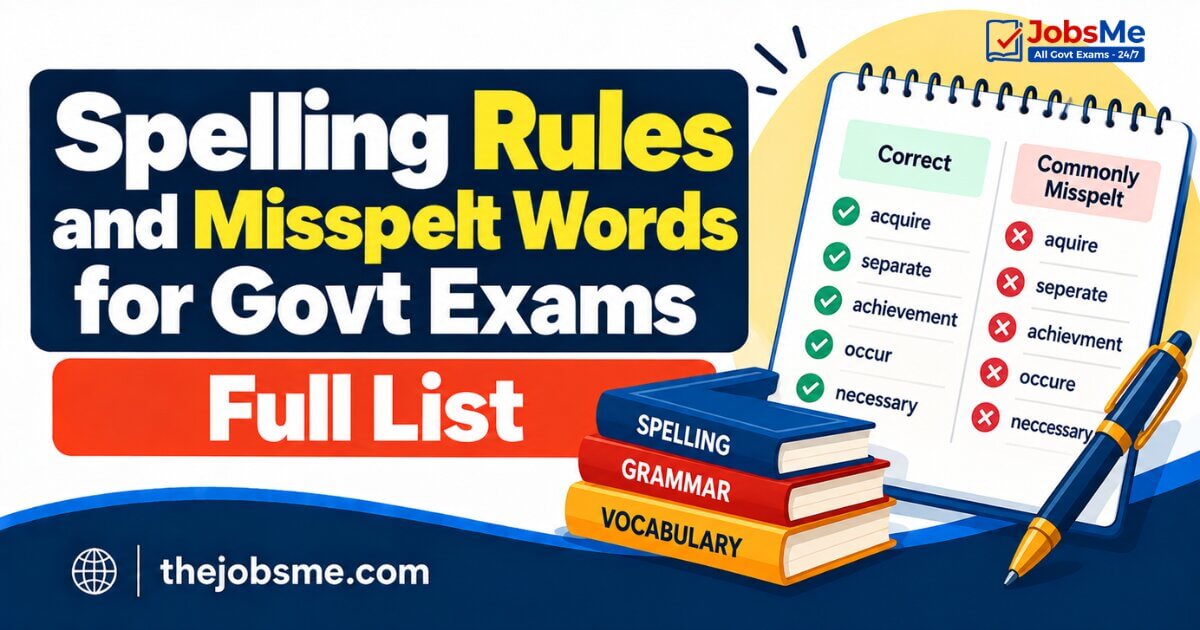
Spelling Rules and Misspelt Words for Govt Exams: Full List
This article is a complete, exam-ready guide to spelling and commonly misspelt words for SSC, banking, insurance, railway and State PSC exams. It covers the ten core spelling rules with their exceptions, the consonant-doubling rules that decide half of all errors, the prefix and suffix changes, the double-letter danger list, silent letters, a table of fifty commonly misspelt words with the wrong version and a memory trick for each, the British and American differences, the two question formats with a solving method, and a fifteen-question practice set with an answer key. Every rule comes with a correct and a wrong spelling that even a beginner can follow.
Introduction
A spelling question gives you four words. One is spelled correctly and three are not, or the reverse. You mark the odd one out.
It looks like the easiest question on the paper. It is also the one most students get wrong, and for a simple reason. English spelling does not follow pronunciation, so a word that sounds right can still be written wrong. Nobody says the second r in February, and nobody hears both cs in accommodation.
Two things fix this topic.
- Rules cover a large share of the errors: when to double a consonant, when to drop a silent e, when y becomes i.
- A word list covers the rest, because some words simply have to be memorised.
This article gives you both, in that order.
Where This Topic Is Asked
| Exam Group | How This Topic Appears | Rough Weight | What Makes It Hard Here |
|---|---|---|---|
| SSC exams | A named topic. You select the correctly or incorrectly spelt word from four options. | 1 to 2 questions in Tier 1, more in Tier 2 | Time. The English section carries 25 questions, and under the revised pattern each section has its own short timer. |
| Bank and insurance exams | Rarely a named topic, but spelling decides answers inside cloze tests, fillers and sentence improvement. | Indirect but regular | You must spot the wrong spelling without being told to look for one. |
| Railway exams | Direct spelling questions on everyday words. | 1 to 2 questions | Very little. These are among the easiest marks in the paper. |
| Defence and police exams | Spelling questions mixed with vocabulary and error spotting. | 1 to 2 questions | Longer and less familiar words. |
| State PSC exams | Objective spelling questions, plus spelling marks in the descriptive paper. | Varies by state | Handwritten answers, where a misspelling is fully visible. |
| Descriptive papers | Spelling errors cost language marks in a letter, report or essay. | Indirect but visible | You are your own proofreader, with no spellcheck. |
Notice the timing note in the first row. With a short sectional timer, a spelling question has to be finished in about 15 seconds, so this is a recognition topic rather than a reasoning one. Confirm the current pattern for your exam in the exam-wise syllabus hub before planning your attempts.
Concept in Simple Words
Why English Spelling Trips Students Up
Three causes explain almost every wrong answer in this topic.
- Pronunciation. Students write what they hear, which gives Febuary for February and enviroment for environment.
- Double letters. The ear cannot hear them, so accommodation loses a c or an m, and occurrence loses an r.
- Silent letters. Letters that are written but not spoken vanish from memory, as in knee, thumb and psychology.
The Two Question Formats
| Format | What You Are Given | How to Solve It | Time |
|---|---|---|---|
| Same word, four spellings | Four versions of one word, such as pionear, pionneer, poineer and pioneer. | Compare the options letter by letter and find where they differ. The difference is usually one doubled letter or one vowel. | 15 seconds. |
| Four different words | Four unrelated words, one of which is misspelt, such as pleasant, peasant, prefferable and proceed. | Check each word against the rules first, especially doubling, then against your memorised list. | 20 seconds. |
The instruction line matters more here than in any other topic. Read whether the question asks for the correctly spelt word or the incorrectly spelt one. Getting that backwards is the most common careless error in the whole section.
Formula Box
- i before e, except after c, and use ei when the sound is like ay
- Silent e is dropped before a vowel suffix, and kept before a consonant suffix
- Double the final consonant after a short vowel in a one-syllable word, or when the last syllable is stressed
- y becomes i after a consonant, but stays before a suffix starting with i
- Add -es after s, sh, ch, x and z
- q is always followed by u, and English words do not end in v or j
- Method = read the instruction, compare the options, apply the rule, then check your list
The Ten Spelling Rules
| Rule | Explanation | Correct | Wrong | Exception |
|---|---|---|---|---|
| 1. I before E, except after C | Use ie normally. Use ei after a c, and also when the vowel sounds like ay. | believe, chief, niece, field / receive, ceiling, deceive / weight, neighbour, freight | recieve, beleive, cieling | weird, seize, foreign, height, either. |
| 2. Drop the silent E before a vowel suffix | When a word ends in a silent e, drop it before -ing, -ed or -able. | make becomes making, hope becomes hoping, use becomes using | makeing, hopeing | Keep the e in dyeing and singeing, to separate them from dying and singing. |
| 3. Keep the E before a consonant suffix | Before -ful, -less, -ly and -ment, the final e usually stays. | hopeful, careless, definitely, excitement, forceful | hopful, carless, definitly | Argument and truly drop the e. |
| 4. Double the final consonant after a short vowel | In a one-syllable word ending in one vowel plus one consonant, double the consonant before a vowel suffix. | run becomes running, sit becomes sitting, hop becomes hopped, thin becomes thinner | runing, siting, hoped for hopped | Does not apply if the word ends in two consonants or has two vowels together. |
| 5. Double only if the last syllable is stressed | In longer words, double the consonant only when the stress falls on the final syllable. | begin becomes beginning, refer becomes referring, occur becomes occurrence, admit becomes admitting, prefer becomes preferred | begining, refering, occurence | Benefit becomes benefited, because the stress is not on the last syllable. |
| 6. Change Y to I after a consonant | If a consonant comes before the y, change it to i before adding -ed, -er, -est or -es. | happy becomes happier, cry becomes cried, party becomes parties, sky becomes skies | happyer, cryed, partys | Keep the y if the suffix begins with i: copying, studying. |
| 7. Keep Y after a vowel | If a vowel comes before the y, simply add s. | boy becomes boys, stay becomes stays, delay becomes delays | boies, staies | A few irregular verbs such as say and pay in the past tense: said, paid. |
| 8. Add -ES after s, sh, ch, x and z | These endings need an extra syllable, so the plural or verb form takes -es. | bus becomes buses, dish becomes dishes, watch becomes watches, box becomes boxes, buzz becomes buzzes | buss, dishs, watchs | Words already ending in e simply add s. |
| 9. Q is always followed by U | In almost all English words, q takes a u after it. | quick, question, quality, quiz, acquire | qick, aqire | A handful of loanwords, which exams do not test. |
| 10. English words do not end in V or J | A word ending in the v sound takes a final e. | give, love, live, serve, believe | giv, luv, serv | Abbreviations and brand names only. |
Two More Rules Worth Knowing
- Use CK after a short vowel in a one-syllable word: back, neck, sock, pick, duck.
- Full becomes -ful when added to the end of a word, dropping one l: cupful, cheerful, joyful, careful. This is a favourite trap, because students write carefull.
Prefix Rules: In Becomes Il, Im and Ir
The prefix in- changes shape to match the letter that follows it. This explains several spellings that look strange.
| Change | Before Which Letter | Examples |
|---|---|---|
| in becomes il | before l | illegible, illiterate, illogical, illegal |
| in becomes im | before m and p | immoral, immature, impossible, impatient |
| in becomes ir | before r | irrelevant, irresponsible, irreplaceable, irregular |
| in stays in | before other letters | indirect, incorrect, inactive, invisible |
Notice what this produces. Illiterate has two l's and irrelevant has two r's, not because of any doubling rule but because the prefix changed to match the root. The same logic explains misspell, which keeps the s of mis and the s of spell. If prefixes interest you, the full set is in root words.
The Danger Lists
Double Letters: The Biggest Single Cause of Errors
You cannot hear a double letter, so these have to be seen and stored. Learn the pattern for each word.
| Correct Spelling | The Pattern | Common Wrong Version | Memory Trick |
|---|---|---|---|
| accommodation | two c's and two m's | accomodation, acommodation | Two cots and two mattresses in the room. |
| necessary | one c, two s's | neccessary, necesary | One collar and two sleeves. |
| occurrence | two c's and two r's | occurence, ocurrence | Read it as oc-cur-rence, and remember occur takes a double r before a suffix. |
| embarrassment | two r's and two s's | embarassment, embarrasment | It is doubly embarrassing, so double both. |
| harassment | one r, two s's | harrassment | The opposite of embarrass, so compare the two and store them as a pair. |
| committee | two m's, two t's, two e's | commitee, comitee | Three doubles in one word. |
| recommend | one c, two m's | reccommend, recomend | It is re plus commend, and commend has the double m. |
| possession | two s's twice | posession, possesion | Four s's in all, in two pairs. |
| questionnaire | two n's | questionaire | Question plus n plus naire. |
| parallel | one r, two l's, then one l | paralell, parrallel | The two l's in the middle stand side by side, like parallel lines. |
| millennium | two l's and two n's | millenium, milennium | From mille meaning thousand and annum meaning year, so both parts keep their doubles. |
| address | two d's and two s's | adress, addres | Add plus dress. |
| aggressive | two g's and two s's | agressive, aggresive | Two g's for extra force. |
| assessment | two s's twice | assesment, asessment | The same double pattern as possession. |
| tomorrow | one m, two r's | tommorow, tommorrow | To plus morrow, so the m stays single. |
Silent Letters
| Silent Letter | Where It Hides | Examples |
|---|---|---|
| Silent K | before n at the start | knee, knife, know, knowledge, knight |
| Silent B | after m, or before t | thumb, comb, doubt, debt, subtle |
| Silent P | before s or n at the start | psychology, pneumonia, receipt |
| Silent G | before n | gnome, sign, foreign, campaign, design |
| Silent H | at the start, or after r and g | hour, honest, heir, rhythm, ghost |
| Silent W | before r, or in some question words | write, wrong, wrist, answer, sword |
| Silent L | before k, m, f and d | talk, calm, half, could, should, would |
| Silent T | in the middle of some words | listen, castle, whistle, often, fasten |
| Silent N | after m at the end | autumn, column, hymn, condemn |
| Silent U | after g | guard, guess, guest, guitar, tongue |
Exam Alert
- Read the instruction line twice. Correctly spelt and incorrectly spelt are opposite tasks.
- Compare the options, do not read them. Find the exact letter where the four versions differ.
- Doubles decide most questions. Check the doubled letters before anything else.
- Never spell by sound. Febuary, enviroment and goverment are all written the way they are spoken, and all are wrong.
- Your first instinct is usually right in this topic, so do not second-guess a familiar word.
Quick Facts
- accommodation → two c's, two m's
- necessary → one c, two s's
- harassment → one r, two s's
- embarrassment → two r's, two s's
- occurrence → two c's, two r's
- recommend → one c, two m's
Fifty Commonly Misspelt Words
| Correct | Common Wrong Version | What to Watch |
|---|---|---|
| achievement | acheivement | i before e here. |
| acquire | aquire | The c before the q. |
| argument | arguement | Drops the e of argue. |
| athlete | athelete | No e in the middle. |
| believe | beleive | i before e, no c present. |
| brochure | broshure | The ch spelling. |
| bureaucracy | beaurocracy | The eau in bureau. |
| business | buisness, bussiness | Busy plus ness, with one s in the middle. |
| calendar | calender | Ends in ar, not er. |
| camouflage | camoflage | The ou in the middle. |
| cemetery | cemetary | Three e's and no a. |
| chauffeur | chauffer | Ends in eur. |
| colleague | collegue, collague | The ea before gue. |
| conscious | concious | The sc in the middle. |
| definitely | definately | Break it as de-fin-ite-ly. |
| discipline | disciplin, descipline | The sc and the final e. |
| entrepreneur | enterpreneur, entreprenuer | Entre, not enter, and eur at the end. |
| environment | enviroment | The n before the m, which nobody pronounces. |
| exaggeration | exageration | Two g's. |
| existence | existance | Ends in ence. |
| February | Febuary | The r before the u. |
| foreigner | foriegner | An ei exception with a silent g. |
| fulfil | fullfill | One l in the middle, and one at the end in British usage. |
| government | goverment | Govern plus ment, so the n stays. |
| grammatical | gramatical | Two m's, from grammar. |
| guarantee | gaurantee | The ua after the g. |
| handkerchief | hankerchief | Hand plus kerchief, with a silent d. |
| hierarchy | heirarchy | Hier, not heir. |
| independent | independant | The adjective ends in ent. |
| knowledge | knowlege | The d before the ge. |
| maintenance | maintainance | Maintain becomes maintenance, dropping the second a. |
| mischievous | mischievious | Three syllables only, with no extra i. |
| occasion | ocassion | Two c's and one s. |
| pioneer | pionear, poineer | Pio plus neer. |
| preferable | prefferable | No doubling, because the stress moves back. |
| privilege | priviledge, privilage | No d, and an e in the middle. |
| pronunciation | pronounciation | It loses the ou of pronounce. |
| receive | recieve | ei after c. |
| relevant | relevent | Ends in ant. |
| responsibility | responsiblity | The i before the l. |
| restaurant | restaurent | Ends in ant, with au in the middle. |
| rhythm | rythm | Two h's and no vowel between them. |
| separately | seperately | There is a rat in sepa-rat-ely. |
| sincerely | sincerly | Keeps the e of sincere. |
| supersede | supercede | The only common English word ending in sede. |
| surprise | suprise | The first r, which is rarely pronounced. |
| twelfth | twelth | The f before the th. |
| vacuum | vacume, vaccum | One c and two u's. |
| Wednesday | Wensday | Read it as Wed-nes-day when you write it. |
| withhold | withold | With plus hold, so two h's meet. |
British and American Spellings
Indian exams follow British spelling. Both forms are correct English, but in an exam the British version is normally the expected answer.
| Difference | British | American |
|---|---|---|
| our against or | colour, honour, behaviour, labour | color, honor, behavior, labor |
| re against er | centre, metre, theatre, litre | center, meter, theater, liter |
| ise against ize | organise, realise, recognise | organize, realize, recognize |
| ce against se | defence, offence, licence as a noun | defense, offense, license |
| Doubling the l | travelling, cancelled, modelling | traveling, canceled, modeling |
| ogue against og | catalogue, dialogue, analogue | catalog, dialog, analog |
The Four-Step Solving Method
- Read the instruction. Decide whether you are hunting for the correct word or the wrong one, and underline that word in the question.
- Compare, do not read. Place the options side by side and find the exact letter where they differ. In same-word questions the difference is a single letter or a doubling.
- Apply a rule. Check the doubling rule, the i-before-e rule and the suffix rules before you rely on memory.
- Fall back on the list. If no rule applies, the word is on the memorised list, so trust the version that looks familiar and move on.
Key Highlights
- Doubling decides most questions. Check doubled letters before anything else.
- Never trust pronunciation. February, environment and government all lose a letter when spoken.
- Compare the options letter by letter instead of reading them one at a time.
- British forms are expected in Indian exams, and American forms appear as distractors.
- This is a recognition topic, so a word you have revised is a mark and a word you have not is a guess.
Worked Examples: Wrong to Right
Example 1 (missing double letter)
Sentence: Select the correctly spelt word: Acommodation, Accomodation, Accommodation, Accommadation.
Trap: Three of the four look reasonable, because the ear hears only one c and one m. The word needs both doubles, and the fourth option also swaps an o for an a.
Correct Answer: Accommodation.
Rule in Simple Words: Two cots and two mattresses. Two c's and two m's.
Example 2 (spelling by sound)
Sentence: Select the correctly spelt word: Enviroment, Environment, Enviourment, Enviorment.
Trap: Nobody pronounces the n before the m, so the shortest option sounds exactly like the word. Spelling follows the written root environ, not the spoken form.
Correct Answer: Environment.
Rule in Simple Words: Never spell by sound. Government, February and surprise fail the same way.
Example 3 (the doubling rule)
Sentence: Select the incorrectly spelt word: Pleasant, Peasant, Prefferable, Proceed.
Trap: Doubling feels right because prefer becomes preferred, so students accept the double f. The stress shifts when able is added, so the consonant is not doubled.
Correct Answer: Prefferable is wrong. The correct spelling is preferable.
Rule in Simple Words: Double only when the final syllable is stressed. Preferred doubles, preferable does not.
Example 4 (an extra syllable added)
Sentence: Select the correctly spelt word: Mischievious, Mischivous, Mischievous, Mischevous.
Trap: Many speakers add a fourth syllable and say mis-chee-vee-ous, which produces the extra i. The word has three syllables and no i before the ous.
Correct Answer: Mischievous.
Rule in Simple Words: If you say an extra syllable, you will write an extra letter. Check the ending.
Example 5 (reading the instruction backwards)
Sentence: The question asks for the INCORRECTLY spelt word, and the student marks the one word that is spelled correctly.
Trap: Under a sectional timer the eye skips the capitalised instruction and settles into the familiar habit of finding the right answer. One misread word costs the whole mark.
Correct Answer: Underline the instruction word before looking at the options.
Rule in Simple Words: Read what the question wants, then read the options.
Example 6 (i before e)
Sentence: Select the correctly spelt word: Recieve, Receive, Receeve, Reciev.
Trap: The first two look almost identical, and recieve is the version most people write by habit. There is a c before the vowels, so the order is ei.
Correct Answer: Receive.
Rule in Simple Words: I before E, except after C. Believe has no c, so it takes ie.
Example 7 (two similar words stored as a pair)
Sentence: Which is correct: Harrassment or Harassment? And Embarassment or Embarrassment?
Trap: The two words feel like they should follow the same pattern, so students double both letters in each. Harassment has one r and two s's, while embarrassment has two of each.
Correct Answer: Harassment and embarrassment.
Rule in Simple Words: Store confusing look-alikes as a pair, with the difference written between them.
Example 8 (British against American)
Sentence: Select the correctly spelt word for an Indian exam: Center, Centre, Centere, Sentre.
Trap: Center appears constantly online and in software, so it looks perfectly normal. Indian exams follow British spelling, which puts the re at the end.
Correct Answer: Centre.
Rule in Simple Words: Follow British spelling: colour, centre, organise, defence, travelling.
Common Traps Students Fall Into
These are the habits that most often cost marks. Each one is a common trap, not a silly mistake, and each has a one-line fix.
- Trap: Writing what you hear. Fix: Spelling follows the written root, not the spoken sound.
- Trap: Missing double letters. Fix: Check the doubled letters first, since they decide most questions.
- Trap: Adding a double letter that does not belong. Fix: Apply the stress rule before doubling. Preferable and benefited take no double.
- Trap: Misreading the instruction. Fix: Underline correctly or incorrectly in the question before you begin.
- Trap: Reading the options instead of comparing them. Fix: Line them up and find the single letter that differs.
- Trap: Choosing the first familiar-looking word. Fix: Familiar is not the same as correct, because the wrong version is often the one you see most.
- Trap: Overthinking after you have decided. Fix: Your first reading is usually right in this topic. Do not talk yourself out of it.
- Trap: Using American spellings. Fix: Indian exams follow British forms, so write colour, centre and organise.
- Trap: Guessing without practice. Fix: This is a memory topic, so a list you never revise is a list you do not have.
- Trap: Skipping spelling in the descriptive paper. Fix: Keep two minutes for proofreading, since a misspelling is fully visible in letter writing and essay answers.
- Trap: Studying spelling separately from vocabulary. Fix: Learn a word's spelling and meaning together, alongside commonly confused words.
Memory Tricks and Formulas
1. Break the word into syllables
Say and write oc-cur-rence, de-fin-ite-ly and Wed-nes-day. Splitting a long word into chunks stops the eye from skipping a letter, and it exposes the silent parts that pronunciation hides.
2. Make a sentence from the letters
Take the letters of a stubborn word and build a phrase. Because becomes Big Elephants Can Always Understand Small Elephants. Silly sentences stick far better than repetition.
3. Two cots and two mattresses
Accommodation has two c's and two m's. Necessary has one collar and two sleeves. Separately has a rat in the middle. Three hooks, three guaranteed marks.
4. Hide a smaller word inside
Find a word within the word. There is a secret in secretary, a rat in separate, a lie in believe and an us in business. The small word fixes the spelling of the big one.
5. Doubling in one line
Double the final consonant when a short vowel comes before it and the stress falls on that syllable. Begin becomes beginning, occur becomes occurrence, prefer becomes preferred. But preferable and benefited take no double, because the stress moves back.
6. Check the ending group
Many errors sit in the last three letters. Ask whether the word ends in ance or ence, ant or ent, ar or er, able or ible. Existence, relevant, calendar and sensible each turn on that single choice.
7. Write it, do not just read it
Copy a difficult word five times by hand. Spelling is stored partly as movement, which is why writing fixes a word faster than reading it ten times.
8. Twenty words a week, from your own errors
Keep a personal list of every word you get wrong and revise about 20 words a week. Your own mistakes are worth more than any general list, because they are the ones you will repeat.
Exam Patterns and High-Yield Facts
Frequently Confused Pairs
| Pair | How They Differ | Mini Trick |
|---|---|---|
| ance vs ence | Existence, occurrence and independence take ence. Maintenance, assistance and relevance take ance. | No rule covers all, so store the word with its ending. |
| ant vs ent | Relevant, assistant and important take ant. Independent, different and consistent take ent. | Independent has three e's. |
| able vs ible | Affordable and preferable take able. Sensible, audible and legible take ible. | If the root is a complete word, able is more likely. |
| ar vs er | Calendar, grammar and particular take ar. Character and manager take er. | Calendar ends in ar, calender does not exist. |
| ise vs ize | British uses ise, American uses ize. | Indian exams follow the British ise. |
| ceed, cede and sede | Only proceed, exceed and succeed use ceed. Supersede is the only common sede word. Everything else uses cede, and the roots explain why: see one-word substitution. | Three ceeds, one sede, the rest cede. |
| Harassment vs Embarrassment | Harassment has one r, embarrassment has two. | Learn them side by side. |
| Practice vs Practise | In British usage the c form is the noun and the s form is the verb. | Same pattern as advice and advise. See homonyms and confusables. |
| Stationary vs Stationery | Stationary means still, stationery means writing materials. | Stationery has an e for envelope. |
| Dyeing vs Dying | Dyeing keeps the e to mean colouring cloth. Dying means ceasing to live. | The e survives to save the meaning. |
Repeating Question Patterns
- Double-letter words dominate: accommodation, committee, occurrence, embarrassment, necessary, recommend.
- Sound-based errors repeat: February, environment, government, surprise, pronunciation, Wednesday.
- ous-ending word sets appear as four-word questions: gregarious, miscellaneous, multifarious, fallacious, hilarious.
- Suffix-ending questions test ance against ence and ant against ent, where three options are real words.
- Loanwords are a favourite: chauffeur, brochure, camouflage, entrepreneur, questionnaire, bureaucracy.
- British against American appears indirectly, with the American form offered as a distractor.
Practice Set: Fifteen Questions
Choose the correctly spelt word in each group. Give each item fifteen seconds.
- Concious / Conscious / Conscous / Consious
- Acommodation / Accomodation / Accommodation / Accommadation
- Mischievious / Mischivous / Mischievous / Mischevous
- Embarassment / Embarrassment / Embarasment / Embarrasment
- Neccessary / Necessary / Necesary / Neccesary
- Exageration / Exaggaration / Exaggeration / Exagerasion
- Privilage / Priviledge / Privilege / Previlige
- Handkercheif / Hankerchief / Handkerchief / Handkarchief
- Occurence / Occurrence / Ocurrence / Occurense
- Enviroment / Environment / Enviourment / Enviorment
- Maintainance / Maintanance / Maintenance / Maintanence
- Collaegue / Colleague / Collague / Collegue
- Existance / Existence / Existense / Exeistance
- Vacume / Vacuum / Vaccume / Vaccum
- Seperately / Separately / Seperatly / Separetely
Quick Facts
Answer key, with the reason in one line each.
- 1. Conscious. The sc in the middle is the part students drop.
- 2. Accommodation. Two c's and two m's.
- 3. Mischievous. Three syllables, with no i before the ous.
- 4. Embarrassment. Two r's and two s's.
- 5. Necessary. One c and two s's.
- 6. Exaggeration. Two g's.
- 7. Privilege. No d anywhere in the word.
- 8. Handkerchief. Hand plus kerchief, with a silent d.
- 9. Occurrence. Two c's and two r's, because occur doubles before a suffix.
- 10. Environment. The n before the m that nobody pronounces.
- 11. Maintenance. Maintain loses its second a in the noun.
- 12. Colleague. The ea before the gue.
- 13. Existence. The ence ending.
- 14. Vacuum. One c and two u's.
- 15. Separately. There is a rat in sepa-rat-ely.
Look at what settled those fifteen. Ten of them turned on a doubled letter or a letter that pronunciation hides. Practise the same eye with the free English MCQ quizzes and full papers from the mock test archive.
One-Liners for Quick Revision
Quick Revision
- Spelling question → four words, one odd → read whether the correct or incorrect one is wanted.
- Three causes of error → pronunciation, double letters, silent letters.
- i before e → except after c, and ei when the sound is like ay → weird and seize are exceptions.
- Silent e → dropped before a vowel suffix → make becomes making.
- Silent e kept → before a consonant suffix → hopeful, careless, excitement.
- Doubling → short vowel plus single consonant in a one-syllable word → run becomes running.
- Doubling in long words → only when the last syllable is stressed → begin becomes beginning.
- No doubling → after two consonants or two vowels → lifted, meeting, rained.
- y after a consonant → becomes i → happy becomes happier, party becomes parties.
- y after a vowel → stays → boy becomes boys, delay becomes delays.
- y before an i suffix → stays → copying, studying.
- Add -es → after s, sh, ch, x and z → buses, dishes, watches, boxes.
- q → always followed by u → quick, acquire.
- No v or j endings → give, love, serve.
- ck → after a short vowel → back, neck, pick.
- full becomes ful → one l when added to a word → careful, cupful, joyful.
- in becomes il, im, ir → before l, before m or p, before r → illegal, impossible, irrelevant.
- Double-letter list → accommodation, committee, occurrence, embarrassment, possession, aggressive.
- One-letter traps → harassment one r, necessary one c, recommend one c, tomorrow one m.
- Sound traps → February, environment, government, surprise, pronunciation, Wednesday.
- Silent letters → knee, thumb, psychology, sign, hour, write, calm, listen, autumn, guard.
- Ending choices → ance or ence, ant or ent, ar or er, able or ible → check the last three letters.
- ceed, cede, sede → proceed, exceed and succeed → supersede is the only sede word.
- British spelling → colour, centre, organise, defence, travelling → expected in Indian exams.
- Dyeing and dying → the e survives to keep the meaning of colouring cloth.
- Method → read the instruction, compare the options, apply a rule, then trust the list.
- Timing → about 15 seconds per question → this is recognition, not reasoning.
- Study rule → twenty words a week, taken from your own wrong answers.
- Writing beats reading → copy a hard word five times by hand.
- Descriptive papers → keep two minutes to proofread spelling before submitting.
Spelling is the most literal topic in the English paper: what you have revised, you can answer, and what you have not, you cannot. So keep a personal list of every word you get wrong, revise twenty a week, and write the hard ones out by hand rather than reading them. Reading supplies the words in their correct form, so ten minutes of daily current affairs reading is worth more than an hour of staring at a list. Support the topic with error spotting and synonyms and antonyms practice, where the same words reappear, and revise the wider topic-wise English notes alongside.
Frequently Asked Questions
How are spelling questions asked in exams?
What is the i before e rule?
When do I double the final consonant?
Why are double letters such a common source of errors?
Which spellings do Indian exams follow, British or American?
How do I remember words like necessary and accommodation?
How much time should I spend on a spelling question?
What is the most common careless mistake in this topic?
How many words should I revise each week?
Does spelling matter in the descriptive paper too?

About the author





