
Gerund, Infinitive and Participle: Function Decides, Not Form
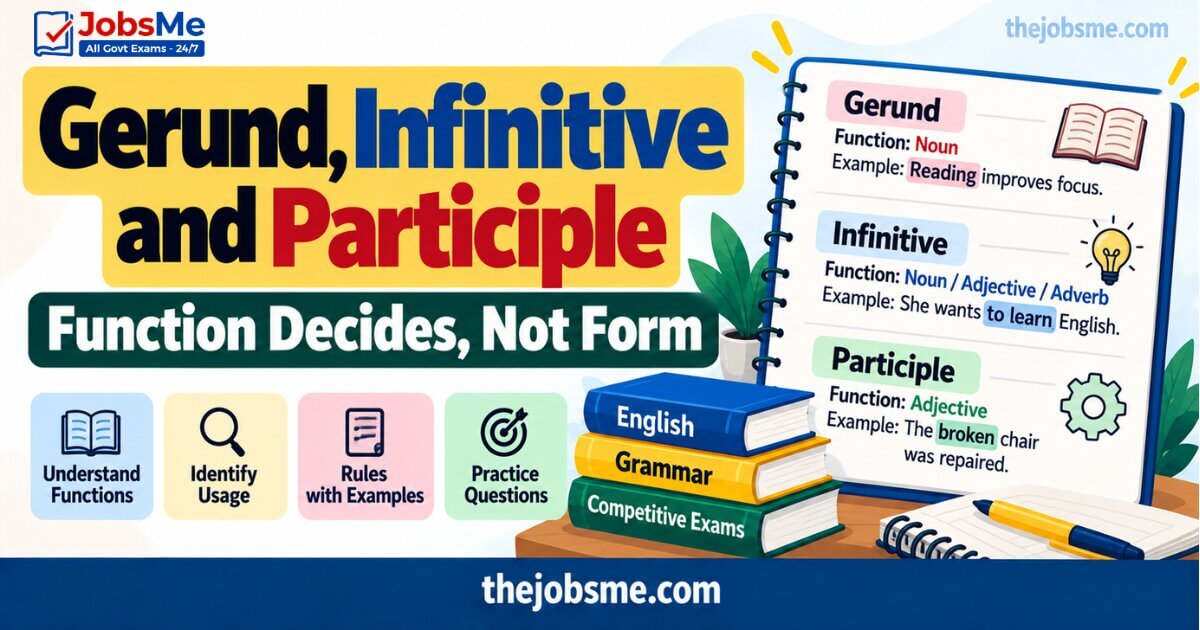
This article is a complete, exam-ready guide to gerunds, infinitives and participles for SSC, banking, insurance, railway, defence and State PSC exams. It rests on a fact that most guides state and then work around: a gerund and a present participle are the same word. Both are the verb plus -ing, so the form tells you nothing and only the job the word is doing can identify it. A gerund works as a noun, a participle works as an adjective or a connector, and an infinitive works as all three. So this guide teaches the function test first, then the jobs each form performs, the perfect and passive versions of all three, the participle connector rules, and the dangling participle error. Ten solved questions, common traps and a fifteen-question practice set with a full answer key are included.
Introduction
Gerunds, infinitives and participles are the three non-finite verb forms. They come from verbs but do not act as verbs, and they carry no tense of their own.
Most guides define them one after another and then ask you to identify them. That order fails on the first real question, and here is why.
A gerund and a present participle are the same word. Both are the verb plus -ing, so the form tells you nothing at all. Only the job the word is doing can identify it.
- Dancing is good exercise. The word fills the subject slot, so it is working as a noun. That makes it a gerund.
- Pinki plays with her dancing doll. The word describes the doll, so it is working as an adjective. That makes it a participle.
Nothing about dancing changed. Its part of speech changed because its job changed. So the question in an exam is never which -ing word this is, but what work the word is doing in this particular sentence.
This article therefore starts with the function test, then works through the jobs each form performs.
Where This Topic Is Asked
| Exam | How This Topic Appears | Rough Weight | Difficulty |
|---|---|---|---|
| SSC CGL and CHSL | Swapped gerunds and infinitives in error spotting, and dangling participles in sentence improvement. | 1 to 2 questions | Easy once the patterns are fixed. |
| IBPS PO and SBI PO | Verb patterns inside long passages, and possessives before gerunds in a cloze test. | 1 to 2 questions | Moderate. |
| RRB NTPC and Group D | Straightforward identification and simple patterns. | 1 question | Easy. |
| State PSC and defence exams | Direct identification and the classic bare infinitive traps. | 1 to 2 questions | Moderate. |
| Sentence rearrangement | A participle phrase usually belongs beside the noun it describes. | Indirect | Moderate. |
| Descriptive papers | A dangling participle is the fault an examiner notices first. | Indirect | Worth a final check. |
Two rules alone account for most of the questions: a preposition always takes a gerund, and a participle phrase must have a logical subject. Everything else in this topic is refinement. Check your own pattern in the exam-wise syllabus hub.
The Function Test
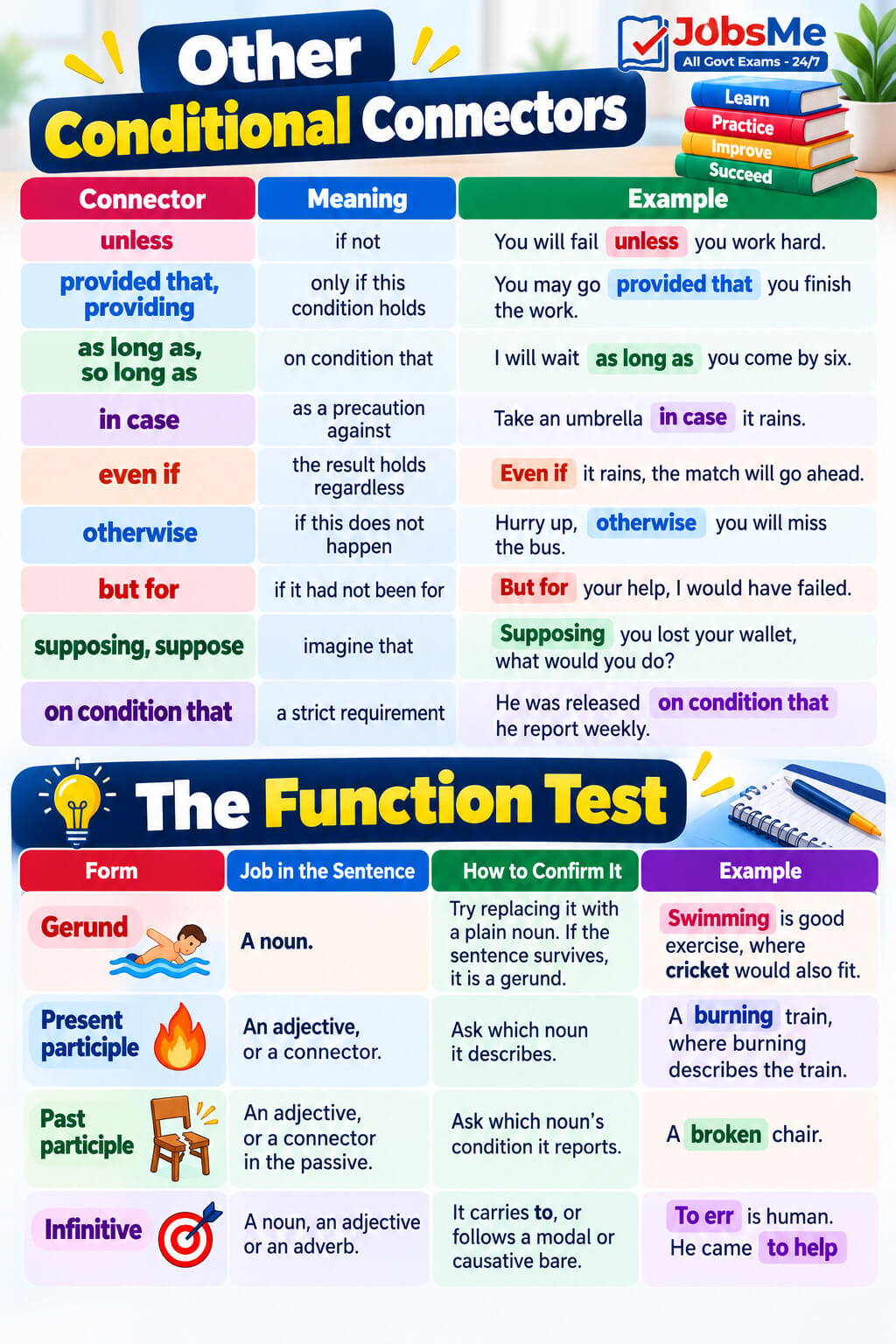
| Form | Job in the Sentence | How to Confirm It | Example |
|---|---|---|---|
| Gerund | A noun. | Try replacing it with a plain noun. If the sentence survives, it is a gerund. | Swimming is good exercise, where cricket would also fit. |
| Present participle | An adjective, or a connector. | Ask which noun it describes. | A burning train, where burning describes the train. |
| Past participle | An adjective, or a connector in the passive. | Ask which noun's condition it reports. | A broken chair. |
| Infinitive | A noun, an adjective or an adverb. | It carries to, or follows a modal or causative bare. | To err is human. He came to help. |
A useful contrast sits in the source material itself. In we are planning to visit a happening club tonight, there is one finite verb and two non-finite ones. Are planning is finite, to visit is an infinitive working as the object, and happening is a participle describing the club. A clause holds exactly one finite verb but may hold several non-finite ones, which is why counting them is the first step in any verb question. That count is covered in verbs.
Formula Box
- Function decides, not form. A gerund and a present participle look identical.
- Gerund equals noun. Participle equals adjective. Infinitive equals all three.
- A preposition always takes a gerund, with no exceptions.
- Use a possessive before a gerund, so my going rather than me going.
- Simultaneous actions take the present participle; a time gap takes the perfect participle.
- A participle phrase needs a logical subject, or the sentence dangles.
- Make takes a bare infinitive in the active and a full one in the passive.
The Gerund and Its Five Jobs
Because a gerund is a noun, it can do everything a noun does.
| Job | Example |
|---|---|
| Subject | Smoking is injurious to health. |
| Object of a verb | She enjoys riding in the hills. |
| Object of a preposition | He is tired of working here. |
| Complement after be | Seeing is believing. |
| In apposition to a noun | His hobby, collecting stamps, keeps him busy. |
The Preposition Rule
This is the single most productive rule in the topic. A verb following a preposition takes the gerund every time, with no exceptions to learn.
- Wrong: I was prohibited from go there. Right: prohibited from going there.
- Wrong: She is confident of get success. Right: confident of getting success.
- Wrong: A monument of Congress failure in address poverty. Right: in addressing poverty.
The difficulty is that to is sometimes a preposition and sometimes the marker of an infinitive. These take gerunds because their to is a preposition: look forward to, used to for a habit, accustomed to, addicted to, averse to, object to, prone to, given to, with a view to, owing to, devoted to, opposed to.
The test is to put a noun after the to. Looking forward to the meeting works, so to is a preposition and the gerund follows. The wider preposition list is in prepositions.
The Possessive Before a Gerund
Because a gerund is a noun, the word in front of it takes the possessive form.
- Wrong: Father is upset about me failing the test. Right: upset about my failing the test.
- Wrong: They objected to him joining late. Right: objected to his joining late.
- Note the form: the word needed is my and their, not mine and theirs, since a noun follows.
Fixed Expressions Taking a Gerund
A group of phrases opening with it or there always takes the gerund.
It is no use, it is no good, it is worth, it is not worth, there is no point, there is no, cannot help, cannot bear, cannot resist.
- Wrong: It is no use to cry before a callous judge. Right: no use crying.
- Right: There is no point worrying about it. It is worth visiting. I cannot help admiring his courage.
The Infinitive and Its Jobs
| Job | Example | Note |
|---|---|---|
| As a noun | To err is human. | Formal; the gerund is commoner in this slot. |
| As an adjective | He is the man to consult. | Equivalent to a relative clause. |
| As an adverb of purpose | He came to help us. | Answers why. |
| After an ordinal or a superlative | He was the first to come and the last to leave. | A fixed pattern after first, last, next, only, best. |
| After certain adjectives | It was hard to find the file. | Easy, hard, happy, glad, lucky, sorry, anxious. |
Purpose Against Reason
This distinction is directly tested. An infinitive states a purpose, while for plus a gerund states a reason.
- Wrong: Rekha was punished to come late. Right: Rekha was punished for coming late.
- Right: He went to the market to buy vegetables, which is his purpose.
- Right: He was praised for saving the child, which is the reason.
How Plus the Infinitive
When the infinitive expresses a method or a learned skill, know requires how before it.
- Wrong: He knows to read and write English. Right: He knows how to read and write English.
One correction is needed here, because a widely used note extends this to teach as well, marking my father taught him to drive a car as wrong. That sentence is perfectly standard English. With teach, how is optional. It is genuinely required only after know, so do not select a taught him to segment as the error.
The Participle and Its Two Jobs
There are three participles, and between them they do two jobs.
| Participle | Form | What It Shows | Example |
|---|---|---|---|
| Present | verb plus -ing | An action in progress, or the nature of a thing. | A burning train. A printing press. |
| Past | third form | A completed action, or a condition. | A broken chair. A burnt finger. |
| Perfect | having plus third form | An action finished before another began. | Having finished his homework, he went to play. |
Job One: As an Adjective
- The present participle names a nature or habit. A dancing doll is a doll that dances. A printing press is a press that prints, which is why a print press is wrong.
- The past participle names a condition. A burnt finger is a finger in a burnt state, and Seema returned disappointed reports her condition on returning.
The distinction matters in pairs such as an interesting book against an interested reader. The -ing form describes what the thing does to you, and the third form describes how you feel.
Job Two: As a Connector
A participle can join two sentences into one, and which participle you use depends on the relationship between the two actions.
| Relationship | Participle | Two sentences | Joined |
|---|---|---|---|
| Simultaneous, active | Present | I saw a man. He was crossing the road. | I saw a man crossing the road. |
| Simultaneous, passive | Past | The workers were dressed in black. They shouted slogans. | Dressed in black, the workers shouted slogans. |
| A gap between the actions | Perfect | The sun rose. The farmers went to the fields. | The sun having risen, the farmers went to the fields. |
| A gap, same subject | Perfect | He finished his homework. He went out to play. | Having finished his homework, he went out to play. |
The third row needs care, and one guide gets it wrong. It offers Having the sun risen, farmers went to their fields, which is not English. When the participle has a different subject from the main clause, that subject comes first, giving the sun having risen.
Converting Between the Three Forms
Transformation questions often ask for the same idea expressed through a different non-finite form. The conversions follow fixed shapes.
| Conversion | Method | Example |
|---|---|---|
| Gerund to infinitive as subject | Open with it and move the infinitive to the end. | Smoking is injurious becomes it is injurious to smoke. |
| Clause to participle | Drop the conjunction and the subject when both clauses share a subject. | As he had failed twice, he tried again becomes having failed twice, he tried again. |
| Clause to infinitive of purpose | Replace so that with the infinitive. | He worked hard so that he might pass becomes he worked hard to pass. |
| Relative clause to infinitive | Replace who or which plus the verb. | He was the first who came becomes he was the first to come. |
| Participle to relative clause | Expand the participle into a full clause. | A man carrying a bag becomes a man who was carrying a bag. |
In every case the meaning must survive unchanged, which is the governing rule of all conversion work. The wider set of conversions is in transformation of sentences.
The Four Forms of Each
Each non-finite form has a simple version and three more, and the perfect versions in particular are tested.
| Version | Infinitive | Gerund | Used When |
|---|---|---|---|
| Simple | to write | writing | Same time as the finite verb, or later. |
| Perfect | to have written | having written | Earlier than the finite verb. |
| Passive | to be written | being written | The subject receives the action. |
| Perfect passive | to have been written | having been written | Earlier, and received. |
When the Perfect Form Is Required
Use the perfect form when the action of the non-finite verb happened before the action of the finite verb.
- Wrong: The exams were supposed to begin on March 27 but were postponed. Right: were supposed to have begun on March 27, since the intended start preceded the postponement.
- Right: He is reported to have left the country last week.
- Right: The manuscript is thought to have been stolen.
- Right: She denied having seen them, using the perfect gerund.
A caution on this rule, because a source illustrates it with she denied to have seen them yesterday. That is wrong for a different reason. Deny takes a gerund, never an infinitive, so it must read she denied having seen them. The perfect rule is right and the example breaks a different rule.
The Passive Forms
- Passive infinitive: The carpet needs to be washed. These doors should be shut at night.
- Passive gerund: I do not like being cheated. He remembers being given the book.
- A gerund can carry a passive sense without the form. The house needs painting means the same as needs to be painted, and both are correct.
Key Highlights
- Form tells you nothing; a gerund and a present participle are the same word.
- Two rules cover most questions: a preposition takes a gerund, and a participle needs a subject.
- The verb lists carry no logic, so they must be memorised rather than reasoned.
- The perfect form marks the earlier action, which Tier 2 papers test directly.
- Three of the six source faults below are sentences no fluent speaker would produce.
The Dangling Participle
A participle phrase must describe the subject of the main clause. When it does not, the sentence says something absurd, and that is the error.
| Faulty sentence | What it actually says | Two repairs |
|---|---|---|
| Walking in the park, a snake bit him. | The snake was walking in the park. | Add a clause: While he was walking in the park, a snake bit him. Or change the subject: Walking in the park, he was bitten by a snake. |
| Being a rainy day, I could not go to school. | I was a rainy day. | Supply the participle's own subject: It being a rainy day, I could not go to school. |
| Having failed twice, his father advised him to try again. | The father failed twice. | As he had failed twice, his father advised him to try again. |
Note the second repair in the first row. One guide writes it as he was bit by a snake, which needs the participle bitten. The full treatment of misplaced and dangling modifiers is in modifiers.
Bare Infinitive: The Active and Passive Asymmetry
A bare infinitive follows modals, had better, would rather, and the verbs make, let, bid, see, hear, watch and feel. There is one twist that examiners use.
- Active: I made the student write an essay.
- Passive: The student was made to write an essay by me.
So make takes a bare infinitive in the active and a full one in the passive, and the same holds for see, hear and bid. Let is the exception, keeping the bare form, though its passive is uncommon and he was allowed to go usually reads better.
Note also that would better is not an English phrase, though one source lists it beside had better and would rather. The bare infinitive list is developed further in modals.
The Verb Patterns in Brief
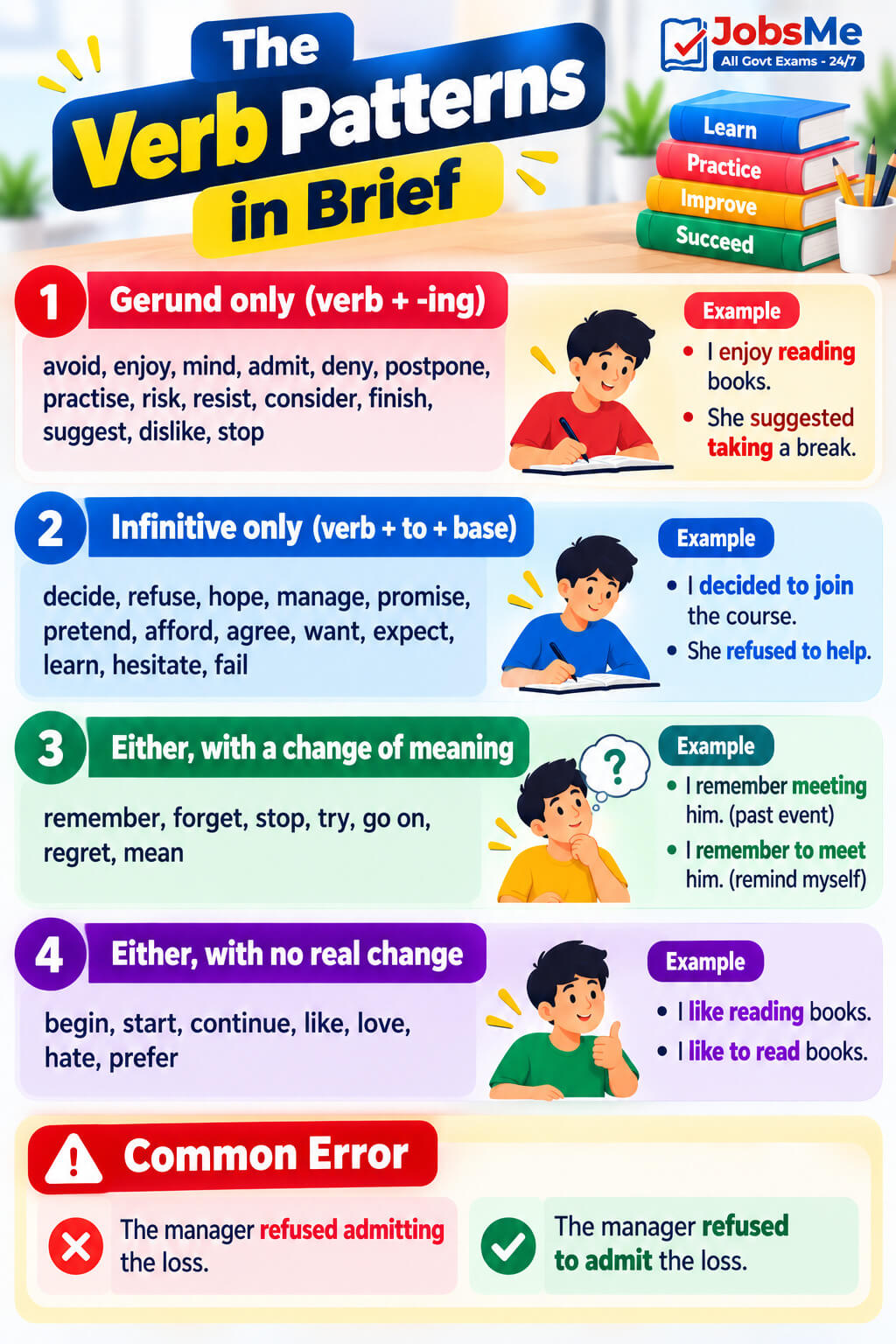
These lists are covered fully in verbs, so here is the working summary.
- Gerund only: avoid, enjoy, mind, admit, deny, postpone, practise, risk, resist, consider, finish, suggest, dislike, stop.
- Infinitive only: decide, refuse, hope, manage, promise, pretend, afford, agree, want, expect, learn, hesitate, fail.
- Either, with a change of meaning: remember, forget, stop, try, go on, regret, mean.
- Either, with no real change: begin, start, continue, like, love, hate, prefer.
The commonest single error in this group is the manager refused admitting the loss, which should read refused to admit.
A Warning About Study Material on This Topic
- An ungrammatical model for the perfect participle. One guide offers Having the sun risen, farmers went to their fields. No fluent speaker would write that. It must read the sun having risen, because a participle with its own subject puts that subject first.
- An example that breaks a different rule. The perfect infinitive rule is illustrated with she denied to have seen them yesterday. Deny takes a gerund, so it should read she denied having seen them.
- A phrase that does not exist. Would better appears in a list of bare infinitive triggers beside had better and would rather. It is not English.
- A participle missing from a correction. A dangling participle is repaired as he was bit by a snake, where the participle bitten is required.
- A correct sentence marked wrong. My father taught him to drive a car is listed as incorrect on the ground that how is compulsory. It is optional after teach, and genuinely required only after know.
- An explanation that reverses itself. Seema returned disappointed is explained as telling us about her condition, namely that she was happy or hopeful. Disappointed means the opposite.
Three of those six are sentences no fluent speaker would produce, so the quickest safeguard is to read every model answer aloud as ordinary English before trusting the rule attached to it.
Exam Alert
- Look forward to and with a view to are the most frequently asked items in this topic.
- Any sentence opening with a participle needs the subject check.
- Check every pronoun before an -ing word for a missing possessive.
- Ask which action came first before choosing between the simple and perfect forms.
- Do not mark taught him to drive wrong; how is optional after teach.
Ten Solved Questions
1. Find the error. He went to the market (a) / with a view to buy (b) / some fresh vegetables. (c) / No error (d)
Working: In with a view to, the word to is a preposition, and a preposition takes a gerund. Answer: (b), which should read with a view to buying.
2. Find the error. The manager refused (a) / admitting that the company (b) / had made a loss. (c) / No error (d)
Working: Refuse belongs to the infinitive-only list. Answer: (b), which should read refused to admit.
3. Find the error. MGNREGA was described (a) / as a living monument of failure (b) / in address poverty. (c) / No error (d)
Working: The preposition in demands a gerund. Answer: (c), which should read in addressing poverty.
4. Find the error. Being a pleasant evening, (a) / we went out for (b) / a long drive by the river. (c) / No error (d)
Working: The participle has no subject, so it attaches to we and implies that we were the evening. Answer: (a), which should read It being a pleasant evening.
5. Find the error. The exams were supposed (a) / to begin on 27 March but (b) / were postponed indefinitely. (c) / No error (d)
Working: The intended start preceded the postponement, so the perfect infinitive is required. Answer: (b), which should read to have begun.
6. Find the error. Father is very upset (a) / about me failing in (b) / the entrance examination. (c) / No error (d)
Working: A gerund takes a possessive in front of it. Answer: (b), which should read about my failing.
7. Find the error. Rekha was punished (a) / to come late to (b) / the morning assembly. (c) / No error (d)
Working: An infinitive states a purpose, but lateness is the reason for the punishment. Answer: (b), which should read for coming late.
8. Choose the correct sentence. (a) The student was made write an essay. (b) The student was made to write an essay. (c) The student was made writing an essay. (d) The student made to write an essay.
Working: Make takes a bare infinitive in the active but a full one in the passive. Answer: (b).
9. Find the error. It is no use to cry (a) / before a judge who has (b) / already made up his mind. (c) / No error (d)
Working: It is no use is a fixed expression taking a gerund. Answer: (a), which should read it is no use crying.
10. Find the error. Having finished the report, (a) / he submitted it to the (b) / head of the department. (c) / No error (d)
Working: The perfect participle correctly marks a gap between the actions, and its subject is the same as the main clause's. The scan comes up clean. Answer: (d), no error.
Quick Facts
- Gerund: verb plus -ing, working as a noun.
- Participle: -ing, third form, or having plus third form, working as an adjective or connector.
- Infinitive: to plus the base verb, or bare after modals and causatives.
- Perfect forms: to have written, having written.
- Passive forms: to be written, being written.
- Perfect passive: to have been written, having been written.
Worked Examples: Wrong to Right
Example 1 (identifying by form rather than function)
Sentence: Asked whether dancing is a gerund, a student answers yes without reading the sentence.
Trap: The -ing ending is the standard gerund signal, so recognition supplies an answer instantly. The same word is a participle when it describes a noun, as in her dancing doll, and only the job decides.
Correct Answer: Gerund in dancing is good exercise; participle in her dancing doll.
Rule in Simple Words: Ask what work the word is doing.
Example 2 (an infinitive after with a view to)
Sentence: A student writes He went to the market with a view to buy vegetables.
Trap: The word to almost always begins an infinitive, so the base verb follows automatically. In this phrase to is a preposition, and a preposition takes a gerund without exception.
Correct Answer: He went to the market with a view to buying vegetables.
Rule in Simple Words: If a noun could follow the to, use the -ing form.
Example 3 (a gerund after refuse)
Sentence: A student writes The manager refused admitting the loss.
Trap: The sentence reads smoothly, and gerunds do follow many verbs of this kind, such as denied and avoided. Refuse sits in the infinitive-only list, and membership of these lists carries no logic.
Correct Answer: The manager refused to admit the loss.
Rule in Simple Words: Learn the two lists as lists, not as reasoning.
Example 4 (a dangling participle)
Sentence: A student writes Being a pleasant evening, we went out for a drive.
Trap: The meaning is entirely clear and nobody would misread it, so the fault feels pedantic. Grammatically the participle attaches to we, so the sentence says we were the evening.
Correct Answer: It being a pleasant evening, we went out for a drive.
Rule in Simple Words: Give the participle a subject of its own.
Example 5 (a simple form where the perfect belongs)
Sentence: A student accepts The exams were supposed to begin on 27 March but were postponed.
Trap: The simple infinitive is correct in most sentences of this shape, and nothing looks incomplete. The intended start came before the postponement, and an earlier action needs the perfect form.
Correct Answer: The exams were supposed to have begun on 27 March.
Rule in Simple Words: Earlier than the finite verb means to have plus the third form.
Example 6 (an object pronoun before a gerund)
Sentence: A student writes Father is upset about me failing the test.
Trap: Me follows a preposition and prepositions do take object forms, so half the reasoning is sound. The next word is a gerund working as a noun, and a noun takes a possessive in front of it.
Correct Answer: Father is upset about my failing the test.
Rule in Simple Words: A possessive goes before a gerund, so my and not me.
Example 7 (purpose for reason)
Sentence: A student writes Rekha was punished to come late.
Trap: An infinitive after a verb is the commonest pattern in English, so it comes out by default. An infinitive states why someone acts, but Rekha did not arrive late in order to be punished.
Correct Answer: Rekha was punished for coming late.
Rule in Simple Words: Purpose takes to; reason takes for plus the -ing form.
Example 8 (a bare infinitive in the passive)
Sentence: Having learnt that make takes a bare infinitive, a student writes The student was made write an essay.
Trap: The rule was learnt correctly and applied consistently, which is exactly what makes this trap effective. Make switches to the full infinitive in the passive, and only let keeps the bare form.
Correct Answer: The student was made to write an essay.
Rule in Simple Words: Bare in the active, full in the passive.
Common Traps Students Fall Into
These are the habits that most often cost marks. Each one is a common trap, not a silly mistake, and each has a one-line fix.
- Trap: Identifying an -ing word by its form. Fix: Ask what job it is doing.
- Trap: Using an infinitive after a preposition. Fix: A preposition always takes a gerund.
- Trap: Missing that to is sometimes a preposition. Fix: Try putting a noun after it.
- Trap: Guessing the verb pattern. Fix: The lists carry no logic, so memorise them.
- Trap: Using an object pronoun before a gerund. Fix: The possessive goes there.
- Trap: Leaving a participle without a subject. Fix: Supply one, as in it being a rainy day.
- Trap: Using the simple form for an earlier action. Fix: The perfect form marks the earlier one.
- Trap: Stating a reason with an infinitive. Fix: Reason takes for plus the gerund.
- Trap: Keeping the bare infinitive in the passive. Fix: Make and see take the full form there.
- Trap: Choosing the wrong participle as a connector. Fix: A time gap needs the perfect participle.
- Trap: Trusting a model answer. Fix: Read it aloud, since three faults above are sentences nobody would say, as with the material warnings in error spotting.
Memory Tricks and Formulas
1. Function, never form
A gerund and a present participle are the same word. Gerund equals noun, participle equals adjective. So ask what the word is doing before naming it.
2. The noun-swap test
Try replacing the -ing word with a plain noun. If the sentence survives, it is a gerund. Swimming is good exercise accepts cricket, so swimming is a gerund.
3. Preposition means gerund, always
This is the one rule with no exceptions. Tired of working, prohibited from going, confident of getting, in addressing, with a view to buying.
4. Could a noun follow the to?
If yes, that to is a preposition and the gerund follows. Looking forward to the holiday works, so it must be looking forward to meeting you.
5. Possessive before a gerund
Because a gerund is a noun, use my, his and their rather than me, him and them. So upset about my failing and objected to his joining.
6. Purpose takes to, reason takes for
He came to help is a purpose. He was punished for coming late is a reason. Ask whether the person acted in order to bring the second thing about.
7. Earlier action, perfect form
If the non-finite verb happened before the finite one, use to have plus the third form, or having plus the third form. Supposed to have begun, denied having seen.
8. Budget the time honestly
With 1 to 2 questions in most papers, one session on the preposition rule, the two verb lists and the dangling participle covers the bulk. The perfect and passive forms repay a second session for Tier 2 and banking papers.
Exam Patterns and High-Yield Facts
Frequently Confused Pairs
| Pair | How They Differ | Mini Trick |
|---|---|---|
| Gerund vs Present participle | Noun against adjective, same form. | Try the noun swap. |
| Looking forward to meeting vs want to meet | Preposition against infinitive marker. | Could a noun follow? |
| Avoided meeting vs Refused to meet | Gerund list against infinitive list. | The verb in front decides. |
| To buy vs For buying | Purpose against reason. | Did they act in order to? |
| To begin vs To have begun | Same time against earlier. | Which happened first? |
| My failing vs Me failing | Possessive against object form. | A gerund is a noun. |
| Interesting vs Interested | What it does to you against how you feel. | An interesting book, an interested reader. |
| Made write vs Was made to write | Active bare against passive full. | Only let keeps the bare form. |
| Crossing vs Having crossed | Simultaneous against a time gap. | Was there a pause between them? |
| Knows how to swim vs Taught him to swim | How is required after know, optional after teach. | Do not mark taught him to wrong. |
Repeating Question Patterns
- An infinitive after look forward to or with a view to, which is the most frequently asked rule in the topic.
- A base verb after any other preposition, as in in address poverty.
- A gerund after refuse, decide or hope, or an infinitive after avoid, enjoy or deny.
- A dangling participle opening a sentence, usually with being.
- An object pronoun where a possessive belongs before a gerund.
- A simple infinitive where the perfect form is needed.
Practice Set: Fifteen Questions
Correct each sentence, or mark it correct as it stands.
- She is looking forward to meet her cousins next month.
- He is tired of working in the same department.
- The committee decided postponing the annual meeting.
- It is no use complaining about the delay now.
- Being a holiday, the offices were closed all day.
- They objected to his joining the club so late.
- He was rewarded to save the drowning child.
- Having submitted the form, she left the office.
- The prisoner denied to have stolen the documents.
- The workers were made to sign the attendance register.
- She avoided answering the question directly.
- I cannot help admiring his patience in such matters.
- He knows to operate the new machine efficiently.
- The sun having set, the villagers returned home.
- My father taught him to ride a bicycle last summer.
Quick Facts
Answer key, with the rule named in each case.
- 1. to meeting. That to is a preposition.
- 2. Correct as it stands. Of is a preposition, so the gerund is right.
- 3. decided to postpone. Decide belongs to the infinitive list.
- 4. Correct as it stands. It is no use takes a gerund.
- 5. It being a holiday. The participle needs its own subject.
- 6. Correct as it stands. A possessive belongs before a gerund.
- 7. rewarded for saving. This is a reason, not a purpose.
- 8. Correct as it stands. The perfect participle marks the earlier action.
- 9. denied having stolen. Deny takes a gerund.
- 10. Correct as it stands. Make takes the full infinitive in the passive.
- 11. Correct as it stands. Avoid belongs to the gerund list.
- 12. Correct as it stands. Cannot help takes a gerund.
- 13. knows how to operate. How is required after know.
- 14. Correct as it stands. A different subject comes before the perfect participle.
- 15. Correct as it stands. How is optional after teach.
Eight of those fifteen were already correct, and the last one is deliberate. My father taught him to ride a bicycle is listed as an error in published material and is perfectly good English, so it is exactly the sentence a well-drilled candidate would wrongly change. Practise with the free English MCQ quizzes and full papers from the mock test archive.
Quick Revision
Quick Revision
- The three non-finite forms. Gerund, infinitive and participle, none of which carries a tense of its own.
- The fact that runs the topic. A gerund and a present participle are the same word, so form tells you nothing and only function identifies them.
- Gerund equals noun, participle equals adjective, and an infinitive can be a noun, an adjective or an adverb.
- The noun-swap test. If a plain noun could replace the -ing word, it is a gerund.
- A clause holds one finite verb but may hold several non-finite ones.
- A gerund does five jobs. Subject, object of a verb, object of a preposition, complement after be, and apposition.
- A preposition always takes a gerund, and this is the one rule in the topic with no exceptions.
- Watch the phrases where to is a preposition. Look forward to, accustomed to, addicted to, averse to, object to, prone to, with a view to, owing to, devoted to, opposed to.
- The test for that trap. If a noun could follow the to, use the -ing form.
- A possessive goes before a gerund, so my failing and his joining rather than me failing and him joining.
- Fixed expressions taking a gerund. It is no use, it is worth, there is no point, cannot help, cannot bear.
- An infinitive states purpose while for plus a gerund states reason, so punished for coming late and not punished to come late.
- How is required after know but optional after teach, so never mark taught him to drive as wrong.
- An infinitive follows first, last, next, only and a superlative, as in the first to come and the last to leave.
- The three participles. Present for an action in progress or a nature, past for a completed action or condition, perfect for an action finished before another began.
- As a connector, simultaneous actions take the present participle, a passive sense takes the past participle, and a time gap takes the perfect participle.
- When the participle has a different subject, that subject comes first, so the sun having risen and never having the sun risen.
- Each form has four versions. Simple, perfect, passive and perfect passive.
- Use the perfect form when the non-finite action came earlier, so supposed to have begun and denied having seen.
- The passive forms are to be written and being written, with to have been written and having been written for the perfect passive.
- A participle phrase must describe the subject of the main clause, or the sentence dangles.
- Two repairs for a dangler. Add a full clause, or give the participle its own subject.
- Make, see, hear and bid take a bare infinitive in the active and a full one in the passive, while let keeps the bare form.
- Gerund only: avoid, enjoy, mind, admit, deny, postpone, practise, risk, resist, consider, finish, suggest. Infinitive only: decide, refuse, hope, manage, promise, pretend, afford, agree, expect, learn.
This topic looks like three definitions and is really one skill. The three forms overlap so heavily in appearance that naming them by sight cannot work, so ask instead what job the word is doing: noun, adjective or adverb. After that, two rules do most of the remaining work. A preposition always takes a gerund, and a participle phrase must describe the subject of its main clause. Learn the two verb lists as lists rather than as reasoning, add the perfect form for an earlier action, and read every printed model answer aloud before trusting it. The topic sits inside verbs, connects to prepositions for the gerund rule and to modals for the bare infinitive, overlaps with modifiers on dangling participles and with active and passive voice on the passive forms, and decides a steady share of error spotting and sentence improvement. The wider set is in the topic-wise English notes.
Frequently Asked Questions
What are gerunds, infinitives and participles?
How do I tell a gerund from a present participle?
What is the quickest test for a gerund?
Why is looking forward to meet wrong?
Why is upset about me failing wrong?
What is the difference between to buy and for buying?
When do I use the perfect infinitive?
Which participle joins two sentences?
What is a dangling participle?
Why is the student was made write an essay wrong?

About the author





