
Cloze Test for Bank Exams: Method, Blank Types and Practice
This article is a complete, exam-ready guide to the cloze test for banking, insurance, SSC and other competitive exams. It covers the three patterns you may meet, including the newer bracket-form version, and separates the five kinds of blank so you know whether grammar, vocabulary, a connector, a phrasal verb or a preposition is being tested. It gives the five-step method, the attempt order that saves the most time, the grammar rules that decide a blank outright, the connector families, and the tone, intensity and formality checks that settle a choice between two plausible words. It ends with three fully solved passages, common traps and a practice passage with a full answer key.
Introduction
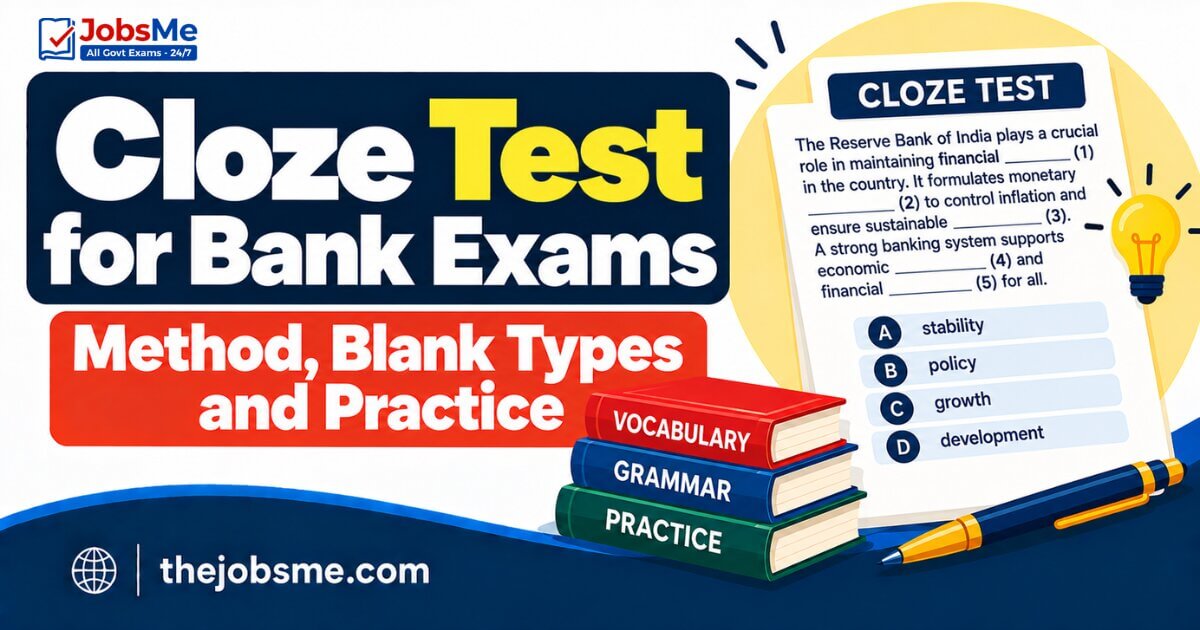
A cloze test is a passage with several words removed. You choose the right word for each blank from the options given.
It looks like a set of fill-in-the-blank questions. It is not. The blanks are not independent, because they belong to one connected passage, and a blank near the end is often decided by a sentence near the beginning. Students who work through the blanks one at a time, without reading the whole passage first, lose marks they could have kept.
The topic blends three skills at once: grammar, vocabulary and logical reasoning. That combination is exactly why examiners like it, and why it rewards preparation so reliably. A set of five blanks can be finished in four to five minutes once the method is automatic.
Where This Topic Is Asked
| Exam | How This Topic Appears | Rough Weight | Difficulty |
|---|---|---|---|
| Bank PO prelims | Usually one passage with five blanks and five options each. | 5 questions, a full set | Moderate. Consistently one of the most reliable scoring blocks in the section. |
| Bank PO mains | One or two passages, sometimes in the newer bracket form. | 5 to 10 questions | Harder, with denser passages and closer options. |
| Bank and insurance clerk exams | One passage with five blanks on a simpler topic. | 3 to 5 questions | Easy to moderate. |
| SSC exams | A short passage with four to five blanks, often testing grammar and prepositions. | 4 to 5 questions | Easy to moderate. |
| Railway and defence exams | Short passages with everyday vocabulary. | 2 to 5 questions | Easy. |
| State PSC exams | Standard passages on civic and policy subjects. | Varies by state | Moderate. |
The Exam Arithmetic
Three numbers should shape how you attempt this topic in a bank paper.
- The English section carries 30 questions on its own 20-minute timer, with no switching between sections.
- A wrong answer costs one-fourth of a mark, while an unanswered question costs nothing.
- A five-blank cloze set should take 4 to 5 minutes, and a ten-blank set about 8 to 10 minutes.
That works out to about a quarter of your English time for a fifth of the marks, which is a good trade because the accuracy here is high once the passage is understood. Confirm the current pattern for your own exam in the exam-wise syllabus hub, since these rules are revised from time to time.
The Three Patterns
| Pattern | What You Are Given | What Decides the Answer | How to Approach It |
|---|---|---|---|
| 1. Conventional | A passage with five to ten blanks, and four or five word options for each. | Meaning, tone and grammar together. | The standard method below. Read the whole passage first. |
| 2. Bracket form | A word is given in brackets beside each blank, and you supply the correct form of it. | Grammar alone, since the word itself is already decided. | Look at what sits immediately before the blank, then apply the verb rule. This version is easier, not harder. |
| 3. Incorrect word replacement | A word is already printed in the passage and you decide whether it should be replaced. | Whether the printed word fits the context. | Check the word against the passage, and be willing to choose no replacement required. |
The bracket form catches students out only because it looks unfamiliar. In truth it removes the hardest part of the topic. When the word is given to you, vocabulary stops mattering and the question becomes a pure grammar test. A blank after would takes the base form. A blank after to takes the base form. A blank after was takes a participle. Nothing else is being asked.
The Five Kinds of Blank
Recognising which kind of blank you are looking at tells you which tool to reach for, and how long to spend.
| Type | What It Tests | Example | How to Solve It | Time |
|---|---|---|---|---|
| 1. Grammar | The correct form of a verb, or agreement with the subject. | The bank has ______ implementing new policies. | Read the word immediately before the blank. Has demands the past participle, so begun is the only possible form. | 30 seconds. The most certain type. |
| 2. Connector | The logical relationship between two clauses. | He studied hard; ______, he failed the exam. | Decide whether the relationship is contrast, addition, cause or example, then pick from that family. | 45 seconds. Only a few options can fit. |
| 3. Preposition | The fixed preposition that a word demands. | She is good ______ mathematics. | These are fixed combinations, so recall rather than reason. Good at, interested in, depend on, different from, capable of. | 30 seconds. |
| 4. Phrasal verb or idiom | Whether you know the fixed phrase. | The project was ______ due to lack of funding. | Only one particle usually gives the right meaning. Called off means cancelled, while called on and called at mean something else entirely. | 45 seconds. |
| 5. Vocabulary | Which word fits the meaning and tone of the passage. | The government's ______ measures reduced poverty. | Several options will be grammatically fine, so decide by tone, intensity and formality. | 60 seconds. The slowest type. |
Formula Box
- Method: read the whole passage, fill the easy blanks, use the context window, eliminate, then verify the flow.
- Context window: for each blank, read the sentence before it, the sentence containing it, and the sentence after it.
- Attempt order: grammar blanks, then connectors, then prepositions and phrases, then vocabulary.
- Tone rule: a positive passage takes positive words and a negative passage takes negative ones.
- Simplicity rule: a simple word that fits beats a difficult word that does not.
- Time: 4 to 5 minutes for five blanks, 8 to 10 for ten.
- Never skip the final read. Read the completed passage once with your answers in place.
The Five-Step Method
| Step | What to Do | Why It Works | Common Mistake | Time |
|---|---|---|---|---|
| 1. Read the whole passage first | Read it once without looking at any options, just to fix the theme and the tone. | Some blanks can only be settled by information that appears later in the passage. | Skipping this read to save time, which then costs more time later. | 30 to 45 seconds |
| 2. Fill the easy blanks | Take the article, preposition and clear verb-form blanks first. | Each filled blank adds context that helps with the harder ones, and it builds momentum. | Starting with the hardest vocabulary blank and stalling. | 1 minute |
| 3. Use the context window | For each remaining blank, read the sentence before, the sentence with the blank, and the sentence after. | A single sentence rarely gives enough information, while three almost always do. | Reading only the sentence containing the blank. | 2 minutes |
| 4. Eliminate rather than select | Remove options that break the grammar, reverse the tone, or read awkwardly. | Two options are usually clearly wrong, which turns a five-way choice into a two-way one. | Hunting for the perfect word instead of removing the impossible ones. | 1 minute |
| 5. Read the passage back | Read the whole thing once with your chosen words in place. | A wrong choice usually breaks the flow, and you will hear it. | Marking the answers without the final read. | 30 seconds |
The Attempt Order That Saves Time
The blanks are printed in passage order. There is no reason to answer them in that order.
- Grammar blanks first. These take about thirty seconds and are the most certain, because a rule decides them rather than a judgement.
- Connector blanks next. Only a handful of words can express contrast, or cause, or addition, so the pool is small.
- Preposition and phrasal-verb blanks after that. You either know the fixed combination or you do not, so there is nothing to gain from lingering.
- Vocabulary blanks last. These need the most context, and by now you have filled in most of the passage, which makes them easier than they would have been at the start.
- Genuinely unclear blanks, last of all. With a penalty for wrong answers, leave a blank you cannot narrow to two options rather than guessing across five.
That ordering is worth a minute or more on a five-blank set, and the minute comes from the easy end rather than the hard end.
The Grammar Rules That Decide a Blank
These rules settle a blank outright, without any judgement about meaning. Learn them and the fastest marks in the topic become automatic.
| What Sits Before the Blank | What the Blank Must Take | Example |
|---|---|---|
| has, have, had | The past participle, that is the third form of the verb. | The bank has begun implementing new policies. |
| is, are, was, were | A present participle for continuous tense, or a past participle for the passive. | The light was emitted from the star. She was bawling loudly. |
| A modal such as can, will, would, should, must | The base form of the verb, with no ending. | Light can traverse vast distances. He would tear the page. |
| The infinitive marker to | The base form of the verb. | She wanted to eat the meal. |
| can be, could be, will be | A past participle, since this is passive. | The signal can be neglected at that distance. |
| a, an, the | A noun, with only adjectives permitted in between. | At the instant of observation. |
| A singular subject | A singular verb, matched to the head noun rather than the nearest noun. | The bank has implemented, not have implemented. |
| A plural subject | A plural verb. | The banks have implemented the rules. |
| An established past-tense passage | Past-tense verbs throughout, unless the time frame visibly changes. | The board announced the scheme and implemented it, not implements it. |
| Fixed prepositions | The one preposition the word demands. | good at, interested in, depend on, different from, capable of. |
Two of those rules do most of the work in the bracket-form pattern. If a modal or the infinitive to sits before the blank, the answer is the base form of the given word, and nothing else needs to be considered. Revise these alongside tenses and subject-verb agreement.
Connector Families
| Relationship | Words in That Family | How the Passage Signals It |
|---|---|---|
| Addition | moreover, furthermore, additionally, besides, also, in addition | The second idea points the same way as the first and strengthens it. |
| Contrast | however, nevertheless, nonetheless, yet, although, though, whereas | The second idea works against the first, as when recovery is followed by caution. |
| Cause and effect | therefore, thus, hence, consequently, as a result, so, due to | The second idea is produced by the first. |
| Example | for example, for instance, such as, namely, specifically | A general claim is followed by a specific case or figure. |
| Time sequence | meanwhile, subsequently, thereafter, previously, initially, finally | Events are being ordered in time. |
| Similarity | similarly, likewise, equally, in the same way | A second case is offered as parallel to the first. |
| Concession | despite, in spite of, admittedly, even so, granted | A point is conceded before the main claim is pressed. |
The same families run through sentence connectors and para jumbles, so learning them once pays in three topics.
Choosing Between Two Plausible Words
The hardest blanks are the ones where two or three options are all grammatically fine. Four checks settle almost all of them.
- Tone. A passage praising a reform will not take harmful or destructive, and a passage describing a crisis will not take strengthened or improved. Decide the polarity of the sentence first, and half the options usually disappear.
- Intensity. Satisfactory, good, excellent and phenomenal sit on a rising scale. Match the strength of the word to the strength of the claim the passage is actually making.
- Formality. Bank and policy passages are formal. So implemented is right where started is weak and kicked off is impossible.
- Natural pairing. When two words mean much the same thing, choose the one that normally sits beside the noun in question. Substantial increase is better formal English than big increase, which is where this topic meets collocations.
Exam Alert
- Read the whole passage before any blank. Later sentences frequently decide earlier blanks.
- Answer out of order. Grammar blanks first, vocabulary blanks last.
- A difficult word is not more likely to be right. Examiners include hard words precisely because they attract guesses.
- Watch the tone. A word can be perfect in meaning and still wrong because it points the wrong way.
- With a penalty for wrong answers, leave a blank you cannot narrow to two options rather than guessing across five.
Key Highlights
- The blanks are connected. Read the whole passage before filling any of them.
- Grammar blanks are free marks. One word before the blank usually decides them outright.
- Connectors come from seven families. Name the relationship, then choose within that family only.
- Tone decides most vocabulary blanks. Check the direction of the sentence before comparing meanings.
- A cloze set is one of the highest-accuracy blocks in the English section once the passage is understood.
Three Solved Passages
Solved Passage 1: Conventional Pattern
Passage. Digital payments have (1) sharply in India over the past decade. The government has (2) several initiatives to encourage cashless transactions, and small merchants in district towns now accept them routinely. (3) this shift, cash still accounts for a large share of small-value purchases. Awareness campaigns in local languages are (4) as necessary as the technology itself, because first-time users are the group most (5) to fraud.
Options. (1) declined, risen, stalled, vanished, hovered. (2) abandoned, ignored, launched, cancelled, delayed. (3) Because of, Despite, Owing to, Since, Thanks to. (4) rarely, hardly, quite, seldom, barely. (5) immune, resistant, prone, opposed, indifferent.
Working:
- Blank 1. The passage is about the spread of digital payments, so the tone is one of growth. Risen fits, and every other option points downwards or sideways.
- Blank 2. Initiatives that encourage something are launched, not abandoned or cancelled. Launched.
- Blank 3. The sentence sets a contrast: payments have spread, yet cash persists. Only Despite expresses contrast. The others express cause.
- Blank 4. The claim is that campaigns matter as much as technology. Quite strengthens that, while rarely, hardly, seldom and barely all reverse it.
- Blank 5. First-time users are vulnerable, and the fixed phrase is prone to. The other four all mean the opposite.
Answers: risen, launched, Despite, quite, prone. Notice that blanks 3, 4 and 5 were decided by direction alone, without any need for fine vocabulary judgement.
Solved Passage 2: Bracket Form
Passage. The cooperative bank (1) (face) a shortage of trained staff two years ago. The board decided that it would (2) (recruit) locally rather than transfer officers from other districts. Applicants were asked to (3) (complete) a short aptitude test. By the time the branch reopened, forty candidates (4) (join) the training programme, and one of them (5) (be) working there still.
Working:
- Blank 1. The phrase two years ago fixes the time as past, so the simple past faced is needed.
- Blank 2. The modal would sits directly before the blank, and a modal always takes the base form. So recruit.
- Blank 3. The infinitive marker to sits before the blank, which again demands the base form. So complete.
- Blank 4. By the time plus a past event calls for the past perfect, so had joined.
- Blank 5. The word still and the present participle working point to a continuing state, so is.
Answers: faced, recruit, complete, had joined, is. No vocabulary was tested at all. Every blank was settled by the word immediately before it or by a time marker in the sentence.
Solved Passage 3: Connector-Led
Passage. The state economy was showing clear signs of recovery. (1), analysts remained cautious in their assessments. (2), unemployment among young graduates was still close to its earlier peak. (3), the government announced a fresh package of skill-training grants. Early results have been modest, (4) officials say the full effect will take two years to appear.
Options. (1) Therefore, Moreover, However, Similarly. (2) For instance, Therefore, Similarly, Nevertheless. (3) However, Consequently, Likewise, Although. (4) so, because, although, therefore.
Working:
- Blank 1. Recovery is positive and caution is negative, so the relationship is contrast. However.
- Blank 2. The unemployment figure explains why analysts were cautious, so it is an example of their concern. For instance.
- Blank 3. High unemployment leads to a government response, which is cause and effect. Consequently.
- Blank 4. Modest results sit against a claim about future effect, so contrast again. Although.
Answers: However, For instance, Consequently, Although. Every one was solved by naming the relationship between the two ideas, and never by weighing the meaning of the connector itself.
Quick Facts
- A modal such as can, will or would is followed by the base form.
- The infinitive to is followed by the base form.
- Has, have, had are followed by the third form.
- Is, are, was, were are followed by a participle.
- Contrast uses however and nevertheless. Cause uses therefore and consequently.
- Fixed pairs to memorise: good at, interested in, depend on, different from, capable of, prone to.
Worked Examples: Wrong to Right
Example 1 (filling blanks in order)
Sentence: A student starts at blank one, cannot decide, and spends ninety seconds on it before reading the rest of the passage.
Trap: Working in order feels systematic, and the first blank is where the eye lands. The information that settles blank one often appears two sentences later, so the delay is self-inflicted.
Correct Answer: Read the whole passage first, then take the easy blanks.
Rule in Simple Words: The passage is one connected argument, not five separate questions.
Example 2 (ignoring the tone)
Sentence: In a passage describing a banking crisis, a student picks strengthened for a blank about the sector.
Trap: The word is grammatically perfect and the sentence reads smoothly with it. A crisis damages a sector, so the word points in the wrong direction entirely.
Correct Answer: A negative passage takes a negative word, so damaged or weakened.
Rule in Simple Words: Decide the direction of the sentence before you weigh the meaning of the words.
Example 3 (choosing the hardest word)
Sentence: Faced with opulent, attributed, effusive and yearning, a student picks the least familiar word on the assumption that examiners prefer difficult vocabulary.
Trap: Difficult words feel like the intended answer in a competitive exam. They are usually there as distractors, and the correct word is often the plainest one that actually fits.
Correct Answer: The word that fits the meaning, whatever its difficulty.
Rule in Simple Words: A simple word that fits always beats a complex word that does not.
Example 4 (missing the word before the blank)
Sentence: For light can ______ vast distances, a student picks a past-tense verb.
Trap: The passage is discussing an established fact, so a past form can feel natural. The modal can sits immediately before the blank, and a modal always takes the base form.
Correct Answer: Traverse, in the base form.
Rule in Simple Words: Look at the single word before the blank before you look at anything else.
Example 5 (a connector chosen by sound)
Sentence: For he studied hard; ______, he failed the exam, a student picks therefore.
Trap: Therefore is the commonest connector in exam passages, so it is the default guess. Studying hard does not cause failure, so the relationship is contrast rather than result.
Correct Answer: However.
Rule in Simple Words: Name the relationship first, then choose from that family only.
Example 6 (breaking tense consistency)
Sentence: In a passage written throughout in the past, a student fills one blank with a present-tense verb because it reads well locally.
Trap: Each sentence can look correct on its own, which hides the inconsistency. A passage keeps one tense unless the time frame visibly changes.
Correct Answer: Match the tense already established elsewhere in the passage.
Rule in Simple Words: Let the unblanked sentences tell you which tense the passage is in.
Example 7 (a fixed preposition guessed)
Sentence: A student writes good in mathematics because it sounds acceptable in everyday Indian usage.
Trap: The phrase is extremely common in speech, which makes it feel correct. Fixed prepositions cannot be reasoned out, and the standard form is good at.
Correct Answer: Good at mathematics.
Rule in Simple Words: Memorise the fixed combinations, because logic will not produce them.
Example 8 (skipping the final read)
Sentence: A student fills all five blanks, marks them and moves on without rereading.
Trap: Each blank was decided carefully, so the set feels finished. A wrong choice usually breaks the flow between two sentences, and only a full read reveals it.
Correct Answer: Spend thirty seconds reading the completed passage.
Rule in Simple Words: The last thirty seconds protect the previous four minutes.
Common Traps Students Fall Into
These are the habits that most often cost marks. Each one is a common trap, not a silly mistake, and each has a one-line fix.
- Trap: Not reading the whole passage first. Fix: Later sentences frequently decide earlier blanks, so the first read is an investment.
- Trap: Treating each blank as a separate question. Fix: Use the context window of three sentences around every blank.
- Trap: Answering in printed order. Fix: Take grammar blanks first and vocabulary blanks last.
- Trap: Ignoring the tone of the passage. Fix: Decide whether the sentence is positive or negative before comparing words.
- Trap: Choosing the most difficult word. Fix: Hard words are usually distractors, so pick what fits.
- Trap: Mismatching the intensity. Fix: Match the strength of the word to the strength of the claim being made.
- Trap: Using informal words in a formal passage. Fix: Bank and policy passages take formal vocabulary throughout.
- Trap: Breaking tense consistency. Fix: The unblanked sentences establish the tense, so follow them.
- Trap: Guessing on fixed prepositions. Fix: These must be memorised, so keep a short list and revise it weekly, alongside error spotting practice.
- Trap: Selecting instead of eliminating. Fix: Remove the impossible options first, since two usually fall away at once.
- Trap: Practising without reviewing. Fix: After every passage, write one line on the clue you missed, exactly as you would in reading comprehension practice.
Memory Tricks and Formulas
1. Read the passage, not the blanks
The first thirty seconds of reading is the highest-value time you will spend on the set. It fixes the theme and the tone, and both of those decide several blanks on their own.
2. Look at the word immediately before
One word before the blank often settles it completely. A modal takes the base form. The infinitive to takes the base form. Has takes the third form. Was takes a participle. Check this before you consider meaning at all.
3. Easy blanks build the passage
Every blank you fill adds context for the ones still open. So take the articles, prepositions and clear verb forms first, and the vocabulary blanks will be easier when you reach them.
4. The three-sentence window
For any stubborn blank, read the sentence before it, the sentence containing it, and the sentence after it. One sentence is rarely enough, and three almost always are.
5. Direction before dictionary
Ask whether the sentence is positive or negative before you compare meanings. This single question removes two or three options in most vocabulary blanks and costs about two seconds.
6. Name the relationship for connectors
Do not weigh connectors against each other. Decide whether the link is contrast, addition, cause, example or sequence, then pick from that family alone. Seven families cover almost every connector blank ever set.
7. Simple beats difficult
Examiners plant unfamiliar words as distractors. So never choose a word because it looks impressive, and never reject one because it looks ordinary.
8. The 4-to-5 minute clock
Allow 4 to 5 minutes for five blanks and 8 to 10 minutes for ten, with a ceiling of about 60 seconds on any single blank. If a blank passes that limit, leave it and return only if time allows.
Exam Patterns and High-Yield Facts
Frequently Confused Pairs
| Pair | How They Differ | Mini Trick |
|---|---|---|
| Cloze test vs Fillers | A cloze test has blanks across a connected passage. Fillers are separate sentences with no shared context. | Passage against sentence. |
| Cloze test vs Reading comprehension | Comprehension asks questions about a complete passage. A cloze test asks you to complete the passage itself. | Answer against fill. |
| Conventional vs Bracket form | The conventional pattern tests vocabulary and grammar together. The bracket form gives you the word and tests grammar alone. | The bracket form is easier, not harder. |
| However vs Therefore | However marks contrast. Therefore marks result. | One turns the argument, the other continues it. |
| Moreover vs For instance | Moreover adds a further point. For instance gives an example of the same point. | New point against same point illustrated. |
| Despite vs Due to | Despite marks contrast. Due to marks cause. | Both take a noun, and they point opposite ways. |
| Prone to vs Immune to | Prone to means likely to suffer. Immune to means protected from. | Exact opposites, and both fit grammatically. |
| Good at vs Good in | Good at is the standard form for skills. | Common Indian usage is not exam usage. |
| Called off vs Called on | Called off means cancelled. Called on means appealed to or visited. | The particle changes the meaning entirely. |
| Substantial vs Big | Both mean large, but only one suits formal writing. | A substantial increase, not a big increase. |
Repeating Passage Themes
- Economy and banking dominate bank papers: digital payments, credit growth, inflation, financial inclusion and regulation.
- Technology and its effects, usually in a benefits-then-risks shape that suits contrast connectors.
- Environment and water, often written as problem and remedy.
- Social policy, covering education, health, employment and migration.
- Science passages in SSC and railway papers, which lean on grammar blanks rather than vocabulary.
- Narrative passages in the bracket form, where a story in the past tense tests verb forms throughout.
Practice Passage: Eight Blanks
Read the whole passage first, then fill the blanks. Allow eight minutes.
Groundwater supplies most of the irrigation in large parts of the country, and the shift began when tube wells (1) rapidly in the late 1960s. Yields rose, and rural incomes rose with them. (2), the cost of that success is now visible. In several districts the water table has (3) by more than a metre a year for a decade. The reason is not carelessness but arithmetic, because power for pumps is free or nearly free in many states, so the extra cost of another hour of pumping is (4) to zero. Recharge, (5), has weakened, as ponds have been built over and rainwater runs off concrete instead of soaking in. Some states have tried to (6) farm power and have retreated in the face of protest. A quieter approach has worked better, (7) paying farmers for the power they do not use and reviving village ponds. None of these measures is dramatic, and a crisis that took fifty years to build will not be (8) by a single scheme.
Options. (1) vanished, spread, declined, hovered. (2) Therefore, However, Similarly, Likewise. (3) risen, fallen, improved, stabilised. (4) close, opposed, immune, superior. (5) moreover, meanwhile, therefore, consequently. (6) meter, metre, boost, waive. (7) namely, despite, although, unless. (8) worsened, undone, deepened, ignored.
Quick Facts
Answer key, with the deciding clue named in each case.
- 1. spread. The passage describes growth in tube wells, so the direction is upward.
- 2. However. Rising incomes are followed by a cost, so the relationship is contrast.
- 3. fallen. A water table that drops by a metre a year has fallen; the other three point the wrong way.
- 4. close. The fixed phrase is close to zero, and the sentence explains why pumping continues.
- 5. meanwhile. Two situations are being described in the same period, which is time rather than cause.
- 6. meter. To meter power is to measure and charge for it, which is what states attempted. Metre is the unit of length.
- 7. namely. A general claim about a quieter approach is followed by the specific measures.
- 8. undone. A crisis is undone or reversed by a remedy, and the other three would reverse the meaning.
Look at what settled those eight: two connectors, one direction check, one fixed phrase, one spelling pair and three tone judgements. Not one needed a rare word. Practise the same approach with the free English MCQ quizzes and full papers from the mock test archive.
Quick Revision
Quick Revision
- What the question is. A passage is given with several words removed, and you choose the right word for each blank from the options offered.
- The central idea. The blanks belong to one connected passage, so a sentence near the end can decide a blank near the beginning.
- What it tests. Grammar, vocabulary and logical reasoning together, which is why it rewards steady preparation so reliably.
- Three patterns exist. The conventional one gives word options, the bracket form gives a word to reshape, and the third asks whether a printed word needs replacing.
- The bracket form is the easiest. When the word is given to you, vocabulary stops mattering and only the verb rules are being tested.
- Five kinds of blank. Grammar, connector, preposition, phrasal verb and vocabulary, each needing a different tool.
- The method. Read the whole passage, fill the easy blanks, use the context window, eliminate the impossible, then read it all back.
- Answer out of order. Take grammar blanks first at about thirty seconds each, and leave vocabulary blanks for last.
- The context window. For any hard blank, read the sentence before it, the sentence containing it, and the sentence after it.
- Look at the word immediately before the blank. That one word settles most grammar blanks on its own.
- Modals take the base form. Can, will, would, should and must are followed by a verb with no ending.
- The infinitive to takes the base form, as in wanted to eat.
- Has, have and had take the third form, so the bank has begun rather than has began.
- Is, are, was and were take a participle, either for continuous tense or for the passive voice.
- Keep the tense consistent. The sentences without blanks tell you which tense the passage is written in.
- Match the verb to the head noun, not to whichever noun happens to sit nearest the blank.
- Articles. Use a or an for a first mention and the for something already introduced or clearly specified.
- Fixed prepositions must be memorised. Good at, interested in, depend on, different from, capable of and prone to.
- Contrast connectors. However, nevertheless, yet, although and whereas signal that the second idea works against the first.
- Cause connectors. Therefore, thus, hence, consequently and as a result signal that the second idea follows from the first.
- Addition connectors. Moreover, furthermore, besides and in addition signal a further point in the same direction.
- Example connectors. For instance, for example, such as and namely introduce a specific case of a general claim.
- Name the relationship first. Decide whether the link is contrast, cause, addition or example, then choose only from that family.
- Check the direction before the dictionary. A positive passage takes positive words, and a negative one takes negative words.
- Match the intensity. Satisfactory, good, excellent and phenomenal are not interchangeable, so fit the strength of the claim.
- Keep the register formal. Bank and policy passages take implemented rather than started, and never kicked off.
- A simple word that fits beats a difficult word that does not. Hard words are usually planted as distractors.
- Eliminate rather than select. Two options are usually clearly wrong, which turns a five-way choice into a two-way one.
- Timing. Give five blanks four to five minutes and ten blanks eight to ten, with a ceiling of one minute on any single blank.
- Best preparation. Solve three or four passages a day and read one editorial, since exam passages are drawn from exactly that kind of writing.
The cloze test is among the most dependable scoring blocks in any English paper, because a passage you have understood gives up most of its blanks without a fight. So spend the first thirty seconds reading rather than answering, fill the grammar blanks before the vocabulary ones, and always read the completed passage back. Build the grammar underneath through tenses and subject-verb agreement, the logic through sentence connectors, and the word sense through collocations and synonyms and antonyms. Since bank passages come from economy writing, ten minutes of daily current affairs reading supplies both the vocabulary and the context, and the wider set is in the topic-wise English notes.
Frequently Asked Questions
What is a cloze test?
Should I read the whole passage before filling any blank?
In which order should I attempt the blanks?
What is the new bracket pattern of the cloze test?
How many cloze test questions are asked?
How much time should a cloze set take?
How do I choose between two words that both seem correct?
Are difficult words usually the right answer?
How do I solve connector blanks quickly?
How should I practise for the cloze test?

About the author





