
Collocations for Govt Exams: Word Pairs, Lists and Tricks
This article is a complete, exam-ready guide to collocations for banking, insurance, SSC, railway and State PSC exams. It explains what a collocation is, how it differs from an idiom and a phrasal verb, all ten types with correct and wrong pairings, the make-do-take-have-give-pay verb chart that causes most errors, an intensifier chart, a banking and economy collocation bank, how collocations decide fillers, word swap, cloze test and sentence improvement questions, the Indian-English pairings to unlearn, and a twelve-question practice set with an answer key. Every rule comes with a correct and a wrong sentence and a memory trick that even a beginner can use.
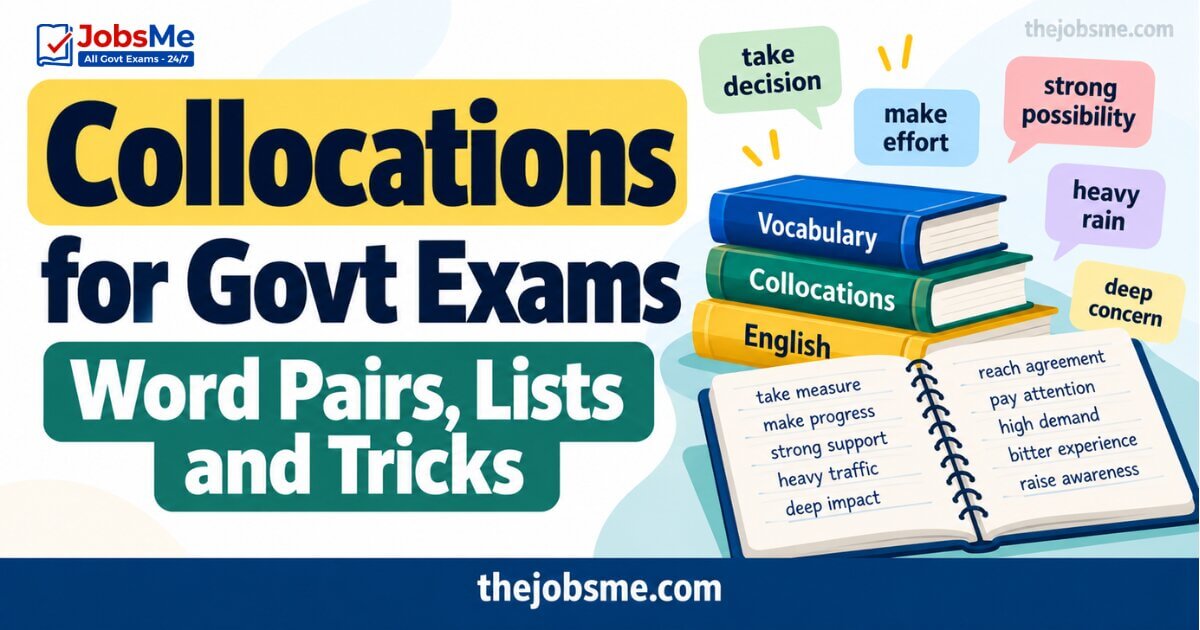
Introduction
A collocation is a pair or group of words that English speakers habitually use together. The words simply belong with each other.
Look at four sentences. Each one is grammatically perfect, and two of them are wrong.
- We must make a decision. Correct.
- We must do a decision. Wrong, though the grammar is fine.
- The heavy rain flooded the road. Correct.
- The strong rain flooded the road. Wrong, though every word is a real word.
No grammar rule explains the difference. English simply pairs make with decision and heavy with rain. That is what a collocation is, and that is why it has to be learned as a pairing rather than worked out.
Here is the important part for an exam. Collocations are almost never asked as a named topic, yet they decide the answer in several question types that are. Fillers, word swap, cloze test, sentence improvement and vocabulary questions inside a passage all turn on whether you know which words go together.
Where This Topic Is Asked
| Question Type | How Collocations Decide It | Rough Weight | Where It Appears |
|---|---|---|---|
| Fillers or fill in the blanks | Two or three options are grammatically possible, and only one collocates with the words around the blank. | 3 to 5 questions | Bank prelims and mains, and SSC papers. |
| Word swap and word usage | Words have been moved out of their natural pairings, and you restore them. | 4 to 5 questions | A named topic in the current bank syllabus. |
| Cloze test | Every blank in the passage is a collocation test in disguise. | Often a full set of 5 questions | Bank and SSC papers. |
| Sentence improvement and phrase replacement | The underlined part is often a wrong pairing, not a grammar error. | 2 to 4 questions | All objective papers. |
| Vocabulary inside comprehension | Synonym questions ask which word fits this sentence, which is a collocation judgement. | 1 to 2 per passage | Every exam with reading comprehension. |
| Descriptive papers and interviews | Correct pairings are what make a letter, essay or answer sound professional. | Indirect, but visible to the examiner | Bank descriptive papers, State PSC mains, interviews. |
Add those rows up and collocations quietly influence eight to twelve questions in a bank paper. That is more than most named topics, which is why this deserves study time even though no syllabus lists it.
Concept in Simple Words
What Makes a Collocation
Two tests tell you that you are looking at a collocation.
- The substitution test. Replace one word with a close synonym. If the sentence suddenly sounds wrong, the original pairing was a collocation. Strong tea works, powerful tea does not.
- The meaning test. The pairing keeps its plain meaning. Heavy rain simply means a lot of rain. Nothing hidden is going on.
That second test is what separates a collocation from an idiom, and exams test the difference.
| Term | What It Is | Example | Key Difference |
|---|---|---|---|
| Collocation | Words that habitually go together, keeping their ordinary meaning. | make a decision, heavy traffic, pay attention | You can work out the meaning from the words. |
| Idiom | A fixed phrase whose meaning cannot be guessed from the words. | a wild goose chase, spill the beans | The meaning is hidden. Learn it in idioms and phrases. |
| Phrasal verb | A verb plus a particle that together take a new meaning. | carry out a survey, break down a barrier | The particle changes the verb's meaning. |
| Compound noun | Two nouns joined so often that they name one thing. | traffic jam, tea break, cash flow | The pair has become a single label. |
One more distinction is worth carrying into the exam. Some collocations are strong, meaning only one word will do: you commit a crime, and nothing else fits. Others are weak, meaning several words work: a mistake can be big, serious, costly or silly. Exams test strong collocations, because those have exactly one correct answer.
Why They Matter Beyond the Exam
- Fluency: correct pairings make your English sound natural rather than translated.
- Precision: strong tea and deep sleep carry an exact sense that a general word would lose.
- Speed: a collocation is a ready-made block, so you produce a sentence faster and the reader understands it faster.
- Register: conduct research is formal while do research is casual, so the right pairing sets the right tone in a letter or an essay.
Formula Box
- Collocation = words that habitually pair, keeping their ordinary meaning
- Test = swap in a synonym; if it sounds wrong, it was a collocation
- Strong collocation = only one word fits, so exams test these
- Ten types = adjective + noun, noun + noun, verb + noun, noun + verb, adverb + adjective, verb + adverb, adverb + verb, verb + preposition, phrasal verb + noun, adjective + preposition
- Learning rule = learn the pair, never the single word
- Daily target = about 10 to 15 pairs a day, taken from what you read
The Ten Types of Collocations
| Type | Explanation | Correct | Wrong | Exam Tip |
|---|---|---|---|---|
| 1. Adjective + noun | A describing word that habitually attaches to a particular noun. | heavy traffic, excruciating pain, fast food, strong wind | big traffic, very strong pain, quick food, powerful wind | The largest single group in fillers. Learn the adjective with its noun. |
| 2. Noun + noun | Two nouns that together name one thing. | traffic jam, tea break, cash flow, round of applause, sense of humour | traffic block, tea pause, set of applause, feeling of humour | Treat these as single words while learning them. |
| 3. Verb + noun | A verb that habitually takes a particular object. | make a decision, pay attention, give advice, take a shower | do a decision, give attention, provide advice, have a shower in Indian usage | The commonest source of errors. See the verb chart below. |
| 4. Noun + verb | The action a particular subject habitually performs. | lions roar, dogs bark, water flows, the economy boomed, a bomb exploded | lions shout, dogs yell, water moves, the economy grew quickly | Common in comprehension and cloze passages on nature and economy. |
| 5. Adverb + adjective | An intensifier fixed to a particular adjective. | completely satisfied, highly unlikely, deeply disappointed, fully aware | fully satisfied, very unlikely, badly disappointed, deeply aware | Tested constantly in fillers. See the intensifier chart below. |
| 6. Verb + adverb | The manner word that habitually follows a verb. | wave frantically, whisper softly, complain bitterly, drive carefully, speak fluently | wave crazily, whisper quietly, complain sadly, drive good, speak well | Watch the adverb form. Drive good is both a grammar error and a wrong pairing. |
| 7. Adverb + verb | An intensifier placed before the verb. | badly need, clearly state, strongly oppose, firmly believe | strongly need, plainly state, badly oppose, hardly believe in that sense | Frequent in editorial passages and word swap questions. |
| 8. Verb + preposition | The preposition fixed to a particular verb. | burst into tears, succeed in life, apologise for a mistake, depend on support | explode into tears, succeed at life, apologise about a mistake, depend upon in every case | Learn the verb and preposition as one unit, never separately. |
| 9. Phrasal verb + noun | A phrasal verb that habitually takes a particular object. | carry out a task, break down a barrier, put forward a proposal, look into a complaint | perform a task in this sense, smash a barrier, put ahead a proposal | Very common in official and banking writing. |
| 10. Adjective + preposition | The preposition that a particular adjective takes. | fond of music, responsible for the work, capable of doing it, aware of the risk | fond with music, responsible with the work, capable to do it, aware about the risk | Overlaps with error spotting, where wrong prepositions are a favourite. |
The High-Yield Charts
Make, Do, Take, Have, Give, Pay
Six verbs cause more collocation errors than everything else combined. Learn which nouns each one takes.
| Verb | General Sense | Common Pairings | Wrong Pairing Students Use |
|---|---|---|---|
| Make | Creating or producing something, including decisions and statements. | make a decision, make an effort, make a mistake, make progress, make arrangements, make a payment, make money, make a complaint, make an appointment | do a decision, do an effort, do a mistake, do progress |
| Do | Performing a task, a duty or unspecified work. | do homework, do business, do research, do a favour, do the dishes, do your duty, do harm, do an exercise | make homework, make business, make a favour |
| Take | Receiving, accepting or engaging in something. | take a decision in Indian usage, take an exam, take a break, take responsibility, take action, take a risk, take steps, take a shower, take notes | give an exam, give a break, do action, do a risk |
| Have | Experiencing or possessing something. | have a discussion, have an idea, have an effect, have a problem, have an opportunity, have a look | make a discussion, do a look, take an effect |
| Give | Handing something over, including things given verbally. | give advice, give a speech, give permission, give priority, give a reason, give an example | provide advice, do a speech, make permission |
| Pay | Directing something valuable towards someone. | pay attention, pay a visit, pay a compliment, pay respect, pay a fine, pay interest | give attention, do a visit, make respect |
One honest note about take a decision. Indian and British English accept it, while American English prefers make a decision. In an Indian exam both are usually safe, but if make a decision is among the options, choose it.
The Intensifier Chart
Adverb and adjective pairings are tested more than any other type in fillers, because several options are always grammatically possible.
| Intensifier | Goes With | Correct Example | Wrong Pairing |
|---|---|---|---|
| Heavy | rain, traffic, losses, rainfall, smoker, fine, industry | Heavy rain flooded the low-lying areas. | strong rain, big traffic |
| Strong | wind, tea, coffee, opinion, evidence, argument, support | Strong winds uprooted several trees. | powerful wind, heavy tea |
| Deeply | concerned, disappointed, moved, rooted, regret | The parents were deeply concerned about the delay. | highly concerned, badly disappointed |
| Highly | unlikely, likely, recommended, skilled, competitive, effective | The outcome is highly unlikely. | deeply unlikely, very recommended |
| Completely | satisfied, different, wrong, unaware, exhausted | The customers were completely satisfied. | fully satisfied, deeply different |
| Fully | aware, funded, equipped, automatic, operational | The committee was fully aware of the risk. | completely aware in formal writing, deeply funded |
| Badly | need, injured, damaged, affected, behaved | The shelter badly needs warm clothing. | strongly needs, heavily injured |
| Bitterly | complain, disappointed, cold, oppose, regret | Residents complained bitterly about the delay. | complain sadly, complain heavily |
| Sharply | rise, fall, decline, criticise, contrast | Prices rose sharply after the announcement. | strongly rose, heavily fell |
| Sound | sleep, judgement, advice, health, economy | After the long journey he had a sound sleep. | good sleep in this exact sense, strong judgement |
Exam Alert
- In a filler, eliminate by pairing, not by meaning. Two options often mean the same thing, and only one collocates.
- Read the noun first, then choose the adjective or adverb that habitually attaches to it.
- Watch for near-synonyms in the options: heavy, strong, powerful, big and great are the classic four-way trap.
- Word swap questions move collocations apart. Restore the natural pair and the sentence repairs itself.
- If two options are both grammatical, the question is almost certainly testing a collocation, not a rule.
Banking, Business and Economy Collocations
These appear constantly in bank passages, cloze tests and fillers, and they are also the vocabulary of a descriptive answer. Learn them in blocks, not as single words.
| Area | Collocations to Learn | Example in a Sentence |
|---|---|---|
| Money and earnings | make money, earn a living, hard-earned money, generate revenue, annual turnover, cash flow | The firm reported a healthy cash flow despite a fall in annual turnover. |
| Banking transactions | deposit a cheque, open an account, withdraw cash, transfer funds, clear a payment, settle a bill | Customers can now transfer funds without visiting the branch. |
| Credit and lending | sanction a loan, repay a loan, default on a payment, charge interest, extend credit, waive a fee | The bank sanctioned the loan after verifying the documents. |
| Business activity | close a deal, launch a scheme, expand operations, cut costs, meet a deadline, go bankrupt, cease to trade | The company cut costs sharply before launching the new scheme. |
| The economy | the economy boomed, curb inflation, boost growth, create jobs, attract investment, widen the deficit | The measures were intended to curb inflation without slowing growth. |
| Policy and governance | implement a policy, enforce a rule, impose a fine, raise a concern, address an issue, take steps | The regulator imposed a fine and asked the bank to address the issue. |
| Society and environment | bridge the gap, raise awareness, tackle pollution, conserve water, reduce emissions, provide access | The campaign aims to raise awareness and reduce water waste. |
These same blocks make your writing sound professional, so use them in essay writing and letter writing practice, and build the habit through banking awareness reading.
Forty Verb and Noun Pairs You Must Know
These are the pairings that appear most often in exam sentences. Read the list aloud twice a week until the right verb arrives automatically.
| Area | Pairings to Memorise | Wrong Version to Unlearn |
|---|---|---|
| Study and exams | take an exam, do homework, attend a class, write a test, pass an exam, fail a subject, score marks, clear a cut-off | give an exam, make homework, give a test, get pass |
| Work and office | hold a meeting, meet a deadline, submit a report, apply for leave, take charge, resign from a post, sign an agreement | keep a meeting, complete a deadline, apply a leave, sign on an agreement |
| Communication | make a phone call, send an email, raise a query, answer a question, reach an agreement, keep a promise, break the news | do a call, put an email, reach on an agreement, tell the news |
| Problems and mistakes | face a problem, solve a problem, make a mistake, correct an error, cause damage, take the blame, find a solution | do a mistake, face with a problem, give the blame |
| Health and daily life | catch a cold, take medicine, follow a diet, get some rest, take a shower, make the bed, do the dishes | get a cold in this sense, eat medicine, take rest, do the bed |
| Money | earn a salary, make a profit, incur a loss, save money, pay a bill, raise funds, cut expenses | get a profit, do a loss, give a bill, collect funds in a formal sense |
| Effort and action | make an effort, take steps, take action, keep a record, set a target, achieve a goal, meet a requirement | do an effort, do steps, keep a target, complete a goal |
| Rules and authority | break a rule, follow a rule, enforce a law, grant permission, impose a ban, lodge a complaint, conduct an inquiry | do a rule, give a ban, put a complaint, take an inquiry |
Key Highlights
- The verb carries the error. In most wrong sentences the noun is fine and the verb is the wrong partner.
- Learn by area, not alphabetically. Grouping by study, work, money and rules is how the pairs come back to you in the exam.
- Say the pair aloud. Sound memory works faster than visual memory for collocations.
- Watch the article. Take a rest and make a phone call include the article as part of the pair.
- If a sentence feels slightly odd but you cannot name the rule, you are looking at a wrong collocation.
How to Learn Collocations: A Five-Step Routine
| Step | What to Do | Why It Works | How Long |
|---|---|---|---|
| 1. Read and listen daily | Read an editorial and underline word pairs rather than difficult words. | You absorb pairings long before you could memorise them, and exam passages come from this kind of writing. | 15 minutes |
| 2. Keep a two-column notebook | Left column the pair, right column your own sentence using it. | Writing your own sentence moves a pair from recognition into use. | 10 minutes |
| 3. Group by theme | File new pairs under headings such as money, work, rules and health. | Themed groups are recalled together, which is how filler questions present them. | Ongoing |
| 4. Practise with blanks | Cover the verb in your own notebook sentences and try to supply it from memory. | This is exactly what a filler question asks you to do. | 10 minutes |
| 5. Use them in writing | Put five new pairs into your next practice letter or essay. | Correct pairings are what make a descriptive answer sound professional rather than translated. | Twice a week |
Two cautions about this routine. Do not translate pairings from your first language, because a phrase that works there often has no equivalent here. And do not overuse a favourite pairing, since repeating heavy or make five times in one essay makes the writing sound thin.
How Collocations Decide Each Question Type
| Question Type | What the Question Looks Like | How to Use Collocations | Time |
|---|---|---|---|
| Filler | A sentence with one blank and four single-word options. | Look at the word immediately before and after the blank, and choose the option that habitually pairs with it. Ignore meaning until the pairing test fails. | 20 seconds. |
| Double filler | Two blanks in one sentence, with paired options. | Solve the easier blank first, then eliminate every option whose first word is already wrong. | 30 seconds. |
| Word swap | Four highlighted words that may be in the wrong places. | Find the two words that clearly belong to other partners. Restoring one natural pair usually fixes the whole sentence. | 40 seconds. |
| Cloze test | A passage with several blanks. | Read the full sentence around each blank. Most blanks are verb-noun or adjective-noun pairings. | Whole set in about 4 minutes. |
| Sentence improvement | An underlined phrase that may need replacing. | Check the pairing before you check the grammar. Many of these have no grammar error at all. | 25 seconds. |
| Vocabulary in a passage | Choose the word closest in meaning as used in the passage. | Substitute each option into the actual sentence. The right synonym must also collocate with the surrounding words. | 30 seconds. |
British, American and Indian Usage
Some pairings differ across varieties of English, and Indian usage adds a third set. Exams follow standard written English, so learn the differences.
- British: have a shower, have a bath, take a holiday, make a complaint.
- American: take a shower, take a bath, go on vacation, file a complaint.
- Indian usage to avoid in exams: give an exam for take an exam, do a mistake for make a mistake, take rest for take a rest, discuss about for discuss, revert back for reply, prepone for advance.
When two varieties are both acceptable, the exam usually offers only one of them, so learn the pair rather than arguing with the option.
Quick Facts
- Make creates → decision, mistake, effort, progress, payment.
- Do performs → homework, business, research, a favour.
- Take receives → an exam, a break, action, responsibility.
- Pay directs → attention, a visit, a fine, respect.
- Heavy rain and traffic. Strong wind and tea. Powerful engine and speech.
Worked Examples: Wrong to Right
Example 1 (filler with four grammatical options)
Sentence: The ______ rain caused flooding in several areas of the city. Options: strong, powerful, heavy, hard.
Trap: All four adjectives describe intensity, and all four fit grammatically, so students choose by feel. English pairs rain with heavy, and reserves strong for wind and powerful for machines.
Correct Answer: heavy rain.
Rule in Simple Words: When every option is grammatical, the question is testing a pairing, not a rule.
Example 2 (make against do)
Sentence: We need to ______ a decision about the new strategy by Friday. Options: do, make, take, have.
Trap: Take a decision is normal in Indian speech, so it feels right, and do feels like a general-purpose verb. Standard written English pairs decision with make, and that is the option exams reward.
Correct Answer: make a decision.
Rule in Simple Words: Make creates something, including decisions. Do performs a task.
Example 3 (adverb intensifier)
Sentence: I am ______ concerned about the environmental impact of this project. Options: highly, strongly, deeply, very.
Trap: Highly and very both sound acceptable in conversation, and strongly feels forceful. Concerned takes deeply, while highly belongs with unlikely, skilled and recommended.
Correct Answer: deeply concerned.
Rule in Simple Words: Learn intensifiers with their adjectives, never on their own.
Example 4 (adverb form and pairing together)
Sentence: She has been working ______ to prepare for her examinations. Options: strongly, hardly, powerfully, hard.
Trap: Hardly looks like the adverb of hard, so students pick it automatically. Hardly means scarcely, which reverses the meaning entirely.
Correct Answer: working hard.
Rule in Simple Words: Hard is both adjective and adverb. Hardly is a different word meaning barely.
Example 5 (word swap)
Sentence: The committee will carry a fine on the firm and impose out an inquiry into the complaint.
Trap: Both verbs are correct English and both belong in the sentence, so nothing looks misspelt or ungrammatical. They have simply been exchanged, and each is now sitting with the wrong partner.
Correct Answer: impose a fine, and carry out an inquiry.
Rule in Simple Words: In a word swap, look for two words that each belong to the other's phrase.
Example 6 (verb and preposition)
Sentence: The project manager is responsible ______ coordinating all the team activities. Options: with, for, of, about.
Trap: With sounds natural because a manager works with a team, so the mind supplies the wrong preposition. The adjective responsible is fixed to for.
Correct Answer: responsible for coordinating.
Rule in Simple Words: Learn the adjective and its preposition as a single unit.
Example 7 (noun and verb)
Sentence: The economy ______ significantly after the new policies were introduced. Options: grew, boomed, increased, expanded.
Trap: All four verbs describe growth, and three of them are perfectly usable in other sentences. With significantly and a policy trigger, boomed is the pairing English prefers for a sharp, sustained rise.
Correct Answer: the economy boomed.
Rule in Simple Words: Some subjects have their own verbs. Economies boom, bombs explode, dogs bark.
Example 8 (vocabulary inside a passage)
Sentence: Choose the word closest in meaning to sound as used in "after the long journey he had a sound sleep". Options: noisy, deep, sensible, healthy.
Trap: Noisy comes from the commonest meaning of the word sound, which makes it the fastest wrong answer. In this pairing it means undisturbed, so deep fits the sentence.
Correct Answer: deep.
Rule in Simple Words: Judge a word by the company it keeps in that sentence, not by its dictionary entry.
Common Traps Students Fall Into
These are the pairings Indian learners most often get wrong. Each one appears in exams, and each has a one-line fix.
- Wrong: "I will give my exam next month." Correct: "I will take my exam next month." — In English, the student takes the exam and the teacher gives it.
- Wrong: "He did a mistake in the calculation." Correct: "He made a mistake in the calculation." — Mistakes are made, not done.
- Wrong: "Please do the needful." Correct: "Please approve the request." — Not a standard pairing, and it names no action.
- Wrong: "Let us discuss about the report." Correct: "Let us discuss the report." — Discuss takes no preposition.
- Wrong: "Kindly revert back tomorrow." Correct: "Kindly reply tomorrow." — Revert already contains the sense of coming back.
- Wrong: "I am having a doubt in this chapter." Correct: "I have a question about this chapter." — Doubt means disbelief, and have is not used in the continuous form for a state.
- Wrong: "Close the light before leaving." Correct: "Switch off the light before leaving." — Lights are switched or turned off, not closed.
- Wrong: "She is fond with classical music." Correct: "She is fond of classical music." — The adjective is fixed to of.
- Wrong: "The meeting was preponed to Monday." Correct: "The meeting was advanced to Monday." — Prepone is not standard written English.
- Wrong: "He passed out from college in 2019." Correct: "He graduated from college in 2019." — Pass out means to faint.
- Wrong: "Take rest for two days." Correct: "Take a rest for two days" or "Rest for two days." — The article is part of the pairing.
- Wrong: "The company gave a good profit." Correct: "The company made a good profit." — Profits are made or earned.
Memory Tricks and Formulas
1. Learn pairs, never single words
Write heavy rain in your notebook, not heavy. A single word gives you a meaning. A pair gives you a usable sentence, and only the pair is tested.
2. MDT: the three big verbs
MDT means Make creates, Do performs, Take receives. Make a decision, do homework, take a break. Run any doubtful noun through those three senses and the right verb usually appears.
3. The substitution test
Swap in a synonym and listen. If powerful tea or big traffic sounds wrong, you have found a collocation, and the original word is the answer.
4. Grammatical means collocational
If two or more options in a filler are grammatically correct, the question is testing a pairing. Stop looking for a rule and start looking for the habitual partner.
5. Read the noun first
In an adjective-noun filler, cover the options and look only at the noun. Ask which adjective normally attaches to it, then find that word in the list. This reverses the usual order and removes most guessing.
6. Chunk your reading
While reading an editorial, underline word pairs rather than difficult words. About 10 to 15 pairs a day from real reading is worth more than a hundred memorised from a list.
7. Keep a two-column notebook
Left column, the collocation. Right column, your own sentence using it. The act of writing your own sentence is what moves a pairing from recognition into use.
8. Watch the four-way adjective trap
Heavy, strong, powerful and great are the four words examiners rotate in fillers. Learn their partners: heavy rain and traffic, strong wind and tea, powerful engine and speech, great importance and difficulty.
Exam Patterns and High-Yield Facts
Frequently Confused Pairs
| Pair | How They Differ | Mini Trick |
|---|---|---|
| Make vs Do | Make produces something, including decisions and mistakes. Do performs a task or duty. | Make a decision, do the work. |
| Say vs Tell | You say something, but you tell someone something. | Tell needs a listener, say does not. |
| Heavy vs Strong | Heavy goes with rain, traffic and losses. Strong goes with wind, tea and evidence. | Rain is heavy, wind is strong. |
| Deeply vs Highly | Deeply pairs with concerned, disappointed and rooted. Highly pairs with unlikely, skilled and recommended. | Feelings go deep, qualities go high. |
| Completely vs Fully | Completely pairs with satisfied, different and wrong. Fully pairs with aware, funded and equipped. | Fully aware, completely satisfied. |
| Hard vs Hardly | Hard means with effort. Hardly means barely, and reverses the meaning. | He works hard, he hardly works. |
| Collocation vs Idiom | A collocation keeps its plain meaning. An idiom hides its meaning. | Heavy rain is literal, spill the beans is not. |
| Strong vs Weak collocation | A strong collocation admits only one word. A weak one allows several. | Exams test the strong ones. |
Practice Set: Twelve Questions
Choose the word that completes each collocation. Give each item fifteen seconds.
- The board will ______ a decision on the merger this week. (do / make / give / perform)
- Commuters faced ______ traffic on the ring road all morning. (strong / heavy / powerful / big)
- The shelter ______ needs blankets before winter sets in. (strongly / badly / heavily / deeply)
- Residents complained ______ about the irregular water supply. (sadly / bitterly / heavily / strongly)
- Students must ______ attention during the safety briefing. (give / make / pay / take)
- The bank ______ the loan after verifying the documents. (gave / sanctioned / made / did)
- The contract must ______ state all the terms and conditions. (plainly / clearly / strongly / deeply)
- She is ______ of classical music and attends every concert. (fond / keen / interested / aware)
- Prices rose ______ after the announcement of the new duty. (strongly / sharply / heavily / deeply)
- The research team will ______ out a survey in four districts. (perform / carry / make / do)
- The measures are intended to ______ inflation without slowing growth. (cut / curb / reduce / stop)
- After the long journey he enjoyed a ______ sleep. (good / nice / sound / pleasant)
Quick Facts
Answer key, with the pairing in one line each.
- 1. make a decision. Make creates, including decisions.
- 2. heavy traffic. Traffic and rain are heavy, never strong.
- 3. badly needs. Badly is the intensifier that pairs with need.
- 4. bitterly complained. Complaints are made bitterly.
- 5. pay attention. Attention is paid, not given.
- 6. sanctioned the loan. The banking pairing for approving credit.
- 7. clearly state. Clearly pairs with state, plainly does not.
- 8. fond of. The adjective is fixed to the preposition of.
- 9. sharply rose. Rises and falls are sharp.
- 10. carry out a survey. A phrasal verb with a fixed object.
- 11. curb inflation. The standard economic pairing.
- 12. sound sleep. Sound means deep and undisturbed here.
Look at what those twelve items had in common. In every one, at least two options were grammatically perfect and only one was the habitual partner. Practise the same judgement with the free English MCQ quizzes and full papers from the mock test archive.
One-Liners for Quick Revision
Quick Revision
- Collocation → words that habitually go together and keep their plain meaning → make a decision, heavy rain.
- Test → swap in a synonym → if it sounds wrong, the original was a collocation.
- Collocation vs idiom → plain meaning against hidden meaning.
- Strong collocation → only one word fits → this is what exams test.
- Weak collocation → several words fit → rarely asked.
- Adjective + noun → heavy traffic, excruciating pain, fast food.
- Noun + noun → traffic jam, tea break, cash flow, round of applause.
- Verb + noun → make a decision, pay attention, give advice.
- Noun + verb → dogs bark, water flows, the economy boomed, a bomb exploded.
- Adverb + adjective → deeply concerned, highly unlikely, completely satisfied.
- Verb + adverb → complain bitterly, drive carefully, speak fluently.
- Adverb + verb → badly need, clearly state, strongly oppose.
- Verb + preposition → burst into tears, succeed in life, apologise for a mistake.
- Phrasal verb + noun → carry out a task, break down a barrier, look into a complaint.
- Adjective + preposition → fond of, responsible for, capable of, aware of.
- Make → decision, effort, mistake, progress, payment, arrangement.
- Do → homework, business, research, a favour, your duty.
- Take → an exam, a break, responsibility, action, a risk, notes.
- Have → a discussion, an idea, an effect, an opportunity.
- Give → advice, a speech, permission, priority, an example.
- Pay → attention, a visit, a compliment, a fine, interest.
- Heavy → rain, traffic, losses, fine, smoker.
- Strong → wind, tea, evidence, opinion, support.
- Deeply → concerned, disappointed, moved, rooted.
- Highly → unlikely, skilled, recommended, competitive.
- Banking pairs → sanction a loan, deposit a cheque, transfer funds, curb inflation, annual turnover.
- Filler rule → if two options are grammatical, the question tests a pairing.
- Word swap rule → find two words sitting with each other's partners.
- Indian usage to avoid → give an exam, do a mistake, discuss about, revert back, prepone, close the light.
- Learning method → learn the pair, keep a two-column notebook, take 10 to 15 pairs a day from real reading.
Collocations improve almost entirely through reading, because you absorb pairings long before you could ever memorise them. So read one editorial a day and underline word pairs rather than difficult words, then write ten of them into your own sentences each evening. Support the habit with synonyms and antonyms and one-word substitution practice, and revise the wider topic-wise English notes alongside. Since bank passages are drawn from economy writing, ten minutes of daily current affairs reading supplies most of the pairs you need, and you can confirm the pattern for your paper in the exam-wise syllabus hub.
Frequently Asked Questions
What is a collocation in English?
What are the main types of collocations?
Are collocations asked directly in exams?
Why is make a decision correct but do a decision wrong?
How do I choose between heavy, strong and powerful?
What is the difference between a collocation and an idiom?
How many collocations should I learn every day?
Which Indian-English pairings should I avoid in exams?
Do British and American collocations differ?
How can I use collocations to solve filler questions faster?

About the author





