
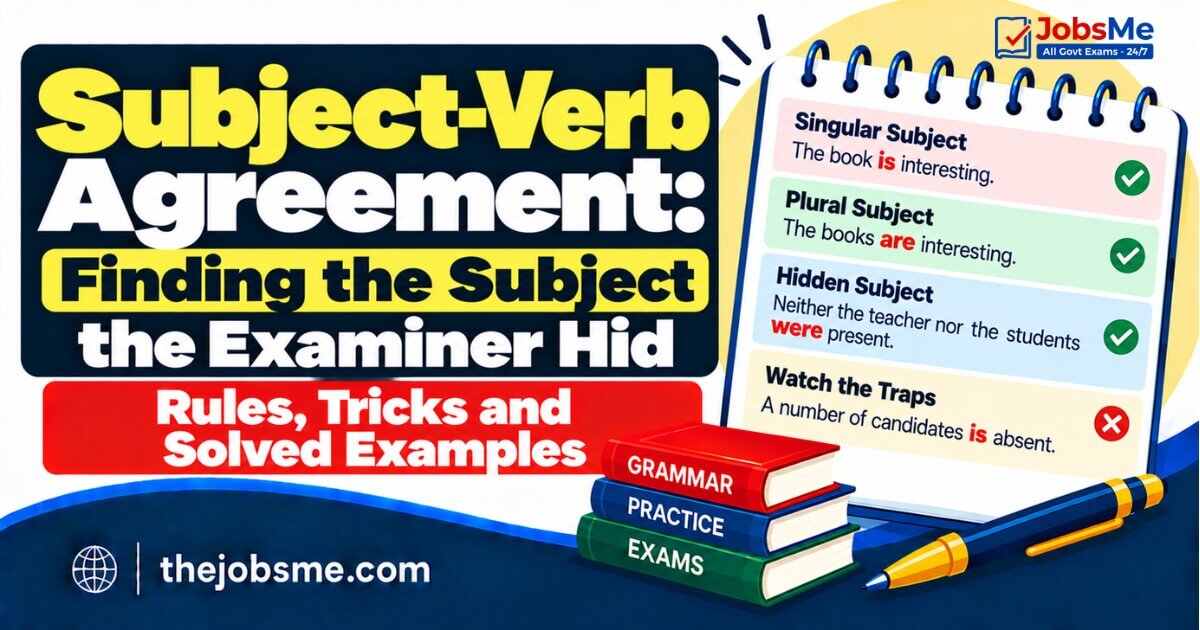
Subject-Verb Agreement: Finding the Subject the Examiner Hid
This article is a complete, exam-ready guide to subject-verb agreement for SSC, banking, insurance, railway, defence and State PSC exams. It is the second-highest-weight grammar topic in the paper and the single most tested area in error spotting, yet almost nobody loses marks on the basic rule. Marks are lost because the examiner hides the real subject, usually by placing a noun of the wrong number right beside the verb. So this guide teaches one method for finding the true subject and then catalogues the structures used to disguise it: intervening phrases, inversion, deceptive noun forms, compound subjects, quantifier-headed phrases, collective nouns and relative clauses. Ten solved questions, common traps and a fifteen-question practice set with a full answer key are included.
Introduction
Subject-verb agreement, also called concord, means the verb must match its subject in number and person. A singular subject takes a singular verb and a plural subject takes a plural verb.
Every candidate knows that. Nobody writes the students studies. So it is worth asking why this topic costs so many marks.
The answer is that examiners almost never test the rule. They test whether you can find the subject, and they hide it by placing a noun of the wrong number right beside the verb.
Look at the cost of all these necessary items have increased. The word sitting next to the verb is items, which is plural and pulls the ear towards have. The actual subject is cost, three words earlier and singular. Nothing about the rule is difficult. Everything about locating the subject is.
So this article gives one method for finding the true subject, and then works through the structures examiners use to disguise it.
Where This Topic Is Asked
| Exam | How This Topic Appears | Rough Weight | Time to Allow |
|---|---|---|---|
| SSC CGL and CHSL | The single most tested area in error spotting, hiding in three or four of the five or six questions. | Around 12 per cent of grammar marks | 12 to 15 seconds a question |
| IBPS PO and SBI PO | Long clauses separating subject and verb, either or proximity, and the number of expressions. | 2 to 3 questions | 20 seconds a question |
| Railway and defence exams | Direct rule checks on titles, subjects ending in s, and distances or amounts. | 1 to 2 questions | 10 seconds a question |
| State PSC and police exams | Collective nouns and distributive rules. | 1 to 2 questions | 15 seconds a question |
| Fillers and cloze | The verb form is often the deciding factor in a blank. | Indirect | Part of the question |
| Descriptive papers | An agreement error in a long sentence is the fault examiners notice first. | Indirect | Final check |
Only tenses carry more weight in the grammar block. That makes this the highest-return topic after tenses, and unusually, one where a single technique covers most of the questions. Check your own pattern in the exam-wise syllabus hub.
The Three-Step Method
| Step | What to Do | Applied to The list of selected candidates have been published |
|---|---|---|
| 1. Find the verb | Locate the finite verb, since that is what has to agree. | Have been published. |
| 2. Strip out the padding | Cross out everything that cannot be the subject. | Strike of selected candidates. |
| 3. Match what remains | Test the verb against the surviving noun. | The list is singular, so it must be has been published. |
The Stripping List
Step two does most of the work, so it is worth being precise about what to remove. None of the following can ever contain the subject of the sentence.
- Prepositional phrases, especially those beginning with of. The quality [of apples] is good.
- Anything between a pair of commas. The captain [, along with the players,] was felicitated.
- Parenthetical connectors and what follows them. As well as, along with, together with, accompanied by, in addition to, besides, including, like, unlike, no less than, rather than, and not.
- Relative clauses beginning with who, which or that, unless the clause itself contains the verb you are testing.
Note the crucial point about the third bullet. And joins two subjects and makes them plural. As well as and its family do not join anything, so the verb agrees with the first noun alone.
- The captain and the players were felicitated. Two subjects, so plural.
- The captain, along with the players, was felicitated. One subject, so singular.
- The students as well as the teacher are unaware of the change. The first noun is plural, so the verb is plural.
Formula Box
- Find the verb, strip the padding, match what remains.
- Cross out every of phrase before deciding anything.
- And makes a subject plural; as well as and along with do not.
- Or and nor take the nearest subject.
- The number of takes a singular verb; a number of takes a plural one.
- One of the students is; one of those students who are.
- Each, every, either and neither are always singular.
- Amounts, distances and periods treated as one unit take a singular verb.
Disguise One: Distance
This is the commonest structure of all, and it costs candidates two or three marks a paper on its own. A phrase is inserted between the subject and the verb so that a noun of the wrong number sits next to the verb.
| Wrong | Right | The Real Subject |
|---|---|---|
| The cost of all these items have increased. | The cost of all these items has increased. | cost |
| The list of selected candidates have been published. | The list of selected candidates has been published. | list |
| A bunch of bananas are lying on the table. | A bunch of bananas is lying on the table. | bunch |
| The chocolates that she gave the children was delicious. | The chocolates that she gave the children were delicious. | chocolates |
| The condition of the roads in the district are poor. | The condition of the roads in the district is poor. | condition |
| The quality of the apples sold here are good. | The quality of the apples sold here is good. | quality |
Every one of those is repaired by the same move: put a finger over the phrase between the subject and the verb, and read what remains.
Disguise Two: Inversion
When the subject comes after the verb, the eye has nothing to check against and the ear takes over.
- There and here. The verb agrees with what follows it. There is a dog outside, but there are twenty questions to answer.
- Questions. Has Ram come? and have Ram and Shyam come?
- After a negative opener. Seldom does he attend, and never have I seen such a crowd.
- Fronted phrases. In the corner stands an old clock, where the subject is clock.
The commonest error here is there is many options available, where the subject options follows the verb and demands are.
Disguise Three: Deceptive Form
Some nouns lie about their number, and exams use all three groups.
| Group | Words | Verb | Example |
|---|---|---|---|
| Look plural, are singular | Mathematics, physics, economics, politics, ethics, statistics, news, innings, summons, measles, mumps, rickets, billiards, draughts. | Singular | Mathematics is an interesting subject. No news is good news. |
| Look singular, are plural | Cattle, poultry, peasantry, gentry, infantry, police, people, clergy, vermin. | Plural | Cattle are grazing in the field. The police have arrested the thieves. |
| Exist only in the plural | Scissors, trousers, spectacles, goggles, binoculars, tongs, pliers, premises, alms, amends, proceeds, thanks, tidings. | Plural | Where are my spectacles? The proceeds were deposited in the bank. |
| Uncountable | Information, advice, furniture, equipment, luggage, baggage, knowledge, scenery, machinery, stationery, poetry, traffic, work, evidence, music. | Singular | The information is useful. The scenery of Kashmir has enchanted us. |
| A pair of | Any plural-only noun preceded by this phrase. | Singular | My shoes are hurting me, but a pair of leather shoes is expensive. |
| Titles of works | Books, films, newspapers, however plural they look. | Singular | The Arabian Nights is a famous collection. |
Two notes on the first row. Statistics, politics and mathematics take a singular verb as subjects of study, but a plural verb when they mean figures, political views or calculations. So statistics is a difficult subject, but the statistics show a rise in enrolment.
And a word of caution about data. Some guides state flatly that data are is the only correct form, since data is the plural of datum. Modern usage widely accepts data is when the word means a body of information, so this is genuinely contested. Do not choose it as the error in a question unless every other part is clean.
Disguise Four: Compound Subjects
Two nouns joined by and usually make a plural subject, but three situations reverse that.
| Situation | Verb | Example |
|---|---|---|
| Two distinct people or things | Plural | The director and the producer have arrived. |
| One person holding two roles | Singular | The poet and philosopher is dead. My friend, philosopher and guide has come. |
| Two words expressing one idea | Singular | Bread and butter is his usual breakfast. Law and order is deteriorating. |
| Each or every before the subjects | Singular | Each boy and each girl has come. Every man and woman was consulted. |
The Article Test
The second row causes the most trouble, and there is a mechanical test for it. Count the articles. Two articles mean two people and a plural verb, while one article means one person and a singular verb.
- The dramatist and the politician are presiding over the function. Two articles, two people.
- The dramatist and politician is presiding over the function. One article, one person who is both.
This test is worth learning because at least one widely circulated guide states the rule, gives an example that contradicts it, and then explains the example incorrectly. The article count settles it every time.
Disguise Five: Alternatives and the Proximity Rule
When subjects are offered as alternatives rather than added together, the verb ignores the first subject entirely and matches the nearest one.
The connectors: or, nor, either or, neither nor, not only but also, none but.
- Neither the manager nor the employees are attending. The nearest subject is plural.
- Neither the employees nor the manager is attending. The nearest subject is singular.
- Either the students or the teacher is responsible.
- Not only the players but also the coach was praised.
One correction is needed here, because a widely used guide states that either or and neither nor always take a singular verb. That is not the rule. The verb follows the nearer subject, so neither the manager nor the employees are available is correct. The guide's own example happens to work only because both its subjects were singular.
A second point on neither of and either of. Both refer to two things only, so for more than two you need none of and any of. None of his four sons looked after him, not neither of his four sons.
Key Highlights
- The rule is never the difficulty; finding the subject is.
- Cover the middle phrase and most questions answer themselves.
- Only and adds a subject, whatever the other connectors seem to do.
- Or and nor follow the nearer subject, not the first one.
- Second only to tenses in weight, and the one topic where a single technique covers most questions.
Disguise Six: Quantifier-Headed Subjects
These are the formulas examiners reuse most, and each has a fixed answer.
| Structure | Verb | Reason | Example |
|---|---|---|---|
| The number of | Singular | The head noun is number. | The number of applicants has increased. |
| A number of | Plural | It means many. | A number of students have qualified. |
| One of the | Singular | The subject is one. | One of my friends is a doctor. |
| Each of, either of, neither of | Singular | These are singular whatever follows. | Each of the boys has submitted the form. |
| Many a | Singular | Singular in form despite the plural sense. | Many a soldier has fallen in battle. |
| More than one | Singular | The head word is one. | More than one student was absent. |
| The amount of | Singular | Used with uncountable nouns. | The amount of money is not sufficient. |
| Percentage or fraction of | Follows the noun after of | The quantity decides. | Fifty per cent of the water is pure. Fifty per cent of the students are present. |
| All | Follows the sense | Quantity against number. | All is well that ends well. All are well at home. |
| A pair of, a bunch of, a series of | Singular | The head noun is the container word. | A series of lectures has been arranged. |
Note the pattern in the last few rows. Where a quantity word heads the phrase, the quantity word decides. Where the phrase means simply many or expresses a proportion, the noun after of decides.
Disguise Seven: Collective Nouns
Jury, committee, team, staff, audience, family, crowd, government, army, herd and class change their verb according to how the group is behaving.
- Acting as one body, the verb is singular. The jury is ready with its verdict. The committee has announced the results.
- Members acting individually or disagreeing, the verb is plural. The jury were divided in their opinions. The audience have taken their seats.
The exam signal is the pronoun. If the sentence goes on to say their opinions or their seats, the subject is being treated as plural and the verb must match. A sentence mixing has with their is internally inconsistent and is itself the error.
Disguise Eight: Relative Clauses
A verb inside a relative clause agrees with the noun that who, which or that refers back to, not with the subject of the main clause. Three patterns are worth learning as a set.
| Structure | Who refers to | Verb | Example |
|---|---|---|---|
| One of the boys, with no relative clause | Not applicable | Singular | One of the boys is absent. |
| One of those boys who | boys, which is plural | Plural | He is one of those boys who are always late. |
| The only one of those boys who | one, because only narrows it | Singular | He is the only one of those boys who is always late. |
| She is the only student who | student, which is singular | Singular | She is the only student who works hard. |
The word only is the switch. Without it the relative pronoun reaches back to the plural noun; with it, the pronoun points at the single individual.
Disguise Nine: Amounts Treated as One Unit
When a plural expression of money, distance, time or weight is thought of as a single quantity, the verb is singular.
- Five thousand rupees is a large amount.
- Ten kilometres is too far to walk.
- Two hours is enough for the paper.
- Fifty kilograms is the baggage limit.
The test is whether the figure is being counted or measured. Ten rupees is lying on the table treats the sum as one amount, while ten rupee coins are lying on the table counts individual objects.
Wishes and Subjunctives
After I wish, if only, as if, as though and suppose, English uses were for every subject.
- I wish I were a bird. If he were rich, he would help others. He behaves as if he were the owner.
One clarification is needed here, because a widely used note calls this a plural verb used with a singular subject. It is not a plural verb but the subjunctive mood, and the same explanation wrongly describes God save the king the same way. That is also a subjunctive, using the bare form of the verb.
A Warning About Study Material on This Topic
- A rule contradicted by its own example. One guide states that two nouns referring to the same person take a singular verb, then gives the dramatist and the politician are presiding, and explains that both nouns refer to the meeting. The rule is right, the example is plural, and the explanation is meaningless. The article count is the reliable test.
- The proximity rule stated as an always-singular rule. Another guide says either or and neither nor take a singular verb. The verb follows the nearer subject, so neither the manager nor the employees are is correct.
- An example that breaks the rule above it. A note explains that cattles and childrens are wrong, and then offers Cattles are grazing in the field as its example.
- The subjunctive called a plural verb. God save the king is described as a plural verb with a singular subject. It is the subjunctive, which uses the bare verb form.
- A typo that destroys the example. Ten mules is a long distance to cover on foot should read ten miles.
So check every example against the rule it claims to demonstrate, particularly in a topic where a single wrong verb form in a model answer teaches the opposite of the intended lesson.
Exam Alert
- Part C carries the main verb in most error spotting sentences, so check it early.
- A long of phrase before the verb is the single commonest structure in the paper.
- Learn the number of and a number of as a pair, since knowing one alone guarantees an error.
- A collective noun with their demands a plural verb.
- Roughly a fifth of error spotting questions have no error, so do not manufacture one.
Ten Solved Questions
1. Find the error. The cost of all these (a) / necessary items have (b) / increased sharply this year. (c) / No error (d)
Working: Strike of all these necessary items. What remains is the cost, which is singular. Answer: (b), which should read has increased.
2. Find the error. The captain along with (a) / the other players were (b) / felicitated at the function. (c) / No error (d)
Working: Along with does not join subjects, so the verb agrees with the captain. Answer: (b), which should read was felicitated.
3. Find the error. Neither the manager (a) / nor the employees was (b) / informed of the decision. (c) / No error (d)
Working: The verb follows the nearer subject, which is employees. Answer: (b), which should read were informed.
4. Find the error. The number of applications (a) / received this year have (b) / crossed all previous records. (c) / No error (d)
Working: The number of takes a singular verb, since the head noun is number. Answer: (b), which should read has crossed.
5. Choose the correct sentence. (a) He is one of those students who is always punctual. (b) He is one of those students who are always punctual. (c) He is one of those student who are punctual. (d) He is one of those students whom are punctual.
Working: Who refers back to students, which is plural. Answer: (b). Adding the only before one would make it singular.
6. Find the error. The dramatist and (a) / the politician is presiding (b) / over the function today. (c) / No error (d)
Working: Two articles mean two people, so the verb must be plural. Answer: (b), which should read are presiding.
7. Find the error. Many a soldier (a) / have fallen in battle (b) / defending this frontier. (c) / No error (d)
Working: Many a is singular in form despite its plural sense. Answer: (b), which should read has fallen.
8. Find the error. The jury has been (a) / divided in their opinions (b) / about the verdict. (c) / No error (d)
Working: The pronoun their signals that the members are acting individually, so the verb must be plural too. Answer: (a), which should read the jury have been.
9. Find the error. Ten kilometres are (a) / too long a distance (b) / to cover on foot. (c) / No error (d)
Working: A distance treated as one quantity takes a singular verb. Answer: (a), which should read ten kilometres is.
10. Find the error. A number of candidates (a) / have been shortlisted (b) / for the final interview. (c) / No error (d)
Working: A number of means many and takes a plural verb, which it has. The scan comes up clean. Answer: (d), no error.
Quick Facts
- Singular: the number of, one of the, each of, either of, neither of, many a, more than one, the amount of.
- Plural: a number of, a great many, both of.
- Look plural, are singular: mathematics, physics, news, innings, summons, measles, billiards.
- Look singular, are plural: cattle, police, people, poultry, peasantry, gentry.
- Proximity: or, nor, either or, neither nor, not only but also.
- First noun only: as well as, along with, together with, accompanied by, in addition to.
Worked Examples: Wrong to Right
Example 1 (matching the nearest noun)
Sentence: A student accepts The cost of all these items have increased.
Trap: The word beside the verb is plural, and the ear settles the question before the eye gets there. The subject is cost, three words earlier, and everything between it and the verb is decoration.
Correct Answer: The cost of all these items has increased.
Rule in Simple Words: Cross out every of phrase before deciding the verb.
Example 2 (treating as well as like and)
Sentence: A student writes The captain along with the players were felicitated.
Trap: Along with means roughly the same as and, so it feels as though it adds a second subject. Grammatically it adds information, not a subject, so the verb still answers to the captain alone.
Correct Answer: The captain, along with the players, was felicitated.
Rule in Simple Words: Only and creates a compound subject.
Example 3 (making either or always singular)
Sentence: A student writes Neither the manager nor the employees was informed.
Trap: Many guides state that either or and neither nor take singular verbs, and the student has learnt that rule faithfully. The actual rule is proximity, so the verb follows whichever subject stands nearer.
Correct Answer: Neither the manager nor the employees were informed.
Rule in Simple Words: The verb matches the nearer subject.
Example 4 (the number of)
Sentence: A student writes The number of applications have crossed all records.
Trap: Applications is plural and the sentence is plainly about many of them, so the plural verb feels correct in meaning as well as sound. The head noun is number, and a number is one thing.
Correct Answer: The number of applications has crossed all records.
Rule in Simple Words: The number of is singular; a number of is plural.
Example 5 (one of those who)
Sentence: A student writes He is one of those students who is always punctual.
Trap: One of the students is is drilled into everyone, so the singular verb transfers automatically. The verb here belongs to the relative clause, and who reaches back to students, not to one.
Correct Answer: He is one of those students who are always punctual.
Rule in Simple Words: Find what who refers to before choosing the verb.
Example 6 (mixing a collective noun's number)
Sentence: A student accepts The jury has been divided in their opinions.
Trap: A jury is one body, so the singular verb looks correct in isolation. The words divided and their both signal individual members, and a sentence cannot treat the same noun as singular and plural at once.
Correct Answer: The jury have been divided in their opinions.
Rule in Simple Words: Let the pronoun tell you which number the sentence has chosen.
Example 7 (counting an amount)
Sentence: A student writes Ten kilometres are too long a distance to walk.
Trap: The number is plainly more than one, so a plural verb seems obviously right. The sentence treats the ten kilometres as a single distance rather than as ten separate things.
Correct Answer: Ten kilometres is too long a distance to walk.
Rule in Simple Words: One amount, one verb.
Example 8 (manufacturing an error)
Sentence: Having learnt that the number of is singular, a student marks a number of candidates have been shortlisted as wrong.
Trap: The two phrases differ by one small word and the rule was learnt as a single fact rather than a pair. A number of means many, so it genuinely is plural.
Correct Answer: No error.
Rule in Simple Words: Learn the two phrases together, never one alone.
Common Traps Students Fall Into
These are the habits that most often cost marks. Each one is a common trap, not a silly mistake, and each has a one-line fix.
- Trap: Matching the verb to the nearest noun. Fix: Strip every of phrase first.
- Trap: Treating as well as and along with as and. Fix: Only and creates a compound subject.
- Trap: Making either or always singular. Fix: The nearer subject decides.
- Trap: Confusing the number of with a number of. Fix: Learn them as a pair, not separately.
- Trap: Carrying the one of the rule into a relative clause. Fix: Ask what who refers back to.
- Trap: Giving a collective noun a singular verb and a plural pronoun. Fix: Pick one number and hold it.
- Trap: Trusting the look of a noun. Fix: Mathematics is singular and cattle is plural, whatever the endings suggest, as noted in commonly confused words.
- Trap: Missing the subject after there or here. Fix: The verb agrees with what follows it.
- Trap: Using a plural verb for an amount. Fix: One quantity takes a singular verb, and the same logic governs tenses with time expressions.
- Trap: Manufacturing errors in correct sentences. Fix: Roughly a fifth of error spotting items have no error, as noted in error spotting.
- Trap: Learning twenty-four numbered rules. Fix: Learn one method and nine disguises.
Memory Tricks and Formulas
1. Cover the middle
Put a finger over everything between the subject and the verb, then read what remains. This single move solves the majority of questions in this topic. Strike prepositional phrases, anything between commas, and everything after as well as.
2. Only and adds
And joins two subjects and makes them plural. As well as, along with, together with, accompanied by, in addition to, besides and unlike add information without adding a subject.
3. Count the articles
For two nouns joined by and, count the articles. Two articles mean two people and a plural verb. One article means one person wearing two hats and a singular verb.
4. Learn the pair, not the rule
The number of is singular and a number of is plural. Learning either one alone guarantees an error on the other, so always write them down together.
5. Ask what who points at
In a relative clause, trace the pronoun back. One of those boys who are, but the only one of those boys who is. The word only is the switch that redirects the pronoun.
6. Let the pronoun decide the collective
If the sentence later says its, the noun is singular. If it says their, the noun is plural and the verb must follow. A sentence using both is the error itself.
7. Counted or measured?
For money, distance, time and weight, ask whether the figure is being counted or measured. Measured means one quantity and a singular verb, so two hours is enough.
8. Budget the time honestly
At 12 per cent of grammar marks this is second only to tenses, and it should take 12 to 15 seconds a question in SSC and about 20 seconds in a bank paper. Practise until the stripping step is automatic.
Exam Patterns and High-Yield Facts
Frequently Confused Pairs
| Pair | How They Differ | Mini Trick |
|---|---|---|
| The number of vs A number of | Singular against plural. | The number has, a number have. |
| And vs As well as | Adds a subject against adds information. | Only and makes it plural. |
| One of the boys is vs One of those boys who are | Main clause against relative clause. | Ask what who refers to. |
| One of those who are vs The only one of those who is | Only redirects the pronoun. | Only points at one. |
| Neither of vs None of | Two against more than two. | Count the options. |
| Many a vs Many | Singular against plural. | Many a soldier has; many soldiers have. |
| The jury is vs The jury are | United against divided. | Watch for its or their. |
| Statistics is vs Statistics show | The subject against the figures. | Study takes singular; data takes plural. |
| Shoes are vs A pair of shoes is | The noun against the container word. | Pair is the head noun. |
| Ten rupees is vs Ten rupee coins are | Measured against counted. | Amount or objects? |
Repeating Question Patterns
- A prepositional phrase inserted between subject and verb, which is the commonest single structure in the whole of error spotting.
- As well as or along with treated as and.
- The proximity rule reversed in an either or construction.
- The number of confused with a number of.
- A relative clause after one of those, testing whether you trace the pronoun.
- A collective noun with a mismatched pronoun.
Practice Set: Fifteen Questions
Correct each sentence, or mark it correct as it stands.
- The list of shortlisted candidates have been displayed on the notice board.
- A number of students have applied for the scholarship this year.
- Each of the officers were given a separate assignment.
- The teacher, along with her students, was present at the ceremony.
- Neither the principal nor the teachers was aware of the change.
- Mathematics are my favourite subject at school.
- The police has arrested three suspects in the case.
- She is one of those candidates who has cleared all three stages.
- Five thousand rupees is a considerable sum for a student.
- The committee has announced its decision after long deliberation.
- Many a candidate have failed to submit the documents on time.
- There is several options available to the applicants.
- The quality of the mangoes sold in this market is excellent.
- Bread and butter is his usual breakfast before work.
- The number of vacant seats are twenty in this session.
Quick Facts
Answer key, with the rule named in each case.
- 1. has been displayed. Strip of shortlisted candidates; the subject is list.
- 2. Correct as it stands. A number of means many and takes a plural verb.
- 3. was given. Each of stays singular whatever noun follows.
- 4. Correct as it stands. Along with does not add a subject.
- 5. were aware. The nearer subject is teachers, which is plural.
- 6. Mathematics is. It looks plural but is singular.
- 7. The police have arrested. It looks singular but is plural.
- 8. who have cleared. Who refers back to candidates.
- 9. Correct as it stands. A sum treated as one amount takes a singular verb.
- 10. Correct as it stands. The verb is singular and the pronoun its matches.
- 11. has failed. Many a is singular in form.
- 12. There are several options. The verb agrees with what follows it.
- 13. Correct as it stands. The subject is quality, which is singular.
- 14. Correct as it stands. Two words expressing one idea take a singular verb.
- 15. The number of vacant seats is twenty. The head noun is number.
Six of those fifteen were already correct, which matters in a topic where students who have just learnt nine disguises begin finding them everywhere. Practise the same restraint with the free English MCQ quizzes and full papers from the mock test archive.
Quick Revision
Quick Revision
- What the topic is. The verb must match its subject in number and person, and this is the second-highest-weight grammar topic after tenses.
- Why marks are lost. Not because the rule is hard, but because the examiner hides the subject by putting a noun of the wrong number beside the verb.
- The method in three steps. Find the verb, strip the padding, match what remains.
- What to strip. Prepositional phrases especially those with of, anything between a pair of commas, and everything after as well as or along with.
- Only and creates a compound subject. As well as, along with, together with, accompanied by, in addition to, besides, like and unlike do not.
- Count the articles when two nouns are joined by and, since two articles mean two people and one article means one person.
- Two words expressing a single idea take a singular verb, so bread and butter is and law and order is.
- Or and nor follow the proximity rule, so the verb matches the nearer subject and not the first one.
- Neither of and either of refer to two things only, and for more than two you need none of and any of.
- The number of takes a singular verb while a number of takes a plural one, so always learn the two together.
- One of the takes a singular verb, and so do each of, either of, neither of, many a and more than one.
- A percentage or fraction follows the noun after of, so fifty per cent of the water is and fifty per cent of the students are.
- Some nouns look plural but are singular. Mathematics, physics, economics, politics, news, innings, summons, measles and billiards.
- Some nouns look singular but are plural. Cattle, poultry, peasantry, gentry, infantry, police, people and clergy.
- Some nouns exist only in the plural. Scissors, trousers, spectacles, premises, proceeds and tidings, though a pair of makes the verb singular.
- Uncountable nouns always take a singular verb. Information, advice, furniture, equipment, luggage, scenery, machinery and knowledge.
- Titles of books and papers take a singular verb however plural they look.
- A collective noun is singular when the group acts as one body and plural when the members act individually.
- The pronoun reveals which number the sentence chose, so its signals singular and their signals plural.
- In a relative clause the verb agrees with whatever who refers back to.
- One of those boys who are, but the only one of those boys who is, because the word only redirects the pronoun.
- After there and here the verb agrees with what follows it.
- Amounts of money, distance, time and weight treated as one quantity take a singular verb, so two hours is enough.
- After I wish, if only and as if, use were for every subject, since this is the subjunctive rather than a plural verb.
- Timing. Twelve to fifteen seconds a question in SSC, about twenty in a bank paper.
Subject-verb agreement rewards technique far more than memorisation. Nobody fails this topic because they do not know that a singular subject takes a singular verb; they fail it because a plural noun was sitting next to the verb and the ear decided before the eye arrived. So make the stripping step automatic, learn the nine disguises as structures rather than as numbered rules, and trust the finger over the middle phrase. The topic sits at the centre of error spotting and sentence improvement, decides many answers in fill in the blanks and cloze test, and connects to adjectives and determiners for the each and every rules and to conjunctions and connectors for the correlative pairs. The wider set is in the topic-wise English notes.
Frequently Asked Questions
What is subject-verb agreement?
Why do candidates lose marks if the rule is so simple?
What is the fastest way to find the true subject?
Does as well as make a subject plural?
What is the rule for either or and neither nor?
What is the difference between the number of and a number of?
Why is one of those students who are correct?
When does a collective noun take a plural verb?
Why is ten kilometres is correct?
How much weight does this topic carry?

About the author





