
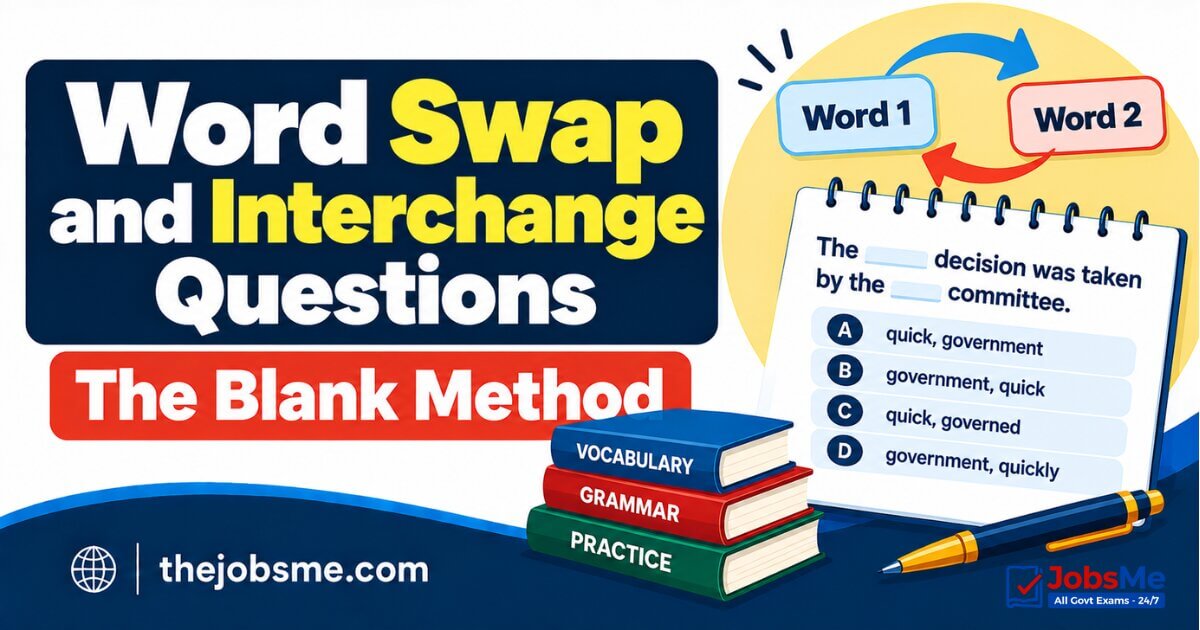
Word Swap and Interchange Questions: The Blank Method
This article is a complete, exam-ready guide to word swap and word interchange questions for banking, insurance and other competitive exams. It covers all five question formats, including the two-sentence A-to-H version that bank papers now favour, and teaches the blank method: replace every marked word with a gap, decide what each gap needs, then fill the gaps from the pool. It also gives the part-of-speech slot rules, the meaning checkpoints examiners break, the rules for deciding when no interchange is needed and when two pairs must move, five fully solved sets, common traps, memory tricks and a twelve-question practice set with a full answer key.
Introduction
A word swap or interchange question gives you a sentence in which two correct words have been placed in each other's slots. Your job is to exchange them.
Read this line. Concerns have been paved regarding the cryptocurrency markets. Nothing is misspelt. The grammar is intact. And yet paved is wrong, because concerns are raised, while roads are paved. Somewhere in the question, the word raised is sitting where paved belongs.
That is what makes this topic different from error spotting. In error spotting a rule has been broken. In an interchange question no rule is broken at all, so the error stays invisible until you check which word each slot actually needs.
Bank examiners have made this a favourite for exactly that reason. It tests grammar, vocabulary and comprehension in a single question, and it cannot be answered by pattern-matching.
Where This Topic Is Asked
| Exam | How This Topic Appears | Rough Weight | Difficulty |
|---|---|---|---|
| Bank PO prelims | One sentence with four highlighted words, or two sentences with two highlighted in each. | 3 to 5 questions | Moderate. Word swap is now listed among the highest-priority topics in the syllabus. |
| Bank PO mains | The two-sentence version with words marked from A to H, where you choose which pair or pairs must be interchanged. | 4 to 5 questions | Hard. Eight marked words give twenty-eight possible pairs, so a method is essential. |
| Bank and insurance clerk exams | Single sentence with four highlighted words and a no-interchange option. | 3 to 4 questions | Moderate. |
| Specialist and grade exams | The same formats on denser editorial sentences. | Varies | Hard, because the vocabulary is heavier. |
| SSC and State PSC exams | Not usually named, but the same judgement decides sentence improvement questions. | Indirect | Moderate. |
The Exam Arithmetic You Should Know
Three facts about the current bank prelims pattern change how you should attempt this topic.
- The English section carries 30 marks and runs on its own 20-minute timer, with no switching between sections. So the whole section allows about forty seconds a question.
- Every wrong answer costs one-fourth of the mark, while an unanswered question costs nothing.
- An interchange question needs 45 to 90 seconds depending on the format.
Put those together and the strategy is clear. This topic is worth attempting when you can confirm the swap, and worth leaving when you cannot. A blind guess between four pairs loses money over a full paper, because you will be wrong three times out of four and pay a penalty each time. Confirm the pattern for your own exam in the exam-wise syllabus hub, since these rules are revised from time to time.
The Five Question Formats
Read the direction line first, every time. These five formats look similar and demand different answers.
| Format | What You Are Given | What You Must Answer | Time |
|---|---|---|---|
| 1. Single sentence, four marked words | One sentence with four words highlighted, some possibly misplaced. | The pair to interchange, or no interchange required. | 45 to 60 seconds. |
| 2. Two sentences, two marked in each | Two related statements, each with two highlighted words. | The correct combination of words to interchange so that both sentences work. | 60 to 75 seconds. |
| 3. Two sentences, marked A to H | Two sentences with eight words highlighted between them. | The pair or pairs that must be interchanged. Often more than one pair is needed. | 75 to 90 seconds. |
| 4. Five words, arrangement asked | One sentence with five words marked A to E, all possibly displaced. | The correct sequence, expressed as a string such as C-D-E-A-B. | 75 seconds. |
| 5. Interchange plus replacement | Four highlighted words, one of which is simply wrong and has no correct slot. | The pair to interchange and the word that replaces the wrong one. | 90 seconds. |
Formats three and five are the ones students lose marks on, and for the same reason: they assume one pair is the answer. In format three two pairs may need to move, and in format five a swap alone will not fix the sentence.
Formula Box
- The blank method is the master technique: turn every marked word into a gap, decide what each gap needs, then fill the gaps.
- Only the marked words are available. Everything unmarked is fixed.
- Each gap needs two things: the right part of speech and the right meaning.
- One confirmed gap solves its partner, because a swap is always a two-way exchange.
- No interchange required is a genuine answer and appears regularly.
- Time: 45 to 90 seconds, depending on the format.
- With negative marking, attempt when you can confirm the swap and skip when you cannot.
The Blank Method
This is the technique that turns a guessing exercise into a solvable one. Instead of testing pairs at random, you rebuild the sentence from empty slots.
The Five Steps
| Step | What to Do | Why It Works |
|---|---|---|
| 1. Read the sentence once, ignoring the marks | Get the overall subject and direction of the sentence. | You cannot judge a slot until you know what the sentence is about. |
| 2. Replace every marked word with a blank | Mentally read the sentence as Concerns have been ______ regarding the markets, and treat the marked words as a separate pool. | This removes the suggestion the wrong word plants in your mind. A misplaced word makes its own slot feel almost right. |
| 3. Decide what each blank demands | For each gap, name the part of speech needed and the kind of meaning needed. | A gap after have been needs a past participle. A gap after the needs a noun. This narrows the pool sharply. |
| 4. Fill the easiest gap first | Start with the gap where only one word from the pool can possibly fit. | Filling one gap tells you which word has been displaced, and that word's original slot is its partner. |
| 5. Fill the rest and read it back | Complete the remaining gaps and read the whole thing through once. | A wrong pairing sounds wrong even to a learner, so the read-back catches what the analysis misses. |
The power of step two is worth dwelling on. When you read concerns have been paved, the word paved occupies the slot and your mind starts constructing a reading in which it might work. Blank the slot out and the question becomes far easier: what have concerns been? Raised. Expressed. Voiced. Now look at the pool and find one of those words.
Slot Rules: What Each Gap Demands
| What Sits Before the Gap | What the Gap Needs | Example |
|---|---|---|
| has, have, had, have been | The third form of the verb, that is the past participle. | Concerns have been raised, not raising or raise. |
| is, are, was, were | Either a present participle for continuous tense or a past participle for the passive. | Roads are largely paved. The report is being prepared. |
| a, an, the | A noun, with only adjectives permitted in between. | The accused fled. The prime objective. |
| A preposition such as of, on, in, to | A noun or a gerund, never a finite verb. | Called on citizens. In favour of reform. |
| A gap immediately before a noun | An adjective. | Radical Islam. Aspirational consumers. |
| A gap immediately after a subject | A finite verb agreeing with that subject in number and tense. | Relations deteriorated. The department directed. |
| A gap between two nations, parties or groups | A noun, because an abstract relation cannot be a verb here. | Relations between the allies, not called between them. |
| A gap after a comma at the start of a clause | Often a connector such as albeit, although or however. | A downtrend, albeit slowly. |
Notice that half of those rules are pure grammar. You do not need to know a difficult word to place it correctly, only to know what shape of word the slot needs. That is why a student with moderate vocabulary can still score here, and it links directly to subject-verb agreement and tenses.
Meaning Checkpoints
Grammar narrows the pool. Meaning finishes the job. These are the word families examiners break, and each is worth learning as a pair.
| Word | What It Actually Goes With | The Word It Is Usually Swapped With |
|---|---|---|
| raised | concerns, objections, funds, a question | paved, which goes with roads and streets |
| prime | objective, concern, minister, importance | breach, which goes with law, trust, privacy, contract |
| aims | at a target, or to do something | albeit, which introduces a qualification |
| achieved | results, success, a target | threatened, which goes with a person or a peace |
| yielded or produced | mixed results, an outcome | threatened again, a very common substitution |
| ascertained | a fact, a cause, the truth | brushed, which goes with aside or off |
| elementary | schools, level, principles | working, which goes with hours, conditions, people |
| complaints | filed, lodged, received | campus, which is a place |
| disclosed | information, a fact, a plan | agreed, which goes with to plus an action |
| failing | to prevent, to comply, to deliver | unique, an adjective describing a problem |
| sanctioned | a loan, a scheme, a project | waived, which goes with a fee or a charge |
| curbed | inflation, misuse, spending | boosted, which goes with growth and demand |
These pairings all come from formal journalism, which is why editorial reading prepares you for this topic better than any word list. The habit is the same one described in collocations.
Decision Rules: One Pair, Two Pairs, or None
Three questions settle which kind of answer you are looking at.
- Is any marked word clearly impossible where it sits? If none is, the answer is almost certainly no interchange required. Check each marked word against its slot individually before deciding.
- After making one swap, does every marked word now sit correctly? If yes, one pair is the answer. If a second word still looks wrong, look for its partner among the words you have not yet moved.
- Does one marked word have no correct slot anywhere in the sentence? Then the question is the replacement type, and you need a swap plus a substitute word from the options.
Exam Alert
- Blank out the marked words before judging them. A misplaced word makes its own slot feel almost acceptable.
- Only the marked words can move. If your correction needs an unmarked word to shift, that answer is not on offer.
- Do not stop at the first successful swap. In the two-sentence format, two pairs frequently need to move.
- Choose the no-interchange option when it is right. Papers include it deliberately, and students avoid it out of suspicion.
- With negative marking, a confirmed swap is worth attempting and an unconfirmed guess is not.
Key Highlights
- Blank the slot before judging the word. This one habit changes the topic from guesswork to method.
- Solve slots, not pairs. There are always far fewer slots than possible pairings.
- Let grammar eliminate first. Auxiliaries, articles and prepositions rule options out completely.
- Finish the whole sentence. A second pair may still need moving after your first swap.
- Under negative marking, a confirmed swap is worth attempting and an unconfirmed guess is not.
Five Solved Sets
Solved Set 1: Two Sentences, Marked A to H
Directions: Choose the pair of words that must be interchanged to make both sentences correct.
Sentence I: Concerns have been (A) paved regarding the cryptocurrency (B) markets, as there is substantially less investor (C) protection than in (D) traditional securities markets.
Sentence II: The roads (E) throughout the state are largely (F) raised and (G) smooth, and power cuts (H) save become a thing of the past.
Working with the blank method:
- Blank A. Concerns have been ______. The auxiliary have been demands a past participle, and concerns are raised, expressed or voiced. Roads are paved, so paved is displaced.
- Find its home. Where would paved belong? Slot F, which currently holds raised in a sentence about roads.
- Check the rest. Markets, protection, traditional, throughout, smooth and save all sit correctly in their slots.
Answer: interchange A and F. Concerns are raised, and roads are paved. One collocation decided the whole question.
Solved Set 2: Prime and Breach
Sentence I: Increasing its GDP should be the nation's (A) breach strategic objective, notwithstanding the side (B) effects this same (C) growth might have on the (D) quality of life of its citizens.
Sentence II: Along with the (E) need for a data protection law, all privacy (F) prime cases should be (G) authorised by the courts, with the agency (H) responsible being held to account.
Working:
- Blank A. The nation's ______ strategic objective. The slot sits before an adjective and a noun, so it needs an adjective meaning most important. That is prime.
- Blank F. All privacy ______ cases. Privacy cases concern violations, so this needs a noun meaning a violation. That is breach.
- Check the rest. Effects, growth, quality, need, authorised and responsible are all correctly placed.
Answer: interchange A and F. Note how both slots were identified independently, and then simply matched. That is faster and safer than testing pairs.
Solved Set 3: A Connector in the Wrong Sentence
Sentence I: Although many of its main figures are (A) liberal in economic terms, the party voters that the leader (B) albeit to court are in (C) favour of (D) protectionist policies.
Sentence II: The share of (E) unbranded sales may witness a downtrend, (F) aims slowly, as many (G) aspirational consumers now prefer pricier and better-quality products.
Working:
- Blank B. The voters that the leader ______ to court. The slot needs a verb, and aims to court makes sense: the leader is targeting those voters.
- Blank F. A downtrend, ______ slowly. A gap after a comma before an adverb needs a connector that softens what came before. Albeit means although, and albeit slowly is standard usage.
- Check the rest. Liberal, favour, protectionist, unbranded and aspirational are correct.
Answer: interchange B and F. The clue here was structural rather than lexical: a connector cannot be a verb, and a verb cannot follow a comma before an adverb like that.
Solved Set 4: Results Are Not Threatened
Sentence I: The problems of (A) implementation of a plastic ban are not (B) unique to India. Bans and taxes on plastic bags have (C) threatened mixed results, with many countries (D) failing even in the developed world.
Sentence II: At the press (E) conference after the meeting, the President (F) disclosed that he had (G) agreed to stop the joint military exercises that had repeatedly (H) achieved the other side.
Working:
- Blank C. Bans have ______ mixed results. Results are produced, yielded or achieved, never threatened.
- Blank H. Exercises that had repeatedly ______ the other side. Military exercises threaten a country. You cannot achieve a country.
- Check the rest. Implementation, unique, failing, conference, disclosed and agreed are all correct.
Answer: interchange C and H. Both slots were decided by asking a simple question: what can this verb actually take as its object?
Solved Set 5: Five Words, Arrangement Asked
Sentence: The President (A) deteriorated on citizens to (B) radical French goods as (C) called between the NATO allies (D) boycott over the hardened stance against (E) relations Islam.
Working, slot by slot:
- Slot A. The President ______ on citizens. Needs a past-tense verb that can take on. You cannot deteriorate on someone. Answer: called, which is (C).
- Slot B. To ______ French goods. After the infinitive to, a base verb is needed. Answer: boycott, which is (D).
- Slot C. As ______ between the NATO allies. Something exists between two countries, so a noun is needed. Answer: relations, which is (E).
- Slot D. ______ over the hardened stance. Needs a past-tense verb that works with over. Answer: deteriorated, which is (A).
- Slot E. Against ______ Islam. Needs an adjective before the noun. Answer: radical, which is (B).
Answer: C-D-E-A-B. The corrected sentence reads: The President called on citizens to boycott French goods as relations between the NATO allies deteriorated over the hardened stance against radical Islam.
Look at what solved that one. Not a single difficult meaning, only five questions about what shape of word each slot required. That is the blank method at its most useful, and it is why this format looks harder than it is.
Quick Facts
- Concerns are raised. Roads are paved.
- Results are achieved or produced. Countries are threatened.
- Loans are sanctioned. Fees are waived.
- A cause is ascertained. A claim is brushed aside.
- Prime describes an objective. Breach names a violation.
- Albeit and notwithstanding are connectors, never verbs.
Worked Examples: Wrong to Right
Example 1 (judging a word in its slot)
Sentence: A student reads concerns have been paved and decides it might mean that the way has been prepared for concerns.
Trap: A misplaced word invites you to build a reading around it, and English is flexible enough that you can usually construct one. Once you blank the slot and ask what concerns are actually done to, only raised fits.
Correct Answer: Blank the slot first, then choose from the pool.
Rule in Simple Words: Never judge a marked word where it sits. Empty the slot and rebuild it.
Example 2 (testing pairs at random)
Sentence: With eight words marked A to H, a student begins testing A with B, then A with C, and runs out of time.
Trap: Testing pairs feels systematic, and the first few attempts are quick. Eight marked words give twenty-eight possible pairs, so this approach cannot finish inside a minute.
Correct Answer: Identify what each slot needs, then match the displaced words.
Rule in Simple Words: Solve slots, not pairs.
Example 3 (stopping after one swap)
Sentence: A student finds that C and H must be interchanged, marks it, and moves on.
Trap: One confirmed correction feels like the whole answer, and the sentence does read better. In the two-sentence format a second pair often needs moving too, and the options include double-pair answers.
Correct Answer: After the first swap, re-read both sentences and check the remaining marked words.
Rule in Simple Words: Check all the marked words before you mark the option.
Example 4 (refusing the no-interchange option)
Sentence: Every marked word is correctly placed, but the student forces the least implausible swap.
Trap: Students assume a question must hide an error, so the no-interchange option looks like a trick. It is a real answer that appears regularly.
Correct Answer: Check each marked word against its slot, and if all four are correct, choose no interchange.
Rule in Simple Words: A correct sentence is still a valid question.
Example 5 (a connector treated as a verb)
Sentence: A student leaves albeit in the slot after a subject, reading it as an action.
Trap: Albeit is an unfamiliar word to many candidates, and unfamiliar words are easy to mistake for verbs. It is a connector meaning although, so it cannot follow a subject as its action.
Correct Answer: Place albeit after a comma, softening what came before, as in a downtrend, albeit slowly.
Rule in Simple Words: Identify the word class of every unfamiliar marked word before placing it.
Example 6 (verb and object mismatch)
Sentence: A student accepts bans have threatened mixed results because both halves concern policy.
Trap: Every word in the phrase is a real policy word, so it reads like ordinary editorial writing. A verb must be able to take its object, and results cannot be threatened.
Correct Answer: Bans have produced or yielded mixed results, and exercises threatened the other side.
Rule in Simple Words: Ask what each verb can actually take as its object.
Example 7 (ignoring the auxiliary)
Sentence: A student places a base verb into a slot that follows has been.
Trap: The meaning may fit perfectly, which makes the grammar error easy to overlook. Has been requires the third form of the verb, so any other form is impossible there regardless of meaning.
Correct Answer: Use the past participle after has, have, had or have been.
Rule in Simple Words: Grammar rules out options before meaning gets a vote.
Example 8 (spending three minutes on one question)
Sentence: A student cannot confirm the swap but keeps working, and loses time meant for two easier questions.
Trap: Persistence feels like the right instinct, and the answer always seems one step away. With a twenty-minute sectional timer and a penalty for wrong answers, the cost of persisting is two other questions.
Correct Answer: Give the question its ninety seconds, then leave it unanswered and move on.
Rule in Simple Words: An unanswered question costs nothing. A wrong one costs a quarter mark.
Common Traps Students Fall Into
These are the habits that most often cost marks. Each one is a common trap, not a silly mistake, and each has a one-line fix.
- Trap: Judging a marked word where it sits. Fix: Blank the slot and ask what it needs before you look at the word.
- Trap: Testing pairs one by one. Fix: Solve slots instead. Eight marked words give twenty-eight pairs and only eight slots.
- Trap: Trying to move an unmarked word. Fix: Only the marked words are available.
- Trap: Stopping after the first successful swap. Fix: Re-read and check every remaining marked word.
- Trap: Never choosing no interchange. Fix: It is a genuine answer, so verify each word rather than assuming an error exists.
- Trap: Ignoring grammar and going by feel. Fix: Check the auxiliary, the article and the preposition first, since they eliminate options outright.
- Trap: Mistaking an unfamiliar word for a verb. Fix: Identify the word class first. Albeit, notwithstanding and whereas are connectors.
- Trap: Accepting a verb that cannot take its object. Fix: Ask whether the action can genuinely apply to that noun.
- Trap: Assuming the pair must be near each other. Fix: Words regularly swap across a whole sentence, or between two sentences.
- Trap: Guessing under negative marking. Fix: Attempt when the swap is confirmed and skip when it is not.
- Trap: Preparing by memorising word lists. Fix: Read editorials and note which words pair with which, supported by error spotting practice.
Memory Tricks and Formulas
1. Blank it before you judge it
The single most valuable habit in this topic is refusing to evaluate a marked word in its current slot. Empty the slot, ask what belongs there, then look at the pool. Everything else follows from this.
2. Slots, not pairs
Four marked words give six possible pairs. Eight give twenty-eight. But four words give only four slots, and eight give only eight. So always work slot by slot, because the number of things to check is far smaller.
3. Grammar votes first, meaning votes second
Check the auxiliary, the article and the preposition before you think about meaning. Grammar removes options outright, while meaning only ranks the survivors. Doing it in the other order wastes time.
4. Ask what the verb can take
Every verb has objects it can accept and objects it cannot. Results are produced, not threatened. Concerns are raised, not paved. Loans are sanctioned, fees are waived. This one question resolves most meaning-based swaps.
5. Identify the word class of anything unfamiliar
You do not need the exact meaning of albeit, notwithstanding or ascertained. You need to know that the first two are connectors and the third is a verb. Word class alone often places the word correctly.
6. One found word gives you two answers
A swap is a two-way exchange, so the moment you know which slot a displaced word belongs in, you also know its partner. There is never a need to search for the second word separately.
7. Two pairs are normal in the long format
In the two-sentence version with eight marked words, expect the possibility of 2 pairs. Finish the whole sentence before you decide, because the option list will contain both single and double answers.
8. The confirm-or-skip rule
With a 20-minute section and a one-fourth penalty, attempt the question when you can name both slots with confidence, and leave it when you cannot. This is the strategy that protects your score over a full paper.
Exam Patterns and High-Yield Facts
Frequently Confused Pairs
| Pair | How They Differ | Mini Trick |
|---|---|---|
| Word swap vs Error spotting | A swap has no broken rule, only a correct word in the wrong slot. Error spotting has a broken rule. | Wrong place against wrong grammar. |
| Word swap vs Word arrangement | A swap names a pair to exchange. An arrangement names the full sequence. | Pair against string. See word usage and arrangement. |
| Word swap vs Jumbled words | A swap keeps the sentence order and moves two words. Jumbled words rebuilds the order entirely. | Two words against the whole sentence. |
| Raised vs Paved | Concerns are raised. Roads are paved. | Abstract things rise, surfaces get paved. |
| Prime vs Breach | Prime is an adjective meaning chief. Breach is a noun meaning a violation. | Prime objective, privacy breach. |
| Aims vs Albeit | Aims is a verb. Albeit is a connector meaning although. | Aims to do, albeit slowly. |
| Achieved vs Threatened | You achieve a result. You threaten a person or a country. | Results achieved, neighbours threatened. |
| Disclosed vs Agreed | You disclose a fact. You agree to an action. | Disclosed that, agreed to. |
| Ascertained vs Brushed | You ascertain a cause. You brush something aside. | Ascertain the truth, brush aside a claim. |
| Elementary vs Working | Elementary describes a school or a principle. Working describes hours, conditions or people. | Elementary school, working hours. |
Repeating Question Patterns
- A verb and its wrong object is the commonest design, as with results threatened and concerns paved.
- An adjective moved off its noun, such as prime objective, radical Islam and elementary schools.
- A connector sitting in a verb slot, especially albeit, notwithstanding and whereas.
- A noun and a verb exchanged, where relations becomes a verb slot and called becomes a noun slot.
- Two pairs in the eight-word format, which students under-attempt because they stop at one.
- No-interchange questions, which students over-attempt because they assume an error exists.
Practice Set: Twelve Questions
For each, name the pair to interchange, or state that no interchange is needed. Give each item sixty seconds.
- Objections were (A) paved in the meeting, though the approach road had already been (B) raised and widened.
- The bank has (A) waived the loan for the cooperative and (B) sanctioned the processing fee for members.
- The department has (A) directed that all (B) elementary and higher secondary schools install complaint boxes on (C) campus for students.
- The inquiry (A) brushed that a power failure caused the landing, and the airline (B) ascertained aside the pilot's account.
- The measures have (A) yielded mixed results, with several states (B) failing to enforce the ban.
- Rising input costs have (A) boosted margins and (B) curbed prices across the sector.
- At the press (A) conference, the minister (B) agreed that he had (C) disclosed to review the policy.
- The share of unbranded sales fell, (A) aims slowly, as the company (B) albeit to reach premium buyers.
- The committee (A) submitted its report on areas (B) prone to flooding after the passes were (C) issued to residents.
- Reducing the deficit should be the state's (A) breach objective, and every privacy (B) prime must be reported.
- Relations (A) deteriorated after the statement, and the envoy was (B) called to the ministry.
- The drought has (A) slashed crop yields and (B) undermined rural livelihoods across four districts.
Quick Facts
Answer key, with the deciding slot named in each case.
- 1. Interchange A and B. Objections are raised; a road is paved and widened.
- 2. Interchange A and B. A loan is sanctioned; a fee is waived.
- 3. No interchange required. Elementary schools, complaint boxes on campus, and a department directs.
- 4. Interchange A and B. An inquiry ascertains a cause; an airline brushes aside an account.
- 5. No interchange required. Measures yield results, and states fail to enforce.
- 6. Interchange A and B. Rising costs curb margins and boost prices, so the two verbs sit in each other's slots.
- 7. Interchange B and C. You disclose that something is so; you agree to do something.
- 8. Interchange A and B. A fall happens albeit slowly; a company aims to reach buyers.
- 9. No interchange required. Areas are prone to flooding, and passes are issued to residents.
- 10. Interchange A and B. A prime objective, and a privacy breach.
- 11. No interchange required. Relations deteriorate, and an envoy is called to a ministry.
- 12. No interchange required. Yields are slashed, and livelihoods are undermined.
Five of those twelve needed no interchange at all. That proportion is deliberate, because the habit of forcing a swap is the single largest source of lost marks in this topic. Practise the same restraint with the free English MCQ quizzes and full papers from the mock test archive.
Quick Revision
Quick Revision
- What the question is. Two correct words have been placed in each other's slots, so nothing is misspelt and no grammar rule is broken.
- Why it is hard. The error is invisible until you check what each slot actually needs, which is why guessing rarely works here.
- The master technique. Replace every marked word with a blank, decide what each blank demands, then fill the blanks from the pool.
- Why blanking matters. A misplaced word makes its own slot feel almost acceptable, and emptying the slot removes that illusion.
- Work slots, not pairs. Eight marked words give twenty-eight possible pairs but only eight slots, so slot-by-slot is always faster.
- The first rule. Only the marked words can move, and everything unmarked in the sentence is fixed.
- One find gives two answers. A swap is a two-way exchange, so once you know where a displaced word belongs, its partner is whatever sits there now.
- Grammar votes first. Check the auxiliary, the article and the preposition before you think about meaning, because grammar rules options out completely.
- After has, have or had, you need the third form of the verb, so any other form in that slot is impossible whatever it means.
- After a or the, you need a noun, with only adjectives allowed in between.
- After a preposition, you need a noun or a gerund, never a finite verb.
- Immediately before a noun, you need an adjective, which is how prime, radical and elementary are placed.
- Immediately after a subject, you need a finite verb agreeing with it in number and tense.
- Ask what each verb can take. Results are produced or achieved, never threatened. Concerns are raised, never paved.
- Learn the word class of hard words. Albeit, notwithstanding and whereas are connectors, so they can never sit in a verb slot.
- Raised and paved. Concerns and objections are raised; roads and streets are paved.
- Prime and breach. Prime is an adjective meaning chief; breach is a noun meaning a violation.
- Achieved and threatened. You achieve a result; you threaten a person or a country.
- Disclosed and agreed. You disclose that something is true; you agree to do something.
- Sanctioned and waived. Loans and schemes are sanctioned; fees and charges are waived.
- Curbed and boosted. Inflation and misuse are curbed; growth and demand are boosted.
- Slashed and undermined. Yields and budgets are slashed; confidence and livelihoods are undermined.
- Do not stop at one swap. In the eight-word two-sentence format, two pairs frequently need to move.
- Choose no interchange when it is right. Some sentences are already correct, and papers include that option on purpose.
- Read the direction line first. Some questions want a pair, some want a full sequence, and some want a swap plus a replacement word.
- Distance is no guide. The two words in a pair may sit far apart, or in different sentences altogether.
- Read the corrected version back. A wrong pairing sounds wrong even to a learner, so your ear is a genuine checking tool.
- Timing. Allow forty-five to sixty seconds for a single sentence and up to ninety for the two-sentence format.
- Negative marking. An unanswered question costs nothing while a wrong one costs a quarter mark, so attempt only confirmed swaps.
- Best preparation. Read one editorial a day and note which words pair with which, since exam sentences are lifted from that kind of writing.
Word swap looks like the hardest question in the English section and is actually one of the most systematic, because the blank method turns it into a series of small, answerable questions. So empty each slot before you judge it, let grammar eliminate before meaning decides, and check every marked word before you commit. The underlying skill is knowing which words belong together, so build it through collocations and keep the grammar sharp through error spotting and tenses. Since the sentences come straight from economy and policy journalism, ten minutes of daily current affairs reading is the highest-return preparation available, supported by banking awareness for the financial vocabulary. Revise the wider topic-wise English notes alongside.
Frequently Asked Questions
What is a word swap or interchange question?
What is the blank method?
Why should I work with slots rather than testing pairs?
How many questions are asked from this topic?
Can the answer be that no interchange is needed?
Can more than one pair need to be interchanged?
What is the difference between word swap and error spotting?
How do I handle a marked word whose meaning I do not know?
How much time should one question take?
Should I guess if I am unsure?

About the author





