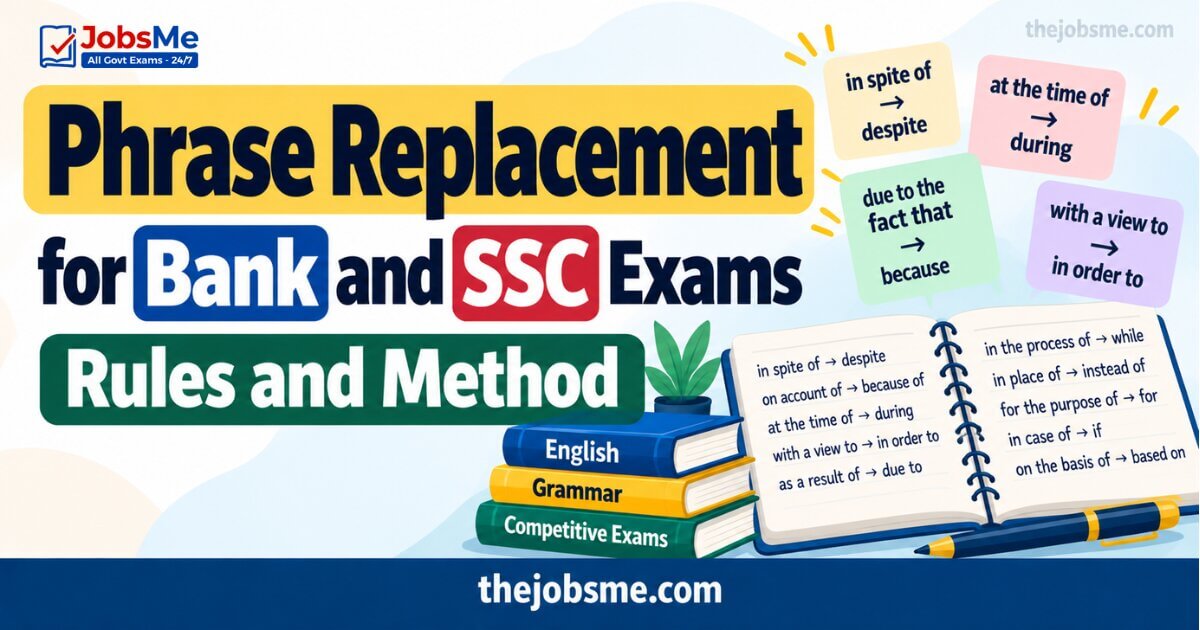
Phrase Replacement for Bank and SSC Exams: Rules and Method
This article is a complete, exam-ready guide to phrase replacement and sentence improvement for banking, insurance, SSC, defence and State PSC exams. It begins with the golden rule that the unmarked part of the sentence is always correct and therefore decides the answer, then covers the six question types, the six-step solving method, eleven grammar checkpoints with wrong and right versions, the fixed-phrase and preposition list that examiners return to every cycle, four option-elimination rules, and the situations in which no correction is required. It also works through eight solved questions and ends with a fifteen-question practice set and a full answer key.
Introduction
A phrase replacement question gives you a sentence with one part underlined. You choose the option that improves that part, or you decide that it needs no change at all.
SSC papers call the same thing sentence improvement, and offer no improvement as the last option. Bank papers call it phrase replacement and offer no correction required. The task is identical.
Here is the insight that makes the whole topic manageable, and most students never hear it stated plainly. The part that is not underlined is always correct, so it is your reference point. It decides the tense, the number and the meaning that the underlined part must match.
Look at a short example. This use of technology help farmers with existing credit to enhance their eligibility. The unmarked words tell you the subject is this use, which is singular. So the verb must be helps. You did not need to know anything about technology or credit. You only needed to read the part you were not asked about.
Where This Topic Is Asked
| Exam | How This Topic Appears | Rough Weight | Difficulty |
|---|---|---|---|
| SSC CGL and CHSL | Called sentence improvement, with no improvement as the last option. | 5 to 10 questions combined with error spotting | Easy to moderate. The grammar tested is basic and repeats heavily. |
| Bank PO prelims | Phrase replacement, often folded into the error-detection block. | 2 to 5 questions | Moderate. |
| Bank PO mains | Several formats together, including contextual and idiomatic replacements. | 5 to 7 questions | Moderate to hard, because the options are grammatically similar. |
| Defence exams | Sentence improvement on straightforward grammar. | Up to 10 questions in some papers | Easy to moderate, and among the highest-value blocks available. |
| Insurance and grade exams | The same formats on denser editorial sentences. | 3 to 5 questions | Moderate. |
| State PSC exams | Objective sentence improvement, plus the same skill while proofreading the descriptive paper. | Varies by state | Moderate. |
Add those rows and this is one of the largest grammar blocks in any English paper. It is also one of the most predictable, because the same eleven or twelve rules are tested cycle after cycle. Confirm the pattern for your own exam in the latest notifications and the exam-wise syllabus hub.
The Golden Rule
Before any method, fix this in your mind. The examiner has underlined one part and left the rest alone, so the rest is guaranteed correct and everything you need is in it.
| What the Unmarked Part Tells You | How to Use It | Example |
|---|---|---|
| The tense of the sentence | If the unmarked part is in the past, the underlined part cannot be in the present or the future. | He attempt to take his sister to hospital in a sentence about a past incident needs attempted to take. |
| The number of the subject | A singular subject in the unmarked part forces a singular verb in the underlined part. | This use of technology is singular, so the verb is helps. |
| Whether a comparison exists | A comparative degree is only correct if the unmarked part actually compares two things. | Capitalism is not a better system for India compares nothing, so it needs good. |
| What the noun refers to | The relative pronoun in the underlined part must match the noun in the unmarked part. | A ministry is not a person, so who becomes which. |
| The intended meaning | Some errors are contextual rather than grammatical, and only the surrounding words reveal them. | To cover the gap between rainfall and demand needs bridge, because gaps are bridged. |
| Whether it is reported speech | A past reporting verb such as warned or said pushes the reported verb one step back. | The manager warned that they will have to work becomes would have to. |
That last row is worth pausing on, because it is often explained wrongly. When a sentence reads the manager warned the team that unless the project is completed by Friday, they will have to work over the weekend, the correction to would have to is not caused by the word unless. Nothing about unless demands would. The cause is the past reporting verb warned, which shifts will to would throughout the reported clause. That distinction is covered fully in direct and indirect speech.
The Six Question Types
| Type | What Is Wrong | Example | How to Spot It |
|---|---|---|---|
| 1. Grammar-based | A rule is broken: tense, agreement, preposition, modal or article. | She go to market every Saturday. | The commonest type. Run the eleven checkpoints below. |
| 2. Contextual | The grammar is fine but the phrase does not fit the meaning. | To cover the gap between supply and demand. | Nothing looks broken, yet the phrase sits oddly with the subject. |
| 3. Idiom or phrasal verb | The wrong particle or the wrong fixed phrase has been used. | The boss called off the meeting. Here nothing is wrong at all. | Check whether the phrase exists in English with that meaning. |
| 4. Error inside the phrase | A verb form or word order fault within the underlined part itself. | The team has been worked hardly to meet the deadline. | Look at the verb form and any adverb attached to it. |
| 5. A better alternative | The part is acceptable but clumsy, and a cleaner version is offered. | He completed his work with much difficulty. | Prefer the option that is clear and economical, not merely different. |
| 6. Word order | The words are correct but arranged wrongly, often around a correlative pair. | She only not speaks English but also French. | Check correlatives, adverb position and modifier placement. |
Types one and four together account for most questions, which is good news: they are pure grammar and therefore learnable. Types two and three need vocabulary, and type five needs judgement.
Formula Box
- Golden rule: the unmarked part is correct and decides tense, number, comparison and meaning.
- Method: read the full sentence, name the error, predict the fix, then match an option.
- Predict before you read the options, because the options are written to mislead.
- Reject any option that introduces a new error, even if it fixes the original one.
- Reject any option that changes the meaning of the sentence.
- No correction required is a genuine answer and appears in every paper.
- Time: 30 to 45 seconds a question, and skip anything that runs longer.
The Six-Step Method
| Step | What to Do | Why It Works | Common Mistake |
|---|---|---|---|
| 1. Read the whole sentence | Read it once, including the parts you cannot change. | The unmarked part carries the tense, the subject and the meaning you must match. | Reading only the underlined words. |
| 2. Name the error | Say to yourself what is wrong: wrong tense, wrong preposition, no comparison, singular subject with plural verb. | A named error is a solved error, because you then know exactly what to look for. | Sensing that something is wrong without identifying what. |
| 3. Predict the correction | Decide what the corrected phrase should say, before you look at the options. | The options are designed to attract you. Predicting first makes you immune to that. | Reading the four options and picking whichever sounds best. |
| 4. Match your prediction | Find the option closest to what you predicted. | If your prediction appears among the options, the question is finished. | Abandoning a correct prediction because an option looks more elaborate. |
| 5. Eliminate on the four rules | Reject options that introduce a new error, change the meaning, only half-fix the problem, or add unnecessary words. | Wrong options almost always fail one of these four tests. | Comparing options against each other rather than against the sentence. |
| 6. Read your version back | Put your chosen option into the sentence and read the whole thing once. | This catches the case where a fix creates a fresh problem elsewhere. | Marking without the read-back. |
Step three is the one that separates fast solvers from slow ones. If you can say what the corrected phrase should be before you look at the options, you cannot be misled by them. If you cannot, you are choosing by feel, and feel is exactly what the wrong options are built to exploit.
The Eleven Grammar Checkpoints
Almost every grammar-based question in this topic comes from one of these eleven areas. Run through them mentally and the error usually surfaces within a few seconds.
| Checkpoint | The Rule | Wrong | Right |
|---|---|---|---|
| 1. Subject-verb agreement | The verb matches the head noun in number, not the nearest noun. Tested more than any other rule. | This use of technology help farmers. | This use of technology helps farmers. |
| 2. To as an infinitive marker | To used as an infinitive marker takes the base form of the verb. | The decision with pause publication. | The decision to pause publication. |
| 3. Modal verbs | Should, would, can, may, must and might are followed by the base verb, never by to. | He must to finish the task. | He must finish the task. |
| 4. Helping verbs | The auxiliary must be present, correctly formed and correctly placed. | She doesn't wanted to eat. | She didn't want to eat. |
| 5. Correct tense | The underlined part must match the time frame set by the unmarked part. | He attempt to take her to hospital yesterday. | He attempted to take her to hospital yesterday. |
| 6. Participles after be and have | Is, are, was, were take the present or past participle. Has, have, had take the past participle. | The team has been worked hardly. | The team has been working hard. |
| 7. Correct preposition | Many words take one fixed preposition and no other. | He is good in English. | He is good at English. |
| 8. Who and which | Who refers to people. Which refers to things, bodies and institutions. | The Ministry of Law, who has been processing the files. | The Ministry of Law, which has been processing the files. |
| 9. Articles | A and an introduce; the refers back or specifies. Some nouns need one and reject the others. | She goes to market every Saturday. | She goes to the market every Saturday. |
| 10. Comparative degree | Use a comparative only when two things are actually being compared. | Capitalism is not a better system for India. | Capitalism is not a good system for India. |
| 11. Conditionals | If and unless take the present tense in the condition clause, with will in the result clause. | If he will come, we will go. | If he comes, we will go. |
Notice that eight of the eleven are verb rules. So if you have limited time, revise tenses and subject-verb agreement first, because between them they decide the majority of these questions.
Fixed Phrases and Prepositions
These are not rules you can reason out. They are fixed combinations, and examiners return to the same ones every cycle.
| Wrong Version | Correct Version | Note |
|---|---|---|
| good in English | good at English | Skills take at. |
| owing to the fact that he was late | owing to his lateness | Owing to and due to take a noun, not a clause. |
| in spite of he was ill | in spite of his illness | In spite of and despite take a noun or a gerund. |
| despite of the delay | despite the delay | Despite never takes of. |
| discuss about the report | discuss the report | Discuss takes no preposition. |
| comprises of five members | comprises five members | Comprise takes no of. |
| prefer tea than coffee | prefer tea to coffee | Prefer takes to. |
| superior than the earlier model | superior to the earlier model | Superior, inferior, senior and junior all take to. |
| different than the original | different from the original | In Indian and British usage, from. |
| capable to do the work | capable of doing the work | Capable of plus a gerund. |
| insisted to pay | insisted on paying | Insist on plus a gerund. |
| comply to the order | comply with the order | Comply with. |
| married with a doctor | married to a doctor | Married to. |
| get used with the routine | get used to the routine | Get used to plus a noun or gerund. |
| no sooner he arrived when | no sooner had he arrived than | No sooner pairs with than and inverts the verb. |
| hardly he had left than | hardly had he left when | Hardly and scarcely pair with when. |
| not only he speaks English but French | he speaks not only English but also French | The pair must sit around parallel items. |
| one of the students were absent | one of the students was absent | One of takes a plural noun and a singular verb. |
| the team along with the coach were | the team along with the coach was | As well as, along with and besides do not change the verb. |
| cover the gap | bridge the gap | Gaps are bridged; surfaces are covered. |
Exam Alert
- Read the unmarked part first. It is guaranteed correct and it decides the answer.
- Predict the fix before reading the options. This is the single biggest accuracy gain available in this topic.
- An option that half-fixes the error is wrong. If a sentence has both a tense fault and an agreement fault, only the option repairing both can be correct.
- Longer is rarely better. Prefer the shortest option that is fully correct.
- No correction required appears in every paper, so verify the sentence before assuming an error exists.
The Four Elimination Rules
- Reject options that introduce a new error. An option may repair the tense and break the agreement. That is still wrong.
- Reject options that change the meaning. Replacing called off the meeting with called up the meeting alters the sense entirely, so grammar alone does not save it.
- Reject options that only half-fix the problem. Many questions carry two faults, and the correct option handles both.
- Reject options that add words without adding meaning. Between two correct options, the shorter one is the intended answer.
When No Correction Is Required
Students lose marks in both directions here: they force a change on a correct sentence, and they accept a faulty one. Three checks settle it.
- Run the eleven checkpoints. If none of them is violated, the grammar is sound.
- Check the meaning against the unmarked part. A grammatically clean phrase can still be contextually wrong, as with cover the gap.
- Check whether the phrase exists in English. Called off means cancelled and is perfectly standard, so a question offering put off and set off as alternatives may well have no error at all.
Key Highlights
- Read the unmarked part first. It is guaranteed correct and it decides the answer.
- Name the fault before you look at the options. A named error is already half corrected.
- Count how many things are wrong. An option that fixes one of two faults is still wrong.
- Not every error is grammatical. A clean phrase can still be wrong for the meaning.
- Eight of the eleven rules tested are verb rules, so tenses and agreement deserve your revision time first.
Eight Solved Questions
Question 1. The three names have reached the Ministry of Law and Justice, who has been processing the files.
Options: (a) who is processing the files (b) which was processed (c) which has been processing the files (d) who were processing the files (e) no correction required.
Working: A ministry is an institution, not a person, so who is wrong and which is needed. That removes (a), (d) and (e). Between (b) and (c), the passive was processed changes the meaning, since the ministry is doing the processing. Answer: (c).
Question 2. This use of technology help farmers with existing credit to enhance their eligibility.
Options: (a) will helping farmers (b) helps farmers (c) helping farmers (d) no improvement.
Working: The subject in the unmarked part is this use, which is singular, so the verb must be helps. Answer: (b). Note that technology is not the subject at all; use is.
Question 3. They believe that capitalism is not a better economic system for India.
Options: (a) no improvement (b) a good (c) a bad (d) the worst.
Working: A comparative degree needs two things being compared, and this sentence compares nothing. So better must become good. Answer: (b).
Question 4. His comments came a day after the World Bank announced the decision with pause publication of its report.
Options: (a) to pause publication (b) no improvement (c) with pausing publication (d) that paused.
Working: A decision is a decision to do something, and to as an infinitive marker takes the base verb. Answer: (a).
Question 5. He claimed that the incident took place outside a police station after he attempt to take his sister to a hospital.
Options: (a) attempted to take (b) will attempt to take (c) no improvement (d) was attempting to have.
Working: The unmarked part is in the past, so the future in (b) is impossible and the present in the original is wrong. (d) changes take to have, which alters the meaning. Answer: (a).
Question 6. The team has been worked hardly to meet the deadline.
Options: (a) working hard (b) work hard (c) worked hard (d) working hardly (e) no correction required.
Working: Two faults sit together. Has been plus worked makes it passive, which is wrong because the team is acting. And hardly means scarcely, which reverses the meaning. Only (a) repairs both. Answer: (a). This is the classic half-fix trap: (c) corrects the adverb and leaves the voice wrong.
Question 7. She only not speaks English but also French.
Options: (a) She speaks not only English (b) She does not only speak English (c) She not only speak English (d) no correction required.
Working: Not only must pair with but also and must sit directly before the first of the two parallel items. Here the parallel items are the two languages, so not only goes before English. Answer: (a).
Question 8. To cover the gap between rainfall and water demand, the government will invest in desilting canals.
Options: (a) to bridge the gap (b) to take down the gap (c) to make for the gap (d) no correction required.
Working: The grammar is faultless, which is what makes this a contextual question. Cover means to place something over or conceal, which is not what happens to a gap. Gaps are bridged, closed or narrowed. Answer: (a).
Quick Facts
- good at a subject, never good in it.
- prefer tea to coffee, and one model is superior to another.
- despite the delay, with no of after it.
- discuss a report and comprise five members, with no preposition.
- no sooner pairs with than; hardly pairs with when.
- one of the officers was transferred, plural noun and singular verb.
Worked Examples: Wrong to Right
Example 1 (reading only the underlined part)
Sentence: A student looks at attempt to take in isolation, finds nothing wrong with it, and marks no improvement.
Trap: The phrase is perfectly good English on its own, which is exactly why the examiner underlined it. The fault only appears against the unmarked part, which sets the sentence in the past.
Correct Answer: Read the unmarked part first, then judge the underlined part against it.
Rule in Simple Words: The error is usually a mismatch, not a mistake.
Example 2 (choosing by feel)
Sentence: A student reads all four options and picks the one that sounds most sophisticated.
Trap: Wrong options are written to sound plausible, and the more elaborate ones sound more considered. Sounding good is not a grammatical test.
Correct Answer: Predict the correction before reading the options, then find your prediction.
Rule in Simple Words: Decide the answer first, then go looking for it.
Example 3 (accepting a half-fix)
Sentence: For has been worked hardly, a student picks worked hard, having noticed the adverb problem.
Trap: The adverb correction is real and satisfying, so the option feels right. The voice is still wrong, because has been worked makes the team the receiver of the action rather than the doer.
Correct Answer: Working hard, which repairs both faults.
Rule in Simple Words: Count the errors before you choose. An option that fixes one of two is wrong.
Example 4 (missing a contextual error)
Sentence: A student sees no grammar fault in cover the gap and marks no correction required.
Trap: Checking grammar is the trained instinct, and the grammar here is genuinely clean. Not every error is grammatical, and a phrase can be well formed and still wrong for the meaning.
Correct Answer: Bridge the gap.
Rule in Simple Words: After the grammar check, ask whether the phrase makes sense with these particular words.
Example 5 (who and which)
Sentence: A student accepts the Ministry, who has been processing the files, because a ministry is made up of people.
Trap: Institutions are staffed by people, so who feels defensible. Grammatically an institution is a thing, and it takes which.
Correct Answer: Which has been processing the files.
Rule in Simple Words: Who is for people. Which is for things, bodies and organisations.
Example 6 (comparative with nothing to compare)
Sentence: A student leaves not a better economic system unchanged.
Trap: Comparatives are so common in everyday speech that better passes unnoticed. A comparative requires a second item, and this sentence names none.
Correct Answer: Not a good economic system.
Rule in Simple Words: No second item, no comparative.
Example 7 (misplacing a correlative)
Sentence: A student accepts She does not only speak English but also French.
Trap: The correlative pair is present and the sentence reads almost naturally. The two parallel items are the languages, not the actions, so the pair must sit around the languages.
Correct Answer: She speaks not only English but also French.
Rule in Simple Words: Put the correlative directly before the first of the two things being paired.
Example 8 (spending too long)
Sentence: A student cannot decide between two options and works for two minutes.
Trap: The two remaining options feel so close that one more read seems bound to settle it. In a timed section, that read costs two other questions you could have answered.
Correct Answer: Give the question forty-five seconds, choose between the surviving options and move on.
Rule in Simple Words: Elimination to two, then decide and go.
Common Traps Students Fall Into
These are the habits that most often cost marks. Each one is a common trap, not a silly mistake, and each has a one-line fix.
- Trap: Reading only the underlined part. Fix: The unmarked part is guaranteed correct and it decides the answer.
- Trap: Reading the options before deciding. Fix: Predict the correction, then look for it.
- Trap: Accepting an option that fixes one of two errors. Fix: Count the faults first.
- Trap: Accepting an option that creates a new error. Fix: Read the whole sentence with your option inserted.
- Trap: Checking grammar only. Fix: Some errors are contextual, so ask whether the phrase fits these words.
- Trap: Choosing the longest option. Fix: Between two correct options, the shorter is intended.
- Trap: Forcing a change on a correct sentence. Fix: No correction required is a real answer in every paper.
- Trap: Ignoring reported speech. Fix: A past reporting verb such as warned shifts will to would in the reported clause.
- Trap: Matching the verb to the nearest noun. Fix: The verb agrees with the head noun, so this use of technology helps.
- Trap: Guessing on fixed phrases. Fix: These cannot be reasoned out, so memorise the list and revise it weekly, alongside commonly confused words.
- Trap: Practising without noting the rule. Fix: After each wrong answer, write the rule you missed. The same habit pays in error spotting.
Memory Tricks and Formulas
1. The unmarked part is your answer key
Everything you need is in the part you are not allowed to change. It fixes the tense, the number, the comparison and the meaning. Read it first, every single time.
2. Name it, then fix it
Do not proceed on a vague sense that something is wrong. Say the fault aloud in your head: wrong tense, singular subject, no comparison, wrong preposition. A named error is already half corrected.
3. Predict before you read
Cover the options with your finger if it helps. Decide what the phrase should say, then uncover them. This one habit removes the influence of the distractors entirely.
4. Count the faults
Before choosing, ask how many things are wrong. If two, then any option repairing only one is out. The has been worked hardly pattern is built on exactly this.
5. Eight of eleven are verb rules
Agreement, infinitives, modals, auxiliaries, tense, participles and conditionals are all verb matters. So if your revision time is short, put it into tenses and agreement rather than anything else.
6. Fixed phrases must be memorised
No reasoning will tell you that prefer takes to or that comprise takes nothing. Keep a list of about 40 fixed phrases and revise it weekly, because these are free marks once learned.
7. Shorter usually wins
Examiners pad wrong options with extra words. So when two options both look grammatical, the leaner one is almost always the intended answer.
8. The 45-second rule
Allow 30 to 45 seconds a question. Eliminate to two options, choose, and move on. With 5 to 7 questions in a mains paper, this block should take about five minutes in total.
Exam Patterns and High-Yield Facts
Frequently Confused Pairs
| Pair | How They Differ | Mini Trick |
|---|---|---|
| Phrase replacement vs Error spotting | Error spotting asks which part is wrong. Phrase replacement asks what the right version is. | One finds, the other fixes. |
| Phrase replacement vs Word swap | A swap moves two existing words. A replacement supplies a new phrase from the options. | Move against substitute. See word swap and interchange. |
| Hard vs Hardly | Hard means with effort. Hardly means scarcely, and reverses the meaning. | Works hard against hardly works. |
| Good vs Better | Use better only when two things are compared. | No second item, no comparative. |
| Who vs Which | Who for people, which for things and institutions. | A ministry takes which. |
| Due to vs Owing to | Both take a noun. Neither takes a clause. | Due to his lateness, not due to he was late. |
| Despite vs In spite of | Same meaning, but despite never takes of. | Despite the delay, in spite of the delay. |
| Comprise vs Consist | Comprise takes no preposition. Consist takes of. | Comprises five members, consists of five members. |
| No sooner vs Hardly | No sooner pairs with than. Hardly and scarcely pair with when. | Sooner than, hardly when. |
| One of the vs Each of the | Both take a plural noun and a singular verb. | One of the students was absent. |
Repeating Question Patterns
- Subject-verb agreement with a long noun phrase is the single most repeated pattern, usually with a plural noun placed beside a singular head noun.
- Tense mismatch against the unmarked part, especially a present verb in a sentence about the past.
- Comparative degree with nothing to compare, as with a better system.
- Wrong preposition in a fixed phrase, such as good in, prefer than and superior than.
- Passive voice where the subject is acting, as with has been worked instead of has been working.
- Contextual errors with clean grammar, which are the ones students most often mark as needing no correction.
Practice Set: Fifteen Questions
Choose the best replacement for the underlined part, or decide that no correction is required. Give each item forty-five seconds.
- The list of selected candidates have been published on the website. (a) has been published (b) were published (c) have published (d) no correction required
- She is very good in mathematics and wants to teach it. (a) at mathematics (b) with mathematics (c) on mathematics (d) no correction required
- If he will reach before noon, we shall start the meeting. (a) reaches (b) would reach (c) will be reaching (d) no correction required
- The committee, who has submitted its report, will meet again in May. (a) which has submitted (b) who have submitted (c) which have submitted (d) no correction required
- He must to complete the form before Friday. (a) complete (b) completing (c) completed (d) no correction required
- The company comprises of five regional divisions. (a) comprises (b) comprise of (c) is comprising (d) no correction required
- No sooner had the train left when the announcement was made. (a) than (b) then (c) that (d) no correction required
- One of the officers were transferred to the district office. (a) was transferred (b) have transferred (c) were transferring (d) no correction required
- Despite of the heavy rain, the event was held as planned. (a) the heavy rain (b) of heavy raining (c) heavy rain was (d) no correction required
- She prefers coffee than tea in the morning. (a) to tea (b) from tea (c) over than tea (d) no correction required
- The minister said that the scheme will be extended to four more districts. (a) would be extended (b) will extend (c) shall be extending (d) no correction required
- The workers have been worked since early morning. (a) have been working (b) has been working (c) worked hardly (d) no correction required
- The government plans with reduce the subsidy in stages. (a) to reduce (b) for reducing (c) with reducing (d) no correction required
- This scheme is superior than the one it replaces. (a) superior to (b) more superior to (c) superior from (d) no correction required
- The team along with its coach was felicitated at the function. (a) no correction required (b) were felicitated (c) have been felicitated (d) is felicitated
Quick Facts
Answer key, with the rule named in each case.
- 1. (a) has been published. The head noun is list, which is singular.
- 2. (a) at mathematics. Skills take good at.
- 3. (a) reaches. The if clause takes the present tense, never will.
- 4. (a) which has submitted. A committee is a body, so it takes which, and its report confirms the singular.
- 5. (a) complete. A modal is followed by the base verb without to.
- 6. (a) comprises. Comprise takes no preposition.
- 7. (a) than. No sooner pairs with than, while hardly pairs with when.
- 8. (a) was transferred. One of the takes a plural noun and a singular verb.
- 9. (a) the heavy rain. Despite never takes of.
- 10. (a) to tea. Prefer takes to.
- 11. (a) would be extended. The past reporting verb said shifts will to would.
- 12. (a) have been working. The workers are acting, so the active continuous is needed, not the passive.
- 13. (a) to reduce. A plan is a plan to do something, and to takes the base verb.
- 14. (a) superior to. Superior, inferior, senior and junior all take to, and never more.
- 15. (a) no correction required. Along with does not change the number of the verb, so the singular was is right.
Notice how many of those fifteen were settled by the unmarked part alone: items 1, 3, 4, 11 and 12. Reading what you cannot change is the fastest route to the answer. Practise it with the free English MCQ quizzes and full papers from the mock test archive.
Quick Revision
Quick Revision
- What the question is. One part of a sentence is underlined, and you choose the best replacement for it or decide it needs no change.
- The other name for it. SSC papers call this sentence improvement and offer no improvement as the last option, but the task is exactly the same.
- The golden rule. The part that is not underlined is guaranteed correct, so it decides the tense, the number, the comparison and the meaning.
- What that means in practice. The error is usually a mismatch with the unmarked part rather than a mistake you could spot in isolation.
- The method. Read the whole sentence, name the fault, predict the correction, then find the option closest to your prediction.
- Why prediction matters. The wrong options are written to sound plausible, so deciding before you read them makes you immune to them.
- Count the faults first. If a sentence has two errors, any option that repairs only one of them is wrong.
- Subject-verb agreement. The verb matches the head noun, so this use of technology helps and the list of candidates has.
- Infinitive to. Used as an infinitive marker, to takes the base verb, as in the decision to pause publication.
- Modal verbs. Should, would, can, may and must are followed by the base verb and never by to.
- Tense. The underlined part must sit in the same time frame that the unmarked part establishes.
- Participles. Is, are, was and were take a participle, while has, have and had take the past participle.
- Reported speech. A past reporting verb such as said or warned shifts will to would in the reported clause.
- Who and which. Who refers to people, and which refers to things, bodies and institutions such as a ministry or a committee.
- Comparative degree. Use better, worse or higher only when two things are actually being compared.
- Conditionals. If and unless take the present tense in the condition clause, with will in the result clause.
- Prepositions after skills. You are good at a subject, not good in it.
- Prefer and superior. Both take to, so you prefer tea to coffee and one model is superior to another.
- Despite and in spite of. Both take a noun, and despite never takes of.
- Discuss and comprise. Neither takes a preposition, so you discuss a report and a body comprises five members.
- No sooner and hardly. No sooner pairs with than, while hardly and scarcely pair with when.
- One of the. This takes a plural noun but a singular verb, so one of the officers was transferred.
- Along with and as well as. These do not change the number of the verb, so the team along with its coach was felicitated.
- Correlative pairs. Not only must pair with but also, and the pair sits directly around the two parallel items.
- Contextual errors. A phrase can be grammatically perfect and still wrong, as when a gap is covered rather than bridged.
- Elimination. Reject options that add a new error, change the meaning, half-fix the fault, or add words without adding sense.
- Length. When two options both look correct, the shorter one is almost always the intended answer.
- No correction required. This appears in every paper, so verify the sentence rather than assuming an error must exist.
- Timing. Allow thirty to forty-five seconds a question, eliminate to two options, then decide and move on.
- Best preparation. Work through two or three years of previous papers, and write down the rule behind every question you get wrong.
Phrase replacement is the most learnable grammar topic in any English paper, because the same eleven rules and the same forty fixed phrases come back cycle after cycle. So start with the golden rule and read the unmarked part first, then name the fault before you look at a single option. Build the underlying grammar through subject-verb agreement, tenses and direct and indirect speech, and sharpen your eye for faults through error spotting. For the contextual questions, the pairings you need come from formal journalism, so ten minutes of daily current affairs reading and some collocations practice will cover them. Revise the wider topic-wise English notes alongside.
Frequently Asked Questions
What is a phrase replacement question?
Is phrase replacement the same as sentence improvement?
What is the most important rule for solving these questions?
How many questions are asked from this topic?
Which grammar rules are tested most often?
Why should I predict the answer before reading the options?
What if an option fixes the error but creates a new one?
Can a sentence with perfect grammar still need correction?
How often is no correction required the right answer?
How much time should one question take?

About the author