
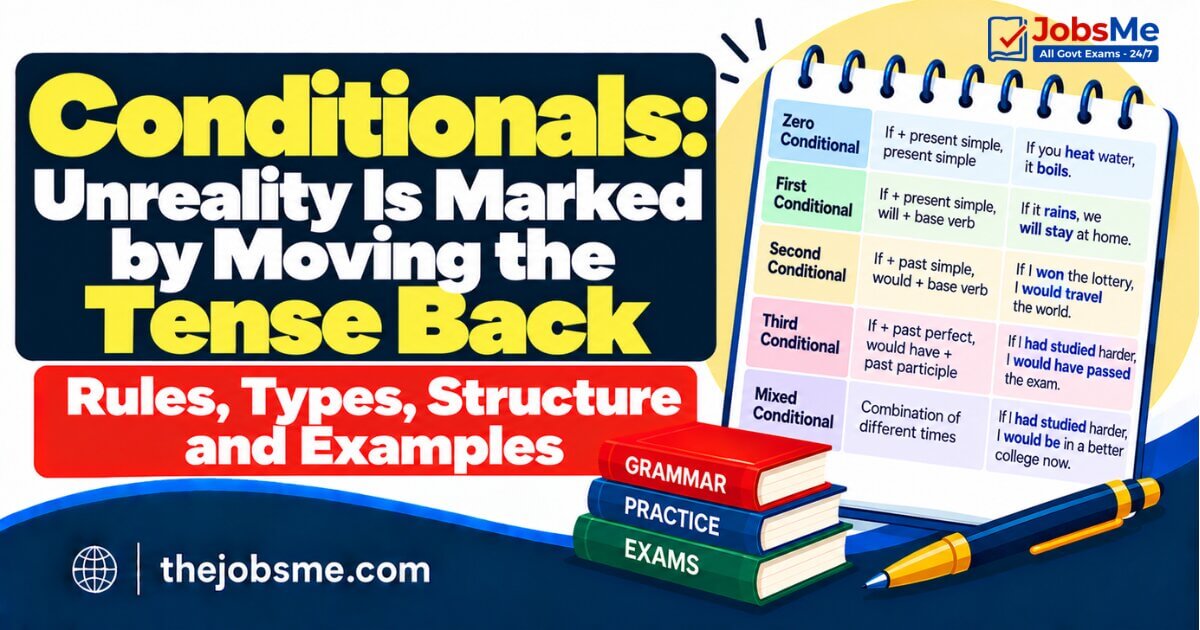
Conditionals: Unreality Is Marked by Moving the Tense Back
This article is a complete, exam-ready guide to conditional sentences for SSC, banking, insurance, railway, defence and State PSC exams. The names of the four types tell you nothing, and memorising four formulas is why candidates confuse them. One idea explains all of them: English marks unreality by moving the tense backwards. A real condition takes the present, an unreal present condition takes the past, and an unreal past condition takes the past perfect. So the past tense in if I won the lottery is not about the past at all; it measures distance from reality. That single principle makes the four types derivable, explains mixed conditionals, and settles the were question. Inverted conditionals, the no-will rule and the unless traps are covered too, with ten solved questions and a fifteen-question practice set.
Introduction
A conditional sentence states a condition and the result that depends on it. It has two halves: the if clause carrying the condition, and the main clause carrying the result.
Every guide then gives four types with four formulas and asks you to memorise them. That is why candidates mix them up, because the names are arbitrary and the formulas look unrelated. They are not.
English marks unreality by moving the tense backwards. A real condition takes the present, an unreal present condition takes the past, and an unreal past condition takes the past perfect. The tense is measuring distance from reality, not distance in time.
That explains the thing students find strangest about the topic. In if I won the lottery, I would travel the world, the past tense won is not about the past at all. The speaker means now or in future. The past form is there to signal that the situation is imaginary.
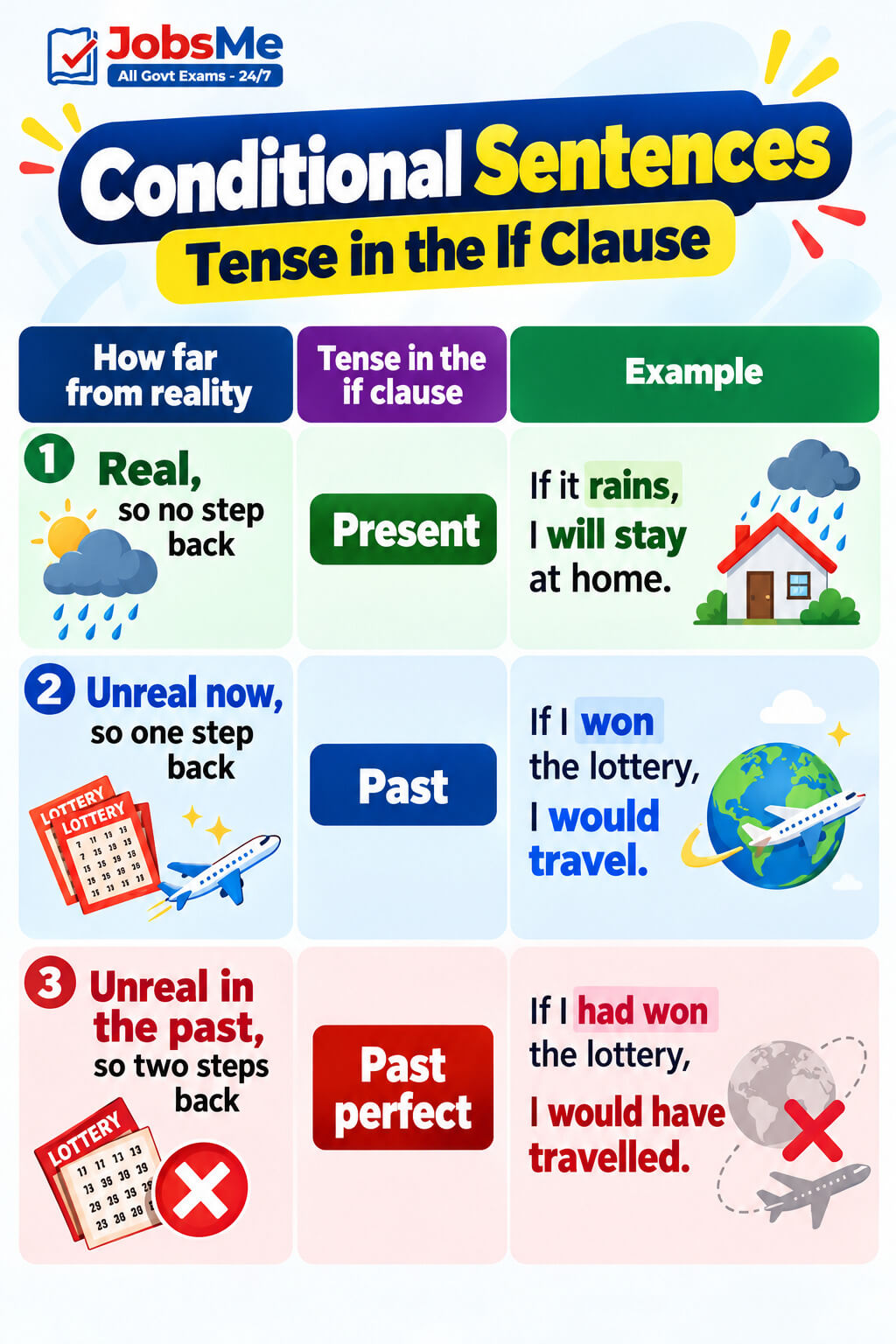
| How far from reality | Tense in the if clause | Example |
|---|---|---|
| Real, so no step back | Present | If it rains, I will stay at home. |
| Unreal now, so one step back | Past | If I won the lottery, I would travel. |
| Unreal in the past, so two steps back | Past perfect | If I had won the lottery, I would have travelled. |
Learn that ladder and the four types stop being four separate formulas. They become one rule applied at three distances.
Where This Topic Is Asked
| Exam | How This Topic Appears | Rough Weight | Difficulty |
|---|---|---|---|
| SSC CGL and CHSL | A broken tense pairing in error spotting, and fill-in-the-blank items. | 1 to 2 questions | Easy once the ladder is fixed. |
| IBPS PO and SBI PO | Conditional forms inside a cloze test, and mixed conditionals. | 1 to 2 questions | Moderate. |
| RRB NTPC and Group D | Straightforward first and second conditional items. | 1 question | Easy. |
| State PSC and defence exams | Inverted conditionals and the unless traps. | 1 to 2 questions | Moderate. |
| Transformation questions | Converting between if and unless, or removing the if. | Indirect | Moderate. |
| Descriptive papers | A broken conditional is a fault an examiner spots at once. | Indirect | Worth a final check. |
The attraction here is that the topic is almost entirely mechanical. Once you can place a sentence on the reality ladder, the tense pairing follows without judgement. Check your own pattern in the exam-wise syllabus hub.
Two Questions Give You the Type
Rather than recalling four names, ask two questions in order.
| Is it real? | Which time? | Type | Structure |
|---|---|---|---|
| Real, and always true | Any time | Zero | If + present simple, present simple. |
| Real, and possible | Future | First | If + present simple, will + base verb. |
| Unreal | Present or future | Second | If + past simple, would + base verb. |
| Unreal | Past | Third | If + past perfect, would have + third form. |
The Four Types With Examples
- Zero, for a general truth or a habit. If you heat water to a hundred degrees, it boils. If you do not water plants, they die. Both halves stay in the present simple, and when can replace if without changing anything.
- First, for a real future possibility. If it rains tomorrow, I will stay at home. If you talk to someone, you will feel better. The condition might well happen.
- Second, for an unreal present or future. If I had a time machine, I could change the past. If I were you, I would take that job. The condition is unlikely or impossible.
- Third, for an unreal past. If they had taken him to hospital sooner, he would not have died. The condition did not happen and now cannot.
Formula Box
- Unreality equals a step back in tense, not a change of time.
- Real condition takes the present; unreal present takes the past; unreal past takes the past perfect.
- No will or would in the if clause of a standard conditional.
- Were is used for every subject in the second conditional.
- The third conditional needs would have plus the third form, never would alone.
- Unless already means if not, so never add a second negative.
- Inversion replaces if with should, were or had.
Why the Tenses Look Wrong
Three things about conditionals puzzle candidates, and the reality ladder explains all three.
Why the Second Conditional Uses a Past Tense for the Present
Because the past form is doing a different job here. It is not reporting past time; it is signalling that the speaker does not believe the condition. Grammarians call this the unreal past, and it is the same form that appears after I wish and as if.
- I wish I had more time means I do not have more time now.
- He behaves as if he owned the place means he does not own it.
- If I knew her address, I would write to her means I do not know it now.
Why Were Appears With Singular Subjects
The second conditional uses were for every subject, including I, he, she and it. This is the subjunctive, a surviving form that marks unreality directly.
- Exam-correct: If I were you, I would accept the offer.
- Exam-correct: If he were here, he would explain it.
- Marked wrong in exams: If my brother was here, I would feel better.
That last form is common in speech and appears in some published model answers, but Indian competitive exams follow the traditional rule, so answer were. The subjunctive is developed further in verbs.
Why the Third Conditional Needs Two Steps
An unreal past has to be marked as unreal and as past, so the tense moves twice. The past simple is already one step back, so unreality pushes it to the past perfect.
- Wrong: If I studied harder, I would have passed. The if clause is only one step back.
- Right: If I had studied harder, I would have passed.
- Wrong: If I had studied harder, I would pass. The result clause has not moved back.
- Right: If I had studied harder, I would have passed.
So both halves must sit at the same distance. A sentence with a past perfect condition and a bare would result is broken, and so is the reverse.
Mixed Conditionals
A mixed conditional has the two clauses at different times, while each clause independently marks its own unreality. There are two genuine patterns, and most published examples of this are not mixed at all.
| Pattern | Structure | Example | What It Means |
|---|---|---|---|
| Past condition, present result | If + past perfect, would + base verb | If I had studied medicine, I would be a doctor now. | I did not study medicine, so I am not a doctor today. |
| Present condition, past result | If + past simple, would have + third form | If he were more careful, he would not have lost the file. | He is careless in general, and that caused a past loss. |
The test for a genuine mixed conditional is that the two clauses point at different times. If she had finished her work, she would have gone to the party is not mixed, because both halves are in the past. It is an ordinary third conditional.
Modals in the Result Clause
The result clause does not have to use will or would. Other modals change the strength of the result without breaking the sentence.
| Type | Standard | Softer alternatives |
|---|---|---|
| First | will | may, might, can, should, could. If it rains, I may stay at home. |
| Second | would | could, might. If I had the money, I could buy it. |
| Third | would have | could have, might have. If he had applied, he might have been selected. |
One correction belongs here, because a widely used note marks if it rains tomorrow, I might take an umbrella as an error, claiming the first conditional requires will. That sentence is perfectly correct. Might simply makes the result less certain than will, and softening the result is a normal use of the first conditional rather than a mistake. The modal strengths are set out in modals.
The No-Will Rule and Its Exceptions
A standard conditional never puts will or would in the if clause. The condition carries the tense marker and the result carries the modal.
- Wrong: If it will rain tomorrow, I will stay at home.
- Right: If it rains tomorrow, I will stay at home.
- Wrong: If he would study harder, he would pass.
- Right: If he studied harder, he would pass.
Two exceptions exist, and both are worth recognising rather than choosing.
- Insistence. If you will keep interrupting, we shall never finish. Here will reports stubborn behaviour, not future time.
- Polite request. If you will kindly wait here, I shall inform the officer. This is a formal courtesy formula.
In an exam, treat will in an if clause as the error unless the sentence plainly expresses insistence or a formal request.
Wishes and Other Unreal Structures
The same backshift that marks an unreal condition marks an unreal wish, which is why these structures belong here rather than in a separate topic.
| Structure | Refers to | Form | Example |
|---|---|---|---|
| I wish | An unreal present | Past simple, with were for be | I wish I knew her address. I wish I were taller. |
| I wish | An unreal past, with regret | Past perfect | I wish I had studied harder. |
| If only | The same, more emphatic | Past simple or past perfect | If only I had known earlier. |
| As if, as though | An unreal comparison | Past simple, with were | He behaves as if he owned the place. |
| It is time | Something overdue | Past simple | It is high time you started revising. |
| Would rather | A preference about someone else | Past simple | I would rather you came tomorrow. |
In every row the past form signals unreality, exactly as it does in the second conditional. So I wish I had more time means I do not have it, and it is high time you started means you have not started. Note that wish followed by would is possible only when complaining about someone else's behaviour, as in I wish you would stop shouting.
Inverted Conditionals
The word if can be dropped altogether and the clause inverted instead. This is more formal and it is a standing exam trap, because candidates read the inverted clause as a question.
| Type | Replace if with | Standard | Inverted |
|---|---|---|---|
| First | should plus the base verb | If you need any help, let me know. | Should you need any help, let me know. |
| Second, with be | were plus the subject | If I were you, I would accept it. | Were I you, I would accept it. |
| Second, with an action verb | were plus the subject plus to | If she called, I would be surprised. | Were she to call, I would be surprised. |
| Third | had plus the subject plus the third form | If I had known, I would have told you. | Had I known, I would have told you. |
Three details complete this section.
- The negative goes after the subject. Should you not agree with the terms, you may cancel. Never should not you agree.
- Should takes a base verb. Should he come is right and should he had come is not, though that form circulates widely online.
- A comma follows the inverted clause when it comes first, and no comma is needed when the result comes first, as in she would have caught the train had she left earlier.
The trap is simple to defeat. If a sentence opens with had, were or should followed directly by a subject and there is no question mark, it is an inverted conditional and not a question.
Key Highlights
- One idea replaces four formulas: unreality is a step back in tense.
- Both halves sit at the same distance, unless the clauses span two times.
- Nothing modal after if in a standard conditional.
- Were for every subject in the second conditional.
- Accuracy here should be near total, since nothing depends on vocabulary or judgement.
Other Conditional Connectors
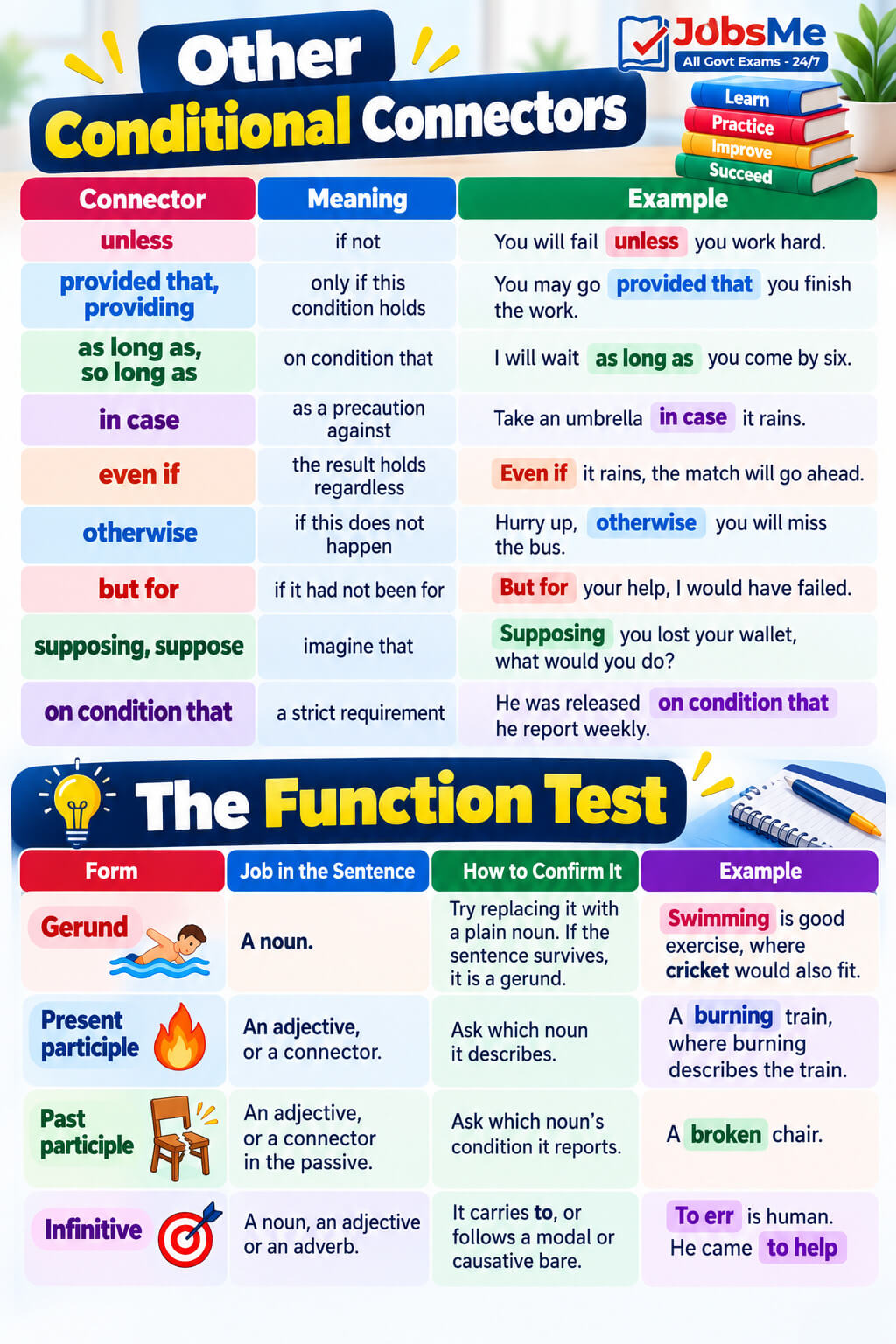
| Connector | Meaning | Example |
|---|---|---|
| unless | if not | You will fail unless you work hard. |
| provided that, providing | only if this condition holds | You may go provided that you finish the work. |
| as long as, so long as | on condition that | I will wait as long as you come by six. |
| in case | as a precaution against | Take an umbrella in case it rains. |
| even if | the result holds regardless | Even if it rains, the match will go ahead. |
| otherwise | if this does not happen | Hurry up, otherwise you will miss the bus. |
| but for | if it had not been for | But for your help, I would have failed. |
| supposing, suppose | imagine that | Supposing you lost your wallet, what would you do? |
| on condition that | a strict requirement | He was released on condition that he report weekly. |
The Unless Traps
Unless already contains the negative, so adding another one reverses the meaning.
- Wrong: You will fail unless you do not work hard.
- Right: You will fail unless you work hard.
- Also right: You will fail if you do not work hard.
Two further points. Unless and if not are interchangeable in most sentences, so the conversion between them is a standard transformation question. And unless cannot be used for a negative condition that is merely regretted, so I would be surprised unless he came is odd where if he did not come is natural. The double-negative rule is covered in conjunctions and connectors.
A Warning About Study Material on This Topic
This topic attracts more errors in published notes than almost any other, and several of them are consequential.
- A memory trick that is simply false. One guide advises that Zero stands for no if. The zero conditional uses if constantly. The name refers to the fact that neither clause moves back from the present.
- An incorrect and a correct version that are identical. The same source marks If I win the lottery, I'll buy a new car as wrong and If I win the lottery, I will buy a new car as right. The only difference between them is a contraction.
- A second identical pair. Under a heading about using will in both clauses, it gives if it rains tomorrow, the park will be closed as both the incorrect and the correct version, and neither has will in both clauses.
- Past perfect called present perfect, three times over. The mixed conditionals section repeatedly analyses had studied, had known and had finished as present perfect or simple past. All three are past perfect.
- Two of three mixed examples are not mixed. If I had known you were coming, I would have prepared something and if she had finished her work, she would have gone to the party are both ordinary third conditionals, since both halves sit in the past.
- A third conditional formula missing have. One formula reads if plus past perfect, would plus bare infinitive. It must be would have plus the third form, and the source's own examples use that while the formula does not.
- A correct sentence marked wrong. If it rains tomorrow, I might take an umbrella is listed as an error. Might is a normal softening of a first conditional result.
- Second conditionals labelled first. If it rained tomorrow, I would take an umbrella and if it snowed overnight, we would have a snow day both appear under the first conditional heading.
So work every model answer through the reality ladder yourself. Where an incorrect version and a correct version are word for word the same, the note has not been checked at all.
Exam Alert
- Check the if clause first for a stray will or would.
- Count the steps back in each half and confirm they match.
- Any sentence with unless needs the second-negative check.
- Look for now or today in the result, which signals a mixed conditional.
- An opening had, were or should with no question mark is an inverted conditional, not an error.
Ten Solved Questions
1. Fill the blank. If you heat water to a hundred degrees, it ___. Options: will boil, boils, boiled, would boil.
Working: This is a general truth, so neither clause moves back from the present. Answer: boils. Will boil would turn a permanent fact into a single future event.
2. Find the error. If it will rain tomorrow, (a) / I will stay at home (b) / and finish the report. (c) / No error (d)
Working: A standard conditional never puts will in the if clause. Answer: (a), which should read if it rains tomorrow.
3. Find the error. If I was you, (a) / I would accept the offer (b) / without any hesitation. (c) / No error (d)
Working: The second conditional takes were for every subject. Answer: (a), which should read if I were you.
4. Find the error. If I studied harder, (a) / I would have passed (b) / the examination last year. (c) / No error (d)
Working: The result clause is at the third-conditional distance, so the condition must be too. Answer: (a), which should read if I had studied harder.
5. Find the error. If she had left earlier, (a) / she would catch the (b) / morning train to Chennai. (c) / No error (d)
Working: Here the condition is two steps back but the result is only one. Answer: (b), which should read she would have caught.
6. Find the error. You will not qualify (a) / unless you do not (b) / revise the whole syllabus. (c) / No error (d)
Working: Unless already means if not, so the second negative reverses the sense. Answer: (b), which should read unless you revise.
7. Choose the correct sentence. (a) Had I know about the meeting, I would have attended. (b) Had I known about the meeting, I would have attended. (c) Should I had known about the meeting, I would have attended. (d) If I would have known, I would have attended.
Working: An inverted third conditional takes had plus the subject plus the third form. Answer: (b). Option (c) misuses should, which takes a base verb.
8. Fill the blank. If I had studied medicine, I ___ a doctor now. Options: would be, would have been, will be, am.
Working: The condition is an unreal past but the result is about the present, which makes this a mixed conditional. Answer: would be.
9. Choose the correct sentence. (a) Should you need any help, let me know. (b) Should you not need any help, let me know. (c) Should not you need any help, let me know. (d) Should you needed any help, let me know.
Working: An inverted first conditional takes should plus the subject plus a base verb, and any negative follows the subject. Answer: (a), with (b) correct in form but reversing the meaning.
10. Find the error. If it rains tomorrow, (a) / I may stay at home (b) / instead of going out. (c) / No error (d)
Working: A first conditional result may take may, might, can or should in place of will, and softening the result is not a fault. Answer: (d), no error.
Quick Facts
- Zero: if + present simple, present simple.
- First: if + present simple, will + base verb.
- Second: if + past simple, would + base verb, with were for be.
- Third: if + past perfect, would have + third form.
- Mixed: past perfect + would, or past simple + would have.
- Inverted: should you need, were I you, had I known.
Worked Examples: Wrong to Right
Example 1 (will in the if clause)
Sentence: A student writes If it will rain tomorrow, I will stay at home.
Trap: The sentence is plainly about the future, and tomorrow confirms it, so a future form feels required in both halves. The if clause marks its time with the present tense, and the modal belongs only in the result.
Correct Answer: If it rains tomorrow, I will stay at home.
Rule in Simple Words: Never will in the if clause.
Example 2 (was for were)
Sentence: A student writes If I was you, I would accept the offer.
Trap: I was is correct agreement everywhere else in English, and the form is universal in speech. The second conditional uses the subjunctive were for every subject, because it marks unreality rather than past time.
Correct Answer: If I were you, I would accept the offer.
Rule in Simple Words: Were for every subject in the second conditional.
Example 3 (one step where two are needed)
Sentence: A student writes If I studied harder, I would have passed last year.
Trap: The past tense studied plainly refers to the past, so it looks like the right choice for a past condition. An unreal past has to be marked twice over, so the condition needs the past perfect.
Correct Answer: If I had studied harder, I would have passed last year.
Rule in Simple Words: Both halves must sit at the same distance from reality.
Example 4 (a result clause left one step short)
Sentence: A student writes If she had left earlier, she would catch the train.
Trap: The condition has been correctly pushed to the past perfect, which feels like the hard part of the job, so the sentence looks finished. The result must move back too, giving would have caught.
Correct Answer: If she had left earlier, she would have caught the train.
Rule in Simple Words: Past perfect condition takes would have plus the third form.
Example 5 (a double negative with unless)
Sentence: A student writes You will not qualify unless you do not revise.
Trap: The intended meaning involves a failure to revise, so a negative feels necessary to express it. Unless already means if not, so the extra negative says the opposite of what was meant.
Correct Answer: You will not qualify unless you revise, or if you do not revise.
Rule in Simple Words: Unless carries its own negative.
Example 6 (reading an inversion as a question)
Sentence: Faced with Had I known about the meeting, I would have attended, a student marks the opening as an error.
Trap: The clause has question word order, with the auxiliary before the subject, so it looks like a botched question. Inversion is the formal way to drop if, and the absence of a question mark confirms it.
Correct Answer: No error. It equals if I had known about the meeting.
Rule in Simple Words: Had, were or should plus a subject, with no question mark, means an inverted conditional.
Example 7 (would have in a mixed conditional)
Sentence: A student writes If I had studied medicine, I would have been a doctor now.
Trap: The condition is an unreal past, and third conditionals take would have, so the pattern transfers automatically. The word now puts the result in the present, so the result clause must use plain would.
Correct Answer: If I had studied medicine, I would be a doctor now.
Rule in Simple Words: Each clause takes the form of its own time.
Example 8 (marking a softened result as wrong)
Sentence: Having read that the first conditional requires will, a student marks if it rains, I might take an umbrella as an error.
Trap: A study note said so, and the rule as printed left no room for alternatives. Other modals are freely available in a result clause, and they change the certainty rather than breaking the grammar.
Correct Answer: No error.
Rule in Simple Words: May, might, can and should are all legal in a result clause.
Common Traps Students Fall Into
These are the habits that most often cost marks. Each one is a common trap, not a silly mistake, and each has a one-line fix.
- Trap: Putting will in the if clause. Fix: The condition marks time with the present tense.
- Trap: Putting would in the if clause. Fix: Use the past simple instead.
- Trap: Writing if I was. Fix: The second conditional takes were throughout.
- Trap: Using the past simple for an unreal past. Fix: An unreal past needs the past perfect.
- Trap: Pairing a past perfect condition with plain would. Fix: Use would have plus the third form.
- Trap: Adding a negative after unless. Fix: Unless already means if not.
- Trap: Reading an inverted clause as a question. Fix: Check for a question mark.
- Trap: Writing should he had come. Fix: Should takes a base verb.
- Trap: Using would have for a present result. Fix: A mixed conditional gives each clause its own time.
- Trap: Marking might or may wrong in a result clause. Fix: Both are legal, as noted in modals.
- Trap: Trusting a printed formula. Fix: Two source formulas in this topic are demonstrably broken.
Memory Tricks and Formulas
1. Unreality is a step back
Real takes the present, unreal now takes the past, unreal past takes the past perfect. The tense is measuring distance from reality, not distance in time.
2. Two questions, then the type
Ask whether the condition is real, then which time it refers to. Real plus future is the first conditional, unreal plus present is the second, unreal plus past is the third.
3. Both halves at the same distance
Present with will, past with would, past perfect with would have. If one half moves, the other must move with it, unless the two clauses genuinely refer to different times.
4. Nothing modal in the if clause
No will and no would after if in a standard conditional. The only exceptions are insistence and formal request, and both are recognisable from the meaning.
5. Were, always were
In a second conditional the verb be takes were for every subject. If I were, if he were, if it were. This is the subjunctive and exams apply it strictly.
6. Unless carries its own negative
Unless equals if not, so a second negative reverses the meaning. You will fail unless you work hard and you will fail if you do not work hard say the same thing.
7. Had, were, should means an inverted if
A sentence opening with one of those three followed by a subject, and carrying no question mark, is a conditional with the if removed. Read it as if and the tense pairing becomes visible.
8. Budget the time honestly
With 1 to 2 questions in most papers and rules that never vary, one session on the ladder and a second on inversion and the connectors will cover it. Accuracy here should approach 100 per cent.
Exam Patterns and High-Yield Facts
Frequently Confused Pairs
| Pair | How They Differ | Mini Trick |
|---|---|---|
| If it rains vs If it will rain | Only the first is standard. | No modal after if. |
| If I win vs If I won | Real possibility against unreal. | Do you believe it might happen? |
| If I was vs If I were | Exams require the subjunctive. | Were for every subject. |
| If I studied vs If I had studied | Unreal present against unreal past. | Count the steps back. |
| Would vs Would have | Present result against past result. | Match the result to its own time. |
| Third vs Mixed | Both halves past against different times. | Look for now or today. |
| Unless vs If not | Interchangeable, but never both. | One negative only. |
| In case vs If | Precaution against condition. | Take an umbrella in case it rains. |
| Even if vs If | Result holds regardless against result depends. | Even if concedes the condition. |
| Had I known vs Had I know | Inversion needs the third form. | Had plus subject plus V3. |
Repeating Question Patterns
- Will or would planted in the if clause, which is the commonest single error.
- Was in place of were in a second conditional.
- A past simple condition paired with would have, or a past perfect condition paired with plain would.
- A second negative after unless.
- An inverted conditional offered among the options, testing whether you read it as a question.
- A mixed conditional with now in the result clause.
Practice Set: Fifteen Questions
Correct each sentence, or mark it correct as it stands.
- If you will come early, we will finish the work on time.
- If you heat ice, it melts into water.
- If I was the principal, I would change the timetable.
- If he had applied earlier, he might have been selected.
- If she studied harder, she would have topped the class last year.
- Unless you do not submit the form, you will lose the seat.
- Had I known about the strike, I would have left earlier.
- If they had invited me, I would be at the party now.
- If it rains tomorrow, the match may be postponed.
- Should you had any doubts, please contact the office.
- If I were a bird, I would fly across the mountains.
- If he would work harder, he would earn more.
- Even if the fees are raised, I will complete the course.
- If we had left earlier, we would catch the morning flight.
- But for your timely help, I would have missed the deadline.
Quick Facts
Answer key, with the rule named in each case.
- 1. If you come early. No will in the if clause.
- 2. Correct as it stands. A general truth keeps both halves in the present.
- 3. If I were the principal. The second conditional takes were.
- 4. Correct as it stands. Might have is a legal third-conditional result.
- 5. If she had studied harder. An unreal past needs the past perfect.
- 6. Unless you submit the form. Unless already means if not.
- 7. Correct as it stands. This is an inverted third conditional.
- 8. Correct as it stands. A past condition with a present result is a mixed conditional.
- 9. Correct as it stands. May softens a first-conditional result.
- 10. Should you have any doubts. Should takes a base verb.
- 11. Correct as it stands. Were is right for every subject.
- 12. If he worked harder. No would in the if clause.
- 13. Correct as it stands. Even if concedes the condition and keeps the result.
- 14. we would have caught. A past perfect condition needs would have.
- 15. Correct as it stands. But for replaces an if clause in the past.
Eight of those fifteen were already correct, and item seven is the one to notice. Had I known about the strike looks like a mangled question, and it is a perfectly formed inverted conditional. That single pattern accounts for a good share of the marks lost in this topic. Practise with the free English MCQ quizzes and full papers from the mock test archive.
Quick Revision
Quick Revision
- What a conditional is. A sentence with an if clause carrying a condition and a main clause carrying the result.
- The one idea that explains the whole topic. English marks unreality by moving the tense backwards, so the tense measures distance from reality rather than distance in time.
- The ladder. Real takes the present, unreal now takes the past, and unreal past takes the past perfect.
- Two questions give you the type. Is the condition real, and which time does it refer to?
- Zero conditional. If plus present simple, present simple, for a general truth or habit, and when can replace if.
- First conditional. If plus present simple, will plus base verb, for a real future possibility.
- Second conditional. If plus past simple, would plus base verb, for an unreal present or future.
- Third conditional. If plus past perfect, would have plus the third form, for an unreal past.
- Both halves must sit at the same distance, unless the two clauses genuinely refer to different times.
- Never will or would in the if clause of a standard conditional.
- The two exceptions are insistence and formal request, as in if you will keep interrupting and if you will kindly wait.
- The second conditional takes were for every subject, since this is the subjunctive marking unreality.
- The same unreal past appears after I wish and as if, so I wish I had more time means I do not have it now.
- Mixed conditionals put the two clauses at different times. Past condition with present result takes would plus a base verb, and present condition with past result takes would have plus the third form.
- A sentence with both halves in the past is not mixed; it is an ordinary third conditional.
- The result clause may take other modals. May, might, can and should in the first, could and might in the second, and could have and might have in the third.
- Softening the result with might is not an error.
- Inversion drops the if. Should plus subject plus base verb for the first, were plus subject for the second, and had plus subject plus the third form for the third.
- For an action verb in the second, use were plus subject plus to, as in were she to call.
- In an inverted clause the negative follows the subject, so should you not agree.
- A sentence opening with had, were or should and carrying no question mark is an inverted conditional, not a question.
- Unless already means if not, so never add a second negative.
- Other connectors. Provided that, as long as, in case, even if, otherwise, but for, supposing and on condition that.
- In case marks a precaution while if marks a condition, and even if keeps the result regardless.
Conditionals should be among the highest-scoring topics in the paper, because nothing in them depends on vocabulary or judgement. The difficulty comes entirely from treating them as four unrelated formulas, which invites the confusion that even published notes fall into. So work from the ladder instead. Decide whether the condition is real, decide which time it refers to, and let both halves sit at the same distance unless the sentence genuinely spans two times. Then check the if clause for a stray will, check unless for a second negative, and read any opening had or were as an inverted if. The topic rests on tenses for the backshift and on modals for the result clause, connects to verbs for the subjunctive and to conjunctions and connectors for the unless family, and appears throughout error spotting, sentence improvement and transformation of sentences. The wider set is in the topic-wise English notes.
Frequently Asked Questions
What is a conditional sentence?
Why does the second conditional use a past tense for the present?
How do I decide which conditional to use?
Why is if I was you wrong?
Can I use will in the if clause?
What is a mixed conditional?
Must the result clause use will or would?
What is an inverted conditional?
How do I spot an inverted conditional in an exam?
Why is unless you do not work hard wrong?

About the author





