
Prepositions: Logical Rules and Fixed Pairs
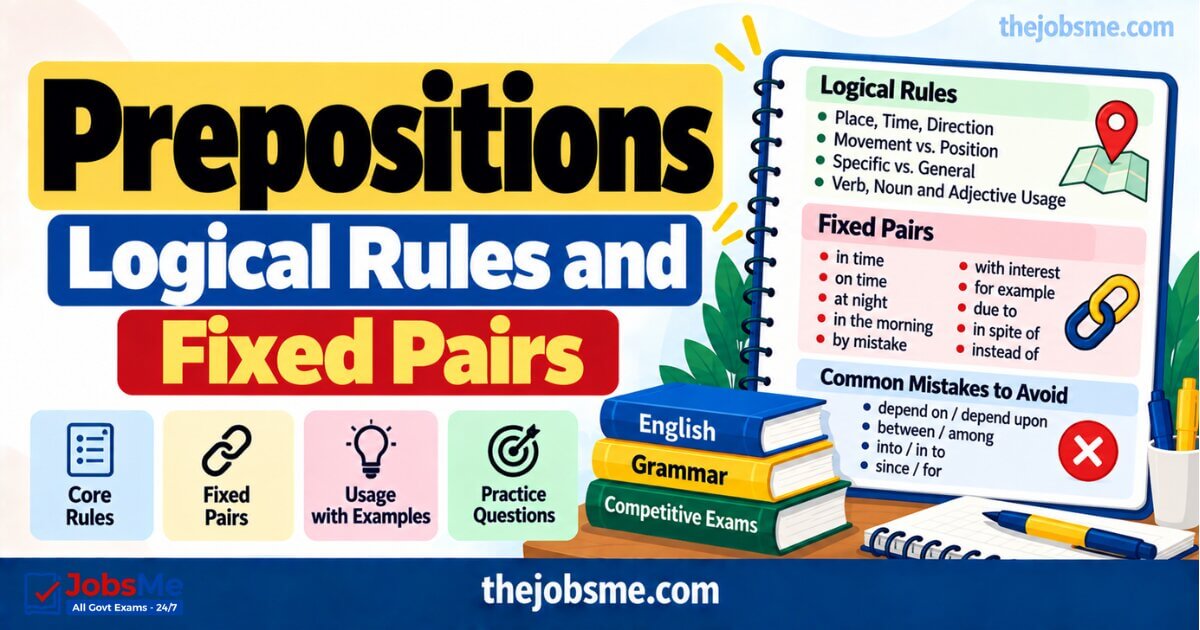
This article is a complete, exam-ready guide to prepositions for SSC, banking, insurance, railway, defence and State PSC exams. It is built on a distinction most guides mention and then ignore: prepositions split into two groups that need two entirely different study methods. Logical prepositions such as in, on, at, since and between follow rules you can reason out. Fixed prepositions such as comply with, abstain from and senior to follow no rule at all, and reasoning about them is exactly how candidates get them wrong. It covers the logical system in full, the categorised fixed-pair lists, the verbs that change preposition for a person or a thing, the verbs that take no preposition at all, and the gerund rule. Ten solved questions, common traps and a fifteen-question practice set with a full answer key are included.
Introduction
A preposition is a word placed before a noun or pronoun to show its relationship with another word: the book is on the table, she arrived at noon, he is good at mathematics.
Almost every guide opens by dividing the topic into simple and fixed prepositions, and then teaches both the same way. That is the mistake, because the division has a consequence most guides never draw.
- Logical prepositions such as in, on, at, since, for and between follow a system. Learn the principle and you can work out any new case.
- Fixed prepositions such as comply with, abstain from and senior to follow nothing. They must be memorised as pairs.
So the first move in any preposition question is to decide which type you are looking at, because trying to reason out a fixed preposition is the commonest way to get one wrong. Good in mathematics is perfectly logical. It is also wrong, because the pair is good at.
This article treats the two halves separately and gives each the method it actually needs.
Where This Topic Is Asked
| Exam | How This Topic Appears | Rough Weight | Difficulty |
|---|---|---|---|
| SSC CGL and CHSL | Wrong prepositions in error spotting, and direct fill-in-the-blank items. | Around 9 per cent of grammar marks, with 1 to 2 direct questions | Easy to moderate. |
| IBPS PO and SBI PO | Error detection, fillers, and blanks inside a cloze test. | 1 to 2 questions | Moderate. |
| RRB NTPC and Group D | Straightforward preposition blanks. | 1 question | Easy. |
| State PSC and police exams | Error spotting on fixed pairs. | 1 to 2 questions | Moderate. |
| Sentence improvement | A wrong preposition is one of the six standard error families. | Indirect | Easy once the pair is known. |
| Descriptive papers | A wrong fixed preposition is immediately visible to an examiner. | Indirect | Worth the care. |
Two facts shape the strategy. Prepositions sit in the same weight band as articles and above narration and modals, so the topic deserves real time. And a very short segment in an error spotting sentence is frequently a preposition trap, precisely because the eye skips over three-word parts. Check your own pattern in the exam-wise syllabus hub.
Part One: The Logical System
In, On and At
One principle covers both time and place. At marks a point, on marks a surface or a day, and in marks an enclosed space or a longer period.
| Word | For Time | For Place |
|---|---|---|
| at | A precise time: at 6 o'clock, at noon, at midnight, at dawn. | A point or a small place: at the corner, at the bus stop, at Alwar. |
| on | Days and dates: on Monday, on 15 August, on my birthday. | A surface: on the table, on the wall, on the roof. |
| in | Months, years, seasons and parts of the day: in July, in 1996, in the morning. | An enclosed space or a larger area: in the room, in Rajasthan, in India. |
Three refinements complete the picture.
- Small against large places. At suits a village or a small town and in a city, state or country, so he lives at Alwar in Rajasthan.
- In against into. In shows a position and into shows movement from outside to inside. There are three students in the class, but he jumped into the river.
- On against onto. Onto is used when the movement involves a change of level, as in he lifted her onto the table.
One correction is needed here, because a widely circulated note claims that at shows a stationary position while in shows movement. That is not the contrast. In shows position just as at does, and it is into that carries movement. The same note offers a temple is situated at Madurai in Chennai as an example, which is geographically impossible, since Madurai and Chennai are separate cities several hundred kilometres apart.
Since, For and From
This is the single most tested distinction in the topic and the one candidates most often lose.
| Word | Rule | Correct | Wrong |
|---|---|---|---|
| since | A point in time, with a perfect tense. | He has been absent since Monday. | She has been sick since three days. |
| for | A period of time, with a perfect tense. | She has been sick for three days. | She has been living here since five years. |
| from | A starting point, but not with a perfect tense unless an end point is given. | The office works from ten to five. | I have been waiting from morning. |
Ask one question: point or period? A point takes since, a period takes for, and from never replaces since in a perfect tense. The tense side of this rule is covered in tenses.
Between and Among
- Between is used for two, and also for more than two when a definite number is in mind and each is considered separately. He divided the property between his two daughters.
- Among is used for more than two where no definite number is in mind. He was happy to be among friends again.
- Between always takes and, never to. The train runs between Delhi and Mumbai.
- Among and amongst mean the same thing, and either may be used.
Other Logical Pairs
| Pair | The Distinction | Example |
|---|---|---|
| By and With | By marks the agent, with marks the instrument. | The snake was killed by him with a stick. |
| Beside and Besides | Beside means at the side of; besides means in addition to. | He sat beside her. Besides English, she speaks Tamil. |
| By and Until | By is a deadline; until is a continuing period. | Finish it by six. Wait here until six. |
| In time and On time | In time means with time to spare; on time means punctually. | He arrived in time to help. The train was on time. |
| At the end and In the end | At the end is a position; in the end means finally. | At the end of the road. In the end, he agreed. |
| Above and Over | Above is simply higher; over suggests covering or crossing. | The shelf above the cups. The bird flew over the house. |
| Below and Under | Below is simply lower; under suggests directly beneath. | Below ground level. Under the table. |
| Due to and Owing to | Traditionally due to follows a noun or a form of be, while owing to modifies the whole clause. | His absence was due to illness. Owing to illness, he was absent. |
Formula Box
- Decide the type first. Logical prepositions are reasoned; fixed ones are recalled.
- At a point, on a surface or day, in an enclosure or longer period.
- Since takes a point in time, for takes a period, and both need a perfect tense.
- Between takes and, never to.
- Latin adjectives ending in -ior take to, never than.
- Some verbs take no preposition at all. Discuss, comprise, enter, resemble, marry, order.
- A preposition is always followed by a gerund, never an infinitive.
Part Two: Fixed Prepositions
These pairs carry no logic. Comply takes with and conform takes to, and no principle explains why. Learning them grouped by the shared preposition is far more efficient than an alphabetical list, because the group itself becomes the memory hook.
The FROM Group: Prohibition and Separation
These words all involve staying away, stopping or being kept out.
- Abstain from. Choose to stay away from a habit. You must abstain from alcohol.
- Refrain from. Stop yourself from an action. Please refrain from talking in the library.
- Prevent from, prohibit from, debar from, disqualify from. He was prevented from entering the hall.
- Differ from a thing, desist from, deviate from, derive from, recover from, suffer from, escape from, protect from, exempt from, hinder from.
- Different from, in Indian and British usage, rather than different than.
The TO Group: Agreement, Attachment and Direction
- Conform to, adhere to, accede to, subscribe to, consent to, object to, yield to, submit to.
- Accustomed to, addicted to, prone to, susceptible to, liable to, averse to, partial to.
- Detrimental to, injurious to, harmful to, beneficial to, essential to, similar to, opposed to, indifferent to.
- Attend to, listen to, refer to, belong to, contribute to, lead to, react to, appoint to.
- Senior to, junior to, superior to, inferior to, prior to, preferable to, elder to.
The WITH Group: Association and Accompaniment
- Comply with, cope with, deal with a person or situation, quarrel with, agree with a person, argue with, sympathise with, correspond with a person.
- Consistent with, familiar with, acquainted with, popular with, satisfied with, content with, busy with.
- Compare with things of the same kind, part with a possession, trifle with, tamper with, interfere with.
The OF Group
- Accused of, convicted of, guilty of, suspicious of, ashamed of, afraid of, tired of, fond of, proud of, capable of, aware of, devoid of.
- Bereft of, deprived of, rid of, cured of a disease, composed of, consist of, dispose of, repent of, approve of, complain of an ailment.
- Characteristic of, typical of, worthy of, independent of, ignorant of.
The IN, FOR, AT, ON and ABOUT Groups
- IN: interested in, involved in, engaged in, absorbed in, confide in a person, deficient in, expert in, persist in, succeed in, result in, versed in.
- FOR: famous for, notorious for, eligible for, fit for, responsible for, grateful for a thing, anxious for, eager for, sorry for, account for, wait for, care for, long for, atone for, compensate for.
- AT: good at, bad at, expert at, surprised at, astonished at, alarmed at, angry at a thing, laugh at, aim at, arrive at a small place, work at.
- ON: depend on, rely on, insist on, concentrate on, congratulate on, comment on, based on, impose on, live on, act on.
- ABOUT: worry about, anxious about, curious about, particular about, doubtful about, complain about a situation.
Where a Preposition Sits in a Sentence
Position is a smaller matter than choice, but two points appear in exams.
- A preposition may end a sentence. The old rule against it came from Latin grammar and is no longer applied. Here is the magazine that you asked for and this is a good hotel to stay at are both correct.
- Formal writing may still prefer to move it. The community the students lived in becomes the community in which the students lived. Both are correct, so choose by register rather than by rule.
- In a question, either position works. What are you thinking of? and Of what are you thinking? are both grammatical, though the second is stiff.
- Watch the embedded question. May I know who you were talking to? is correct, while May I know who were you talking to? keeps question word order where a statement order is needed.
For exam purposes, the position of a preposition is almost never the intended error. The choice of preposition is. So do not mark a segment wrong merely because a sentence ends with one.
Prepositional Phrases Worth Memorising
These behave as single units and appear in fillers and idioms and phrases questions alike.
| Phrase | Meaning | Example |
|---|---|---|
| in lieu of | instead of | He was given a cheque in lieu of cash. |
| by virtue of | because of | She got the post by virtue of her experience. |
| in charge of | responsible for | He is in charge of the accounts section. |
| in the charge of | under the care of | The files are in the charge of the clerk. |
| on account of | because of | The match was cancelled on account of rain. |
| in accordance with | following | The order was issued in accordance with the rules. |
| with a view to | with the aim of, and it takes a gerund | He studied hard with a view to qualifying. |
| at the cost of | sacrificing | He succeeded at the cost of his health. |
| by means of | using | The message was sent by means of a courier. |
| in spite of | despite | In spite of the delay, they finished on time. |
Verbs That Change Preposition for a Person or a Thing
This group is an examiner favourite, because the verb is right and only the preposition is wrong.
| Word | With a Person | With a Thing or Idea | Examples |
|---|---|---|---|
| Agree | agree with | agree to a proposal | I agree with you. He agreed to my terms. |
| Angry or annoyed | angry with | angry at an action | She is angry with her brother. He was angry at the delay. |
| Deal | deal with a person | deal in a commodity | How do you deal with him? My uncle deals in electronics. |
| Compare | compare with, for like things | compare to, for unlike things | Compare this graph with last year's. Life is compared to a journey. |
| Cure | cured of a disease | a cure for a disease | He was cured of malaria. There is no cure for it. |
| Differ | differ with a person | differ from a thing | I differ with you. This differs from that. |
| Part | part from a person | part with a possession | She parted from her friends. He would not part with the book. |
| Confide | confide in a person | confide to, meaning to entrust | She confides in her sister. |
| Grateful | grateful to a person | grateful for a favour | I am grateful to you for your help. |
| Complain | complain to a person | complain of an ailment, about a situation | He complained to the manager about the noise. |
| Wait | wait on, meaning to serve | wait for, meaning to await | The staff waited on the guests. We waited for the bus. |
| Provide | provide a person with | provide for a need | The school provided them with books. |
Key Highlights
- Two halves, two methods. Reason the logical ones, recall the fixed ones.
- Since with a period is the single commonest planted error in this topic.
- Synonyms do not share prepositions, so comply with but conform to.
- A preposition always takes a gerund, never an infinitive.
- Short segments in error spotting are where prepositions hide, precisely because the eye skips them.
Verbs That Take No Preposition At All
Adding one is called a superfluous preposition, and it is a standard error spotting item because the extra word sounds entirely natural.
| Wrong | Right | Note |
|---|---|---|
| discuss about the matter | discuss the matter | Also describe, emphasise and investigate. |
| comprise of ten chapters | comprise ten chapters | Consist of and composed of are the safe alternatives. |
| order for a cup of tea | order a cup of tea | |
| enter into the room | enter the room | Enter into is only for agreements and alliances. |
| married with her | married her | Married to is correct as a state. |
| resemble with his father | resemble his father | |
| reach at the station | reach the station | Arrive at is correct. |
| request for a favour | request a favour | |
| attack on the enemy | attack the enemy | An attack on is correct as a noun. |
| accompany with him | accompany him | |
| despite of the delay | despite the delay | In spite of takes of. |
| lack of confidence, as a verb | he lacks confidence | A lack of is correct as a noun. |
| jumped off of the beam | jumped off the beam | |
| Where are the plates at? | Where are the plates? |
The Gerund Rule
A preposition is always followed by a gerund, never an infinitive. So it is capable of doing, never capable to do, and insisted on paying, never insisted to pay.
The trap lies in a small group where to is a preposition rather than part of an infinitive. These all take the -ing form.
- Look forward to meeting you, never to meet.
- Accustomed to living here. Used to waking early, when it means habituated.
- Object to paying. Averse to travelling. Addicted to playing games.
- Prone to making errors. Given to boasting. With a view to improving results.
- Owing to being late. Take to smoking.
The test is simple. Try inserting a noun after the word to. If a noun fits, as in look forward to the holiday, then to is a preposition and the verb after it must take -ing.
A Warning About Study Material on This Topic
- A broken model sentence. One reference gives I am look forward to meeting you as an example. It should read I am looking forward to meeting you.
- A geographical impossibility. Another offers a temple is situated at Madurai in Chennai to illustrate small against large places. Madurai is not in Chennai.
- A wrong contrast. The same source claims at shows a stationary position while in shows movement. Movement is carried by into, not in.
- Errors inside model answers. For whom was instructions given? is offered as correct usage, though the verb does not agree with the plural subject. May I know who were you talking to? keeps question word order inside an embedded clause, where it should read who you were talking to.
So check every example against the rule it claims to illustrate, and treat a source that mislabels a well-known city with appropriate caution elsewhere too.
Exam Alert
- Ask point or period before choosing between since and for.
- Check the superfluous list whenever a verb is followed by about, of or for.
- Latin comparatives take to, and this is planted every year.
- Person or thing decides agree, angry, differ, deal and complain.
- A sentence ending in a preposition is almost never the intended error, so do not mark it.
Ten Solved Questions
1. He has been absent ___ Monday. Options: from, since, for, at.
Working: Monday is a point in time, and the tense is perfect. Answer: since.
2. She has been unwell ___ three days. Options: since, from, for, by.
Working: Three days is a period, not a point. Answer: for.
3. Find the error. Every employee must (a) / comply to the (b) / new safety regulations. (c) / No error (d)
Working: Comply takes with, while conform takes to. This is a fixed pair with no logic to fall back on. Answer: (b).
4. Find the error. The committee will (a) / discuss about the proposal (b) / at the next meeting. (c) / No error (d)
Working: Discuss takes no preposition. Answer: (b).
5. Find the error. She is senior (a) / than me (b) / in the department. (c) / No error (d)
Working: Latin adjectives ending in -ior take to. Answer: (b). The full set is in degrees of comparison.
6. Choose the correct sentence. (a) I look forward to meet you. (b) I look forward to meeting you. (c) I am look forward to meet you. (d) I look forward for meeting you.
Working: Here to is a preposition, so the verb takes the -ing form. Answer: (b).
7. The prize was divided ___ the four winners. Options: between, among, in, with.
Working: Four winners with no separate consideration of each calls for among. Answer: among.
8. Find the error. He was angry (a) / at his brother (b) / for arriving late. (c) / No error (d)
Working: A person takes angry with, while an action or thing takes angry at. Answer: (b).
9. Find the error. The scheme comprises of (a) / four separate components (b) / funded by the state. (c) / No error (d)
Working: Comprise in the active voice takes no preposition. Answer: (a).
10. Find the error. I have been waiting (a) / from morning for (b) / the results to appear. (c) / No error (d)
Working: A perfect tense with a starting point takes since, not from. Answer: (b).
Quick Facts
- Since a point, for a period, from only with an end point or a non-perfect tense.
- FROM group: abstain, refrain, prevent, prohibit, debar, differ from a thing.
- TO group: conform, adhere, accede, object, accustomed, addicted, injurious, similar.
- WITH group: comply, cope, deal with a person, consistent, familiar, satisfied.
- No preposition: discuss, comprise, enter, resemble, marry, order, request, reach.
- Gerund after to: look forward to, accustomed to, object to, with a view to.
Worked Examples: Wrong to Right
Example 1 (reasoning out a fixed pair)
Sentence: A student writes She is good in mathematics, reasoning that mathematics is a field and fields take in.
Trap: The reasoning is sound and would work for a logical preposition. Fixed pairs carry no logic at all, so reasoning is precisely the wrong tool and produces a confident wrong answer.
Correct Answer: She is good at mathematics.
Rule in Simple Words: Decide the type first, because fixed pairs are recalled and never reasoned.
Example 2 (since with a period)
Sentence: A student writes She has been sick since three days.
Trap: Since feels like the natural word whenever a duration is being described, and this construction is common in Indian English speech. Since takes a point in time only, and three days is a stretch of time.
Correct Answer: She has been sick for three days.
Rule in Simple Words: Ask whether it is a point or a period.
Example 3 (from in a perfect tense)
Sentence: A student writes I have been waiting from morning.
Trap: From genuinely marks a starting point, so the logic seems right. In a perfect tense with no end point given, English requires since.
Correct Answer: I have been waiting since morning.
Rule in Simple Words: From needs an end point, or a tense that is not perfect.
Example 4 (the superfluous preposition)
Sentence: A student writes We will discuss about the proposal tomorrow.
Trap: The extra word sounds natural and even more complete, since most verbs of communication do take one. Discuss already contains the sense of about, so adding it is redundant.
Correct Answer: We will discuss the proposal tomorrow.
Rule in Simple Words: Discuss, comprise, enter, resemble, order and request take none.
Example 5 (comply against conform)
Sentence: A student writes Every employee must comply to the regulations.
Trap: Conform to is correct and means almost the same thing, so the pattern transfers by analogy. Fixed prepositions do not transfer between synonyms, and comply takes with.
Correct Answer: Every employee must comply with the regulations.
Rule in Simple Words: Learn the pair, not the meaning.
Example 6 (the -to trap with a gerund)
Sentence: A student writes I look forward to meet you or She is accustomed to live alone.
Trap: The word to usually begins an infinitive, so the base verb follows automatically. In these expressions to is a preposition, and a preposition always takes the -ing form.
Correct Answer: I look forward to meeting you. She is accustomed to living alone.
Rule in Simple Words: If a noun could follow the to, use the -ing form.
Example 7 (person against thing)
Sentence: A student writes He was angry at his brother or I agree to you.
Trap: Both prepositions are genuinely used with these words, so neither looks wrong in isolation. The choice depends on whether the object is a person or a thing, and the student has picked the wrong one.
Correct Answer: He was angry with his brother. I agree with you.
Rule in Simple Words: Check whether the object is a person before choosing.
Example 8 (skipping the short segment)
Sentence: In an error spotting question a student checks the long segments carefully and passes over a three-word part reading an heir at.
Trap: Short parts look too small to hold a mistake, and the eye slides past them. Prepositions and articles are exactly what examiners hide in short segments, precisely because they are skipped.
Correct Answer: An heir to the throne.
Rule in Simple Words: A three-word segment deserves the same attention as a ten-word one.
Common Traps Students Fall Into
These are the habits that most often cost marks. Each one is a common trap, not a silly mistake, and each has a one-line fix.
- Trap: Reasoning out a fixed preposition. Fix: Decide the type first, then recall rather than reason.
- Trap: Using since with a period of time. Fix: A point takes since, a period takes for.
- Trap: Using from in a perfect tense. Fix: From needs an end point or a non-perfect tense.
- Trap: Adding a preposition to discuss, comprise or enter. Fix: Learn the superfluous list.
- Trap: Writing senior than. Fix: Latin adjectives ending in -ior take to.
- Trap: Following a preposition with an infinitive. Fix: A preposition always takes the -ing form.
- Trap: Missing the -to trap. Fix: Look forward to, accustomed to and object to all take gerunds.
- Trap: Ignoring whether the object is a person. Fix: Agree with a person, agree to a proposal.
- Trap: Transferring a preposition between synonyms. Fix: Comply with but conform to, however close the meanings.
- Trap: Skipping short segments in error spotting. Fix: Short parts are where prepositions hide.
- Trap: Learning fixed pairs alphabetically. Fix: Group them by the shared preposition, as with collocations.
Memory Tricks and Formulas
1. Logical or fixed?
Ask this before anything else. If the preposition expresses time, place or direction, reason it out. If it is attached to a particular verb or adjective, recall the pair and do not reason at all.
2. Point, surface, enclosure
At a point, on a surface or a day, in an enclosure or a longer period. One line covers both time and place, so at 6 o'clock on Monday in July.
3. Point or period?
For since and for, ask whether the word after the blank names a moment or measures a stretch. Since Monday and since two o'clock are points, while for three days and for five years are periods.
4. Group by preposition
Learn the FROM group, the TO group and the WITH group together. Prohibition and separation take from, agreement and attachment take to, and association takes with. The group itself becomes the memory hook.
5. Person or thing?
A dozen common words switch preposition depending on the object. Agree with a person and to a proposal, angry with a person and at a thing, deal with a person and in a commodity, cured of a disease but a cure for one.
6. Could a noun follow the to?
If yes, then to is a preposition and the verb after it takes -ing. Look forward to the holiday works, so it must be look forward to meeting you.
7. The no-preposition list
Discuss, comprise, enter, resemble, marry, order, request, attack, accompany, reach, describe, emphasise and investigate all transit directly to their objects. Adding a preposition sounds natural and is wrong.
8. Budget the time honestly
With roughly 9 per cent of grammar marks and 1 to 2 direct questions in an SSC paper, this topic pays well. Give the logical rules one session and the fixed pairs a few minutes daily, since lists fade without repetition.
Exam Patterns and High-Yield Facts
Frequently Confused Pairs
| Pair | How They Differ | Mini Trick |
|---|---|---|
| Since vs For | Point in time against period of time. | Since Monday, for three days. |
| Since vs From | From does not sit in a perfect tense without an end point. | Waiting since morning. |
| Between vs Among | Two, or a definite few, against an indefinite many. | Between two, among many. |
| Comply with vs Conform to | Same meaning, different fixed partner. | Synonyms do not share prepositions. |
| Agree with vs Agree to | A person against a proposal. | Ask who or what. |
| Compare with vs Compare to | Like things against unlike things. | Graphs are compared with graphs; life is compared to a journey. |
| Beside vs Besides | At the side of against in addition to. | The s adds something. |
| In vs Into | Position against movement inward. | In the class, into the river. |
| Different from vs than | Indian and British usage prefers from. | Different from the original. |
| Enter vs Enter into | A room takes none; an agreement takes into. | Enter the hall, enter into a contract. |
Repeating Question Patterns
- Since used with a period of time, which is the single commonest planted preposition error.
- A superfluous preposition after discuss, comprise, enter or order.
- A fixed pair replaced by a plausible synonym's preposition, such as comply to.
- A Latin comparative followed by than rather than to.
- An infinitive after a preposition, especially with look forward to.
- The person against thing choice, most often with agree, angry or differ.
Practice Set: Fifteen Questions
Correct each sentence, or mark it correct as it stands.
- He has been working in this office since five years.
- The candidate was debarred from taking the examination.
- Please refrain to comment on the ongoing inquiry.
- The management acceded to the employees' demands.
- We will discuss about the budget in tomorrow's meeting.
- She is looking forward to receive your reply.
- The prize money was divided between the six participants equally.
- This model is superior than the one released last year.
- He was cured from a serious illness last winter.
- The book comprises twelve chapters and an appendix.
- I have been waiting from ten in the morning.
- She was angry at her colleague for missing the deadline.
- Smoking is injurious to health.
- He entered into the examination hall five minutes late.
- The new rules are consistent with the earlier guidelines.
Quick Facts
Answer key, with the rule named in each case.
- 1. for five years. Five years is a period, not a point.
- 2. Correct as it stands. Debar belongs to the FROM group.
- 3. refrain from commenting. Refrain takes from, and a preposition takes a gerund.
- 4. Correct as it stands. Accede takes to.
- 5. discuss the budget. Discuss takes no preposition.
- 6. looking forward to receiving. Here to is a preposition, so the gerund follows.
- 7. among the six participants, or between if each share is considered separately. Six with no separate consideration takes among.
- 8. superior to. Latin comparatives take to.
- 9. cured of a serious illness. A disease takes of.
- 10. Correct as it stands. Comprise correctly takes no preposition.
- 11. since ten in the morning. A perfect tense with a starting point takes since.
- 12. angry with her colleague. A person takes with.
- 13. Correct as it stands. Injurious belongs to the TO group.
- 14. entered the examination hall. Enter into is only for agreements.
- 15. Correct as it stands. Consistent takes with.
Five of those fifteen were already correct, which matters because a student who has just read three long fixed-pair lists starts suspecting every preposition on the page. Practise the same restraint with the free English MCQ quizzes and full papers from the mock test archive.
Quick Revision
Quick Revision
- What a preposition does. It sits before a noun or pronoun and shows its relationship with another word in the sentence.
- The topic has two halves that need two methods. Logical prepositions are reasoned out, while fixed prepositions are recalled as pairs.
- Decide the type before anything else, because reasoning out a fixed pair is the commonest way to get one wrong.
- At marks a point, on marks a surface or a day, and in marks an enclosure or a longer period, and this one line covers both time and place.
- At suits a small place and in a larger one, so he lives at Alwar in Rajasthan.
- In shows position while into shows movement inward, and onto is used for a change of level.
- Since takes a point in time and for takes a period, and both need a perfect tense.
- From never replaces since in a perfect tense unless an end point is also given.
- Between is for two, or for a definite few considered separately, while among is for an indefinite many.
- Between always takes and, never to.
- By marks the agent and with marks the instrument, so it was killed by him with a stick.
- Beside means at the side of while besides means in addition to.
- Learn fixed pairs grouped by the shared preposition. Prohibition and separation take from, agreement and attachment take to, and association takes with.
- The FROM group. Abstain, refrain, prevent, prohibit, debar, desist, deviate, derive, recover, suffer, differ from a thing, and different from.
- The TO group. Conform, adhere, accede, object, accustomed, addicted, prone, averse, detrimental, injurious, beneficial, similar, opposed.
- The WITH group. Comply, cope, deal with a person, quarrel, agree with a person, consistent, familiar, acquainted, satisfied, compare with like things.
- Latin adjectives ending in -ior take to, so senior to, junior to, superior to, inferior to, prior to and preferable to.
- Some verbs change preposition for a person or a thing. Agree with a person and to a proposal, angry with a person and at a thing, deal with a person and in a commodity, differ with a person and from a thing.
- Some verbs take no preposition at all. Discuss, comprise, enter, resemble, marry, order, request, attack, accompany, reach, describe, emphasise and investigate.
- Enter into is reserved for agreements and alliances, not for rooms.
- Despite takes no of, though in spite of does.
- A preposition is always followed by a gerund, never an infinitive, so capable of doing and insisted on paying.
- Watch the words where to is a preposition. Look forward to, accustomed to, object to, averse to, addicted to, prone to and with a view to all take the -ing form.
- The test for that trap. If a noun could follow the word to, then to is a preposition and the verb takes -ing.
- Short segments hide prepositions, so a three-word part in an error spotting question deserves full attention.
Prepositions are small words that carry a disproportionate share of the marks, and they punish two opposite habits at once. Reason about a fixed pair and you will get it wrong; try to memorise the logical system and you will never finish. So sort every question into its type first, learn the in, on and at principle properly, drill the since and for distinction until it is instant, and take the fixed lists a group at a time rather than alphabetically. The topic feeds straight into error spotting, sentence improvement and fill in the blanks, overlaps with phrasal verbs where the particle changes the meaning, and supports collocations generally. The wider set is in the topic-wise English notes.
Frequently Asked Questions
What is a preposition?
What is the difference between simple and fixed prepositions?
Why is reasoning dangerous with fixed prepositions?
When do I use in, on and at?
What is the difference between since and for?
Can from replace since?
Which verbs take no preposition at all?
Why is look forward to meet you wrong?
When does a verb change its preposition?
Why is senior than wrong?

About the author





