
Verbs: One Finite Verb per Clause, and What Decides the Rest
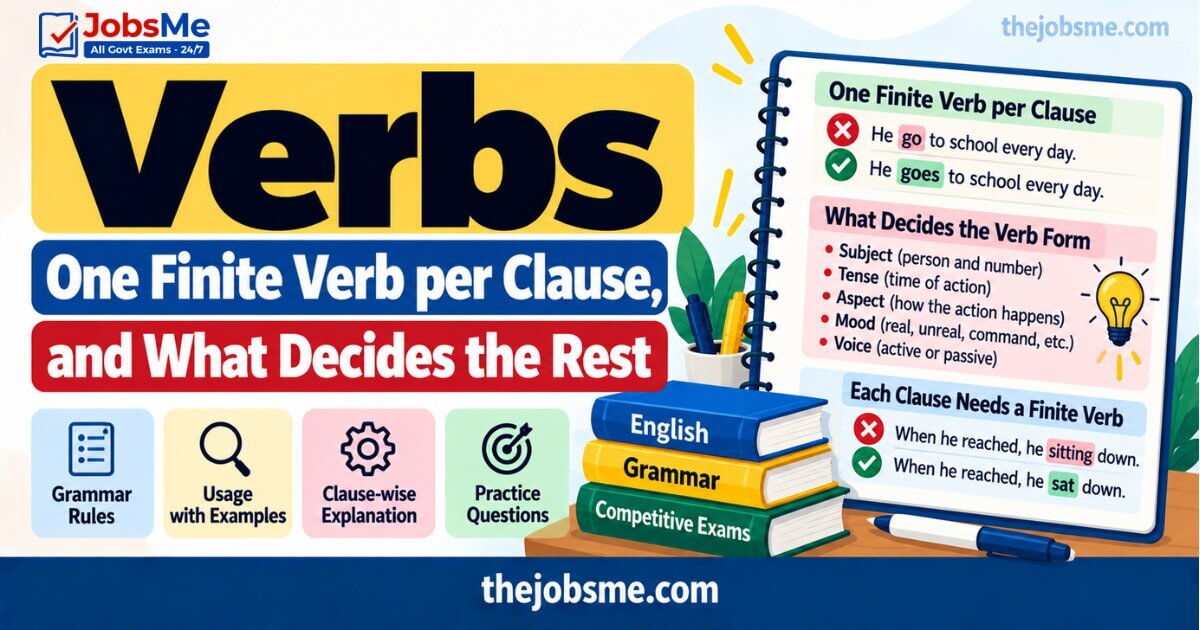
This article is a complete, exam-ready guide to verbs for SSC, banking, insurance, railway, defence and State PSC exams. It is built on the rule that generates nearly every verb error in the paper: a clause contains exactly one finite verb, and every other verb in it must be non-finite. Once you count the finite verbs, a second question decides everything else, because the form of a non-finite verb is fixed by the word immediately in front of it. A preposition demands a gerund, a modal or a causative demands a bare infinitive, and specific verbs demand one or the other. It also covers the five verb forms, the causative and perception patterns, stative verbs that resist the continuous, and the pairs whose meaning changes with the form. Ten solved questions, common traps and a fifteen-question practice set with a full answer key are included.
Introduction
A verb expresses an action, an occurrence or a state of being. It is the one part of speech no sentence can do without.
Most guides handle the topic by listing nine or ten kinds of verb: main, auxiliary, modal, transitive, intransitive, regular, irregular, finite, non-finite. Those labels are worth knowing, but they do not tell you how to answer a question.
One rule does. A clause contains exactly one finite verb, and every other verb in it must be non-finite. Nearly every verb error in an exam paper is a violation of that count.
Look at three faulty sentences from published study material.
- The committee decided to postponing the meeting. Two verbs, one finite, and the second is in the wrong non-finite form.
- She avoided to meet him. Same shape, same fault.
- The manager made all the employees to fill out the forms. Again the second verb has taken the wrong form.
In each case the finite verb is correct and the trouble sits in the second verb. So the method has two steps. Count the finite verbs, then let the word immediately in front of the second verb decide its form. That word is the controller, and it never gives you a choice.
Where This Topic Is Asked
| Exam | How This Topic Appears | Rough Weight | Difficulty |
|---|---|---|---|
| SSC CGL and CHSL | Wrong verb forms in error spotting, especially look forward to, had better and the causative make. | 1 to 2 direct questions, and it underlies the whole grammar block | Easy, with a target of a few seconds a question. |
| IBPS PO and SBI PO | Meaning shifts such as remember doing against remember to do, and possessives before gerunds in a cloze test. | 1 to 2 questions | Moderate. |
| RRB NTPC and Group D | Straightforward form identification and irregular past forms. | 1 question | Easy. |
| State PSC and defence exams | Direct identification and the classic bare infinitive traps. | 1 to 2 questions | Moderate. |
| Every other grammar topic | You cannot check agreement, tense or voice without first finding the finite verb. | Foundational | Worth the time. |
| Descriptive papers | A wrong verb form is the most visible fault in written English. | Indirect | Worth a final check. |
The direct weight is modest and the indirect weight is the whole English section. Subject-verb agreement, tenses and voice all begin by locating the finite verb, so this is the topic that makes the others fast. Check your own pattern in the exam-wise syllabus hub.
The Five Forms
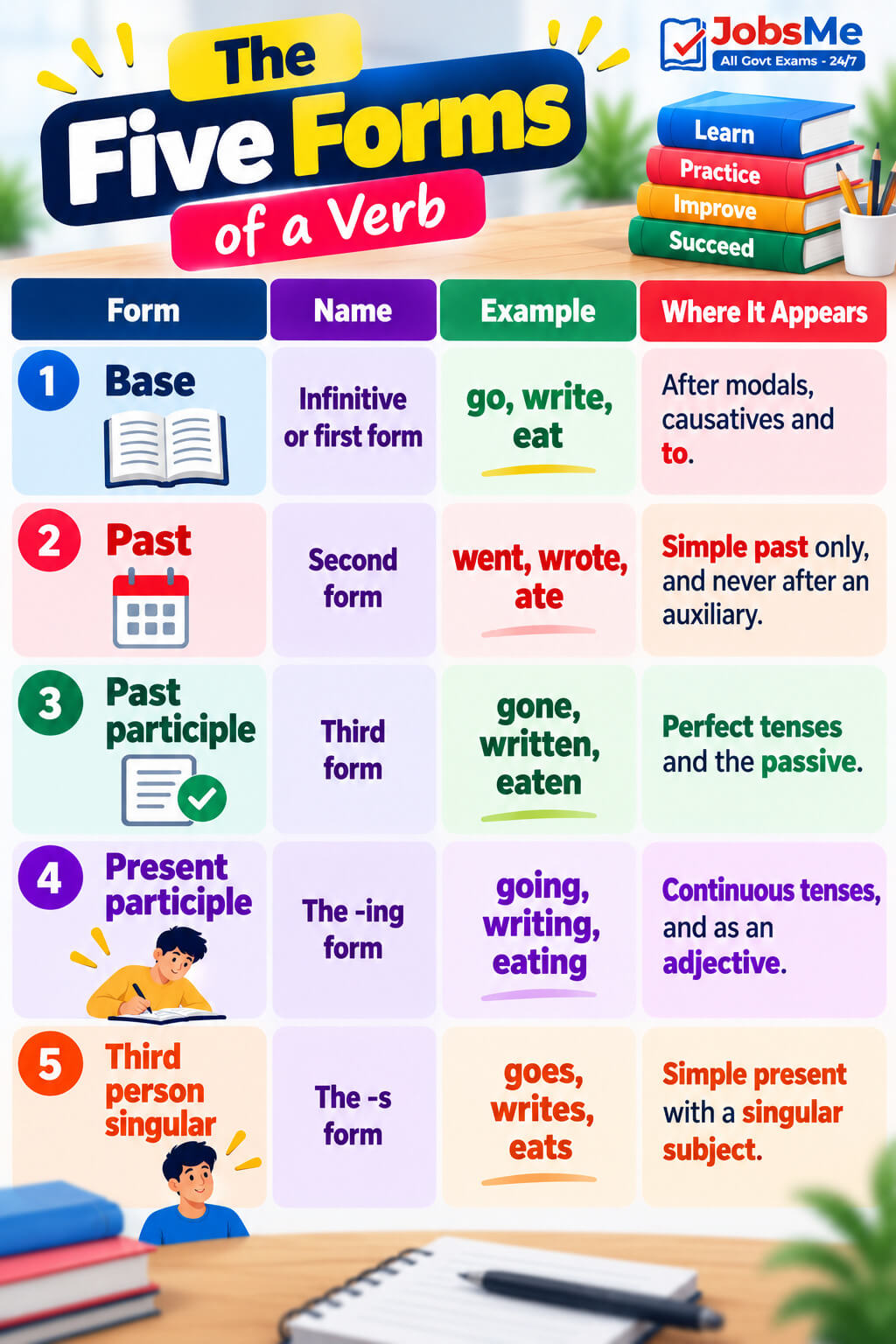
| Form | Name | Example | Where It Appears |
|---|---|---|---|
| Base | Infinitive or first form | go, write, eat | After modals, causatives and to. |
| Past | Second form | went, wrote, ate | Simple past only, and never after an auxiliary. |
| Past participle | Third form | gone, written, eaten | Perfect tenses and the passive. |
| Present participle | The -ing form | going, writing, eating | Continuous tenses, and as an adjective. |
| Third person singular | The -s form | goes, writes, eats | Simple present with a singular subject. |
A note on numbering. Coaching material labels these V1 to V5, but the numbering is a local convention rather than standard grammar, and sources disagree about which number belongs to the -ing form. So learn the names rather than the numbers, because a rule written as accustomed to plus V4 is ambiguous unless you already know that source's scheme.
Regular and Irregular Forms
Regular verbs add -ed for both past forms, so walk gives walked and walked. Irregular verbs do not, and the past and the participle often differ.
| Base | Past | Participle | Base | Past | Participle |
|---|---|---|---|---|---|
| go | went | gone | lie, to recline | lay | lain |
| bite | bit | bitten | lay, to place | laid | laid |
| drink | drank | drunk | rise | rose | risen |
| begin | began | begun | raise | raised | raised |
| choose | chose | chosen | hang, an object | hung | hung |
| forget | forgot | forgotten | hang, a person | hanged | hanged |
The commonest error here is using the past form where the participle belongs. He has went and she had drank are both wrong, because an auxiliary demands the participle. So the rule is simple: after has, have, had or any form of be, the past form never appears.
Main, Auxiliary and Modal
| Type | What It Does | Members | Example |
|---|---|---|---|
| Main or lexical | Carries the actual meaning. | Every other verb in English. | She writes a letter. |
| Primary auxiliary | Builds tense, aspect, voice, questions and negatives. | Be, have, do, in all their forms. | She is writing. They have left. Does he know? |
| Modal auxiliary | Adds attitude: ability, permission, obligation, possibility. | Can, could, may, might, will, would, shall, should, must. | You must study. |
The three primary auxiliaries also work as main verbs, which is what makes them worth attention.
- Be as a main verb: Today is a cold day. My weight is sixty kilograms.
- Have as a main verb: I have tea in the morning. You have a test tomorrow.
- Do as a main verb: He did the work daily. Also for emphasis, as in I do go to class every day.
The modal side of this is covered fully in modals, including the four structural rules and the double-modal trap.
Formula Box
- One finite verb per clause; every other verb must be non-finite.
- The controlling word decides the non-finite form, and it never offers a choice.
- A preposition always takes a gerund.
- Make, let, have, see and hear take a bare infinitive.
- Get, force, allow and cause take a full infinitive.
- After an auxiliary, never the past form, so has gone and not has went.
- Stative verbs resist the continuous, so I know rather than I am knowing.
Finite and Non-Finite
| Kind | Changes with subject and tense? | Job in the clause | Example |
|---|---|---|---|
| Finite | Yes, on both counts. | The engine of the clause, and there is exactly one. | She likes apples. They liked apples. |
| Gerund | No, it is fixed. | Works as a noun. | Swimming is good exercise. |
| Infinitive | No. | Works as a noun, adjective or adverb. | I want to read. |
| Participle | No. | Works as an adjective. | A flying spark. A broken glass. |
The test for a finite verb is the tense test. If you can put the verb into the past and the sentence survives, it is finite. She likes apples becomes she liked apples, so likes is finite. Swimming is good exercise cannot become swam is good exercise, so swimming is not.
A correction belongs here, because one guide defines a bare infinitive by the example shall. Shall is a modal auxiliary, not an infinitive of any kind. A bare infinitive is the base form of an ordinary verb used without to, as in let me go.
The Four Controllers
Once you know the second verb must be non-finite, one question settles which form. Look at the word immediately before it. That word is the controller, and each type of controller demands exactly one form.
| Controller | Demands | Examples |
|---|---|---|
| Any preposition | Gerund, without exception. | afraid of flying, good at swimming, insisted on paying, before leaving |
| A modal, or had better, would rather | Bare infinitive. | must go, can swim, had better leave |
| Make, let, have, see, hear, watch, feel | Bare infinitive after the object. | made him wait, let her speak, saw him cross |
| A verb from the gerund list | Gerund. | avoid, enjoy, mind, postpone, consider, admit, deny, finish, risk, suggest |
| A verb from the infinitive list | Full infinitive. | decide, want, hope, refuse, promise, agree, expect, plan, learn, manage, hesitate |
The single most useful line in this topic is the first row. A verb following a preposition is a gerund every time, with no exceptions to memorise. So it is he is afraid of flying, never afraid of to fly.
The To Trap
The first row creates a difficulty, because to is sometimes a preposition and sometimes the marker of an infinitive. These take gerunds because the to is a preposition.
Look forward to, accustomed to, used to for a habit, addicted to, averse to, object to, prone to, given to, with a view to, owing to.
- Wrong: We are looking forward to meet the director.
- Right: We are looking forward to meeting the director.
- The test: try putting a noun after the to. Looking forward to the meeting works, so to is a preposition and the gerund follows.
Linking Verbs and Their Complements
A linking verb does not report an action. It connects the subject to a word describing the subject, and that changes what may follow it.
The linking verbs: be, become, seem, appear, look, feel, smell, taste, sound, grow, remain, stay, turn, prove.
| Rule | Why | Example |
|---|---|---|
| An adjective follows, not an adverb | The word describes the subject rather than the action. | The soup tastes good, not well. |
| A subject pronoun follows in formal use | The complement equals the subject. | It was he who called, in traditional usage. |
| No passive is possible | There is no object to promote. | She seems tired cannot be converted. |
| The substitution test | Replace the verb with a form of be. | The flower is sweet works, so smells is linking here. |
Several verbs work both ways, which is where marks are lost. She looked closely at the report is an action, so it takes an adverb. She looked happy after the news is linking, so it takes an adjective. The adverb side of this is in adverbs.
Causative Verbs
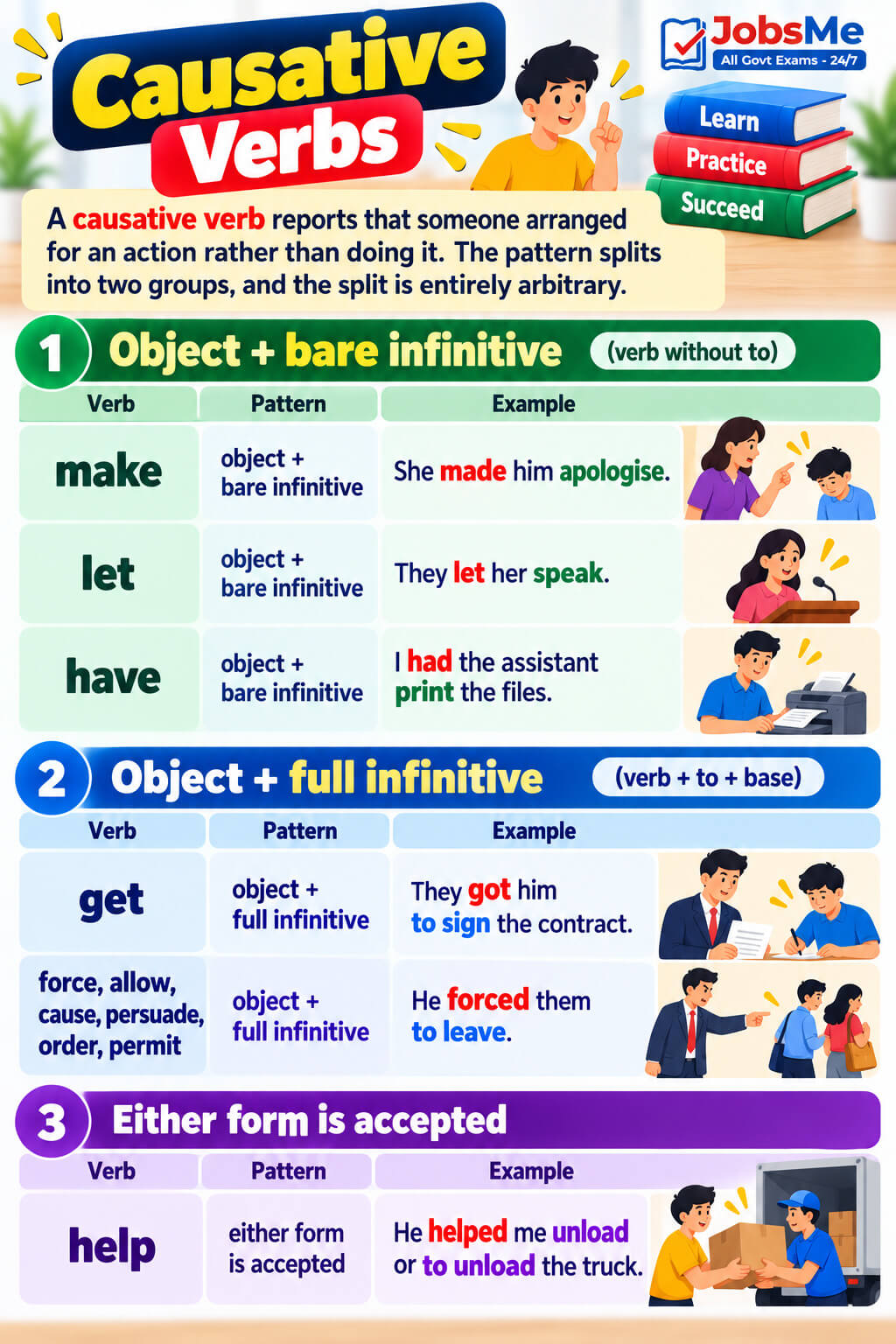
A causative verb reports that someone arranged for an action rather than doing it. The pattern splits into two groups, and the split is entirely arbitrary.
| Verb | Pattern | Example |
|---|---|---|
| make | object + bare infinitive | She made him apologise. |
| let | object + bare infinitive | They let her speak. |
| have | object + bare infinitive | I had the assistant print the files. |
| get | object + full infinitive | They got him to sign the contract. |
| force, allow, cause, persuade, order, permit | object + full infinitive | He forced them to leave. |
| help | either form is accepted | He helped me unload or to unload the truck. |
Three words take the bare infinitive: make, let and have. Everything else in the group takes to, and get is the one most often confused with them. So she made him wait, but they got him to wait.
The Passive Causative
When the doer is unimportant, a different pattern applies: have or get + object + third form.
- She had her car repaired. Someone repaired it for her.
- I have my room cleaned every week.
- He got his documents verified before applying.
Note that make switches to the full infinitive in the true passive, so the employees were made to fill out the forms is correct even though the active is made them fill out. This is covered further in active and passive voice.
Key Highlights
- One finite verb per clause, and every other verb must be non-finite.
- The controlling word fixes the form and never offers a choice.
- A preposition always takes a gerund, with no exceptions at all.
- Only make, let and have drop the to among the causatives.
- This topic pays out everywhere, since agreement, tense and voice all begin by finding the finite verb.
Verbs of Perception
See, hear, watch, notice and feel take a bare infinitive or an -ing form, and the choice changes the meaning.
- Bare infinitive means the whole action was witnessed. I saw him cross the road, so he reached the other side.
- The -ing form means the action was in progress. I saw him crossing the road, so it was under way when I looked.
Both are correct English, and only the intended meaning decides. So in a question offering both, read for whether the action was completed or ongoing.
Pairs Whose Meaning Changes With the Form
A small group of verbs takes both a gerund and an infinitive, with different meanings. This is under-taught and heavily tested.
| Verb | With a gerund | With an infinitive |
|---|---|---|
| remember | Recalling the past. I remember locking the door. | Not forgetting a duty. Remember to lock the door. |
| forget | Failing to recall. I shall never forget meeting her. | Failing to do a duty. He forgot to post the letter. |
| stop | Ending an activity. He stopped smoking last year. | Pausing in order to do something. He stopped to smoke. |
| try | Experimenting with a method. Try adding more salt. | Attempting something difficult. He tried to lift the box. |
| go on | Continuing the same thing. She went on speaking. | Moving to something new. She went on to describe the plan. |
| regret | Being sorry about the past. I regret telling him. | Being sorry to announce. We regret to inform you. |
| mean | Involving as a consequence. This means starting again. | Intending. I meant to call you. |
The pattern is broadly consistent. A gerund looks backwards at something already done, while an infinitive looks forward to something intended.
Stative Verbs and the Continuous
Some verbs describe a state rather than an action, and states do not progress, so these resist the continuous form.
Know, believe, understand, remember, forget, mean, belong, own, possess, contain, consist, comprise, seem, appear, resemble, prefer, like, love, hate, want, need, doubt, deserve.
- Wrong: I am knowing the answer. Right: I know the answer.
- Wrong: He is having a car. Right: He has a car.
- Wrong: This book is belonging to me. Right: This book belongs to me.
The exception is that several of these verbs have a second, active meaning that does allow the continuous. He is having a good time and she is having lunch are both correct, because there have means experience or eat rather than possess. So ask which sense the sentence uses before deciding.
The Subjunctive
After a small set of verbs of demanding or proposing, the clause after that takes the base form of the verb regardless of the subject.
The verbs: suggest, demand, insist, recommend, propose, request, require, order, urge, advise, command, stipulate, move.
- The manager requires that we complete the project on time.
- The board demanded that he stop making excuses, and not stops.
- I suggest that she be informed immediately, and not is.
Indian and British usage often inserts should instead, giving demanded that he should stop, and both forms appear in exam keys. So treat should as acceptable but never write the ordinary present form, because demanded that he stops is wrong under either convention.
Transitive and Intransitive
- Transitive verbs need an object. She bought a book. He kicked the ball.
- Intransitive verbs take none. The baby cried. They slept peacefully.
- Many verbs work both ways. I am painting is intransitive; I am painting the car is transitive.
- Only transitive verbs go passive, which is why the flight was arrived is impossible.
Two small groups are worth memorising. Discuss, comprise, enter, resemble, order and reach are transitive and need no preposition, so discuss about the matter is wrong. And lie, rise, sit and arise are intransitive while lay, raise, set and arouse are transitive, which is why lay down and rest should read lie down. The preposition side is in prepositions.
A Warning About Study Material on This Topic
- A modal called a bare infinitive. One guide defines bare infinitives with the example shall. Shall is a modal auxiliary. A bare infinitive is the base form of an ordinary verb, as in let me go.
- An ungrammatical model sentence. The same source illustrates the gerund rule with Clara's eagerness to volunteering is a surprise at her age. That is wrong; a noun followed by to takes an infinitive, so it should read eagerness to volunteer.
- A second ungrammatical example. It also gives My mother refused me to talk to her to show that refuse takes an infinitive. Refuse cannot take an object and an infinitive together, so it should read my mother refused to talk to me.
- A mislabelled tense, followed by a contradiction. The same guide states that modals exist only in simple tenses and offers the train might be at the station as past tense. It is a present possibility, and the very next rule in the source describes perfect and continuous forms of modals.
- Should and would called modal + ed. A table presents them as the -ed forms of shall and will. They are separate modals with their own meanings, and neither contains an -ed ending.
So test every model sentence by reading it aloud as ordinary English. Two of the five faults above are sentences no fluent speaker would produce, which is the quickest way to catch them.
Exam Alert
- Read backwards from any -ing or to form to find its controller.
- Check every has, have or had for a past form where the participle belongs.
- Check any continuous form against the stative list.
- A sentence opening with a participle needs a logical subject.
- Once the causative rule is fresh, resist deleting the to from got him to sign.
Ten Solved Questions
1. Find the error. The committee decided (a) / to postponing the meeting (b) / until next week. (c) / No error (d)
Working: Decide belongs to the infinitive list, so the controller demands to plus the base form. Answer: (b), which should read to postpone.
2. Find the error. The manager made all (a) / the employees to fill out (b) / the feedback forms. (c) / No error (d)
Working: Make is a causative taking a bare infinitive after its object. Answer: (b), which should read fill out.
3. Find the error. We are looking forward (a) / to meet the director (b) / at the annual conference. (c) / No error (d)
Working: Here to is a preposition, and a preposition always takes a gerund. Answer: (b), which should read to meeting.
4. Find the error. She carefully avoided (a) / to meet him at (b) / the reception yesterday. (c) / No error (d)
Working: Avoid belongs to the gerund list. Answer: (a) and (b) together, and the marked error is (b), which should read meeting him.
5. Find the error. He has went (a) / to the office already (b) / to collect the papers. (c) / No error (d)
Working: An auxiliary demands the participle, never the past form. Answer: (a), which should read he has gone.
6. Find the error. He is having a car (a) / and a small flat (b) / near the railway station. (c) / No error (d)
Working: Have meaning possess is stative and resists the continuous. Answer: (a), which should read he has a car.
7. Choose the sentence meaning that he gave up the habit. (a) He stopped to smoke last year. (b) He stopped smoking last year. (c) He stopped for smoking last year. (d) He has stopped to smoke.
Working: A gerund after stop means the activity ended, while an infinitive means he paused in order to do it. Answer: (b).
8. Find the error. The board demanded (a) / that he stops making (b) / excuses for the losses. (c) / No error (d)
Working: A verb of demanding takes the base form after that. Answer: (b), which should read that he stop, or that he should stop.
9. Find the error. Being a rainy day, (a) / I decided to stay at home (b) / and read a book. (c) / No error (d)
Working: The participle has no logical subject, so the sentence implies that I was the rainy day. Answer: (a), which should read It being a rainy day. The full treatment is in modifiers.
10. Find the error. They got him (a) / to sign the contract (b) / before the deadline. (c) / No error (d)
Working: Get takes a full infinitive, unlike make, let and have. The sentence is correct. Answer: (d), no error.
Quick Facts
- Bare infinitive after: modals, had better, would rather, make, let, have, see, hear, watch.
- Full infinitive after: get, force, allow, cause, persuade, decide, want, refuse, hope, manage.
- Gerund after: every preposition, plus avoid, enjoy, mind, postpone, consider, admit, deny, risk.
- Third form after: has, have, had, and every form of be.
- Stative, so no continuous: know, believe, own, contain, belong, resemble, seem, prefer.
- Base form after: demand, suggest, insist, recommend, propose, plus that.
Worked Examples: Wrong to Right
Example 1 (the wrong non-finite form)
Sentence: A student writes The committee decided to postponing the meeting.
Trap: Both to postpone and postponing are real forms, and the sentence has the right number of verbs, so nothing looks obviously missing. The controller decides, and decide belongs to the infinitive list.
Correct Answer: The committee decided to postpone the meeting.
Rule in Simple Words: Look at the word in front of the second verb.
Example 2 (a full infinitive after a causative)
Sentence: A student writes The manager made all the employees to fill out the forms.
Trap: Nearly every verb that governs another verb takes to, so the pattern transfers by habit. Make, let and have are the exceptions, and each takes a bare infinitive after its object.
Correct Answer: The manager made all the employees fill out the forms.
Rule in Simple Words: Make, let and have take no to.
Example 3 (get treated like make)
Sentence: Having learnt the last rule, a student writes They got him sign the contract.
Trap: Get means much the same as make here, so the pattern seems to carry over. The split between the two groups is arbitrary, and get sits with the full-infinitive group.
Correct Answer: They got him to sign the contract.
Rule in Simple Words: Only three verbs drop the to, and get is not one of them.
Example 4 (an infinitive after look forward to)
Sentence: A student writes We are looking forward to meet the director.
Trap: The word to usually begins an infinitive, so the base verb follows automatically. Here to is a preposition, and a preposition takes a gerund without exception.
Correct Answer: We are looking forward to meeting the director.
Rule in Simple Words: If a noun could follow the to, use the -ing form.
Example 5 (the past form after an auxiliary)
Sentence: A student writes He has went to the office and she had drank the milk.
Trap: Both sentences plainly refer to the past, and the past form is the one most students recall first. An auxiliary always demands the participle, and the past form never follows has, have, had or be.
Correct Answer: He has gone to the office. She had drunk the milk.
Rule in Simple Words: Third form after an auxiliary, always.
Example 6 (a stative verb in the continuous)
Sentence: A student writes He is having a car and I am knowing the answer.
Trap: The continuous is the form used for anything happening now, and both states are true now. A state does not progress, so verbs of knowing, possessing and believing take the simple form.
Correct Answer: He has a car. I know the answer.
Rule in Simple Words: States use the simple form; actions use the continuous.
Example 7 (the wrong half of a meaning pair)
Sentence: A student writes He stopped to smoke last year to mean he gave up the habit.
Trap: Both forms are correct English and both concern smoking, so neither looks wrong on its own. The infinitive means he paused in order to smoke, which is the opposite of what was intended.
Correct Answer: He stopped smoking last year.
Rule in Simple Words: A gerund looks back at something done; an infinitive looks forward to something intended.
Example 8 (a subjunctive given an ordinary present)
Sentence: A student writes The board demanded that he stops making excuses.
Trap: The subject is third person singular, so the -s form seems required by ordinary agreement. Verbs of demanding trigger the subjunctive, which uses the bare base form whatever the subject.
Correct Answer: The board demanded that he stop making excuses.
Rule in Simple Words: After demand, suggest or insist, use the base form.
Common Traps Students Fall Into
These are the habits that most often cost marks. Each one is a common trap, not a silly mistake, and each has a one-line fix.
- Trap: Guessing the non-finite form. Fix: The controlling word decides it, so read backwards.
- Trap: Putting an infinitive after a preposition. Fix: A preposition always takes a gerund.
- Trap: Adding to after make, let or have. Fix: Those three take a bare infinitive.
- Trap: Dropping to after get. Fix: Get sits with the full-infinitive group.
- Trap: Using an infinitive after look forward to. Fix: That to is a preposition.
- Trap: Using the past form after an auxiliary. Fix: Has gone, not has went.
- Trap: Putting a stative verb in the continuous. Fix: I know, not I am knowing.
- Trap: Choosing the wrong half of a meaning pair. Fix: Gerund for the past, infinitive for the intended.
- Trap: Giving a subjunctive clause an -s form. Fix: Use the base form after demand or suggest.
- Trap: Leaving a participle without a subject. Fix: Supply one, as in modifiers.
- Trap: Trusting a rule written in V-numbers. Fix: Sources number the forms differently, so learn the names.
Memory Tricks and Formulas
1. Count the finite verbs
A clause holds exactly one. If a sentence has two verbs and only one conjunction is missing, the second verb must be non-finite, and the question is only which form.
2. Read backwards to the controller
The word immediately before a non-finite verb fixes its form and never offers a choice. Preposition means gerund, modal means bare infinitive, and a listed verb means whichever form that verb governs.
3. Preposition means gerund, always
This is the one rule in the topic with no exceptions. Afraid of flying, good at swimming, insisted on paying, before leaving, with a view to improving.
4. Make, let, have take no to
Three verbs only. Everything else in the causative group, including get, force, allow, cause and persuade, takes a full infinitive. Help accepts either.
5. Third form after an auxiliary
After has, have, had or any form of be, the past form never appears. So has gone, had drunk, was written, and never has went.
6. States take the simple form
Know, believe, own, contain, belong, resemble and prefer describe conditions rather than activities, so they resist the continuous. Watch for a second active sense, since having lunch is fine.
7. Gerund looks back, infinitive looks forward
Remember locking the door is a memory; remember to lock it is a duty. Stopped smoking ended a habit; stopped to smoke began one act. The pattern holds across the whole pair list.
8. Budget the time honestly
Direct questions are worth 1 to 2 marks, and the target is a few seconds each once the controllers are automatic. Give one session to the controllers and irregular forms, since the return spreads across every other grammar topic.
Exam Patterns and High-Yield Facts
Frequently Confused Pairs
| Pair | How They Differ | Mini Trick |
|---|---|---|
| Finite vs Non-finite | Changes with tense against fixed. | Try putting it into the past. |
| Made him wait vs Got him to wait | Bare against full infinitive. | Only make, let and have drop the to. |
| Avoided meeting vs Decided to meet | Gerund list against infinitive list. | The verb in front decides. |
| Looking forward to meeting vs want to meet | Preposition against infinitive marker. | Could a noun follow the to? |
| Has gone vs Has went | Only the participle follows an auxiliary. | Third form after has. |
| He has a car vs He is having lunch | Possession against experience. | Which sense of have? |
| Stopped smoking vs Stopped to smoke | Ended the habit against paused to do it. | Gerund looks back. |
| Saw him cross vs Saw him crossing | Whole action against action in progress. | Was it completed? |
| Lie vs Lay | Intransitive against transitive. | Lay needs an object. |
| Demanded that he stop vs stops | Subjunctive against ordinary present. | Base form after demand. |
Repeating Question Patterns
- An infinitive where a gerund belongs, most often after look forward to or a listed verb such as avoid.
- A full infinitive after the causative make.
- The past form used after an auxiliary, as in has went or had drank.
- A stative verb placed in the continuous.
- A dangling participle opening a sentence with no logical subject.
- An -s form inside a subjunctive clause after demand, suggest or insist.
Practice Set: Fifteen Questions
Correct each sentence, or mark it correct as it stands.
- She avoided to answer the question directly.
- They got him to withdraw the complaint.
- The officer made the clerk to repeat the entry.
- I am looking forward to hearing from you soon.
- He has went home without informing anyone.
- She is knowing the whole story already.
- He stopped smoking after the doctor's warning.
- The principal let the students leave early.
- Remember to submit the form before Friday.
- Being late, the gates were already closed.
- I suggest that she be informed immediately.
- He insisted that the file is reopened at once.
- They watched the train leave the platform.
- This flat is belonging to my uncle.
- She helped me carry the boxes upstairs.
Quick Facts
Answer key, with the rule named in each case.
- 1. avoided answering. Avoid belongs to the gerund list.
- 2. Correct as it stands. Get takes a full infinitive.
- 3. made the clerk repeat. Make takes a bare infinitive.
- 4. Correct as it stands. That to is a preposition, so the gerund is right.
- 5. has gone home. An auxiliary demands the participle.
- 6. She knows the whole story. Know is stative.
- 7. Correct as it stands. A gerund after stop means the habit ended.
- 8. Correct as it stands. Let takes a bare infinitive.
- 9. Correct as it stands. An infinitive after remember marks a duty.
- 10. Being late, I found the gates already closed, or As I was late. The participle had no logical subject.
- 11. Correct as it stands. The subjunctive takes the base form be.
- 12. that the file be reopened, or should be reopened. Insist triggers the subjunctive.
- 13. Correct as it stands. A perception verb takes a bare infinitive for a whole action.
- 14. This flat belongs to my uncle. Belong is stative.
- 15. Correct as it stands. Help accepts either form.
Eight of those fifteen were already correct, which is the highest proportion in this series and deliberate. Once the causative rule is fresh, students start deleting to from got him to withdraw and adding it to let the students leave. Practise with the free English MCQ quizzes and full papers from the mock test archive.
Quick Revision
Quick Revision
- The rule that generates most verb errors. A clause contains exactly one finite verb, and every other verb in it must be non-finite.
- The test for a finite verb. Put it into the past, and if the sentence survives it is finite.
- The three non-finite forms. Gerund working as a noun, infinitive working as a noun, adjective or adverb, and participle working as an adjective.
- The controller decides the non-finite form, and the controller is the word immediately in front of it.
- A preposition always takes a gerund, and this is the one rule with no exceptions.
- Watch the words where to is a preposition. Look forward to, accustomed to, addicted to, averse to, object to, prone to, with a view to.
- The test for that trap. If a noun could follow the to, use the -ing form.
- Modals, had better and would rather take a bare infinitive.
- Make, let and have take a bare infinitive after the object, while get, force, allow, cause and persuade take a full one, and help accepts either.
- The passive causative is have or get plus the object plus the third form, as in she had her car repaired.
- Perception verbs take either form with a change of meaning, so saw him cross means the whole action and saw him crossing means it was in progress.
- Some verbs take gerunds: avoid, enjoy, mind, postpone, consider, admit, deny, finish, risk, suggest, dislike, resist.
- Some verbs take infinitives: decide, want, hope, refuse, promise, agree, expect, plan, learn, manage, hesitate, pretend.
- The five verb forms. Base, past, past participle, present participle, and the -s form.
- Learn the names rather than the V-numbers, since sources number them differently.
- After an auxiliary, never the past form, so has gone rather than has went and had drunk rather than had drank.
- Stative verbs resist the continuous. Know, believe, understand, own, possess, contain, belong, resemble, seem, prefer.
- Some of those have a second active sense that does allow it, so having lunch and having a good time are both fine.
- A gerund looks back and an infinitive looks forward. Remember locking the door is a memory; remember to lock it is a duty.
- Stopped smoking ended a habit while stopped to smoke began one act, and the same pattern governs forget, try, go on, regret and mean.
- Verbs of demanding trigger the subjunctive, so demand, suggest, insist, recommend and propose take the base form after that.
- Should is acceptable in that clause but the ordinary present is not, so never demanded that he stops.
- Only transitive verbs can go passive, and lie, rise and sit are intransitive while lay, raise and set are transitive.
- A participle needs a logical subject, or the sentence dangles.
Verbs look like the largest topic in the syllabus and reduce to two questions. How many finite verbs does this clause have, and what does the controlling word demand of the rest? Answer those in order and the traps disappear: the wrong non-finite form, the missing to, the past form after an auxiliary, and the state placed in the continuous. This is also the topic that pays out everywhere else, since subject-verb agreement, tenses and active and passive voice all begin by locating the finite verb. It connects to modals for the auxiliary half, to prepositions for the gerund rule, to modifiers for dangling participles, and it decides a large share of error spotting and sentence improvement. The wider set is in the topic-wise English notes.
Frequently Asked Questions
What is the difference between a finite and a non-finite verb?
How many finite verbs can a clause have?
How do I decide between a gerund and an infinitive?
Why is looking forward to meet wrong?
Which causative verbs take no to?
Why is he has went wrong?
What are stative verbs?
Why is he is having a good time correct then?
What is the difference between stopped smoking and stopped to smoke?
Why is demanded that he stops wrong?

About the author





