
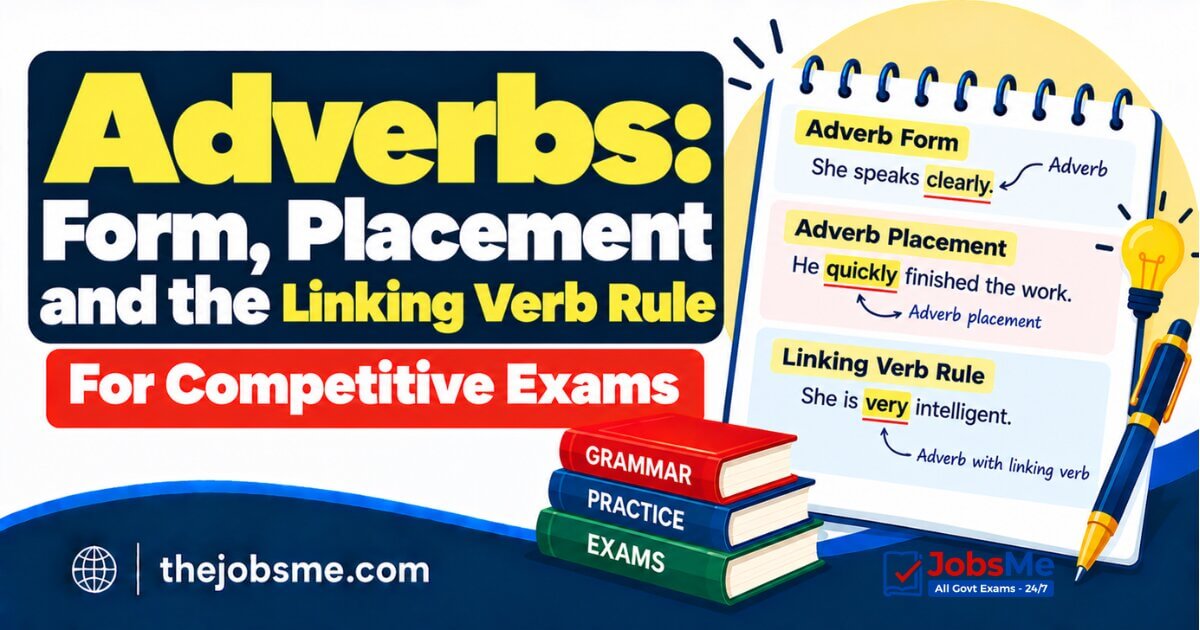
Adverbs: Form, Placement and the Linking Verb Rule
This article is a complete, exam-ready guide to adverbs for SSC, banking, insurance, railway, defence and State PSC exams. Papers rarely ask you to identify an adverb. What they ask is whether the adjective or the adverb form belongs in a sentence, and where the word should sit, because both decisions change either the correctness or the meaning. It covers the linking verb rule that settles the form question, the words ending in -ly that are not adverbs at all, the pairs such as hard and hardly that mean different things, the placement rules for enough, only, also and even, the royal order of adverbs, and the inversion required after a negative opener. Ten solved questions, common traps and a fifteen-question practice set with a full answer key are included.
Introduction
An adverb is a word that modifies a verb, an adjective or another adverb, telling you how, when, where, how often or to what extent. She sings beautifully. The test was extremely difficult. He works quite efficiently.
Defining them is easy, and it is not what exams test. No paper asks you to circle the adverb in a sentence. What papers ask is whether the adjective or the adverb form belongs there, and where the word should sit.
Both questions matter for a reason. Choosing the wrong form makes a sentence ungrammatical, and choosing the wrong position often leaves the sentence perfectly grammatical while changing what it says. He only died a week ago and he died only a week ago are both correct English, and they mean different things.
So this article gives the type lists one compact table and spends its space on the two decisions that carry marks.
Where This Topic Is Asked
| Exam | How This Topic Appears | Rough Weight | Difficulty |
|---|---|---|---|
| SSC CGL and CHSL | Wrong form or wrong placement inside error spotting and sentence improvement. | Around 4 per cent of grammar marks, with 1 to 2 questions | Easy to moderate. |
| IBPS PO and SBI PO | Error detection, and the correct option in a filler. | 1 to 2 questions | Moderate. |
| RRB NTPC and Group D | Straightforward form questions such as good against well. | 1 question | Easy. |
| State PSC and police exams | Placement of only and enough, and inversion after hardly. | 1 to 2 questions | Moderate. |
| Reading comprehension | A limiting adverb can change what a sentence claims. | Indirect | Moderate. |
| Descriptive papers | Adverb overuse weakens writing; a stronger verb usually serves better. | Indirect | Worth knowing. |
The topic sits in the supporting band, below tenses and agreement but alongside conjunctions and determiners. That makes it worth one focused session rather than a week. Check your own pattern in the exam-wise syllabus hub.
The Types, Once and Compactly
| Type | Question It Answers | Examples |
|---|---|---|
| Manner | How? | slowly, carefully, well, fast, equally |
| Time | When? | now, yesterday, soon, already, tomorrow |
| Place | Where? | here, there, everywhere, inside, abroad |
| Frequency | How often? | always, never, often, rarely, usually |
| Degree | To what extent? | very, too, quite, almost, extremely |
| Certainty | How sure? | definitely, surely, probably, perhaps |
| Interrogative | Used to ask | how, when, where, why |
| Conjunctive, or connectors | Link two sentences | however, therefore, moreover, nevertheless |
One caution about the last row and about a category some guides call adverbs of purpose. Words such as because and since are subordinating conjunctions, not adverbs, so a sentence like since she was late, she took a cab contains no adverb of purpose at all. The connector family is covered in conjunctions and connectors.
Formula Box
- After a linking verb, use an adjective, not an adverb. She looks beautiful, not beautifully.
- The linking test. Replace the verb with a form of be. If the sentence still works, it is linking.
- Not every -ly word is an adverb. Friendly, lively, costly and timely are adjectives.
- Not every adverb has -ly. Fast, hard, late, early and straight do not.
- Enough goes after an adjective or adverb and before a noun.
- Limiting words sit immediately before what they limit.
- A negative opener inverts the auxiliary and the subject.
- -ly adverbs take more and most, never -er and -est.
The Form Question: Adjective or Adverb?
This decides more marks than anything else in the topic, and the rule that settles it is missing from most study material.
The basic principle is familiar. An adjective describes a noun and an adverb describes a verb, so the fast runner won the race but the runner ran fast.
The Linking Verb Exception
After a linking verb you use an adjective, not an adverb, because the word describes the subject rather than the action.
The linking verbs: be, become, seem, appear, look, feel, smell, taste, sound, grow, remain, stay, turn, prove.
- Right: She looks beautiful. Wrong: She looks beautifully.
- Right: The soup tastes good. Wrong: The soup tastes well.
- Right: He feels bad about the delay. Wrong: He feels badly about the delay.
- Right: The proposal sounds reasonable. Wrong: The proposal sounds reasonably.
The Substitution Test
Several verbs work both ways, which is where candidates lose the mark. Use this test.
Replace the verb with the matching form of be. If the sentence still makes sense, the verb is linking and needs an adjective. If it does not, the verb is an action verb and needs an adverb.
| Sentence | Test | Verdict |
|---|---|---|
| The flower smells ___. | The flower is sweet makes sense. | Linking, so sweet. |
| He smelled the flower ___. | He was the flower makes no sense. | Action, so carefully. |
| She looked ___ at the report. | She was at the report makes no sense. | Action, so closely. |
| She looked ___ after the news. | She was happy makes sense. | Linking, so happy. |
| The team performed ___. | The team was does not work here. | Action, so well. |
| The plan proved ___. | The plan was successful makes sense. | Linking, so successful. |
This single test resolves the good against well confusion permanently. She is a good writer and she writes well, but also the soup tastes good, because taste is linking there.
The -ly Traps
Words Ending in -ly That Are Adjectives
The ending is not a reliable signal. These are all adjectives and cannot modify a verb.
Friendly, lively, lonely, lovely, ugly, silly, costly, timely, orderly, cowardly, miserly, likely, kindly, elderly, deadly, manly.
- Wrong: He spoke friendly to the visitors.
- Right: He spoke in a friendly manner to the visitors.
- Wrong: She behaved cowardly during the crisis.
- Right: She behaved in a cowardly way during the crisis.
Since no adverb form exists for these words, the repair is always the same: use a phrase such as in a friendly manner or in a cowardly way.
Adverbs Without -ly
Fast, hard, late, early, straight, high, low, near, deep, wrong, right, well, much, little, very, quite, soon, still, just.
- Right: She runs fast. Wrong: She runs fastly, which is not a word.
- Right: He works hard. Wrong: He works hardly, which means something else entirely.
Pairs Where the -ly Changes the Meaning
This is the group examiners use most, because both forms exist and both are correct in their own sense.
| Without -ly | With -ly | Example of Each |
|---|---|---|
| hard, with effort | hardly, scarcely | He works hard. He hardly works. |
| late, not on time | lately, recently | He came late. He has been unwell lately. |
| near, close by | nearly, almost | She lives near. She nearly fell. |
| high, at a height | highly, very much | The kite flew high. He is highly respected. |
| deep, far down | deeply, intensely | He dug deep. She was deeply moved. |
| most, to the greatest degree | mostly, mainly | What I want most. The staff are mostly local. |
| free, without payment | freely, without restraint | Children travel free. He spoke freely. |
| short, abruptly | shortly, soon | He stopped short. She will arrive shortly. |
| sure, in informal use | surely, certainly | Surely you are joking. |
| just, only or recently | justly, fairly | He just left. He was justly rewarded. |
| pretty, fairly | prettily, in a pretty way | It is pretty cold. She sang prettily. |
The pair to know above all others is hard and hardly, because he hardly works reverses the meaning of he works hard while looking almost identical.
Key Highlights
- Two decisions carry the marks: which form belongs, and where it sits.
- Linking verbs take adjectives, which is the rule most study material omits.
- The -ly ending proves nothing in either direction.
- Wrong placement often leaves a correct sentence that says something else.
- Over-correction is the risk here, since not every adjective after a verb is wrong.
Placement Rules
Adverbs of Frequency
These follow one rule with one exception.
- Before the main verb. She always arrives early. He never complains.
- After a form of be. She is always punctual. They were never informed.
- Between the auxiliary and the main verb. He has always worked here. She will never agree.
The commonest error puts the adverb after the main verb, giving she sings always beautifully where it should read she always sings beautifully.
Adverbs of Manner
- After the verb, or after the object if there is one. She spoke gently. He read the letter carefully.
- Never between the verb and its object. Write he read the letter carefully, not he read carefully the letter.
Enough
This word changes position depending on what it modifies, and the two cases are opposite.
| What It Modifies | Position | Wrong | Right |
|---|---|---|---|
| An adjective | After it. | He is enough wise to understand. | He is wise enough to understand. |
| An adverb | After it. | She did not run enough fast. | She did not run fast enough. |
| A noun | Before it. | I have money enough for the tickets. | I have enough money for the tickets. |
| A verb | After it. | He does not enough practise. | He does not practise enough. |
The memory line is short: enough follows an adjective or adverb and precedes a noun. So old enough but enough time.
Only, Just, Almost and Merely
These limiting words attach to whatever immediately follows them, so moving one changes the meaning without breaking any rule.
- Only she gave me ten rupees means nobody else gave me anything.
- She only gave me ten rupees means giving was all she did.
- She gave me only ten rupees means the amount was limited to ten.
The exam trap is nearly always the same shape. He only died a week ago implies that dying was the only thing he did, when the intended sense is he died only a week ago. The full treatment sits in modifiers.
Also, Too, As Well and Even
| Word | Position | Example |
|---|---|---|
| also | In the middle, before the main verb or after be. Commoner in writing. | She also goes to the gym every week. |
| too | At the end, usually. Commoner in speech. | She must be really hungry too. |
| as well | At the end. Commoner in speech than also. | I will go for a trek as well. |
| even | Immediately before the word it emphasises. | Even the manager was surprised. The manager was even surprised. |
The Royal Order of Adverbs
When several adverbs sit together, they follow a settled sequence: manner, place, frequency, time, purpose.
I run quickly down the road every morning before school because I might miss the bus. Manner, place, frequency, time, then purpose. In practice, avoid stacking more than two or three, because a sentence carrying five adverbs is usually better rewritten.
Adverb Phrases and Adverb Clauses
A group of words can do an adverb's job. Knowing the difference matters mainly for sentence-structure questions and for transformation of sentences.
| Form | What It Is | Example |
|---|---|---|
| Adverb | A single word. | He answered promptly. |
| Adverb phrase | A group of words with no subject and verb of its own. | He answered without any delay. |
| Adverb clause | A group of words with its own subject and verb, introduced by a subordinating conjunction. | He answered as soon as the question was put. |
The test is simple: a clause has its own subject and finite verb, while a phrase does not. All three forms answer the same question, which is how the simple, complex and compound conversions work.
Inversion After a Negative Opener
When a sentence begins with a negative or restrictive adverb, the auxiliary moves in front of the subject.
Structure: Hardly or Scarcely + had + subject + third form + when + subject + past simple.
- Wrong: Hardly I had stepped out than it began to rain.
- Right: Hardly had I stepped out when it began to rain.
- Wrong: Scarcely the exam started then the power went out.
- Right: Scarcely had the exam started when the power went out.
- Also inverted: Seldom does he attend the review meetings. Never have I seen such a crowd.
Two traps run together here. The partner word is when or before for hardly and scarcely, while than belongs only to no sooner. And the inversion is compulsory, not optional. The pairing side is covered in conjunctions and connectors.
Comparative and Superlative Forms
| Adverb Type | Rule | Examples |
|---|---|---|
| Short adverbs without -ly | Add -er and -est. | fast, faster, fastest. hard, harder, hardest. early, earlier, earliest. |
| Adverbs ending in -ly | Use more and most. | quietly, more quietly, most quietly. carefully, more carefully, most carefully. |
| Irregular | Learn them. | well, better, best. badly, worse, worst. much, more, most. little, less, least. |
So she spoke more quickly than he did is correct and she spoke quicklier does not exist. In careful writing, avoid dropping the -ly to form a comparative, so prefer more quickly to quicker when the word is modifying a verb.
A Warning About Study Material on This Topic
- An adjective used to illustrate degrees of adverbs. One guide states that adverbs have three degrees and gives angry, angrier, angriest. Angry is an adjective. The adverb series is angrily, more angrily, most angrily.
- An example with no adverb in it. The same source illustrates front position with I will read a book, a sentence containing no adverb at all.
- A mislabelled pair. We quite often study English is offered as an adverb modifying an adjective. Both words are adverbs, since quite modifies often.
- A garbled sentence analysis. An extremely small child entered the room is labelled subject, adverbial, object, verb. It is subject, verb, object, and extremely sits inside the subject rather than standing as a separate element.
- Conjunctions called adverbs. Since she was late, she took a cab is given as an adverb of purpose, but since is a subordinating conjunction.
- An error left unmarked. She writes quick appears in a list of correct examples. It should read she writes quickly.
So test every example against the rule it claims to demonstrate, particularly in a topic where the same word can belong to two different parts of speech.
Exam Alert
- Run the be substitution whenever a describing word follows a verb.
- Hard and hardly is the pair examiners reuse most, because it reverses the meaning.
- Enough is tested on which side of the word it sits.
- A sentence opening with hardly or seldom carries both a partner check and an inversion check.
- Friendly, lively and cowardly have no adverb form at all, so the repair is a phrase.
Ten Solved Questions
1. Find the error. The soup on the table (a) / tastes very well (b) / this evening. (c) / No error (d)
Working: Taste is a linking verb here, since the soup is good makes sense. A linking verb takes an adjective. Answer: (b), which should read tastes very good.
2. Find the error. He is enough wise (a) / to see through (b) / the whole scheme. (c) / No error (d)
Working: Enough follows the adjective it modifies. Answer: (a), which should read wise enough.
3. Find the error. I have money enough (a) / to cover the fees (b) / for this year. (c) / No error (d)
Working: Enough precedes a noun. Answer: (a), which should read enough money.
4. Find the error. Hardly I had reached (a) / the office than (b) / the power failed. (c) / No error (d)
Working: Two faults, and both sit in the marked parts. The opener requires inversion, so it must be hardly had I reached, and hardly pairs with when. The inversion error comes first. Answer: (a).
5. Choose the correct sentence. (a) He works hardly and deserves promotion. (b) He works hard and deserves promotion. (c) He hardly works and deserves promotion. (d) He hard works and deserves promotion.
Working: Hardly means scarcely, which reverses the intended praise. Answer: (b).
6. Find the error. She spoke quicker (a) / than the previous speaker (b) / and finished on time. (c) / No error (d)
Working: An adverb ending in -ly forms its comparative with more. Answer: (a), which should read more quickly.
7. Find the error. The receptionist spoke (a) / friendly to every visitor (b) / who entered the office. (c) / No error (d)
Working: Friendly is an adjective despite the ending, and no adverb form exists. Answer: (b), which should read in a friendly manner.
8. Find the error. She sings always (a) / beautifully at the (b) / annual function. (c) / No error (d)
Working: An adverb of frequency goes before the main verb. Answer: (a), which should read she always sings.
9. Choose the sentence meaning that the amount was limited to ten rupees. (a) Only she gave me ten rupees. (b) She only gave me ten rupees. (c) She gave me only ten rupees. (d) She gave only me ten rupees.
Working: A limiting word governs what follows it, so it must sit directly before ten rupees. Answer: (c).
10. Find the error. He read carefully the letter (a) / before signing it (b) / and passing it on. (c) / No error (d)
Working: An adverb of manner does not sit between a verb and its object. Answer: (a), which should read read the letter carefully.
Quick Facts
- Linking verbs: be, become, seem, appear, look, feel, smell, taste, sound, grow, remain, stay, turn, prove.
- -ly adjectives: friendly, lively, lonely, costly, timely, orderly, cowardly, likely.
- Adverbs without -ly: fast, hard, late, early, straight, high, near, deep, well.
- Meaning pairs: hard and hardly, late and lately, near and nearly, high and highly.
- Enough: adjective after, noun before.
- Comparatives: -ly adverbs take more and most.
Worked Examples: Wrong to Right
Example 1 (adverb after a linking verb)
Sentence: A student writes The soup tastes well, reasoning that tastes is a verb and verbs take adverbs.
Trap: The reasoning matches the rule everyone learns first, and it works for ordinary verbs. A linking verb connects the subject to a description of the subject, so the word describes the soup rather than the tasting.
Correct Answer: The soup tastes good.
Rule in Simple Words: After be, seem, look, feel, taste, smell and sound, use an adjective.
Example 2 (trusting the -ly ending)
Sentence: A student writes He spoke friendly to the visitors.
Trap: The word ends in -ly, which is the standard adverb signal, so it looks like the adverb form already. Friendly is an adjective, and no adverb form of it exists in English.
Correct Answer: He spoke in a friendly manner to the visitors.
Rule in Simple Words: Friendly, lively, costly and cowardly are adjectives; use a phrase instead.
Example 3 (hard against hardly)
Sentence: A student writes He works hardly and deserves the promotion.
Trap: Adding -ly looks like the correct way to turn an adjective into an adverb, and the sentence reads smoothly. Hardly means scarcely, so the sentence now says he barely works at all.
Correct Answer: He works hard and deserves the promotion.
Rule in Simple Words: Some adverbs already exist without -ly, and adding it changes the meaning.
Example 4 (enough before an adjective)
Sentence: A student writes He is enough wise to see through the scheme.
Trap: Most modifiers come before the word they modify, so this position feels natural. Enough is the exception when it modifies an adjective or an adverb, and it must follow.
Correct Answer: He is wise enough to see through the scheme.
Rule in Simple Words: Enough follows an adjective or adverb and precedes a noun.
Example 5 (frequency after the verb)
Sentence: A student writes She sings always beautifully.
Trap: Keeping the two adverbs together seems tidy, and the meaning is perfectly clear. An adverb of frequency has a fixed slot before the main verb, or after a form of be.
Correct Answer: She always sings beautifully.
Rule in Simple Words: Frequency goes before the main verb and after be.
Example 6 (missing the inversion)
Sentence: A student writes Hardly I had reached the office when the power failed.
Trap: The partner word is correct and the meaning is complete, so the sentence looks finished. A restrictive adverb at the start of a sentence demands that the auxiliary come before the subject.
Correct Answer: Hardly had I reached the office when the power failed.
Rule in Simple Words: Hardly, scarcely, seldom and never at the start invert the word order.
Example 7 (splitting a verb from its object)
Sentence: A student writes He read carefully the letter before signing it.
Trap: Putting the adverb next to the verb it modifies seems like exactly the right instinct. English does not allow an adverb of manner to sit between a verb and its object.
Correct Answer: He read the letter carefully before signing it.
Rule in Simple Words: Manner adverbs go after the object, not before it.
Example 8 (quicker for more quickly)
Sentence: A student writes She spoke quicker than the previous speaker.
Trap: Quicker is a real word and the sentence is perfectly comprehensible, so nothing jars. When the word is modifying a verb, the adverb form is required, and -ly adverbs take more.
Correct Answer: She spoke more quickly than the previous speaker.
Rule in Simple Words: Adverbs ending in -ly take more and most.
Common Traps Students Fall Into
These are the habits that most often cost marks. Each one is a common trap, not a silly mistake, and each has a one-line fix.
- Trap: Using an adverb after a linking verb. Fix: Replace the verb with a form of be and see whether it still works.
- Trap: Assuming every -ly word is an adverb. Fix: Friendly, lively, costly and timely are adjectives.
- Trap: Adding -ly to an adverb that does not need it. Fix: Fast, hard, late and early are already adverbs.
- Trap: Confusing hard with hardly. Fix: The -ly form means scarcely and reverses the sense.
- Trap: Placing enough before an adjective. Fix: It follows an adjective or adverb and precedes a noun.
- Trap: Putting a frequency adverb after the main verb. Fix: It goes before the main verb and after be.
- Trap: Splitting a verb from its object with a manner adverb. Fix: Put it after the object.
- Trap: Forgetting inversion after hardly, scarcely or seldom. Fix: The auxiliary comes before the subject.
- Trap: Forming a comparative with -er on an -ly adverb. Fix: Use more and most.
- Trap: Ignoring where a limiting word sits. Fix: Only, just and even attach to whatever follows them.
- Trap: Stacking adverbs in a descriptive answer. Fix: A stronger verb usually beats a weak verb plus an adverb, as noted in essay writing.
Memory Tricks and Formulas
1. The be substitution
Replace the verb with the matching form of be. If the sentence still makes sense, the verb is linking and needs an adjective. If it collapses, use the adverb. This one test settles the whole form question.
2. The linking verb list
Be, become, seem, appear, look, feel, smell, taste, sound, grow, remain, stay, turn and prove. All of them take an adjective when they describe the subject, so the soup tastes good and she looks tired.
3. The ending proves nothing
Friendly, lively and costly end in -ly and are adjectives. Fast, hard and late lack -ly and are adverbs. So decide by the job the word is doing, never by its ending.
4. Adjective after, noun before
For enough, four words are enough to remember: adjective after, noun before. Wise enough and enough money. The same holds for an adverb, so fast enough.
5. Frequency before the verb, after be
She always arrives early, but she is always punctual. One rule with one exception, and the exception is simply the verb be.
6. Never split verb and object
An adverb of manner sits after the object, so he read the letter carefully rather than he read carefully the letter. The rule holds however natural the wrong order sounds.
7. -ly takes more, not -er
Adverbs ending in -ly form comparatives with more and superlatives with most. Short adverbs without -ly take -er and -est, and well, badly, much and little are irregular.
8. Budget the time honestly
With roughly 4 per cent of grammar marks and 1 to 2 questions in an SSC paper, this topic deserves one session rather than a week. Spend most of it on the linking verb rule and the -ly pairs.
Exam Patterns and High-Yield Facts
Frequently Confused Pairs
| Pair | How They Differ | Mini Trick |
|---|---|---|
| Good vs Well | Adjective against adverb, but well is an adjective when it means healthy. | A good writer writes well. |
| Hard vs Hardly | With effort against scarcely. | He works hard; he hardly works. |
| Late vs Lately | Not on time against recently. | Came late; unwell lately. |
| Near vs Nearly | Close by against almost. | Lives near; nearly fell. |
| High vs Highly | At a height against very much. | Flew high; highly respected. |
| Most vs Mostly | To the greatest degree against mainly. | What I want most; mostly local. |
| Adjective vs Adverb after a verb | Linking verbs take adjectives; action verbs take adverbs. | Substitute a form of be. |
| Friendly vs In a friendly manner | The first is an adjective with no adverb form. | Use a phrase instead. |
| Enough money vs Wise enough | Noun before, adjective after. | Four words, one rule. |
| Hardly when vs No sooner than | Different partner words, same inversion. | Hardly when, sooner than. |
Repeating Question Patterns
- An adverb used after a linking verb, most often tastes well or looks beautifully.
- An -ly adjective used as an adverb, usually friendly or cowardly.
- Hard swapped for hardly, which reverses the meaning while looking like a correction.
- Enough placed on the wrong side of an adjective or a noun.
- A frequency adverb after the main verb.
- A missing inversion after hardly, scarcely or seldom at the start of a sentence.
Practice Set: Fifteen Questions
Correct each sentence, or mark it correct as it stands.
- The new proposal sounds reasonably to the committee.
- He is old enough to apply for the post.
- She behaved friendly with all the new trainees.
- Hardly had the meeting started when the projector failed.
- The candidate answered quicker than anyone expected.
- He works hardly and rarely takes a day off.
- I have enough time to complete the application.
- She reads always the newspaper before breakfast.
- The officer examined carefully the documents.
- He has been unwell lately and has missed several classes.
- She looks tired after the long journey.
- Scarcely had we sat down than the announcement was made.
- The team performed good in the final round.
- He is highly respected in the department.
- Seldom does the minister visit this district.
Quick Facts
Answer key, with the rule named in each case.
- 1. sounds reasonable. Sound is a linking verb here, so it takes an adjective.
- 2. Correct as it stands. Enough correctly follows the adjective.
- 3. behaved in a friendly manner. Friendly is an adjective with no adverb form.
- 4. Correct as it stands. The inversion and the partner word when are both right.
- 5. answered more quickly. An -ly adverb takes more.
- 6. works hard. Hardly means scarcely and reverses the sense.
- 7. Correct as it stands. Enough correctly precedes the noun.
- 8. She always reads the newspaper. Frequency goes before the main verb.
- 9. examined the documents carefully. A manner adverb does not split verb and object.
- 10. Correct as it stands. Lately correctly means recently.
- 11. Correct as it stands. Look is linking here, so the adjective is right.
- 12. when the announcement was made. Scarcely pairs with when, not than.
- 13. performed well. Perform is an action verb and needs an adverb.
- 14. Correct as it stands. Highly correctly means very much.
- 15. Correct as it stands. Seldom at the start correctly inverts the auxiliary and subject.
Six of those fifteen were already correct, and that proportion is deliberate. This topic invites over-correction, because once the linking verb rule is fresh a student starts changing every adjective that follows a verb. Practise the same restraint with the free English MCQ quizzes and full papers from the mock test archive.
Quick Revision
Quick Revision
- What an adverb does. It modifies a verb, an adjective or another adverb, answering how, when, where, how often or to what extent.
- What exams actually test. Not identification but two decisions: which form belongs there, and where the word should sit.
- The basic rule. An adjective describes a noun and an adverb describes a verb, so the fast runner ran fast.
- The linking verb exception. After be, become, seem, appear, look, feel, smell, taste, sound, grow, remain, stay, turn and prove, use an adjective.
- The substitution test. Replace the verb with a form of be, and if the sentence still makes sense the verb is linking and takes an adjective.
- So the soup tastes good and she looks tired, while the team performed well and he read the letter carefully.
- The -ly ending proves nothing. Friendly, lively, lonely, costly, timely, orderly, cowardly and likely are all adjectives.
- Those words have no adverb form, so use a phrase such as in a friendly manner.
- Many adverbs have no -ly at all. Fast, hard, late, early, straight, high, near, deep, well, much and very.
- Some pairs change meaning with the -ly. Hard and hardly, late and lately, near and nearly, high and highly, most and mostly, free and freely, short and shortly.
- The pair to know above all is hard and hardly, since he hardly works reverses he works hard.
- Adverbs of frequency go before the main verb and after a form of be, so she always sings but she is always punctual.
- Adverbs of manner go after the verb or after the object, and never between a verb and its object.
- Enough follows an adjective or an adverb and precedes a noun, so wise enough but enough money.
- Limiting words attach to whatever follows them, so only, just, even and merely must sit immediately before what they limit.
- Also sits in the middle while too and as well sit at the end, and even goes directly before the word it emphasises.
- The royal order of adverbs is manner, place, frequency, time, purpose, though stacking more than two or three is usually a sign to rewrite.
- A negative or restrictive opener inverts the word order, so hardly had I reached and seldom does he attend.
- Hardly and scarcely pair with when or before, while than belongs only to no sooner.
- Adverbs ending in -ly take more and most, so more quickly rather than quicklier.
- Short adverbs without -ly take -er and -est, and well, badly, much and little are irregular.
- Because and since are conjunctions, not adverbs, whatever some study material calls them.
- In descriptive writing, prefer a stronger verb to a weak verb propped up by an adverb.
Adverbs are a small topic with two sharp edges. One is the form question, where a linking verb quietly demands an adjective and the usual rule leads you astray. The other is placement, where a sentence can be perfectly grammatical and still say the wrong thing. So learn the linking verb list and the substitution test, memorise the pairs where -ly changes the meaning, and keep the placement rules for frequency, manner and enough in mind. The topic feeds into error spotting and sentence improvement, overlaps with modifiers on placement and with degrees of comparison on the comparative forms, and connects to commonly confused words for the hard and hardly family. The wider set is in the topic-wise English notes.
Frequently Asked Questions
What is an adverb?
What do exams actually test in this topic?
Why is the soup tastes well wrong?
How do I know whether a verb is linking?
Do all adverbs end in -ly?
What is the difference between hard and hardly?
Where does enough go in a sentence?
Where do adverbs of frequency go?
How are comparatives of adverbs formed?
Why does a sentence starting with hardly need inversion?

About the author





