
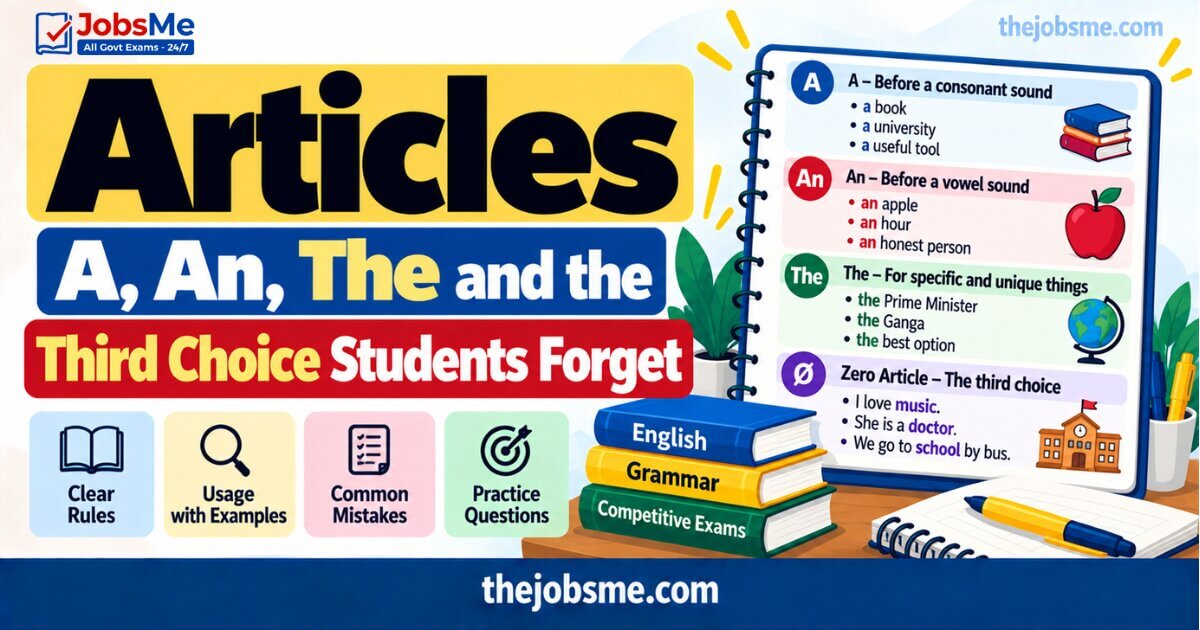
Articles: A, An, The and the Third Choice Students Forget
This article is a complete, exam-ready guide to articles for SSC, banking, insurance, railway, defence and State PSC exams. It rests on a point most guides bury: every article question has three possible answers, not two, because leaving the article out is often the correct choice. Omission carries the highest error-spotting yield in the whole topic, so the zero-article cases get a full catalogue here rather than a footnote. It also covers the sound rule and its four trap groups, the structural formulas that force the, the primary and secondary purpose rule for institutions, and the fixed expressions where an article is compulsory. Ten solved questions, common traps and a fifteen-question practice set with a full answer key are included.
Introduction
An article is one of three small words placed before a noun to show whether it is general or specific. A and an are indefinite, and the is definite.
Almost every guide then teaches the topic as a choice between those three words. That framing is where marks are lost.
Every article question has three possible answers, not two, because the correct choice is often no article at all. Exams test that third option harder than either of the others.
Look at the honesty is the best policy, we had a dinner at nine, he was promoted to the post of a Director, and what sort of a man is he. Every one contains an article that should not be there. None of them is a question about a against the, and a student who only ever asks that question will pass straight over all four.
So this guide gives the sound rule and the uses of the their due, and then treats omission as the main event rather than an appendix.
Where This Topic Is Asked
| Exam | How This Topic Appears | Rough Weight | Difficulty |
|---|---|---|---|
| SSC CGL and CHSL | Inserted or missing articles in error spotting, and direct fill-in-the-blank items. | Around 9 per cent of grammar marks, with 2 to 3 questions | Easy, and the same rules repeat every year. |
| IBPS PO and SBI PO | Error detection, and article blanks inside a cloze test. | 1 to 2 questions | Moderate. |
| RRB NTPC and Group D | Straightforward sound-rule items such as an hour and a university. | 1 question | Easy. |
| State PSC and police exams | Omission cases and the uses of the. | 1 to 2 questions | Easy to moderate. |
| Sentence improvement | A wrong or missing article is a standard planted fault. | Indirect | Easy once the rule is known. |
| Descriptive papers | Article errors are the commonest visible fault in Indian English writing. | Indirect | Worth a final check. |
Articles sit in the same weight band as prepositions and above modals and narration, which makes this one of the best returns per hour in the whole grammar block. The rules are few, they never change, and they repeat. Check your own pattern in the exam-wise syllabus hub.
The Decision Tree
Three questions in order settle nearly every case.
| Step | Question | If Yes | If No |
|---|---|---|---|
| 1 | Is the noun specific, already mentioned, unique or particularised? | Use the. | Go to step two. |
| 2 | Is the noun singular and countable? | Use a or an, decided by sound. | Go to step three. |
| 3 | Is it a plural, an uncountable, a proper noun or one of the omission cases? | Use no article at all. | Re-check step one. |
The classic first-mention pattern falls straight out of this. I bought a book. The book was expensive. The first mention is new so it takes a, and the second is now known so it takes the.
Formula Box
- Three choices, not two. A or an, the, or nothing.
- Sound decides a and an, never spelling.
- Noun plus of plus noun takes the. The music of India.
- Superlatives and ordinals take the.
- No article after type of, kind of, sort of, post of or title of.
- No article before meals, diseases, games, subjects or languages.
- No article after elect, appoint, make or crown for a unique post.
- Primary purpose takes no article; secondary purpose takes the.
A or An: Sound, Never Spelling
The choice depends entirely on the first spoken sound of the following word, and never on the first letter. One widely used note defines an as the article used before words beginning with a, e, i, o or u, and only then adds the sound rule. That order is backwards and produces exactly the errors the topic tests.
The Four Trap Groups
| Trap | Why It Catches People | Correct |
|---|---|---|
| Vowel letter, consonant sound | The word starts with u or e but is pronounced with a yoo sound. | a university, a European, a uniform, a unique idea, a useful book, a union |
| The wun sound | One begins with o but is pronounced with a w sound. | a one-rupee coin, a one-eyed man, a one-way street |
| Consonant letter, vowel sound | The h is silent, so the word opens on a vowel. | an hour, an honest man, an heir, an honour, an honorary post |
| Abbreviations read letter by letter | The letter name begins with a vowel sound even when the letter is a consonant. | an MLA, an FIR, an SP, an MP, an X-ray, an LLB, but a BA and a UNO report |
The last row needs one extra step. Ask whether the abbreviation is read letter by letter or as a word. MLA is read em-el-ay, so it takes an. NATO is read as a word beginning with a consonant sound, so it takes a.
Other Uses of A and An
- Before number collectives. A dozen, a hundred, a couple, a gallon.
- Meaning per. Twice a week, sixty kilometres an hour, ten rupees a kilo.
- In quantity phrases. A bit, a lot of, a great deal of, a little.
- Before a singular noun that stands for a whole class. A dog is a faithful animal.
- After such, what, quite and rather, when a singular countable noun follows. Such a beautiful girl. What a surprise. Quite a problem.
That last rule is worth memorising as a formula: such or what plus a or an plus adjective plus singular noun. Examiners delete the article to create the error.
The Definite Article: The Structural Formulas
The uses of the could fill a page, but exams keep returning to a small set of structures. These are the ones that actually earn marks.
| Structure | Rule | Example |
|---|---|---|
| Noun + of + noun | A prepositional phrase with of makes the noun definite. | He likes the music of India. The honesty of Rahim cannot be doubted. |
| The + comparative, twice | Parallel increase or decrease needs the in both halves. | The higher you go, the cooler it becomes. |
| The + comparative, of two | Choosing one out of exactly two. | She is the better of the two sisters. |
| The + superlative | The highest degree among three or more. | Mount Everest is the highest mountain. |
| The + ordinal | Before first, second, next, last. | Who was the first president of India? |
| The + singular noun for a class | A whole species named by one member. | The dog is a faithful animal. The cow gives milk. |
| The + adjective for a group | Names a class of people. | The poor need protection. The rich should pay more. |
| The + surname in the plural | A whole family. | I invited the Bakers for dinner. |
| The + musical instrument | When speaking of playing it. | She plays the veena. |
| Unique things | Only one exists. | The sun, the moon, the earth, the sky. |
Two cautions belong here. The class rule has a famous exception: man and woman in the general sense take no article, so it is man is mortal and not the man is mortal. And the superlative rule is not quite without exception, since a possessive replaces the article, giving my best friend rather than my the best friend, and most meaning simply very takes a, as in a most interesting book.
The With Names
| Takes the | Takes no article |
|---|---|
| Rivers: the Ganga, the Nile | Single mountains: Mount Everest |
| Seas and oceans: the Indian Ocean | Single lakes: Lake Chilika |
| Mountain ranges: the Himalayas, the Alps | Continents: Asia, Africa |
| Groups of islands: the Andamans | Cities and states: Chennai, Kerala |
| Plural or compound country names: the Netherlands, the Philippines, the United States | Most country names: India, Japan, New Zealand |
| Deserts: the Thar, the Sahara | Individual islands: Sri Lanka |
| Newspapers, ships and monuments: the Hindu, the Titanic, the Taj Mahal | Names of people: Ram, Rahim |
| Holy books: the Gita, the Quran | Languages and subjects: Tamil, physics |
One correction is needed on this table, because a widely used version explains the country rule as being about single-word names. That is not the distinction. New Zealand has two words and takes no article, while the Netherlands has one and takes the. The real rule is that plural names and names describing a union or federation take the.
Repetition and Omission of Articles
When two or more nouns are joined, whether to repeat the article decides how many people or things the sentence describes. This is a small rule with a large effect on meaning.
| Sentence | Articles | What It Means |
|---|---|---|
| The secretary and the treasurer have arrived. | Two | Two different people. |
| The secretary and treasurer has arrived. | One | One person holding both posts. |
| A black and a white dog were sitting outside. | Two | Two dogs, one of each colour. |
| A black and white dog was sitting outside. | One | One dog of two colours. |
Notice that the verb has to follow the article count, which is why this rule appears in subject-verb agreement questions as often as in article questions. Counting the articles tells you whether the subject is singular or plural.
The Zero Article: Where the Marks Are
This is the highest-yielding section of the topic. Adding an article where none belongs is a structural error, and it sounds entirely natural to an Indian ear, which is exactly why examiners use it.
| Category | Rule | Wrong | Right |
|---|---|---|---|
| Proper nouns | Names of people and most places take nothing. | The Ram is my friend. | Ram is my friend. |
| Material nouns in general | Gold, water, milk, iron. | The gold is a precious metal. | Gold is a precious metal. |
| Abstract nouns in general | Honesty, wisdom, love, poverty. | The honesty is the best policy. | Honesty is the best policy. |
| Plural nouns in general | A general statement about a whole class. | The birds fly in the sky. | Birds fly in the sky. |
| Uncountable nouns in general | Advice, information, furniture, luggage. | The information is power. | Information is power. |
| Meals | Breakfast, lunch, dinner, supper. | We had a dinner at nine. | We had dinner at nine. |
| Diseases | Cancer, malaria, diabetes, cholera. | The cancer is a dangerous disease. | Cancer is a dangerous disease. |
| Games and sports | Cricket, football, chess, hockey. | He plays the cricket every Sunday. | He plays cricket every Sunday. |
| Languages and subjects | Tamil, English, physics, history. | She teaches the English. | She teaches English. |
| Days, months and festivals | Monday, July, Diwali, Pongal. | We meet on the Monday. | We meet on Monday. |
| After type of, kind of, sort of | No article follows these phrases. | What sort of a man is he? | What sort of man is he? |
| After post of, title of, rank of | The designation takes nothing. | He was promoted to the post of a Director. | He was promoted to the post of Director. |
| Modes of transport with by | By bus, by train, by air, by post. | She came by the bus. | She came by bus. |
Diseases: The Exceptions
A short list of illnesses does keep the article, and these are worth learning because they contradict the rule just above. The flu, the measles, the mumps, the rickets, the plague and the itch all take the. Everything else in the category takes nothing.
Unique Appointments
When a noun names a post that only one person can hold at a time, and it follows elect, appoint, make, choose or crown, no article is used.
- Wrong: We elected him the chairman of the committee.
- Right: We elected him chairman of the committee.
- Wrong: The board decided to appoint him as a manager.
- Right: The board decided to appoint him manager.
- Right: He was crowned king of the region.
Key Highlights
- Three answers, not two. Omission is the highest-yielding case in the topic.
- Sound rules the indefinite article, so say the word before you choose.
- An of phrase turns a general noun specific and pulls in the.
- Four categories take nothing: meals, diseases, games and subjects.
- Learn the compulsory expressions in the same sitting, or the omission rules will be over-applied.
Primary Purpose Against Secondary Purpose
A group of institution words changes with the reason for going there, and this is one of the neater rules in English grammar.
The words: school, college, church, temple, hospital, prison, jail, court, bed, table, market, sea.
| Purpose | Article | Example | What It Means |
|---|---|---|---|
| Primary | None | He goes to school every day. | He goes there to study. |
| Secondary | The | He went to the school to meet the principal. | He went to the building, not to study. |
| Primary | None | The thief was sent to prison. | He was sent there as a prisoner. |
| Secondary | The | His family went to the prison to see him. | They visited the building. |
| Primary | None | She goes to bed at ten. | She goes there to sleep. |
| Secondary | The | She sat on the bed and opened the file. | The bed is furniture here. |
| Primary | None | He went to hospital after the accident. | He went there as a patient. |
| Secondary | The | My father went to the hospital to see a friend. | He was a visitor. |
The test is one question: is the person using the place for what it exists to do? If yes, drop the article. If they are simply visiting the building, keep it.
Fixed Expressions Where the Article Is Compulsory
Examiners work the omission rule in both directions. Some phrases must keep their article, and deleting it is the planted error.
- In a hurry, in a rage, in a dilemma, in a temper, in a nutshell.
- Make a noise, tell a lie, take a fancy to, have a headache, catch a cold.
- At a loss, at a stretch, at a distance, as a rule, as a whole.
- To a great extent, on an average, in a sense.
- Wrong: Don't make noise in the reading room. Right: Don't make a noise in the reading room.
- Wrong: He was in hurry to catch the train. Right: He was in a hurry to catch the train.
A Warning About Study Material on This Topic
- The sound rule stated by letter. One guide defines an as the article used before words beginning with a, e, i, o or u, adding the sound rule only afterwards. That order produces an university and a hour, which are exactly the errors the topic tests.
- A comparison example that makes no sense. Another offers The Sachin Tendulkar of cricket is famous to show the used with a proper noun. The real construction compares one person to another, as in he is the Sachin Tendulkar of Indian hockey. As written, the sentence says nothing.
- A geography rule based on word count. A table explains that single-word countries take no article. New Zealand is two words and takes none, while the Netherlands is one word and takes the. The rule concerns plural and federal names, not length.
- An answer that is not an article. A solved question asks which article fits the manager gave ___ advice that changed the branch's performance, and answers some. That is not one of the three articles, and by the particularisation rule the correct answer is the, since the relative clause makes the advice specific.
- An overstated claim. One source says the superlative rule has zero exceptions. A possessive replaces the article, so it is my best friend and never my the best friend.
So test every example against the rule it claims to demonstrate, and be wary of any source that presents the sound rule as a spelling rule.
Exam Alert
- Check every short segment in error spotting, since articles hide in three-word parts.
- Scan for sort of, kind of and post of, where an article is often inserted.
- Check both halves of any parallel comparison.
- Ask the purpose whenever school, hospital, prison, court or bed appears.
- Indian usage and exam usage differ most in exactly the places examiners choose to test.
Ten Solved Questions
1. Find the error. The honesty is (a) / the best policy (b) / in every walk of life. (c) / No error (d)
Working: An abstract noun used in a general sense takes no article. Answer: (a), which should read Honesty is. Note that the best policy is correct, since superlatives take the.
2. Find the error. He was promoted (a) / to the post of a Director (b) / last month. (c) / No error (d)
Working: No article follows post of. Answer: (b), which should read the post of Director.
3. Find the error. What sort of a man (a) / would behave like that (b) / in a public place? (c) / No error (d)
Working: Sort of, kind of and type of take no article after them. Answer: (a), which should read what sort of man.
4. Choose the correct sentence. (a) She is an university student. (b) She is a university student. (c) She is a hour late. (d) She is a honest woman.
Working: University opens on a yoo sound, so it takes a. Options (c) and (d) both have silent h and need an. Answer: (b).
5. Find the error. The higher you go, (a) / cooler it becomes (b) / on the mountain. (c) / No error (d)
Working: A parallel comparison needs the in both halves. Answer: (b), which should read the cooler it becomes.
6. Find the error. The injured man (a) / was rushed to the hospital (b) / within minutes. (c) / No error (d)
Working: He is going there as a patient, which is the primary purpose, so the article is dropped in exam usage. Answer: (b), which should read rushed to hospital.
7. Find the error. We elected him (a) / the chairman of the (b) / newly formed committee. (c) / No error (d)
Working: A unique post after elect takes no article. Answer: (b), which should read elected him chairman.
8. Find the error. Please do not make noise (a) / in the reading room (b) / during examination hours. (c) / No error (d)
Working: Make a noise is a fixed expression and keeps its article. Answer: (a).
9. Find the error. He likes music of India (a) / more than any other (b) / classical tradition. (c) / No error (d)
Working: A noun qualified by an of phrase becomes definite. Answer: (a), which should read the music of India.
10. Find the error. Cancer is a dangerous disease (a) / that claims many lives (b) / across the world every year. (c) / No error (d)
Working: Diseases take no article, and cancer correctly has none. A dangerous disease is a first mention of a countable noun, so a is right. Answer: (d), no error.
Quick Facts
- Consonant sound: a university, a European, a uniform, a one-rupee coin, a useful book.
- Vowel sound: an hour, an honest man, an heir, an MLA, an FIR, an X-ray.
- The is compulsory: noun + of + noun, parallel comparatives, superlatives, ordinals, unique things.
- No article: meals, diseases, games, subjects, languages, days, months.
- No article after: sort of, kind of, type of, post of, elect, appoint, crown.
- Article compulsory: in a hurry, at a loss, as a rule, make a noise, tell a lie.
Worked Examples: Wrong to Right
Example 1 (never considering omission)
Sentence: Faced with the honesty is the best policy, a student weighs a against the and decides the is fine.
Trap: The question has been read as a choice between two articles, which is how the topic is usually taught. The correct answer was to remove the article altogether, and that option never entered the student's mind.
Correct Answer: Honesty is the best policy.
Rule in Simple Words: Always ask whether no article is the answer.
Example 2 (spelling instead of sound)
Sentence: A student writes an university and a hour.
Trap: U is a vowel and h is a consonant, so the letters point clearly in one direction. Articles follow the spoken sound, and university begins with a yoo sound while hour begins with a vowel sound.
Correct Answer: A university and an hour.
Rule in Simple Words: Say the word aloud before choosing.
Example 3 (an article after sort of)
Sentence: A student writes What sort of a man is he?
Trap: Man is a singular countable noun, and singular countable nouns normally take an article. The phrase sort of blocks the article entirely, along with kind of, type of and post of.
Correct Answer: What sort of man is he?
Rule in Simple Words: Nothing follows sort of, kind of, type of or post of.
Example 4 (missing the particularising phrase)
Sentence: A student accepts He likes music of India.
Trap: Music is uncountable and abstract, and such nouns usually take no article, so the sentence obeys a rule the student knows well. The phrase of India particularises it, and a particularised noun takes the.
Correct Answer: He likes the music of India.
Rule in Simple Words: Noun plus of plus noun takes the.
Example 5 (half a parallel comparison)
Sentence: A student writes The higher you go, cooler it becomes.
Trap: The first the is present and the sentence reads smoothly aloud, so it feels complete. Parallel comparisons need the article in both halves, and dropping the second is a standard planted error.
Correct Answer: The higher you go, the cooler it becomes.
Rule in Simple Words: Two comparatives, two articles.
Example 6 (missing the purpose rule)
Sentence: A student accepts The injured man was rushed to the hospital.
Trap: The sentence is natural, widely written, and standard in American usage. Indian exams follow the British convention, where a person going somewhere for its primary purpose drops the article.
Correct Answer: The injured man was rushed to hospital.
Rule in Simple Words: Ask why the person went there.
Example 7 (deleting a compulsory article)
Sentence: Having learnt the omission rules, a student writes Do not make noise and he was in hurry.
Trap: The omission rules have just been learnt and are being applied enthusiastically to every noun in sight. A set of fixed expressions keeps its article, and removing it is itself the error.
Correct Answer: Do not make a noise. He was in a hurry.
Rule in Simple Words: Learn the compulsory phrases alongside the omission list.
Example 8 (an article before a unique post)
Sentence: A student writes They appointed him as a manager.
Trap: Every other use of manager would take an article, so the sentence looks perfectly ordinary. After elect, appoint, make or crown, a post held by one person at a time takes nothing.
Correct Answer: They appointed him manager.
Rule in Simple Words: One post, one holder, no article.
Common Traps Students Fall Into
These are the habits that most often cost marks. Each one is a common trap, not a silly mistake, and each has a one-line fix.
- Trap: Treating the question as a choice between two articles. Fix: No article is the third answer and often the right one.
- Trap: Deciding by spelling. Fix: Say the word aloud, since sound decides.
- Trap: Writing a MLA or an BA. Fix: Ask how the abbreviation is read aloud.
- Trap: Putting an article after sort of or post of. Fix: Those phrases block it entirely.
- Trap: Missing the of phrase that particularises a noun. Fix: Noun plus of plus noun takes the.
- Trap: Dropping the second the in a parallel comparison. Fix: Two comparatives need two articles.
- Trap: Ignoring the primary purpose rule. Fix: Ask why the person went to the place.
- Trap: Adding an article before a meal, disease, game or subject. Fix: All four categories take nothing.
- Trap: Deleting an article from a fixed expression. Fix: Make a noise and in a hurry keep theirs.
- Trap: Adding an article after elect or appoint. Fix: A unique post takes nothing.
- Trap: Applying the omission rules to every noun after learning them. Fix: Balance them against the compulsory list, exactly as in error spotting.
Memory Tricks and Formulas
1. Three doors, not two
Before choosing between a and the, ask whether the answer is neither. Omission carries the highest error yield in this topic, and a student who never considers it will miss every one of those questions.
2. Say it aloud
Sound decides, never spelling. A university, an hour, a one-rupee coin, an MLA. If you cannot say the word in the exam hall, mouth it silently and listen to the first sound.
3. Of makes it definite
Whenever a noun is followed by an of phrase, it becomes specific and takes the. So music alone takes nothing, but the music of India takes the article. This single formula appears every year.
4. The two comparatives
A parallel comparison needs the twice. The sooner, the better. The higher you go, the cooler it becomes. Examiners delete the second one, so check both halves.
5. Why did they go there?
For school, hospital, prison, court, church and bed, ask the purpose. Going to study, to be treated, to be punished or to sleep means no article. Visiting the building means the.
6. Four categories that take nothing
Meals, diseases, games and subjects. Breakfast, malaria, cricket, physics. The only exceptions are a short list of illnesses: the flu, the measles, the mumps, the plague and the rickets.
7. Learn the compulsory list too
In a hurry, in a rage, at a loss, as a rule, make a noise, tell a lie, take a fancy to. Studying omission alone produces over-correction, so learn both lists in the same sitting.
8. Budget the time honestly
At roughly 9 per cent of grammar marks and 2 to 3 questions an SSC paper, this is one of the best returns per hour in the syllabus. Two sessions cover it, because the rules are few and never change.
Exam Patterns and High-Yield Facts
Frequently Confused Pairs
| Pair | How They Differ | Mini Trick |
|---|---|---|
| A university vs An hour | Consonant sound against vowel sound. | Spelling is irrelevant. |
| An MLA vs A BA | Em against Bee. | Read the abbreviation aloud. |
| Honesty vs The honesty of Rahim | General against particularised. | An of phrase adds the. |
| Goes to school vs Went to the school | To study against to visit. | Ask the purpose. |
| Man is mortal vs The dog is faithful | Man and woman are the exception to the class rule. | Only those two drop it. |
| Cancer vs The flu | Most diseases take nothing; a short list keeps the. | Flu, measles, mumps, plague, rickets. |
| The Netherlands vs New Zealand | Plural or federal names against ordinary ones. | Not about word count. |
| The best student vs My best friend | A possessive replaces the article. | Never both together. |
| The better of the two vs The best of the three | Two against more than two. | Both keep the. |
| Make a noise vs Play cricket | Compulsory article against zero article. | Learn both lists together. |
Repeating Question Patterns
- An article inserted before an abstract or material noun, which is the commonest single fault.
- An article after sort of, kind of or post of.
- A missing the before a noun followed by an of phrase.
- The second the deleted from a parallel comparison.
- The sound rule broken, usually with university, hour, honest or an abbreviation.
- An article added before a meal, disease, game or subject.
Practice Set: Fifteen Questions
Correct each sentence, or mark it correct as it stands.
- He is an university student in his final year.
- We had a lunch at the new restaurant near the station.
- The wisdom of Solomon is famous throughout the world.
- What kind of a book are you looking for?
- She waited for an hour outside the examination hall.
- The malaria is still common in several districts.
- The more you practise, more confident you become.
- He was appointed as a principal of the new college.
- Please do not make noise during the lecture.
- Mount Everest is the highest mountain in the world.
- The prisoner was sent to the jail for five years.
- She plays veena every evening after work.
- He submitted an FIR at the local police station.
- Gold is a precious metal that never loses its value.
- The Netherlands is known for its canals and tulips.
Quick Facts
Answer key, with the rule named in each case.
- 1. a university. The word opens on a yoo sound.
- 2. had lunch. Meals take no article.
- 3. Correct as it stands. The of phrase particularises the abstract noun.
- 4. what kind of book. No article follows kind of.
- 5. Correct as it stands. The h in hour is silent.
- 6. Malaria is still common. Diseases take no article.
- 7. the more confident you become. A parallel comparison needs both articles.
- 8. appointed principal. A unique post after appoint takes nothing.
- 9. make a noise. This is a fixed expression that keeps its article.
- 10. Correct as it stands. A superlative takes the, and a single mountain takes none.
- 11. sent to jail. He goes there for the primary purpose.
- 12. plays the veena. A musical instrument takes the.
- 13. Correct as it stands. FIR is read ef-eye-ar, which opens on a vowel sound.
- 14. Correct as it stands. A material noun in a general sense takes nothing.
- 15. Correct as it stands. A plural country name takes the.
Six of those fifteen were already correct, and that balance matters here more than in most topics. A student who has just read a long omission list starts deleting articles from sentences that needed them. Practise the same restraint with the free English MCQ quizzes and full papers from the mock test archive.
Quick Revision
Quick Revision
- There are three answers, not two. A or an, the, or no article at all, and omission carries the highest error yield.
- The decision tree. Specific or already mentioned takes the; singular countable and new takes a or an; everything else takes nothing.
- Sound decides between a and an, never spelling.
- A university, a European, a uniform, a one-rupee coin, because all four open on consonant sounds.
- An hour, an honest man, an heir, an honour, because the h is silent.
- An MLA, an FIR, an SP, an X-ray, but a BA and a NATO officer, so read the abbreviation aloud first.
- Such, what, quite and rather take a or an before a singular countable noun, as in such a beautiful girl.
- A noun followed by an of phrase becomes definite, so the music of India and the honesty of Rahim.
- A parallel comparison needs the twice, as in the higher you go, the cooler it becomes.
- The comparative of two takes the, so she is the better of the two sisters.
- Superlatives and ordinals take the, though a possessive replaces it, giving my best friend.
- A singular noun standing for a whole class takes the, except man and woman, so the dog is faithful but man is mortal.
- The plus an adjective names a group, as in the poor and the rich.
- Rivers, seas, ranges, deserts, holy books, newspapers and plural country names take the.
- Single mountains, lakes, continents, cities and most countries take nothing.
- Proper, material and abstract nouns in a general sense take no article.
- Plural and uncountable nouns in a general sense take no article.
- Meals, diseases, games and subjects take no article, with the flu, the measles, the mumps, the plague and the rickets as the exceptions.
- No article follows type of, kind of, sort of, post of, title of or rank of.
- No article follows elect, appoint, make or crown when the post can be held by one person at a time.
- Primary purpose drops the article and secondary purpose keeps it, so he goes to school but he went to the school to meet the principal.
- Modes of transport with by take nothing, so by bus and by train.
- Some fixed expressions keep the article, including in a hurry, in a rage, at a loss, as a rule, make a noise and tell a lie.
- Learn the omission list and the compulsory list together, since studying only one produces over-correction.
Articles are the smallest words in English and among the most reliably tested, because Indian usage differs from exam usage in exactly the places examiners choose. The rules are few and they never change, which makes this two sessions of work for about nine per cent of the grammar marks. So ask the omission question first, decide a and an by ear rather than by eye, watch for the of phrase that turns a general noun specific, and learn the compulsory expressions alongside the zero-article list. The topic feeds straight into error spotting, sentence improvement and fill in the blanks, and it connects to adjectives and determiners, since articles are the central determiners, and to degrees of comparison for the superlative rules. The wider set is in the topic-wise English notes.
Frequently Asked Questions
How many articles are there in English?
Why do exams test omission so heavily?
What is the rule for a and an?
Why is it an MLA but a BA?
When does an abstract noun take the?
What is the primary purpose rule?
Which nouns never take an article?
Are there diseases that do take the?
Why is we elected him chairman correct without an article?
Do superlatives always take the?

About the author





