
Transformation of Sentences: Templates That Keep the Meaning
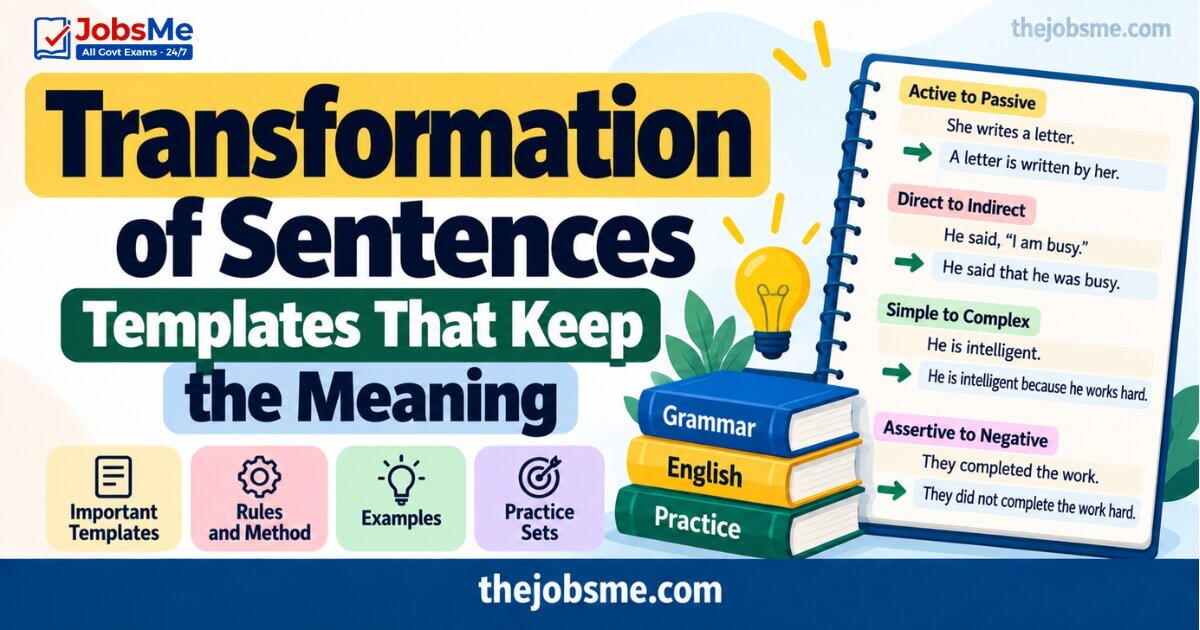
This article is a complete, exam-ready guide to the transformation of sentences for SSC, banking, railway, defence, State PSC and teaching exams. It is built around the one rule the topic actually rests on: the meaning must survive the change exactly. It gives ready templates for each transformation type, including the three degrees of comparison, affirmative and negative pairs, assertive and interrogative conversions, exclamatory forms and the simple, complex and compound ladder. It also explains where the marks really are, since transformation is rarely a named topic but shows up inside voice, narration, error spotting and sentence improvement questions. Ten solved questions, common traps and a fifteen-question practice set with a full answer key are included.
Introduction
Transformation of sentences means rewriting a sentence in a different grammatical form while saying exactly the same thing. No other metal is as heavy as lead and Lead is the heaviest of all metals are different sentences carrying identical information.
The whole topic rests on one rule, and everything else is detail. The meaning must survive the change exactly. If the new sentence says even slightly more or less than the original, the transformation has failed, however correct its grammar.
That sounds simple and it is where most errors occur. Later in this article you will see well-known study material that breaks this rule while teaching the topic, converting she speaks French fluently into she does not speak French fluently and calling it a transformation. That is not a transformation. It is a contradiction.
Where the Marks Actually Are
It is worth being straight about this, because it decides how much time the topic deserves.
No SSC or bank paper asks a question labelled transformation of sentences. What they ask are its individual branches, and two of those branches carry real weight.
| Branch | How It Appears | Rough Weight | Priority |
|---|---|---|---|
| Active and passive voice | Direct conversion questions in SSC Tier 1 and Tier 2. | 2 to 3 questions in SSC Tier 1, around 10 per cent of grammar marks | High. Learn it thoroughly. |
| Direct and indirect speech | Narration conversion questions, and faults inside error spotting. | Around 5 per cent of grammar marks | High. |
| Degrees of comparison | Occasional direct questions, and frequently the hidden error in an error spotting item. | 1 question or none | Moderate, and quick to learn. |
| Simple, complex and compound | Rarely asked directly, but underlies sentence rearrangement and para jumbles. | Indirect | Moderate. |
| Assertive, interrogative and exclamatory | Common in teaching exams, state police papers and school-level tests. | Varies by exam | Low for SSC and banking, high for teaching exams. |
| All types together | Descriptive papers, where rephrasing the same idea in different structures is what good writing looks like. | Indirect | Useful. |
So the honest advice is this. If you are preparing for SSC or banking, put your hours into voice and narration and treat the rest as a fast revision. If you are preparing for a teaching or state-level paper, the whole topic is directly examinable. Check your own pattern in the exam-wise syllabus hub.
The Three Tests of a Valid Transformation
Before accepting any answer, run these three checks.
- Does it say the same thing? Not something similar, not something reasonable, but the same. Adding a fact the original did not contain is the commonest failure.
- Is the tense preserved? A transformation changes structure, not time. If the original was in the past, the new sentence stays in the past.
- Is the new sentence itself grammatically correct? Agreement, articles and prepositions must all still work in the rebuilt structure.
Formula Box
- The cardinal rule. The meaning must survive exactly, or the transformation has failed.
- Degrees. No other X is as tall as Y equals Y is taller than any other X equals Y is the tallest X.
- Affirmative to negative. Use an antonym plus a negative word, never a bare not.
- Only becomes none but. Always becomes never plus the opposite. Must becomes cannot but.
- Rhetorical questions. Who does not? means everyone does. Is there any? means there is none.
- Exclamatory. What a clever boy he is! becomes He is a very clever boy.
- Structure ladder. A participle phrase, a subordinate clause and a coordinate clause can express one idea three ways.
Degrees of Comparison
This is the most template-driven part of the topic, which makes it the fastest to learn. Every comparison can be written three ways, and the three forms map onto each other exactly.
| Degree | Template | Example |
|---|---|---|
| Positive | No other A is as ADJ as B. | No other metal is as heavy as lead. |
| Comparative | B is ADJ-er than any other A. | Lead is heavier than any other metal. |
| Superlative | B is the ADJ-est of all A. | Lead is the heaviest of all metals. |
Two smaller patterns complete the set, and both appear in exams.
| Meaning | Positive | Comparative | Superlative |
|---|---|---|---|
| B beats everyone | No other city is as large as Delhi. | Delhi is larger than any other city. | Delhi is the largest city. |
| B is among the best | Very few girls in the school are as clever as Binsha. | Binsha is cleverer than most other girls in the school. | Binsha is one of the cleverest girls in the school. |
| Two things compared | B is not as tall as A. | A is taller than B. | Not used, since a superlative needs three or more. |
| Equality | B is as good as A. | A is not better than B. | Not applicable. |
Watch the difference between any other and one of the. The first claims the top position outright, while the second claims only a place near the top. Confusing them is the commonest error in this branch, because Binsha is cleverer than any other girl says considerably more than the original did.
Two further points on wording. Use any other rather than any when comparing something with members of its own group, since Delhi is larger than any city illogically includes Delhi itself. And keep the noun plural after of all but singular after any other.
Affirmative and Negative
Here is where circulating study material goes most badly wrong, so the principle matters more than the list. You cannot make a sentence negative by adding not, because that reverses the meaning instead of preserving it. You use an antonym together with a negative word, so that two reversals cancel out.
- He is a good boy becomes He is not a bad boy, and not He is not a good boy.
- She always comes on time becomes She never comes late, and not She does not come on time.
| Affirmative Pattern | Negative Equivalent | Example |
|---|---|---|
| Only | None but | Only a brave man can do this. None but a brave man can do this. |
| Only, with a thing | Nothing but | He eats only fruit. He eats nothing but fruit. |
| Always | Never plus the antonym | He is always punctual. He is never late. |
| Must | Cannot but | We must obey the law. We cannot but obey the law. |
| As soon as | No sooner than | As soon as the bell rang, the students left. No sooner had the bell rung than the students left. |
| Everyone | There is none who does not | Everyone loves his country. There is none who does not love his country. |
| Both and | Not only but also | She is both clever and hardworking. She is not only clever but also hardworking. |
| As as | Not less than | He is as tall as his brother. He is not less tall than his brother. |
| Too to | So that not | She was too tired to walk. She was so tired that she could not walk. |
| If | Unless | If you work hard, you will succeed. Unless you work hard, you will not succeed. |
The unless row deserves a warning. Unless already means if not, so it never takes another not in its own clause. And take care with conditionals generally, since a sentence like If it rains, we will stay at home says nothing at all about what happens if it does not rain. Converting it to If it does not rain, we will not stay at home invents a claim the original never made, which fails the cardinal rule.
Key Highlights
- One rule governs the topic. The meaning must survive the change exactly.
- Most wrong answers are fluent sentences that quietly say something new.
- Each type has a fixed template pair, so drilling templates beats reasoning from scratch.
- Voice and narration carry the marks, and the rest is worth about an hour.
- Test every answer against the original meaning, including answers printed in study material.
Assertive and Interrogative
Two different conversions hide under this heading, and mixing them up costs marks.
The Ordinary Question
Move the auxiliary in front of the subject and add a question mark. If there is no auxiliary, supply do, does or did. He will help you becomes Will he help you? and He likes football becomes Does he like football?
The Rhetorical Question
This is the one exams actually test. A rhetorical question is a statement wearing a question mark, and the transformation flips the polarity.
| Interrogative | Assertive | The Logic |
|---|---|---|
| Who does not love his country? | Everyone loves his country. | A negative question asserts the positive. |
| Who can solve this problem? | Nobody can solve this problem. | A positive question asserts the negative. |
| Is there any use in complaining? | There is no use in complaining. | Is there any means there is none. |
| Why waste time on this? | It is useless to waste time on this. | Why plus a bare verb expresses futility. |
| Shall I ever forget those days? | I shall never forget those days. | A positive question asserts the negative. |
The rule reverses in both directions: a question phrased negatively becomes a positive statement, and a question phrased positively becomes a negative one. Read the question aloud and ask what the speaker actually believes, which is always the opposite of the surface form.
Exclamatory and Assertive
| Exclamatory | Assertive | Pattern |
|---|---|---|
| What a clever boy he is! | He is a very clever boy. | What a plus a noun becomes a very plus the noun. |
| How fast he runs! | He runs very fast. | How plus an adverb becomes very plus the adverb. |
| What a beautiful view this is! | This is a very beautiful view. | The same noun pattern. |
| Alas! We have lost him. | It is very sad that we have lost him. | An interjection becomes a clause naming the emotion. |
| Hurrah! We have won. | It is a matter of great joy that we have won. | The same interjection pattern. |
| If only I were rich! | I wish I were rich. | An optative sentence becomes a wish. |
Note the word order carefully. The exclamatory form puts the subject and verb at the end, so What a clever boy he is keeps he is last, while the assertive form restores the normal order.
Imperative Transformations
- Imperative to assertive. Please close the door becomes You are requested to close the door.
- Command to assertive. Do your duty becomes You should do your duty.
- Imperative to passive. Shut the window becomes Let the window be shut.
- Negative imperative. Do not waste time becomes You are advised not to waste time.
Simple, Complex and Compound: The Clause Ladder
This branch confuses students more than any other, and the cause is usually that the three sentence types were never clearly defined. Fix that first and the conversions become mechanical.
| Type | Definition | What It Contains | Example |
|---|---|---|---|
| Simple | One independent clause and no dependent clause. | One finite verb, with any extra ideas carried by phrases. | Being ill, he could not attend the meeting. |
| Complex | One independent clause plus at least one dependent clause. | A subordinating conjunction such as because, although, if, when, that or which. | Because he was ill, he could not attend the meeting. |
| Compound | Two or more independent clauses. | A coordinating conjunction from FANBOYS: for, and, nor, but, or, yet, so. | He was ill, so he could not attend the meeting. |
Every conversion is therefore the same operation. To go up the ladder you expand a phrase into a clause, and to go down you compress a clause into a phrase.
The Conversion Table
| Idea | Simple | Complex | Compound |
|---|---|---|---|
| Cause | Being ill, he stayed at home. | Because he was ill, he stayed at home. | He was ill, so he stayed at home. |
| Time order | Having finished his work, he went home. | After he had finished his work, he went home. | He finished his work and then went home. |
| Purpose | He left early to catch the train. | He left early so that he might catch the train. | He wanted to catch the train, so he left early. |
| Contrast | In spite of his illness, he went to work. | Although he was ill, he went to work. | He was ill, but he went to work. |
| Condition | Without hard work, you cannot succeed. | If you do not work hard, you cannot succeed. | Work hard, or you will not succeed. |
| Description | I saw a wounded bird. | I saw a bird which was wounded. | I saw a bird and it was wounded. |
| Reported fact | He confessed his guilt. | He confessed that he was guilty. | He was guilty and he admitted it. |
Two further pairs are worth memorising because they appear constantly.
- Too to becomes so that not. She was too tired to walk becomes She was so tired that she could not walk.
- As soon as becomes no sooner than. As soon as the bell rang, the students ran out becomes No sooner had the bell rung than the students ran out. Note the inversion and the past perfect, which are compulsory.
Exam Alert
- Never add a fact. To win the game, they practised daily does not become They practised daily and they won, because the original never said they won.
- Never invent a cause. She is smart and hardworking does not become She is smart because she is hardworking.
- Never simply add not. That contradicts the sentence rather than transforming it.
- Keep the tense. Structure changes, time does not.
- Any of these three failures makes the answer wrong even when the resulting sentence is perfect English.
Voice and Narration
These two branches carry most of the exam marks in this topic, and each is large enough to deserve separate study.
- Voice. The object becomes the subject, the main verb takes its third form, and a form of be is added in the same tense. The teacher praised the student becomes The student was praised by the teacher. The tense never changes, which is the check that catches most errors. The full treatment is in active and passive voice.
- Narration. The reporting verb governs everything after it. Pronouns shift to the reporter's point of view, tenses move back one step, and words of time and place change. She said, "I am reading a novel" becomes She said that she was reading a novel. Universal truths are the exception and keep their tense. The full treatment is in direct and indirect speech.
Ten Solved Questions
1. Change to comparative. Iron is the most useful of all metals.
Working: The superlative template becomes the comparative template with any other. Answer: Iron is more useful than any other metal. Note the singular metal after any other.
2. Change to positive. Delhi is larger than any other city.
Working: The comparative becomes no other A is as ADJ as B. Answer: No other city is as large as Delhi. Note that the adjective returns to its plain form in the positive degree.
3. Change to negative. Only a brave man can do this.
Working: Only with a person becomes none but. Answer: None but a brave man can do this. With a thing rather than a person, the equivalent is nothing but.
4. Change to assertive. Who does not love his country?
Working: A negatively phrased rhetorical question asserts the positive. Answer: Everyone loves his country.
5. Change to negative. He is always punctual.
Working: Use never with the antonym so the two reversals cancel. Answer: He is never late. Writing He is not always punctual would change the meaning entirely.
6. Change to complex. She was too tired to walk.
Working: The too to pattern becomes so that not. Answer: She was so tired that she could not walk.
7. Change to compound. Because she was late, she missed the bus.
Working: Turn the dependent clause into an independent one and join with a coordinating conjunction. Answer: She was late, so she missed the bus.
8. Change to simple. He finished his work and went home.
Working: Compress the first clause into a participle phrase. Answer: Having finished his work, he went home. The past participle form shows that one action preceded the other.
9. Change to assertive. What a beautiful garden it is!
Working: What a plus a noun becomes a very plus the noun, with normal word order restored. Answer: It is a very beautiful garden.
10. Change to negative using no sooner. As soon as the bell rang, the students ran out.
Working: No sooner demands inversion of the auxiliary, the past perfect in the first clause, and than rather than when. Answer: No sooner had the bell rung than the students ran out.
Quick Facts
- Only becomes none but for people and nothing but for things.
- Always punctual becomes never late, using antonym plus negative.
- Too tired to walk becomes so tired that she could not walk.
- As soon as becomes no sooner had ... than.
- What a clever boy he is becomes he is a very clever boy.
- Any other for the top spot; very few for one of the best.
Worked Examples: Wrong to Right
Example 1 (adding a fact)
Sentence: For To win the game, they practised every day, a student writes They practised every day, and they won the game.
Trap: The new sentence is fluent, and a story that ends in victory feels like the natural completion. The original states a purpose and never says whether it was achieved, so the transformation has invented a fact.
Correct Answer: They wanted to win the game, so they practised every day.
Rule in Simple Words: A purpose is not a result.
Example 2 (adding not)
Sentence: For She speaks French fluently, a student writes She does not speak French fluently.
Trap: The instruction says change to negative, and adding not is the obvious way to do that. Adding not contradicts the sentence, and the aim is to change its form while keeping its meaning.
Correct Answer: She does not speak French haltingly, or better, rewrite as Her French is not poor.
Rule in Simple Words: Negative transformation needs an antonym and a negative together.
Example 3 (any against any other)
Sentence: A student writes Delhi is larger than any city.
Trap: Dropping other feels like a small tidying of the phrase. Without other, the sentence includes Delhi in the comparison and claims Delhi is larger than itself.
Correct Answer: Delhi is larger than any other city.
Rule in Simple Words: Comparing a thing with its own group needs any other.
Example 4 (top position against near the top)
Sentence: For Binsha is one of the cleverest girls in the school, a student writes Binsha is cleverer than any other girl.
Trap: Both sentences praise Binsha, so they feel interchangeable. One of the cleverest places her near the top, while cleverer than any other puts her at the top alone.
Correct Answer: Very few girls in the school are as clever as Binsha.
Rule in Simple Words: One of the pairs with very few, not with any other.
Example 5 (inventing a cause)
Sentence: For She is smart, and she is hardworking, a student writes She is smart because she is hardworking.
Trap: The instruction says make it complex, and because is the handiest subordinating conjunction. The original lists two qualities side by side and never claims one causes the other.
Correct Answer: She is not only smart but also hardworking, or as a complex sentence, She is a girl who is both smart and hardworking.
Rule in Simple Words: And does not mean because.
Example 6 (breaking the no sooner structure)
Sentence: A student writes No sooner the bell rang when the students ran out.
Trap: The words look correct in isolation, and the ordinary word order feels safer than inversion. No sooner demands three things at once: the auxiliary before the subject, the past perfect, and than.
Correct Answer: No sooner had the bell rung than the students ran out.
Rule in Simple Words: No sooner takes inversion, the past perfect and than.
Example 7 (changing the tense)
Sentence: For The chef cooked the meal, a student writes The meal is cooked by the chef.
Trap: The passive structure is correctly built, so the sentence passes a grammar check. Voice change never touches the tense, and the original was in the simple past.
Correct Answer: The meal was cooked by the chef.
Rule in Simple Words: Structure changes, time does not.
Example 8 (denying the condition)
Sentence: For If it rains, we will stay at home, a student writes If it does not rain, we will not stay at home.
Trap: Both halves have been made negative, which looks like a consistent and thorough conversion. The original says nothing about what happens without rain, so the new sentence makes a claim that was never there.
Correct Answer: Unless it rains, we will not stay at home reverses it correctly, though the safest answer is to keep the conditional and rephrase the structure instead.
Rule in Simple Words: Negating both halves of a condition changes what the sentence claims.
Common Traps Students Fall Into
These are the habits that most often cost marks. Each one is a common trap, not a silly mistake, and each has a one-line fix.
- Trap: Adding information the original did not contain. Fix: A purpose is not a result, and a list is not a cause.
- Trap: Making a sentence negative by adding not. Fix: Use an antonym plus a negative word so the two reversals cancel.
- Trap: Writing any instead of any other. Fix: A thing cannot be larger than itself.
- Trap: Treating one of the best as equal to better than any other. Fix: Near the top is not the same as at the top.
- Trap: Changing the tense during a voice change. Fix: Voice moves the focus, never the time.
- Trap: Using no sooner with when. Fix: No sooner takes than, while hardly and scarcely take when.
- Trap: Forgetting inversion after no sooner. Fix: The auxiliary must come before the subject.
- Trap: Adding not after unless. Fix: Unless already contains the negative.
- Trap: Keeping exclamatory word order in an assertive sentence. Fix: Restore the normal subject and verb order, checking the punctuation as in punctuation rules.
- Trap: Reversing a rhetorical question the wrong way. Fix: A negative question asserts the positive, and a positive question asserts the negative.
- Trap: Trusting every answer key you find online. Fix: Test each answer against the original meaning, as you would in sentence improvement.
Memory Tricks and Formulas
1. The meaning test
Read the original and the transformation one after the other and ask whether a reader would learn anything different from the second. If the second sentence tells you even one extra fact, the transformation has failed. This single test catches most wrong answers, including a good many printed in study material.
2. The degree triangle
Three templates, learnt once. No other A is as ADJ as B, B is ADJ-er than any other A, B is the ADJ-est of all A. Write them out three times and this branch is finished.
3. Two negatives make a positive
To turn an affirmative sentence negative without changing the meaning, reverse the word and reverse the sentence. Good becomes not bad, always punctual becomes never late. A single reversal contradicts, while a double reversal preserves.
4. Ask what the speaker believes
For any rhetorical question, ignore the question mark and ask what the speaker actually thinks. Who does not love his country? is spoken by someone who believes everyone does, so that belief is the assertive form.
5. Expand or compress
Going from simple to complex or compound means expanding a phrase into a clause with its own verb. Going the other way means compressing a clause into a phrase. That is the entire structure branch in one sentence.
6. FANBOYS for compound, subordinators for complex
A compound sentence needs one of for, and, nor, but, or, yet, so. A complex sentence needs a subordinator such as because, although, if, when, that or which. Choosing the wrong family is what produces the wrong sentence type.
7. The three compulsory parts of no sooner
Inversion, past perfect, and than. Miss any one and the sentence is wrong. The same inversion applies to hardly and scarcely, which take when instead.
8. Where to spend your time
With 2 to 3 questions on voice in an SSC Tier 1 paper and around 5 per cent of grammar marks on narration, those two branches deserve most of your hours. The rest of this topic is worth about one hour of template drilling in total.
Exam Patterns and High-Yield Facts
Frequently Confused Pairs
| Pair | How They Differ | Mini Trick |
|---|---|---|
| Any vs Any other | Comparing within a group needs any other. | Delhi cannot beat itself. |
| One of the best vs Better than any other | Near the top against at the top. | One of the pairs with very few. |
| No sooner vs Hardly | No sooner takes than; hardly takes when. | Sooner than, hardly when. |
| Complex vs Compound | Complex has a dependent clause; compound has two independent ones. | Subordinator against FANBOYS. |
| Simple vs Complex | Simple has one finite verb; complex has two clauses. | Count the finite verbs. |
| Too to vs Very | Too carries a negative result; very does not. | Too tired to walk means she did not walk. |
| Unless vs If not | They mean the same, so never combine them. | Unless already holds the not. |
| Only with a person vs a thing | None but for people, nothing but for things. | People take none. |
| What a vs How | What a introduces a noun; how introduces an adjective or adverb. | What a boy, how fast. |
| Transformation vs Correction | Transformation rewrites a correct sentence; correction repairs a faulty one. | Nothing is wrong with the original here. |
Repeating Question Patterns
- Superlative to comparative, testing whether you write any other and keep the noun singular.
- Affirmative to negative with only, where none but is the expected answer.
- Rhetorical question to assertive, testing whether you flip the polarity correctly.
- Too to converted into so that, which appears in both school and competitive papers.
- As soon as converted into no sooner, testing inversion and the past perfect together.
- Simple to complex, where a participle phrase must become a clause with a subordinating conjunction.
Practice Set: Fifteen Questions
Transform each sentence as instructed, keeping the meaning unchanged.
- Change to positive: Lead is heavier than any other metal.
- Change to superlative: No other student in the class is as diligent as Meera.
- Change to negative: Only members are allowed inside the hall.
- Change to affirmative: There is none who does not admire courage.
- Change to assertive: Who can bear such an insult?
- Change to assertive: How beautifully she sings!
- Change to exclamatory: It is a very difficult question.
- Change to complex: He was too weak to lift the box.
- Change to compound: Although he was warned, he ignored the advice.
- Change to simple: Because she was ill, she did not attend the interview.
- Change to complex: I saw a broken window on the first floor.
- Change to negative using no sooner: As soon as the results appeared, the phone began ringing.
- Change to negative: He is always honest in his dealings.
- Change to comparative: Very few rivers in India are as long as the Ganga.
- Change to assertive: Please submit the form before Friday.
Quick Facts
Answer key, with the template named in each case.
- 1. No other metal is as heavy as lead. The comparative template becomes the positive one.
- 2. Meera is the most diligent student in the class. The positive template becomes the superlative one.
- 3. None but members are allowed inside the hall. Only with people becomes none but.
- 4. Everyone admires courage. The double negative resolves into a plain affirmative.
- 5. Nobody can bear such an insult. A positive rhetorical question asserts the negative.
- 6. She sings very beautifully. How plus an adverb becomes very plus the adverb.
- 7. What a difficult question it is! A very plus a noun becomes what a, with the subject and verb moved to the end.
- 8. He was so weak that he could not lift the box. Too to becomes so that not.
- 9. He was warned, but he ignored the advice. The subordinator gives way to a FANBOYS conjunction.
- 10. Being ill, she did not attend the interview. The clause compresses into a participle phrase.
- 11. I saw a window which was broken on the first floor. The adjective expands into a relative clause.
- 12. No sooner had the results appeared than the phone began ringing. Inversion, past perfect and than, all three.
- 13. He is never dishonest in his dealings. The antonym plus never preserves the meaning.
- 14. The Ganga is longer than most other rivers in India. Very few as as pairs with than most other, not with than any other.
- 15. You are requested to submit the form before Friday. An imperative becomes an assertive sentence.
Item 14 is the one most students get wrong, because the pull towards than any other is strong. The original only says that few rivers match the Ganga, which is not the same as saying none does. Practise the same care with the free English MCQ quizzes and full papers from the mock test archive.
Quick Revision
Quick Revision
- What the topic is. Rewriting a sentence in a different grammatical form while saying exactly the same thing.
- The one rule that governs everything. The meaning must survive the change exactly, so a transformation that adds or removes a fact has failed however good its grammar.
- Where the marks are. No paper asks a question labelled transformation, but voice carries two to three questions in SSC Tier 1 and narration around five per cent of grammar marks.
- The three validity checks. Same meaning, same tense, and a grammatically correct new sentence.
- The degree triangle. No other A is as adjective as B, B is adjective-er than any other A, and B is the adjective-est of all A.
- Always write any other, never any, when comparing something with members of its own group.
- Keep the noun singular after any other and plural after of all.
- One of the cleverest pairs with very few are as clever as, and never with cleverer than any other, because near the top is not the same as at the top.
- Negative transformation needs two reversals. Use an antonym together with a negative word so that the reversals cancel out.
- Only becomes none but for people and nothing but for things.
- Always becomes never plus the antonym, so always punctual becomes never late.
- Must becomes cannot but, and everyone becomes there is none who does not.
- Both and becomes not only but also.
- Too to becomes so that not, so too tired to walk becomes so tired that she could not walk.
- As soon as becomes no sooner than, which needs inversion of the auxiliary, the past perfect, and than rather than when.
- Unless already means if not, so it never takes another not in its own clause.
- A negatively phrased rhetorical question asserts the positive, so who does not love his country means everyone loves his country.
- A positively phrased rhetorical question asserts the negative, so who can solve this problem means nobody can.
- What a plus a noun becomes a very plus the noun, and how plus an adverb becomes very plus the adverb.
- Exclamatory sentences put the subject and verb at the end, so restore normal word order when converting to assertive.
- An imperative becomes assertive with a phrase such as you are requested to or you should.
- A simple sentence has one independent clause, a complex sentence adds a dependent clause, and a compound sentence has two independent clauses.
- Compound sentences use FANBOYS, which are for, and, nor, but, or, yet and so.
- Complex sentences use subordinators such as because, although, if, when, that and which.
- Going up the ladder means expanding a phrase into a clause, and going down means compressing a clause into a phrase.
- Voice change never alters the tense, which is the quickest check on a passive answer.
- Narration shifts pronouns, tenses and words of time and place, except for universal truths, which keep their tense.
- Do not trust every answer key you find. Test each one against the original meaning, since published material for this topic frequently breaks its own cardinal rule.
Transformation of sentences is a topic where the grammar is easy and the discipline is hard, because almost every wrong answer is a fluent sentence that quietly says something new. So learn the templates until they are automatic, then check every answer against the original meaning before accepting it. Put your real preparation hours into active and passive voice and direct and indirect speech, since those two branches carry the marks. The clause work here also feeds directly into para jumbles and error spotting, and the structural variety pays off in essay writing. The wider set is in the topic-wise English notes.
Frequently Asked Questions
What is the transformation of sentences?
What is the most important rule in this topic?
Is transformation of sentences asked in SSC and bank exams?
How do I change an affirmative sentence into a negative one?
What is the difference between any and any other in comparisons?
How do I convert one of the cleverest girls into the positive degree?
What are the rules for no sooner?
How is a rhetorical question converted into a statement?
What is the difference between a complex and a compound sentence?
Why do published answer keys sometimes look wrong?

About the author





