
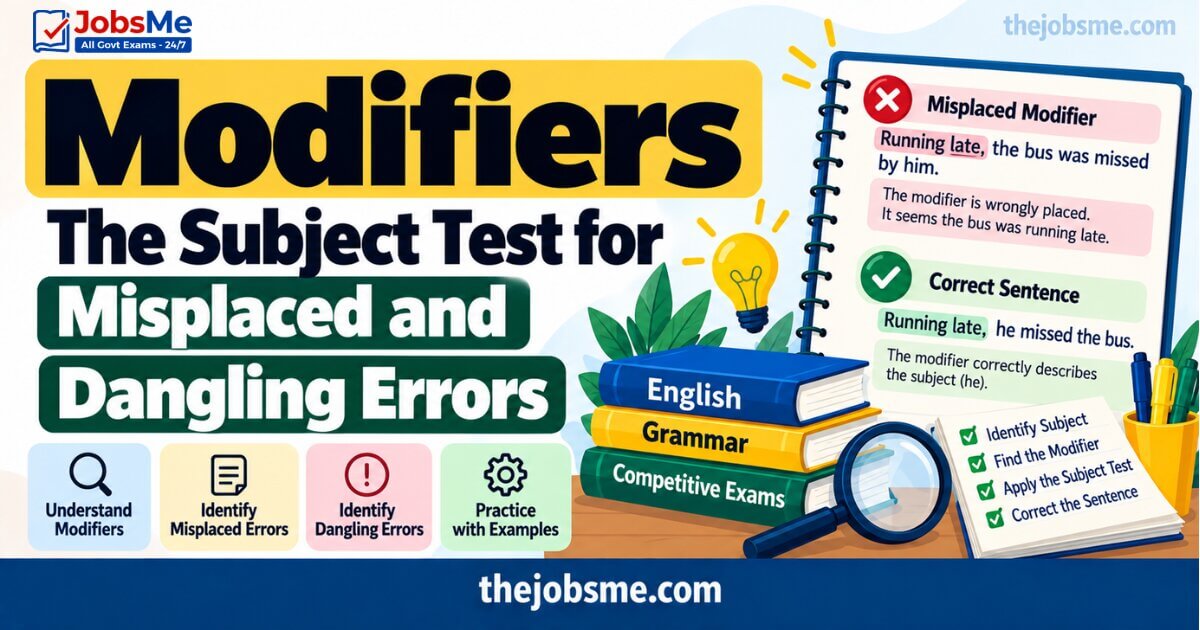
Modifiers: The Subject Test for Misplaced and Dangling Errors
This article is a complete, exam-ready guide to modifiers for SSC, banking, insurance, railway, defence and State PSC exams. It is built around a single question that resolves almost every modifier error: who or what is actually performing the action described in the modifier. It then shows why diagnosing the error correctly matters, since a misplaced modifier is repaired by moving it while a dangling modifier is repaired by supplying the missing subject. It also covers limiting modifiers such as only and just, squinting modifiers, the four traps examiners reuse, and the idiomatic constructions that look dangling but are perfectly correct. Ten solved questions, common traps and a fifteen-question practice set with a full answer key are included.
Introduction
A modifier is any word, phrase or clause that adds information about another part of the sentence. In he bought a new electric car, the words new and electric are modifiers. So is who lives next door in the boy who lives next door is my classmate.
Defining them is the easy part, and it is not what exams test. The whole examinable topic is placement, because a modifier attaches itself to whatever it happens to be sitting next to, whether or not that was what you meant.
Consider Walking in the park, a snake bit him. Every word is spelt correctly and the grammar of each clause is sound. The sentence nonetheless says that the snake was taking a walk.
And here is the useful part. Almost every modifier error in an exam paper is resolved by asking one question: who or what is actually doing the action described in the modifier? That question is the whole method, and the rest of this article is about applying it.
Where This Topic Is Asked
| Exam | How This Topic Appears | Rough Weight | Difficulty |
|---|---|---|---|
| SSC CGL and CHSL | Inside sentence improvement and error spotting, where the faulty sentence reads perfectly smoothly. | Around 10 per cent of sentence correction questions | Moderate. The fault is invisible if you read for meaning. |
| Bank PO and clerk | Error detection and phrase replacement items built on introductory phrases. | 1 to 2 questions | Moderate. |
| All exams | Limiting modifiers such as only placed in the wrong position to change the meaning. | Indirect but frequent | Easy once the pattern is known. |
| Reading comprehension | A modifier attached to the wrong noun can change what a passage appears to say. | Indirect | Moderate. |
| Descriptive papers | A dangling modifier is one of the errors an examiner notices instantly and remembers. | Indirect | Worth the final check. |
| Interviews and official writing | Misplaced modifiers produce sentences that are unintentionally comic. | Career-long | Worth learning once. |
Note what makes this topic difficult. A sentence with a dangling modifier contains no spelling error, no agreement error and no wrong tense, so a student scanning for the usual faults finds nothing. Check your own pattern in the exam-wise syllabus hub.
What Can Be a Modifier
| Form | What It Does | Example |
|---|---|---|
| Single adjective | Describes a noun. | The beautiful garden attracted visitors. |
| Single adverb | Describes a verb, adjective or another adverb. | She speaks very clearly. |
| Noun used as a modifier | Describes another noun. | A school teacher. A stone wall. |
| Prepositional phrase | Describes a noun or a verb. | The book on the table is mine. |
| Participial phrase | A verb form acting as an adjective. | The crying baby. Exhausted, she went to bed. |
| Infinitive phrase | Describes a noun or an adjective. | This is the best way to learn grammar. |
| Relative clause | Describes a noun, beginning with who, which or that. | The boy who won the race is my cousin. |
| Adverbial clause | Describes a verb, showing time, reason or condition. | She stayed home because it was raining. |
Read that table once for recognition. The three forms that cause exam errors are the participial phrase, the prepositional phrase and the relative clause, because those are long enough to drift away from what they describe.
The Golden Rule and the Subject Test
A modifier attaches to whatever noun stands nearest to it. So keep every modifier next to the word it is meant to describe.
That rule is easy to state and hard to apply while reading fast, so use the test instead.
| Step | What to Do | Applied to Walking in the park, a snake bit him |
|---|---|---|
| 1. Find the modifier | Usually an opening phrase ending at a comma. | Walking in the park. |
| 2. Name the action | What is being done in that phrase? | Walking. |
| 3. Find the first noun after the comma | That is what the modifier has attached itself to. | A snake. |
| 4. Ask whether it can do the action | If it cannot, the sentence is broken. | A snake cannot walk in a park, so the sentence is wrong. |
Four steps, and the whole diagnosis takes about five seconds once it is habitual. The single most reliable signal is a comma near the start of a sentence, so train your eye to stop there.
Formula Box
- The golden rule. A modifier attaches to the nearest noun, so keep it beside what it describes.
- The subject test. Find the opening phrase, name the action, look at the first noun after the comma, and ask whether it can perform that action.
- Misplaced means the right noun is present but in the wrong place, so move the modifier.
- Dangling means the right noun is missing altogether, so supply the subject.
- Limiting modifiers such as only and just go immediately before the word they limit.
- Some phrases only look dangling. Generally speaking and considering the circumstances are correct.
The Diagnosis: Misplaced Against Dangling
Students often treat these as one topic with one repair. They are two different faults, and the repair for one does not work on the other.
| Feature | Misplaced Modifier | Dangling Modifier |
|---|---|---|
| The problem | The noun it should describe is in the sentence, but the modifier sits somewhere else. | The noun it should describe is not in the sentence at all. |
| Example | I saw a dog chasing a boy with a black tail. | To improve your English, a dictionary should be used. |
| What goes wrong | The tail attaches to the boy instead of the dog. | Nobody in the sentence is improving their English. |
| The repair | Move the modifier next to its target noun. | Add the missing subject, or expand the phrase into a full clause. |
| Repaired | I saw a dog with a black tail chasing a boy. | To improve your English, you should use a dictionary. |
| How to tell them apart | Ask whether the right noun exists anywhere in the sentence. | If it does not exist, the modifier is dangling. |
So the diagnosis decides the repair, which is why it is worth making before you reach for the options. Moving a modifier that has no target achieves nothing, and supplying a subject when one already exists creates a clumsy sentence.
Misplaced Modifiers at Three Levels
Single Words
- Wrong: He only died yesterday, which suggests dying was the only thing he did.
- Right: He died only yesterday.
- Wrong: She almost drove her children to school every day, which suggests she never quite managed it.
- Right: She drove her children to school almost every day.
Phrases
- Wrong: I saw a dog chasing a boy with a black tail. Right: I saw a dog with a black tail chasing a boy.
- Wrong: We built a house for them out of bricks. Right: We built a house out of bricks for them.
- Wrong: The naughty girl grabbed the papers flying out of the window, if the girl was not flying. Right: The naughty girl grabbed the papers that were flying out of the window.
Clauses
- Wrong: The broken chair was sold by the merchant that had a missing leg. Right: The broken chair that had a missing leg was sold by the merchant.
- Wrong: A mermaid appeared in my dream that sang like a goddess. Right: A mermaid that sang like a goddess appeared in my dream.
Notice the repair in every case. Nothing is added or removed, and the words are simply moved so that the modifier touches its target. That is the signature of a misplaced modifier, and it distinguishes the fix from the dangling one.
Limiting Modifiers and the Only Ladder
A small group of words limits whatever immediately follows them, so moving one word changes the meaning of the entire sentence without breaking any grammar rule.
The limiting words: only, just, almost, nearly, hardly, scarcely, barely, merely, simply, even and always.
Take one sentence and move a single word through it.
| Sentence | What It Means |
|---|---|
| Only she told him she loved him. | Nobody else told him. |
| She only told him she loved him. | She told him but did nothing further about it. |
| She told only him she loved him. | She told nobody else. |
| She told him only she loved him. | She was the only person who loved him. |
| She told him she only loved him. | Her feeling was love and nothing more. |
| She told him she loved only him. | She loved nobody else. |
Six sentences, six different meanings, one word moved. This is why exam questions place only deliberately, and why a sentence containing a limiting word deserves a second look even when it reads perfectly. The rule is simple: put the limiting word immediately before what it limits.
Key Highlights
- One question resolves the topic. Who or what is doing the action in the modifier?
- The fault is invisible to an ordinary error scan, since nothing is misspelt and no verb disagrees.
- Diagnosis decides the repair. Misplaced means move it; dangling means supply the subject.
- A passive clause after an opening phrase is the single most productive exam trap.
- Over-correction is the characteristic mistake here, because some openings only look dangling.
Dangling Modifiers: The Four Exam Traps
A dangling modifier has no target at all. The action described in the opening phrase belongs to somebody who never appears in the sentence. Examiners build these on four reliable patterns.
Trap 1: The Participial Phrase
An opening phrase ending in -ing or -ed must describe the subject that follows the comma.
- Wrong: Walking down the street, the trees looked beautiful. Trees do not walk.
- Right: Walking down the street, I saw beautiful trees.
- Wrong: Walking in the park, a snake bit him.
- Right: Walking in the park, he was bitten by a snake. Or, while he was walking in the park, a snake bit him.
Trap 2: The Infinitive Phrase
An opening phrase beginning with to plus a verb needs somebody capable of that purpose.
- Wrong: To improve your English, a dictionary should be used. A dictionary cannot improve anyone's English by itself.
- Right: To improve your English, you should use a dictionary.
- Wrong: To qualify for the post, a degree is required.
- Right: To qualify for the post, a candidate must hold a degree.
Trap 3: The Passive Voice After a Modifier
This is the pattern that catches the most candidates, because the passive construction hides the doer completely.
- Wrong: Having completed the project, the report was submitted. Who completed it?
- Right: Having completed the project, the team submitted the report.
- Wrong: After reviewing the file, a decision was taken.
- Right: After reviewing the file, the officer took a decision.
An introductory phrase followed by a passive main clause is worth suspecting on sight, because the passive removes the very subject the modifier needs.
Trap 4: Age and Time Expressions
- Wrong: At the age of five, my mother took me to school. The mother was not five.
- Right: When I was five, my mother took me to school.
- Wrong: At the age of ten, his father got a promotion.
- Right: When he was ten, his father got a promotion.
The Two Repairs
- Supply the subject immediately after the comma. Walking in the park, he was bitten by a snake. This keeps the phrase and changes the main clause.
- Expand the phrase into a full clause with its own subject and verb. While he was walking in the park, a snake bit him. This keeps the main clause and changes the phrase.
Both are correct, and exams accept either. Choose whichever produces the more natural sentence, and prefer the second when the main clause is passive and you do not know who acted.
Squinting Modifiers
A squinting modifier sits between two things it could plausibly describe, so the reader cannot tell which is meant. Nothing is wrong grammatically, and the sentence simply has two meanings.
- Ambiguous: Learners who seek their teacher's feedback often can improve their marks. Is the seeking frequent, or the improvement?
- Meaning one: Learners who often seek their teacher's feedback can improve their marks.
- Meaning two: Learners who seek their teacher's feedback can often improve their marks.
- Ambiguous: The kids who played at the playground sometimes bought ice cream.
- Meaning one: Sometimes, the kids who played at the playground bought ice cream.
- Meaning two: The kids who sometimes played at the playground bought ice cream.
The repair is to move the modifier so it can only look one way. In an exam the correct option will be the one that removes the ambiguity without changing anything else.
Phrases That Only Look Dangling
This section matters and almost no guide includes it. Once students learn the dangling rule they begin correcting sentences that were never wrong, which costs marks in a paper where no error is a live option.
A group of fixed expressions works as a comment on the whole sentence rather than as a description of its subject. These are called absolute constructions, and they are entirely correct.
- Generally speaking, the scheme has worked well.
- Considering the circumstances, the decision was reasonable.
- Judging by the evidence, the claim seems weak.
- Having said that, the risks remain considerable.
- Given the delay, a fresh notification is likely.
- Assuming the figures are correct, the target has been met.
- According to the report, enrolment has risen.
- Broadly speaking, the two systems are similar.
None of these is a dangling modifier, and none should be marked as an error. The test is whether the phrase describes the subject or comments on the statement as a whole. Generally speaking does not claim that the scheme is speaking.
The Five-Second Scan
- Stop at the first comma. Most exam modifier errors sit in an opening phrase.
- Name the action in that phrase.
- Look at the first noun after the comma and ask whether it can perform that action.
- If it cannot, decide the type. Is the right noun elsewhere in the sentence, or missing entirely?
- Apply the matching repair. Move the modifier, or supply the subject.
Two extra checks take a second each. Scan for only, just and almost, and check whether any adverb sits between two things it could describe. This fits naturally into the wider method in error spotting.
A Warning About Study Material on This Topic
- A correction that is still wrong. One widely used guide corrects Flying out of the window, the naughty girl grabbed the papers to The naughty girl grabbed the papers, flying out of the window. The revised sentence now suggests the girl was flying. The proper repair is the papers that were flying out of the window.
- A grammatical slip inside a model answer. Another source offers Walking in the park, he was bit by a snake as the correct version. The past participle of bite is bitten.
- A mislabelled example. Running quickly makes her breathless is offered as a squinting modifier. It is an ambiguous gerund phrase, and the suggested repair, fast running makes her breathless, is not natural English.
- A correction that changes the meaning. She saw a man walking through the window is corrected to she saw a man who was walking past the window, which quietly chooses one of the two possible readings and alters the preposition as well.
So check every model answer against the rule it claims to demonstrate, and be especially careful with corrections that read smoothly but shift the meaning.
Exam Alert
- Stop at the opening comma and check the very next noun, every time.
- Suspect any sentence shaped Having done X, Y was done, since the passive hides the doer.
- Scan for only, just and almost even when the sentence reads perfectly.
- Reject any option that changes the meaning while clarifying the structure.
- Generally speaking and considering the circumstances are correct, so do not mark them as errors.
Ten Solved Questions
1. Find the error. Walking down the road, (a) / the buildings (b) / looked impressive to him. (c) / No error (d)
Working: The action is walking, and the first noun after the comma is the buildings, which cannot walk. The walker is not named anywhere, so this is dangling. Answer: (b), and the sentence should read he found the buildings impressive.
2. Choose the correct sentence. (a) Having completed the project, the report was submitted. (b) Having completed the project, the team submitted the report. (c) Having completed the project, submission of the report followed. (d) The report was submitted, having completed the project.
Working: Only one option gives the completing action a doer. Answer: (b).
3. Correct the sentence. At the age of six, my father enrolled me in a music class.
Working: As written, the father was six. Expanding the phrase into a clause is the cleanest repair. Answer: When I was six, my father enrolled me in a music class.
4. Correct the sentence. I saw a dog chasing a boy with a black tail.
Working: The tail belongs to the dog, which is in the sentence, so this is misplaced rather than dangling. Move the phrase. Answer: I saw a dog with a black tail chasing a boy.
5. Which sentence means that she loved nobody else? (a) Only she loved him. (b) She only loved him. (c) She loved only him. (d) She loved him only.
Working: A limiting word governs what follows it, so it must sit directly before him. Answer: (c).
6. Find the error. To qualify for the post, (a) / a degree in commerce (b) / is required. (c) / No error (d)
Working: A degree cannot qualify for a post. The person who qualifies is missing. Answer: (b), and it should read a candidate must hold a degree in commerce.
7. Find the error. Considering the circumstances, (a) / the committee took (b) / a reasonable decision. (c) / No error (d)
Working: This looks like a dangling modifier and is not. Considering the circumstances is an absolute construction commenting on the whole statement. Answer: (d), no error.
8. Correct the sentence. The broken chair was sold by the merchant that had a missing leg.
Working: The clause has drifted away from the chair. Answer: The broken chair that had a missing leg was sold by the merchant.
9. Remove the ambiguity. Officers who submit their reports promptly are rewarded.
Working: Promptly squints between submitting and rewarding. Answer: either Officers who promptly submit their reports are rewarded or Officers who submit their reports are promptly rewarded, depending on the intended sense.
10. Find the error. After reviewing the application, (a) / a decision was taken (b) / within two days. (c) / No error (d)
Working: An introductory phrase followed by a passive clause, which is the third trap. The reviewer has vanished. Answer: (b), and it should read the officer took a decision.
Quick Facts
- Misplaced: the target noun is present but badly placed, so move the modifier.
- Dangling: the target noun is absent, so supply the subject.
- Squinting: two possible targets, so move the modifier to one side.
- The four traps: participial phrase, infinitive phrase, passive main clause, age or time phrase.
- Limiting words: only, just, almost, nearly, hardly, scarcely, barely, merely, simply, even.
- The safe list: generally speaking, considering, judging by, having said that, given, assuming, according to.
Worked Examples: Wrong to Right
Example 1 (reading for meaning)
Sentence: A student reads Walking down the street, the trees looked beautiful and finds nothing wrong.
Trap: The intended meaning arrives instantly, so the brain supplies the missing walker without noticing. Nothing is misspelt, the tenses agree and the sentence flows, which is exactly why the ordinary error scan misses it.
Correct Answer: Walking down the street, I saw beautiful trees.
Rule in Simple Words: Ask who is doing the action, not whether the sentence sounds right.
Example 2 (moving a modifier that has no target)
Sentence: For To improve your English, a dictionary should be used, a student rearranges the words instead of adding a subject.
Trap: Rearranging is the fix for the other kind of modifier error, and it has worked before. Here the person improving their English is absent from the sentence, so no rearrangement can help.
Correct Answer: To improve your English, you should use a dictionary.
Rule in Simple Words: Diagnose first, because misplaced needs moving and dangling needs a subject.
Example 3 (missing the passive trap)
Sentence: A student accepts Having reviewed the file, a decision was taken.
Trap: Official English is full of passive constructions, so the sentence sounds properly bureaucratic and correct. The passive has removed the very person the modifier needs, leaving the reviewing unattached.
Correct Answer: Having reviewed the file, the officer took a decision.
Rule in Simple Words: An introductory phrase followed by a passive clause deserves suspicion.
Example 4 (only in the wrong place)
Sentence: A student writes I only need two more marks when the meaning is that two marks are all that is needed.
Trap: This placement is universal in speech, so it never sounds wrong. Strictly, it limits the verb and says needing is the only thing being done.
Correct Answer: I need only two more marks.
Rule in Simple Words: Put the limiting word immediately before what it limits.
Example 5 (correcting a correct sentence)
Sentence: Having learnt the dangling rule, a student marks Considering the circumstances, the committee acted well as an error.
Trap: The sentence opens with an -ing phrase and a comma, which is the exact shape of the error just learnt. Absolute constructions comment on the whole statement rather than describing the subject, and they are standard English.
Correct Answer: No error.
Rule in Simple Words: Generally speaking and considering the circumstances are not dangling.
Example 6 (the age expression)
Sentence: A student accepts At the age of five, my mother took me to school.
Trap: The meaning is obvious and nobody would genuinely misread it, so the fault feels pedantic. Grammatically the phrase attaches to my mother, which makes her five years old.
Correct Answer: When I was five, my mother took me to school.
Rule in Simple Words: An age phrase describes whoever follows the comma.
Example 7 (the relative clause that drifts)
Sentence: A student accepts A mermaid appeared in my dream that sang like a goddess.
Trap: The clause sits at the end where extra detail usually goes, so its position looks unremarkable. A relative clause attaches to the noun immediately before it, which here is my dream.
Correct Answer: A mermaid that sang like a goddess appeared in my dream.
Rule in Simple Words: A who or which clause describes the noun right before it.
Example 8 (accepting a fix that shifts the meaning)
Sentence: For She saw a man walking through the window, a student picks an option reading she saw a man who was walking past the window.
Trap: The revised sentence is unambiguous, and clarity feels like the goal. It has also changed through to past and silently chosen one of two possible meanings, which a correction must not do.
Correct Answer: Choose the option that removes the ambiguity while keeping the words, such as Through the window, she saw a man walking.
Rule in Simple Words: A repair clarifies the meaning without replacing it.
Common Traps Students Fall Into
These are the habits that most often cost marks. Each one is a common trap, not a silly mistake, and each has a one-line fix.
- Trap: Reading for meaning rather than structure. Fix: Ask who is performing the action in the modifier.
- Trap: Skipping past the opening comma. Fix: Most exam modifier errors sit in the introductory phrase.
- Trap: Treating misplaced and dangling as one fault. Fix: One needs moving, the other needs a subject.
- Trap: Missing the passive trap. Fix: A passive main clause after an opening phrase hides the doer.
- Trap: Ignoring limiting words. Fix: Only, just and almost change the meaning by position alone.
- Trap: Leaving a relative clause at the end. Fix: A who or which clause describes the noun immediately before it.
- Trap: Overlooking squinting adverbs. Fix: An adverb between two verbs can look both ways, a point that also matters in reading comprehension.
- Trap: Marking absolute constructions as errors. Fix: Generally speaking and considering the circumstances are correct.
- Trap: Choosing an option that changes the meaning. Fix: A correction clarifies without replacing, as in sentence improvement.
- Trap: Choosing the longest rewritten option. Fix: The best repair is usually the smallest one that works.
- Trap: Never checking descriptive answers. Fix: Scan your own opening phrases before submitting an essay.
Memory Tricks and Formulas
1. Who is doing it?
One question resolves nearly every modifier error: who or what is performing the action described in the modifier? If the answer is a noun that could not possibly do it, or if there is no answer at all, the sentence is broken.
2. Stop at the comma
Exam modifier errors almost always sit in an opening phrase closed by a comma. Train your eye to pause there and check the very next noun, because that is what the phrase has attached itself to.
3. Present or absent
Ask whether the correct noun exists anywhere in the sentence. If it is present but badly placed, the modifier is misplaced and you move it. If it is absent, the modifier is dangling and you supply it.
4. Passive plus opening phrase equals suspicion
The passive voice removes the doer, and a modifier needs one. So a sentence of the shape Having done X, Y was done is wrong far more often than it is right.
5. Limiting words go next to their target
Only, just, almost, nearly, merely, even and simply limit whatever follows them immediately. Move the word to sit directly before what you mean to restrict, and read the sentence back to confirm.
6. Relative clauses cling to the nearest noun
A clause beginning with who, which or that describes the noun immediately before it and nothing else. If that noun is wrong, move the clause rather than rewriting the sentence.
7. Learn the safe list
Generally speaking, considering the circumstances, judging by, having said that, given, assuming and according to are all correct openings. Knowing them prevents the over-correction that follows learning this topic.
8. Budget the time honestly
Modifiers make up roughly 10 per cent of sentence correction questions, so they are worth real attention but not days of it. Two sessions on the subject test and the four traps will cover almost everything examiners use.
Exam Patterns and High-Yield Facts
Frequently Confused Pairs
| Pair | How They Differ | Mini Trick |
|---|---|---|
| Misplaced vs Dangling | The target noun is present but badly placed, against absent altogether. | Move it, or supply it. |
| Dangling vs Squinting | Dangling has no target; squinting has two possible ones. | None against two. |
| Modifier vs Complement | A modifier adds optional detail; a complement completes the meaning. | Remove it and see whether the sentence survives. |
| She is very happy vs She is happy | Very is a modifier, happy is a complement. | The complement cannot be deleted. |
| Only she vs She only | Nobody else did it, against she did nothing else. | The word governs what follows it. |
| Hard vs Hardly | Hard means with effort; hardly is a limiting near-negative. | He works hard against he hardly works. |
| Absolute construction vs Dangling modifier | One comments on the whole statement, the other describes the subject. | Generally speaking is safe. |
| Adjective vs Adverb after a verb | Linking verbs take adjectives, action verbs take adverbs. | She kept the room clean, but she cleaned it thoroughly. |
| Present vs Past participle | The -ing form is active, the third form is passive. | The crying baby against the broken glass. |
| Restrictive vs Non-restrictive clause | Commas make the clause extra rather than identifying. | Covered in punctuation rules. |
Repeating Question Patterns
- An opening participial phrase with the wrong subject after the comma, which is the commonest single pattern.
- An opening phrase followed by a passive main clause, which hides the doer entirely.
- An age or time phrase attached to the wrong person.
- A limiting word placed to change the meaning, usually only.
- A relative clause left at the end of the sentence, attaching to the wrong noun.
- A correct absolute construction offered as a possible error, testing whether you over-correct.
Practice Set: Fifteen Questions
Correct each sentence, or mark it correct as it stands.
- Running towards the station, the train was already moving.
- Generally speaking, the new policy has been well received.
- To secure admission, the entrance test must be cleared by applicants.
- She almost finished the entire syllabus before the exam.
- Having reviewed the accounts, several discrepancies were found.
- The candidate submitted the form to the clerk that was incomplete.
- At the age of twelve, his uncle taught him to swim.
- Considering the heavy rain, the match was postponed.
- He only wants a transfer, not a promotion.
- I saw a woman feeding a child with a red umbrella.
- Students who revise their notes regularly perform better.
- Exhausted after the long journey, the hotel room felt welcoming.
- Judging by the response, the campaign has succeeded.
- The officer explained the rule to the trainees standing near the gate.
- While waiting for the results, the phone rang.
Quick Facts
Answer key, with the diagnosis named in each case.
- 1. Dangling. Running towards the station, he found the train already moving. A train does not run towards a station on foot.
- 2. Correct as it stands. Generally speaking is an absolute construction.
- 3. Dangling with a passive clause. To secure admission, applicants must clear the entrance test.
- 4. Misplaced limiting word. She finished almost the entire syllabus. As written, she never quite finished anything.
- 5. Dangling with a passive clause. Having reviewed the accounts, the auditor found several discrepancies.
- 6. Misplaced clause. The candidate submitted the form that was incomplete to the clerk.
- 7. Dangling age phrase. When he was twelve, his uncle taught him to swim.
- 8. Correct as it stands. Considering here comments on the whole statement.
- 9. Misplaced limiting word. He wants only a transfer, not a promotion.
- 10. Misplaced phrase. I saw a woman with a red umbrella feeding a child.
- 11. Squinting. Rewrite as Students who regularly revise their notes perform better, or Students who revise their notes perform better regularly, depending on the sense.
- 12. Dangling. Exhausted after the long journey, she found the hotel room welcoming.
- 13. Correct as it stands. Judging by is an absolute construction.
- 14. Correct as it stands, if the trainees were standing near the gate. The clause correctly attaches to the nearest noun.
- 15. Dangling. While I was waiting for the results, the phone rang.
Four of those fifteen were already correct, and three of the four were absolute constructions. That proportion is deliberate, because over-correction is the characteristic mistake of a student who has just learnt this topic. Practise the same restraint with the free English MCQ quizzes and full papers from the mock test archive.
Quick Revision
Quick Revision
- What a modifier is. Any word, phrase or clause that adds information about another part of the sentence.
- The examinable part is placement, because a modifier attaches to whatever noun it happens to sit beside.
- The golden rule. Keep every modifier next to the word it is meant to describe.
- The one question that resolves the topic. Who or what is actually doing the action described in the modifier?
- The five-second scan. Stop at the first comma, name the action, look at the next noun, and ask whether it can perform that action.
- A misplaced modifier has its target noun in the sentence but sitting in the wrong place, so the repair is to move the modifier.
- A dangling modifier has no target noun at all, so the repair is to supply the missing subject.
- Diagnose before repairing, because moving a modifier that has no target achieves nothing.
- The two repairs for a dangling modifier. Put the subject straight after the comma, or expand the phrase into a full clause with its own subject and verb.
- Trap one is the participial phrase, so walking down the street must describe whoever follows the comma.
- Trap two is the infinitive phrase, so to improve your English needs a person capable of that purpose.
- Trap three is the passive main clause, which removes the very doer the modifier needs and is the pattern that catches most candidates.
- Trap four is the age or time phrase, so at the age of five attaches to whoever comes next.
- Limiting modifiers change meaning by position alone. Only, just, almost, nearly, hardly, scarcely, barely, merely, simply and even.
- Put a limiting word immediately before what it limits, so I need only two marks rather than I only need two marks.
- A relative clause describes the noun immediately before it, so a who or which clause left at the end of a sentence usually needs moving.
- A squinting modifier sits between two things it could describe, and the repair is to move it so it can look only one way.
- Some openings only look dangling and are perfectly correct. Generally speaking, considering the circumstances, judging by, having said that, given, assuming and according to.
- Over-correction is the characteristic mistake of a student who has just learnt this topic, so trust the safe list.
- A repair must clarify the meaning without replacing it, so reject any option that quietly chooses a different sense.
- Prefer the smallest repair that works, since a heavily rewritten option is usually a distractor.
- Weight and timing. Modifiers account for roughly a tenth of sentence correction questions, and two focused sessions cover the whole topic.
Modifiers are the quietest error family in the English paper. Nothing is misspelt, no verb disagrees and no tense slips, which is exactly why a student scanning for the usual faults reads straight past them. So stop at the opening comma, ask who is doing the action, and let the diagnosis choose the repair. The topic sits inside error spotting and sentence improvement, overlaps with punctuation rules for restrictive clauses, and shows up whenever active and passive voice hides a doer. Careful placement also improves essay writing more than most grammar topics. The wider set is in the topic-wise English notes.
Frequently Asked Questions
What is a modifier?
What is a misplaced modifier?
What is a dangling modifier?
How do I tell the two apart quickly?
What is the fastest way to spot a modifier error?
Why does the passive voice cause modifier errors?
Where should the word only be placed?
What is a squinting modifier?
Are phrases like generally speaking dangling modifiers?
How much weight does this topic carry in exams?

About the author





