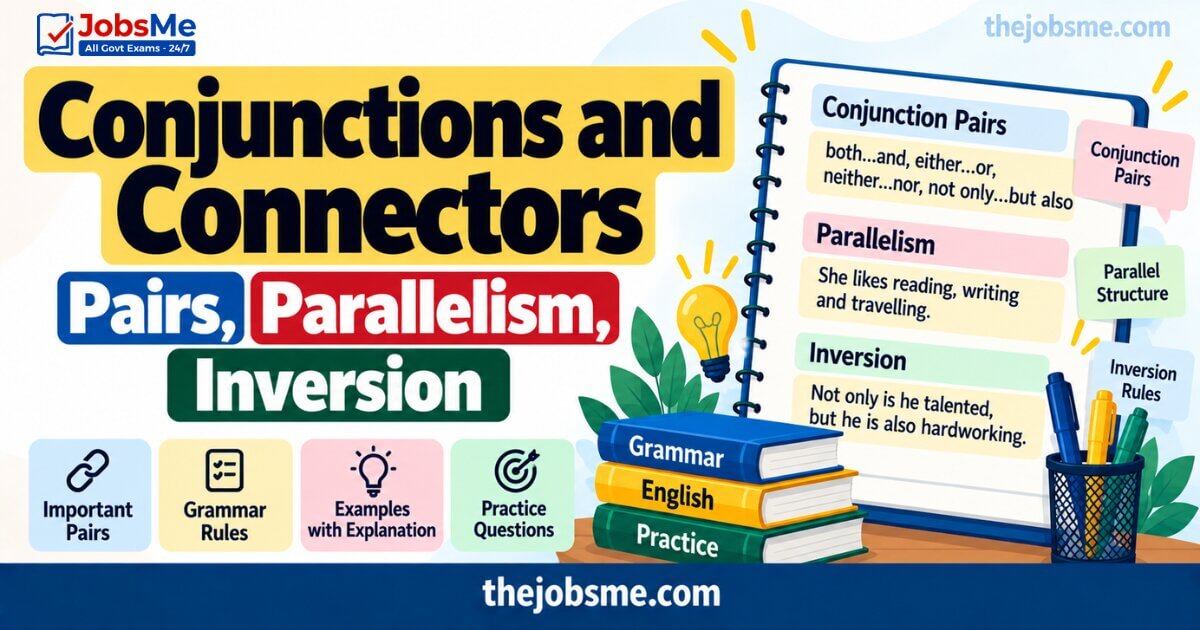
Conjunctions and Connectors: Pairs, Parallelism, Inversion
This article is a complete, exam-ready guide to conjunctions and connectors for SSC, banking, insurance, railway, defence and State PSC exams. It is organised around the point that decides most questions: which family a joining word belongs to, because the family determines the punctuation, the word order and whether a fixed partner word is required. It covers the four families and how each behaves, the full correlative pair table with the wrong partners examiners plant, the three laws governing correlatives, the negative words that must never take another negative, and the difference between a conjunction and a connector. Ten solved questions, common traps and a fifteen-question practice set with a full answer key are included.
Introduction
A conjunction is a word or pair of words that joins other words, phrases or clauses. Rahul studied hard and he passed the exam. Without conjunctions every idea would need its own sentence.
Here is what makes this topic unusual. Every candidate already uses these words fluently, dozens of times a day. Marks are not lost because the word is unknown. They are lost because the rule behind the word was never learnt, so a sentence that sounds completely natural in conversation turns out to be wrong on paper.
Although he worked hard, but he failed is a sentence most Indian students would write by reflex. It is also an error, and a very frequently tested one.
The topic organises itself around one idea. A joining word belongs to one of four families, and the family decides everything: the punctuation it takes, whether the word order inverts, and whether a fixed partner word is compulsory. Get the family right and the rest follows.
Where This Topic Is Asked
| Exam | How This Topic Appears | Rough Weight | Difficulty |
|---|---|---|---|
| SSC CGL and CHSL | Direct fillers, and errors hidden inside a connector in error spotting. | 1 to 2 direct questions, plus errors inside 3 to 5 others | Easy. The same pairs repeat every year. |
| IBPS PO and SBI PO | Fillers, error detection, and connector choices inside a cloze test. | 1 to 2 questions | Moderate. |
| RRB NTPC and Group D | Straightforward fill-in-the-conjunction items. | 1 question | Easy. |
| State PSC and police exams | Error spotting on correlative pairs. | 1 to 2 questions | Moderate. |
| Para jumbles and rearrangement | The connector is often the clue that fixes the order of two sentences. | Indirect but decisive | Moderate. |
| Descriptive papers | Connectors carry the logic of an argument from one paragraph to the next. | Indirect | Useful. |
Add the direct and the indirect together and this is one of the better-paying small topics in the paper. Correlative errors sit most often in the first or second segment of an error spotting sentence, so a sentence opening with No sooner, Hardly or Although deserves an immediate check. Confirm your own pattern in the exam-wise syllabus hub.
The Four Families and How They Behave
This table is the spine of the topic. Learn the behaviour column rather than the definition.
| Family | What It Joins | Punctuation | Partner Required |
|---|---|---|---|
| Coordinating for, and, nor, but, or, yet, so | Two elements of equal rank, including two complete sentences. | A comma before it when it joins two complete sentences, and no comma when it joins two words or phrases. | No. |
| Subordinating because, although, if, when, since, unless, while, until | A dependent clause to an independent one. | A comma only when the dependent clause comes first. | No, except for although and though. |
| Correlative either or, neither nor, not only but also | Two grammatically parallel elements. | Varies with the structure. | Yes, and the partner is fixed. |
| Conjunctive adverbs, or connectors however, therefore, moreover, nevertheless | Nothing grammatically. They signal a relationship between two sentences. | A semicolon or full stop before, and a comma after. | No. |
The fourth row is the one that costs marks, and one widely used source states the position backwards. Words such as however, therefore and moreover are connectors, not conjunctions. They cannot join two complete sentences with a comma, because they do no grammatical joining at all.
- Wrong: He was tired, however he finished the work.
- Right: He was tired; however, he finished the work.
- Also right: He was tired, but he finished the work, using a real conjunction.
This is the same fault as the comma splice discussed in punctuation rules, and it appears in both error spotting and descriptive writing.
Formula Box
- FANBOYS are the seven coordinating conjunctions: for, and, nor, but, or, yet, so.
- A comma goes before a coordinating conjunction only when it joins two complete sentences.
- A subordinating clause placed first takes a comma; placed second it takes none.
- Correlatives take a fixed partner. No sooner takes than; hardly takes when.
- Correlatives must join parallel elements, so a noun after either needs a noun after or.
- A negative opener inverts the word order. No sooner had I reached.
- Lest, unless, until, hardly and seldom are already negative, so never add not.
- However and therefore need a semicolon, because they are connectors rather than conjunctions.
Coordinating Conjunctions
Seven words, remembered as FANBOYS: for, and, nor, but, or, yet, so. Each joins two things of equal rank.
| Word | Relationship | Example |
|---|---|---|
| for | Reason, similar to because. | She stayed home, for it was raining heavily. |
| and | Addition. | I want an apple and an orange. |
| nor | Adds a second negative. | He did not call, nor did he write. |
| but | Contrast. | She is young, but she is very capable. |
| or | Choice. | Would you like tea or coffee? |
| yet | Contrast against expectation. | He is talented, yet he remains humble. |
| so | Result. | I was hungry, so I made a sandwich. |
Two points settle most coordinating questions.
- The comma rule. Put a comma before the conjunction when both sides could stand alone as sentences. Tom walked his dog, and he collected the post. Leave it out when the conjunction joins two words or phrases. Tom walked his dog and collected the post.
- Starting a sentence. Beginning with And or But is accepted in modern writing and common in journalism. In an exam answer, however, keep them inside the sentence, since examiners generally follow the traditional convention.
Subordinating Conjunctions
These attach a dependent clause to an independent one, and the family is large. Group them by the relationship they express rather than learning a list.
| Relationship | Words | Example |
|---|---|---|
| Cause or reason | because, since, as, now that | I stayed home because I was unwell. |
| Time | when, while, before, after, until, till, as soon as | I will call you when I arrive. |
| Condition | if, unless, provided that, in case | I will go if you come with me. |
| Contrast or concession | although, though, even though, whereas, while | Although he was tired, he continued working. |
| Purpose | so that, in order that, lest | He left early so that he might catch the train. |
| Result | so that, such that | He spoke in such anger that the boy began to cry. |
| Comparison | than, as, as if, as though | He behaves as if he were the owner. |
The comma rule is the mirror of the coordinating one. A dependent clause placed first takes a comma after it, and placed second it takes none. So Because I was late, I missed the bus, but I missed the bus because I was late.
The Correlative Pair Table
This is the highest-value table in the topic. Each pair has exactly one legal partner, and examiners plant a plausible wrong one.
| Opener | Correct Partner | The Trap Partner | Example |
|---|---|---|---|
| No sooner | than | when or then | No sooner had I reached than the train left. |
| Hardly | when or before | than | Hardly had he arrived when the bell rang. |
| Scarcely | when or before | than | Scarcely had she asked when he replied. |
| Barely | when or before | than | Barely had we started when it rained. |
| Not only | but also | but, and also | He lost not only his home but also his job. |
| Either | or | nor | You can either take the bus or walk. |
| Neither | nor | or | He is neither tall nor short. |
| Both | and | as well as, but | Both eggs and ham are staples. |
| Between | and | to | The train runs between Delhi and Mumbai. |
| From | to | and | She sings from morning to evening. |
| Whether | or | not that | I am doubtful whether he will come or not. |
| Although or Though | yet, or nothing | but, so | Although he worked hard, yet he failed. |
| Lest | should, or a bare verb | would, may, will | Walk carefully lest you should fall. |
| Such | that or as | which | He spoke with such anger that she wept. |
| So | as, in negatives | than | He is not so good as you. |
| As | as, in both types | so | He is as good as you. |
| Rather or Other | than | but, from | I would rather die than beg. |
| Seldom | or never, if ever | or ever, if never | He seldom or never watches films. |
| What with | and | or | What with school and sports, she is always busy. |
Nineteen pairs, and each one gives away the answer the moment you see its opening word. This single table answers more exam questions than the rest of the topic combined.
Connectors in Longer Writing
Connectors do a job conjunctions cannot: they carry logic across a sentence boundary, and across a paragraph boundary. That makes them the backbone of descriptive answers and the main clue in rearrangement questions.
| Relationship | Connectors | What They Signal |
|---|---|---|
| Addition | moreover, furthermore, besides, in addition, also | The next sentence continues the same line of argument. |
| Contrast | however, nevertheless, on the other hand, in contrast, still | The next sentence pushes against what came before. |
| Result | therefore, consequently, hence, thus, accordingly | The next sentence follows from the previous one. |
| Example | for instance, for example, to illustrate, namely | An illustration of the point just made. |
| Sequence | first, next, subsequently, finally, in the end | A step in an ordered list. |
| Summary | in short, to summarise, altogether, in conclusion | The argument is closing. |
| Clarification | that is to say, in other words, put differently | The same point restated more plainly. |
In a rearrangement question the connector usually fixes the order, because a sentence opening with however cannot be first and a sentence opening with in conclusion cannot be second. The same signals are used in paragraph completion.
The Three Laws of Correlatives
Law One: The Partner Is Fixed
There is no choice and no near-equivalent. No sooner takes than and nothing else, while hardly, scarcely and barely take when or before. Swapping them is the commonest planted error in this family.
- Wrong: No sooner had we started when the power failed.
- Right: No sooner had we started than the power failed.
- Wrong: Scarcely had the helper opened the gate than the dogs ran out.
- Right: Scarcely had the helper opened the gate when the dogs ran out.
Law Two: The Elements Must Be Parallel
Whatever grammatical form follows the first half of the pair must also follow the second. If a noun follows not only, a noun must follow but also.
- Wrong: He not only lost his home but also his job. A verb follows the first half and a noun the second.
- Right: He lost not only his home but also his job. Now a noun follows both.
- Wrong: She wanted to either eat a burger or a sandwich.
- Right: She wanted to eat either a burger or a sandwich.
- Wrong: He likes both basketball and playing football.
- Right: He likes both basketball and football.
The repair is nearly always the same: move the first half of the pair further to the right until the two halves are followed by matching forms. Nothing needs to be added or deleted.
Law Three: A Negative Opener Inverts the Word Order
When a sentence begins with No sooner, Hardly, Scarcely, Barely, Seldom, Never or Not only, the auxiliary verb moves in front of the subject.
| Opener | Structure | Example |
|---|---|---|
| No sooner | No sooner + had + subject + third form + than + simple past | No sooner had I reached the station than the train left. |
| No sooner, alternative | No sooner + did + subject + base verb + than | No sooner did she arrive than he came. |
| Hardly or Scarcely | Hardly + had + subject + third form + when + simple past | Hardly had I completed the lesson when my friends arrived. |
| Seldom or Never | Seldom + auxiliary + subject + verb | Seldom does he attend the review meetings. |
| Not only, at the start | Not only + auxiliary + subject + verb, but also | Not only did he lose his job, but he also lost his home. |
So a question opening with one of these words carries three separate checks at once: the partner word, the tense sequence, and the inversion. Missing any one of them makes the sentence wrong.
Key Highlights
- The family decides everything: punctuation, word order and whether a partner is required.
- Correlative partners are fixed, so the opening word tells you the answer.
- A negative opener carries three checks at once: partner, tense and inversion.
- However and therefore are connectors, not conjunctions, and need a semicolon.
- Everyday fluency misleads here, because the wrong sentence usually sounds perfectly natural.
The Negative Words That Refuse Another Negative
Several joining words already contain a negative meaning, so adding not, no or never creates a double negative.
| Word | What It Already Means | Wrong | Right |
|---|---|---|---|
| lest | for fear that, in order that not | Walk carefully lest you should not fall. | Walk carefully lest you should fall. |
| unless | if not | Unless you do not register, it will be scrapped. | Unless you register, it will be scrapped. |
| until | up to the time when not | Wait here until I do not return. | Wait here until I return. |
| hardly, scarcely, barely | almost not | He hardly does not speak in meetings. | He hardly speaks in meetings. |
| seldom, rarely | almost never | She seldom does not miss a class. | She seldom misses a class. |
The same rule explains why these words take a positive question tag, which is covered in question tags.
Confusable Pairs
| Pair | The Distinction | Example |
|---|---|---|
| Unless and Until | Unless sets a condition, until sets a time limit. | She will not succeed unless she works hard. Wait until they return. |
| Since, time and cause | It can mean from the time that or because, and only the sentence decides. | Thirty years have passed since I took my first flight, which is time, not cause. |
| While and When | While suits a continuing action, when a short or instant one. | While he was reading, the bell rang. |
| If and Whether | Both express doubt, but whether is preferred before or not and after a preposition. | I am doubtful whether he will come or not. |
| That, for certainty | That introduces something asserted rather than doubted. | I am sure that he will come back. |
| Because and As | Both give a reason, but because is stronger and answers why directly. | He failed because he did not prepare. |
| Either of and Neither of | Both refer to two things only; for more than two use any of or none of. | Neither of the two answers was correct. |
| As well as and And | As well as does not change the subject, so the verb follows the first noun. | The captain as well as the players was felicitated. |
| The reason is that | Never the reason is because, since both words express cause. | The reason is that the file was misplaced. |
| And which | Use and which only when an earlier which clause exists. | This is a book which is short and which is useful. |
A Warning About Study Material on This Topic
The published material for conjunctions is unusually unreliable, and several of the errors sit inside the very rules they are teaching.
- A rule contradicted by its own example. One source states that lest must be followed by should or the bare verb, then gives the example Walk carefully lest he may fall. The example uses exactly the auxiliary the rule forbids.
- A solved previous-year question with a wrong answer. An exam blog gives ___ you study, ___ you will pass with the answer either or. Either you study or you will pass is meaningless. The sentence needs if, or a negative construction with unless.
- The connector rule stated backwards. One guide says therefore is not a connector, it is mistaken as a conjunction. The truth is the reverse: therefore is a connector and is mistaken for a conjunction.
- A wrong explanation with a right answer. For More than thirty years have now passed ___ I took my first flight, the answer since is correct, but the explanation claims since here replaces because. It is temporal, not causal.
- A table of conjunctive adverbs that mostly are not. One list offers again, also, certainly and besides as adverbial conjunctions, with examples in which every one of them is functioning as an ordinary adverb or a preposition.
So test every example against the rule it claims to illustrate, and be especially wary of solved previous-year questions circulating without a source.
Exam Alert
- Check the first two segments first, since correlative errors usually sit there.
- Although with but is planted because Indian students write it by reflex.
- Lest should not and unless do not are the two commonest double negatives.
- A comma before however is a comma splice, not a style choice.
- Some sentences really are correct, so resist finding faults that are not there.
Ten Solved Questions
1. Find the error. Scarcely had the helper opened the gate (a) / than the dogs (b) / ran out into the street. (c) / No error (d)
Working: Scarcely takes when or before, never than. Answer: (b).
2. Find the error. He did not climb the tree (a) / lest he should not (b) / break his leg. (c) / No error (d)
Working: Lest already carries the negative, so not must go. Answer: (b).
3. Find the error. Both Ram as well as Shyam (a) / have cleared (b) / the prelims this year. (c) / No error (d)
Working: Both pairs with and, never with as well as. Answer: (a), which should read Both Ram and Shyam.
4. Find the error. Although India played exceptionally well, (a) / but they lost (b) / the final match. (c) / No error (d)
Working: Although takes yet or nothing at all, never but. Answer: (b).
5. Choose the correct sentence. (a) No sooner I had reached the station when the train left. (b) No sooner had I reached the station than the train left. (c) No sooner I reached the station than the train left. (d) No sooner did I reached the station than the train left.
Working: Three things are required at once: inversion, the past perfect, and than. Only one option has all three. Answer: (b).
6. Correct the sentence. He not only lost his home but also his job.
Working: A verb follows not only and a noun follows but also, so the halves are not parallel. Move the first half to the right. Answer: He lost not only his home but also his job.
7. Find the error. She is neither free (a) / or interested in (b) / taking up this task. (c) / No error (d)
Working: Neither pairs with nor. Answer: (b).
8. Fill the blank. The air quality improved on Monday, ___ experts warned it could deteriorate again. Options: and, but, so, because.
Working: The two clauses are of equal weight and contrast with each other, which calls for a coordinating conjunction of contrast. Answer: but.
9. Find the error. The proposal was rejected, (a) / however the committee (b) / agreed to reconsider it. (c) / No error (d)
Working: However is a connector rather than a conjunction, so it cannot join two sentences with a comma. Answer: (b), which needs a semicolon before it and a comma after.
10. Find the error. Unless you do not submit (a) / the form by Friday, (b) / your application will lapse. (c) / No error (d)
Working: Unless already means if not. Answer: (a), which should read Unless you submit.
Quick Facts
- No sooner takes than; hardly, scarcely, barely take when or before.
- Although takes yet or nothing; both takes and; between takes and.
- Lest takes should or a bare verb, never would, may or will.
- Rather and other take than; such takes that or as.
- So as for negatives only; as as for both.
- Connectors take a semicolon before and a comma after.
Worked Examples: Wrong to Right
Example 1 (although with but)
Sentence: A student writes Although he worked hard, but he failed the exam.
Trap: Both words signal contrast, so using both feels emphatic rather than wrong, and this construction is extremely common in Indian English speech. One contrast marker is enough, and although already supplies it.
Correct Answer: Although he worked hard, he failed the exam, or Although he worked hard, yet he failed.
Rule in Simple Words: Although takes yet or nothing, never but.
Example 2 (no sooner with when)
Sentence: A student writes No sooner had we started when the power failed.
Trap: When feels natural after a time expression, and the inversion is already correct, so most of the sentence looks right. No sooner has exactly one partner, which is than.
Correct Answer: No sooner had we started than the power failed.
Rule in Simple Words: No sooner takes than; hardly and scarcely take when.
Example 3 (lest with not)
Sentence: A student writes Walk carefully lest you should not fall.
Trap: The intended meaning is to avoid falling, so adding not feels like stating that purpose explicitly. Lest already means for fear that, so the negative is built in and the sentence now says the opposite.
Correct Answer: Walk carefully lest you should fall.
Rule in Simple Words: Lest, unless and until never take another negative.
Example 4 (broken parallelism)
Sentence: A student writes He not only lost his home but also his job.
Trap: The sentence reads smoothly and both halves of the pair are present, so nothing obviously jars. A verb follows the first half and a noun the second, which breaks the parallel the pair requires.
Correct Answer: He lost not only his home but also his job.
Rule in Simple Words: Move the first half right until both halves are followed by matching forms.
Example 5 (however as a joiner)
Sentence: A student writes The scheme was funded, however the money never reached the districts.
Trap: However behaves like but in meaning, so it feels like a conjunction. Grammatically it is an adverb and joins nothing, so a comma cannot hold two sentences together around it.
Correct Answer: The scheme was funded; however, the money never reached the districts.
Rule in Simple Words: Connectors take a semicolon before and a comma after.
Example 6 (missing the inversion)
Sentence: A student writes No sooner I reached the station than the train left.
Trap: The partner word is correct and the meaning is clear, so the sentence looks finished. A negative adverbial opener demands that the auxiliary come before the subject, and this one has ordinary word order.
Correct Answer: No sooner had I reached the station than the train left.
Rule in Simple Words: A negative opener inverts the auxiliary and the subject.
Example 7 (both with as well as)
Sentence: A student writes Both Ram as well as Shyam have cleared the prelims.
Trap: As well as means roughly and, so the sentence seems to say what was intended. Both takes and, and as well as additionally does not make the subject plural.
Correct Answer: Both Ram and Shyam have cleared the prelims.
Rule in Simple Words: Both takes and, never as well as.
Example 8 (trusting a downloaded answer key)
Sentence: A student learns from a practice blog that ___ you study, ___ you will pass takes either or.
Trap: The blank pattern looks like a correlative slot, and the key is presented as a previous-year answer. Either you study or you will pass is not a meaningful sentence, since the two halves are not alternatives.
Correct Answer: If you study, you will pass.
Rule in Simple Words: Read the meaning before accepting any answer key.
Common Traps Students Fall Into
These are the habits that most often cost marks. Each one is a common trap, not a silly mistake, and each has a one-line fix.
- Trap: Writing although with but. Fix: One contrast marker per sentence.
- Trap: Pairing no sooner with when. Fix: No sooner takes than; hardly takes when.
- Trap: Forgetting the inversion after a negative opener. Fix: The auxiliary comes before the subject.
- Trap: Adding not after lest, unless or until. Fix: Those words are already negative.
- Trap: Breaking parallelism in a correlative pair. Fix: Matching forms after both halves.
- Trap: Pairing both with as well as. Fix: Both takes and.
- Trap: Writing between with to. Fix: Between takes and; from takes to.
- Trap: Joining two sentences with however and a comma. Fix: Connectors need a semicolon.
- Trap: Putting a comma before every and. Fix: Only when both sides are complete sentences.
- Trap: Treating as well as as though it made the subject plural. Fix: The verb follows the first noun, as in subject-verb agreement.
- Trap: Trusting a free answer key. Fix: Test every answer against the meaning of the sentence.
Memory Tricks and Formulas
1. Name the family first
Coordinating, subordinating, correlative or connector. The family decides the punctuation, the word order and whether a partner is required, so naming it answers most of the question before you look at the options.
2. FANBOYS and the comma
The seven coordinating conjunctions are for, and, nor, but, or, yet, so. A comma goes before one only when both sides could stand alone as sentences. Two words or two phrases take no comma.
3. Sooner than, hardly when
Four words that settle the commonest pair question. No sooner takes than, while hardly, scarcely and barely take when or before. Say it aloud until it is automatic.
4. Three checks on a negative opener
A sentence beginning with No sooner, Hardly, Scarcely, Seldom or Not only needs all three at once: the correct partner word, the past perfect where required, and the auxiliary placed before the subject. Missing any one makes it wrong.
5. Move the pair, do not add words
When a correlative breaks parallelism, the repair is to shift the first half of the pair to the right. Not only lost his home becomes lost not only his home. Nothing is added and nothing is removed.
6. Already negative, so no second negative
Lest, unless, until, hardly, scarcely, barely, seldom and rarely all carry a negative inside them, so none of them takes not, no or never. The same list explains their positive question tags.
7. Semicolon for connectors
However, therefore, moreover, nevertheless, consequently and furthermore join nothing grammatically. Give them a semicolon or a full stop before and a comma after, or replace them with a real conjunction.
8. Budget the time honestly
With 1 to 2 direct questions and errors hidden inside 3 to 5 others in an SSC paper, this topic repays study well. One session on the pair table and the three laws covers almost everything examiners use.
Exam Patterns and High-Yield Facts
Frequently Confused Pairs
| Pair | How They Differ | Mini Trick |
|---|---|---|
| No sooner vs Hardly | No sooner takes than; hardly takes when. | Sooner than, hardly when. |
| Although vs But | Using both doubles the contrast. | One contrast marker only. |
| Unless vs Until | Condition against time. | Unless you work; until they return. |
| Conjunction vs Connector | One joins grammatically; the other only signals a relationship. | But takes a comma; however takes a semicolon. |
| Both and vs Both as well as | Only and is correct with both. | Both takes and. |
| Between and vs Between to | Between always takes and. | From takes to; between takes and. |
| So as vs As as | So as is for negatives only; as as works in both. | Not so good as; as good as. |
| If vs Whether | Whether is preferred before or not and after a preposition. | Doubtful whether he will come or not. |
| Since, time vs cause | Only the sentence decides which sense applies. | Years have passed since is time, not cause. |
| Either of vs Any of | Either is for two; any is for more than two. | Count the options first. |
Repeating Question Patterns
- A correlative given the wrong partner, which is the commonest single pattern in this family.
- Although paired with but, planted because Indian students write it by reflex.
- A negative word followed by another negative, usually lest should not or unless do not.
- A negative opener without inversion.
- Broken parallelism in a not only construction.
- However or therefore joining two sentences with a comma.
Practice Set: Fifteen Questions
Correct each sentence, or mark it correct as it stands.
- Hardly had the meeting begun than the power went off.
- Although the scheme was well funded, but it failed to reach the villages.
- He left early lest he should not miss the train.
- The seminar will run from ten in the morning to four in the afternoon.
- Both the manager as well as the clerks were transferred.
- She is not only a fine administrator but also a good writer.
- No sooner the results were announced than the phones started ringing.
- The proposal was sound, however the funding was refused.
- You must choose between the morning shift to the evening shift.
- Neither the officers or the staff were informed of the change.
- He is not so experienced as his predecessor.
- Unless you do not apply before Friday, your form will not be accepted.
- I would rather resign than accept those terms.
- She wanted to either join the course or take up the job.
- Seldom does he attend the monthly review meetings.
Quick Facts
Answer key, with the rule named in each case.
- 1. when the power went off. Hardly takes when, not than.
- 2. Remove but, or write yet it failed. Although never pairs with but.
- 3. lest he should miss. Lest already contains the negative.
- 4. Correct as it stands. From correctly pairs with to.
- 5. Both the manager and the clerks. Both takes and.
- 6. Correct as it stands. Both halves are followed by noun phrases, so the parallel holds.
- 7. No sooner had the results been announced than. The inversion and the past perfect were both missing.
- 8. sound; however, the funding. However is a connector and needs a semicolon.
- 9. between the morning shift and the evening shift. Between takes and.
- 10. Neither the officers nor the staff. Neither pairs with nor.
- 11. Correct as it stands. So and as is right in a negative sentence.
- 12. Unless you apply before Friday. Unless already means if not.
- 13. Correct as it stands. Rather correctly takes than.
- 14. to join either the course or the job, or better, either to join the course or to take up the job. The two halves must be parallel.
- 15. Correct as it stands. Seldom at the start correctly inverts the auxiliary and the subject.
Five of those fifteen were already correct, which matters because a student who has just learnt nineteen pairs starts finding faults that are not there. Practise the same restraint with the free English MCQ quizzes and full papers from the mock test archive.
Quick Revision
Quick Revision
- What a conjunction is. A word or pair of words that joins other words, phrases or clauses.
- Why marks are lost here. Not because the word is unknown, but because the rule behind a word used daily was never learnt.
- Name the family first. Coordinating, subordinating, correlative or connector, since the family decides the punctuation, the word order and whether a partner is needed.
- FANBOYS are the seven coordinating conjunctions. For, and, nor, but, or, yet and so.
- A comma goes before a coordinating conjunction only when both sides could stand alone as complete sentences.
- A subordinating clause takes a comma when it comes first and none when it comes second.
- Connectors are not conjunctions. However, therefore, moreover and nevertheless join nothing grammatically and need a semicolon before and a comma after.
- Correlative partners are fixed. No sooner takes than, while hardly, scarcely and barely take when or before.
- Not only takes but also, either takes or, neither takes nor, and both takes and.
- Between takes and while from takes to, so it is between Delhi and Mumbai, never between Delhi to Mumbai.
- Although and though take yet or nothing, and never but or so.
- Lest takes should or a bare verb, never would, may or will.
- Such takes that or as, and rather and other take than.
- So and as is used in negative sentences while as and as works in both affirmative and negative ones.
- Correlatives must join parallel elements, so a noun after the first half needs a noun after the second.
- To repair broken parallelism, move the first half of the pair to the right rather than adding or deleting words.
- A negative opener inverts the word order, so the auxiliary comes before the subject in No sooner had I reached.
- A negative opener carries three checks at once. The partner word, the tense sequence and the inversion.
- Lest, unless, until, hardly, scarcely, barely, seldom and rarely are already negative, so none of them takes another not, no or never.
- Unless sets a condition and until sets a time limit.
- Since can mean either from the time that or because, and only the sentence decides which.
- As well as does not make a subject plural, so the verb agrees with the first noun.
- Write the reason is that, never the reason is because.
- Published material on this topic is unusually unreliable, so test every example and every answer key against the meaning of the sentence.
Conjunctions are the most rule-bound small topic in the English paper, and also the one where everyday fluency misleads you most. The words are familiar, the sentences sound right, and the errors are invisible until you know the pairs. So learn the pair table until each opening word calls up its partner automatically, apply the three laws to every correlative, and remember that a connector needs a semicolon rather than a comma. The topic feeds straight into error spotting and sentence improvement, supplies the clues that solve para jumbles and sentence connectors questions, and shapes the structure work in transformation of sentences. The wider set is in the topic-wise English notes.
Frequently Asked Questions
What is a conjunction?
What are the four families of joining words?
Why is although with but wrong?
What partner does no sooner take?
What is the inversion rule?
Why can lest not take not?
What is parallelism in correlative conjunctions?
Are however and therefore conjunctions?
When does a comma go before and?
What is the difference between unless and until?

About the author