
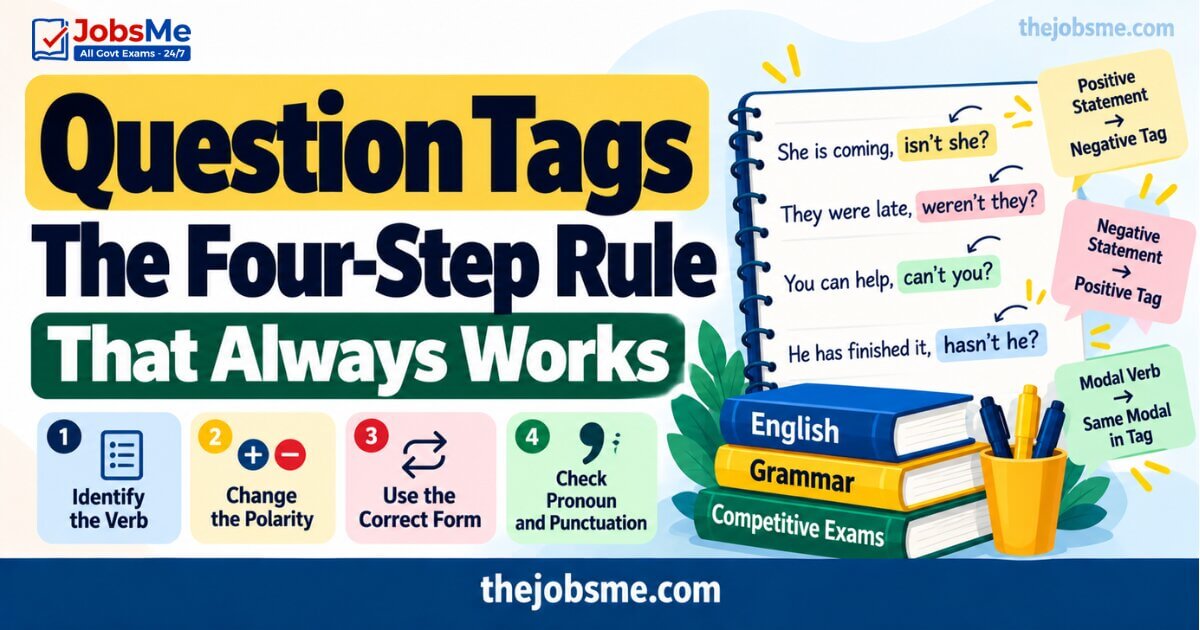
Question Tags: The Four-Step Rule That Always Works
This article is a complete, exam-ready guide to question tags for SSC, banking, railway, defence, State PSC and teaching exams. Unlike most English topics, this one is entirely mechanical, so it teaches a four-step procedure that produces the correct tag every time rather than a list to memorise. It covers finding the operator, flipping the polarity, choosing the pronoun and contracting the negative, along with the hidden negatives that catch most candidates, the full exception table including I am and imperatives, and the advanced cases where the tag follows a subordinate clause. Ten solved questions, common traps and a fifteen-question practice set with a full answer key are included.
Introduction
A question tag is a short question added to the end of a statement to invite agreement or confirmation. It is raining, isn't it? The statement does the work, and the tag asks the listener to confirm it.
This topic is unusual in one important way, and it is worth saying at the start. Question tags are entirely mechanical. There is no vocabulary to memorise and no judgement to exercise, only a fixed procedure of four steps that produces the correct tag every time.
That makes this one of the few English topics you can genuinely finish. Learn the four steps and the short list of exceptions, and you will never lose a mark here again.
One definition point first, because two widely used sources get it wrong. A tag attaches to a statement and to nothing else. Some guides list You like mangoes, don't you? under interrogative sentences and Wow! That was a great show, wasn't it? under exclamatory ones. In both cases the tag is attached to a plain declarative clause. You cannot add a tag to an actual question, so Do you like mangoes, don't you? is impossible. Imperatives are the one genuine exception, and they follow their own rules.
Where This Topic Is Asked
| Exam | How This Topic Appears | Rough Weight | Difficulty |
|---|---|---|---|
| SSC CGL, CHSL and CPO | Rarely a dedicated question, but a regular item inside error spotting and sentence improvement. | Indirect, roughly 1 question in some shifts | Easy once the procedure is known. |
| Teaching exams such as CTET and State TET | Direct fill-in-the-tag questions, since pedagogy papers test grammar explicitly. | 1 to 2 questions | Easy to moderate. |
| State PSC and police exams | Direct questions in the grammar block. | Varies by state | Easy. |
| Bank exams | Occasionally inside error detection, and in reading passages that quote speech. | Indirect | Easy. |
| Descriptive and interview stages | Natural spoken English uses tags constantly, so they affect fluency impressions. | Indirect | Useful. |
| School and board exams | A standard grammar question with full marks available. | Direct | Easy. |
The direct weight is small in SSC and banking, and honest preparation planning should reflect that. The reason to learn it anyway is the cost-to-benefit ratio, since about an hour of study closes the topic permanently. Check your own pattern in the exam-wise syllabus hub.
The Anatomy of a Tag
Every question tag has exactly two parts and follows a fixed shape.
- A comma separates it from the statement, and a question mark closes it.
- The first word is the operator, which is an auxiliary or modal verb.
- The second word is a pronoun, never a noun. Ravi is playing, isn't he? and never isn't Ravi?
- A negative tag is always contracted. Write isn't he, never is not he.
The Four-Step Tag Machine
Run these four steps in order and the tag builds itself.
| Step | What to Do | Worked on She has finished the report |
|---|---|---|
| 1. Find the operator | Take the auxiliary or modal from the statement. If there is none, supply do, does or did to match the tense. | The operator is has. |
| 2. Flip the polarity | A positive statement takes a negative tag, and a negative statement takes a positive one. | The statement is positive, so the tag is negative: hasn't. |
| 3. Choose the pronoun | Replace the subject with the pronoun that matches it in number and gender. | The subject is she, so the pronoun is she. |
| 4. Contract and attach | Contract any negative, add a comma before and a question mark after. | She has finished the report, hasn't she? |
Try it on a harder sentence. The students did not submit their assignments. The operator is did. The statement is negative, so the tag is positive, giving did. The subject the students becomes they. The result is did they?
Formula Box
- Step 1. Take the auxiliary or modal, or supply do, does or did.
- Step 2. Positive statement takes a negative tag, and negative takes positive.
- Step 3. Use a pronoun, never a noun.
- Step 4. Contract the negative, comma before, question mark after.
- Hidden negatives count as negative, so hardly, seldom, rarely, never, few and nobody all take a positive tag.
- I am takes aren't I.
- Let's takes shall we, and an imperative takes will you.
Step 1: Finding the Operator
| Statement Contains | Operator in the Tag | Example |
|---|---|---|
| A form of be | The same form. | She is crying, isn't she? They were late, weren't they? |
| A form of have as auxiliary | The same form. | He has finished, hasn't he? They had left, hadn't they? |
| A modal | The same modal. | You can swim, can't you? We should leave, shouldn't we? |
| Will or shall | The same, with won't as the negative of will. | They will come, won't they? |
| No auxiliary, present simple | Do or does. | She sings well, doesn't she? They play football, don't they? |
| No auxiliary, past simple | Did. | They went home, didn't they? |
| Have got, meaning possession | Have or has, not do. | He has got a car, hasn't he? |
| Used to | Did. | She used to have long hair, didn't she? |
| Need or dare as modals | The same word. | He need not go now, need he? |
The commonest mistake at this step is borrowing the wrong operator. He likes tea, isn't he? is wrong because likes is not a form of be, and the sentence has no auxiliary at all, so the tag needs doesn't he.
Step 2: Flipping the Polarity, Including Hidden Negatives
The basic rule is easy. A positive statement takes a negative tag and a negative statement takes a positive one. The difficulty is that a sentence can be negative without containing not, and this is what SSC papers test.
| Hidden Negative | Why It Counts | Correct Tag |
|---|---|---|
| hardly, scarcely, barely | They mean almost not. | He hardly ever speaks, does he? |
| seldom, rarely | They mean almost never. | They rarely eat out, do they? |
| never | An outright negative. | She never complains, does she? |
| no, none, nobody, nothing, no one | They negate the subject or object. | Nobody called, did they? |
| few, little without a | Few means hardly any, while a few means some. | Few people attended, did they? |
| neither, nor | They exclude both options. | Neither answer was right, was it? |
| Prefixes such as un- and dis- | These are not hidden negatives, since the sentence stays positive. | He is unhappy, isn't he? |
The last row matters as much as the others. A negative meaning inside a single word does not make the clause negative, so he is unhappy still takes a negative tag. The test is grammatical negation of the clause, not the mood of the sentence. The same trigger words appear in error spotting questions.
Step 3: Choosing the Pronoun
| Subject | Pronoun in the Tag | Example |
|---|---|---|
| An ordinary noun | The matching pronoun. | Ravi is playing, isn't he? The girls are ready, aren't they? |
| There as introductory subject | There is repeated, unusually for a tag. | There is a dog outside, isn't there? |
| This or that | It. | This is Paul's pen, isn't it? |
| These or those | They. | These are your books, aren't they? |
| Everyone, someone, nobody, anybody | They, even though the verb is singular. | Everyone has a mother, haven't they? Someone is coming, aren't they? |
| Everything, nothing, something | It. | Nothing was decided, was it? |
| A collective noun acting as one unit | It. | The company has decided, hasn't it? |
| One as a general subject | One, in formal usage. | One cannot be too careful, can one? |
The row on everyone deserves a note, because it looks inconsistent. The verb stays singular while the pronoun goes plural, giving Everyone has a mother, haven't they? That is standard and is what exams expect.
Collective nouns need care too. One widely circulated example reads The team has already taken their positions, haven't they? That sentence is internally inconsistent, mixing a singular verb with a plural pronoun and a plural tag. Choose one number and hold it: either the team has taken its positions, hasn't it? or the team have taken their positions, haven't they?
Step 4: Contracting the Negative
A negative tag is always contracted in ordinary English. Isn't he, doesn't she, won't they. The uncontracted form is not merely formal but wrong in a tag, so is not he? and did he not? are both incorrect.
One contraction is irregular and is asked repeatedly. The tag for I am is aren't I, because English has no accepted contraction for am not in this position. So it is I am late again, aren't I? and never amn't I or am not I.
Key Highlights
- This topic is a procedure, not a list, so four steps replace all memorisation.
- The operator always comes from the statement, which is why the tense never matters.
- Hidden negatives decide most exam questions, and they contain no not at all.
- Only three tags are genuinely irregular: aren't I, shall we, and the repeated there.
- One hour of study closes this topic permanently, which few English topics allow.
The Exception Table
Once the four steps are automatic, only these special cases remain. They are few enough to learn in a single sitting.
| Sentence Type | Tag | Example |
|---|---|---|
| I am | aren't I | I am your friend, aren't I? |
| I am not | am I | I am not late, am I? |
| Positive imperative | will you, won't you, can't you or would you | Open the door, will you? Help me, would you? |
| Negative imperative | will you only | Don't shout, will you? |
| Let's, meaning a suggestion | shall we | Let's go for a walk, shall we? |
| Let us, meaning a request for permission | will you | Let us go home early, will you? |
| There is or there are | isn't there, aren't there | There aren't any spiders, are there? |
| Have got | hasn't or haven't | She has got two brothers, hasn't she? |
| Used to | didn't | He used to smoke, didn't he? |
| Need not or dare not | need or dare | You need not worry, need you? |
| Ought to | oughtn't or shouldn't | We ought to leave, oughtn't we? |
Two points about imperatives, since study material often overstates the rule. Some sources say a positive imperative must take won't you. That is only one option and it carries a note of invitation. Will you is the neutral default, won't you is a polite invitation, and would you or could you soften a request further. A negative imperative allows only will you.
Tags Across the Tenses
Because the operator always comes from the statement, the tense takes care of itself. This table is a reference rather than a new rule, and it is worth reading once to confirm that the four steps hold everywhere.
| Tense | Positive Statement | Negative Statement |
|---|---|---|
| Simple present with be | You are happy, aren't you? | You are not ready, are you? |
| Simple present, other verbs | She sings well, doesn't she? | They don't eat meat, do they? |
| Present continuous | They are studying, aren't they? | You aren't eating, are you? |
| Present perfect | He has finished his work, hasn't he? | It hasn't snowed, has it? |
| Simple past with be | She was late, wasn't she? | She was not here, was she? |
| Simple past, other verbs | They went to the cinema, didn't they? | He didn't study, did he? |
| Past continuous | He was crying, wasn't he? | You weren't eating, were you? |
| Past perfect | I had met him before, hadn't I? | I had not seen the film, had I? |
| Simple future | They will come, won't they? | He won't forget, will he? |
| Future perfect | It will have started by then, won't it? | It will not have ended, will it? |
| Modals | We should leave now, shouldn't we? | She can't drive, can she? |
Notice that not one row required a new decision. The tense never changes the procedure, because step one simply copies whatever operator the statement already contains. Revise the operators themselves through tenses.
Answering a Question Tag
Short answers follow the fact, not the form of the tag, and this catches people in interviews.
- You are happy, aren't you? If you are, answer Yes, I am.
- She isn't your sister, is she? If she is not, answer No, she isn't.
- It won't rain today, will it? If it will not, answer No, it won't.
The answer agrees with reality rather than with the polarity of the tag, so a negative question about a true fact still takes yes. If someone asks You haven't finished, have you? and you have finished, the correct reply is Yes, I have.
When the Tag Follows a Different Clause
Two advanced cases appear in harder papers and in error spotting items, and both are worth knowing because most candidates have never met them.
The Tag Follows the Main Idea
When a sentence begins with I think, I believe or I suppose, that opening is not the part being questioned. The tag is built from the clause that carries the actual information.
- I think she is lying, isn't she? and not don't I?
- I believe he has resigned, hasn't he?
Negative Transfer
When the opening clause is negative, the negation belongs logically to the second clause, so the tag stays positive.
- I don't think he will come, will he?
- I don't suppose she knows about it, does she?
Read the second example carefully. The speaker means she probably does not know, so the underlying statement is negative and the tag is therefore positive. Following the surface grammar would give do I?, which is wrong.
Same-Polarity Tags
One genuine exception to the flipping rule exists, and study material sometimes lists examples of it without explanation, which confuses students who have just learnt to flip.
A positive statement can take a positive tag to express surprise, interest, sarcasm or a conclusion drawn from what was just said. So you are moving to London, are you? and Oh, you know everything, do you?
This construction is real, but it is not what exams test. Unless a question clearly signals surprise or sarcasm, always flip the polarity.
A Note on Intonation
- Falling tone means you are confident and merely inviting agreement. This is your car, isn't it?
- Rising tone means you are genuinely uncertain and asking a real question. He is from France, isn't he?
This never appears in a written objective paper, but it matters in an interview, where a rising tag can make a confident statement sound hesitant. Tags also disappear entirely when speech is reported, which is covered in direct and indirect speech.
Exam Alert
- Hidden negatives are the favourite trap. Hardly, seldom, rarely, never, few, little and nobody all take a positive tag.
- A prefix is not a negative. He is unhappy takes isn't he, because the clause itself is positive.
- The operator must match the statement, so a sentence with no auxiliary needs do, does or did.
- Nouns never appear in tags, however long or important the subject is.
- Every negative tag is contracted, so did he not? is wrong in every context.
Ten Solved Questions
1. Ravi hardly ever comes on time, ___?
Working: Hardly is a hidden negative, so the clause counts as negative and the tag is positive. There is no auxiliary, so the operator is does. Answer: does he?
2. I am the senior-most candidate here, ___?
Working: The irregular contraction applies. Answer: aren't I?
3. Let's begin the meeting, ___?
Working: Let's makes a suggestion, which takes shall we. Answer: shall we?
4. Don't touch the wires, ___?
Working: A negative imperative allows only one tag. Answer: will you?
5. Everyone has submitted the form, ___?
Working: The verb stays singular while the pronoun goes plural. Answer: haven't they?
6. There were very few applicants this year, ___?
Working: Two special features at once. Few without a is a hidden negative, so the tag is positive, and a sentence beginning with there repeats there in the tag. Answer: were there?
7. He used to work in the accounts section, ___?
Working: Used to takes did. Answer: didn't he?
8. I don't think the manager will approve this, ___?
Working: The negation transfers to the second clause, so the underlying statement is that the manager will probably not approve. The tag is built from that clause and stays positive. Answer: will he?
9. Find the error. The girls have completed the project, haven't the girls? (a) The girls (b) have completed (c) the project (d) haven't the girls
Working: A tag takes a pronoun, never a repeated noun. Answer: (d), which should read haven't they?
10. Find the error. She is unwell today, is she? (a) She is (b) unwell (c) today (d) is she
Working: Unwell carries a negative meaning but the clause is grammatically positive, so the tag must be negative. Answer: (d), which should read isn't she?
Quick Facts
- Positive statement takes a negative tag, and negative takes positive.
- No auxiliary means do, does or did in the tag.
- Hidden negatives: hardly, scarcely, barely, seldom, rarely, never, no, none, nobody, nothing, few, little.
- I am takes aren't I; let's takes shall we; there is takes isn't there.
- Imperatives take will you, and negative imperatives take only will you.
- Everyone and nobody take they; everything and nothing take it.
Worked Examples: Wrong to Right
Example 1 (missing a hidden negative)
Sentence: A student writes He seldom visits us, doesn't he?
Trap: The sentence contains no not, so it looks positive and the flipping rule seems to demand a negative tag. Seldom means almost never, so the clause is already negative and the tag must be positive.
Correct Answer: He seldom visits us, does he?
Rule in Simple Words: Hardly, seldom, rarely and never make a clause negative without using not.
Example 2 (treating a prefix as a negative)
Sentence: A student writes The scheme is unpopular, is it?
Trap: Having just learnt about hidden negatives, the student now treats every negative-sounding word the same way. A prefix negates one word, not the clause, so the sentence is grammatically positive.
Correct Answer: The scheme is unpopular, isn't it?
Rule in Simple Words: Ask whether the clause is negated, not whether the meaning is gloomy.
Example 3 (borrowing the wrong operator)
Sentence: A student writes He likes tea, isn't he?
Trap: Isn't it and isn't he are so common in speech that they become a default tag for everything. The statement has no form of be and no auxiliary at all, so the tag must supply does.
Correct Answer: He likes tea, doesn't he?
Rule in Simple Words: No auxiliary in the sentence means do, does or did in the tag.
Example 4 (repeating the noun)
Sentence: A student writes The students are ready, aren't the students?
Trap: Repeating the subject feels clearer and more precise, especially with a long noun phrase. A tag takes a pronoun by rule, whatever the subject.
Correct Answer: The students are ready, aren't they?
Rule in Simple Words: Pronouns only, never nouns.
Example 5 (an uncontracted negative)
Sentence: A student writes He didn't study, did he not?
Trap: Uncontracted forms usually read as more formal and correct, so did he not feels safer in an exam. In a tag the negative is always contracted, so the uncontracted version is simply wrong.
Correct Answer: He didn't study, did he?
Rule in Simple Words: Contract every negative tag.
Example 6 (tagging the reporting clause)
Sentence: A student writes I think she is lying, don't I?
Trap: The grammatical main clause is I think, so building the tag from it looks technically defensible. The information being questioned is in the second clause, and that is what the tag responds to.
Correct Answer: I think she is lying, isn't she?
Rule in Simple Words: Tag the idea, not the opening phrase.
Example 7 (mixing number with a collective noun)
Sentence: A student writes The team has taken their positions, haven't they?
Trap: A team is both one unit and many people, so both numbers feel available at once. Whichever you choose must hold across the verb, the pronoun and the tag.
Correct Answer: The team has taken its positions, hasn't it? or The team have taken their positions, haven't they?
Rule in Simple Words: Pick a number and keep it for the whole sentence.
Example 8 (a tag on a real question)
Sentence: A student is asked to add a tag to Do you like mangoes? and produces Do you like mangoes, don't you?
Trap: Study material sometimes files ordinary statements under the heading of interrogative sentences, which suggests that questions can take tags. A tag turns a statement into a question, so a sentence that is already a question has nothing left to convert.
Correct Answer: You like mangoes, don't you?
Rule in Simple Words: Tags attach to statements, and to imperatives as a special case.
Common Traps Students Fall Into
These are the habits that most often cost marks. Each one is a common trap, not a silly mistake, and each has a one-line fix.
- Trap: Missing a hidden negative. Fix: Hardly, seldom, rarely, never, few, little and nobody take a positive tag.
- Trap: Treating a negative prefix as clause negation. Fix: Unhappy and dishonest leave the clause positive.
- Trap: Using isn't it as a default tag. Fix: The operator must come from the statement.
- Trap: Forgetting do, does or did. Fix: A sentence with no auxiliary needs one supplied in the tag.
- Trap: Repeating the noun. Fix: A tag always takes a pronoun.
- Trap: Writing an uncontracted negative. Fix: Did he not is wrong in every context.
- Trap: Using am not I or amn't I. Fix: The tag for I am is aren't I.
- Trap: Giving let's the tag will you. Fix: A suggestion with let's takes shall we.
- Trap: Building the tag from I think. Fix: Tag the clause carrying the information.
- Trap: Missing negative transfer. Fix: I don't think he will come takes will he, a point that also appears in sentence improvement.
- Trap: Learning tags by memorising sentences. Fix: Run the four steps, as you would any procedure in subject-verb agreement.
Memory Tricks and Formulas
1. Operator, opposite, pronoun, contract
Four words in that order build every tag: take the operator, flip to the opposite polarity, replace the subject with a pronoun, and contract the negative. Say the four steps to yourself for a week and they become automatic.
2. Ask whether the clause is negated
Not whether the sentence sounds negative. He is unhappy is a positive clause, while he is hardly ever happy is a negative one, even though the second contains no not.
3. The seven hidden negatives
Hardly, scarcely, barely, seldom, rarely, never, and the no family of no, none, nobody and nothing. Add few and little when they appear without a. Every one takes a positive tag.
4. Three irregular tags to memorise
I am takes aren't I. Let's takes shall we. There is repeats there. These three are the only genuinely odd ones, and they cover most exception questions.
5. Imperatives take will you
Will you works for every imperative, positive or negative. Won't you and would you are politer alternatives for positive imperatives only, so when in doubt use will you.
6. Tag the second clause
When a sentence opens with I think, I believe or I suppose, build the tag from what follows. And if that opening is negative, the tag stays positive, because the negation belongs to the second clause.
7. Everyone takes they
Indefinite pronouns referring to people take they in the tag even though the verb stays singular. So everyone has, haven't they and nobody came, did they. Indefinites referring to things take it.
8. Budget the time honestly
With roughly 1 question in an SSC shift and 1 to 2 in a teaching paper, this topic does not deserve days of work. One hour on the four steps and the exception table closes it permanently.
Exam Patterns and High-Yield Facts
Frequently Confused Pairs
| Pair | How They Differ | Mini Trick |
|---|---|---|
| Few vs A few | Few is negative, a few is positive. | Few came, did they? A few came, didn't they? |
| Little vs A little | The same distinction with uncountables. | Little was said, was it? |
| Hardly vs Hard | Hardly means scarcely, hard means with effort. | He hardly works, does he? He works hard, doesn't he? |
| Unhappy vs Not happy | A prefix leaves the clause positive; not negates it. | Unhappy takes isn't he; not happy takes is he. |
| Let's vs Let us | A suggestion against a request for permission. | Let's go, shall we? Let us go, will you? |
| Have got vs Have as a main verb | Possession takes has; the action verb takes does. | He has got a car, hasn't he? He has lunch at one, doesn't he? |
| This or that vs These or those | Singular takes it, plural takes they. | This is fine, isn't it? These are fine, aren't they? |
| Everyone vs Everything | People take they, things take it. | Everyone came, didn't they? Everything is ready, isn't it? |
| I am vs I am not | The irregular contraction applies only to the positive. | I am right, aren't I? I am not right, am I? |
| Flipped vs Same-polarity tag | Flipped is the rule; same-polarity signals surprise or sarcasm. | Unless surprise is signalled, always flip. |
Repeating Question Patterns
- A hidden negative in the statement, which is the single most tested feature of this topic.
- A sentence with no auxiliary, testing whether you supply do, does or did.
- The irregular tags, especially aren't I and shall we.
- An imperative, where students often try to flip the polarity as though it were a statement.
- A noun repeated in the tag, which appears as an error spotting item.
- An indefinite pronoun subject, testing the singular verb with the plural tag pronoun.
Practice Set: Fifteen Questions
Add the correct question tag, or correct the tag given.
- She has been transferred to Delhi, ___?
- They rarely attend the review meetings, ___?
- I am the last person on the list, ___?
- Let's postpone the discussion, ___?
- Nobody informed the supervisor, ___?
- Don't switch off the server, ___?
- The candidates were not shortlisted, ___?
- Correct the tag: The officers have signed the file, haven't the officers?
- He used to teach at this college, ___?
- There is no water in the tank, ___?
- Correct the tag: The proposal is unrealistic, is it?
- Everyone in the batch cleared the test, ___?
- I don't think she has been informed, ___?
- Correct the tag: You didn't attend the session, did you not?
- You need not repeat the whole procedure, ___?
Quick Facts
Answer key, with the rule named in each case.
- 1. hasn't she? Positive statement, so the tag flips, and the operator has is already there.
- 2. do they? Rarely is a hidden negative, so the tag stays positive and needs do.
- 3. aren't I? The irregular contraction for I am.
- 4. shall we? Let's makes a suggestion.
- 5. did they? Nobody is negative, so the tag is positive, and the pronoun for an indefinite person is they.
- 6. will you? A negative imperative allows only this tag.
- 7. were they? The statement is negative, so the tag is positive.
- 8. haven't they? A tag takes a pronoun, never a repeated noun.
- 9. didn't he? Used to takes did.
- 10. is there? No water makes the clause negative, and a sentence opening with there repeats it in the tag.
- 11. isn't it? A prefix does not negate the clause, so the tag must be negative.
- 12. didn't they? Everyone takes the plural pronoun even with a singular verb.
- 13. has she? Negative transfer, since the negation belongs to the second clause.
- 14. did you? Every negative tag is contracted, so did you not is wrong.
- 15. need you? Need not used as a modal repeats need in the tag.
Every one of those fifteen was settled by the four steps plus one entry from the exception table. That is what makes this topic finishable in a way that vocabulary topics never are. Try more with the free English MCQ quizzes and full papers from the mock test archive.
Quick Revision
Quick Revision
- What a question tag is. A short two-word question added to a statement to invite agreement or confirmation.
- Tags attach to statements only, with imperatives as the single special case, so a real question can never take a tag.
- The topic is mechanical. Four steps in fixed order produce the correct tag every time, with no judgement required.
- Step one is the operator. Take the auxiliary or modal from the statement, and supply do, does or did if there is none.
- Step two is the polarity. A positive statement takes a negative tag and a negative statement takes a positive one.
- Step three is the pronoun. A tag always uses a pronoun and never repeats the noun.
- Step four is the contraction. Every negative tag is contracted, so did he not is wrong in all contexts.
- Hidden negatives are the commonest trap. Hardly, scarcely, barely, seldom, rarely and never all make a clause negative without using not.
- The no family counts too. No, none, nobody, nothing and no one all take a positive tag.
- Few and little are negative without a, so few people attended takes did they, while a few people attended takes didn't they.
- A negative prefix does not negate the clause, so he is unhappy still takes isn't he.
- I am takes aren't I, while I am not takes am I.
- Let's takes shall we when it makes a suggestion, and let us takes will you when it asks permission.
- Imperatives take will you, with won't you and would you as politer options for positive imperatives only.
- A sentence beginning with there repeats there in the tag, so there is a dog outside takes isn't there.
- This and that take it, while these and those take they.
- Everyone, someone and nobody take they, even though the verb stays singular, so everyone has a mother takes haven't they.
- Everything, nothing and something take it.
- A collective noun must keep one number throughout, so either the team has taken its positions, hasn't it, or the team have taken their positions, haven't they.
- Have got meaning possession takes has or have, while have as an action verb takes does.
- Used to takes did, and need not or dare not repeat need or dare.
- When a sentence opens with I think or I believe, build the tag from the clause that carries the information.
- Negative transfer keeps the tag positive, so I don't think he will come takes will he.
- Same-polarity tags exist but are rarely tested, since they signal surprise or sarcasm rather than ordinary confirmation.
- Falling intonation invites agreement while rising intonation asks a genuine question, which matters in interviews rather than written papers.
- Budget about an hour. The direct weight is small, but the topic can be closed permanently in one sitting.
Question tags are the most finishable topic in the English paper. The procedure never varies, the exceptions fit on one page, and nothing here depends on vocabulary or judgement. So learn the four steps until they run without thinking, memorise the hidden negatives, and give the exception table one careful reading. The topic connects to error spotting, where tags appear as planted faults, to subject-verb agreement, which decides the operator, and to punctuation rules for the comma and question mark. The wider set is in the topic-wise English notes.
Frequently Asked Questions
What is a question tag?
What is the basic rule for forming a question tag?
What are hidden negatives and why do they matter?
Does a word like unhappy count as a negative?
What is the question tag for I am?
What tag do imperative sentences take?
Why does let's take shall we?
Which pronoun follows everyone or nobody?
What happens when a sentence begins with I think?
Can a positive statement take a positive tag?

About the author





