
Interjections: Where the Exam Marks Actually Are
This article is a complete, exam-ready guide to interjections for SSC, banking, railway, defence, State PSC and teaching exams. Most guides treat the topic as a list of emotional words to memorise, which is not what papers ask. The marks lie elsewhere: in converting sentences containing interjections into indirect speech, in changing exclamatory sentences into assertive ones, in punctuating them correctly, and in identifying when a familiar word is working as an interjection rather than as an adverb or noun. It covers the reporting-verb table for narration, the deletion rule, the very and great insertion rule, the punctuation conventions, and the full functional catalogue. Ten solved questions, common traps and a fifteen-question practice set with a full answer key are included.
Introduction
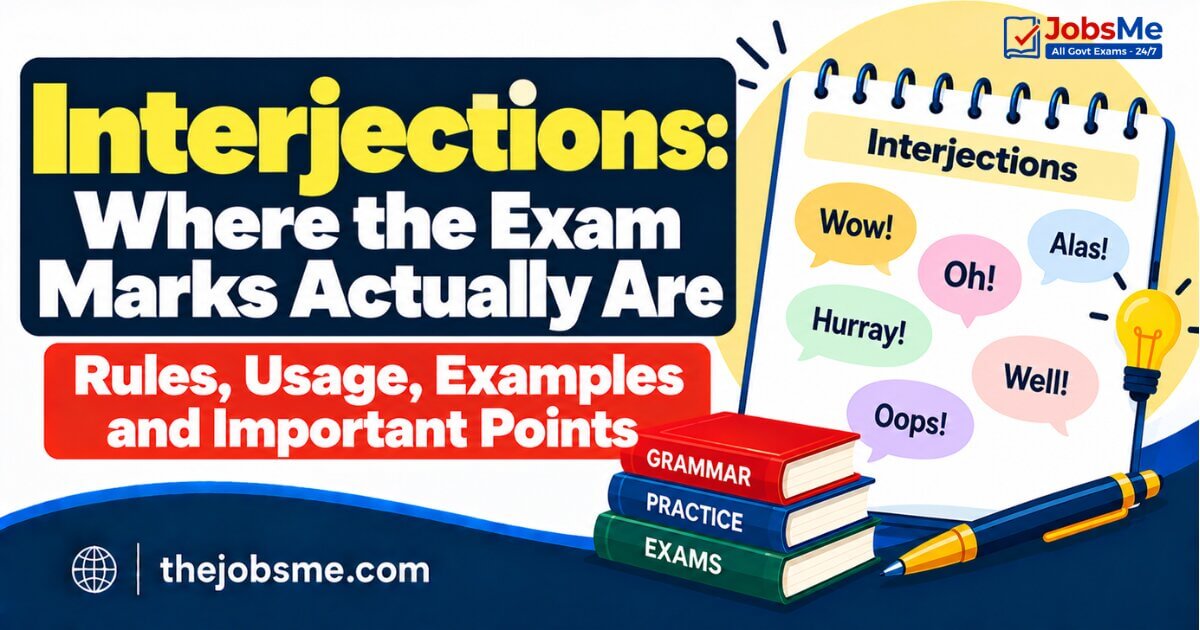
An interjection is a word or short phrase that expresses a sudden feeling and has no grammatical connection to the rest of the sentence. Alas! He could not qualify for the mains. The word alas carries the sorrow, and the sentence beside it would stand perfectly well without it.
It is the eighth part of speech, and the smallest topic in the English syllabus. It is also the one where study material most consistently teaches the wrong half.
Open almost any guide and you will find a long list of emotional words grouped by feeling, with a note that alas means sorrow and hurrah means joy. No competitive exam asks what alas means. What papers actually ask is what happens to that word when the sentence is converted into indirect speech, or turned into an assertive statement, or punctuated correctly.
So this article gives the word lists their due in one compact section and spends the rest of its space where the marks are.
Where This Topic Is Asked
| Route Into the Paper | What Is Actually Tested | Rough Weight | Difficulty |
|---|---|---|---|
| Narration questions | Converting Alas! I am ruined into indirect speech, where the interjection must disappear. | Part of the 1 to 3 marks narration carries | Moderate, and the rule is counter-intuitive. |
| Sentence transformation | Changing an exclamatory sentence into an assertive one and back. | 1 question in many papers | Easy once the template is known. |
| Parts of speech identification | Deciding whether a word such as well is working as an interjection or an adverb. | 1 question in SSC CHSL, MTS and teaching papers | Easy. |
| Punctuation questions | Whether the interjection takes a comma or an exclamation mark. | Indirect | Easy. |
| Descriptive papers | Knowing to leave them out, since they belong to informal writing. | Indirect | Worth knowing once. |
| Direct questions on meaning | Occasionally in school-level and state papers. | Rare in SSC and banking | Easy. |
The honest summary is that this is a small topic with a poor return if studied the usual way and a decent return if studied properly. An hour spent on the narration and transformation rules is worth more than a week spent memorising which noise means which emotion. Check your own pattern in the exam-wise syllabus hub.
The Defining Feature: Grammatical Independence
Every other part of speech does a job inside the sentence. A noun names, a verb acts, an adjective describes, a conjunction joins. An interjection does none of these. It sits beside the sentence rather than inside it.
Three consequences follow, and each one is testable.
- It does not affect subject-verb agreement. Alas! The students were absent takes the same verb as the sentence without alas.
- It does not affect the tense. Adding or removing an interjection changes nothing about the verb.
- It can be deleted without breaking the sentence. This is the identification test, and it is the most useful line in the topic.
So to check whether a word is an interjection, delete it. If what remains is a complete, correct sentence and only the emotion has been lost, the word was an interjection.
One correction is worth making here. Some study material states that an interjection is unique because it needs no subject or predicate. That is not quite the distinguishing feature, since no individual word carries a subject or predicate. What makes an interjection unique is that it has no grammatical relationship with anything else in the sentence.
Is It Really an Interjection?
Many interjections are ordinary words doing an unusual job, so exams ask you to identify the part of speech from the sentence rather than from the word. Apply the deletion test to each of these.
| Word | As an Interjection | As Another Part of Speech |
|---|---|---|
| well | Well! You have arrived at last. | She sings well, an adverb. The well is deep, a noun. |
| good | Good! Now we can begin. | He is a good officer, an adjective. |
| right | Right! Let us move on. | Turn right, an adverb. Your right to appeal, a noun. |
| now | Now! Stop that at once. | He is busy now, an adverb. |
| no | No! That cannot be true. | There is no water, a determiner. |
| indeed | Indeed! I had no idea. | It was indeed a fine speech, an adverb. |
| hark | Hark! The bell is ringing. | The policy harks back to the nineties, a verb. |
Notice how the deletion test settles every row. Remove well from Well! You have arrived and the sentence survives. Remove it from she sings well and the sentence is damaged, which proves it was doing grammatical work and was therefore an adverb.
One more correction is needed, because a widely used source repeatedly calls interjections joyful adverbs and exclamatory adverbs. They are not adverbs at all. An adverb modifies a verb, an adjective or another adverb, while an interjection modifies nothing. That is the whole distinction between the two.
Formula Box
- The definition. A word expressing sudden feeling, with no grammatical link to the sentence.
- The identification test. Delete it. If the sentence survives intact, it was an interjection.
- Strong emotion takes an exclamation mark, mild emotion takes a comma.
- In the middle of a sentence, it takes a comma on both sides.
- In indirect speech the interjection is deleted, and the reporting verb carries the emotion instead.
- What a becomes a very, and how becomes very, when converting to assertive.
- Avoid them entirely in descriptive papers.
The Four Types
| Type | What It Means | Examples |
|---|---|---|
| Primary | Words that exist only as interjections and belong to no other part of speech. | Alas, hurrah, ouch, phew, oops, aha, hush, hark, ugh, eek. |
| Secondary | Words borrowed from other parts of speech and used as interjections. | Good, well, right, indeed, goodness, bravo, nonsense, wonderful. |
| Mild | Softer feeling, usually followed by a comma. | Oh, I did not expect that. Well, let me think. |
| Strong | Intense feeling, followed by an exclamation mark. | Hurrah! We have won. Ouch! That hurt. |
| Volitive | Directs the listener's behaviour rather than expressing feeling. | Hush! The baby is sleeping. Hark! Listen to that. |
The primary and secondary distinction is the one worth remembering, because it is exactly what the identification questions test.
The Functional Catalogue
Here is the word list, given once and compactly.
| Feeling | Interjections | Example |
|---|---|---|
| Joy or triumph | Hurrah, hooray, yay, aha, bravo, yippee | Hurrah! I have cleared the cutoff. |
| Grief or regret | Alas, ah, oh no, oh dear | Alas! He could not qualify. |
| Surprise or disbelief | Oh, what, ah, my goodness, oh my | What! The exam has been postponed? |
| Pain | Ouch, ow, ah | Ouch! I stubbed my toe. |
| Approval or praise | Bravo, well done, splendid, excellent | Bravo! You scored full marks. |
| Attention or silence | Hark, hush, listen, look, ahem, shh | Hush! The examination has started. |
| Greeting or farewell | Hello, hey, hi, bye, adieu, farewell | Hello! Is this the exam hall? |
| Relief | Phew, thank goodness, whew | Phew! I reached just in time. |
| Disgust | Ugh, yuck, ew | Ugh! This water smells bad. |
| Hesitation or thought | Um, er, hmm, well | Hmm, let me think about that. |
| Mistake or alarm | Oops, uh-oh, yikes | Oops! I forgot the admit card. |
Read that table twice and it is done. The four rows worth committing properly are grief, joy, approval and surprise, because those are the ones narration questions use.
Interjection Phrases
Not every interjection is a single word. A number of fixed phrases do the same job, and they behave identically: no grammatical link to the sentence, deleted in indirect speech, and replaced by a reporting verb.
| Phrase | Feeling | In Indirect Speech |
|---|---|---|
| What a pity! | Regret | exclaimed with regret |
| How sad! | Sorrow | exclaimed with sorrow |
| Well done! | Approval | applauded, praised |
| Good heavens! | Surprise or alarm | exclaimed with surprise |
| Dear me! | Mild dismay | exclaimed with concern |
| Oh dear! | Dismay | exclaimed with dismay |
| Thank goodness! | Relief | exclaimed with relief |
| How dare you! | Anger | exclaimed angrily |
| No way! | Disbelief or refusal | exclaimed in disbelief |
Treat a phrase exactly as you would a single word, so What a pity! He has failed becomes he exclaimed with regret that he had failed. The phrase disappears in full, not in part.
The Exclamatory Sentence
An interjection and an exclamatory sentence are related but not the same thing, and questions sometimes turn on the difference.
- An interjection is a word standing beside a sentence. Wow! The results are out.
- An exclamatory sentence is a whole sentence built to express strong feeling, usually opening with what or how. What a relief the results are!
- An optative sentence expresses a wish or prayer. May you live long! or If only I had studied harder!
The word order matters and is often what a question tests. An exclamatory sentence beginning with what or how pushes the subject and verb to the end, so it is how fast he runs and never how fast does he run. That second version is a question, not an exclamation.
An optative sentence converts to assertive with a wish clause, so May you live long! becomes I wish that you may live long, and If only I were rich! becomes I wish I were rich.
Punctuation Rules
| Position | Rule | Example |
|---|---|---|
| At the start, strong feeling | An exclamation mark, and the next word takes a capital letter. | Hurrah! We have won the match. |
| At the start, mild feeling | A comma, and the sentence continues in lower case. | Well, I am not sure about that. |
| In the middle | A comma before and a comma after. | He finished the race, phew, just in time. |
| Standing alone | It may take an exclamation mark, a full stop or a question mark. | Ouch! Hmm. Eh? |
| Never | An interjection takes no apostrophe when made plural. | Write wows and yippees, never wow's. |
The comma against exclamation mark choice is a real question in punctuation items, and the rule is simply intensity. Compare Oh, I see what you mean with Oh! I forgot my admit card. The first is a mild realisation and the second a jolt.
Key Highlights
- The word lists answer almost no exam questions. The conversions do.
- Delete the interjection in indirect speech and let the reporting verb carry the feeling.
- Never keep both, since that states the emotion twice.
- The intensity word decides assertive conversions, so never drop very or great.
- The deletion test settles every part of speech question in this topic.
Interjections in Indirect Speech
This is where the marks are, and the rule surprises most candidates.
When a sentence containing an interjection is converted into indirect speech, the interjection is deleted entirely. Its emotional work is taken over by the reporting verb, so keeping the word as well is wrong.
- Direct: "Alas! I am ruined," said the merchant.
- Correct indirect: The merchant exclaimed with sorrow that he was ruined.
- Wrong indirect: The merchant exclaimed with sorrow that alas he was ruined.
Students keep the interjection because deleting a word feels like losing meaning. The meaning has not been lost, because it has moved into exclaimed with sorrow. Keeping both states the emotion twice.
The Reporting Verb Table
Choosing the right reporting verb is the other half of the question, and it follows directly from the feeling.
| Interjection | Feeling | Reporting Verb |
|---|---|---|
| Alas, oh dear, ah | Sorrow or regret | exclaimed with sorrow, exclaimed with regret, lamented |
| Hurrah, hooray, yippee | Joy | exclaimed with joy, exclaimed with delight |
| Bravo, well done | Approval | applauded, praised, exclaimed with approval |
| Oh, what, my goodness | Surprise | exclaimed with surprise, exclaimed in astonishment |
| Ugh, yuck | Disgust | exclaimed with disgust |
| Hush, shh | A command for silence | urged, ordered, asked |
| Hark, listen | Drawing attention | called attention, urged |
| Phew | Relief | exclaimed with relief |
| May God, would that | A wish or prayer | prayed, wished |
Two worked conversions show the whole pattern.
- Direct: "Hurrah! We have won the match," said the captain. Indirect: The captain exclaimed with joy that they had won the match.
- Direct: "Bravo! You have done well," said the teacher. Indirect: The teacher applauded and said that he had done well.
Notice that everything else follows the ordinary narration rules. The tense shifts back, the pronouns adjust to the reporter's point of view, and the quotation marks disappear. The full treatment is in direct and indirect speech.
Exclamatory to Assertive
The second high-value conversion turns an exclamation into a plain statement, and it has a fixed template with one detail that examiners exploit.
| Exclamatory | Assertive | The Rule |
|---|---|---|
| What a clever boy he is! | He is a very clever boy. | What a plus a noun becomes a very plus the noun. |
| What a beautiful garden this is! | This is a very beautiful garden. | The same noun pattern. |
| How fast he runs! | He runs very fast. | How plus an adverb becomes very plus the adverb. |
| How kind she is! | She is very kind. | The same pattern with an adjective. |
| Alas! We have lost him. | It is very sad that we have lost him. | An interjection becomes a clause naming the emotion. |
| Hurrah! We have won. | It is a matter of great joy that we have won. | The same pattern for joy. |
The detail that decides these questions is the intensity word. A conversion that drops very or great has lost the emotional force the original carried, and examiners routinely offer such an option as a distractor.
Watch the word order too. The exclamatory form puts the subject and verb at the end, so what a clever boy he is keeps he is last, while the assertive form restores the normal order. The wider set of conversions is in transformation of sentences.
Register: Leave Them Out of Formal Writing
Interjections belong to speech and to informal writing. In a bank mains essay or an SSC descriptive letter, they read as unserious.
- Informal: Oops! There was a mistake in the report.
- Formal: Unfortunately, an error occurred in the report.
- Informal: Wow! The scheme has done really well.
- Formal: The scheme has performed remarkably well.
The rule for descriptive papers is simple: no interjections at all, and no exclamation marks except where the content genuinely demands one. The same restraint is discussed in essay writing.
A Warning About Study Material on This Topic
- Interjections called adverbs. One widely used source describes them as joyful adverbs and exclamatory adverbs, and states outright that Ah, What and Oh are exclamatory adverbs. They belong to a separate part of speech, and calling them adverbs contradicts the definition given three lines earlier in the same document.
- An answer key using a word not offered. A practice set supplies ten options and then answers one question with Bravo, which is not among them. The same key uses Ah for two different blanks from a single-use list.
- Approval mixed with request. A list of interjections expressing approval includes Please, which requests rather than approves.
- Missing punctuation in a model example. No way are we going is offered as correct usage. It should read No way! We are not going.
Exam Alert
- The commonest distractor keeps the interjection inside the reported clause.
- The second commonest drops very from an exclamatory conversion.
- Plain said is usually wrong here, because it loses the emotion you just deleted.
- Secondary interjections such as well, right and now are what identification questions use.
- In a descriptive paper, leave interjections out entirely.
Ten Solved Questions
1. Convert to indirect speech. "Alas! I have failed the examination," said Ravi.
Working: Delete the interjection and let the reporting verb carry the sorrow. Answer: Ravi exclaimed with sorrow that he had failed the examination.
2. Convert to indirect speech. "Hurrah! Our team has won," said the boys.
Working: Joy takes exclaimed with joy, and the present perfect shifts to the past perfect. Answer: The boys exclaimed with joy that their team had won.
3. Which indirect form is correct? (a) He exclaimed with sorrow that alas he was ruined. (b) He exclaimed with sorrow that he was ruined. (c) He said that alas he was ruined. (d) He exclaimed alas that he was ruined.
Working: The interjection must go, and the reporting verb must name the emotion. Answer: (b).
4. Convert to assertive. What a beautiful painting this is!
Working: What a plus a noun becomes a very plus the noun, with normal word order restored. Answer: This is a very beautiful painting.
5. Convert to assertive. How quickly the time passes!
Working: How plus an adverb becomes very plus the adverb. Answer: The time passes very quickly.
6. Identify the part of speech of well. Well! I did not expect to see you here.
Working: Delete it and the sentence survives complete, so it is doing no grammatical work. Answer: Interjection. In she plays the veena well, the same word would be an adverb.
7. Choose the correct punctuation. (a) Oh! I see what you mean. (b) Oh, I see what you mean. (c) Oh I see what you mean. (d) Oh; I see what you mean.
Working: This is mild realisation rather than shock, so a comma fits. Answer: (b). Option (a) is not wrong in itself but suggests a much stronger reaction.
8. Find the error. The results were declared (a) / and phew (b) / everyone had passed. (c) / No error (d)
Working: An interjection inside a sentence needs a comma on each side. Answer: (b), which should read and, phew,.
9. Convert to indirect speech. "Bravo! You have played splendidly," said the coach.
Working: Approval takes applauded, and the interjection is dropped. Answer: The coach applauded and said that he had played splendidly.
10. Which sentence uses hark as an interjection? (a) The proposal harks back to an older scheme. (b) Hark! Someone is at the door. (c) He harked to the advice. (d) The harking of the dogs continued.
Working: Only in option (b) does the word stand outside the sentence structure. Answer: (b).
Quick Facts
- Alas takes exclaimed with sorrow. Hurrah takes exclaimed with joy.
- Bravo takes applauded. Oh and what take exclaimed with surprise.
- What a becomes a very; how becomes very.
- Strong feeling takes an exclamation mark; mild feeling takes a comma.
- Mid-sentence interjections take a comma on each side.
- Primary: alas, hurrah, ouch, phew. Secondary: well, good, right, indeed.
Worked Examples: Wrong to Right
Example 1 (studying the word list)
Sentence: A student memorises fifty interjections grouped by emotion, then meets a narration question and does not know what to do with alas.
Trap: The lists are the visible content of every guide, and finishing one feels like completing the topic. Exams do not ask what alas means; they ask what happens to it when the sentence is converted.
Correct Answer: Learn the deletion rule and the reporting-verb table first.
Rule in Simple Words: The marks are in the conversions, not the vocabulary.
Example 2 (keeping the interjection in indirect speech)
Sentence: A student writes He exclaimed with sorrow that alas he was ruined.
Trap: Deleting a word feels like throwing away part of the speaker's meaning, so keeping it seems safer and more faithful. The emotion has already moved into exclaimed with sorrow, so the sentence now states it twice.
Correct Answer: He exclaimed with sorrow that he was ruined.
Rule in Simple Words: The reporting verb absorbs the interjection, so the word itself goes.
Example 3 (a flat reporting verb)
Sentence: A student converts "Hurrah! We have won" into He said that they had won.
Trap: Said is the default reporting verb and is never wrong in ordinary narration, so it feels safe here too. Deleting the interjection without upgrading the reporting verb loses the emotion entirely.
Correct Answer: He exclaimed with joy that they had won.
Rule in Simple Words: Delete the word and replace its work in the reporting verb.
Example 4 (dropping very)
Sentence: For What a clever boy he is! a student writes He is a clever boy.
Trap: The new sentence is grammatical, natural and says roughly the same thing, so nothing looks wrong. The exclamatory form carried an intensity that has now vanished, and examiners plant exactly this option.
Correct Answer: He is a very clever boy.
Rule in Simple Words: What a becomes a very, and how becomes very.
Example 5 (calling it an adverb)
Sentence: Asked to name the part of speech of Oh in Oh! I forgot the date, a student answers adverb.
Trap: Some study material genuinely labels these words exclamatory adverbs, so the wrong answer has been taught. An adverb modifies a verb, an adjective or another adverb, and Oh modifies nothing at all.
Correct Answer: Interjection.
Rule in Simple Words: If it modifies nothing and can be deleted, it is an interjection.
Example 6 (missing the mid-sentence commas)
Sentence: A student writes He reached the hall phew just before the gate closed.
Trap: The interjection is short and the sentence reads acceptably aloud, so the commas feel optional. An interjection inside a sentence needs a comma on each side, exactly like any other inserted element.
Correct Answer: He reached the hall, phew, just before the gate closed.
Rule in Simple Words: Two commas for anything dropped into the middle of a sentence.
Example 7 (an interjection in a formal essay)
Sentence: In a bank mains essay a candidate writes Alas! The scheme has not reached the poorest districts.
Trap: The word adds feeling to an argument, and feeling seems persuasive. Formal writing conveys concern through the content, and an interjection makes an otherwise serious paragraph read as casual.
Correct Answer: Unfortunately, the scheme has not reached the poorest districts.
Rule in Simple Words: No interjections in descriptive papers.
Example 8 (misreading a familiar word)
Sentence: Asked which sentence uses well as an interjection, a student picks She sings well.
Trap: The word is identical in both sentences, so the choice looks arbitrary. Part of speech depends on the job the word does in that particular sentence, not on the word itself.
Correct Answer: Well! You have arrived at last.
Rule in Simple Words: Apply the deletion test to the sentence in front of you.
Common Traps Students Fall Into
These are the habits that most often cost marks. Each one is a common trap, not a silly mistake, and each has a one-line fix.
- Trap: Memorising word lists and stopping there. Fix: The marks are in narration and transformation.
- Trap: Keeping the interjection in indirect speech. Fix: Delete it, because the reporting verb now carries it.
- Trap: Using said as the reporting verb. Fix: Choose one that names the emotion.
- Trap: Dropping very or great in an assertive conversion. Fix: The intensity word preserves the emotional degree.
- Trap: Keeping exclamatory word order in an assertive sentence. Fix: Restore the normal subject and verb order.
- Trap: Calling an interjection an adverb. Fix: An adverb modifies something and an interjection modifies nothing.
- Trap: Judging a word by itself rather than by its sentence. Fix: Use the deletion test each time.
- Trap: Using an exclamation mark for a mild reaction. Fix: Mild feeling takes a comma.
- Trap: Forgetting the commas around a mid-sentence interjection. Fix: One before and one after, as in punctuation rules.
- Trap: Using them in descriptive answers. Fix: They belong to speech and informal writing only, as noted in letter writing.
- Trap: Adding an apostrophe to make a plural. Fix: Write wows, never wow's.
Memory Tricks and Formulas
1. The deletion test
Remove the word. If the sentence remains complete and correct and only the feeling is missing, the word was an interjection. This single test answers every identification question and settles the adverb confusion permanently.
2. Delete and absorb
In indirect speech the interjection disappears and the reporting verb takes over its job. Alas becomes exclaimed with sorrow, hurrah becomes exclaimed with joy, and bravo becomes applauded. Never keep both.
3. What a becomes a very
For exclamatory to assertive, what a plus a noun becomes a very plus the noun, and how plus an adjective or adverb becomes very plus that word. The intensity word is what the question is really testing.
4. Loud takes a bang, quiet takes a comma
Strong feeling takes an exclamation mark and mild feeling takes a comma. Ouch! against Well, let me think. Read the sentence aloud and the choice is obvious.
5. Two commas in the middle
An interjection dropped into the middle of a sentence needs a comma on each side, exactly like any other inserted element. He reached the hall, phew, just in time.
6. Primary against secondary
Primary interjections such as alas, hurrah and ouch exist only as interjections. Secondary ones such as well, good and right are borrowed from other parts of speech, which is precisely why identification questions use them.
7. Four rows, not fifty words
If you learn only part of the catalogue, learn grief, joy, approval and surprise, since those four supply almost every narration question that uses an interjection.
8. Budget the time honestly
This topic contributes to roughly 1 to 3 marks across a paper, and almost all of it through narration and transformation. One hour on the conversion rules closes it, and further time is better spent elsewhere.
Exam Patterns and High-Yield Facts
Frequently Confused Pairs
| Pair | How They Differ | Mini Trick |
|---|---|---|
| Interjection vs Adverb | An adverb modifies something; an interjection modifies nothing. | Delete it and see whether the sentence breaks. |
| Interjection vs Conjunction | A conjunction joins; an interjection has no grammatical function at all. | Joining against exclaiming. |
| Primary vs Secondary | One exists only as an interjection; the other is borrowed. | Alas is primary; well is secondary. |
| Mild vs Strong | Intensity decides the punctuation. | Comma for mild, exclamation mark for strong. |
| Exclaimed with joy vs Exclaimed with sorrow | The reporting verb must match the feeling. | Hurrah takes joy, alas takes sorrow. |
| Said vs Exclaimed | Said loses the emotion the interjection carried. | Upgrade the verb when you delete the word. |
| Ah vs Aha | Ah is realisation or regret; aha is discovery or triumph. | Aha finds something. |
| Hark vs Hush | One draws attention to a sound; the other demands silence. | Hark listens, hush stops. |
| Oh vs Oh no | Surprise against dismay. | No adds the bad news. |
| Exclamatory sentence vs Interjection | An exclamatory sentence is a whole sentence; an interjection is a word beside one. | What a day it is! against Wow! |
Repeating Question Patterns
- Narration conversion of a sentence opening with an interjection, testing whether you delete it and choose the right reporting verb.
- A distractor option that keeps the interjection inside the reported clause.
- Exclamatory to assertive conversion, with one option quietly dropping very or great.
- Part of speech identification using a secondary interjection such as well or right.
- A punctuation item testing comma against exclamation mark.
- A missing comma around a mid-sentence interjection in an error spotting question.
Practice Set: Fifteen Questions
Answer or correct each item.
- Convert to indirect speech: "Alas! My purse has been stolen," said the traveller.
- Convert to indirect speech: "Hurrah! I have cleared the interview," said Anita.
- Convert to assertive: What a splendid building this is!
- Convert to assertive: How gracefully she dances!
- Identify the part of speech of right: Right! Let us begin the meeting.
- Identify the part of speech of well: The candidate answered every question well.
- Punctuate: Oh I did not realise you were waiting.
- Punctuate: Hurrah we have been selected.
- Correct the sentence: The office was closed and alas we had to return.
- Convert to indirect speech: "Bravo! You have done splendidly," said the principal.
- Which is correct? (a) He exclaimed with joy that hurrah they had won. (b) He exclaimed with joy that they had won.
- Convert to assertive: Alas! She could not attend the ceremony.
- Rewrite formally for an essay: Wow! The literacy rate has improved a lot.
- Which sentence uses now as an interjection? (a) He is busy now. (b) Now! Stop arguing at once.
- Correct the plural: The speech was full of wow's and cheers.
Quick Facts
Answer key, with the rule named in each case.
- 1. The traveller exclaimed with sorrow that his purse had been stolen. Delete the interjection; the verb carries the grief.
- 2. Anita exclaimed with joy that she had cleared the interview.
- 3. This is a very splendid building. What a becomes a very.
- 4. She dances very gracefully. How plus an adverb becomes very plus the adverb.
- 5. Interjection. Deleting it leaves a complete sentence.
- 6. Adverb. It modifies answered, and deleting it damages the sense.
- 7. Oh, I did not realise you were waiting. Mild feeling takes a comma.
- 8. Hurrah! We have been selected. Strong feeling takes an exclamation mark.
- 9. The office was closed and, alas, we had to return. A mid-sentence interjection takes two commas.
- 10. The principal applauded and said that he had done splendidly. Approval takes applauded.
- 11. (b). The interjection must not survive into the reported clause.
- 12. It is very sad that she could not attend the ceremony.
- 13. The literacy rate has improved considerably. Formal writing takes no interjection.
- 14. (b). In option (a) the word is an adverb of time.
- 15. full of wows and cheers. An interjection takes no apostrophe in the plural.
Notice how few of those needed the word list at all. Eleven of the fifteen turned on a conversion, a punctuation rule or an identification test, which is the whole argument of this article in one practice set. Try more with the free English MCQ quizzes and full papers from the mock test archive.
Quick Revision
Quick Revision
- What an interjection is. A word or short phrase expressing sudden feeling, with no grammatical connection to the rest of the sentence.
- It is the eighth part of speech and the smallest topic in the English syllabus.
- Where the marks really are. Narration conversion, exclamatory to assertive transformation, punctuation and part of speech identification, not the meanings of the words.
- The defining feature is grammatical independence, so an interjection affects neither subject-verb agreement nor tense.
- The identification test. Delete the word, and if the sentence remains complete and only the feeling is lost, it was an interjection.
- An interjection is not an adverb, because an adverb modifies a verb, an adjective or another adverb while an interjection modifies nothing.
- Primary interjections exist only as interjections, such as alas, hurrah, ouch, phew, oops and hark.
- Secondary interjections are borrowed from other parts of speech, such as well, good, right, indeed and goodness, and these are what identification questions use.
- Strong feeling takes an exclamation mark and mild feeling takes a comma.
- A mid-sentence interjection takes a comma on each side.
- An interjection takes no apostrophe in the plural, so write wows rather than wow's.
- In indirect speech the interjection is deleted entirely, because the reporting verb takes over its emotional work.
- Keeping both the interjection and an emotional reporting verb states the feeling twice and is the commonest error in this topic.
- Match the reporting verb to the feeling. Alas takes exclaimed with sorrow, hurrah takes exclaimed with joy, bravo takes applauded, and oh takes exclaimed with surprise.
- Deleting the word without upgrading the verb loses the emotion, so plain said is usually wrong here.
- Everything else in the conversion follows ordinary narration rules, so the tense shifts back and the pronouns adjust.
- What a plus a noun becomes a very plus the noun when converting exclamatory to assertive.
- How plus an adjective or adverb becomes very plus that word.
- The intensity word decides these questions, so an option that drops very or great has lost the emotional degree.
- Restore normal word order in the assertive form, since the exclamatory form puts the subject and verb at the end.
- Alas becomes it is very sad that, and hurrah becomes it is a matter of great joy that.
- Use no interjections in descriptive papers, since they belong to speech and informal writing.
- Timing. The topic is worth about an hour, spent almost entirely on the conversion rules.
Interjections are the one topic where the visible content and the examinable content barely overlap. The word lists fill every guide and answer almost no questions, while the deletion rule for narration and the intensity rule for assertive conversion quietly decide several marks a year. So learn the four emotional families that narration uses, memorise the reporting verbs that replace them, and apply the deletion test whenever a part of speech question appears. The topic connects directly to direct and indirect speech and transformation of sentences, overlaps with punctuation rules for the comma and exclamation mark, and turns up in error spotting when the commas around one are missing. The wider set is in the topic-wise English notes.
Frequently Asked Questions
What is an interjection?
How do I know whether a word is an interjection?
Are interjections a kind of adverb?
What happens to an interjection in indirect speech?
Which reporting verbs go with which interjections?
How is an exclamatory sentence changed into an assertive one?
Why does the word very matter so much in that conversion?
When does an interjection take a comma rather than an exclamation mark?
What is the difference between primary and secondary interjections?
Should interjections be used in a descriptive paper?

About the author





