
Degrees of Comparison: Rules, Traps and Exam Errors
This article is a complete, exam-ready guide to degrees of comparison for SSC, banking, insurance, railway, defence and State PSC exams. It separates the two halves of the topic that most study material runs together: forming comparative and superlative words, which is easy and barely tested, and the logic of comparison, which is where every exam mark actually sits. The formation rules are compressed into one efficient section, and the rest of the article works through the comparison traps examiners return to, including Latin comparatives that take to rather than than, absolute adjectives that cannot be compared, and the any against any other distinction. Ten solved questions, common traps and a fifteen-question practice set with a full answer key are included.
Introduction
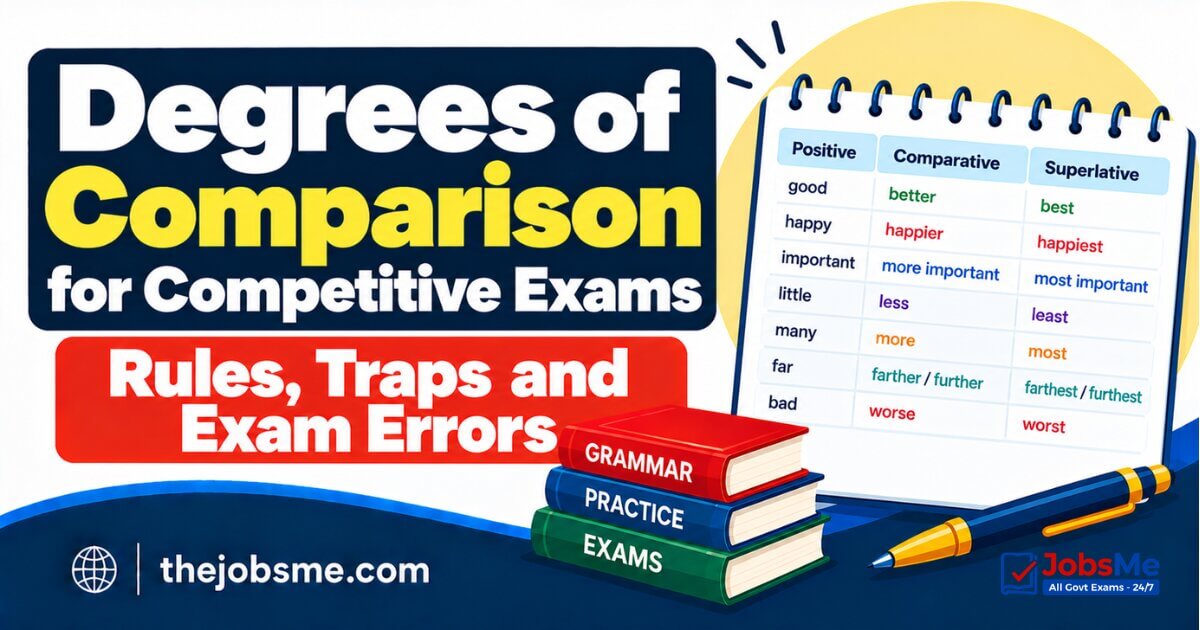
Degrees of comparison are the three forms an adjective or adverb takes to show how much of a quality something has. Tall describes, taller compares two, and tallest compares more than two.
Here is the thing worth knowing before you start. This is really two topics wearing one name, and only the second one earns marks.
- Forming the words. Whether to write bigger or more big, happier or more happy. This is school-level spelling, and any adult reader of English already does it correctly by instinct.
- The logic of comparison. What may be compared with what, which adjectives refuse comparison altogether, and which take to instead of than. This is what SSC and bank papers test, and almost none of it is instinctive.
Open almost any guide to this topic and you will find page after page of word lists, hundreds of rows of positive, comparative and superlative forms. The reference document behind this article contains twenty such tables. That is effort spent on the half that was never going to be asked. So the formation rules here are compressed into one section, and the rest of the article goes where the marks are.
Where This Topic Is Asked
| Exam | How This Topic Appears | Rough Weight | Difficulty |
|---|---|---|---|
| SSC CGL and CHSL | Inside error spotting and sentence improvement, where comparison is a recurring error family. | Part of the 4 to 5 error spotting questions per paper | Moderate. The same six or seven rules repeat. |
| Bank PO and clerk | Error detection items, and occasionally in sentence completion. | 1 question in many shifts | Moderate. |
| SSC CPO, MTS and Stenographer | Both error spotting and direct degree-change questions. | 1 to 2 questions | Easy to moderate. |
| Railway and defence exams | Straightforward fill-in-the-degree questions. | 1 question | Easy. |
| Teaching and State PSC exams | Direct questions, including degree conversion. | Varies by state | Easy to moderate. |
| Descriptive papers | A faulty comparison is one of the errors an examiner notices immediately. | Indirect | Worth the care. |
Notice the pattern. The topic almost never announces itself. It arrives disguised as an error spotting item, which is why students who have memorised a hundred word lists still miss the question. Check your own pattern in the exam-wise syllabus hub.
Part One: Forming the Words
All of it fits in one table. Read it once, confirm you already knew it, and move on to the part that matters.
| Word Type | Rule | Examples |
|---|---|---|
| One syllable, ordinary ending | Add -er and -est. | tall, taller, tallest. long, longer, longest. kind, kinder, kindest. |
| One syllable, consonant plus vowel plus consonant | Double the last letter, then add -er and -est. | big, bigger, biggest. hot, hotter, hottest. sad, sadder, saddest. |
| Ending in e | Add only -r and -st. | large, larger, largest. brave, braver, bravest. fine, finer, finest. |
| Ending in y | Change y to i, then add -er and -est. | happy, happier, happiest. busy, busier, busiest. costly, costlier, costliest. |
| Two syllables or more | Use more and most before the word. | beautiful, more beautiful, most beautiful. important, more important, most important. |
| Irregular | No pattern, so learn them. | good, better, best. bad, worse, worst. little, less, least. many and much, more, most. far, farther or further, farthest or furthest. |
| Adverbs | The same rules apply. | fast, faster, fastest. well, better, best. badly, worse, worst. slowly, more slowly, most slowly. |
Two small points complete this half. A superlative normally takes the before it, and a comparative normally takes than after it. So it is she is the tallest girl and he is taller than I am, never she is tallest girl or he is taller me.
Formula Box
- Never double a comparison. More better and most tallest are always wrong.
- Latin comparatives take to, never than. Superior, inferior, senior, junior, prior, posterior, preferable.
- Absolute adjectives cannot be compared. Unique, perfect, complete, universal, square, round, parallel.
- Compare like with like. The speed of one car goes against the speed of another, not against the car.
- Any other inside the same group, any outside it.
- Comparative for two, superlative for more than two.
- Two qualities of one person take more, so more wise than shrewd.
Key Highlights
- Two topics, one name. Formation is instinctive; the comparison rules are not.
- The Latin nine are the highest-value rule in the whole topic.
- Absolutes take no degree, so the repair is to remove the comparison rather than fix it.
- Every comparison must put two things of the same kind side by side.
- This topic almost never announces itself, arriving instead as an error spotting item.
Part Two: The Comparison Traps
Everything from here is what exams actually test. There are eight traps, and together they account for nearly every degrees-of-comparison error in a competitive paper.
Trap 1: Double Comparison
An adjective is compared once, never twice. If the word already ends in -er or -est, it cannot also take more or most.
- Wrong: He is more smarter than his sister. Right: He is smarter than his sister.
- Wrong: These mangoes are more tastier than those. Right: These mangoes are tastier than those.
- Wrong: She is the most tallest girl in the class. Right: She is the tallest girl in the class.
- Wrong: This is more best. Right: This is the best.
One idiomatic exception survives and is worth recognising rather than avoiding. The lesser of two evils is correct, even though lesser is technically a double comparative, because the phrase is fixed.
Trap 2: Latin Comparatives Take To
A small group of adjectives came into English already carrying comparative meaning from Latin. They compare, but they take to rather than than. This is the most heavily tested single rule in the whole topic, and it appears in bank error spotting papers year after year.
| Adjective | Wrong | Right |
|---|---|---|
| superior | This cloth is superior than that. | This cloth is superior to that. |
| inferior | His work is inferior than mine. | His work is inferior to mine. |
| senior | She is senior than me in service. | She is senior to me in service. |
| junior | Shelley is junior than Wordsworth. | Shelley is junior to Wordsworth. |
| prior | Everything was settled prior than his leaving. | Everything was settled prior to his leaving. |
| posterior and anterior | The event was posterior than the treaty. | The event was posterior to the treaty. |
| preferable | This pen is preferable than that. | This pen is preferable to that. |
| prefer | I prefer tea than coffee. | I prefer tea to coffee. |
| elder | My sister is elder than me. | My sister is elder to me. |
Two extra notes on this group. Preferable already means more desirable, so more preferable is a double comparative and wrong. And these words also appear in ordinary positive use, as in our senior clerk or a minor problem, where no comparison is involved at all.
Trap 3: Adjectives That Cannot Be Compared
Some adjectives already express an absolute state, so there are no degrees of it. A thing is either unique or it is not, and nothing can be more square than something else.
The absolute list: unique, perfect, complete, entire, full, empty, universal, ideal, excellent, supreme, extreme, chief, round, square, circular, parallel, eternal and infinite.
- Wrong: This idea is more universal than that. Right: This idea is universal and that one is not.
- Wrong: It was the most unique opportunity. Right: It was a unique opportunity.
- Wrong: This track is more parallel than that. Right: This track is parallel and that one is not.
The repair is usually not to fix the comparison but to remove it, restating the sentence so that one thing has the quality and the other does not.
Trap 4: Compare Like with Like
A comparison must put two things of the same kind side by side. This is the trap that catches strong candidates, because the faulty sentence reads perfectly naturally.
- Wrong: The speed of this car is greater than the old one. Right: The speed of this car is greater than that of the old one. The original compares a speed with a car.
- Wrong: The colour of this wall is more attractive than the old one. Right: ...than that of the old one.
- Wrong: The Indian hockey team played better than Pakistan. Right: ...better than the Pakistan team. A team cannot be compared with a country.
- Wrong: The population of Mumbai is larger than Delhi. Right: ...larger than that of Delhi.
The signal to watch for is a sentence beginning with the speed of, the population of, the climate of or any similar phrase, because the second half must then repeat the structure with that of or those of.
Trap 5: Any Against Any Other
When a comparative is used to express a superlative meaning, one small word decides whether the sentence is logical.
- Inside the same group, use any other. Sanya is smarter than any other student in her class. Writing any student would include Sanya herself, making her smarter than herself.
- Outside the group, use any. Delhi is cleaner than any city in Bangladesh. Delhi is not a Bangladeshi city, so there is nothing to exclude and any other would be wrong.
Ask one question: is the subject a member of the group it is being compared with? If yes, write any other. If no, write any. Both errors appear in exams, so learn the pair rather than just the first half.
Trap 6: Two for Comparative, Three for Superlative
- Wrong: Take the shortest of the two routes. Right: Take the shorter of the two routes.
- Wrong: Among the three, who is more hard-working? Right: Among the three, who is the most hard-working?
- Wrong: She is taller of all the girls. Right: She is the tallest of all the girls.
Two signal words settle almost every question of this type. Of the two demands a comparative, while of all, among and in the class demand a superlative.
Trap 7: Two Qualities of One Person
This rule is rarely taught and regularly tested. When you compare two qualities of the same person or thing, use more even with a short adjective that would normally take -er.
- Wrong: He is wiser than shrewd. Right: He is more wise than shrewd.
- Wrong: She is braver than clever. Right: She is more brave than clever.
The logic is that you are not measuring one person against another but weighing two descriptions of the same person, so the sentence means wise rather than shrewd. The -er form cannot carry that sense.
Trap 8: Incomplete Double Comparison
When a sentence contains two comparisons, each must be grammatically complete on its own. Readers accept the shortened version in speech, but exams do not.
- Wrong: He is as bad if not better than his brother. Right: He is as bad as, if not better than, his brother.
- Wrong: I can run as fast, if not faster than you. Right: I can run as fast as, if not faster than, you.
The test is to read each comparison separately. He is as bad his brother is clearly broken, which shows the second as is missing.
Degrees of Comparison with Adverbs
Adverbs take the same three degrees and follow the same spelling logic, but two points differ enough to be worth stating.
| Adverb | Comparative | Superlative | Note |
|---|---|---|---|
| fast | faster | fastest | Short adverbs without -ly take -er and -est. |
| hard | harder | hardest | Do not confuse with hardly, which means scarcely. |
| early | earlier | earliest | Ends in y, so the y becomes i. |
| slowly | more slowly | most slowly | Adverbs ending in -ly take more and most. |
| carefully | more carefully | most carefully | The same rule. |
| well | better | best | Irregular, and the adverb form of good. |
| badly | worse | worst | Irregular. |
The rule that catches students is that an adverb ending in -ly almost always takes more, so more slowly is right and slowlier does not exist. The one common exception is early, which behaves like an adjective. And watch the pair he works harder against he hardly works, since one is a comparative and the other a negative.
Adjectives Used in the Positive Degree Only
A further group looks comparative but has settled into ordinary descriptive use, and none of them takes than.
Major, minor, interior, exterior, inner, outer, former, latter, utter, upper and ulterior.
- Right: It is a major issue. It is a minor problem. He had an ulterior motive.
- Wrong: This issue is major than that one.
Confusable Pairs Within the Topic
| Pair | How They Differ | Example |
|---|---|---|
| Elder and older | Elder is only for members of the same family and only before a noun, and it never takes than. | My elder brother. He is older than I am. |
| Eldest and oldest | The same restriction applies. | My eldest sister. This is the oldest temple in the village. |
| Farther and further | Farther is for physical distance, further for extent or something additional. | Chennai is farther than Vellore. No further questions were asked. |
| Latest and last | Latest means most recent, last means final. | His latest novel is selling well. His last novel was published before he died. |
| Nearest and next | Nearest is about distance, next is about order. | The nearest hospital. The next chapter. |
| Less and fewer | Less measures quantity, fewer counts items. | Less water. Fewer than twenty people. |
| Later and latter | Later refers to time, latter to the second of two things. | He arrived later. Of the two plans, the latter is cheaper. |
| Lesser and less | Lesser means smaller in importance and survives in fixed phrases. | The lesser of two evils. Less sugar, please. |
Converting Between the Three Degrees
Some papers ask you to rewrite a sentence in a different degree without changing its meaning. Three templates cover it.
| Meaning | Positive | Comparative | Superlative |
|---|---|---|---|
| B beats every other member | No other metal is as heavy as lead. | Lead is heavier than any other metal. | Lead is the heaviest of all metals. |
| B is among the best | Very few girls are as clever as Binsha. | Binsha is cleverer than most other girls. | Binsha is one of the cleverest girls. |
| Two things compared | B is not as tall as A. | A is taller than B. | Not used, since a superlative needs three. |
Keep the noun singular after any other and plural after of all, and never treat one of the cleverest as equal to cleverer than any other, because near the top is not the same as at the top. The wider method is in transformation of sentences.
A Warning About Study Material on This Topic
This deserves a section of its own, because the published material for degrees of comparison is unusually unreliable and a student cannot spot the errors without knowing the rules already.
- Identical wrong and right examples. A widely copied rule set presents She is wiser than her brother as both the incorrect and the correct version, with a cross beside one and a tick beside the other. The same happens with These shoes are preferable to those. Whatever the rule was meant to show, the example shows nothing.
- The wrong version marked correct. The same set gives My sister is elder than me a tick. It should be elder to me, and this is exactly the rule the section claims to be teaching.
- A wrong answer key. Another guide asks students to complete Ram is ___ than most of her friends and gives the answer as smartest. The sentence contains than, so the answer must be smarter.
- A garbled headline rule. One source opens with the claim that when a single quality is compared between two people, more or most should be used. The opposite is true, and the correct rule is that a short adjective takes -er and never takes more alongside it.
So test every example you meet against the rule it claims to illustrate, and be especially careful with answer keys that circulate as free downloads.
Exam Alert
- Superior, inferior, senior, junior, prior and preferable take to, and this is the commonest planted error.
- Check both directions of the any rule, since papers test any as often as any other.
- Of the two always signals a comparative, never a superlative.
- Most unique and more perfect are wrong however emphatic they sound.
- Once the rules are fresh there is a strong pull to over-correct, so some sentences really are already right.
Ten Solved Questions
1. Find the error. This piece of cloth (a) / is superior (b) / than the one you bought. (c) / No error (d)
Working: Superior is a Latin comparative and takes to. Answer: (c), which should read superior to.
2. Take the ___ of the two routes. Options: short, shorter, shortest, most short.
Working: Of the two demands a comparative. Answer: shorter.
3. Find the error. The population of Mumbai (a) / is much larger (b) / than Delhi. (c) / No error (d)
Working: A population is being compared with a city. Answer: (c), which should read than that of Delhi.
4. Sanya is smarter than ___ student in her class. Options: any, any other, some other, every.
Working: Sanya belongs to the class, so she must be excluded from the comparison. Answer: any other.
5. Delhi is cleaner than ___ city in Bangladesh. Options: any, any other, the other, all other.
Working: Delhi is not a Bangladeshi city, so there is nothing to exclude. Answer: any. This is the mirror image of the previous question and catches students who learnt only half the rule.
6. Find the error. He is (a) / more wiser (b) / than his brother. (c) / No error (d)
Working: Wiser is already comparative, so more creates a double comparison. Answer: (b).
7. Choose the correct sentence. (a) He is wiser than shrewd. (b) He is more wise than shrewd. (c) He is wisest than shrewd. (d) He is more wiser than shrewd.
Working: Two qualities of one person are being weighed, which requires more even with a short adjective. Answer: (b).
8. Find the error. It was the (a) / most unique opportunity (b) / of his career. (c) / No error (d)
Working: Unique is absolute and admits no degrees. Answer: (b), which should read a unique opportunity.
9. Correct the sentence. He is as bad if not better than his brother.
Working: The first comparison is incomplete without its second as. Answer: He is as bad as, if not better than, his brother.
10. Change to the comparative degree. Lead is the heaviest of all metals.
Working: The superlative template converts to the any other template, with the noun turning singular. Answer: Lead is heavier than any other metal.
Quick Facts
- The Latin nine: superior, inferior, senior, junior, prior, posterior, anterior, preferable, prefer. All take to.
- Absolutes: unique, perfect, complete, universal, square, round, parallel, entire, full, empty, ideal, supreme.
- Positive only: major, minor, interior, exterior, inner, outer, former, latter, utter, upper, ulterior.
- Any other inside the group, any outside it.
- Of the two takes a comparative; of all takes a superlative.
- Adverbs in -ly take more, so more slowly and never slowlier.
Worked Examples: Wrong to Right
Example 1 (studying the wrong half)
Sentence: A student spends three days memorising word lists of positive, comparative and superlative forms, then misses an error spotting question on superior than.
Trap: The lists are long and finishing them feels like real progress, because they are countable and the comparison rules are not. Nobody is ever asked whether happy becomes happier, since any competent reader of English knows that already.
Correct Answer: Give the formation table one reading and spend the rest of the time on the eight traps.
Rule in Simple Words: Study the half that is actually asked.
Example 2 (superior than)
Sentence: A student accepts This brand is superior than the imported one.
Trap: Every other comparative in English takes than, so the pattern is overwhelmingly established. Words borrowed from Latin already contain the comparison and take to instead.
Correct Answer: This brand is superior to the imported one.
Rule in Simple Words: Superior, inferior, senior, junior, prior and preferable all take to.
Example 3 (comparing unlike things)
Sentence: A student accepts The climate of Bengaluru is better than Chennai.
Trap: The intended meaning is obvious and the sentence sounds like ordinary speech, so nothing jars. Grammatically it compares a climate with a city, and exams treat that as an error.
Correct Answer: The climate of Bengaluru is better than that of Chennai.
Rule in Simple Words: If the sentence opens with the something of, repeat the structure with that of.
Example 4 (learning half the any rule)
Sentence: Having learnt to write any other, a student writes Delhi is cleaner than any other city in Bangladesh.
Trap: The rule was learnt as a fixed phrase rather than as a decision, so it gets applied everywhere. Any other exists to exclude the subject from its own group, and Delhi was never in that group.
Correct Answer: Delhi is cleaner than any city in Bangladesh.
Rule in Simple Words: Ask whether the subject belongs to the group before choosing.
Example 5 (comparing an absolute)
Sentence: A student writes This is the most perfect solution we have found.
Trap: Adding most feels like emphasis rather than comparison, and the phrase is common in advertising. Perfect describes a state that has no degrees, so nothing can be more perfect than something else.
Correct Answer: This is the perfect solution, or this solution is the best we have found.
Rule in Simple Words: Absolute adjectives take no more and no most.
Example 6 (superlative for two)
Sentence: A student writes She is the best of the two candidates.
Trap: A superlative sounds like stronger praise, and the best is a far commoner phrase than the better. A superlative requires at least three items to rank.
Correct Answer: She is the better of the two candidates.
Rule in Simple Words: Of the two always takes a comparative.
Example 7 (elder than)
Sentence: A student writes My sister is elder than me, having seen it in a published answer key marked correct.
Trap: Seeing the form with a tick beside it in study material makes it very hard to unlearn. Elder takes to, and it works best before a noun, as in my elder sister.
Correct Answer: My sister is elder to me, or more naturally, my sister is older than I am.
Rule in Simple Words: Elder never takes than.
Example 8 (the incomplete double comparison)
Sentence: A student writes Our scheme is as effective if not better than theirs.
Trap: The sentence flows well aloud, and the missing word is one nobody hears in speech. Split it and the fault is obvious, since as effective theirs is broken English.
Correct Answer: Our scheme is as effective as, if not better than, theirs.
Rule in Simple Words: Each comparison must stand alone when read separately.
Common Traps Students Fall Into
These are the habits that most often cost marks. Each one is a common trap, not a silly mistake, and each has a one-line fix.
- Trap: Memorising word lists instead of rules. Fix: Formation is instinctive, while the comparison rules are not.
- Trap: Doubling the comparison. Fix: Use more or -er, never both.
- Trap: Writing superior than. Fix: Latin comparatives take to.
- Trap: Writing more preferable. Fix: Preferable is already comparative.
- Trap: Comparing an absolute adjective. Fix: Nothing is more unique, more perfect or more parallel, a point worth checking in cloze test options too.
- Trap: Comparing unlike things. Fix: Add that of or those of to match the structures.
- Trap: Using any other everywhere. Fix: Only when the subject belongs to the group.
- Trap: Using a superlative for two things. Fix: Of the two takes the comparative, a point also tested in phrase replacement.
- Trap: Writing wiser than shrewd. Fix: Two qualities of one person take more.
- Trap: Dropping the second as. Fix: Read each comparison separately to check it stands alone.
- Trap: Trusting a downloaded answer key. Fix: Test every example against the rule it claims to show, as in sentence improvement practice.
Memory Tricks and Formulas
1. Once only
An adjective is compared once. If it already ends in -er or -est, no more or most may join it. This one line kills the commonest error in the topic.
2. The Latin nine
Superior, inferior, senior, junior, prior, posterior, anterior, preferable and prefer. All nine take to, never than, and elder behaves the same way. Say the list aloud until it runs by itself, because this is the single most tested rule here.
3. Absolutes have no degrees
Unique, perfect, complete, universal, square, round, parallel, entire, full, empty, ideal, supreme. A thing either is or is not, so the repair is to remove the comparison rather than to fix it.
4. That of, those of
Whenever a sentence opens with the speed of, the population of or the climate of, the second half must repeat the structure. Speeds go against speeds and climates against climates, never against cars and cities.
5. Inside or outside
Before writing any other, ask whether the subject belongs to the group. Sanya is in her class, so she needs any other. Delhi is not in Bangladesh, so it needs any.
6. Count the items
Of the two takes a comparative. Of all, among and in the class take a superlative. Counting the items being ranked settles this instantly.
7. One person, two qualities
When the sentence weighs two descriptions of the same subject, use more whatever the length of the adjective. More wise than shrewd means wise rather than shrewd, and wiser cannot carry that.
8. Budget the time honestly
This topic contributes to the 4 to 5 error spotting questions in an SSC paper rather than standing alone. Two focused sessions on the eight traps are worth more than a week on word lists.
Exam Patterns and High-Yield Facts
Frequently Confused Pairs
| Pair | How They Differ | Mini Trick |
|---|---|---|
| Superior to vs Superior than | Only to is correct. | Latin words came with the comparison built in. |
| Any vs Any other | Inside the group takes any other, outside takes any. | Ask whether the subject is a member. |
| Better of the two vs Best of the two | Two items take a comparative. | A superlative needs three to rank. |
| Elder vs Older | Elder is family only and takes no than. | My elder brother, but older than I am. |
| Farther vs Further | Distance against extent. | Farther down the road, further discussion. |
| Latest vs Last | Most recent against final. | His latest book, his last book. |
| Later vs Latter | Time against the second of two. | Arrived later, chose the latter. |
| Less vs Fewer | Quantity against number. | Less water, fewer bottles. |
| More wise vs Wiser | Two qualities of one person against two people compared. | More wise than shrewd, but wiser than his brother. |
| One of the best vs Better than any other | Near the top against at the top. | One of the pairs with very few. |
Repeating Question Patterns
- A Latin comparative followed by than, which is the commonest planted error in this family.
- A double comparison, usually more attached to an -er word.
- An unlike comparison, where a quality is compared with a thing.
- The any and any other decision, asked in both directions in different shifts.
- A superlative used for two items, signalled by the phrase of the two.
- An absolute adjective given a degree, most often most unique.
Practice Set: Fifteen Questions
Correct each sentence, or mark it correct as it stands.
- He is junior than me in the department.
- This laptop is more costlier than the one I saw yesterday.
- The climate of Pune is pleasanter than Mumbai.
- Of the two proposals, the second is the best.
- Meera is taller than any girl in her class.
- Mount Everest is higher than any peak in Africa.
- This was the most unique performance of the evening.
- He is more courageous than wise.
- My brother is elder than me by four years.
- She is as competent as, if not better than, her predecessor.
- I prefer coffee than tea in the mornings.
- Among the four candidates, she is more experienced.
- The salary offered here is better than that of the previous firm.
- These figures are more accurate than those published last year.
- This proposal is preferable to the earlier one.
Quick Facts
Answer key, with the rule named in each case.
- 1. junior to me. A Latin comparative takes to.
- 2. costlier than. More with an -er word is a double comparison.
- 3. pleasanter than that of Mumbai. A climate cannot be compared with a city.
- 4. the better of the two. Two items take a comparative.
- 5. any other girl. Meera belongs to the class and must be excluded.
- 6. Correct as it stands. Everest is not in Africa, so any is right.
- 7. a unique performance. Unique is absolute and takes no degree.
- 8. Correct as it stands. Two qualities of one person take more.
- 9. elder to me, or more naturally older than I am. Elder never takes than.
- 10. Correct as it stands. Both comparisons are complete.
- 11. prefer coffee to tea. Prefer takes to.
- 12. she is the most experienced. Four candidates require a superlative.
- 13. Correct as it stands. The salary is compared with a salary through that of.
- 14. Correct as it stands. Figures are compared with figures through those.
- 15. Correct as it stands. Preferable correctly takes to and no more.
Five of those fifteen were already correct, which matters because this topic invites over-correction once the rules are fresh. Practise the same restraint with the free English MCQ quizzes and full papers from the mock test archive.
Quick Revision
Quick Revision
- What the topic is. The three forms an adjective or adverb takes to show how much of a quality something has.
- The topic has two halves, and only the second earns marks. Forming the words is instinctive, while the logic of comparison is not.
- Formation in one line. Short words take -er and -est, words ending in y change y to i, words of two syllables or more take more and most, and a handful are irregular.
- A superlative normally takes the before it, and a comparative normally takes than after it.
- Never double a comparison. More better, most tallest and more costlier are always wrong.
- The lesser of two evils is the one idiomatic exception and should be recognised rather than corrected.
- Latin comparatives take to and never than. Superior, inferior, senior, junior, prior, posterior, anterior, preferable and prefer.
- Elder also takes to, works best before a noun, and is used only within a family.
- More preferable is wrong, because preferable already means more desirable.
- Absolute adjectives admit no degrees. Unique, perfect, complete, universal, square, round, parallel, entire, full, empty, ideal and supreme.
- Repair an absolute by removing the comparison, so this idea is universal and that one is not.
- Compare like with like. A speed goes against a speed and a climate against a climate, never against a car or a city.
- Add that of or those of whenever a sentence opens with the speed of, the population of or a similar phrase.
- Use any other when the subject belongs to the group, so Sanya is smarter than any other student in her class.
- Use any when the subject is outside the group, so Delhi is cleaner than any city in Bangladesh.
- Two items take a comparative and three or more take a superlative, so it is the better of the two and the best of the three.
- Of the two signals a comparative while of all, among and in the class signal a superlative.
- Two qualities of one person take more, even with a short adjective, so he is more wise than shrewd.
- Each comparison must be complete on its own, so write as bad as, if not better than, his brother.
- Some adjectives are positive only and take no than. Major, minor, interior, exterior, inner, outer, former, latter, utter, upper and ulterior.
- Farther is for distance and further for extent, latest means most recent while last means final, and nearest is distance while next is order.
- Later refers to time and latter to the second of two things.
- The three conversion templates. No other A is as adjective as B, B is adjective-er than any other A, and B is the adjective-est of all A.
- Keep the noun singular after any other and plural after of all.
- One of the cleverest is not the same as cleverer than any other, since near the top is not at the top.
- Published material on this topic is unusually unreliable, so test every example against the rule it claims to illustrate.
Degrees of comparison is a topic where the visible part is easy and the tested part is hidden. Nobody will ask you to turn happy into happiest, but plenty of papers will slip superior than or more unique into an error spotting item and wait. So skim the formation table, learn the Latin nine and the absolute list properly, and check every comparison for whether it puts two things of the same kind side by side. The topic feeds directly into error spotting and sentence improvement, connects to transformation of sentences for degree conversion, to tenses and subject-verb agreement for the rest of the grammar block, and to commonly confused words for the elder and farther pairs. The wider set is in the topic-wise English notes.
Frequently Asked Questions
What are the three degrees of comparison?
Which part of this topic do exams actually test?
Why is superior than wrong?
What is a double comparison?
Which adjectives cannot be compared?
What is wrong with the speed of this car is greater than the old one?
When should I use any other rather than any?
Why is he is wiser than shrewd wrong?
What is the difference between elder and older?
Why do study materials on this topic contain so many errors?

About the author





