
Static GK Notes – Topic-Wise Study Material
Hand-picked updates, explainers, and notifications for Static GK aspirants.
World War I and World War II – Complete Static GK & General Awareness Notes for Competitive Exams with Memory Tricks
This article presents complete, exam-ready notes on World War I (1914–1918) and World War II (1939–1945), covering their causes, alliances, major battles, important treaties and conferences, key leaders, India's role, and the aftermath of each war. It includes high-frequency facts such as the assassination of Archduke Franz Ferdinand, the Treaty of Versailles, the rise of Hitler, Pearl Harbor, D-Day, the atomic bombings of Hiroshima and Nagasaki, and the formation of the League of Nations and United Nations. All facts are arranged in a structured format with tables, memory tricks, and one-liners to help UPSC, SSC, IBPS, RRB, PSU, and State PCS aspirants score better in General Awareness and World History sections.
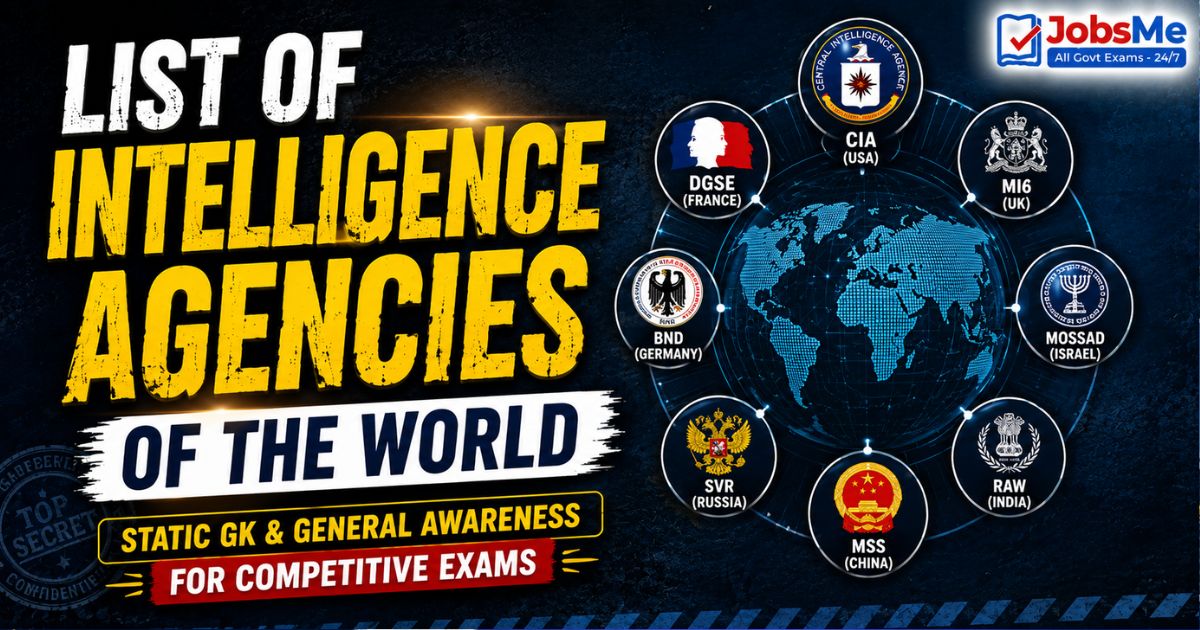
List of Intelligence Agencies of the World – Static GK & General Awareness for Competitive Exams with Memory Tricks
This article presents a complete list of the major intelligence agencies of the world along with their countries, headquarters, founding years, and key functions. It covers famous agencies like the CIA (USA), MI6 (UK), Mossad (Israel), RAW and IB (India), ISI (Pakistan), MSS (China), FSB and SVR (Russia), BND (Germany), and DGSE (France), with memory tricks and one-liners for quick revision. All facts are arranged in an exam-ready format to help UPSC, SSC, IBPS, RRB, PSU, and State PCS aspirants score better in the General Awareness and International Affairs sections.
List of World Famous Monuments and Landmarks with Their Locations – Static GK & General Awareness for Competitive Exams with Memory Tricks
This article presents a complete list of world famous monuments and landmarks along with the countries and cities where they are located, the rulers or architects who built them, and their key historical and architectural features. It covers iconic structures like the Taj Mahal (Agra, India), the Eiffel Tower (Paris, France), the Great Wall of China, the Statue of Liberty (USA), the Colosseum (Rome, Italy), the Pyramids of Giza (Egypt), and Christ the Redeemer (Brazil), along with memory tricks and one-liners for quick revision. All facts are arranged in exam-ready format to help UPSC, SSC, IBPS, RRB, PSU, and State PCS aspirants score better in the General Awareness and Static GK sections.
List of Parliaments of Countries – Static GK & General Awareness for Competitive Exams with Memory Tricks
This article presents a complete list of parliaments of countries across the world along with their structure (unicameral or bicameral) and key exam facts. It covers iconic legislatures like the Indian Sansad (Lok Sabha and Rajya Sabha), US Congress, UK Parliament, Japan's Diet, Russia's Federal Assembly (Duma), Iran's Majlis, Israel's Knesset, Germany's Bundestag, and the world's oldest parliament, Iceland's Althing, with memory tricks and one-liners for quick revision. All facts are arranged in exam-ready format to help UPSC, SSC, IBPS, RRB, PSU, and State PCS aspirants score better in General Awareness and Polity sections.
List of High Courts of India – Static GK & General Awareness for Competitive Exams with Memory Tricks
This article presents a complete and updated list of all 25 High Courts of India, covering their year of establishment, principal seat, benches, territorial jurisdiction, and the Act under which each was created. It includes key facts like the oldest High Court (Calcutta, 1862), the newest ones (Andhra Pradesh and Telangana, 2019), the smallest (Sikkim) and largest (Allahabad), along with memory tricks and one-liners for quick revision. All facts are arranged in exam-ready format to help UPSC, SSC, IBPS, RRB, PSU, and State PCS aspirants score better in General Awareness and Indian Polity sections.
Round Table Conferences (1930–1932) – First, Second & Third RTC – Static GK & General Awareness for Competitive Exams with Memory Tricks
This article covers the three Round Table Conferences (1930–1932) held in London between the British Government and Indian leaders to discuss constitutional reforms for India. It explains the dates, venue, chairman, key participants, agenda, major events like the Gandhi-Irwin Pact and the Communal Award, and the outcomes of each conference, including how the recommendations led to the Government of India Act 1935. All facts are arranged in exam-ready format with tables, memory tricks, and one-liners to help UPSC, SSC, IBPS, RRB, PSU, and State PCS aspirants score better in Modern History and General Awareness sections.
List of British Acts in India (1773–1947) – Static GK & General Awareness for Competitive Exams with Memory Tricks
This article presents a complete, exam-ready list of all major British Acts passed in India from the Regulating Act of 1773 to the Indian Independence Act of 1947, covering the East India Company Acts, Charter Acts, Government of India Acts, and Indian Councils Acts along with their key provisions and significance. It explains landmark laws such as the Regulating Act 1773, Pitt's India Act 1784, the Charter Acts of 1813, 1833 and 1853, the Government of India Act 1858, the Morley-Minto Reforms of 1909, the Montagu-Chelmsford Reforms of 1919, and the Government of India Act 1935, with memory tricks and one-liners for quick revision. All facts are arranged to help UPSC, SSC, IBPS, RRB, PSU, and State PCS aspirants score better in General Awareness, Polity, and Modern History sections.
Socio-Religious Reform Movements in India – Static GK & General Awareness for Competitive Exams with Memory Tricks
This article presents a complete list of the major socio-religious reform movements of 19th and early 20th century India, covering Hindu, Muslim, Sikh, Parsi, and regional anti-caste reform movements along with their founders, founding years, headquarters, and key contributions. It includes landmark movements like the Brahmo Samaj (Raja Ram Mohan Roy), Arya Samaj (Swami Dayananda Saraswati), Ramakrishna Mission (Swami Vivekananda), Aligarh Movement (Sir Syed Ahmad Khan), and Satyashodhak Samaj (Jyotirao Phule), with memory tricks, a year-wise timeline, and one-liners for quick revision. All facts are arranged in exam-ready format to help UPSC, SSC, IBPS, RRB, PSU, and State PCS aspirants score better in General Awareness and Modern History sections.
List of Important Newspapers and Journals of the Freedom Struggle – Static GK & General Awareness for Competitive Exams with Founders and Memory Tricks
This article presents a complete, exam-ready list of important newspapers and journals published during the Indian freedom struggle, along with their founders, languages, and year of publication. It covers landmark publications such as the Bengal Gazette (India's first newspaper), Kesari and Mahratta by Bal Gangadhar Tilak, Young India and Harijan by Mahatma Gandhi, Amrita Bazar Patrika, The Hindu, Al-Hilal by Abul Kalam Azad, and Mook Nayak by Dr. B. R. Ambedkar, with memory tricks and one-liners for quick revision. All facts are arranged in a structured format to help UPSC, SSC, IBPS, RRB, PSU, and State PCS aspirants score better in General Awareness and Modern History sections.
European Arrival in India – Advent of Europeans: Static GK & General Awareness for Competitive Exams with Memory Tricks
This article presents a complete account of the European arrival in India, covering the Portuguese, Dutch, English, Danish, and French trading companies along with their dates of arrival, founders, key settlements, important governors, and the battles that decided European supremacy. It includes landmark facts like Vasco da Gama reaching Calicut in 1498, the Portuguese capture of Goa in 1510, the founding of the English East India Company in 1600, and the Battle of Plassey in 1757, with memory tricks and one-liners for quick revision. All facts are arranged in exam-ready format to help UPSC, SSC, IBPS, RRB, PSU, and State PCS aspirants score better in General Awareness and Modern History sections.
Bhakti and Sufi Movements – Static GK & General Awareness Notes for Competitive Exams with Saints, Silsilahs and Memory Tricks
This article presents complete, exam-ready notes on the Bhakti and Sufi Movements of medieval India, covering the Saguna and Nirguna schools, the Alvar and Nayanar saints of the South, the regional Bhakti saints of Maharashtra, Bengal, Assam and the North, and the major Sufi silsilahs such as Chishti, Suhrawardi, Qadiri, Naqshbandi and Firdausi along with their founders and famous saints. It includes the key works, regions, philosophies and nicknames of important figures like Kabir, Guru Nanak, Mirabai, Tulsidas, Chaitanya, Ramananda, Khwaja Moinuddin Chishti, Nizamuddin Auliya and Amir Khusrau, with memory tricks and one-liners for quick revision. All facts are arranged in a structured format to help UPSC, SSC, IBPS, RRB, PSU, Insurance and State PCS aspirants score better in General Awareness, Art and Culture, and Medieval History sections.
Vedic Age and 16 Mahajanapadas – Static GK & General Awareness for Competitive Exams with Memory Tricks
This article gives a complete, exam-ready overview of the Vedic Age (1500–600 BCE) and the 16 Mahajanapadas of ancient India, covering the Early and Later Vedic periods, Vedic literature, the Sapta Sindhu rivers, society, polity, and economy, along with the names, capitals, present-day locations, rulers, and key facts of all sixteen Mahajanapadas. It includes the four Vedas, important assemblies like Sabha and Samiti, the rise of Magadha, republics and monarchies, and the Second Urbanisation, presented with memory tricks and one-liners for quick revision. All facts are arranged in a structured format to help UPSC, SSC, IBPS, RRB, PSU, and State PCS aspirants score better in General Awareness and Ancient History sections.
National Highways of India – Complete List, Numbering System & Static GK for Competitive Exams with Memory Tricks
This article gives a complete, exam-ready guide to the National Highways of India, covering the longest highway (NH 44), the shortest highway, the 2010 numbering system, key corridors like the Golden Quadrilateral and the North-South & East-West corridors, the role of NHAI and MoRTH, milestone colour codes, and the top longest highways with their routes. It includes memory tricks, frequently confused facts, repeating PYQ patterns, and one-liners for quick revision. All facts are arranged in a structured format to help UPSC, SSC, IBPS, RRB, PSU, and State PCS aspirants score better in General Awareness and Static GK sections.
List of Famous Caves in India – Static GK & General Awareness for Competitive Exams with Memory Tricks
This article presents a complete list of famous caves in India along with their states, rivers/hills, religion, and key features, covering Buddhist, Hindu, and Jain rock-cut caves as well as natural limestone caves. It includes iconic sites like Ajanta and Ellora (Maharashtra), Elephanta (Mumbai), Bhimbetka (Madhya Pradesh), Udayagiri-Khandagiri (Odisha), Badami (Karnataka), Barabar (Bihar), Borra (Andhra Pradesh), and the longest cave Krem Liat Prah (Meghalaya), with memory tricks and one-liners for quick revision. All facts are arranged in exam-ready format to help UPSC, SSC, IBPS, RRB, PSU, and State PCS aspirants score better in General Awareness, Art & Culture, and Geography sections.
Hill Stations of India – Complete Static GK & General Awareness List for Competitive Exams with Memory Tricks
This article presents a complete state-wise list of important hill stations of India, covering their locations, mountain ranges, elevations, famous nicknames, and key attractions. It includes major hill stations like Shimla (Queen of Hills), Ooty (Queen of Hill Stations), Darjeeling, Mussoorie, Nainital, Munnar, Khajjiar (Mini Switzerland of India), and Shillong (Scotland of the East), along with memory tricks and one-liners for quick revision. All facts are arranged in exam-ready format to help UPSC, SSC, IBPS, RRB, PSU, and State PCS aspirants score better in the Indian Geography and General Awareness sections.
List of Major Glaciers of India and Their Rivers – Static GK & General Awareness for Competitive Exams with Memory Tricks
This article presents a complete list of the major glaciers of India along with their location, mountain range, length, the rivers they feed, and their strategic, religious, and environmental significance. It covers important glaciers like Siachen (largest in India), Gangotri (source of the Ganga), Zemu (largest in the Eastern Himalayas), Yamunotri, Bara Shigri, Pindari, Milam, and Drang-Drung, with memory tricks and one-liners for quick revision. All facts are arranged in exam-ready format to help UPSC, SSC, IBPS, RRB, PSU, and State PCS aspirants score better in General Awareness and Indian Geography sections.
Important Himalayan Passes of India – Static GK & General Awareness for Competitive Exams with Memory Tricks
This article presents a complete, state-wise list of the important Himalayan passes of India, covering their location, mountain range, altitude, the regions or countries they connect, and the rivers or trade routes associated with them. It includes high-frequency exam passes like Khardung La, Zoji La, Banihal, Rohtang, Bara-lacha La, Shipki La, Nathu La, Jelep La, Lipulekh, Mana, Sela, and Bomdi La, along with memory tricks and one-liners for quick revision. All facts are arranged in exam-ready format to help UPSC, SSC, IBPS, RRB, PSU, and State PCS aspirants score better in General Awareness and Indian Geography sections.
List of Important Waterfalls of India – Static GK & General Awareness for Competitive Exams with Memory Tricks
This article presents a complete list of the important waterfalls of India, covering the tallest, widest, and most famous falls along with their rivers, states, and key features. It includes iconic falls like Kunchikal Falls (highest in India), Nohkalikai Falls (highest plunge waterfall), Jog Falls (Sharavathi River), Dudhsagar Falls (Sea of Milk), Chitrakote Falls (widest, Niagara of India), and Athirappilly Falls (Niagara of South India), with memory tricks and one-liners for quick revision. All facts are arranged in exam-ready format to help UPSC, SSC, IBPS, RRB, PSU, and State PCS aspirants score better in Geography and General Awareness sections.
Climate of India and the Monsoon System – Static GK & General Awareness for Competitive Exams with Memory Tricks
This article presents a complete, exam-ready guide to the Climate of India and the Monsoon System, covering the factors that control India's climate, the four seasons, the mechanism of the Southwest and Northeast Monsoons, important local winds (Loo, Mango Showers, Kal Baisakhi), rainfall extremes, Koppen's climatic regions, and key phenomena like El Nino, La Nina, IOD, ITCZ, and jet streams. It includes memory tricks, frequently confused facts, and one-liners covering every major fact for quick revision. All content is arranged to help UPSC, SSC, IBPS, RRB, PSU, and State PCS aspirants score better in the Geography and General Awareness sections.
Important Laws of Physics – Static GK & General Awareness for Competitive Exams with Formulas and Memory Tricks
This article presents a complete list of the most important laws of physics, covering laws of motion, gravitation, electricity, magnetism, optics, thermodynamics, gas laws, and modern physics, along with their statements, formulas, discoverers, and real-life applications. It includes frequently asked laws like Newton's Three Laws of Motion, Ohm's Law, Coulomb's Law, Archimedes' Principle, Hooke's Law, Boyle's Law, the Laws of Thermodynamics, and Kepler's Laws, with memory tricks and one-liners for quick revision. All facts are arranged in exam-ready format to help UPSC, SSC, IBPS, RRB, PSU, and State PCS aspirants score better in the General Science and Physics sections.
List of 118 Elements, Their Symbols and Atomic Numbers – Static GK & General Science for Competitive Exams with Memory Tricks
This article presents the complete list of all 118 elements of the modern periodic table with their chemical symbols and atomic numbers, from Hydrogen (H, 1) to Oganesson (Og, 118), along with the Latin-origin symbols that confuse most students. It includes important facts on atomic number, chemical symbols, smallest and largest atoms, and exam-ready memory tricks and one-liners for quick revision. All facts are arranged in exam-ready format to help UPSC, SSC, IBPS, RRB, PSU, and State PCS aspirants score better in the General Science and General Awareness sections.
Acids, Bases and Salts – Static GK & General Awareness for Competitive Exams with Memory Tricks
This article presents a complete, exam-ready guide to Acids, Bases and Salts, covering their definitions, properties, the pH scale, acid-base indicators, common acids and bases with their chemical formulas and sources, and important salts of daily life like common salt, baking soda, washing soda, bleaching powder and plaster of Paris. It explains key concepts such as neutralisation, strong vs weak acids, natural and synthetic indicators, and the everyday and industrial uses of each chemical, along with memory tricks and one-liners for quick revision. All facts are arranged in a structured format to help UPSC, SSC, IBPS, RRB, PSU, and State PCS aspirants score better in the General Science and General Awareness sections.
Scientific Names of Plants and Animals – Static GK & General Awareness for Competitive Exams with Memory Tricks
This article presents a complete list of scientific names (binomial nomenclature) of common animals, birds, plants, fruits, vegetables, and crops, along with the meaning of genus and species and the rules for writing scientific names correctly. It includes high-frequency exam facts like Homo sapiens (human), Panthera tigris (tiger), Mangifera indica (mango), and Oryza sativa (rice), with memory tricks and one-liners for quick revision. All facts are arranged in exam-ready format to help UPSC, SSC, IBPS, RRB, PSU, and State PCS aspirants score better in the General Awareness and General Science sections.
Vitamins and Their Deficiency Diseases – Static GK & General Awareness for Competitive Exams with Memory Tricks
This article presents a complete list of vitamins, their chemical (scientific) names, solubility, deficiency diseases, key functions, and food sources, covering all 13 essential vitamins including Vitamin A (Retinol), Vitamin C (Ascorbic Acid), Vitamin D (Calciferol), and the entire B-complex group. It explains classic deficiency diseases such as Night Blindness, Beriberi, Pellagra, Scurvy, Rickets, and Anaemia in a simple, exam-ready format with memory tricks and one-liners for quick revision. All facts are arranged to help UPSC, SSC, IBPS, RRB, PSU, and State PCS aspirants score better in the General Science and General Awareness sections.
Indian Martial Arts – Complete Static GK for Government Exams
Indian martial arts are ancient combat traditions rooted in self-defence, warfare, fitness, and cultural identity. They are a frequently asked Static GK topic in UPSC, SSC, Banking, Railways, Defence, and State PSC exams, especially under Art & Culture and General Awareness.
Recent posts

Latest quizzes
New job notifications
Introduction
JobsMe's Static GK posts are comprehensive, exam-mapped topic guides built for aspirants who want more than a bare list of facts. Each post covers one Static GK topic in full - with structured tables, previous year question (PYQ) analysis, category-wise organisation, and topic-specific memory tricks that help you learn faster and retain longer. After reading any post, test yourself with the corresponding interactive quiz from the Static GK quiz archive, and if you are logged in, track how your score improves with every attempt.
Looking for current events to complement your static preparation? Visit daily current affairs or catch up with monthly current affairs.
What Makes JobsMe Static GK Posts Different
Every Static GK topic on the internet has been covered by dozens of platforms. What sets JobsMe apart is how each topic is presented - built specifically for exam performance, not just information.
Exam-Pattern Framing, Not Just Facts
Every post opens with a statement of how questions from that topic are typically asked in competitive exams - whether as one-liners, match-the-following, multi-statement correct/incorrect, or identification-based MCQs. This framing means you read the content with the right exam lens from the very first paragraph. You are not just learning facts; you are learning how those facts get tested.
Previous Year Question (PYQ) Analysis
Each post includes a section on how that topic has been asked in previous papers - specific questions from UPSC Prelims, SSC CGL, IBPS PO, RRB NTPC, and other exams. This shows you which sub-topics within each Static GK category are tested most frequently and should receive the most preparation time.
Memory Tricks Built Into Every Topic
Memorising hundreds of Static GK facts is genuinely difficult without good mnemonic strategies. JobsMe posts include custom-built memory tricks for every topic - acronyms for grouping related items, visual association techniques for facts that are hard to distinguish, chronological patterns for historical events, and rhyme-based recall for numerical facts. These are not generic tips; they are written specifically for the facts in that post.
Structured Tables and Quick Revision Charts
Every post includes at least one structured table or quick-revision chart - such as a country-capital-currency table, a dynasty timeline, a battles-date-outcome matrix, or an organisation-headquarters grid. These tables are designed to be saved, printed, or screenshotted for last-minute revision. They contain everything you need to answer exam questions on that topic without any additional reading.
Topic-Wise Coverage - What's Available
Below is a guide to the key Static GK topics covered or planned in JobsMe's post archive. Each topic links to its dedicated post.
Indian History Topics
- Founders and Rulers of Indian Dynasties (Ancient to Medieval)
- Important Battles in Indian History (Ancient, Medieval, Colonial)
- The Indian National Movement - Key Events and Personalities
- Mughal Empire - Rulers, Contributions, Administration
- Colonial India - British East India Company to Independence
World and Indian Geography Topics
- Countries, Capitals and Currencies of the World
- Superlatives of India and the World (Largest, Longest, Highest, Smallest)
- Indian Cities and Their Nicknames
- Important Rivers of India - Origins, Tributaries, Dams
- National Parks, Wildlife Sanctuaries, and Biosphere Reserves of India
- Important Mountain Passes and Peaks of India and the World
International Organisations and Institutions
- International Organisations and Their Headquarters
- United Nations and Its Principal Organs
- Specialised Agencies of the UN (WHO, UNESCO, ILO, UNICEF, FAO)
- Financial Institutions - IMF, World Bank, ADB, NDB
- Regional Organisations - SAARC, ASEAN, SCO, BRICS, G20, G7, QUAD
Indian Polity and Constitution
- Fundamental Rights (Articles 12-35)
- Directive Principles of State Policy (Articles 36-51)
- Important Constitutional Articles at a Glance
- Important Constitutional Amendments (42nd, 44th, 73rd, 74th, 86th, 101st)
- Constitutional Bodies - Election Commission, CAG, UPSC, Finance Commission
- National Symbols of India - Animal, Bird, Flower, Fruit, Tree, Emblem, Song
Economy and Banking Topics
- Important RBI Rates and Their Definitions
- Headquarters of Indian and International Banks
- Important Economic Concepts - GDP, GNP, Inflation Types, Fiscal Deficit
- Five-Year Plans and NITI Aayog
- Stock Exchanges - NSE, BSE, Global Exchanges
Science and Technology Topics
- Important Inventions and Their Inventors
- Diseases, Deficiencies, and their Causal Organisms
- ISRO Missions - Satellites, Launch Vehicles, Space Probes
- Human Body - Important Glands, Organs, and Functions
- Important Scientific Principles and Laws
Culture, Awards, and Miscellaneous
- Padma Awards - Complete List of Bharat Ratna, Padma Vibhushan, Padma Bhushan, Padma Shri
- Nobel Prize - Subject, First Indian Winner, Recent Winners
- Sahitya Akademi and Jnanpith Award Winners
- Classical Dance Forms of India and Their States of Origin
- Books and Authors - Famous Indian and World Literature
- Stadiums, Sports Trophies, and Tournament Names
- Important Committees and Commissions - and Their Purpose
How to Read Static GK Posts for Maximum Retention
Step 1 - Read with a Question in Mind
Before opening any Static GK post, ask yourself: "How would an examiner turn this into a question?" For a post on Countries-Capitals-Currencies, the examiner might ask the capital of a lesser-known country, or the currency used by a country that shares a currency name with another. Reading with this question lens focuses your attention on the most testable facts.
Step 2 - Focus on Tables and Charts First
In a long Static GK post, the table or quick-revision chart at the end contains the exam-critical facts in their densest form. Read the table first to understand the scope of what needs to be memorised, then read the narrative text to understand the context and patterns. This sequence is faster and more efficient than reading top-to-bottom.
Step 3 - Apply the Memory Tricks
Do not skip the memory tricks section. The 2-3 minutes spent encoding a mnemonic for a group of facts will save you from blanking on those facts under exam pressure. Memory tricks are most effective when you create a mental image or association actively - do not just read the trick, actually visualise it.
Step 4 - Attempt the Quiz Immediately
Within 30 minutes of finishing the post, go to the quiz archive and attempt the corresponding quiz. This immediate testing is far more effective for retention than reviewing the post again. Focus especially on the explanation for any question you got wrong.
Step 5 - Re-Attempt After Spaced Intervals
Return to the quiz 3-5 days later and attempt it again without reviewing the post. This is spaced repetition - proven by decades of memory research to be the most effective long-term retention strategy. If you are logged in, your history will show you exactly which attempts had which scores, so you can see the improvement directly.