Types of Banks in India – Static GK & General Awareness for Competitive Exams with Memory Tricks
This article presents a complete classification of the types of banks in India, covering the Reserve Bank of India, commercial banks (public sector, private sector, foreign, and regional rural banks), cooperative banks, small finance banks, payments banks, development banks, and the scheduled vs non-scheduled distinction, along with their functions, regulators, and key examples. It explains important facts such as the Payments Bank deposit limit of Rs. 2 lakh, the 12 Public Sector Banks, the Second Schedule of the RBI Act 1934, and the role of NABARD, SIDBI, and EXIM Bank. All facts are arranged in exam-ready format with memory tricks and one-liners to help UPSC, SSC, IBPS, RRB, PSU, Insurance, and State PCS aspirants score better in General Awareness and Banking Awareness sections.
Jump to section
- Introduction
- Core Concepts: How Banks Are Classified in India
- Types of Banks Based on Function
- Types of Commercial Banks Based on Ownership
- Differentiated Banks: Small Finance Banks and Payments Banks
- Scheduled vs Non-Scheduled Banks
- Structure of Cooperative Banks
- Memory Tricks and Mnemonics
- Additional Notes
- One-Liners for Quick Revision
Introduction
The Indian banking system is a well-structured, multi-layered network of financial institutions, each created to serve a specific purpose — from massive public-sector giants to small cooperative societies and digital-first payments banks. At the top sits the Reserve Bank of India (RBI), the central bank and apex regulator, beneath which operate commercial banks, cooperative banks, regional rural banks, small finance banks, payments banks, and development banks. Understanding how these banks are classified — by ownership, by function, and by their place in the RBI's schedule — is essential for anyone preparing for a banking or government exam.
Questions on the types of banks appear regularly in IBPS PO, SBI Clerk, RRB NTPC, SSC CGL, UPSC Prelims, RBI Grade B, Insurance (LIC, NIACL), and State PCS examinations. Typical questions ask which bank is the regulator, what the Payments Bank deposit limit is, how many Public Sector Banks exist, which schedule of the RBI Act lists scheduled banks, or which institution supports agriculture and rural development. This article brings together every important classification and fact in a structured, exam-ready format. To strengthen this topic further, you can refer to the Banking Awareness notes on thejobsme.com.
The topic is also closely tied to current affairs themes such as bank mergers, RBI licensing of new small finance banks, the rise of UPI and digital payments, the demand by payments banks to raise the deposit cap to Rs. 5 lakh, and the recognition of Domestic Systemically Important Banks (D-SIBs) — making it doubly important for both objective papers and the descriptive sections of competitive exams.
Core Concepts: How Banks Are Classified in India
A bank is a financial institution that accepts deposits from the public, lends money, and facilitates payments and settlements. In India, all banks operate under the Banking Regulation Act, 1949 and are regulated by the Reserve Bank of India. Banks are classified on three main bases, and the same bank can fall under more than one category at once.
Three Bases of Classification
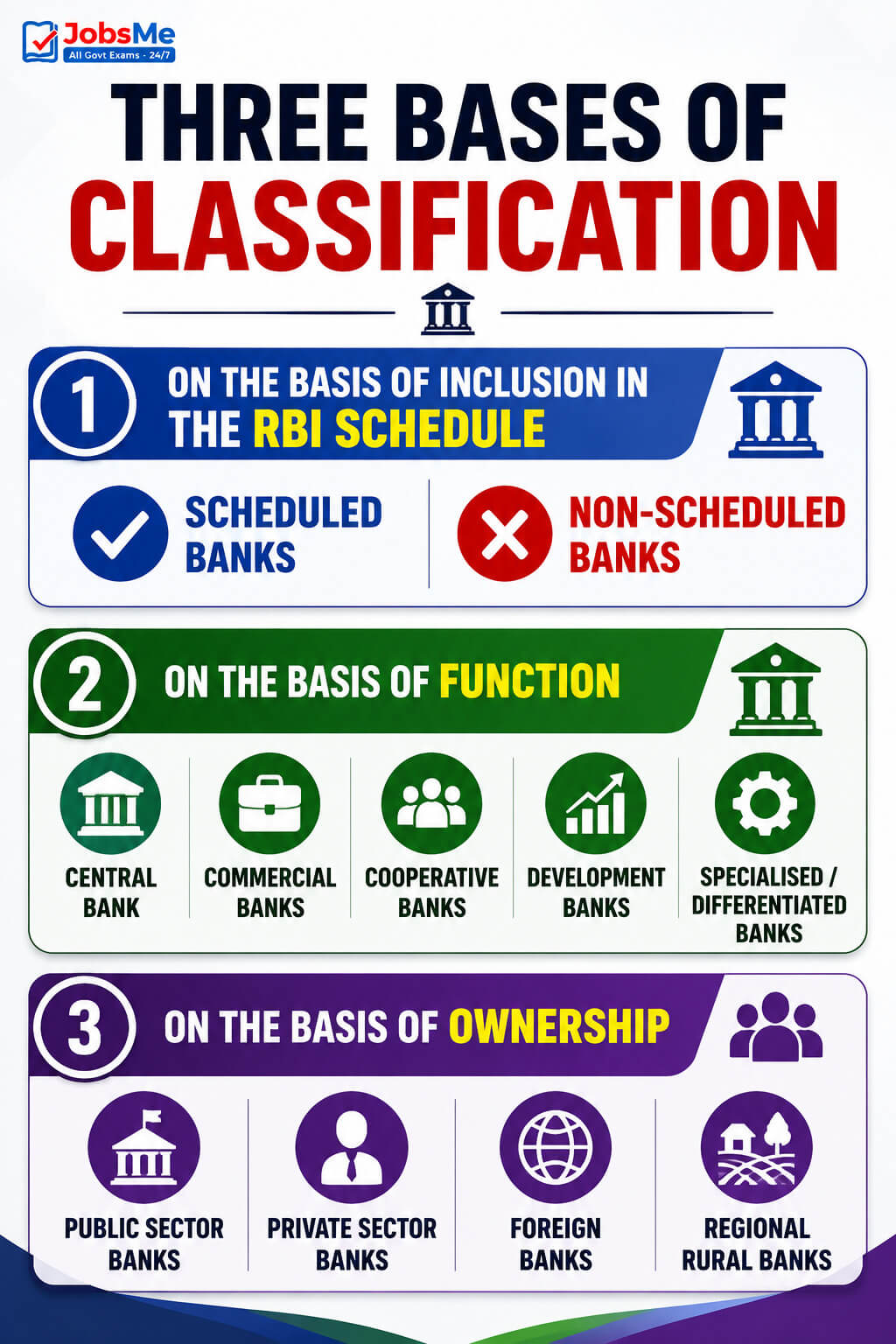
- On the basis of inclusion in the RBI Schedule: Banks are divided into Scheduled Banks (listed in the Second Schedule of the RBI Act, 1934) and Non-Scheduled Banks (not listed).
- On the basis of function: Banks are divided into Central Bank, Commercial Banks, Cooperative Banks, Development Banks, and Specialised/Differentiated Banks.
- On the basis of ownership: Commercial banks are further divided into Public Sector Banks, Private Sector Banks, Foreign Banks, and Regional Rural Banks.
The two principal facilities that a Scheduled Commercial Bank enjoys are the ability to borrow from the RBI at the bank rate and automatic membership of the clearing house. To understand the regulatory side better, you can explore the Banking Awareness section, and test yourself with the Banking Awareness Quiz on thejobsme.com.
Types of Banks Based on Function
The following table lists the major functional categories of banks in India, their role, regulator, and key examples.
| Type of Bank | Role / Function | Key Details & Examples |
|---|---|---|
| Central Bank (RBI) | Apex regulatory and monetary authority of the country. | The Reserve Bank of India is the central bank, established in 1935 and nationalised in 1949; owned by the Union Ministry of Finance; acts as banker to the government, banker's bank, issuer of currency (except the one-rupee note and coins), custodian of foreign exchange reserves, and controller of credit. There is only one central bank in a country. |
| Commercial Banks | Profit-making institutions that accept deposits and provide loans to all sectors. | Regulated under the Banking Regulation Act, 1949; main source of funds is public deposits; do not charge concessional rates unless directed by RBI; include public sector, private sector, foreign banks, and regional rural banks. Examples: SBI, HDFC Bank, ICICI Bank. |
| Cooperative Banks | Member-owned institutions providing rural and micro-financing on a no-profit, mutual-help basis. | Registered under the Cooperative Societies Act, 1912; regulated jointly by RBI and NABARD plus state registrars; offer concessional loans to farmers, small businesses, and self-employed workers. Examples: Saraswat Co-operative Bank, Cosmos Bank, Maharashtra State Cooperative Bank. |
| Development Banks (DFIs) | Provide long-term finance to high-risk and priority sectors that commercial banks avoid. | Also called Term-Lending Institutions (TLIs); finance industry, agriculture, trade, and housing. Examples: NABARD (agriculture/rural), SIDBI (MSMEs), EXIM Bank (foreign trade), NHB (housing finance), and erstwhile IDBI (industry, later converted into a commercial bank). |
| Specialised / Differentiated Banks | Cater to a specific segment of customers with niche products. | Concept introduced on the recommendation of the Nachiket Mor Committee (2013); includes Small Finance Banks and Payments Banks. Examples: AU Small Finance Bank, Airtel Payments Bank. |
Types of Commercial Banks Based on Ownership
Commercial banks are the most visible and widely used banks in India. They are further divided into four ownership-based categories.
| Type of Commercial Bank | Ownership / Definition | Key Details & Examples |
|---|---|---|
| Public Sector Banks (PSBs) | Banks where the government holds more than 50% of the shares. | Constituted under the SBI Act, 1955 and the Banking Companies (Acquisition and Transfer of Undertakings) Acts of 1970 and 1980; there are 12 Public Sector Banks after recent mergers. Examples: State Bank of India, Punjab National Bank, Bank of Baroda. SBI is the largest bank in India. |
| Private Sector Banks | Banks where the majority of equity is held by private shareholders or institutions. | Follow all RBI rules and regulations; around 21-22 private sector banks operate in India. Examples: HDFC Bank, ICICI Bank, Axis Bank, Kotak Mahindra Bank. |
| Foreign Banks | Banks headquartered abroad but operating branches in India. | Must follow both home-country rules and RBI regulations; bring global expertise and specialised services. Examples: Citibank, HSBC, Standard Chartered, Deutsche Bank. |
| Regional Rural Banks (RRBs) | Banks set up to provide institutional credit to agriculture and rural sectors. | Established under the Regional Rural Banks Act, 1976 (RRB Ordinance, 1975); jointly owned by the Central Government (50%), the Sponsor Bank (35%), and the State Government (15%). Example: Arunachal Pradesh Rural Bank. |
Differentiated Banks: Small Finance Banks and Payments Banks
These are newer categories of banks introduced by the RBI to deepen financial inclusion. Both are based on the recommendations of the Nachiket Mor Committee.
| Type of Bank | Purpose | Key Features & Examples |
|---|---|---|
| Small Finance Banks (SFBs) | Financial inclusion of MSMEs, small farmers, micro-enterprises, and the unbanked. | RBI-licensed; can accept deposits and give loans (full basic banking, but no large loan commitments); categorised under Scheduled Commercial Banks; there are 12 SFBs as of 2026. Examples: AU Small Finance Bank (the largest SFB), Ujjivan, Jana, Equitas, ESAF. |
| Payments Banks | Promote digital transactions and financial inclusion for migrants, low-income households, and small merchants. | Can accept demand deposits up to Rs. 2 lakh per customer (raised from Rs. 1 lakh in April 2021); cannot give loans or issue credit cards; cannot accept NRI deposits; invest mainly in government securities; offer debit cards, mobile banking, NEFT, RTGS, IMPS, and UPI. Examples: Airtel Payments Bank, India Post Payments Bank, Fino Payments Bank. |
Scheduled vs Non-Scheduled Banks
This is one of the most frequently tested classifications. The distinction is based purely on whether a bank is listed in the Second Schedule of the RBI Act, 1934.
| Basis | Scheduled Banks | Non-Scheduled Banks |
|---|---|---|
| Definition | Listed in the Second Schedule of the RBI Act, 1934, under Section 42(6)(a). | Not included in the Second Schedule of the RBI Act, 1934. |
| Paid-up Capital | Minimum paid-up capital and reserves of Rs. 5 lakh (older norm cited as Rs. 25 lakh in some sources). | Generally below the threshold; smaller capital requirements. |
| Cash Reserve | Maintain the cash reserve ratio (CRR) with the RBI. | Maintain their cash reserves with themselves, not with the RBI. |
| RBI Borrowing & Clearing House | Eligible to borrow from the RBI at the bank rate and get automatic clearing-house membership. | Cannot borrow from the RBI for daily needs; operate under regional limitations. |
| Coverage | Includes Public Sector, Private, Foreign, RRBs, Scheduled SFBs, Scheduled Payments Banks, and Scheduled Cooperative Banks; covered by DICGC deposit insurance. | Rare; operate within narrow local boundaries with stricter investment limits. |
Structure of Cooperative Banks
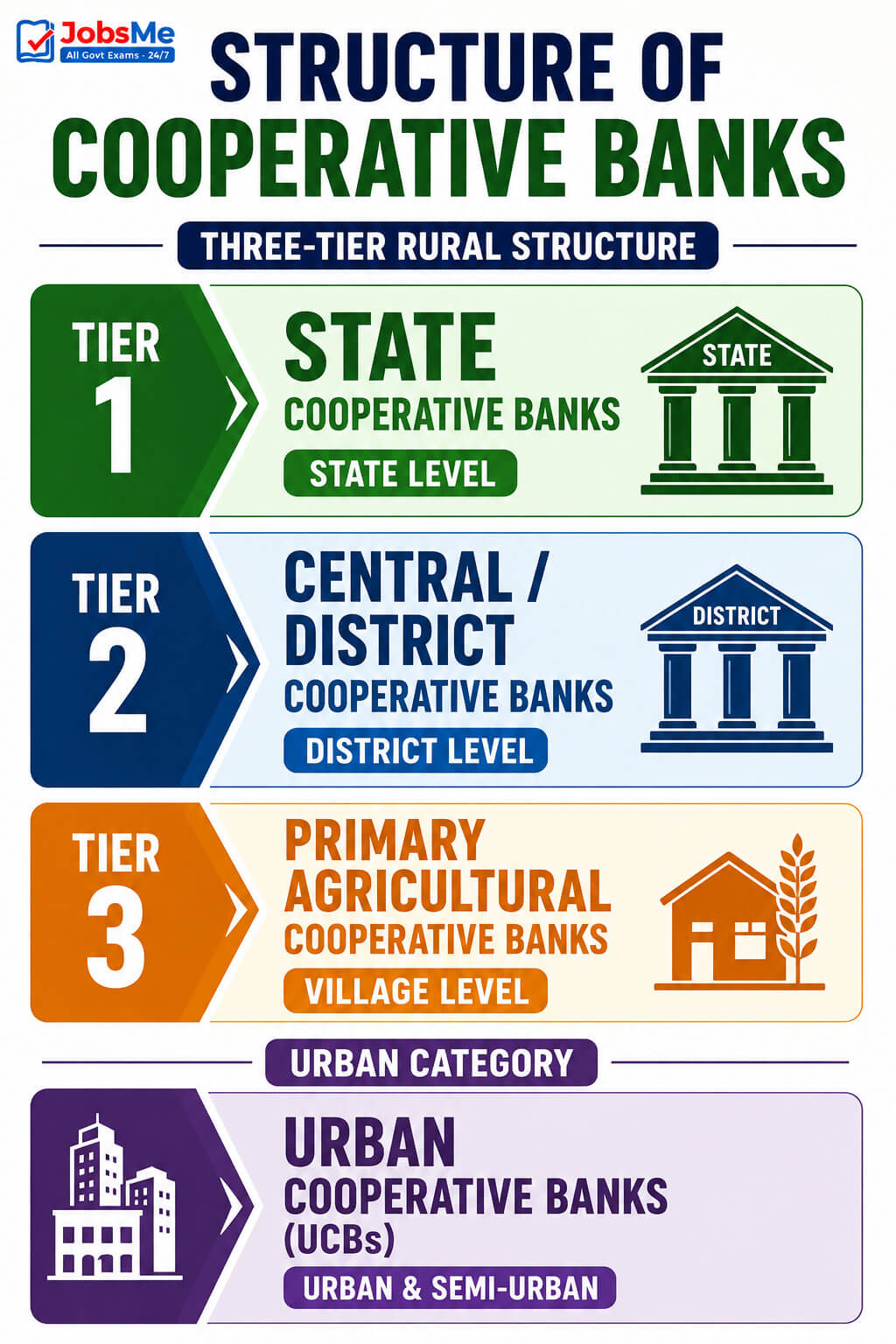
Cooperative banks have a distinct three-tier rural structure and a separate urban category. They are owned by their members and aim at social welfare rather than profit.
| Tier / Type | Level | Key Details |
|---|---|---|
| State Cooperative Banks | Tier 1 - State Level | Apex cooperative body in each state; balances funds and secures finance from national development institutions like NABARD. |
| Central / District Cooperative Banks | Tier 2 - District Level | Link the state apex banks with village-level societies; distribute agricultural credit across districts. |
| Primary Agricultural Cooperative Banks | Tier 3 - Village Level | Provide short-term loans directly to farmers for agriculture and allied activities at the grassroots level. |
| Urban Cooperative Banks (UCBs) | Urban & Semi-Urban | Primary cooperative banks serving small borrowers and businesses in towns and cities; concentrated mainly in Andhra Pradesh, Gujarat, Karnataka, Maharashtra, and Tamil Nadu. |
Memory Tricks and Mnemonics
Trick 1: Four Types of Commercial Banks — "PPFR"
To remember the four ownership-based types of commercial banks, use the acronym "PPFR":
- P → Public Sector Banks (e.g., SBI).
- P → Private Sector Banks (e.g., HDFC Bank).
- F → Foreign Banks (e.g., Citibank).
- R → Regional Rural Banks (e.g., Arunachal Pradesh Rural Bank).
"Public-Private-Foreign-Rural — the four faces of commerce."
Trick 2: Development Banks — "NSEN"
Remember the four major development financial institutions and what each supports with "NSEN":
- N → NABARD → Agriculture and Rural development.
- S → SIDBI → Small industries / MSMEs.
- E → EXIM Bank → Export-Import (foreign trade).
- N → NHB → National Housing finance.
"Nabard farms, Sidbi builds, Exim trades, NHB houses."
Trick 3: Payments Bank "CANNOT" List
Payments Banks have key prohibitions. Remember what they cannot do:
- Cannot give loans.
- Cannot issue credit cards.
- Cannot accept NRI deposits.
- Cannot hold more than Rs. 2 lakh per customer.
"A Payments Bank takes your money but never lends it back."
Trick 4: Scheduled Bank Schedule Number — "Second Schedule, 1934"
Link the year to the schedule: "1934 → Second Schedule → RBI Act." Scheduled banks are in the Second Schedule of the RBI Act of 1934, with a paid-up capital of at least Rs. 5 lakh. Just remember: RBI Act came in 1934, and scheduled banks sit on its second list.
Trick 5: RRB Ownership Ratio — "50-35-15"
The ownership of a Regional Rural Bank is split in a fixed ratio. Remember the descending order "Centre-Sponsor-State":
- 50% → Central Government.
- 35% → Sponsor Bank.
- 15% → State Government.
"Centre leads with 50, Sponsor follows 35, State backs 15 — they add up to 100."
Trick 6: Functions of RBI — "GICCC"
Remember the core functions of the Reserve Bank of India with "GICCC":
- G → Government's bank.
- I → Issuer of currency.
- C → Controller of credit.
- C → Custodian of foreign exchange reserves.
- C → Clearing-house and banker's bank.
Trick 7: SFB vs Payments Bank — The "Lending Line"
The single biggest difference is lending. Use the contrast:
- Small Finance Bank (SFB) → CAN lend → full banking for the small and unbanked.
- Payments Bank → CANNOT lend → only deposits and digital payments.
"Small Finance lends Small; Payments only Pays."
Additional Notes
Frequently Confused Facts
- Small Finance Bank vs Payments Bank: An SFB can accept deposits and give loans (full basic banking); a Payments Bank can only accept deposits up to Rs. 2 lakh and cannot lend or issue credit cards.
- Payments Bank vs RRB: A Payments Bank is a private differentiated bank focused on digital payments; an RRB is a government-sponsored bank focused on rural and agricultural credit.
- Scheduled vs Non-Scheduled: Scheduled banks are in the Second Schedule of the RBI Act, 1934, and can borrow from the RBI; non-scheduled banks are not listed and maintain reserves with themselves.
- NABARD vs SIDBI vs EXIM Bank: NABARD supports agriculture and rural development; SIDBI supports MSMEs; EXIM Bank supports foreign trade.
- Commercial vs Cooperative Banks: Commercial banks are profit-driven corporate entities; cooperative banks are member-owned and work on a no-profit, mutual-help basis for rural and micro-financing.
- Repo Rate vs Bank Rate: Repo rate is the rate at which RBI lends to banks against securities; bank rate is the rate at which banks borrow from RBI without providing security.
- Central Bank vs Commercial Bank: A country has only one central bank (RBI in India) that regulates others; there are many commercial banks that serve the public.
- Public Sector Banks count: There are 12 Public Sector Banks after the recent mergers — not the older figures of 27 or 19.
Repeating PYQ Patterns
Certain facts about the types of banks are asked repeatedly in competitive exams. The Payments Bank deposit limit of Rs. 2 lakh, the 12 Public Sector Banks, the Second Schedule of the RBI Act 1934, the RRB ownership ratio of 50:35:15, the functions of the RBI, and the roles of NABARD, SIDBI, and EXIM Bank appear most often in IBPS PO, SBI Clerk, RRB NTPC, and RBI Grade B papers. Banking and Insurance exams frequently test the difference between SFBs and Payments Banks and the regulator of cooperative banks. UPSC Prelims focuses on Development Financial Institutions, D-SIBs, and the Nachiket Mor Committee, while SSC CGL asks straightforward matching questions on bank types and their examples. State PCS exams often add regional cooperative bank structures.
Quick Insight
The structure of Indian banking is constantly evolving with the economy. Bank mergers have reduced the number of Public Sector Banks to 12, the rise of UPI has pushed payments banks to the centre of the digital economy, and payments banks have even urged the Finance Ministry to raise the deposit cap from Rs. 2 lakh to Rs. 5 lakh. The RBI now also recognises Domestic Systemically Important Banks (D-SIBs) — SBI, ICICI Bank, and HDFC Bank — as "too big to fail." Understanding how each type of bank fits into this layered system helps aspirants answer both direct factual questions and current-affairs-linked questions with confidence. For more, explore the Static GK notes and the Computer Awareness section on thejobsme.com.
One-Liners for Quick Revision
- Reserve Bank of India (RBI) → Central bank and apex regulator → established 1935, nationalised 1949, owned by the Ministry of Finance.
- Banking Regulation Act, 1949 → Primary law governing banks in India.
- RBI Act, 1934 → Scheduled banks listed in its Second Schedule under Section 42(6)(a).
- Commercial Banks → Profit-making banks accepting deposits and giving loans → regulated under the Banking Regulation Act, 1949.
- Public Sector Banks (PSBs) → Government holds more than 50% → 12 PSBs after mergers → e.g., SBI, PNB, Bank of Baroda.
- State Bank of India (SBI) → Largest bank in India by assets, branches, and deposits.
- Private Sector Banks → Majority equity held by private shareholders → e.g., HDFC Bank, ICICI Bank, Axis Bank, Kotak Mahindra Bank.
- Foreign Banks → Headquartered abroad, branches in India → e.g., Citibank, HSBC, Standard Chartered.
- Regional Rural Banks (RRBs) → Rural and agricultural credit → owned 50% Centre, 35% Sponsor Bank, 15% State → set up under the RRB Act, 1976.
- Cooperative Banks → Member-owned, no-profit, rural/micro-financing → registered under the Cooperative Societies Act, 1912 → regulated by RBI and NABARD.
- Three-Tier Cooperative Structure → State Cooperative Banks (state), Central/District Cooperative Banks (district), Primary Agricultural Cooperative Banks (village).
- Urban Cooperative Banks (UCBs) → Serve small urban and semi-urban borrowers and businesses.
- Development Banks (DFIs) → Long-term finance for high-risk priority sectors → also called Term-Lending Institutions.
- NABARD → National Bank for Agriculture and Rural Development → supports rural and agricultural development.
- SIDBI → Small Industries Development Bank of India → supports MSMEs.
- EXIM Bank → Export-Import Bank of India → supports foreign trade.
- NHB → National Housing Bank → supports housing finance companies.
- IDBI → Industrial Development Bank of India → originally a development bank, later converted into a commercial bank.
- Small Finance Banks (SFBs) → Financial inclusion of MSMEs and small farmers → CAN lend → 12 SFBs as of 2026 → e.g., AU, Ujjivan, Jana, Equitas, ESAF.
- AU Small Finance Bank → Largest Small Finance Bank in India.
- Payments Banks → Deposits up to Rs. 2 lakh → cannot lend or issue credit cards → cannot accept NRI deposits → e.g., Airtel, India Post, Fino Payments Bank.
- Payments Bank deposit limit → Rs. 2 lakh per customer → raised from Rs. 1 lakh in April 2021.
- Nachiket Mor Committee (2013) → Recommended Small Finance Banks and Payments Banks.
- Scheduled Banks → In the Second Schedule of the RBI Act 1934 → can borrow from RBI → automatic clearing-house membership → covered by DICGC insurance.
- Non-Scheduled Banks → Not in the Second Schedule → maintain cash reserves with themselves, not RBI.
- D-SIBs (Too Big to Fail) → SBI, ICICI Bank, and HDFC Bank.
- DICGC → Deposit insurance up to Rs. 5 lakh per depositor.
- Repo Rate → Rate at which RBI lends to banks against securities; Bank Rate → rate at which banks borrow from RBI without security.
- NBFCs → Lend and invest like banks but cannot issue cheques on themselves and are not covered by DICGC deposit insurance.
To revise this topic interactively, attempt the Banking Awareness Quiz and the Static GK Quiz on thejobsme.com. You can also check the latest openings at Latest Government Job Notifications and stay updated with Daily Current Affairs.
Free quiz • No signup required
Put this topic into practice with Indian Cultural Institutions – Static GK MCQ Quiz. It is the quickest way to reinforce what you just learned.
Frequently Asked Questions
Who regulates the banking system in India?
What is the deposit limit in a Payments Bank in India?
What is the difference between a Scheduled Bank and a Non-Scheduled Bank?
How many Public Sector Banks are there in India?
What is the difference between a Small Finance Bank and a Payments Bank?
Who owns a Regional Rural Bank in India?
What do NABARD, SIDBI, and EXIM Bank do?
Which committee recommended Small Finance Banks and Payments Banks?
Under which law are cooperative banks registered and regulated?
Which banks are recognised as Domestic Systemically Important Banks (D-SIBs) in India?

About the author