Financial Regulators in India and the World – Static GK & General Awareness for Competitive Exams with Memory Tricks
This article presents a complete list of major financial regulators in India and across the world, covering the RBI, SEBI, IRDAI, PFRDA, IFSCA, NABARD, IBBI, and important global bodies, along with their establishment year, headquarters, regulatory domain, and current heads. It includes the most exam-relevant facts such as which regulator controls banks, the stock market, insurance, pensions, and insolvency, with memory tricks and one-liners for quick revision. All facts are arranged in exam-ready format to help UPSC, SSC, IBPS, RRB, PSU, and State PCS aspirants score better in Banking Awareness, General Awareness, and Economy sections.

Jump to section
Introduction
A financial regulator is a government or statutory body that supervises, controls, and develops a specific segment of the financial system to protect consumers, ensure stability, and prevent fraud. In India, the financial system is regulated by several specialised authorities — the Reserve Bank of India (RBI) oversees banking and monetary policy, the Securities and Exchange Board of India (SEBI) regulates the stock market, the Insurance Regulatory and Development Authority of India (IRDAI) governs insurance, and the Pension Fund Regulatory and Development Authority (PFRDA) looks after pensions. Each of these bodies has a defined domain, a year of establishment, a headquarters, and a head whose name is frequently asked in exams.
Questions on financial regulators appear regularly in IBPS PO, SBI Clerk, RBI Grade B, RRB NTPC, SSC CGL, UPSC Prelims, State PCS, and various Insurance and PSU exams. Questions typically ask which body regulates a particular sector, when a regulator was established, where its headquarters is located, under which Act it was created, or who the current chairperson is. This article brings together every important financial regulator in a structured, exam-ready format. To strengthen this topic further, you can refer to the detailed notes in the Banking Awareness section on thejobsme.com.
Financial regulators are also closely tied to current affairs themes such as repo rate changes, new market regulations, insurance reforms, pension scheme launches, and leadership appointments — making this topic doubly important for aspirants preparing for the Economy and Current Affairs portions of both Prelims and Mains.
Core Concepts: What Financial Regulators Do
Financial regulators exist to keep the financial system safe, transparent, and growth-oriented. Each regulator is created under a specific law and given powers to license, monitor, penalise, and develop its sector. Understanding the role of each body helps students match the regulator to its function quickly in the exam hall.
Functions of Financial Regulators
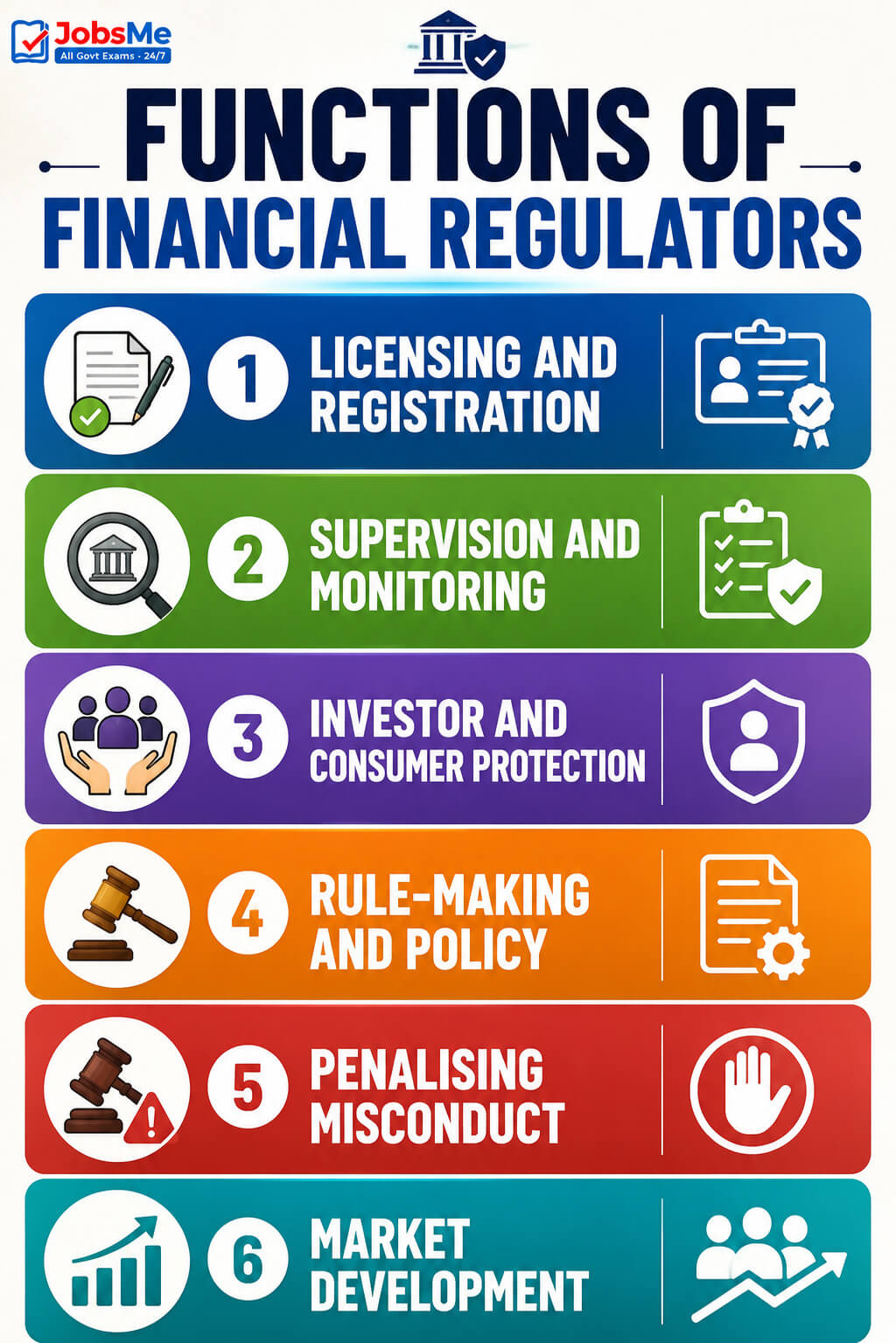
- Licensing and Registration: Granting permission to banks, brokers, insurers, and intermediaries to operate. Example: RBI licenses banks; SEBI registers stockbrokers and mutual funds.
- Supervision and Monitoring: Inspecting and auditing regulated entities to ensure compliance. Example: RBI supervises banks; IRDAI monitors insurance companies.
- Investor and Consumer Protection: Safeguarding the interests of depositors, investors, policyholders, and pension subscribers.
- Rule-Making and Policy: Framing regulations, guidelines, and policy such as RBI's monetary policy and SEBI's listing rules.
- Penalising Misconduct: Imposing fines, cancelling licences, and taking enforcement action against fraud and violations.
- Market Development: Promoting orderly growth of the sector, such as IRDAI's "Insurance for All by 2047" goal and PFRDA's expansion of the pension network.
Statutory vs Non-Statutory Regulators
A statutory regulator is created by an Act of Parliament and has legal powers (for example, RBI, SEBI, IRDAI, PFRDA). A self-regulatory or developmental body may operate without full statutory regulatory authority. Knowing the Act behind each regulator is a high-scoring detail in banking and PSU exams.
Major Financial Regulators of India
The following table lists the most exam-relevant financial regulators of India along with their year of establishment, headquarters, regulatory domain, and other key details.
| Regulator | Regulates | Establishment / Act / Headquarters / Key Details |
|---|---|---|
| Reserve Bank of India (RBI) | Banking sector, monetary policy, currency, foreign exchange | Established on 1 April 1935 under the RBI Act, 1934, on the recommendation of the Hilton Young Commission; nationalised on 1 January 1949; headquarters in Mumbai (originally Kolkata). It is India's central bank and the monetary authority. Sir Osborne Smith was the first Governor and Sir C. D. Deshmukh the first Indian Governor. |
| Securities and Exchange Board of India (SEBI) | Securities market, stock exchanges, mutual funds, brokers | Set up as a non-statutory body in 1988 and made statutory under the SEBI Act, 1992; headquarters in Mumbai. It protects investors and regulates the capital market. Madhabi Puri Buch was its first woman chairperson. |
| Insurance Regulatory and Development Authority of India (IRDAI) | Insurance sector (life and general insurance) | Established in 1999 under the IRDAI Act, 1999; headquarters in Hyderabad. It licenses insurers, monitors products, and protects policyholders. It set the goal of "Insurance for All by 2047." |
| Pension Fund Regulatory and Development Authority (PFRDA) | Pension sector, National Pension System (NPS), Atal Pension Yojana | Set up as an interim body in 2003 and made statutory on 1 February 2014 under the PFRDA Act, 2013; headquarters in New Delhi. It regulates the NPS and the Atal Pension Yojana (APY). |
| International Financial Services Centres Authority (IFSCA) | Financial products and services in IFSCs (GIFT City) | Established in April 2020 under the IFSCA Act, 2019; headquarters at GIFT City, Gandhinagar, Gujarat. It is a unified regulator for banking, insurance, securities, and funds in International Financial Services Centres. Injeti Srinivas was its first chairperson. |
| National Bank for Agriculture and Rural Development (NABARD) | Agricultural and rural credit; apex development bank | Established on 12 July 1982 on the recommendation of the Shivaraman Committee; headquarters in Mumbai. It is the apex regulator and refinancing body for rural and agricultural finance, regulating Regional Rural Banks and cooperative banks (along with RBI). |
| Insolvency and Bankruptcy Board of India (IBBI) | Insolvency and bankruptcy proceedings | Established on 1 October 2016 under the Insolvency and Bankruptcy Code (IBC), 2016; headquarters in New Delhi. It regulates insolvency professionals, agencies, and information utilities under the Ministry of Corporate Affairs. |
| Financial Stability and Development Council (FSDC) | Apex coordinating body for financial stability | Set up in 2010 (non-statutory) under the Ministry of Finance; chaired by the Union Finance Minister. It coordinates among all financial regulators (RBI, SEBI, IRDAI, PFRDA) to maintain overall financial stability. |
| National Housing Bank (NHB) | Housing finance companies | Established in 1988 under the National Housing Bank Act, 1987; headquarters in New Delhi. It promotes and regulates housing finance institutions. It is now a wholly owned subsidiary of the RBI. |
For more on how these bodies appear in the banking syllabus, you can practise with the Banking Awareness Quiz on thejobsme.com.
Current Heads of Major Indian Financial Regulators
The names of regulatory heads are among the most frequently asked current affairs facts in banking and PSU exams. The table below lists the current heads as of 2026.
| Regulator | Current Head (2026) | Designation / Key Details |
|---|---|---|
| RBI | Sanjay Malhotra | 26th Governor of the RBI; took charge on 11 December 2024, succeeding Shaktikanta Das; a 1990-batch IAS officer of the Rajasthan cadre. |
| SEBI | Tuhin Kanta Pandey | 11th Chairman of SEBI; assumed office on 1 March 2025, succeeding Madhabi Puri Buch; a 1987-batch IAS officer of the Odisha cadre and former Finance Secretary. |
| IRDAI | Ajay Seth | Chairman of IRDAI; took charge on 1 September 2025, succeeding Debasish Panda; a 1987-batch IAS officer of the Karnataka cadre and former Economic Affairs Secretary. |
| PFRDA | Sivasubramanian Ramann | Chairperson of PFRDA; appointed in 2025, succeeding Deepak Mohanty; a 1991-batch Indian Audit and Accounts Service officer and former CMD of SIDBI. |
| IFSCA | K. Rajaraman | Chairperson of IFSCA; took charge in 2023, succeeding the first chairperson Injeti Srinivas; a 1989-batch IAS officer of the Tamil Nadu cadre. |
Major Global Financial Regulators and Bodies
Several international financial institutions and regulators are also tested in UPSC Prelims, RBI Grade B, and banking exams. The table below covers the most important ones.
| Body | Domain | Headquarters / Key Details |
|---|---|---|
| International Monetary Fund (IMF) | Global monetary cooperation and exchange rate stability | Headquarters in Washington, D.C., USA; established in 1944 at the Bretton Woods Conference; publishes the World Economic Outlook; has 190+ member countries. |
| World Bank | Development finance and poverty reduction | Headquarters in Washington, D.C., USA; established in 1944; its main lending arm is the IBRD; works alongside the IMF as a Bretton Woods institution. |
| Bank for International Settlements (BIS) | Central bank cooperation; "bank of central banks" | Headquarters in Basel, Switzerland; established in 1930; the oldest international financial institution; issues the Basel norms (Basel I, II, III) for banking regulation. |
| Financial Action Task Force (FATF) | Anti-money laundering and counter-terror financing | Headquarters in Paris, France; established in 1989 by the G7; maintains the "grey list" and "black list" of non-compliant countries. |
| Financial Stability Board (FSB) | Monitoring the global financial system | Headquarters in Basel, Switzerland; established in 2009 after the global financial crisis; successor to the Financial Stability Forum. |
| U.S. Securities and Exchange Commission (SEC) | U.S. securities market | Headquarters in Washington, D.C., USA; established in 1934; the American equivalent of India's SEBI. |
Memory Tricks and Mnemonics
Trick 1: Who Regulates What — "Banks, Shares, Insure, Pension"
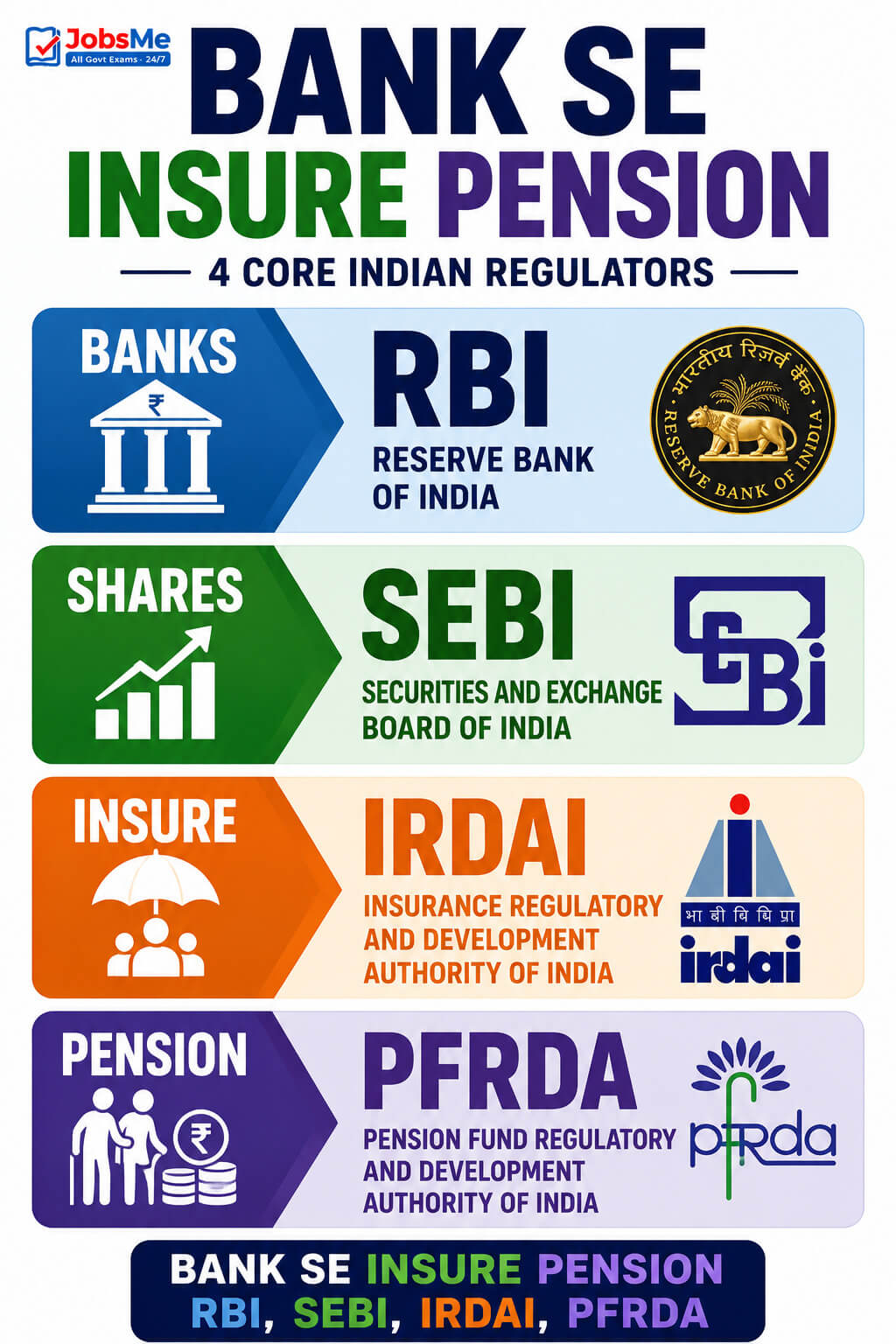
Remember the four core Indian regulators by their sector in order:
- Banks → RBI (Reserve Bank of India).
- Shares / Stock Market → SEBI (Securities and Exchange Board of India).
- Insurance → IRDAI (Insurance Regulatory and Development Authority of India).
- Pension → PFRDA (Pension Fund Regulatory and Development Authority).
"Bank Se Insure Pension" — RBI, SEBI, IRDAI, PFRDA in order."
Trick 2: Headquarters Map — "MMH-DG"
Group the headquarters of the main regulators to recall them faster:
- M → Mumbai → RBI, SEBI, NABARD.
- H → Hyderabad → IRDAI.
- D → Delhi → PFRDA, IBBI, NHB.
- G → Gandhinagar (GIFT City) → IFSCA.
"Insurance lives in Hyderabad, the GIFT is in Gujarat."
Trick 3: Establishment Years — "35-92-99"
Lock the founding years of the big three into a sequence:
- 1935 → RBI (the oldest of the three).
- 1992 → SEBI (statutory status).
- 1999 → IRDAI.
"RBI first, SEBI second, IRDAI last — 35, 92, 99."
Trick 4: The Act Behind Each Regulator — "Each Has Its Own Law"
- RBI → RBI Act, 1934.
- SEBI → SEBI Act, 1992.
- IRDAI → IRDAI Act, 1999.
- PFRDA → PFRDA Act, 2013.
- IFSCA → IFSCA Act, 2019.
- IBBI → Insolvency and Bankruptcy Code, 2016.
"The Act year is usually one year before the body starts working."
Trick 5: Global Bodies in Basel — "BB Twins"
Two important global financial bodies share Basel, Switzerland as their home:
- BIS → Bank for International Settlements (1930, the bank of central banks).
- FSB → Financial Stability Board (2009, post-crisis watchdog).
"Both 'B' bodies live in Basel."
Trick 6: Bretton Woods Twins — "World Money in Washington"
The IMF and the World Bank were both born at Bretton Woods in 1944 and sit in Washington, D.C.:
- IMF → fixes short-term monetary and exchange-rate problems.
- World Bank → funds long-term development projects.
"IMF is the doctor for the economy; World Bank is the builder."
Trick 7: Pension Schemes Under PFRDA — "NPS + APY"
To remember what PFRDA controls, link it to its two flagship schemes:
- NPS → National Pension System (opened to all citizens in 2009).
- APY → Atal Pension Yojana (launched in 2015 for the unorganised sector).
Additional Notes
Frequently Confused Facts
- RBI vs SEBI: RBI regulates banks and monetary policy; SEBI regulates the stock market, brokers, and mutual funds. Money market is RBI's domain; capital market is SEBI's domain.
- SEBI establishment dates: SEBI was set up as a non-statutory body in 1988 but became a statutory body only in 1992 through the SEBI Act. Exams usually treat 1992 as the key year.
- IRDAI headquarters: IRDAI is the only major financial regulator headquartered in Hyderabad, not Mumbai or Delhi.
- PFRDA statutory status: PFRDA existed from 2003 but became statutory only on 1 February 2014 under the PFRDA Act, 2013.
- NABARD vs RBI: NABARD is the apex body for rural and agricultural credit, but cooperative banks and Regional Rural Banks are jointly regulated by NABARD and RBI.
- IBBI vs RBI: IBBI handles corporate insolvency and bankruptcy under the IBC; it is under the Ministry of Corporate Affairs, not the RBI.
- FSDC chairman: The FSDC is chaired by the Union Finance Minister, not by the RBI Governor.
- SEBI vs SEC: SEBI is India's market regulator; the SEC is the United States' market regulator. They perform similar roles in their respective countries.
- IMF vs World Bank: Both were founded in 1944 at Bretton Woods, but the IMF handles monetary stability while the World Bank funds development.
- BIS vs FSB: Both are in Basel; BIS (1930) is the bank of central banks, while FSB (2009) monitors global financial stability.
Repeating PYQ Patterns
Certain facts about financial regulators are asked repeatedly in competitive exams. RBI (1935, Mumbai, RBI Act 1934), SEBI (statutory in 1992, Mumbai), IRDAI (1999, Hyderabad), PFRDA (statutory in 2014, NPS and APY), NABARD (1982, rural credit), and IBBI (2016, IBC) appear most often in IBPS PO, SBI Clerk, RBI Grade B, and SSC CGL papers. Banking exams frequently ask "which body regulates X sector" and "where is the headquarters of Y." UPSC Prelims focuses on the Act, year, and the relationship between regulators and the FSDC. Current affairs sections across all exams ask for the current heads — Sanjay Malhotra (RBI), Tuhin Kanta Pandey (SEBI), Ajay Seth (IRDAI), and Sivasubramanian Ramann (PFRDA). Global bodies like the IMF, World Bank, BIS, and FATF are common in UPSC Prelims and the General Awareness sections of RBI and NABARD exams.
Quick Insight
Financial regulators are the guardians of the economy — they decide how safely your money, investments, insurance, and pension are managed. Every repo rate change you hear about comes from the RBI; every new rule for mutual funds comes from SEBI; every insurance reform comes from IRDAI; and every pension update comes from PFRDA. Understanding which body controls which sector lets aspirants instantly decode any economy-related news item, which is invaluable for both Prelims (direct matching questions) and Mains or interviews (analysis of financial stability and reforms). For further reading on related topics, you can refer to the Banking Awareness notes and test yourself with the Static GK Quiz on thejobsme.com.
One-Liners for Quick Revision
- Reserve Bank of India (RBI) → Banking and monetary policy regulator → established 1935, RBI Act 1934, headquartered in Mumbai.
- RBI first Governor → Sir Osborne Smith → first Indian Governor was Sir C. D. Deshmukh.
- RBI current Governor (2026) → Sanjay Malhotra → 26th Governor, took charge December 2024.
- SEBI → Securities market regulator → non-statutory in 1988, statutory under SEBI Act 1992, headquartered in Mumbai.
- SEBI first woman chairperson → Madhabi Puri Buch → current chairman is Tuhin Kanta Pandey (since March 2025).
- IRDAI → Insurance regulator → established 1999, IRDAI Act 1999, headquartered in Hyderabad.
- IRDAI current chairman (2026) → Ajay Seth → took charge September 2025; goal of "Insurance for All by 2047."
- PFRDA → Pension regulator → statutory on 1 February 2014, PFRDA Act 2013, headquartered in New Delhi.
- PFRDA schemes → National Pension System (NPS) and Atal Pension Yojana (APY).
- PFRDA current chairperson (2026) → Sivasubramanian Ramann → appointed 2025.
- IFSCA → Unified regulator for IFSCs → established April 2020, IFSCA Act 2019, headquartered at GIFT City, Gandhinagar.
- IFSCA first chairperson → Injeti Srinivas → current chairperson is K. Rajaraman.
- NABARD → Apex rural and agricultural credit bank → established 12 July 1982, Shivaraman Committee, headquartered in Mumbai.
- IBBI → Insolvency and bankruptcy regulator → established 1 October 2016 under the IBC 2016, headquartered in New Delhi.
- FSDC → Apex financial stability body → set up 2010, chaired by the Union Finance Minister, non-statutory.
- National Housing Bank (NHB) → Housing finance regulator → established 1988, NHB Act 1987, now an RBI subsidiary.
- IMF → Global monetary cooperation → established 1944 at Bretton Woods, headquartered in Washington, D.C.
- World Bank → Development finance → established 1944 at Bretton Woods, headquartered in Washington, D.C.
- BIS → Bank of central banks → established 1930, headquartered in Basel; issues Basel norms.
- FATF → Anti-money laundering body → established 1989, headquartered in Paris; maintains grey and black lists.
- FSB → Global financial stability monitor → established 2009, headquartered in Basel.
- U.S. SEC → American securities market regulator → established 1934, headquartered in Washington, D.C.
For more Static GK and economy topics, explore the Static GK section on thejobsme.com. You can also test your preparation with the Banking Awareness Quiz and check the latest openings at Latest Government Job Notifications.
Free quiz • No signup required
Put this topic into practice with Indian Cultural Institutions – Static GK MCQ Quiz. It is the quickest way to reinforce what you just learned.
Frequently Asked Questions
Which body is the regulator of the banking sector in India?
Who regulates the stock market in India?
Where is the headquarters of IRDAI located?
What does PFRDA regulate in India?
Who is the current Governor of the RBI in 2026?
Which financial regulator is headquartered at GIFT City?
What is the role of NABARD in India?
Which body regulates insolvency and bankruptcy in India?
Who chairs the Financial Stability and Development Council (FSDC)?
What is the difference between the IMF and the World Bank?

About the author