Continents and Oceans of the World – Static GK & General Awareness for Competitive Exams with Memory Tricks
This article presents a complete, exam-ready guide to the seven continents and five oceans of the world, covering their area, population, ranking, key features, and the major straits, isthmuses, and canals that connect or separate them. It includes ready facts like Asia being the largest continent, Australia the smallest, the Pacific being the largest and deepest ocean, the Arctic the smallest, and the Challenger Deep in the Mariana Trench being the deepest point on Earth, along with memory tricks and one-liners for quick revision. All facts are arranged in a structured Static GK format to help UPSC, SSC, IBPS, RRB, PSU, and State PCS aspirants score better in the General Awareness section.
Jump to section
Introduction
Our planet is divided into seven great landmasses called continents and five large bodies of salt water called oceans. From Asia, the largest and most populous continent, to Australia (Oceania), the smallest, and from the vast Pacific Ocean to the small and shallow Arctic Ocean, the geography of continents and oceans forms the foundation of the World Geography section in almost every competitive exam. The ocean covers roughly 71% of the Earth's surface, while the seven continents together make up about 29% of the land.
Questions on continents and oceans appear regularly in UPSC Prelims, SSC CGL, IBPS PO, RRB NTPC, SBI Clerk, State PCS, and various Insurance and Defence exams. Objective papers usually test which continent or ocean is the largest, smallest, deepest, or most populous, and which water bodies or land bridges separate them. This article brings together every important fact about the continents and oceans in a structured, exam-ready format. To explore other related topics, you can refer to the Static GK section on thejobsme.com.
Continents and oceans are also closely linked to current affairs themes such as climate change, melting Arctic ice, maritime boundary disputes, the Indo-Pacific strategy, and shipping routes through the Suez and Panama canals — making this topic doubly important for aspirants preparing for both objective General Awareness sections and descriptive papers.
Core Concepts: Continents and Oceans Explained
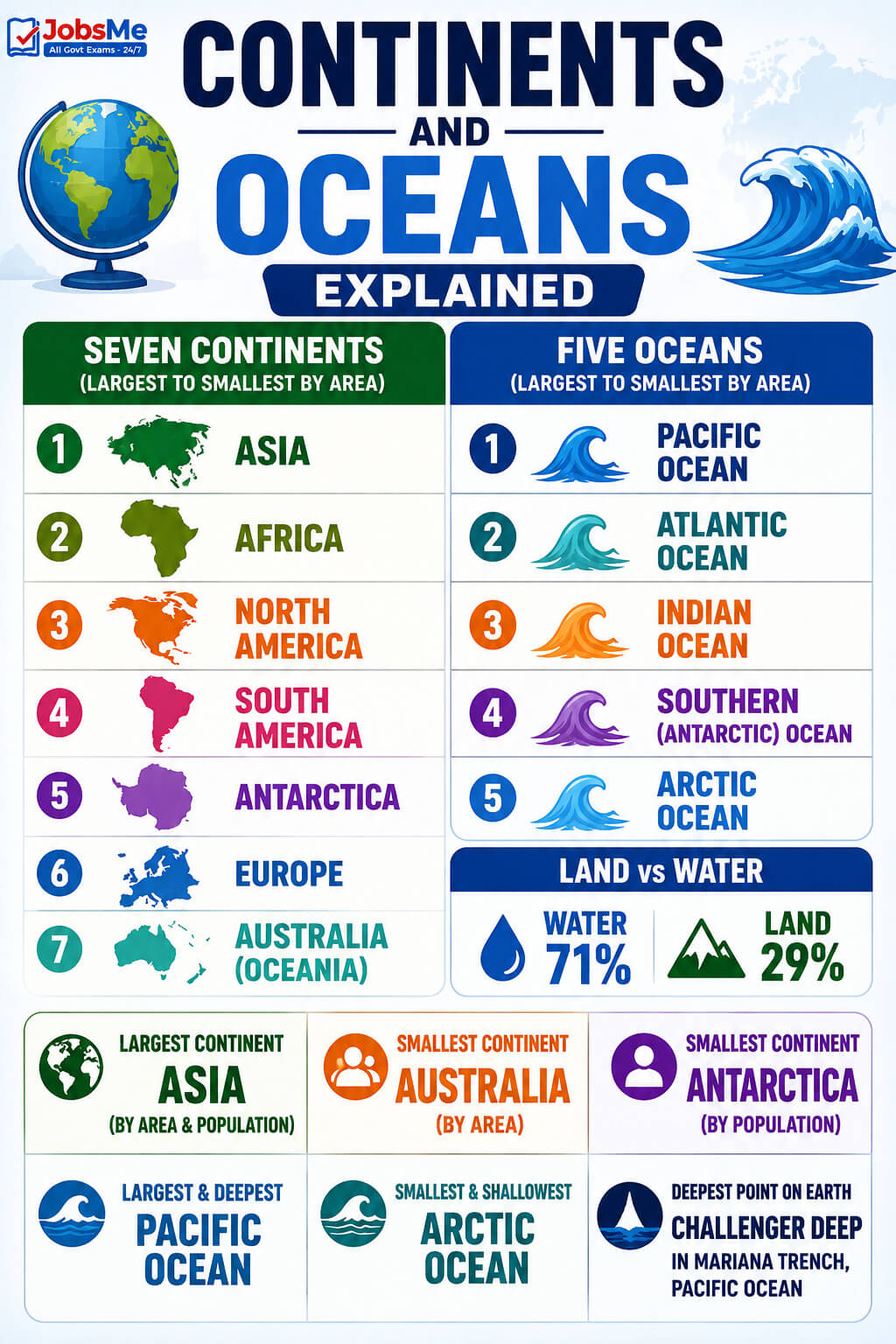
A continent is a large, continuous mass of land separated from other landmasses by oceans. An ocean is one of the large connected bodies of salt water that together form the single global ocean. Understanding their ranking by area, population, and depth is the key skill being tested in exams.
- Seven continents: Asia, Africa, North America, South America, Antarctica, Europe, and Australia (Oceania) — listed here from largest to smallest by area.
- Five oceans: Pacific, Atlantic, Indian, Southern (Antarctic), and Arctic — listed from largest to smallest by area.
- Land vs water: Water covers about 71% of the Earth's surface; land covers about 29%.
- Largest continent: Asia, both by area and by population.
- Smallest continent: Australia (Oceania) by area; Antarctica by permanent population (it has no permanent residents).
- Largest and deepest ocean: the Pacific Ocean.
- Smallest and shallowest ocean: the Arctic Ocean.
- Deepest point on Earth: the Challenger Deep in the Mariana Trench, in the Pacific Ocean.
The Seven Continents of the World
The following table lists all seven continents in order of size, along with their approximate area, population, number of countries, and key exam-relevant features.
| Rank (by Area) | Continent | Approx. Area | Key Features and Exam Points |
|---|---|---|---|
| 1 | Asia | About 44.6 million sq km | Largest continent by both area and population (around 4.6 billion people, nearly 60% of the world). Has the most countries (about 49) and the highest mountains, including Mount Everest. Home to the world's two most populous countries, India and China. |
| 2 | Africa | About 30 million sq km | Second largest continent by area and population. Has the most countries of any continent (54). Often called the "birthplace of mankind" as the oldest human fossils were found here. The Equator, Tropic of Cancer, and Tropic of Capricorn all pass through Africa. |
| 3 | North America | About 24.5 million sq km | Third largest continent. Major countries include the United States, Canada, and Mexico. The United States has the world's largest economy. Connected to South America by the narrow Isthmus of Panama. |
| 4 | South America | About 17.8 million sq km | Contains the Amazon Rainforest (the largest rainforest) and the Amazon River, plus the Andes, the longest mountain range on land. Brazil is its largest country. |
| 5 | Antarctica | About 14 million sq km | The southernmost, coldest, windiest, and driest continent, almost entirely covered by a thick ice sheet. It has no permanent human population — only seasonal research station staff. Governed by the Antarctic Treaty. |
| 6 | Europe | About 10 million sq km | Second smallest continent by area but third highest by population. Has about 49 countries. Often called the wealthiest continent. Separated from Asia by the Ural Mountains; together Europe and Asia are called Eurasia. |
| 7 | Australia (Oceania) | About 8.6 million sq km | Smallest continent by area and one of the least populated (around 43 million people). Also called the "Island Continent." Includes Australia, New Zealand, and Pacific island nations like Fiji and Tonga. Highest point of Oceania is Mount Kosciuszko in Australia. |
Key Continent Records
| Record | Continent | Reason / Key Detail |
|---|---|---|
| Largest continent (area) | Asia | About 30% of the Earth's total land area. |
| Largest continent (population) | Asia | Around 60% of the world's population lives here. |
| Smallest continent (area) | Australia (Oceania) | The smallest of the seven continents by land area. |
| Least populated continent | Antarctica | No permanent population; only research personnel. |
| Most countries | Africa | 54 countries, more than any other continent. |
| Coldest continent | Antarctica | Covered by permanent ice; lowest temperatures on Earth recorded here. |
| Wealthiest continent | Europe | High per-capita income and developed economies. |
The Five Oceans of the World
The single global ocean is divided into five named oceans. The table below lists them in order of size, with their deepest points and key features. This is one of the most frequently tested areas in Banking Awareness and SSC GK papers.
| Rank (by Area) | Ocean | Deepest Point | Key Features and Exam Points |
|---|---|---|---|
| 1 | Pacific Ocean | Challenger Deep, Mariana Trench (about 10,994 m) | Largest and deepest ocean in the world, covering about one-third of the Earth's surface. Contains the deepest point on Earth, the Challenger Deep. Surrounded by the volcanic "Ring of Fire." Bounded by Asia and Australia in the west and the Americas in the east. |
| 2 | Atlantic Ocean | Milwaukee Deep, Puerto Rico Trench (about 8,408 m) | Second largest ocean, shaped like the letter "S." Separates the Americas from Europe and Africa. Contains the Mid-Atlantic Ridge, the longest mountain range under the sea. Important for global shipping and trade routes. |
| 3 | Indian Ocean | Java (Sunda) Trench (about 7,250 m) | Third largest ocean and the only major ocean named after a country (India). Bounded by Africa, Asia, and Australia. Strategically vital for India's trade and security; key region in the Indo-Pacific. |
| 4 | Southern Ocean (Antarctic Ocean) | South Sandwich Trench (about 7,385 m) | Surrounds the continent of Antarctica. The newest officially recognised ocean. Known for cold currents, icebergs, and the Antarctic Circumpolar Current that flows around the globe. |
| 5 | Arctic Ocean | Molloy Hole / Fram Strait (about 5,550 m) | Smallest and shallowest ocean, located around the North Pole. Mostly covered by sea ice. Climate change and the melting of Arctic ice are major current affairs themes. |
Key Ocean Records
| Record | Ocean / Feature | Key Detail |
|---|---|---|
| Largest ocean | Pacific Ocean | Covers about one-third of the Earth's surface. |
| Deepest ocean | Pacific Ocean | Contains the Challenger Deep, the deepest point on Earth. |
| Smallest and shallowest ocean | Arctic Ocean | Located around the North Pole, mostly ice-covered. |
| Deepest point on Earth | Challenger Deep, Mariana Trench | About 10,994 m deep, in the western Pacific near Guam; deeper than Mount Everest is tall. |
| Newest recognised ocean | Southern Ocean | Surrounds Antarctica; recognised as a distinct ocean. |
| Ocean named after a country | Indian Ocean | The only major ocean named after a nation. |
Land Bridges and Canals: How Continents and Oceans Connect
Exams frequently ask which narrow strip of land (isthmus) or man-made canal connects continents or separates oceans. The table below lists the most important ones.
| Feature | Connects / Separates | Key Details |
|---|---|---|
| Isthmus of Panama | Links North and South America; separates the Pacific and Atlantic Oceans | A narrow land bridge in Panama. The Panama Canal cuts across it, connecting the Atlantic and Pacific Oceans and opened in 1914. |
| Isthmus of Suez | Links Africa and Asia; separates the Mediterranean Sea and the Red Sea | A land bridge in eastern Egypt. The Suez Canal runs across it, connecting the Mediterranean Sea with the Red Sea and shortening the Europe-Asia sea route. |
| Panama Canal | Connects the Atlantic (Caribbean Sea) and Pacific Oceans | An artificial lock-type canal across the Isthmus of Panama, completed in 1914. It saves ships from sailing around South America. |
| Suez Canal | Connects the Mediterranean Sea and the Red Sea | An artificial sea-level canal in Egypt with no locks. It links Europe to Asia and is one of the world's busiest shipping routes. |
| Bering Strait | Separates Asia and North America; links the Arctic and Pacific Oceans | A narrow stretch of water between Russia (Siberia) and the United States (Alaska). |
| Ural Mountains | Separate Europe and Asia | The conventional boundary dividing the two continents that together form Eurasia. |
Memory Tricks and Mnemonics
Trick 1: Seven Continents by Size — "AAA-SAE-A"
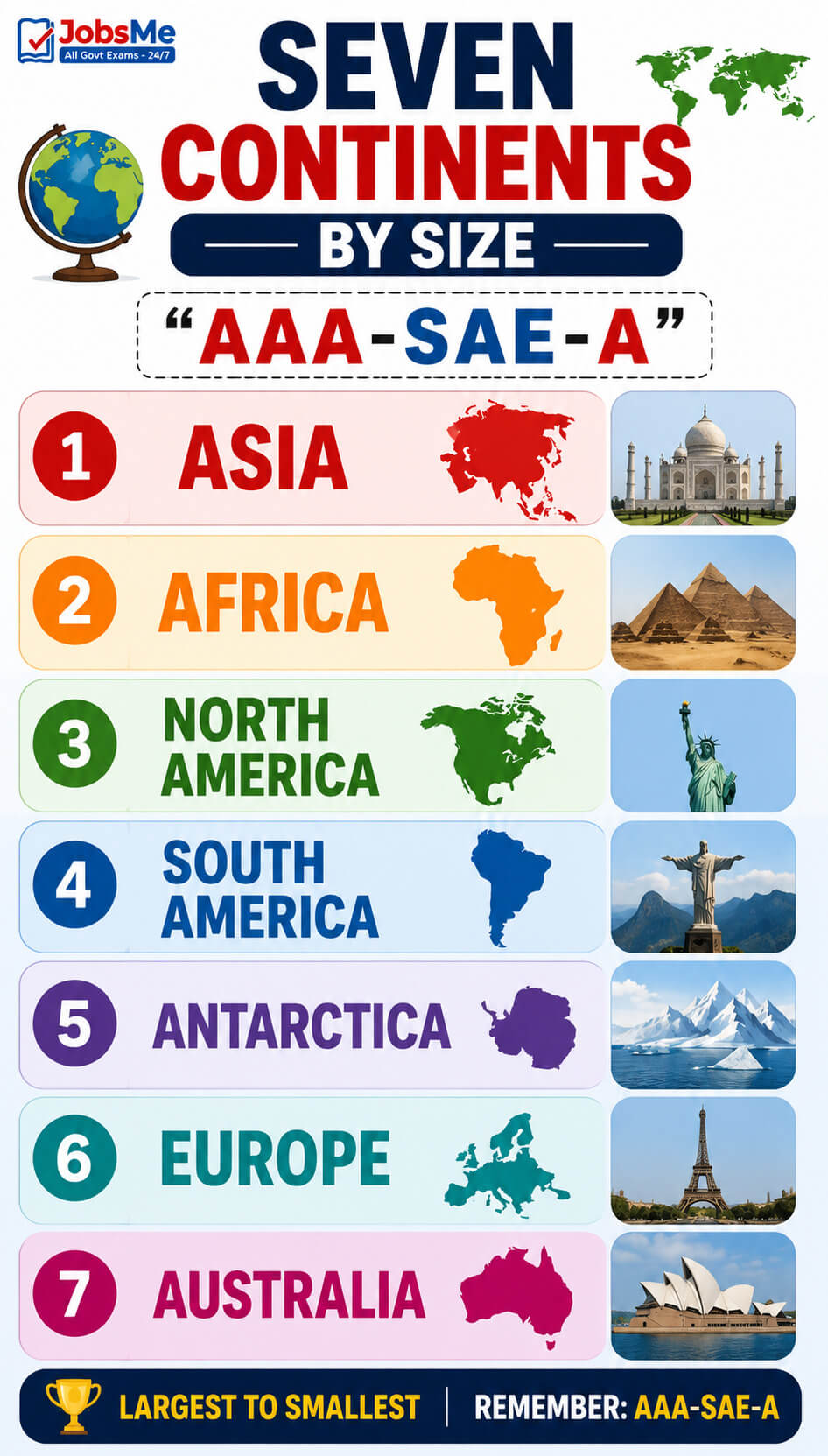
Remember the seven continents from largest to smallest with the order: Asia, Africa, America (North), America (South), Antarctica, Europe, Australia.
- Asia → largest.
- Africa → second.
- North America → third.
- South America → fourth.
- Antarctica → fifth.
- Europe → sixth.
- Australia → smallest.
"All Animals Need A Apple Every Afternoon" — first letters cue Asia, Africa, North & South America, Antarctica, Europe, Australia.
Trick 2: Five Oceans by Size — "PAISA"
Recall the five oceans from largest to smallest with the word PAISA:
- P → Pacific (largest).
- A → Atlantic.
- I → Indian.
- S → Southern.
- A → Arctic (smallest).
"PAISA goes from big to small — just like saving money."
Trick 3: Biggest vs Smallest — "Pacific is Big, Arctic is Small"
Lock the two extremes together so you never confuse them:
- Pacific → largest and deepest ocean.
- Arctic → smallest and shallowest ocean.
"P for Pacific = Plenty (biggest); A for Arctic = A little (smallest)."
Trick 4: Deepest Point — "Challenger in the Mariana"
The deepest point on Earth has two names students mix up:
- Mariana Trench → the trench itself, in the Pacific Ocean.
- Challenger Deep → the deepest spot inside the Mariana Trench.
"The Challenger went Deep into the Mariana, deeper than Everest is tall."
Trick 5: Two Famous Canals — "Panama joins Oceans, Suez joins Seas"
Don't confuse the two great canals:
- Panama Canal → joins the Pacific and Atlantic Oceans (North-South America).
- Suez Canal → joins the Mediterranean and Red Seas (Africa-Asia).
"Panama = Pacific (both start with P); Suez = Seas (both start with S)."
Trick 6: Antarctica's Two Records — "Coldest and Emptiest"
Antarctica holds two different "smallest/extreme" titles:
- Coldest continent → covered in permanent ice.
- Least populated → no permanent human residents, only researchers.
"Australia is the smallest by land; Antarctica is the emptiest by people."
Trick 7: Indian Ocean — "The Only Ocean With a Name"
To remember the unique fact about the Indian Ocean:
- Indian Ocean → the only major ocean named after a country.
"No ocean is called the 'China Ocean' or the 'America Ocean' — only India got one."
Additional Notes
Frequently Confused Facts
- Largest continent vs largest ocean: Asia is the largest continent; the Pacific is the largest ocean. Do not mix them up.
- Smallest continent vs least populated: Australia is the smallest continent by area, but Antarctica is the least populated (no permanent residents).
- Mariana Trench vs Challenger Deep: The Mariana Trench is the trench; the Challenger Deep is the deepest point within it. Both are in the Pacific Ocean.
- Panama Canal vs Suez Canal: Panama connects the Pacific and Atlantic Oceans; Suez connects the Mediterranean and Red Seas. Suez has no locks; Panama is a lock-type canal.
- Isthmus of Panama vs Isthmus of Suez: Panama links North and South America; Suez links Africa and Asia.
- Most countries: Africa has the most countries (54), not Asia, even though Asia has more people.
- Arctic Ocean: It is the smallest and shallowest ocean, located around the North Pole — not the Southern Ocean, which surrounds Antarctica at the South Pole.
- Europe and Asia: They are separate continents but form one landmass called Eurasia, divided by the Ural Mountains.
Repeating PYQ Patterns
Certain facts are asked again and again. "Largest continent — Asia," "Smallest continent — Australia," "Largest and deepest ocean — Pacific," "Smallest ocean — Arctic," "Deepest point — Challenger Deep / Mariana Trench," "Continent with most countries — Africa," and "Continent with no permanent population — Antarctica" appear most often in SSC CGL, RRB NTPC, and State PCS papers. Banking exams such as IBPS PO and SBI Clerk usually test simple matching of an ocean or continent with its rank or key feature, while questions on the Suez Canal, Panama Canal, and Isthmus of Panama are common in both Banking Awareness and SSC GK. You can practise these in the Static GK Quiz section.
Quick Insight
Continents and oceans are not just static facts — they shape today's biggest current affairs. The melting of the Arctic Ocean ice is central to climate change discussions, the Indian Ocean and the Indo-Pacific are at the heart of India's strategic and trade policy, and the Suez and Panama canals remain critical chokepoints for global shipping, often making headlines when blocked or congested. For aspirants, linking these geographic facts to current events makes them easier to remember and more useful in both objective and descriptive papers. For more exam preparation material, you can refer to the Daily Current Affairs notes and the Banking Awareness section on thejobsme.com.
One-Liners for Quick Revision
- Total continents → 7 → Asia, Africa, North America, South America, Antarctica, Europe, Australia.
- Total oceans → 5 → Pacific, Atlantic, Indian, Southern, Arctic.
- Earth's surface covered by water → about 71% → land covers about 29%.
- Largest continent → Asia → biggest by both area and population.
- Most populous continent → Asia → around 60% of the world's people.
- Second largest continent → Africa → also second most populous.
- Continent with most countries → Africa → 54 countries.
- Birthplace of mankind → Africa → oldest human fossils found here.
- Third largest continent → North America → includes USA, Canada, Mexico.
- Continent with the Amazon Rainforest → South America → also has the Andes, the longest land mountain range.
- Coldest continent → Antarctica → covered by permanent ice.
- Least populated continent → Antarctica → no permanent human residents.
- Wealthiest continent → Europe → developed economies, high per-capita income.
- Smallest continent → Australia (Oceania) → also called the "Island Continent."
- Highest peak of Oceania → Mount Kosciuszko → located in Australia.
- Europe-Asia boundary → Ural Mountains → together they form Eurasia.
- Largest ocean → Pacific Ocean → covers about one-third of the Earth.
- Deepest ocean → Pacific Ocean → contains the deepest point on Earth.
- Deepest point on Earth → Challenger Deep → in the Mariana Trench, Pacific Ocean, about 10,994 m deep.
- Second largest ocean → Atlantic Ocean → "S"-shaped, has the Mid-Atlantic Ridge.
- Third largest ocean → Indian Ocean → only major ocean named after a country.
- Newest recognised ocean → Southern Ocean → surrounds Antarctica.
- Smallest and shallowest ocean → Arctic Ocean → around the North Pole, mostly ice-covered.
- Isthmus of Panama → links North and South America; separates the Pacific and Atlantic Oceans.
- Isthmus of Suez → links Africa and Asia; separates the Mediterranean and Red Seas.
- Panama Canal → connects the Pacific and Atlantic Oceans → completed in 1914.
- Suez Canal → connects the Mediterranean and Red Seas → a sea-level canal with no locks.
- Bering Strait → separates Asia and North America → links the Arctic and Pacific Oceans.
- Ring of Fire → volcanic belt around the Pacific Ocean → high earthquake and volcanic activity.
For more Static GK topics like boundary lines, famous personalities, and important canals, explore the Static GK section on thejobsme.com. You can also test your knowledge with the Static GK Quiz and check the latest exam updates at Latest Government Job Notifications.
Free quiz • No signup required
Put this topic into practice with Indian Cultural Institutions – Static GK MCQ Quiz. It is the quickest way to reinforce what you just learned.
Frequently Asked Questions
How many continents and oceans are there in the world?
Which is the largest continent in the world?
Which is the smallest continent in the world?
Which is the largest and deepest ocean?
Which is the smallest ocean in the world?
What is the deepest point in the ocean?
Which continent has the most countries?
Why is Antarctica considered the least populated continent?
What is the difference between the Suez Canal and the Panama Canal?
Which ocean is named after a country?

About the author