List of Important Literary Awards in India and the World – Static GK & General Awareness for Competitive Exams with Memory Tricks
This article presents a complete list of important Indian and international literary awards, covering the Jnanpith Award, Sahitya Akademi Award, Saraswati Samman, Vyas Samman, Moortidevi Award, JCB Prize, and global honours like the Nobel Prize in Literature, the Booker Prize, the International Booker Prize, and the Pulitzer Prize. It includes the awarding bodies, year of establishment, prize money, first recipients, and the latest winners, along with memory tricks and one-liners for quick revision. All facts are arranged in exam-ready format to help UPSC, SSC, IBPS, RRB, PSU, and State PCS aspirants score better in General Awareness, Awards and Honours, and Current Affairs sections.
Jump to section
Introduction
Literary awards recognise outstanding contributions to literature and are among the most frequently tested topics in the Awards and Honours segment of competitive exams. In India, the Jnanpith Award is the highest literary honour, followed by the Sahitya Akademi Award, while private trusts confer prestigious honours like the Saraswati Samman and Vyas Samman. At the global level, the Nobel Prize in Literature, the Booker Prize, the International Booker Prize, and the Pulitzer Prize are the most celebrated literary honours.
Questions on literary awards appear regularly in UPSC Prelims, SSC CGL, IBPS PO, RRB NTPC, SBI Clerk, State PCS, and various Insurance and Defence exams. Questions typically ask which body confers a particular award, who instituted it, who was the first recipient, the prize money involved, or who is the most recent winner. Because winners change every year, this topic also overlaps heavily with current affairs. To explore other related Static GK topics, you can refer to the Static GK section on thejobsme.com.
Literary awards are doubly important because they connect Static GK with current affairs — every year a fresh set of winners is announced and asked in exams. Tracking the latest Jnanpith, Sahitya Akademi, Nobel, and Booker winners alongside the permanent facts about each award (establishing body, year, prize money, first winner) gives aspirants an edge in both Prelims matching questions and descriptive answers. You can keep up with the newest winners through the Daily Current Affairs updates on thejobsme.com.
Core Concepts: Understanding Literary Awards
A literary award is a prize given to a writer, poet, or translator for excellence in literature. Some awards honour a single outstanding work, while others recognise a writer's lifetime contribution. Understanding who gives each award and on what basis helps students answer related questions confidently.
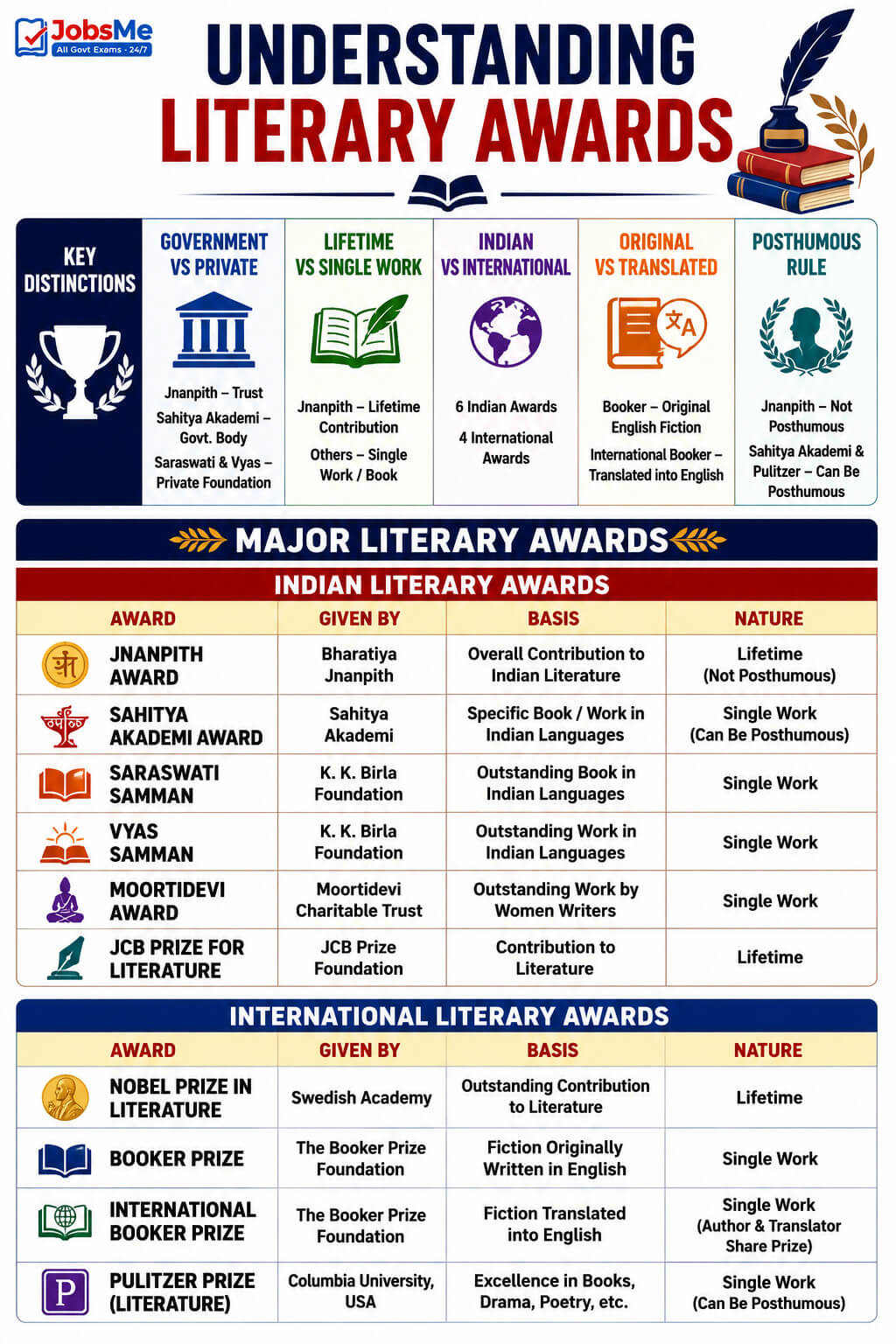
Key Distinctions to Remember
- Government vs Private Awards: The Jnanpith Award is given by the Bharatiya Jnanpith (a trust founded by the Sahu Jain family), while the Sahitya Akademi Award is given by the Sahitya Akademi, India's National Academy of Letters (a government-funded body). The Saraswati Samman and Vyas Samman are given by the private K. K. Birla Foundation.
- Lifetime vs Single Work: The Jnanpith Award now honours a writer's overall contribution to literature, while the Sahitya Akademi Award, Saraswati Samman, and Booker Prize are given for a specific book or work.
- Indian vs International: The Jnanpith, Sahitya Akademi, Saraswati Samman, Vyas Samman, Moortidevi, and JCB Prize are Indian awards; the Nobel Prize in Literature, Booker Prize, International Booker Prize, and Pulitzer Prize are international honours.
- Original vs Translated Work: The Booker Prize is for fiction originally written in English; the International Booker Prize is for fiction translated into English, with the prize money shared equally between author and translator.
- Posthumous Rule: The Jnanpith Award is never given posthumously, whereas the Sahitya Akademi Award and the Pulitzer Prize can be awarded after a writer's death.
Important Indian Literary Awards
The following table lists the most exam-relevant Indian literary awards along with the awarding body, year of establishment, prize money, and key details.
| Award | Awarding Body / Year | Key Details |
|---|---|---|
| Jnanpith Award | Bharatiya Jnanpith; instituted 1961, first given 1965 | India's oldest and highest literary award, given for outstanding contribution to literature. Awarded to writers in Eighth Schedule languages and English; never given posthumously. Prize: cash of Rs 11 lakh, a citation, and a bronze replica of Vagdevi (Goddess Saraswati). First recipient: G. Sankara Kurup (Malayalam, 1965) for Odakkuzhal. First woman winner: Ashapoorna Devi (Bengali, 1976). Kannada has won the most Jnanpith Awards. |
| Sahitya Akademi Award | Sahitya Akademi (National Academy of Letters); established 1954, first given 1955 | India's second-highest literary honour, given annually for an outstanding book in any of 24 languages (22 Eighth Schedule languages plus English and Rajasthani). Prize: an engraved copper plaque (designed by Satyajit Ray), a shawl, and Rs 1,00,000. First awards (1955) included R. K. Narayan (English) for The Guide. Can be given posthumously. |
| Saraswati Samman | K. K. Birla Foundation; instituted 1991 | Annual award for an outstanding prose or poetry work published in the previous 10 years in any of the 22 Eighth Schedule languages. Prize: Rs 15 lakh, a citation, and a plaque. First recipient: Harivansh Rai Bachchan for his autobiography (Kya Bhooloon Kya Yaad Karoon and others). Named after the Hindu goddess of knowledge. |
| Vyas Samman | K. K. Birla Foundation; instituted 1991 | Annual award given only for an outstanding literary work in the Hindi language published in the previous 10 years. Prize: Rs 4 lakh (now enhanced). First recipient: Ram Vilas Sharma for Bharat Ke Praacheen Bhasha Parivar Aur Hindi. |
| Moortidevi Award | Bharatiya Jnanpith; instituted 1983 | Given for a literary work emphasising Indian philosophy and culture in any Indian language or English. Considered the second-highest honour given by the Bharatiya Jnanpith after the Jnanpith Award. |
| Bhasha Samman | Sahitya Akademi; instituted 1996 | Given for contribution to languages other than the 24 major recognised languages, and to classical and medieval literature. Prize: a plaque and Rs 1,00,000. |
| JCB Prize for Literature | JCB Literature Foundation; instituted 2018 | One of India's richest literary prizes for a distinguished work of fiction by an Indian author, including translations. Prize: Rs 25 lakh for the author (with an additional sum for the translator if the work is a translation). |
| Sahitya Akademi Yuva Puraskar | Sahitya Akademi; instituted 2011 | Given to young writers (aged 35 or below) for an outstanding book in the recognised languages. A companion award, the Bal Sahitya Puraskar, honours children's literature. |
Latest Indian Literary Award Winners
The following recent winners are high-value for current affairs and Awards and Honours questions.
| Award (Edition / Year) | Winner | Details |
|---|---|---|
| 60th Jnanpith Award (2025) | R. Vairamuthu (Tamil) | Eminent Tamil poet and lyricist; the third Tamil writer to receive the Jnanpith Award; announced/given in 2026. |
| 59th Jnanpith Award (2024) | Vinod Kumar Shukla (Hindi) | Hindi writer and poet known for his minimalistic style; the first writer from Chhattisgarh to receive the honour. |
| 58th Jnanpith Award (2023) | Jagadguru Rambhadracharya (Sanskrit) and Gulzar (Urdu) | Jointly conferred; presented by the President in 2025. Sanskrit's second Jnanpith and Urdu's fifth. Gulzar is also an Oscar and Dadasaheb Phalke Award winner. |
| 35th Saraswati Samman (2025) | Ramkumar Mukhopadhyay (Bengali) | Awarded for his novel Hara Parbati Katha. |
| 34th Saraswati Samman (2024) | Sadhu Bhadreshdas (Sanskrit) | Awarded for his Sanskrit work Swaminarayan Siddhanta Sudha. |
| Sahitya Akademi Award (2025) | 24 authors across languages | Notable winners include Navtej Sarna (English) for the novel Crimson Spring and Mamta Kalia (Hindi) for the memoir Jeete Jee Allahabad; ceremony held in New Delhi. |
Important International Literary Awards
Global literary awards are equally important for exams, especially when an Indian wins or is nominated. The table below covers the major international literary honours.
| Award | Awarding Body / Year | Key Details |
|---|---|---|
| Nobel Prize in Literature | Swedish Academy (Sweden); first awarded 1901 | The world's most prestigious literary honour, given for a writer's body of work. Instituted from the will of Alfred Nobel. Rabindranath Tagore (1913, for Gitanjali) was the first Asian and first Indian to win. 2025 winner: László Krasznahorkai (Hungary). |
| Booker Prize | Booker Prize Foundation (UK); first awarded 1969 | For the best single work of fiction originally written in English and published in the UK or Ireland. Prize: GBP 50,000. Open to writers of any nationality since 2014. 2025 winner: David Szalay for Flesh. Indian winners include Arundhati Roy (1997, The God of Small Things), Salman Rushdie (1981, Midnight's Children), Kiran Desai (2006, The Inheritance of Loss), and Aravind Adiga (2008, The White Tiger). |
| International Booker Prize | Booker Prize Foundation (UK); began 2005, annual since 2016 | For a single work of fiction translated into English and published in the UK or Ireland. Prize: GBP 50,000 split equally between author and translator. 2025 winner: Heart Lamp by Banu Mushtaq, translated from Kannada by Deepa Bhasthi — the first short-story collection to win, with Bhasthi the first Indian translator to win. Geetanjali Shree's Tomb of Sand (translated by Daisy Rockwell) won in 2022, the first Hindi work to win. |
| Pulitzer Prize | Columbia University (USA); first awarded 1917 | Awarded for achievements in journalism, literature, drama, and music in the United States. Established under the will of journalist Joseph Pulitzer. Includes categories such as Fiction, Poetry, Drama, History, and Biography. |
| Cervantes Prize | Ministry of Culture, Spain; instituted 1976 | The most prestigious award for Spanish-language literature, often called the Nobel of the Spanish-speaking world. |
Memory Tricks and Mnemonics
Trick 1: Highest Indian Literary Award — "J Before S"
To remember the order of importance of the two top Indian literary awards:
- J → Jnanpith Award (highest, given by Bharatiya Jnanpith).
- S → Sahitya Akademi Award (second highest, given by the Sahitya Akademi).
"J before S — Jnanpith outranks Sahitya Akademi."
Trick 2: Birla Foundation Pair — "Saraswati for All, Vyas for Hindi"
Both the Saraswati Samman and Vyas Samman are given by the K. K. Birla Foundation. Distinguish them as:
- Saraswati Samman → any of the 22 Eighth Schedule languages → Rs 15 lakh.
- Vyas Samman → only Hindi → Rs 4 lakh.
"Saraswati speaks every language; Vyas speaks only Hindi."
Trick 3: First Recipients — "First Faces"
- Jnanpith Award → G. Sankara Kurup (Malayalam, 1965).
- Saraswati Samman → Harivansh Rai Bachchan (1991).
- Vyas Samman → Ram Vilas Sharma (1991).
- Nobel Prize in Literature (India) → Rabindranath Tagore (1913).
"Kurup, Bachchan, Sharma, Tagore — remember the firsts."
Trick 4: Booker vs International Booker — "English vs Translated"
- Booker Prize → fiction originally in English → one winner (the author).
- International Booker Prize → fiction translated into English → prize split between author and translator.
"Plain Booker is in English; International Booker is translated and shared."
Trick 5: Prize Money Ladder — "11, 15, 1, 50"
Group the cash amounts to recall them quickly:
- Jnanpith Award → Rs 11 lakh.
- Saraswati Samman → Rs 15 lakh.
- Sahitya Akademi Award → Rs 1 lakh.
- Booker / International Booker → GBP 50,000.

Trick 6: Indian Booker Winners — "RReKA"
Remember the four Indian-origin Booker Prize winners with "RReKA":
- R → Salman Rushdie (1981, Midnight's Children).
- R → Arundhati Roy (1997, The God of Small Things).
- K → Kiran Desai (2006, The Inheritance of Loss).
- A → Aravind Adiga (2008, The White Tiger).
Trick 7: Awarding Bodies — "Who Gives What"
- Bharatiya Jnanpith → Jnanpith Award and Moortidevi Award.
- Sahitya Akademi → Sahitya Akademi Award, Yuva Puraskar, Bal Sahitya Puraskar, Bhasha Samman.
- K. K. Birla Foundation → Saraswati Samman and Vyas Samman.
- Swedish Academy → Nobel Prize in Literature.
- Columbia University → Pulitzer Prize.
Additional Notes
Frequently Confused Facts
- Jnanpith vs Sahitya Akademi: Jnanpith is the highest and is given by a private trust (Bharatiya Jnanpith) for lifetime contribution; Sahitya Akademi is the second highest and is given by the National Academy of Letters for a single book.
- Saraswati Samman vs Vyas Samman: Both are from the K. K. Birla Foundation. Saraswati Samman covers all 22 Eighth Schedule languages (Rs 15 lakh); Vyas Samman is only for Hindi (Rs 4 lakh).
- Booker Prize vs International Booker Prize: The Booker is for novels written in English; the International Booker is for translated fiction, with the prize shared between the author and the translator.
- First Indian Nobel in Literature vs First Indian Booker: Rabindranath Tagore won the Nobel in Literature (1913); Salman Rushdie was an early Indian-origin Booker winner (1981).
- Posthumous awards: The Jnanpith Award is never given posthumously; the Sahitya Akademi Award can be (for example, Jibanananda Das in Bengali in 1955).
- Vagdevi vs Saraswati: The Jnanpith Award carries a bronze replica of Vagdevi, which is another name for Goddess Saraswati — the same deity, so do not treat them as two different statues.
- Tomb of Sand vs Heart Lamp: Geetanjali Shree's Tomb of Sand (Hindi) won the International Booker in 2022; Banu Mushtaq's Heart Lamp (Kannada) won it in 2025 and was the first short-story collection to do so.
Repeating PYQ Patterns
Certain literary-award facts are asked repeatedly in competitive exams. The awarding body of the Jnanpith Award (Bharatiya Jnanpith), the first Jnanpith recipient (G. Sankara Kurup), the first Indian Nobel laureate in Literature (Rabindranath Tagore), the Saraswati Samman and Vyas Samman being given by the K. K. Birla Foundation, Indian Booker winners (Roy, Rushdie, Desai, Adiga), and the difference between the Booker and International Booker prizes appear most often in UPSC Prelims, SSC CGL, and RRB NTPC papers. Banking exams (IBPS PO, SBI Clerk) frequently focus on the latest winners and prize money, making this a strong overlap with Banking Awareness and current affairs. State PCS exams often add regional-language winners — for example, Tamil PCS may ask about R. Vairamuthu and Malayalam PCS about G. Sankara Kurup or Prabha Varma.
Quick Insight
Literary awards are a live bridge between Static GK and current affairs — the permanent facts (founding body, year, prize money, first winner) stay fixed, while a fresh set of winners is announced each year. In recent years, Indian literature has gained global recognition through the International Booker Prize, with Geetanjali Shree's Tomb of Sand (2022) and Banu Mushtaq's Heart Lamp (2025) bringing Hindi and Kannada writing to the world stage. Watching these announcements helps aspirants connect a writer's name to the right award instantly, which is valuable for both Prelims matching questions and Mains answers on Indian languages and culture. For more related preparation, you can practise with the Static GK Quiz and review the latest Banking Awareness notes on thejobsme.com.
One-Liners for Quick Revision
- Jnanpith Award → Highest Indian literary award → given by Bharatiya Jnanpith; instituted 1961, first given 1965; Rs 11 lakh + Vagdevi bronze replica.
- First Jnanpith recipient → G. Sankara Kurup (Malayalam, 1965) → for Odakkuzhal.
- First woman Jnanpith winner → Ashapoorna Devi (Bengali, 1976).
- Most Jnanpith Awards (language) → Kannada.
- 60th Jnanpith Award (2025) → R. Vairamuthu (Tamil).
- 59th Jnanpith Award (2024) → Vinod Kumar Shukla (Hindi), first from Chhattisgarh.
- 58th Jnanpith Award (2023) → Jagadguru Rambhadracharya (Sanskrit) and Gulzar (Urdu).
- Sahitya Akademi Award → Second-highest Indian literary honour → given by the Sahitya Akademi; established 1954, first given 1955; Rs 1 lakh + copper plaque (designed by Satyajit Ray).
- Sahitya Akademi Award (2025) → 24 authors; Navtej Sarna (English, Crimson Spring), Mamta Kalia (Hindi, Jeete Jee Allahabad).
- Saraswati Samman → Given by K. K. Birla Foundation; instituted 1991; Rs 15 lakh; covers 22 Eighth Schedule languages.
- First Saraswati Samman → Harivansh Rai Bachchan (1991).
- 35th Saraswati Samman (2025) → Ramkumar Mukhopadhyay (Bengali) for Hara Parbati Katha.
- 34th Saraswati Samman (2024) → Sadhu Bhadreshdas (Sanskrit) for Swaminarayan Siddhanta Sudha.
- Vyas Samman → Given by K. K. Birla Foundation; instituted 1991; Rs 4 lakh; only for Hindi works.
- First Vyas Samman → Ram Vilas Sharma (1991).
- Moortidevi Award → Given by Bharatiya Jnanpith; instituted 1983; for works on Indian philosophy and culture.
- Bhasha Samman → Given by Sahitya Akademi; instituted 1996; for minor and classical languages; Rs 1 lakh.
- JCB Prize for Literature → Given by JCB Literature Foundation; instituted 2018; Rs 25 lakh for Indian fiction including translations.
- Sahitya Akademi Yuva Puraskar → For young writers aged 35 or below; instituted 2011.
- Nobel Prize in Literature → Given by the Swedish Academy; first awarded 1901; for a writer's body of work.
- First Indian / Asian Nobel laureate in Literature → Rabindranath Tagore (1913) for Gitanjali.
- Nobel Prize in Literature (2025) → László Krasznahorkai (Hungary).
- Booker Prize → Given by the Booker Prize Foundation (UK); first awarded 1969; for fiction in English; GBP 50,000.
- Booker Prize (2025) → David Szalay for Flesh.
- Indian Booker winners → Salman Rushdie (1981), Arundhati Roy (1997), Kiran Desai (2006), Aravind Adiga (2008).
- International Booker Prize → For translated fiction; prize split between author and translator; annual since 2016.
- International Booker (2025) → Heart Lamp by Banu Mushtaq, translated from Kannada by Deepa Bhasthi → first short-story collection to win; first Indian translator winner.
- International Booker (2022) → Tomb of Sand by Geetanjali Shree, translated by Daisy Rockwell → first Hindi work to win.
- Pulitzer Prize → Given by Columbia University (USA); first awarded 1917; for journalism, literature, drama, and music.
- Cervantes Prize → Spain's highest honour for Spanish-language literature; instituted 1976.
For more Static GK topics like awards, books and authors, and important days, explore the Static GK notes on thejobsme.com. You can also test your knowledge with the Daily Current Affairs Quiz and check out the latest exam updates at Latest Government Job Notifications.
Free quiz • No signup required
Put this topic into practice with Indian Cultural Institutions – Static GK MCQ Quiz. It is the quickest way to reinforce what you just learned.
Frequently Asked Questions
Which is the highest literary award in India?
Who was the first recipient of the Jnanpith Award?
Who gives the Sahitya Akademi Award and what is its rank among Indian literary honours?
What is the difference between the Saraswati Samman and the Vyas Samman?
Who was the first Indian to win the Nobel Prize in Literature?
What is the difference between the Booker Prize and the International Booker Prize?
Who won the International Booker Prize in 2025?
Which Indian authors have won the Booker Prize?
Who won the 59th and 60th Jnanpith Awards?
Which work won the first International Booker Prize for a Hindi book?

About the author