Lakes of the World – Static GK & General Awareness for Competitive Exams with Memory Tricks
This article presents a complete, exam-ready guide to the important lakes of the world, covering the largest, deepest, highest, and lowest lakes, their formation types, bordering countries, and continent-wise records. It includes the Top 10 largest lakes (Caspian Sea, Lake Superior, Lake Victoria, Lake Baikal and more), the classification of lakes by water type and formation, key India-specific lakes, and the differences between lakes, seas, lagoons, wetlands and ponds. With memory tricks, frequently confused facts and one-liners for quick revision, all data is arranged to help UPSC, SSC, IBPS, RRB, PSU, Insurance and State PCS aspirants score better in the Geography and General Awareness sections.
Jump to section
- Introduction
- Core Concepts: What Is a Lake and Why It Matters in Exams
- Top 10 Largest Lakes in the World
- Record-Holding Lakes of the World
- Largest Lakes by Continent
- Important Lakes and Their Bordering Countries
- Important Lakes in India
- Lake vs Sea vs Lagoon vs Wetland vs Pond
- Memory Tricks and Mnemonics
- Additional Notes
- One-Liners for Quick Revision
Introduction
Lakes are inland bodies of water that occupy basins surrounded by land. From the vast Caspian Sea, the largest lake on Earth, to Lake Baikal, the world's deepest and oldest freshwater lake, and from Lake Victoria, Africa's largest lake, to Lake Titicaca, the highest navigable lake, the lakes of the world are a high-yield topic in physical and economic geography. Questions about which lake is the largest, deepest, highest or lowest, and which countries share a particular lake, are tested again and again in competitive exams.
Questions on lakes of the world appear regularly in UPSC Prelims, SSC CGL, IBPS PO, RRB NTPC, SBI Clerk, State PCS, and various Insurance and Defence exams. Objective papers usually ask for record-holding lakes, bordering countries, or the type of a particular lake, while UPSC Mains rewards an understanding of lake formation, the East African Rift system, and current environmental issues such as the shrinking Aral Sea and Lake Chad. This article brings together every important lake in a structured, exam-ready format. To explore other related topics, you can refer to the Static GK section on thejobsme.com.
Lakes are also closely linked to current affairs themes such as climate change (falling water levels in Lake Titicaca and Lake Chad), Ramsar wetland sites, the Aral Sea ecological disaster, and the conservation of Indian lakes like Chilika, Loktak and Wular — making this topic doubly important for aspirants preparing for both the environment-focused General Studies papers and objective General Awareness sections.
Core Concepts: What Is a Lake and Why It Matters in Exams
A lake is a large, inland body of water that occupies a basin surrounded by land. Lakes are distinct from oceans, seas and lagoons. Most lakes have inflows and outflows in the form of rivers or streams, but some lakes in endorheic (closed) basins have no outflow and lose water only through evaporation or seepage, which makes them saline. The majority of the world's freshwater lakes lie in the Northern Hemisphere, especially in Canada, Finland and Siberia.
In competitive exams, the skill being tested is recognising the correct record-holder and the correct location. Below are the key ways lakes are classified, which forms the foundation for most questions.
Classification of Lakes by Water Type and Duration
- Temporary Lakes: Form after rainfall in depressions where evaporation exceeds precipitation. Example: desert lakes (playas).
- Permanent Lakes: Deep and long-lasting, where precipitation exceeds evaporation. Examples: the Great Lakes of North America and the East African Rift Lakes.
- Freshwater Lakes: Fed by rivers and have an outflow. Example: the Great Lakes of North America.
- Saline (Salt) Lakes: Have no outflow and high evaporation, leading to high salt content. Examples: the Dead Sea (about 250‰ salinity), Great Salt Lake in Utah (about 220‰), and the Aral Sea.
Classification of Lakes by Formation Process
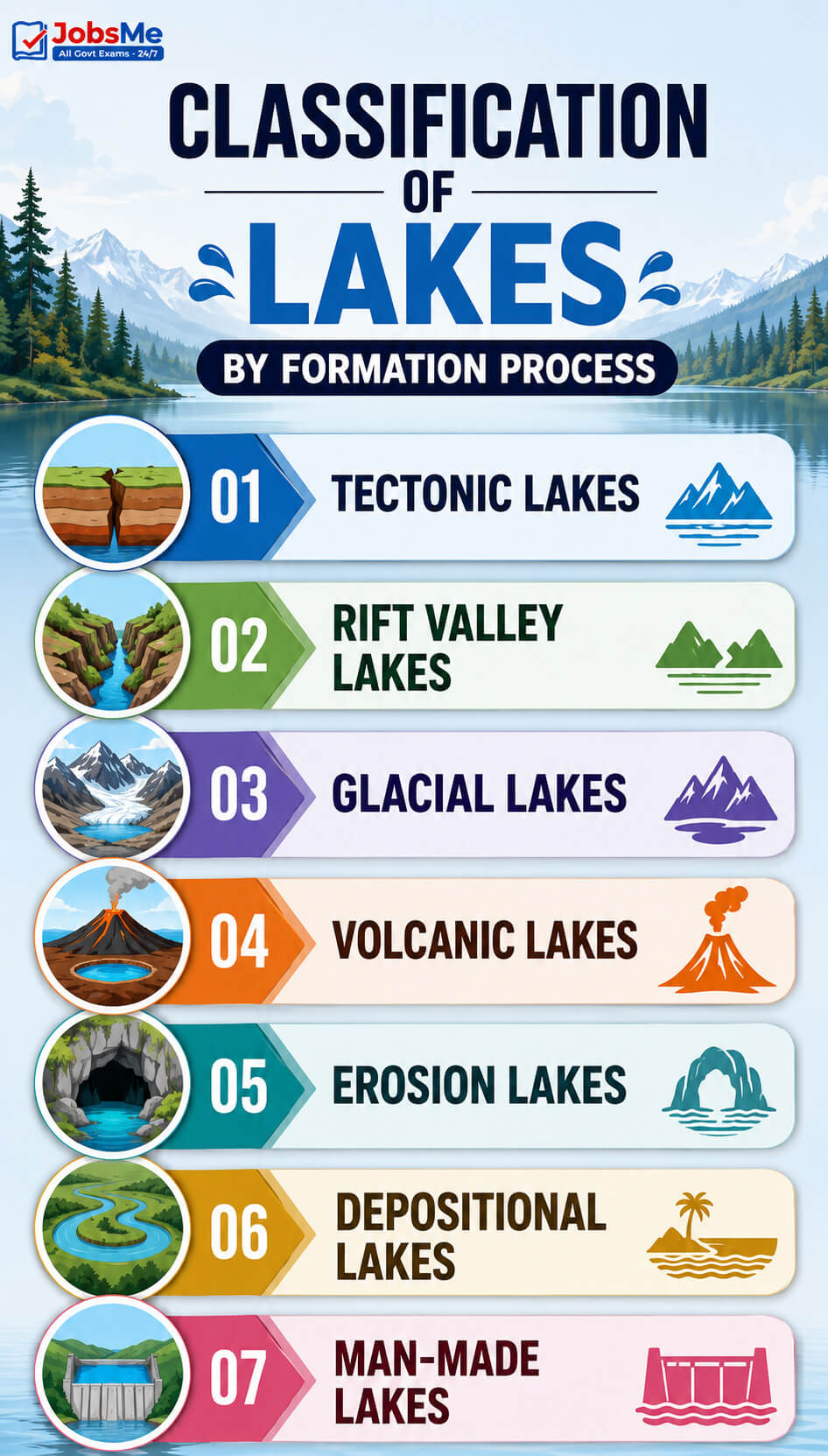
- Tectonic Lakes: Formed by warping, subsidence, bending or fracturing of the Earth's crust. Examples: Lake Titicaca and the Caspian Sea.
- Rift Valley Lakes: Form in deep, narrow rift valleys created by faulting. Examples: the East African Rift Lakes — Tanganyika, Malawi, Edward, Albert — and the Dead Sea.
- Glacial Lakes: Include cirque lakes or tarns (in mountain hollows), rock-hollow lakes (common in Finland, Scandinavia, Patagonia and Canada), and morainic-dammed lakes (where glacial debris blocks valleys).
- Volcanic Lakes: Crater and caldera lakes form in volcanic craters. Examples: Lonar Lake (India) and Krakatoa (Indonesia). Lava-blocked lakes form from volcanic land deformation.
- Erosion Lakes: Karst lakes form in limestone areas through solution hollows and cave-roof collapse; wind-deflated lakes form in deserts, such as the Great Basin in Utah.
- Depositional Lakes: Fluvial ox-bow lakes form from river meander cut-offs (Lower Mississippi, Lower Ganges); marine lagoons form along coasts, such as Lake Chilika in India; barrier lakes form when landslides or avalanches block rivers, such as the Shiwalik Duns.
- Man-made Lakes: Formed by dams and reservoirs for irrigation and electricity. Examples: Lake Mead (Hoover Dam, USA), Gobind Sagar (Bhakra-Nangal Dam, India), Hirakud Lake (Mahanadi, Odisha), and tin-mining lakes in Malaysia.
Lakes are not permanent features of the Earth. Over geological time they either drain naturally or get filled with sediment (silt), a process that may take thousands of years but is relatively fast on a geological scale.
Top 10 Largest Lakes in the World
The following table lists the ten largest lakes in the world by surface area, along with their type, area, bordering countries and key features. The Caspian Sea, though called a "sea," is the world's largest lake.
| Rank | Lake | Type | Area (km²) | Bordering Countries | Key Features |
|---|---|---|---|---|---|
| 1 | Caspian Sea | Saline water | 389,000 | Kazakhstan, Turkmenistan, Azerbaijan, Russia, Iran | World's largest lake and largest enclosed body of water; geologically closer to a small ocean; length about 1,199 km, maximum depth 1,025 m, volume 78,200 km³; famous for sturgeon fishing. |
| 2 | Lake Superior | Freshwater | 82,100 | Canada, United States | Largest freshwater lake in the world by surface area; part of the Great Lakes; length about 616 km, maximum depth 406 m, volume 12,070 km³; known for cold, clear waters and historic shipwrecks. |
| 3 | Lake Victoria | Freshwater | 59,940 | Tanzania, Uganda, Kenya | Largest lake in Africa and second-largest freshwater lake in the world; chief feeder of the Nile; length about 322 km, maximum depth 81 m, volume 2,420 km³; rich biodiversity with many islands. |
| 4 | Lake Huron | Freshwater | 59,590 | Canada, United States | Part of the Great Lakes; named after the Huron tribe; famous for Georgian Bay and the largest number of islands among lakes; length about 332 km, maximum depth 229 m, volume 3,520 km³. |
| 5 | Lake Michigan | Freshwater | 58,030 | United States | Largest lake entirely within a single country; hydrologically joined to Lake Huron; the Mackinac Bridge is an iconic landmark; length about 494 km, maximum depth 282 m, volume 4,930 km³. |
| 6 | Lake Tanganyika | Freshwater | 32,900 | Tanzania, DR Congo, Burundi, Zambia | Second-oldest and second-deepest freshwater lake in the world after Baikal; longest freshwater lake; length about 676 km, maximum depth 1,470 m, volume 18,750 km³; home to many unique fish species. |
| 7 | Lake Baikal | Freshwater | 31,722 | Russia | World's deepest and oldest freshwater lake; largest lake by volume (about 23,610 km³); maximum depth 1,642 m; holds a large share of the planet's unfrozen freshwater; a UNESCO World Heritage Site. |
| 8 | Great Bear Lake | Freshwater | 31,153 | Canada | Largest lake entirely within Canada and the fourth-largest freshwater lake in the world; in the Northwest Territories; length about 373 km, maximum depth 446 m, volume 2,234 km³; known for clear waters. |
| 9 | Lake Malawi | Freshwater | 29,600 | Malawi, Mozambique, Tanzania | Also called Lake Nyasa or the "Lake of the Stars"; third-largest freshwater lake in Africa and ninth-largest in the world; famous for its cichlid fish; length about 579 km, maximum depth 706 m, volume 8,640 km³. |
| 10 | Great Slave Lake | Freshwater | 27,200 | Canada | Deepest lake in North America and second-largest freshwater lake in Canada after Great Bear Lake; length about 480 km, maximum depth 614 m, volume 1,115 km³; a key habitat for migratory birds. |
Record-Holding Lakes of the World
This section covers the lakes that hold world records — the most frequently tested set of facts on this topic. You can reinforce these through the Static GK Quiz on thejobsme.com.
| Category | Lake | Key Details |
|---|---|---|
| Largest Lake (overall) | Caspian Sea | Largest lake and largest enclosed water body on Earth; saline; area about 389,000 km². |
| Largest Freshwater Lake by Area | Lake Superior | Largest freshwater lake in the world by surface area; part of the Great Lakes of North America. |
| Deepest Lake / Largest by Volume | Lake Baikal (Russia) | World's deepest freshwater lake (about 1,637-1,642 m) and largest lake by volume; also the oldest lake. |
| Longest Lake | Lake Tanganyika (Africa) | Longest freshwater lake (about 660-676 km); second-deepest and second-largest by volume. |
| Highest Lake (overall) | Crater Lake of Ojos del Salado (Andes) | Highest lake on Earth at about 6,390 m elevation; very small in size. |
| Highest Large Lake | Pumoyong Tso (Tibet, China) | Highest large lake, at about 5,018 m elevation. |
| Highest Navigable Lake | Lake Titicaca (Peru / Bolivia) | Highest navigable lake at about 3,812 m; largest lake in South America; water levels recently fell to historic lows due to climate change. |
| Lowest Lake | Dead Sea | Lowest point on land at about 418-423 m below sea level; about 10 times saltier than the ocean. |
| Largest Lake Entirely in One Country | Lake Michigan | Largest lake lying entirely within a single country (United States). |
Largest Lakes by Continent
Each continent has its own largest lake, a popular matching question in objective papers.
| Continent | Largest Lake | Key Details |
|---|---|---|
| Asia | Lake Baikal (or Caspian Sea if counted) | Baikal is the largest freshwater lake in Asia; the Caspian Sea is larger but saline and shared with Europe. |
| Africa | Lake Victoria | Largest lake in Africa and the second-largest freshwater lake in the world. |
| North America | Lake Superior | Largest freshwater lake in the world by surface area. |
| South America | Lake Titicaca | Highest navigable lake and largest lake in South America. |
| Europe | Lake Ladoga | Largest lake in Europe, located in Russia; Lake Onega is the second largest. |
| Australia | Lake Eyre | Largest lake in Australia; a salt lake that is mostly dry or seasonal. |
| Antarctica | Lake Vostok | Subglacial freshwater lake beneath the thick Antarctic ice sheet; a focus of scientific research. |
Important Lakes and Their Bordering Countries
Knowing which countries share a lake is one of the most commonly tested points. The table below covers the key lakes, their continent, bordering countries, water type and special facts.
| Lake | Continent | Bordering Countries | Water Type | Special Facts |
|---|---|---|---|---|
| Lake Superior | North America | USA, Canada | Freshwater | Largest freshwater lake by surface area. |
| Lake Victoria | Africa | Tanzania, Uganda, Kenya | Freshwater | Largest lake in Africa; second-largest freshwater lake in the world. |
| Lake Baikal | Asia (Russia) | Russia (Siberia) | Freshwater | Deepest lake in the world (about 1,637 m); largest by volume. |
| Lake Tanganyika | Africa | Tanzania, DR Congo, Burundi, Zambia | Freshwater | Longest freshwater lake; second-deepest in the world. |
| Lake Michigan | North America | USA (entirely) | Freshwater | Largest lake entirely within a single country. |
| Lake Huron | North America | USA, Canada | Freshwater | Part of the Great Lakes; has the most islands among lakes. |
| Lake Erie | North America | USA, Canada | Freshwater | Shallowest and most polluted of the Great Lakes. |
| Lake Ontario | North America | USA, Canada | Freshwater | Smallest of the Great Lakes by surface area. |
| Dead Sea | Asia | Israel, Jordan, Palestine | Highly saline | Lowest point on Earth's land surface (about −423 m); roughly 10 times saltier than the ocean. |
| Aral Sea | Asia | Kazakhstan, Uzbekistan | Saline (shrinking) | Shrinking since the 1960s due to Soviet irrigation diversion; a symbol of environmental disaster. |
| Lake Titicaca | South America | Peru, Bolivia | Freshwater | Highest navigable lake (about 3,812 m); largest lake in South America. |
| Lake Eyre | Australia | Australia (South Australia) | Salt lake (seasonal) | Largest lake in Australia; mostly dry or seasonal. |
| Lake Vostok | Antarctica | Under the Antarctic ice sheet | Freshwater (subglacial) | Subglacial lake; subject of ongoing scientific research. |
| Lake Ladoga | Europe | Russia | Freshwater | Largest lake in Europe. |
| Lake Onega | Europe | Russia | Freshwater | Second-largest lake in Europe after Ladoga. |
| Lake Maracaibo | South America | Venezuela | Brackish (mixed) | Technically a bay connected to the sea; one of the oldest and largest in South America. |
| Lake Chad | Africa | Chad, Niger, Nigeria, Cameroon | Freshwater (shrinking) | A vital regional water source that is rapidly shrinking. |
| Chilika Lake | Asia (India) | India (Odisha) | Brackish | India's largest brackish-water lagoon; rich in biodiversity. |
| Wular Lake | Asia (India) | India (Jammu & Kashmir) | Freshwater | Largest freshwater lake in India. |
Other Notable Lakes of the World
- Lake Geneva (Lac Léman): One of the largest lakes in Western Europe, shared by Switzerland and France; a popular tourist destination.
- Lake Como: Italy; renowned for its scenic beauty and a popular retreat for artists and celebrities.
- Loch Ness: Scotland; deep lake famous for the legend of the Loch Ness Monster, "Nessie."
- Lake Balaton: Largest lake in Central Europe, often called the "Hungarian Sea."
- Lake Plitvice: Part of Plitvice Lakes National Park in Croatia, a UNESCO World Heritage Site.
- Lake Turkana: The world's largest desert lake (Kenya / Ethiopia), known for its greenish-blue colour.
- Lake Nasser: A large man-made reservoir formed by the Aswan High Dam in Egypt.
- Lake Van: Largest lake in Turkey and one of the largest endorheic (closed-basin) lakes in the world.
- Issyk-Kul: One of the largest alpine lakes in the world (Kyrgyzstan); never freezes despite its mountain setting.
- Tonle Sap: Largest freshwater lake in Southeast Asia (Cambodia); famous for reversing its flow direction seasonally.
- Lake Poyang: Largest freshwater lake in China; an important habitat for migratory birds.
- Lake Winnipeg: One of the largest freshwater lakes in North America (Canada).
- Lake Poopó: Once the second-largest lake in Bolivia, it has shrunk dramatically due to climate change.
- Lake General Carrera (Buenos Aires): Straddles Chile and Argentina; famous for its marble caves.
Important Lakes in India
Indian lakes are tested in both world-geography and Indian-geography sections, and overlap heavily with the environment and Ramsar-site syllabus. The table below covers the most important lakes by state and type.
| Lake | Type | State / UT | Special Features |
|---|---|---|---|
| Wular Lake | Freshwater | Jammu & Kashmir | Largest freshwater lake in India; one of the largest in Asia; a Ramsar site vital to the region's hydrology. |
| Dal Lake | Freshwater | Jammu & Kashmir | Famous for houseboats and shikaras; a major tourist attraction in Srinagar. |
| Pangong Tso | Saline (endorheic) | Ladakh | High-altitude lake known for its blue waters; partially extends into China. |
| Tso Moriri | Freshwater | Ladakh | High-altitude lake and a designated Ramsar site. |
| Cholamu (Cholamoo) Lake | Freshwater | Sikkim | One of the highest lakes in India, located very near the Indo-China border. |
| Chilika Lake | Brackish (lagoon) | Odisha | Largest coastal lagoon in India; a Ramsar site famous for migratory birds and Irrawaddy dolphins. |
| Pulicat Lake | Brackish (lagoon) | Andhra Pradesh & Tamil Nadu | Second-largest brackish-water lagoon in India; a key habitat for migratory birds. |
| Sambhar Lake | Saltwater | Rajasthan | Largest inland saltwater lake in India and a major source of salt production; a Ramsar site. |
| Lonar Lake | Crater lake | Maharashtra | Formed by a meteor impact; both alkaline and saline. |
| Loktak Lake | Freshwater | Manipur | Largest freshwater lake in northeast India; famous for floating biomass (phumdis); Keibul Lamjao, the only floating national park, is located here. |
| Kolleru Lake | Freshwater | Andhra Pradesh | A seasonal lake lying between the Godavari and Krishna rivers; used for water storage. |
| Upper Lake (Bhojtal) | Freshwater | Madhya Pradesh (Bhopal) | One of the oldest man-made lakes in India. |
| Vembanad Lake | Brackish | Kerala | Longest lake in India and the largest in Kerala; famous for backwater houseboat tourism. |
| Ashtamudi Lake | Brackish | Kerala | Second-largest lake in Kerala; palm-shaped; a Ramsar site. |
| Hussain Sagar | Artificial (freshwater) | Telangana (Hyderabad) | Built in the 16th century during the reign of Ibrahim Quli Qutub Shah; famous for the Buddha statue at its centre. |
| Nakki Lake | Artificial | Rajasthan (Mt. Abu) | The only hill-station lake in Rajasthan. |
| Pichola Lake | Artificial | Rajasthan (Udaipur) | Famous for the Lake Palace hotel. |
| Pushkar Lake | Religious / Freshwater | Rajasthan | A sacred pilgrimage site; the annual Pushkar fair is held here. |
| Renuka Lake | Freshwater | Himachal Pradesh | Shaped like a reclining woman; mythologically significant; a Ramsar site. |
| Salim Ali Lake | Freshwater | Maharashtra (Aurangabad) | Named after the famous ornithologist Salim Ali. |
| Kanwar (Kabar) Lake | Freshwater | Bihar | Asia's largest freshwater ox-bow lake, though now shrinking; a Ramsar site. |
| Harike Lake | Freshwater (wetland) | Punjab | Largest wetland in northern India, at the confluence of the Beas and Sutlej rivers; a Ramsar site. |
| Gobind Sagar | Artificial (freshwater) | Himachal Pradesh | Man-made reservoir formed by the Bhakra-Nangal Dam on the Sutlej river. |
Lake vs Sea vs Lagoon vs Wetland vs Pond
Distinguishing a lake from similar water bodies is a frequent source of confusion. The differences below are commonly tested in objective papers.
Lake vs Sea
- Lake: A water body enclosed by land; mostly freshwater (some are saline); completely inland; fed by rainfall, rivers and groundwater; few or no waves. Examples: Wular Lake, Chilika Lake, the Great Lakes.
- Sea: A large saline water body connected to an ocean; salinity around 35‰; much larger than lakes; has strong waves and is fed by the ocean. Examples: Arabian Sea, Bay of Bengal, Mediterranean Sea.
Lake vs Lagoon
- Lake: Completely surrounded by land; fresh or saline; can be deep; formed by tectonic, glacial, volcanic or fluvial action. Example: Dal Lake.
- Lagoon: A shallow coastal water body separated from the sea by sandbars or reefs; usually saline or brackish; formed by coastal deposition. Examples: Chilika Lake (Odisha) and Vembanad Lake (Kerala).
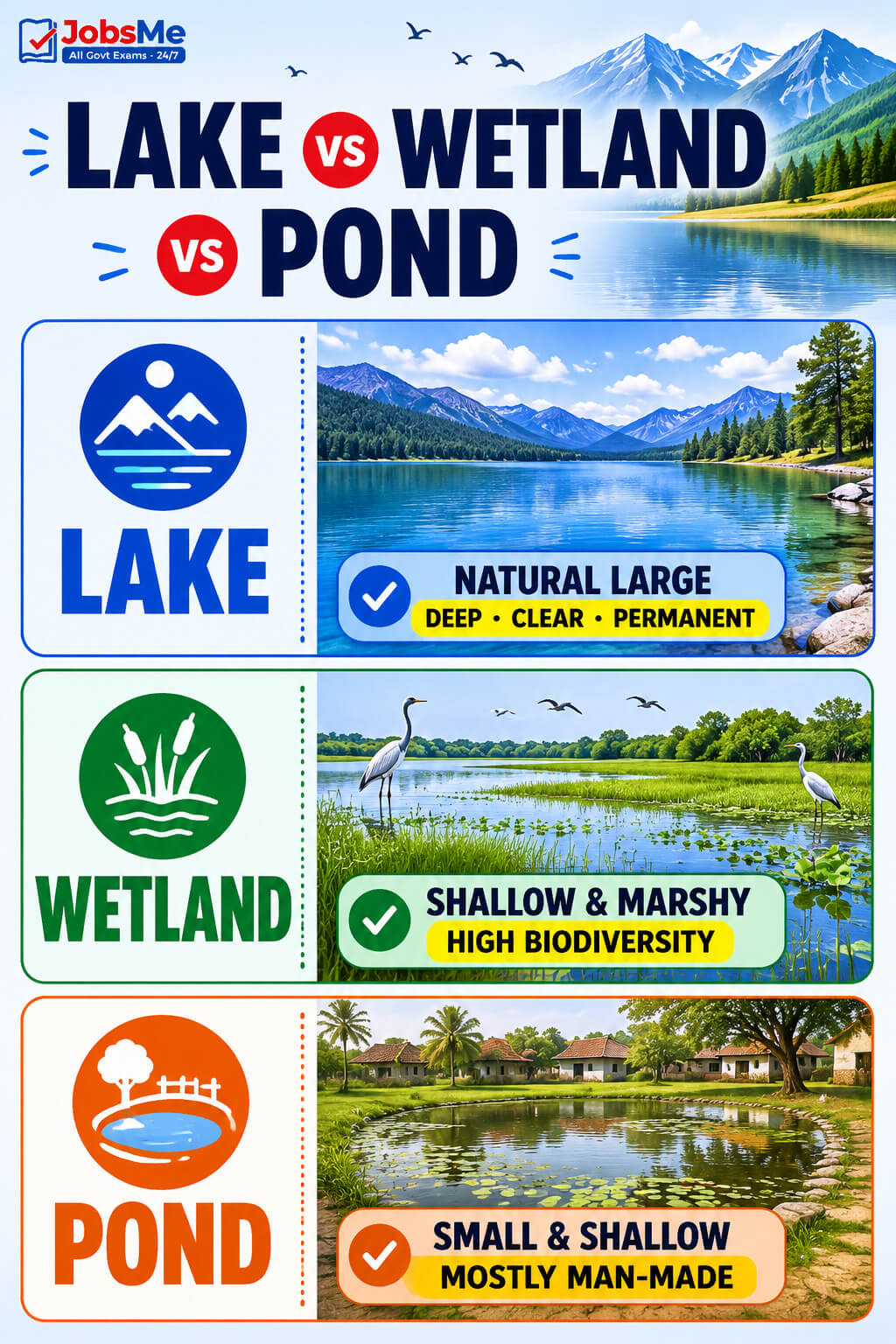
Lake vs Wetland vs Pond
- Wetland: Land permanently or seasonally submerged in water; shallow and often marshy; very high biodiversity; aids water purification and flood control. Examples: the Sundarbans and Kaziranga wetlands.
- Pond: A small, shallow, mostly man-made water body; sunlight reaches the entire bottom. Examples: village ponds.
Memory Tricks and Mnemonics
Trick 1: Top 10 Largest Lakes — "Caspian Stays Very Huge, Michigan Tries Becoming Greatly Massive, Greatly Slow"
Use the first letters to recall the Top 10 in order of area: Caspian, Superior, Victoria, Huron, Michigan, Tanganyika, Baikal, Great Bear, Malawi, Great Slave.
"Caspian Superior Victoria Huron Michigan, Tanganyika Baikal, Great Bear Malawi Great Slave."
Trick 2: The "Three Bs of Baikal"
Lake Baikal holds three superlatives that all begin with the idea of being the "most":
- Biggest by volume (largest freshwater store).
- Bottommost — the deepest lake (about 1,642 m).
- Born first — the oldest lake on Earth.
"Baikal = Biggest volume, Bottom-most depth, Born first."
Trick 3: Great Lakes Order — "Super Man Helps Every One" (West to East)
The five Great Lakes from west to east are Superior, Michigan, Huron, Erie, Ontario. Remember "Super Man Helps Every One." The classic acronym HOMES (Huron, Ontario, Michigan, Erie, Superior) helps recall the five names in any order.
Trick 4: Highest vs Lowest — "Titicaca on Top, Dead Sea at the Bottom"
- Lake Titicaca → highest navigable lake (about 3,812 m), highest up.
- Dead Sea → lowest point on land (about 418 m below sea level), at the very bottom and the saltiest.
"Titicaca touches the sky; the Dead Sea sinks the lowest."
Trick 5: Tanganyika's Twin Seconds
Lake Tanganyika is "second" in two famous lists — the second-deepest lake (after Baikal) and the second-largest by volume (after Baikal). It is also the longest freshwater lake. "Tanganyika comes second to Baikal twice, but it is the longest of all."
Trick 6: Shrinking Lakes — "ATP is Draining"
Three lakes famous for shrinking due to human activity and climate change: Aral Sea, Titicaca (record low levels), and Poopó (and Lake Chad). "ATP energy is running out, just like these shrinking lakes."
Trick 7: India's "Largest" Lakes — One Word Each
- Wular → largest freshwater lake in India.
- Chilika → largest coastal lagoon (brackish) in India.
- Sambhar → largest inland saltwater lake in India.
- Vembanad → longest lake in India.
"Wular Fresh, Chilika Coast, Sambhar Salt, Vembanad Long."
Additional Notes
Frequently Confused Facts
- Largest lake vs largest freshwater lake: The Caspian Sea is the largest lake overall (saline), while Lake Superior is the largest freshwater lake by surface area — a very common trap.
- Deepest lake vs largest freshwater lake: Lake Baikal is the deepest and largest by volume, but Lake Superior is larger by surface area.
- Lake Victoria vs Lake Tanganyika: Victoria is the largest lake in Africa by area; Tanganyika is the longest and second-deepest.
- Lake Michigan vs the other Great Lakes: Michigan is the only Great Lake lying entirely within one country (USA); the others are shared with Canada.
- Highest lake vs highest navigable lake: Ojos del Salado crater lake is the highest overall; Lake Titicaca is the highest navigable lake.
- Caspian Sea, Aral Sea and Dead Sea: All three are technically lakes, not seas, despite their names.
- Lonar vs Pangong: Lonar (Maharashtra) is a meteor-impact crater lake; Pangong Tso (Ladakh) is a high-altitude saline lake shared with China.
- Vembanad vs Wular: Vembanad (Kerala) is the longest lake in India; Wular (J&K) is the largest freshwater lake.
- Chilika vs Pulicat: Chilika (Odisha) is the largest brackish lagoon; Pulicat (Andhra Pradesh-Tamil Nadu) is the second largest.
Repeating PYQ Patterns
Certain lake facts are asked repeatedly. The Caspian Sea (largest lake), Lake Baikal (deepest and largest by volume), Lake Superior (largest freshwater by area), Lake Titicaca (highest navigable), the Dead Sea (lowest and saltiest), and Lake Tanganyika (longest, second-deepest) appear most often in SSC CGL, RRB NTPC and State PCS papers. For India-specific questions, Wular (largest freshwater), Chilika (largest lagoon), Sambhar (largest saltwater), Vembanad (longest), Lonar (crater lake) and Loktak (floating phumdis) are perennial favourites. UPSC Prelims often combines lakes with the environment syllabus by asking about Ramsar sites and shrinking lakes like the Aral Sea and Lake Chad. You can practise these in the Static GK Quiz section.
Quick Insight
Lakes are increasingly in the news because of climate change and human pressure. The water level of Lake Titicaca recently fell to historic lows, the Aral Sea has nearly vanished after decades of irrigation diversion, and Lake Chad and Lake Poopó are shrinking fast. In India, the conservation of Ramsar wetlands such as Chilika, Loktak, Wular and Sambhar is a recurring environment theme. For aspirants, linking the static records of each lake with its current environmental status is the smartest way to handle both objective and descriptive questions. For more exam preparation material, you can refer to the Daily Current Affairs notes and the Static GK section on thejobsme.com.
One-Liners for Quick Revision
- Caspian Sea → largest lake in the world (saline) → shared by Kazakhstan, Turkmenistan, Azerbaijan, Russia and Iran; famous for sturgeon.
- Lake Superior → largest freshwater lake by surface area → part of the Great Lakes (USA-Canada).
- Lake Victoria → largest lake in Africa, second-largest freshwater lake in the world → feeds the Nile (Tanzania, Uganda, Kenya).
- Lake Huron → Great Lake with the most islands → named after the Huron tribe (USA-Canada).
- Lake Michigan → largest lake entirely within one country → lies wholly in the USA.
- Lake Tanganyika → longest freshwater lake, second-deepest and second-largest by volume → Tanzania, DR Congo, Burundi, Zambia.
- Lake Baikal → deepest, oldest and largest-by-volume freshwater lake → Russia (Siberia); UNESCO site.
- Great Bear Lake → largest lake entirely within Canada, fourth-largest freshwater lake in the world.
- Lake Malawi (Nyasa) → "Lake of the Stars," ninth-largest lake in the world → Malawi, Mozambique, Tanzania.
- Great Slave Lake → deepest lake in North America → in Canada.
- Lake Erie → shallowest and most polluted Great Lake.
- Lake Ontario → smallest Great Lake by surface area.
- Dead Sea → lowest point on land (about 418 m below sea level), about 10x saltier than the ocean → Israel, Jordan, Palestine.
- Aral Sea → shrinking since the 1960s, a symbol of ecological disaster → Kazakhstan, Uzbekistan.
- Lake Titicaca → highest navigable lake and largest lake in South America → Peru, Bolivia.
- Lake Eyre → largest lake in Australia, a mostly dry salt lake.
- Lake Vostok → subglacial freshwater lake beneath the Antarctic ice sheet.
- Lake Ladoga → largest lake in Europe (Russia); Lake Onega is second.
- Lake Maracaibo → brackish, technically a bay connected to the sea → Venezuela.
- Lake Chad → rapidly shrinking African lake → Chad, Niger, Nigeria, Cameroon.
- Ojos del Salado crater lake → highest lake on Earth (about 6,390 m) in the Andes.
- Pumoyong Tso → highest large lake (about 5,018 m) in Tibet, China.
- Lake Turkana → world's largest desert lake (Kenya).
- Lake Van → largest lake in Turkey, a large endorheic lake.
- Tonle Sap → largest freshwater lake in Southeast Asia; reverses flow seasonally (Cambodia).
- Lake Poyang → largest freshwater lake in China.
- Lake Geneva → large Western European lake shared by Switzerland and France.
- Loch Ness → Scottish lake famous for the "Nessie" legend.
- Lake Balaton → largest lake in Central Europe, the "Hungarian Sea."
- Wular Lake → largest freshwater lake in India → Jammu & Kashmir.
- Dal Lake → famous for houseboats → Srinagar, Jammu & Kashmir.
- Pangong Tso → high-altitude saline lake partly in China → Ladakh.
- Tso Moriri → high-altitude Ramsar lake → Ladakh.
- Cholamu Lake → one of India's highest lakes, near the Indo-China border → Sikkim.
- Chilika Lake → largest coastal lagoon in India, famous for migratory birds → Odisha.
- Pulicat Lake → second-largest brackish lagoon in India → Andhra Pradesh & Tamil Nadu.
- Sambhar Lake → largest inland saltwater lake in India, major salt source → Rajasthan.
- Lonar Lake → meteor-impact crater lake, alkaline and saline → Maharashtra.
- Loktak Lake → floating phumdis, home to Keibul Lamjao National Park → Manipur.
- Kolleru Lake → seasonal lake between the Godavari and Krishna rivers → Andhra Pradesh.
- Upper Lake (Bhojtal) → one of the oldest man-made lakes in India → Bhopal, Madhya Pradesh.
- Vembanad Lake → longest lake in India, backwater tourism → Kerala.
- Ashtamudi Lake → second-largest lake in Kerala, palm-shaped Ramsar site → Kerala.
- Hussain Sagar → 16th-century artificial lake with a central Buddha statue → Hyderabad, Telangana.
- Nakki Lake → only hill-station lake in Rajasthan → Mt. Abu.
- Pichola Lake → famous for the Lake Palace hotel → Udaipur, Rajasthan.
- Pushkar Lake → sacred lake of the annual Pushkar fair → Rajasthan.
- Renuka Lake → woman-shaped Ramsar lake → Himachal Pradesh.
- Salim Ali Lake → named after the famous ornithologist → Aurangabad, Maharashtra.
- Kanwar (Kabar) Lake → Asia's largest freshwater ox-bow lake → Bihar.
- Harike Lake → largest wetland in northern India, Beas-Sutlej confluence → Punjab.
- Gobind Sagar → reservoir of the Bhakra-Nangal Dam → Himachal Pradesh.
- Lake formation types → tectonic, rift valley, glacial, volcanic, erosional, depositional and man-made.
For more Static GK topics like boundary lines, monuments and rivers, explore the Static GK section on thejobsme.com. You can also test your knowledge with the Daily Current Affairs Quiz and check out the latest exam notifications at Latest Government Job Notifications.
Free quiz • No signup required
Put this topic into practice with Indian Cultural Institutions – Static GK MCQ Quiz. It is the quickest way to reinforce what you just learned.
Frequently Asked Questions
Which is the largest lake in the world?
Which is the largest freshwater lake in the world?
Which is the deepest lake in the world?
Which is the highest navigable lake in the world?
Which is the lowest and saltiest lake in the world?
Why is the Caspian Sea considered a lake and not a sea?
Which is the largest freshwater lake in India?
What is special about Loktak Lake in Manipur?
Which lakes in the world are shrinking due to human activity and climate change?
What is the difference between a lake and a lagoon?

About the author