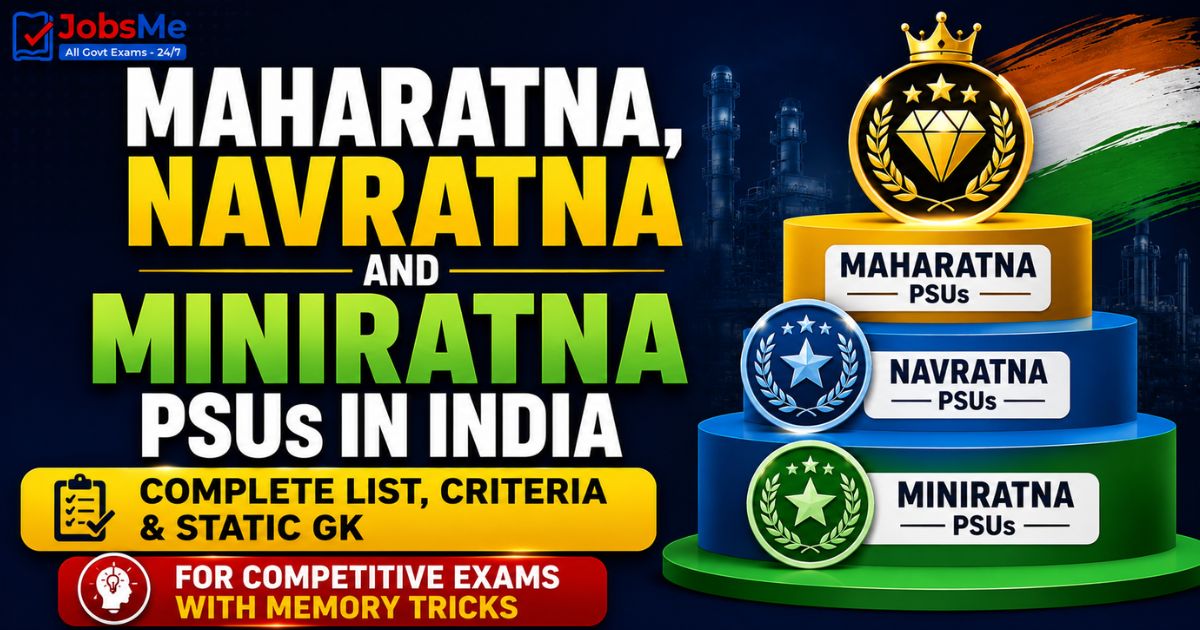
Maharatna, Navratna and Miniratna PSUs in India – Complete List, Criteria and Static GK for Competitive Exams with Memory Tricks
This article presents a complete, exam-ready guide to India's Maharatna, Navratna and Miniratna Public Sector Undertakings (PSUs), covering the full official list of 14 Maharatna, 26 Navratna and Miniratna (Category-I and II) Central Public Sector Enterprises, along with eligibility criteria, investment powers and the ministries that govern them. It explains why ONGC, NTPC, Coal India, HAL, BEL, IRCTC, BSNL and AAI carry these prestigious "Ratna" tags, with the latest 2026 figures, memory tricks and quick-revision one-liners. All facts are arranged in a structured format to help UPSC, SSC, IBPS, RRB, PSU, Insurance and State PCS aspirants score better in General Awareness, Banking Awareness and Indian Economy sections.
Jump to section
- Introduction
- Core Concepts: What Are Maharatna, Navratna and Miniratna PSUs
- Comparison of the Three Ratna Categories
- Complete List of Maharatna Companies (14)
- Complete List of Navratna Companies (26)
- Miniratna Companies (Category-I and Category-II)
- Memory Tricks and Mnemonics
- Additional Notes
- One-Liners for Quick Revision
Introduction
India's public sector is built on the strength of its Central Public Sector Enterprises (CPSEs) — government-owned companies where the Centre holds at least 51% equity. To reward the best-performing among them and give them the freedom to compete globally, the Government of India grants three special status tags: Maharatna, Navratna and Miniratna. Giants like ONGC, NTPC, Coal India, Indian Oil and Hindustan Aeronautics Limited (HAL) are Maharatnas; companies like Bharat Electronics (BEL) and NMDC are Navratnas; while IRCTC, BSNL and the Airports Authority of India (AAI) fall under the Miniratna category.
Questions on PSU classification appear regularly in UPSC Prelims, SSC CGL, IBPS PO, RRB NTPC, SBI Clerk, State PCS and various Insurance and Defence exams, especially in the Indian Economy and Banking Awareness portions. Examiners commonly ask which company holds which status, how many companies are in each category, the investment powers attached to each tag, and the year a particular PSU was upgraded. This article brings together the complete official list and criteria in a single, exam-ready format. To explore related topics, you can refer to the Banking Awareness notes on thejobsme.com.
The "Ratna" system is also a recurring current-affairs theme — every upgrade of a PSU (the latest being HAL becoming the 14th Maharatna in October 2024), proposals to add new "Ratna" tiers aligned with Vision 2047, disinvestment news, and record dividend payouts make this topic doubly important for aspirants preparing for both Prelims and Mains.
Core Concepts: What Are Maharatna, Navratna and Miniratna PSUs
The classification is a performance-based reward system run by the Department of Public Enterprises (DPE) under the Ministry of Finance (earlier under the Ministry of Heavy Industries and Public Enterprises). Higher status means greater financial autonomy — the company's Board can approve bigger investments without running to the government for approval each time. Understanding the hierarchy and the limits attached to each tag is the key to answering most exam questions on this topic.
The Three-Tier Hierarchy
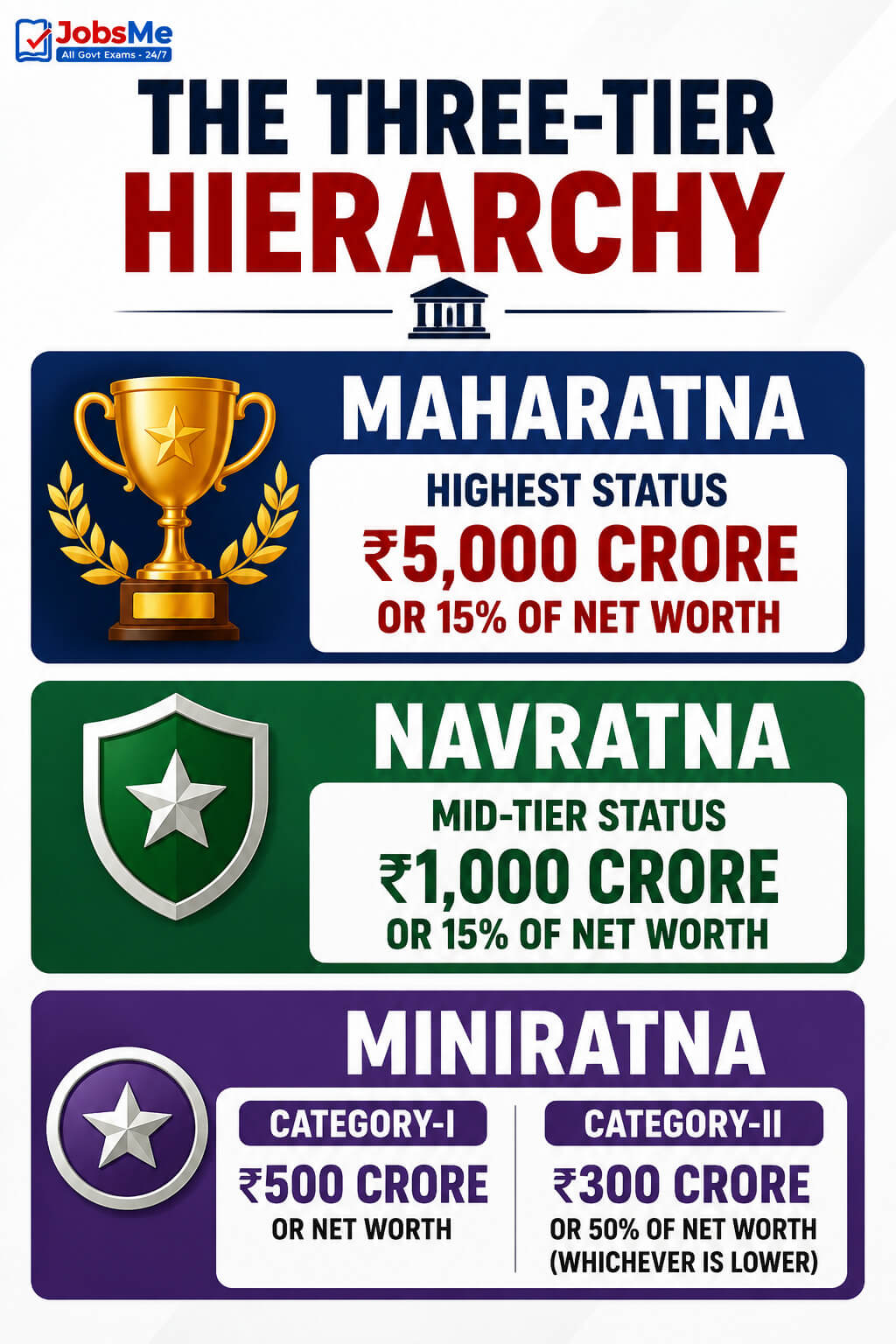
- Maharatna: The highest status, introduced in 2010. These are India's largest CPSEs with a strong global presence. They can invest up to ₹5,000 crore or 15% of their net worth in a single project without government approval.
- Navratna: The mid-tier status, introduced in 1997. These are strong-performing CPSEs that can invest up to ₹1,000 crore or 15% of their net worth in a single project.
- Miniratna: The entry-level status, also introduced in 1997, divided into two categories. Category-I companies can invest up to ₹500 crore (or net worth), and Category-II companies up to ₹300 crore (or 50% of net worth, whichever is lower).
Eligibility Criteria at a Glance
- Maharatna: Must already be a Navratna; listed on an Indian stock exchange with minimum public shareholding under SEBI norms; average annual turnover above ₹25,000 crore, average net worth above ₹15,000 crore and average net profit after tax above ₹5,000 crore in the last three years; significant global presence.
- Navratna: Must be a Schedule 'A' and Miniratna Category-I company with at least three "Excellent" or "Very Good" MoU ratings in the last five years, and a composite score of 60 out of 100 on six performance parameters.
- Miniratna Category-I: Profit in each of the last three years, pre-tax profit of ₹30 crore or more in at least one of those years, and a positive net worth.
- Miniratna Category-II: Profit in each of the last three years and a positive net worth.
Comparison of the Three Ratna Categories
The table below summarises the most exam-relevant differences between the three categories, including the year of introduction, investment powers and examples.
| Feature | Maharatna | Navratna | Miniratna (Cat-I / Cat-II) |
|---|---|---|---|
| Year Introduced | 2010 | 1997 | 1997 |
| Investment Power (single project) | Up to ₹5,000 crore or 15% of net worth | Up to ₹1,000 crore or 15% of net worth | Cat-I: up to ₹500 crore; Cat-II: up to ₹300 crore (or 50% of net worth, whichever is lower) |
| Pre-condition | Must already be a Navratna | Must be Schedule 'A' + Miniratna Cat-I | Must be a continuously profit-making CPSE |
| Number as of 2026 | 14 | 26 | Around 74 (Cat-I + Cat-II combined) |
| Examples | ONGC, NTPC, Coal India, HAL | BEL, NMDC, IRCTC, NHPC | AAI, BSNL, Cochin Shipyard, MOIL |
Complete List of Maharatna Companies (14)
As of 2026, there are 14 Maharatna CPSEs. The category began in 2010, the first companies were granted the status in 2011, and the latest addition was Hindustan Aeronautics Limited (HAL) in October 2024. The table below lists all 14 along with their sector and key details.
| Company | Sector | Key Details |
|---|---|---|
| Oil and Natural Gas Corporation (ONGC) | Oil & Gas | India's largest crude oil and natural gas producer; first PSU to get Maharatna status (2010); recognised as Navratna in 1997; established 1956. |
| NTPC Limited | Power Generation | India's largest power generation company; founded 1975; granted Maharatna status in 2010; operates thermal, hydro, solar and gas plants. |
| Indian Oil Corporation (IOCL) | Oil & Gas | India's largest oil refining and fuel marketing company; among the first five Maharatnas; nationwide refinery and retail network. |
| Coal India Limited (CIL) | Mining (Coal) | World's largest coal-producing company; among the first Maharatnas; meets the bulk of India's coal demand. |
| Steel Authority of India Limited (SAIL) | Steel | One of India's largest steel producers; operates integrated and special steel plants; among the first five Maharatnas; New Delhi headquarters. |
| Bharat Heavy Electricals Limited (BHEL) | Heavy Engineering | India's largest power equipment manufacturer; supplies products for power, transport, defence, oil & gas and renewables. |
| GAIL (India) Limited | Natural Gas | India's largest natural gas processing and distribution company; operates an extensive gas pipeline network. |
| Bharat Petroleum Corporation Limited (BPCL) | Oil & Gas | Major oil refining and fuel marketing company; engaged in refining crude oil and marketing petroleum products nationwide. |
| Hindustan Petroleum Corporation Limited (HPCL) | Oil & Gas | Leading oil refining and marketing company; a subsidiary associated with ONGC; major fuel retailer in India. |
| Power Grid Corporation of India (POWERGRID) | Power Transmission | India's largest electric power transmission utility; established 1989 (as National Power Transmission Corporation), renamed 1992; Maharatna in 2019; Gurugram headquarters. |
| Power Finance Corporation (PFC) | Financial Services (Power) | Non-banking financial company established 1986; financial backbone of India's power sector. |
| REC Limited (Rural Electrification Corporation) | Financial Services (Power) | NBFC and Public Financial Institution under the Ministry of Power; established 1969; finances power and infrastructure projects, especially rural electrification. |
| Oil India Limited (OIL) | Oil & Gas | India's second-largest oil and gas exploration company; founded 1959; operates under the Ministry of Petroleum and Natural Gas. |
| Hindustan Aeronautics Limited (HAL) | Aerospace & Defence | The 14th and latest Maharatna (October 2024); Bengaluru-based; designs and manufactures aircraft, helicopters and avionics; built the LCA Tejas and Dhruv helicopter. |
Complete List of Navratna Companies (26)
As of 2026, there are 26 Navratna CPSEs, as per the Department of Public Enterprises. The Navratna scheme was introduced in 1997 to support PSUs that had a comparative advantage in becoming global giants. To know which of these companies feature in current banking and economy questions, you can also check the Daily Current Affairs on thejobsme.com.
| Company | Sector / Key Details |
|---|---|
| Bharat Electronics Ltd. (BEL) | Defence electronics; manufactures radars, communication and electronic warfare systems. |
| Central Warehousing Corporation (CWC) | Warehousing and logistics; provides storage facilities across India. |
| Container Corporation of India Ltd. (CONCOR) | Logistics; handles container rail transport and inland container depots. |
| Engineers India Ltd. (EIL) | Engineering consultancy; specialises in petroleum refineries and hydrocarbon projects. |
| Housing & Urban Development Corporation Ltd. (HUDCO) | Financial services; finances housing and urban infrastructure projects. |
| Indian Railway Catering and Tourism Corporation Ltd. (IRCTC) | Railways; handles online rail ticketing, catering and tourism. |
| Indian Railway Finance Corporation Ltd. (IRFC) | Financial services; the dedicated financing arm of Indian Railways. |
| Indian Renewable Energy Development Agency Ltd. (IREDA) | Financial services; finances renewable and clean energy projects. |
| Ircon International Ltd. | Construction; an engineering and construction company in transport infrastructure. |
| Mahanagar Telephone Nigam Ltd. (MTNL) | Telecom; provides telecom services in Delhi and Mumbai. |
| Mazagon Dock Shipbuilders Ltd. (MDL) | Defence shipbuilding; builds warships and submarines for the Indian Navy. |
| National Aluminium Company Ltd. (NALCO) | Mining and metals; an integrated bauxite-alumina-aluminium producer. |
| National Fertilizers Ltd. (NFL) | Fertilizers; a major producer of urea and other fertilizers. |
| NBCC (India) Ltd. | Construction; engaged in project management consultancy and real estate. |
| NHPC Ltd. | Power; India's largest hydropower generation company. |
| NLC India Ltd. | Mining and power; lignite mining and lignite-based power generation. |
| NMDC Ltd. | Mining; India's largest iron ore producer. |
| ONGC Videsh Ltd. (OVL) | Oil & gas; the overseas arm of ONGC for exploration abroad. |
| Rail Vikas Nigam Ltd. (RVNL) | Railways; executes rail infrastructure projects. |
| RailTel Corporation India Ltd. | Telecom; provides telecom and broadband infrastructure along railway routes. |
| Rashtriya Chemicals and Fertilizers Ltd. (RCF) | Fertilizers and chemicals; produces fertilizers and industrial chemicals. |
| Rashtriya Ispat Nigam Ltd. (RINL) | Steel; operates the Visakhapatnam Steel Plant. |
| RITES Ltd. | Consultancy; transport infrastructure consultancy and engineering services. |
| Shipping Corporation of India Ltd. (SCI) | Shipping; India's largest shipping company operating a diverse fleet. |
| SJVN Ltd. | Power; engaged in hydro, thermal, solar and wind power generation. |
| Solar Energy Corporation of India (SECI) | Renewable energy; the nodal agency for India's solar and renewable energy programmes. |
Miniratna Companies (Category-I and Category-II)
Miniratna CPSEs are profit-making companies given limited but important autonomy. They are split into two categories, with around 74 Miniratnas in total as of 2026. The table below lists the most exam-relevant examples from each category.
Miniratna Category-I (Major Examples)
| Company | Sector / Key Details |
|---|---|
| Airports Authority of India (AAI) | Aviation; manages civil aviation infrastructure and airports across India. |
| Bharat Sanchar Nigam Ltd. (BSNL) | Telecom; a state-owned telecom service provider across India. |
| Bharat Dynamics Ltd. (BDL) | Defence; manufactures guided missiles and allied defence equipment. |
| BEML Ltd. | Heavy engineering; manufactures mining, construction and defence equipment. |
| Cochin Shipyard Ltd. | Shipbuilding; India's largest shipbuilding and ship-repair yard. |
| Garden Reach Shipbuilders & Engineers Ltd. (GRSE) | Defence shipbuilding; builds warships for the Indian Navy. |
| Goa Shipyard Ltd. (GSL) | Defence shipbuilding; constructs naval and coast guard vessels. |
| Hindustan Copper Ltd. (HCL) | Mining; the only vertically integrated copper producer in India. |
| Mangalore Refinery & Petrochemicals Ltd. (MRPL) | Oil & gas; a refinery and a subsidiary associated with ONGC; Schedule 'A' Miniratna. |
| MOIL Ltd. | Mining; India's largest manganese ore producer. |
| Mishra Dhatu Nigam Ltd. (MIDHANI) | Metals; manufactures special steels, superalloys and titanium alloys. |
| MMTC Ltd. | Trading; engaged in trading minerals, metals and bullion. |
| MSTC Ltd. | Trading and e-commerce; provides e-auction and e-commerce services. |
| Numaligarh Refinery Ltd. (NRL) | Oil & gas; an oil refinery in Assam. |
| Pawan Hans Ltd. | Aviation; provides helicopter services. |
| THDC India Ltd. | Power; hydropower generation (Tehri dam project). |
| WAPCOS Ltd. | Consultancy; water resources, power and infrastructure consultancy. |
| India Tourism Development Corporation Ltd. (ITDC) | Tourism; runs hotels and tourism services (Ashok Group of Hotels). |
| KIOCL Ltd. | Mining; iron ore mining and pelletisation. |
| Telecommunications Consultants (India) Ltd. (TCIL) | Telecom consultancy; provides telecom and IT consultancy globally. |
Miniratna Category-II (Major Examples)
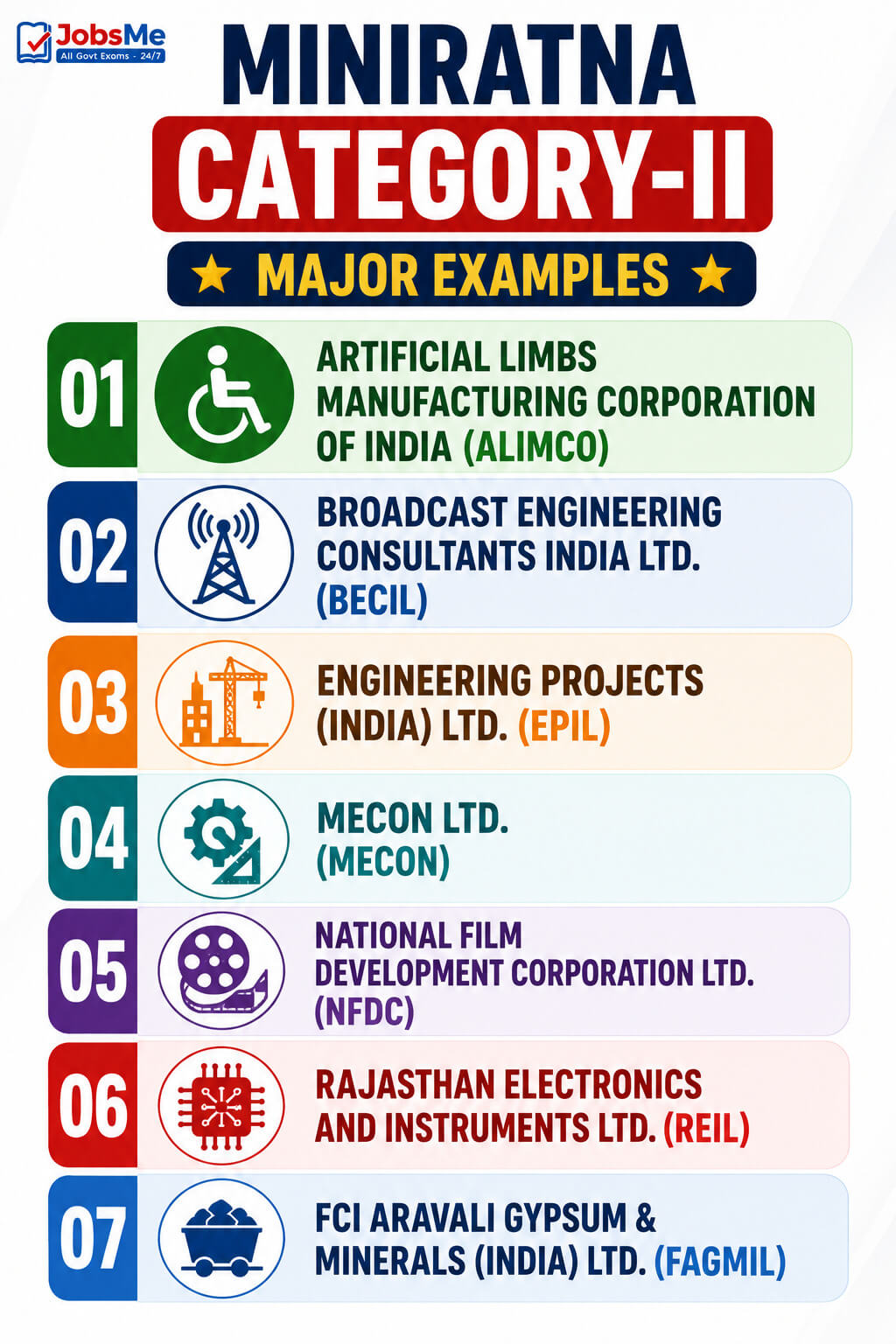
| Company | Sector / Key Details |
|---|---|
| Artificial Limbs Manufacturing Corporation of India (ALIMCO) | Healthcare; manufactures aids and appliances for persons with disabilities. |
| Broadcast Engineering Consultants India Ltd. (BECIL) | Consultancy; broadcast engineering and IT consultancy services. |
| Engineering Projects (India) Ltd. (EPIL) | Construction; turnkey engineering and construction projects. |
| MECON Ltd. | Engineering consultancy; design and consultancy in steel and metals. |
| National Film Development Corporation Ltd. (NFDC) | Films; promotes and finances Indian cinema. |
| Rajasthan Electronics and Instruments Ltd. (REIL) | Electronics; manufactures electronics and solar products. |
| FCI Aravali Gypsum & Minerals (India) Ltd. (FAGMIL) | Mining; mines gypsum and other minerals. |
Memory Tricks and Mnemonics
Trick 1: The Three Tiers — "MNM = 5-1-half"
Remember the investment power of each tier as a quick number sequence:
- Maharatna → ₹5,000 crore (the big "5").
- Navratna → ₹1,000 crore (the "1").
- Miniratna → Cat-I ₹500 crore / Cat-II ₹300 crore (the "half and less").
"5 for the great jewel, 1 for the nine jewels, 5-and-3 hundred for the mini."
Trick 2: Years of Introduction — "Navratna and Miniratna are Twins (1997), Maharatna is the Latecomer (2010)"
- 1997 → Navratna AND Miniratna both introduced together.
- 2010 → Maharatna introduced (the newest, highest tier).
"The two younger jewels came first; the greatest jewel came last."
Trick 3: First Five Maharatnas — "CNOIS"
The first batch of Maharatnas (granted around 2010-11) can be remembered as "CNOIS":
- C → Coal India.
- N → NTPC.
- O → ONGC (the first-ever Maharatna).
- I → Indian Oil (IOCL).
- S → SAIL.
Trick 4: The "Oil-Heavy" Maharatna List
Six of the 14 Maharatnas are oil and gas companies — group them to remember faster:
- Upstream / Exploration: ONGC, Oil India (OIL).
- Refining & Marketing: Indian Oil (IOCL), BPCL, HPCL.
- Gas: GAIL.
"Two explore, three refine, one gas — six oil jewels in all."
Trick 5: The Two Power-Finance Maharatnas — "PFC and REC"
Two Maharatnas are finance companies of the power sector — easy to confuse with banks:
- PFC → Power Finance Corporation (established 1986).
- REC → Rural Electrification Corporation (established 1969).
"PFC and REC fund power, they don't generate it."
Trick 6: Latest and First Maharatnas — "First ONGC, Last HAL"
- First Maharatna ever → ONGC (2010).
- 14th and latest Maharatna → HAL (October 2024).
- 2019 entrant → POWERGRID.
Trick 7: Navratna "Railway Family"
Several Navratnas belong to the Indian Railways family — group them together:
- IRCTC → ticketing, catering, tourism.
- IRFC → finance arm of Railways.
- RVNL → rail project execution.
- RailTel → railway telecom and broadband.
- RITES & Ircon → consultancy and construction.
"The railways have six jewels of their own."
Additional Notes
Frequently Confused Facts
- First Maharatna vs First Navratna of ONGC: ONGC was made a Navratna in 1997 and the first Maharatna in 2010 — both relate to ONGC but in different years.
- Maharatna vs Navratna investment limit: Maharatna can invest up to ₹5,000 crore; Navratna up to ₹1,000 crore. Both share the 15% of net worth ceiling.
- HAL — Navratna then Maharatna: HAL was earlier a Navratna and became the 14th Maharatna in October 2024; it is no longer counted among the 26 Navratnas.
- PFC vs REC vs IRFC: PFC and REC are Maharatnas (power-sector financiers); IRFC (railway financier) is a Navratna.
- Miniratna Category-I vs II: Category-I needs pre-tax profit of ₹30 crore or more in at least one of the last three years; Category-II only needs continuous profit and positive net worth.
- NHPC vs NLC vs SJVN: All three are power-sector Navratnas — NHPC is mainly hydropower, NLC is lignite-based, and SJVN is multi-source (hydro, solar, wind, thermal).
- Year confusion: Navratna and Miniratna were both introduced in 1997; Maharatna only in 2010. Do not mix up these years.
- DPE ministry: The Department of Public Enterprises now functions under the Ministry of Finance (it was earlier under the Ministry of Heavy Industries and Public Enterprises).
Repeating PYQ Patterns
Certain facts are asked repeatedly across competitive exams. The number of Maharatna companies (14), the first Maharatna (ONGC), the latest Maharatna (HAL, 2024), the year Maharatna was introduced (2010), the year Navratna and Miniratna were introduced (1997), and the investment limits (₹5,000 cr / ₹1,000 cr / ₹500 cr / ₹300 cr) appear most often in UPSC Prelims, SSC CGL and RRB NTPC papers. Banking exams (IBPS PO, SBI Clerk, RBI Grade B) and Insurance exams frequently ask to match a company with its Ratna status, and ask which ministry grants the status (the Department of Public Enterprises). State PCS exams may add region-specific PSUs and recent disinvestment news. For sharpening these areas, attempt the Banking Awareness Quiz and the Static GK Quiz on thejobsme.com.
Quick Insight
The Ratna system is more than a list to memorise — it reflects how India runs its public sector economy. Each upgrade signals that a PSU has crossed major financial milestones, which is why HAL's promotion to Maharatna in 2024 made headlines amid India's defence self-reliance push. The government is also reportedly considering new "Ratna" tiers aligned with Vision 2047, focusing on corporate governance, capital expenditure and sustainability rather than just turnover. Understanding this topic helps aspirants connect economy news, disinvestment debates and Budget announcements to the bigger picture — valuable for both Prelims matching questions and Mains economy answers. For ongoing updates, refer to the Daily Current Affairs page on thejobsme.com.
One-Liners for Quick Revision
- CPSE → Central Public Sector Enterprise → company with at least 51% Central Government holding.
- Granting authority → Department of Public Enterprises (DPE) → now under the Ministry of Finance.
- Maharatna introduced → 2010 → highest status tier.
- Navratna introduced → 1997 → mid-tier status.
- Miniratna introduced → 1997 → entry-level status, Category-I and II.
- Maharatna investment power → up to ₹5,000 crore or 15% of net worth in a single project.
- Navratna investment power → up to ₹1,000 crore or 15% of net worth in a single project.
- Miniratna Cat-I power → up to ₹500 crore (or net worth).
- Miniratna Cat-II power → up to ₹300 crore (or 50% of net worth, whichever is lower).
- Number of Maharatnas (2026) → 14.
- Number of Navratnas (2026) → 26.
- Number of Miniratnas (2026) → around 74 (Cat-I + Cat-II).
- First-ever Maharatna → ONGC (2010).
- Latest (14th) Maharatna → Hindustan Aeronautics Limited (HAL), October 2024.
- POWERGRID Maharatna → granted in 2019; headquartered in Gurugram.
- Maharatna turnover criterion → average annual turnover above ₹25,000 crore (last 3 years).
- Maharatna net worth criterion → average net worth above ₹15,000 crore (last 3 years).
- Maharatna profit criterion → average net profit after tax above ₹5,000 crore (last 3 years).
- Navratna composite score → 60 out of 100 on six performance parameters.
- Maharatna pre-condition → must already be a Navratna.
- Navratna pre-condition → must be Schedule 'A' and Miniratna Category-I.
- Oil & gas Maharatnas → ONGC, OIL, IOCL, BPCL, HPCL, GAIL.
- Power-finance Maharatnas → PFC and REC.
- Steel Maharatna → SAIL.
- Coal Maharatna → Coal India Limited (CIL).
- Power generation Maharatna → NTPC.
- Power transmission Maharatna → POWERGRID.
- Heavy engineering Maharatna → BHEL.
- Aerospace & defence Maharatna → HAL.
- Defence electronics Navratna → Bharat Electronics (BEL).
- Iron ore Navratna → NMDC.
- Aluminium Navratna → NALCO.
- Hydropower Navratna → NHPC.
- Railway Navratnas → IRCTC, IRFC, RVNL, RailTel, RITES, Ircon.
- Renewable energy Navratna → Solar Energy Corporation of India (SECI).
- Warship-building Navratna → Mazagon Dock Shipbuilders (MDL).
- Shipping Navratna → Shipping Corporation of India (SCI).
- Telecom Miniratna → BSNL.
- Aviation Miniratna → Airports Authority of India (AAI).
- Manganese ore Miniratna → MOIL.
- Largest shipyard Miniratna → Cochin Shipyard.
- Copper Miniratna → Hindustan Copper Limited (HCL).
- Missile-making Miniratna → Bharat Dynamics Limited (BDL).
For more Static GK topics like Indian economy, banking and current affairs, explore the Static GK section on thejobsme.com. You can also test yourself with the Daily Current Affairs Quiz and check the Latest Government Job Notifications to apply for upcoming PSU and exam openings.
Free quiz • No signup required
Put this topic into practice with Indian Cultural Institutions – Static GK MCQ Quiz. It is the quickest way to reinforce what you just learned.
Frequently Asked Questions
How many Maharatna companies are there in India as of 2026?
Which was the first company to receive Maharatna status?
When were the Maharatna, Navratna and Miniratna categories introduced?
What is the investment power of a Maharatna company?
What is the difference between Navratna and Miniratna companies?
Which authority grants Maharatna, Navratna and Miniratna status?
How many Navratna companies are there in India?
What are the main eligibility criteria for Maharatna status?
Is HAL a Maharatna or a Navratna company?
What is the difference between Miniratna Category-I and Category-II?

About the author