Volcanoes – Active, Dormant and Extinct: Complete Static GK & General Awareness for Competitive Exams with Memory Tricks
This article covers volcanoes classified as active, dormant and extinct, including India's volcanic sites (Barren Island, Baratang, Narcondam, Deccan Traps, Dhosi Hill, Tosham Hills, Dhinodhar Hills and Loktak Lake) and the world's major volcanoes, types, eruption styles and distribution along the Ring of Fire. It includes the largest volcanoes in the world, key exam facts, memory tricks and one-liners for quick revision. All facts are arranged in exam-ready format to help UPSC, SSC, IBPS, RRB, PSU, Defence and State PCS aspirants score better in Geography and General Awareness.
Jump to section
- Introduction
- Core Concept: What Is a Volcano and How Are Volcanoes Classified
- Volcanoes in India: Active, Dormant and Extinct
- Types of Volcanoes (by Shape and Material)
- Types of Volcanic Eruptions
- Distribution of Volcanoes and the Ring of Fire
- Largest and Most Famous Volcanoes of the World
- Memory Tricks and Mnemonics
- Additional Notes
- One-Liners for Quick Revision
Introduction
A volcano is an opening or vent in the Earth's crust through which magma, molten rock (lava), ash, and gases escape to the surface. It is essentially a conduit or pipe that rises from below the crust and vents to the surface of the Earth. Volcanoes are among the most powerful natural structures on the planet — they shape landscapes, create new land and mineral deposits, and also pose serious hazards. Based on how often they erupt, volcanoes are classified into three types: active, dormant, and extinct.
Questions on volcanoes appear regularly in UPSC Prelims and Mains (Geography and Disaster Management), SSC CGL, IBPS PO, RRB NTPC, State PCS, and various Defence, Insurance and PSU exams. Objective papers usually ask which is India's only active volcano, the classification of a particular volcano, the location of famous world volcanoes, or facts about the Ring of Fire. This article brings together every important fact on volcanoes in a structured, exam-ready format. To explore other related topics, you can refer to the Static GK section on thejobsme.com.
The topic of volcanoes is also closely linked to current affairs themes such as the recurring eruptions of Barren Island, eruptions in Indonesia and Iceland, and disaster-management news — making it doubly important for aspirants preparing for both objective General Awareness sections and descriptive answer writing.
Core Concept: What Is a Volcano and How Are Volcanoes Classified
A volcano forms where magma from beneath the crust reaches the surface, often at the boundaries of tectonic plates or above hotspots. Volcanoes tend to be conical in shape but vary in form depending on the nature of the erupted material, especially the viscosity of the lava. Most volcanoes are concentrated at convergent and divergent plate boundaries, while a few in plate interiors are associated with hotspots.
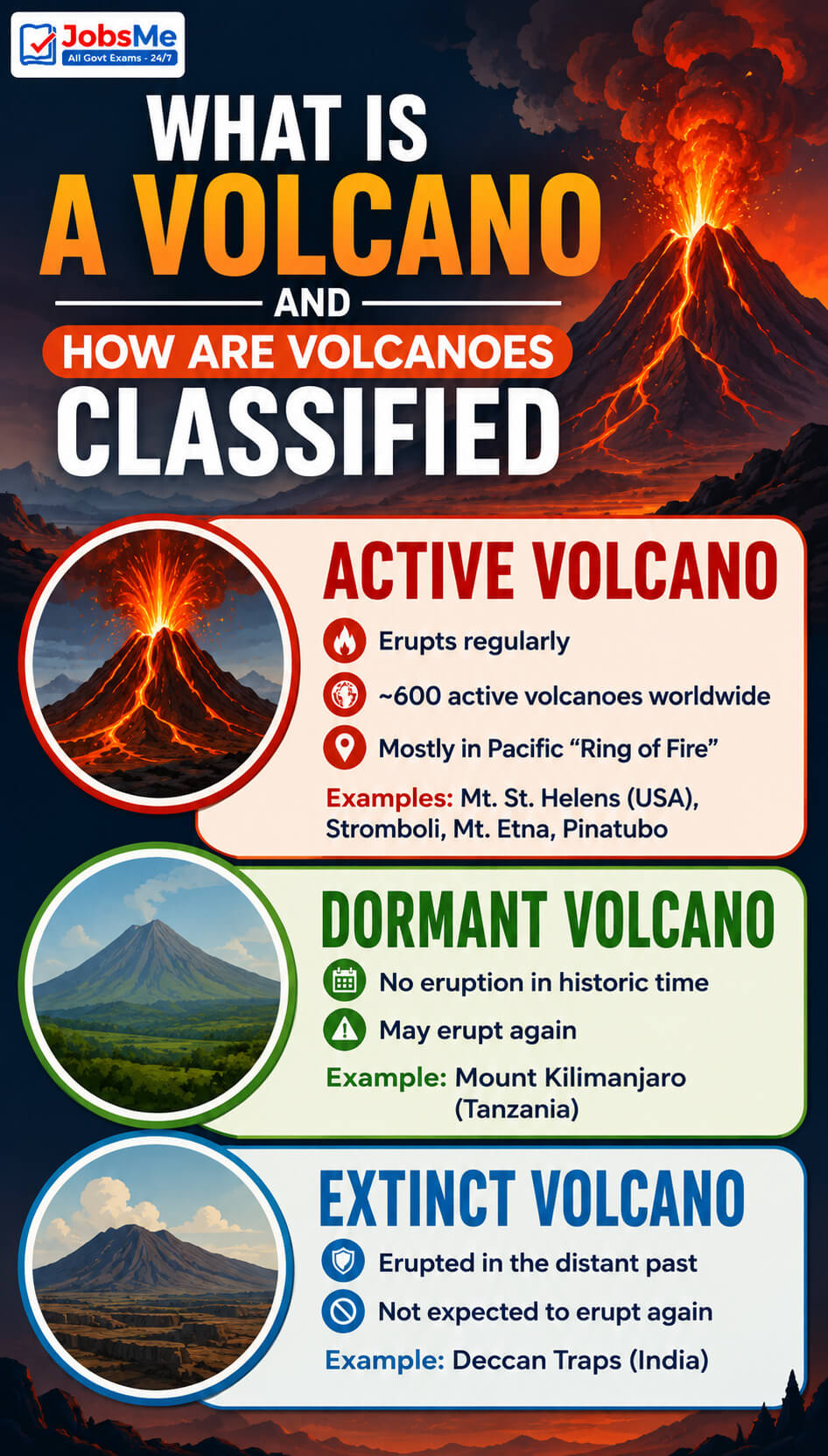
- Active Volcano: A volcano that constantly or frequently ejects lava, gases, ash, cinder and pumice. There are about 600 active volcanoes in the world, most of them around the Pacific "Ring of Fire". Examples: Mt. St. Helens (USA), Stromboli and Mt. Etna (Mediterranean), and Pinatubo (Philippines).
- Dormant Volcano: A volcano which, though not extinct, has not been known to erupt within the historic period but may erupt again. The classic example is Mount Kilimanjaro in Tanzania.
- Extinct Volcano: A volcano that functioned in the distant geological past and is not expected to erupt again, its remains occurring where there is no longer any active volcanic activity. Example: the Deccan Traps in India.
Volcanoes are also classified on the basis of the material erupted (basalt cones, basalt domes, ash and cinder cones, composite or strato cones) and the type of eruption. The most active volcanoes are located in Asia due to intense tectonic plate activity, while South America has the largest number of volcanoes overall.
Volcanoes in India: Active, Dormant and Extinct
India has 8 major volcanic sites spread across the Andaman and Nicobar Islands, Gujarat, Haryana, Maharashtra and Central India, and Manipur. The mainland is volcanically inactive today; all the active volcanic activity is found in the Andaman region, which lies along the subduction zone where the Indian Plate slides beneath the Burma Plate. The table below lists all of India's volcanic sites with their status and key details.
Active Volcanoes in India
| Volcano / Site | Location | Status | Key Features |
|---|---|---|---|
| Barren Island | Andaman Sea, about 135-138 km northeast of Port Blair | Active (magmatic) | India's only confirmed active volcano and the only active volcano in South Asia. It lies on the volcanic arc stretching from Sumatra to Myanmar, formed by the subduction of the Indian Plate beneath the Burma Plate. First recorded eruption in 1787; after nearly 150 years of dormancy it reawakened in 1991 and has erupted in 1994-95, 2005-07, 2017-19, and again from January 2022 through 2025, with ash plumes reaching up to 3,000 m. |
| Baratang Island | Andaman Islands (North and Middle Andaman district) | Active (mud volcano) | Contains the only known mud volcanoes in India. Mud volcanoes do not erupt lava; instead, pressurised natural gas forces mud and hot water to the surface through cracks. Eruptions have been sporadic, with activity in 2005 linked to the 2004 Indian Ocean earthquake. Also known as Ranchiwalas Island. |
Dormant Volcanoes in India
| Volcano / Site | Location | Status | Key Features |
|---|---|---|---|
| Narcondam Island | Northern Andaman Sea, about 124-130 km northeast of Port Blair | Dormant (stratovolcano) | A small, remote, uninhabited volcanic island whose peak rises to about 710 m above sea level and is formed of andesite. It is home to the endangered Narcondam Hornbill. Its lava composition suggests a magmatic system different from Barren Island. The name may derive from the Tamil "naraka-kundam" meaning "a pit of Hell". |
Extinct Volcanoes in India
| Volcano / Site | Location | Status | Key Features |
|---|---|---|---|
| Deccan Traps | Deccan Plateau, west-central India (17°-24°N, 73°-74°E) | Extinct (flood basalt province) | One of the largest volcanic provinces on Earth, formed by massive flood basalt eruptions about 66 million years ago that originally covered roughly 1.5 million km² — about half of modern India. Many scientists link these eruptions to the mass extinction that ended the age of dinosaurs. The word "trap" comes from the Scandinavian "trappa" (stairs), referring to the step-like hills of the region. |
| Dhinodhar Hills | Nakhatrana Taluka, Kutch District, Gujarat | Extinct (volcanic plug) | A volcanic plug — a solidified remnant of magma that once filled a volcanic vent — rising to about 386 m. Its dark grey basaltic rock stands out against the surrounding sandstone. The last eruption was approximately 500 million years ago. It is a popular trekking, tourist and pilgrimage spot. |
| Dhosi Hill | Aravalli Range, Narnaul (Mahendragarh district, Haryana) on the Haryana-Rajasthan border | Extinct | An extinct volcano standing alone at the north-west end of the Aravalli range, 345-470 m above the surrounding land, with a distinct crater and visible lava flows. One of the oldest volcanic formations in India, with the last eruption around 750 million years ago. It belongs to the Precambrian Malani igneous suite of rocks. |
| Tosham Hills | Bhiwani District, Haryana (Aravalli Range) | Extinct | Part of the Aravalli Mountain Range showing igneous rock formations and belonging to the Precambrian Malani igneous suite. The last eruption occurred about 732 million years ago. The site has ancient rock inscriptions, rock paintings and hilltop lakes, and is a major biodiversity site in Haryana. |
| Loktak Lake Area | Manipur | Ancient volcanic formations | The surrounding geological formations show evidence of ancient volcanic activity from India's past. Loktak Lake is also famous as the largest freshwater lake in Northeast India. |
In terms of an active structure, the biggest volcano in India is Barren Island; in terms of sheer geological scale, the Deccan Traps are the largest volcanic feature. For more state-wise geography and exam facts, see the Static GK notes on thejobsme.com.
Types of Volcanoes (by Shape and Material)
| Type | Key Features | Examples |
|---|---|---|
| Shield Volcano / Basalt Dome | Gently sloping sides formed by low-viscosity (runny) basaltic lava that flows over large areas. | Mauna Loa (Hawaii); Hawaiian volcanoes; Mt. Etna and several Iceland volcanoes are also basalt domes. |
| Stratovolcano / Composite Cone | Steep slopes built up by alternating layers of lava and pyroclastic material, attesting to alternating explosive and quiet eruptions. Most of the world's largest volcanoes fall in this category. | Mount St. Helens (USA), Fujiyama (Japan), Vesuvius (Italy), Popocatepetl (Mexico), Cotopaxi (Ecuador), Mayon (Philippines). |
| Cinder Cone / Ash Cone | Small, steep-sided cones built from explosive eruptions with a predominance of pyroclastic material, forming around a crater. Usually a few hundred metres high. | Common explosive-type cones worldwide. |
| Basalt Cone | Rare; tends to be low rather than high because of the fluidity of basaltic lava. | Rangitoto (New Zealand), Skjaldbreit (Iceland). |
| Caldera | A large volcanic crater formed by the collapse of a volcano's summit after a massive eruption. | Mount Aso (Japan) has one of the largest calderas. |
| Submarine Volcano | Forms underwater and helps create seafloor features such as mid-ocean ridges. | Volcanoes along the Mid-Atlantic Ridge. |
Types of Volcanic Eruptions
| Eruption Type | Key Features |
|---|---|
| Icelandic | Fissure eruption releasing free-flowing, gas-poor basaltic magma; quiet eruptions with great volumes of lava that build up plateaus (e.g. Columbia Plateau, the Lava Plateau of India). |
| Hawaiian | Fissure, caldera and pit-crater eruptions; mobile lavas with some gas; quiet to moderately active; produces fire fountains and builds lava domes with only minor ash. |
| Strombolian | Strato cone with summit craters; moderate, rhythmic to nearly continuous explosions from spasmodic gas escape; ejects bombs and scoria with light steam clouds. |
| Vulcanian | Central-vent strato cone with more viscous lava that crusts over between eruptions; gas builds up, then violent eruptions eject bombs, pumice and ash with dark, cauliflower-shaped clouds. |
| Vesuvian | More paroxysmal than Strombolian or Vulcanian; extremely violent explosion of gas-charged magma after long quiescence; empties the vent to great depth with towering cauliflower clouds. |
| Plinian (Pilian) | A more violent form of Vesuvian eruption; uprush of gas carries clouds rapidly upward in a tall vertical column for miles, narrow at base and expanding at the top. |
| Pelean | Results from high-viscosity lava and delayed explosiveness; the vent is blocked by a dome or plug, and gas, ash and blocks rush downslope as glowing avalanches (nuée ardentes). |
| Katmaian | A variant of Pelean eruption with massive outpourings of fluidised ash flows and widespread tephra; ignimbrites, hot springs and fumaroles are common products. |
Distribution of Volcanoes and the Ring of Fire
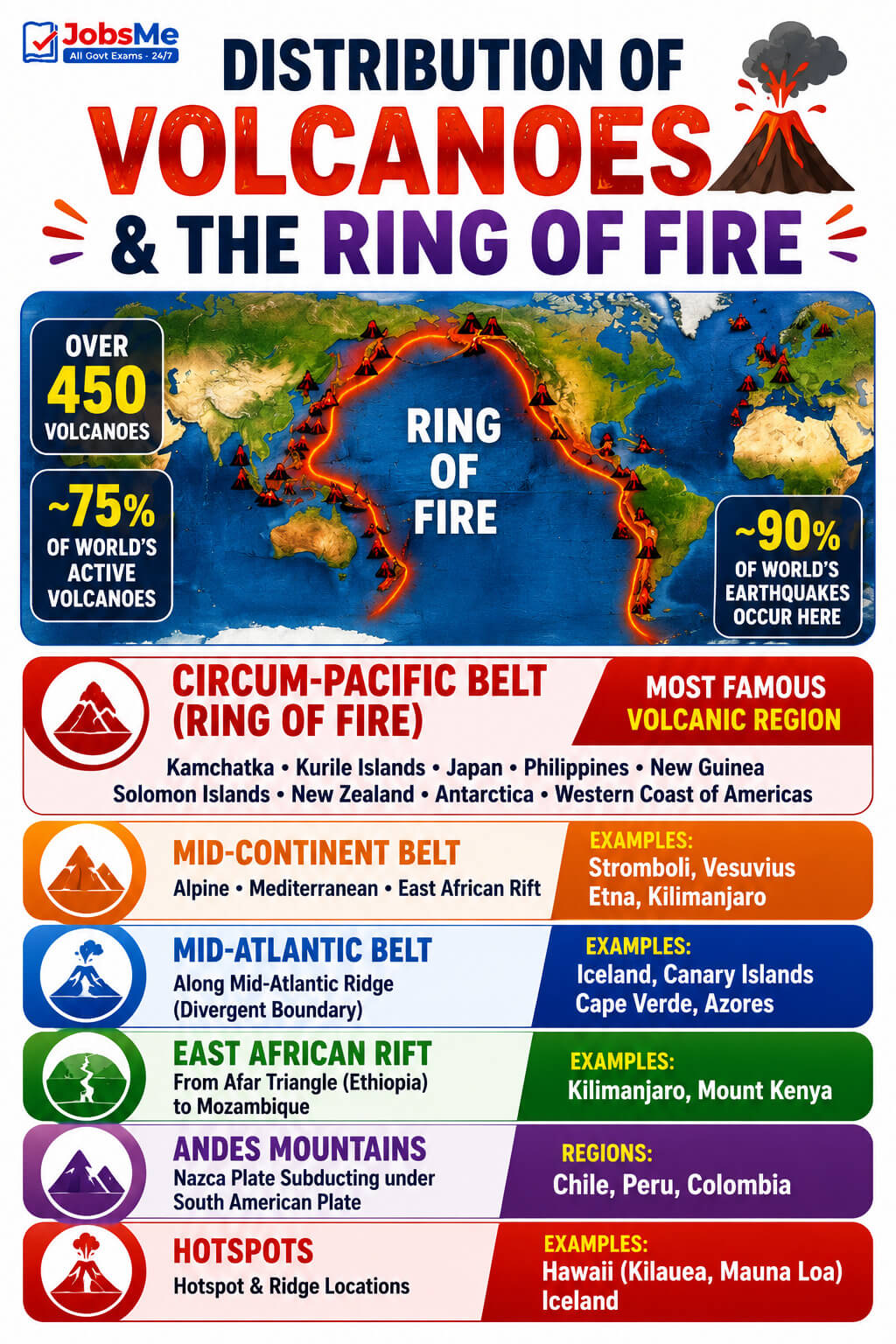
Volcanoes are not evenly spread; they cluster along tectonic plate boundaries and hotspots. About 80% of the world's volcanoes are associated with destructive or convergent plate boundaries, while about 15% are found along constructive or divergent margins.
- Circum-Pacific Belt (Ring of Fire): The most famous volcanic region, encircling the Pacific Ocean across the Kamchatka Peninsula, Kurile Islands, Japan, the Philippines, New Guinea, New Zealand, the Solomon Islands, Antarctica and the western coast of the Americas. It contains over 450 volcanoes and is home to roughly 75% of the world's active volcanoes, and nearly 90% of the world's earthquakes occur along it.
- Mid-Continent Belt: Includes volcanoes of the Alpine mountain chain, the Mediterranean Sea, and the East African fault zone. Examples: Stromboli, Vesuvius, Etna, Kilimanjaro.
- Mid-Atlantic Belt: Mostly fissure-eruption volcanoes along the Mid-Atlantic Ridge, where the North American, Eurasian, South American and African plates move apart. Examples: Iceland, the Canary Islands, Cape Verde, the Azores.
- East African Rift: A divergent boundary running from the Afar Triangle in Ethiopia to Mozambique, with notable volcanoes like Kilimanjaro and Mount Kenya.
- Andes Mountains: Formed by the Nazca Plate subducting beneath the South American Plate, causing volcanic activity in Chile, Peru and Colombia.
- Hotspots: Hawaii (Kilauea, Mauna Loa) and Iceland are classic hotspot and ridge locations with frequent activity.
An estimated 1,500 volcanoes worldwide have the potential to be active, and each year about 50 to 70 of them erupt. Indonesia is the world's most volcanic country with 167 known active volcanoes. Australia is the only continent with no active volcano on its mainland (the only one on Australian territory is Big Ben on McDonald Island).
Largest and Most Famous Volcanoes of the World
Top 10 Largest Volcanoes in the World (by Elevation)
| Volcano | Height | Key Features |
|---|---|---|
| Ojos del Salado | 6,893 m (22,615 ft) | The world's highest active volcano, on the Argentina-Chile border. |
| Monte Pissis | 6,793 m (22,287 ft) | Argentina's massive inactive volcano in the Andes. |
| Nevado Tres Cruces | 6,748 m (22,139 ft) | A huge volcanic massif spanning Argentina and Chile. |
| Llullaillaco | 6,739 m (22,110 ft) | High stratovolcano on the Chile-Argentina border. |
| Nevado Tres Cruces Central | 6,629 m (21,748 ft) | Another peak of the Tres Cruces range. |
| Incahuasi | 6,621 m (21,722 ft) | Twin stratovolcano near the Argentina-Chile border. |
| Tipas | 6,600 m (21,850 ft) | Part of the Ojos del Salado complex in Argentina. |
| Tupungato | 6,570 m (21,555 ft) | A high Andes volcano first climbed in 1897. |
| Nevado Sajama | 6,542 m (21,463 ft) | Bolivia's highest peak, part of the Andean Volcanic Arc. |
| Ata | 6,501 m (21,329 ft) | A large caldera now mostly submerged in Kagoshima Bay, Japan. |
Famous Volcanoes Around the World (Continent-Wise)
| Volcano | Country / Region | Key Features |
|---|---|---|
| Kilimanjaro | Tanzania (Africa) | Africa's tallest peak at 5,895 m; the classic example of a dormant volcano. The name means "shining mountain". |
| Ol Doinyo Lengai | Tanzania (Africa) | The only volcano on Earth that erupts natrocarbonatite lava; its name means "Mountain of God" in Masai. |
| Mount Cameroon | Cameroon (Africa) | The only volcano outside Europe with records of an eruption before the Common Era (5 BC); still active, with a recent eruption in 2000. |
| Krakatoa | Indonesia (Asia) | Erupted so violently in 1883 that the sound was heard 5,000 km away and global temperatures dropped by over a degree. |
| Mount Merapi | Indonesia (Asia) | Indonesia's single most active volcano, looming over Yogyakarta and Solo and the temples of Borobudur and Prambanan. |
| Mount Tambora | Indonesia (Asia) | Its 1815 eruption was so powerful it lost 1,400 m from its summit and caused the "Year Without a Summer". |
| Mount Bromo | Indonesia (Asia) | Famous for dramatic scenery near Mount Semeru, Indonesia's third highest active volcano. |
| Mount Fuji (Fujiyama) | Japan (Asia) | Japan's highest and most beautiful volcano and one of the most climbed mountains in the world; a classic stratovolcano. |
| Mount Aso | Japan (Asia) | One of the largest active volcanoes in the world, with one of the largest calderas. |
| Mayon Volcano | Philippines (Asia) | Described as the world's most perfect volcanic cone; a composite stratovolcano. |
| Mount Pinatubo | Philippines (Asia) | An active volcano famous for its major 1991 eruption. |
| El Teide | Tenerife, Canary Islands (Europe) | The highest active volcano in the Canary Islands at 3,715 m; a flank vent was seen erupting by Columbus's crew in 1492. |
| Mount Vesuvius | Italy (Europe) | Near Naples; active but presently quiet (last erupted 1944); closely monitored due to its proximity to a major city. |
| Mount Etna | Sicily, Italy (Europe) | Europe's highest volcano at 3,350 m and one of Italy's most active. |
| Stromboli | Aeolian Islands, Italy (Europe) | In near-continuous activity since ancient times; called the "Lighthouse of the Mediterranean". |
| Santorini | Aegean Sea, Greece (Europe) | Its eruption destroyed the Minoan civilisation over 3,600 years ago; still active, last erupted in 1950. |
| Mount St. Helens | Washington, USA (North America) | Famous for its violent 18 May 1980 eruption; a well-known stratovolcano. |
| Popocatepetl | Mexico (North America) | Near Mexico City; name means "smoking mountain" in Nahuatl, with a frequent volcanic plume. |
| Paricutin | Mexico (North America) | A famous cinder cone that grew suddenly from a cornfield in the 20th century. |
| Soufriere Hills | Montserrat (Caribbean) | Once considered dormant, it began erupting again in 1995, forcing closure of the southern half of the island. |
| Cotopaxi | Ecuador (South America) | One of South America's most spectacular volcanoes at 5,911 m; a composite cone. |
| Arenal | Costa Rica (Central America) | Known for frequent eruptions that light up the night sky. |
| Kilauea | Hawaii, USA (Oceania) | Erupted continuously from its Pu'u O'o flank vent since 1983; a shield volcano. |
| Mauna Loa | Hawaii, USA (Oceania) | The largest volcano by volume in the world and a classic shield volcano at 4,170 m. |
| Mauna Kea | Hawaii, USA (Oceania) | The highest volcano in Hawaii at 4,205 m, pockmarked with cinder cones and home to major astronomical observatories. |
| White Island | New Zealand (Oceania) | New Zealand's most active volcano, a volcanic island in the Bay of Plenty. |
| Mount Ruapehu | New Zealand (Oceania) | New Zealand's highest volcano, with a crater lake that forms when it is not erupting. |
| Big Ben | McDonald Island (Australian territory) | The only active volcano on Australian territory, in the sub-Antarctic Heard and McDonald Islands. |
| Tamu Massif | Pacific Ocean | The largest single volcano on Earth, discovered in 2013. |
You can test your grasp of these world geography facts in the Static GK Quiz section on thejobsme.com.
Memory Tricks and Mnemonics
Trick 1: India's Only Active Volcano — "Barren = Burning"
Both Barren Island and the word "Burning" start with B. Use this to lock in that Barren Island is India's only confirmed active volcano in the Andaman Sea.
"Barren is Burning — India's only active one."
Trick 2: India's Andaman Trio — "Barren, Baratang, Narcondam"
All three Andaman volcanoes begin with consonants and can be grouped by status:
- Barren → Active (lava).
- Baratang → Active (mud volcano).
- Narcondam → Dormant.
"Two B's are Active, one N is Napping (dormant)."
Trick 3: Extinct Volcanoes of India — "DDDTL"
Remember the five extinct/ancient sites with the cue D-D-D-T-L:
- Deccan Traps (Maharashtra / Central India).
- Dhinodhar Hills (Gujarat).
- Dhosi Hill (Haryana).
- Tosham Hills (Haryana).
- Loktak Lake area (Manipur).
Trick 4: Active vs Dormant vs Extinct — "Always Dancing Eventually Stops"
Use the first letters A-D-E in order of decreasing activity:
- Active → erupts now (Barren Island, Etna).
- Dormant → sleeping, may wake (Kilimanjaro, Narcondam).
- Extinct → finished forever (Deccan Traps, Dhosi Hill).
Trick 5: Two "Lighthouses of the Mediterranean"
Italy's Stromboli is called the "Lighthouse of the Mediterranean" because of its near-continuous glow. Picture a lighthouse on an Italian island to remember Stromboli over Etna.
"Stromboli glows like a lighthouse."
Trick 6: World Volcano Superlatives — "Highest, Largest, Most"
- Highest active volcano → Ojos del Salado (Argentina-Chile).
- Largest volcano by volume → Mauna Loa (Hawaii).
- Largest single volcano on Earth → Tamu Massif (Pacific Ocean).
- Most volcanic country → Indonesia (167 active volcanoes).
- Only continent without an active mainland volcano → Australia.
Trick 7: Ring of Fire Numbers — "75 and 90"
The Pacific Ring of Fire holds about 75% of the world's active volcanoes, and about 90% of the world's earthquakes happen along it. Remember: "Fire 75, Quakes 90."
Additional Notes
Frequently Confused Facts
- Barren vs Baratang: Barren Island is the active lava (magmatic) volcano; Baratang has the only mud volcanoes in India. Both are in the Andamans but are very different.
- Active vs Dormant in the Andamans: Barren Island is active, while Narcondam is dormant — do not interchange them.
- Biggest volcano in India: By active structure it is Barren Island, but by geological scale it is the extinct Deccan Traps.
- Dormant example trap: The textbook example of a dormant volcano is Kilimanjaro, not Vesuvius or Etna.
- Highest active volcano: It is Ojos del Salado, not Cotopaxi (a common error — Cotopaxi is often wrongly called the highest).
- Largest by volume vs largest single volcano: Mauna Loa is the largest by volume on land, while Tamu Massif (undersea) is the largest single volcano on Earth.
- Ring of Fire location: It surrounds the Pacific Ocean, not the Atlantic; the Mid-Atlantic Ridge is a separate, fissure-type belt.
Repeating PYQ Patterns
Certain volcano facts are asked repeatedly. Barren Island (India's only active volcano), Narcondam (dormant), Deccan Traps (extinct), Baratang (mud volcano), Kilimanjaro (dormant example), the Ring of Fire (75% of active volcanoes), Indonesia (most volcanic country), and Ojos del Salado (highest active volcano) appear most often in SSC CGL, RRB NTPC and State PCS papers. For UPSC Prelims and Mains, examiners focus on the tectonic setting (Indian Plate-Burma Plate subduction), the link between the Deccan Traps and the dinosaur extinction, and the distribution of volcanoes along plate boundaries and hotspots. Banking exams (IBPS PO, SBI Clerk) usually test simple matching of a volcano with its country or status. You can practise these in the Static GK Quiz section.
Quick Insight
Volcanoes are a live current-affairs topic, not just static geography. Barren Island has erupted repeatedly in recent years (2017-19 and again from 2022 onward), and eruptions in Indonesia, Iceland and elsewhere regularly make headlines linked to disaster management and aviation safety. Because volcanoes sit at the intersection of physical geography, environment and disaster management, they reward aspirants who can connect the static list with recent eruptions. For more exam-preparation material, you can refer to the Daily Current Affairs notes and the Static GK section on thejobsme.com.
One-Liners for Quick Revision
- Volcano → an opening or vent through which magma, lava, ash and gases reach the surface → conduit from below the crust.
- Active volcano → erupts constantly or frequently → about 600 worldwide, mostly in the Ring of Fire.
- Dormant volcano → not extinct but not erupted in the historic period → example: Kilimanjaro.
- Extinct volcano → erupted in the distant geological past, not expected again → example: Deccan Traps.
- Barren Island → India's only confirmed active volcano → Andaman Sea, ~135-138 km NE of Port Blair; first eruption 1787, reawakened 1991.
- Baratang Island → only mud volcanoes in India → Andaman Islands; erupts gas, mud and hot water, not lava.
- Narcondam Island → India's dormant stratovolcano → northern Andaman Sea; home of the endangered Narcondam Hornbill.
- Deccan Traps → largest extinct volcanic feature in India → flood basalt, ~66 million years ago, linked to dinosaur extinction.
- Dhinodhar Hills → volcanic plug in Kutch, Gujarat → dark grey basalt, last eruption ~500 million years ago.
- Dhosi Hill → extinct volcano in the Aravalli Range, Narnaul, Haryana → distinct crater, last eruption ~750 million years ago.
- Tosham Hills → extinct volcanic formation in Bhiwani, Haryana → last eruption ~732 million years ago; major biodiversity site.
- Loktak Lake area → ancient volcanic formations in Manipur → also the largest freshwater lake in Northeast India.
- Shield volcano → gentle slopes, runny basaltic lava → example: Mauna Loa.
- Stratovolcano → steep, layered cone of lava and ash → examples: Mount St. Helens, Fuji, Vesuvius, Mayon.
- Caldera → large crater from summit collapse after a big eruption → example: Mount Aso.
- Ring of Fire → belt around the Pacific Ocean → over 450 volcanoes, ~75% of active volcanoes, ~90% of earthquakes.
- Mid-Atlantic Ridge → fissure-type volcanic belt → Iceland, Canary Islands, Azores, Cape Verde.
- East African Rift → divergent boundary → Kilimanjaro and Mount Kenya.
- Indonesia → most volcanic country in the world → 167 known active volcanoes.
- Australia → only continent with no active mainland volcano → exception: Big Ben on McDonald Island.
- Ojos del Salado → world's highest active volcano → Argentina-Chile border, 6,893 m.
- Mauna Loa → largest volcano by volume → Hawaii, shield volcano.
- Tamu Massif → largest single volcano on Earth → Pacific Ocean, discovered 2013.
- Kilimanjaro → Africa's tallest peak and classic dormant volcano → Tanzania, 5,895 m.
- Ol Doinyo Lengai → only volcano erupting natrocarbonatite lava → Tanzania.
- Krakatoa → 1883 eruption heard 5,000 km away → Indonesia.
- Mount Tambora → 1815 eruption caused the "Year Without a Summer" → Indonesia.
- Mount Vesuvius → near Naples, last erupted 1944 → famously destroyed Pompeii in antiquity.
- Mount Etna → Europe's highest volcano → Sicily, Italy, 3,350 m.
- Stromboli → "Lighthouse of the Mediterranean" → near-continuous activity in Italy's Aeolian Islands.
- Santorini → eruption ended the Minoan civilisation → Aegean Sea, Greece.
- Mount St. Helens → violent 18 May 1980 eruption → Washington, USA.
- Mount Pinatubo → major 1991 eruption → Philippines.
- Mayon Volcano → world's most perfect cone → Philippines.
- Mount Fuji → Japan's highest and most climbed volcano → near Tokyo.
- Kilauea → continuously erupting shield volcano since 1983 → Hawaii.
- Plate boundaries → ~80% of volcanoes at convergent margins, ~15% at divergent margins → rest at hotspots.
- Number of volcanoes → about 1,500 potentially active worldwide → roughly 50-70 erupt each year.
For more Static GK topics like boundary lines, mountains and lakes, explore the Static GK section on thejobsme.com. You can also test your knowledge with the Daily Current Affairs Quiz and check the latest exam updates at Latest Government Job Notifications.
Free quiz • No signup required
Put this topic into practice with Indian Cultural Institutions – Static GK MCQ Quiz. It is the quickest way to reinforce what you just learned.
Frequently Asked Questions
Which is the only active volcano in India?
How many volcanic sites does India have?
Which is the dormant volcano in India?
What is the difference between active, dormant and extinct volcanoes?
What is special about Baratang Island?
Why are the Deccan Traps important for exams?
What is the Ring of Fire?
Which is the highest active volcano in the world?
Which country has the most active volcanoes?
Why does India have volcanoes only in the Andaman Islands?

About the author