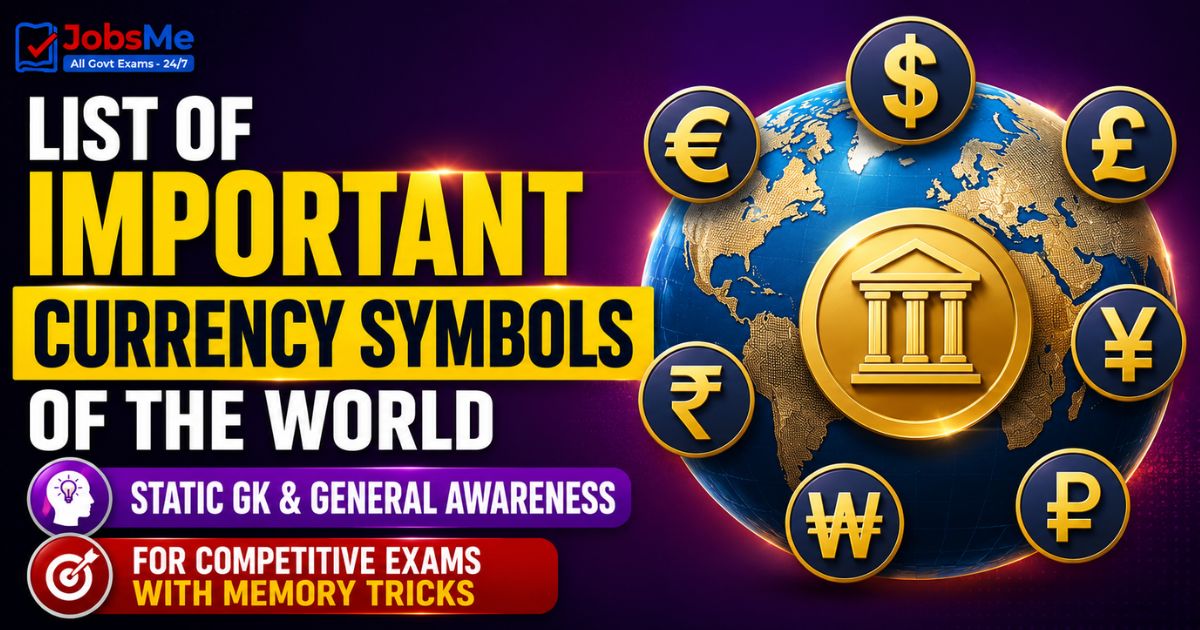
List of Important Currency Symbols of the World – Static GK & General Awareness for Competitive Exams with Memory Tricks
This article presents a complete, region-wise list of important currency symbols, their currencies, ISO 4217 codes and the countries that use them, covering major world currencies (Dollar $, Euro €, Pound £, Yen ¥, Rupee ₹) and key Asian, Middle Eastern, European and African currencies. It also explains the story behind the Indian Rupee symbol designed by D. Udaya Kumar in 2010, along with memory tricks and one-liners for quick revision. All facts are arranged in exam-ready format to help UPSC, SSC, IBPS, RRB, PSU, Insurance and State PCS aspirants score better in the General Awareness and Banking Awareness sections.
Jump to section
Introduction
A currency symbol is a graphic sign used to represent the name of a currency in a quick and simple way — for example, $ stands for the US Dollar, € for the Euro, £ for the British Pound, ¥ for the Japanese Yen, and ₹ for the Indian Rupee. These symbols appear on price tags, salary slips, bank statements, forex boards and international financial documents, and knowing which symbol belongs to which country is a frequently tested area of General Awareness.
Questions on currency symbols, currencies and their countries appear regularly in SSC CGL, IBPS PO and Clerk, RRB NTPC, SBI Clerk, UPSC Prelims, State PCS, and various Insurance and Defence exams. Banking exams in particular favour this topic because forex, exchange rates and international settlements are part of everyday banking. This article brings together every important currency symbol in a structured, region-wise, exam-ready format. To explore other related topics, you can refer to the Static GK section on thejobsme.com.
The topic is also closely linked to current affairs themes such as exchange rate movements, depreciation and appreciation of the rupee, foreign exchange reserves, new currency launches and central bank decisions — making it doubly important for aspirants preparing for both objective General Awareness and Banking Awareness sections.
Core Concepts: Understanding Currency Symbols and Codes
To answer currency questions correctly, students must understand three related but distinct things: the currency name, its symbol, and its ISO code. Mixing these up is the single biggest mistake in the exam, so it helps to learn all three together.
- Currency Name: The official name of the money used in a country. Example: Rupee, Dollar, Yen, Dinar.
- Currency Symbol: The short graphic sign used to write amounts quickly. Example: ₹ for Rupee, ¥ for Yen, € for Euro.
- ISO 4217 Code: A three-letter code created by the International Organization for Standardization to remove confusion between currencies that share the same symbol or name. The first two letters usually come from the country code (ISO 3166) and the third from the currency name. Example: USD (United States Dollar), INR (Indian Rupee), JPY (Japanese Yen), CHF (Swiss Franc, where CH is Switzerland and F is Franc).
- Shared Symbols: Many countries share the same symbol — $ is used by the USA, Canada, Australia, Singapore and others; £ is used by the United Kingdom and others. The ISO code is what tells them apart (USD vs CAD vs AUD).
Major World Currency Symbols
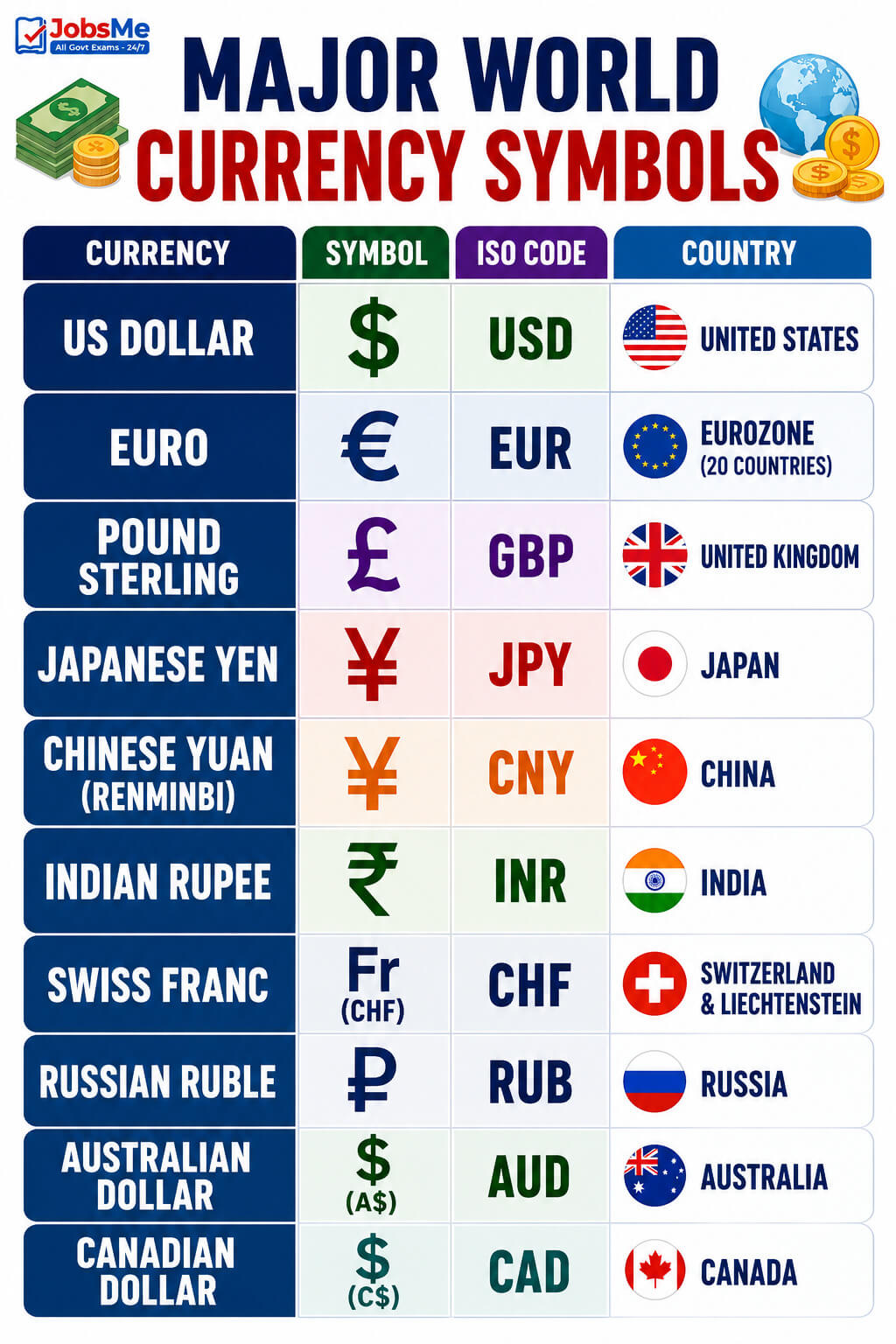
The following table lists the most exam-relevant currency symbols of major global economies, along with their ISO codes and key details.
| Currency | Symbol | ISO Code | Country / Key Details |
|---|---|---|---|
| US Dollar | $ | USD | United States; the world's primary reserve currency and the most widely used in international trade and forex. |
| Euro | € | EUR | Official currency of the Eurozone, used by 20 European Union member countries such as Germany, France, Italy and Spain. |
| Pound Sterling | £ | GBP | United Kingdom; one of the oldest currencies still in use and a major global reserve currency. |
| Japanese Yen | ¥ | JPY | Japan; shares the ¥ symbol with the Chinese Yuan but is distinguished by the code JPY. |
| Chinese Yuan (Renminbi) | ¥ | CNY | China; Renminbi is the official name of the currency while Yuan is its main unit. Uses the same ¥ symbol as the Yen. |
| Indian Rupee | ₹ | INR | India; the symbol was designed by D. Udaya Kumar and adopted in 2010, combining the Devanagari "Ra" and Roman "R". |
| Swiss Franc | Fr (CHF) | CHF | Switzerland and Liechtenstein; considered a safe-haven currency. Code CHF stands for Confoederatio Helvetica Franc. |
| Russian Ruble | ₽ | RUB | Russia; the ruble symbol with a horizontal stroke through the letter R (Cyrillic Er) was adopted in 2013. |
| Australian Dollar | $ (A$) | AUD | Australia; shares the $ symbol but distinguished as A$ and by the code AUD. |
| Canadian Dollar | $ (C$) | CAD | Canada; uses the $ symbol, written as C$ to separate it from the US Dollar. |
Asian Currency Symbols
Asian currencies are frequently asked in SSC, Railways and Banking exams, especially currencies of India's neighbouring countries.
| Currency | Symbol | ISO Code | Country / Key Details |
|---|---|---|---|
| Bangladeshi Taka | ৳ | BDT | Bangladesh; the Taka is the official currency, with the symbol drawn from the Bengali script. |
| Pakistani Rupee | ₨ (Rs) | PKR | Pakistan; uses Rs/Rupee like several South Asian nations but distinguished by the code PKR. |
| Sri Lankan Rupee | Rs (₨) | LKR | Sri Lanka; another South Asian rupee, separated from the Indian Rupee by the code LKR. |
| Nepalese Rupee | Rs (₨) | NPR | Nepal; pegged to the Indian Rupee at a fixed exchange rate for decades. |
| Bhutanese Ngultrum | Nu. | BTN | Bhutan; pegged at par with the Indian Rupee, which also circulates freely in Bhutan. |
| Afghan Afghani | ؋ | AFN | Afghanistan; the afghani is divided into 100 pul. |
| Thai Baht | ฿ | THB | Thailand; the baht symbol is derived from the Thai script. |
| South Korean Won | ₩ | KRW | South Korea; the won uses the symbol ₩ (W with two strokes). |
| Indonesian Rupiah | Rp | IDR | Indonesia; the rupiah shares a common Sanskrit root with the rupee. |
| Malaysian Ringgit | RM | MYR | Malaysia; RM stands for Ringgit Malaysia. |
| Singapore Dollar | $ (S$) | SGD | Singapore; written as S$ to distinguish it from other dollars. |
| Vietnamese Dong | ₫ | VND | Vietnam; the dong symbol is a small "d" with a stroke. |
| Philippine Peso | ₱ | PHP | Philippines; the peso symbol is a P with two horizontal strokes. |
Middle East and African Currency Symbols
Gulf and Middle Eastern currencies are commonly tested because of India's strong trade and migration links with the region.
| Currency | Symbol | ISO Code | Country / Key Details |
|---|---|---|---|
| Saudi Riyal | SR (﷼) | SAR | Saudi Arabia; the riyal is the currency of the largest Gulf economy. |
| UAE Dirham | AED (Dh) | AED | United Arab Emirates; the dirham is widely used by the Indian diaspora in Dubai and Abu Dhabi. |
| Kuwaiti Dinar | KD | KWD | Kuwait; often cited as one of the highest-valued currencies in the world. |
| Qatari Riyal | QR | QAR | Qatar; the riyal is the currency of this Gulf nation. |
| Omani Rial | OMR (﷼) | OMR | Oman; another high-value Gulf currency. |
| Bahraini Dinar | BD | BHD | Bahrain; one of the strongest currencies by value. |
| Israeli New Shekel | ₪ | ILS | Israel; the new shekel symbol combines the Hebrew letters shin and qoph. |
| Turkish Lira | ₺ | TRY | Turkey; the lira symbol resembles a tilted anchor and was adopted in 2012. |
| Egyptian Pound | E£ (LE) | EGP | Egypt; the pound here is divided into 100 piastres. |
| South African Rand | R | ZAR | South Africa; the rand is named after the Witwatersrand ridge where gold was discovered. |
| Nigerian Naira | ₦ | NGN | Nigeria; the naira is the currency of Africa's most populous country. |
| Kenyan Shilling | KSh | KES | Kenya; the shilling is shared in form by several East African nations. |
Other Important Currency Symbols
A few more symbols appear often in objective papers and are worth memorising.
| Currency | Symbol | ISO Code | Country / Key Details |
|---|---|---|---|
| Brazilian Real | R$ | BRL | Brazil; the largest economy in South America. |
| Mexican Peso | $ | MXN | Mexico; uses the $ symbol but distinguished by code MXN. |
| Polish Zloty | zł | PLN | Poland; zloty literally means "golden" in Polish. |
| Ukrainian Hryvnia | ₴ | UAH | Ukraine; the hryvnia symbol was introduced in 2004. |
| Costa Rican / Salvadoran Colon | ₡ | CRC | Costa Rica; the colon is named after explorer Christopher Columbus (Cristobal Colon). |
The Story of the Indian Rupee Symbol
The Indian Rupee symbol ₹ is one of the most important single facts in this topic and is asked repeatedly in exams. Before 2010, the rupee was written only as Rs, Re or an abbreviation in Indian languages. In March 2009, the Government of India launched an open competition through the Ministry of Finance to design a unique symbol for the rupee.
- Designer: D. Udaya Kumar, a post-graduate in Design from IIT Bombay (later an Associate Professor at IIT Guwahati).
- Year Adopted: The symbol was approved and presented to the public on 15 July 2010.
- Design Meaning: It is an amalgam of the Devanagari letter "Ra" (र) and the Roman capital "R" without its vertical bar. The two parallel horizontal lines at the top represent the national flag (tricolour) and also resemble the "equal to" (=) sign, symbolising the nation's desire to reduce economic disparity.
- Selection: It was chosen from thousands of entries (around 3,331 responses), shortlisted to five final designs.
Memory Tricks and Mnemonics
1. The "DEPJ-R" Major Currencies Trick
To remember the five biggest currency symbols and their order of global importance, use the acronym DEPJ-R:
"Dollar, Euro, Pound, Yen, Rupee."
- D = Dollar $ (USD)
- E = Euro € (EUR)
- P = Pound £ (GBP)
- J = (Japanese) Yen ¥ (JPY)
- R = Rupee ₹ (INR)
2. The "Same Symbol, Different Code" Trick for Yen and Yuan
Both the Japanese Yen and Chinese Yuan use the symbol ¥. Remember: "Japan = JPY, China = CNY — same sign, the code decides." Keep the J for Japan and C for China firmly in mind.
3. The Dollar Family Trick
Many countries use the $ sign. Remember the dollar family with the letter clue: "US is plain $, others wear a hat letter."
- US Dollar = $ (USD)
- Australian Dollar = A$ (AUD)
- Canadian Dollar = C$ (CAD)
- Singapore Dollar = S$ (SGD)
4. The South Asian Rupee Trick
India, Pakistan, Sri Lanka and Nepal all use the rupee. Remember the phrase "India Pays Some Notes" for the codes I-P-S-N: INR, PKR, LKR, NPR. Bhutan breaks the chain with Ngultrum (BTN) but stays pegged to the Indian Rupee.
5. The "Rupee Symbol in 2010 by Udaya Kumar" Trick
Lock the Indian Rupee facts with the rhyme: "Udaya Kumar gave the ₹ in twenty-ten." Adopted year (2010) plus designer (Udaya Kumar) are the two most asked facts.
6. The Gold and Gulf Dinar Trick
The highest-value currencies cluster in the Gulf. Remember "Kuwait, Bahrain, Oman — the Dinar/Rial kings." The Kuwaiti Dinar (KWD) is regularly cited as one of the strongest currencies in the world.
7. The "Named After People and Places" Trick
Some currencies are named after history. Remember the contrast: "Rand from a ridge, Colon from Columbus." The South African Rand comes from the Witwatersrand, while the Colon is named after Christopher Columbus.
Additional Notes
Frequently Confused Facts
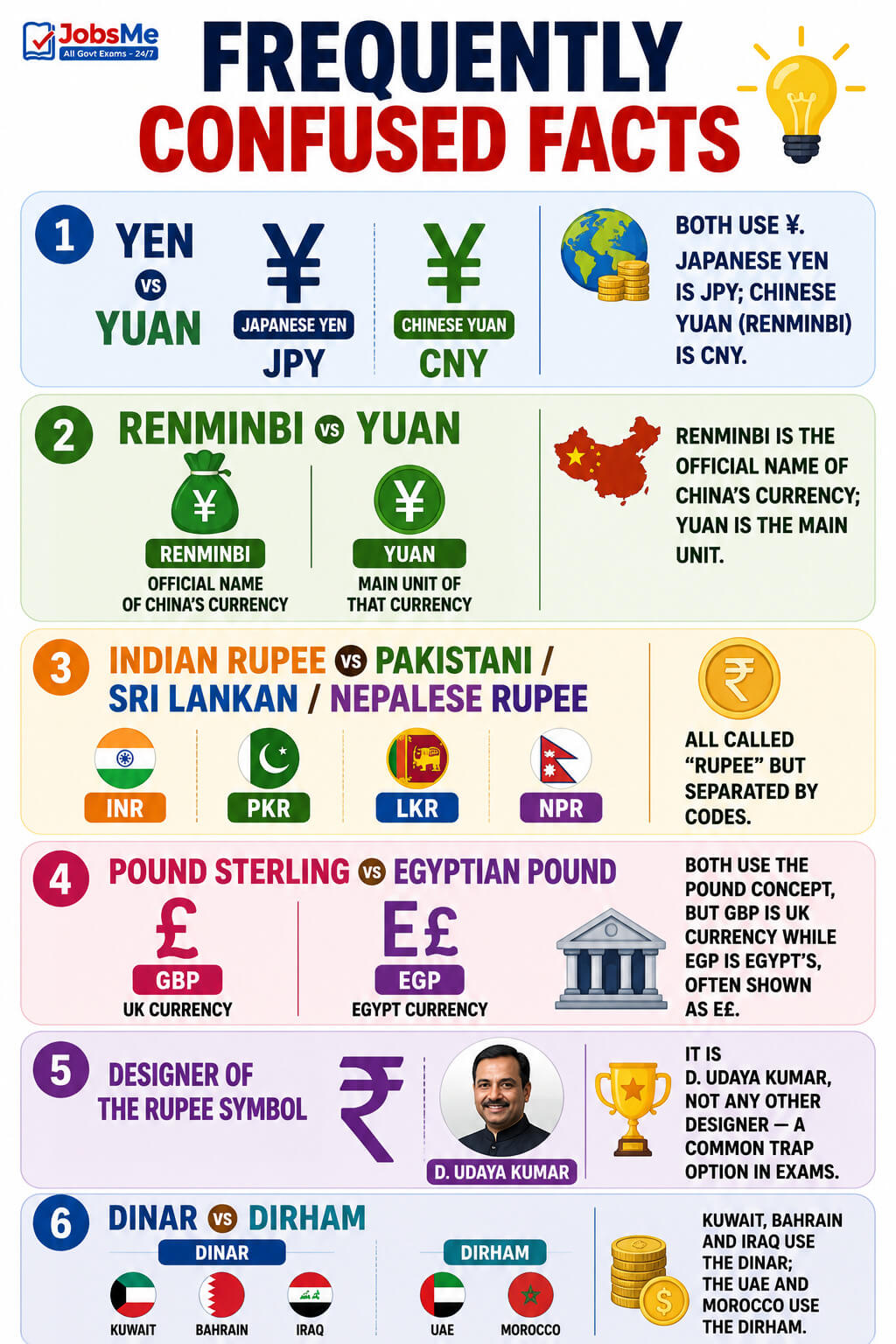
- Yen vs Yuan: Both use ¥. Japanese Yen is JPY; Chinese Yuan (Renminbi) is CNY.
- Renminbi vs Yuan: Renminbi is the official name of China's currency; Yuan is the main unit of that currency.
- Indian Rupee vs Pakistani / Sri Lankan / Nepalese Rupee: All called "rupee" but separated by codes INR, PKR, LKR and NPR.
- Pound Sterling vs Egyptian Pound: Both use the pound concept, but GBP is the UK currency while EGP is Egypt's, often shown as E£.
- Designer of the Rupee Symbol: It is D. Udaya Kumar, not any other designer — a common trap option in exams.
- Dinar vs Dirham: Kuwait, Bahrain and Iraq use the Dinar; the UAE and Morocco use the Dirham.
Repeating PYQ Patterns
- SSC CGL and Railways (RRB NTPC): Frequently ask "which country uses this currency" and "match the currency to the country," especially for neighbouring countries.
- IBPS and SBI (Banking Awareness): Favour the Indian Rupee symbol facts — designer and year — and Gulf currencies due to forex relevance.
- UPSC Prelims: Occasionally asks indirect questions linking currencies to economic groupings and reserve currencies.
- Insurance and PSU exams: Test the Dollar, Euro, Pound and Yen as the major reserve currencies.
Quick Insight
Currency symbols are not just static facts — they connect directly to current affairs. News about the rupee touching record lows against the dollar, fluctuations in the value of the Yen, the rise of the Euro, or new currency symbol launches (like the Turkish Lira and Russian Ruble in recent years) all draw from this topic. Keeping an eye on daily forex and economy news helps reinforce these facts naturally. For ongoing updates, refer to the daily current affairs page and strengthen your basics with the Banking Awareness notes on thejobsme.com.
One-Liners for Quick Revision
- US Dollar → symbol $ → ISO code USD; world's primary reserve currency.
- Euro → symbol € → EUR; used by 20 Eurozone countries.
- Pound Sterling → symbol £ → GBP; currency of the United Kingdom.
- Japanese Yen → symbol ¥ → JPY; shares its sign with the Chinese Yuan.
- Chinese Yuan (Renminbi) → symbol ¥ → CNY; Renminbi is the name, Yuan the unit.
- Indian Rupee → symbol ₹ → INR; designed by D. Udaya Kumar, adopted 15 July 2010.
- Swiss Franc → symbol Fr → CHF; a safe-haven currency (CH = Switzerland).
- Russian Ruble → symbol ₽ → RUB; symbol adopted in 2013.
- Australian Dollar → symbol A$ → AUD; a dollar-family currency.
- Canadian Dollar → symbol C$ → CAD; uses the $ sign with a C prefix.
- Bangladeshi Taka → symbol ৳ → BDT; drawn from the Bengali script.
- Pakistani Rupee → Rs → PKR; South Asian rupee.
- Sri Lankan Rupee → Rs → LKR; separated from INR by code.
- Nepalese Rupee → Rs → NPR; pegged to the Indian Rupee.
- Bhutanese Ngultrum → Nu. → BTN; pegged at par with the Indian Rupee.
- Afghan Afghani → symbol ؋ → AFN; divided into 100 pul.
- Thai Baht → symbol ฿ → THB; from the Thai script.
- South Korean Won → symbol ₩ → KRW; uses W with two strokes.
- Indonesian Rupiah → Rp → IDR; shares a Sanskrit root with rupee.
- Malaysian Ringgit → RM → MYR; RM means Ringgit Malaysia.
- Singapore Dollar → S$ → SGD; a dollar-family currency.
- Vietnamese Dong → symbol ₫ → VND; a small d with a stroke.
- Philippine Peso → symbol ₱ → PHP; a P with two strokes.
- Saudi Riyal → SR → SAR; currency of the largest Gulf economy.
- UAE Dirham → AED → AED; widely used by the Indian diaspora in Dubai.
- Kuwaiti Dinar → KD → KWD; among the highest-valued currencies.
- Qatari Riyal → QR → QAR; currency of Qatar.
- Omani Rial → OMR → OMR; a high-value Gulf currency.
- Bahraini Dinar → BD → BHD; one of the strongest currencies by value.
- Israeli New Shekel → symbol ₪ → ILS; combines Hebrew shin and qoph.
- Turkish Lira → symbol ₺ → TRY; symbol adopted in 2012.
- Egyptian Pound → E£ → EGP; divided into 100 piastres.
- South African Rand → R → ZAR; named after the Witwatersrand ridge.
- Nigerian Naira → symbol ₦ → NGN; currency of Africa's most populous country.
- Kenyan Shilling → KSh → KES; an East African shilling.
- Brazilian Real → R$ → BRL; largest South American economy.
- Mexican Peso → $ → MXN; uses the dollar sign, code MXN.
- Polish Zloty → zł → PLN; zloty means "golden".
- Ukrainian Hryvnia → symbol ₴ → UAH; introduced in 2004.
- Colon → symbol ₡ → CRC; named after Christopher Columbus.
Practice these facts regularly with the Static GK quiz and the Banking Awareness quiz on thejobsme.com. You can also stay updated with the latest government job notifications to plan your exam preparation better.
Free quiz • No signup required
Put this topic into practice with Indian Cultural Institutions – Static GK MCQ Quiz. It is the quickest way to reinforce what you just learned.
Frequently Asked Questions
Who designed the Indian Rupee symbol?
In which year was the Indian Rupee symbol adopted?
What does the Indian Rupee symbol represent?
Which currencies share the same symbol?
What is the difference between a currency symbol and an ISO code?
Which countries use the rupee as their currency?
What is the currency of Bhutan and how is it linked to India?
What is the ISO code for the Swiss Franc and why is it CHF?
Which currency is often considered one of the highest valued in the world?
What is the difference between Renminbi and Yuan?

About the author