Deserts of the World – Static GK & General Awareness List with Locations and Memory Tricks for Competitive Exams
This article presents a complete, region-wise list of the major deserts of the world along with their locations, type (hot or cold), approximate area, and key facts. It covers the world's largest deserts such as Antarctica, the Arctic, the Sahara, the Arabian and the Gobi, the driest desert (Atacama), the oldest desert (Namib), and India's own Thar and cold deserts of Ladakh and Spiti, with memory tricks, frequently confused facts, and one-liners for quick revision. All facts are arranged in exam-ready format to help UPSC, SSC, IBPS, RRB, PSU, and State PCS aspirants score better in the General Awareness and Geography sections.
Jump to section
Introduction
Deserts are among the most fascinating landforms on Earth, covering nearly one-third of the planet's total land surface. A desert is any region that receives very little precipitation — generally less than 250 mm (about 10 inches) of rainfall per year — leading to extreme aridity, sparse vegetation, and harsh living conditions. Contrary to popular belief, deserts are not always hot and sandy: the two largest deserts in the world, the Antarctic and the Arctic, are actually cold polar deserts of ice.
Questions on the deserts of the world appear regularly in UPSC Prelims, SSC CGL, IBPS PO, RRB NTPC, SBI Clerk, State PCS, and various Insurance, Railways and Defence exams. Objective papers usually test which desert is the largest, the driest, the oldest, or in which country a particular desert lies, while map-based questions ask aspirants to match a desert with its continent. This article brings together every important desert in a structured, region-wise, exam-ready format. To explore other related topics, you can refer to the Static GK section on thejobsme.com.
The topic is also linked to current affairs themes such as desertification, climate change, the expansion of the Sahara, the Great Green Wall project in Africa, solar energy projects in the Thar, and the Rann Utsav in Gujarat — making it doubly important for aspirants preparing for both the Geography and Environment sections as well as objective General Awareness papers.
Core Concepts: Types of Deserts
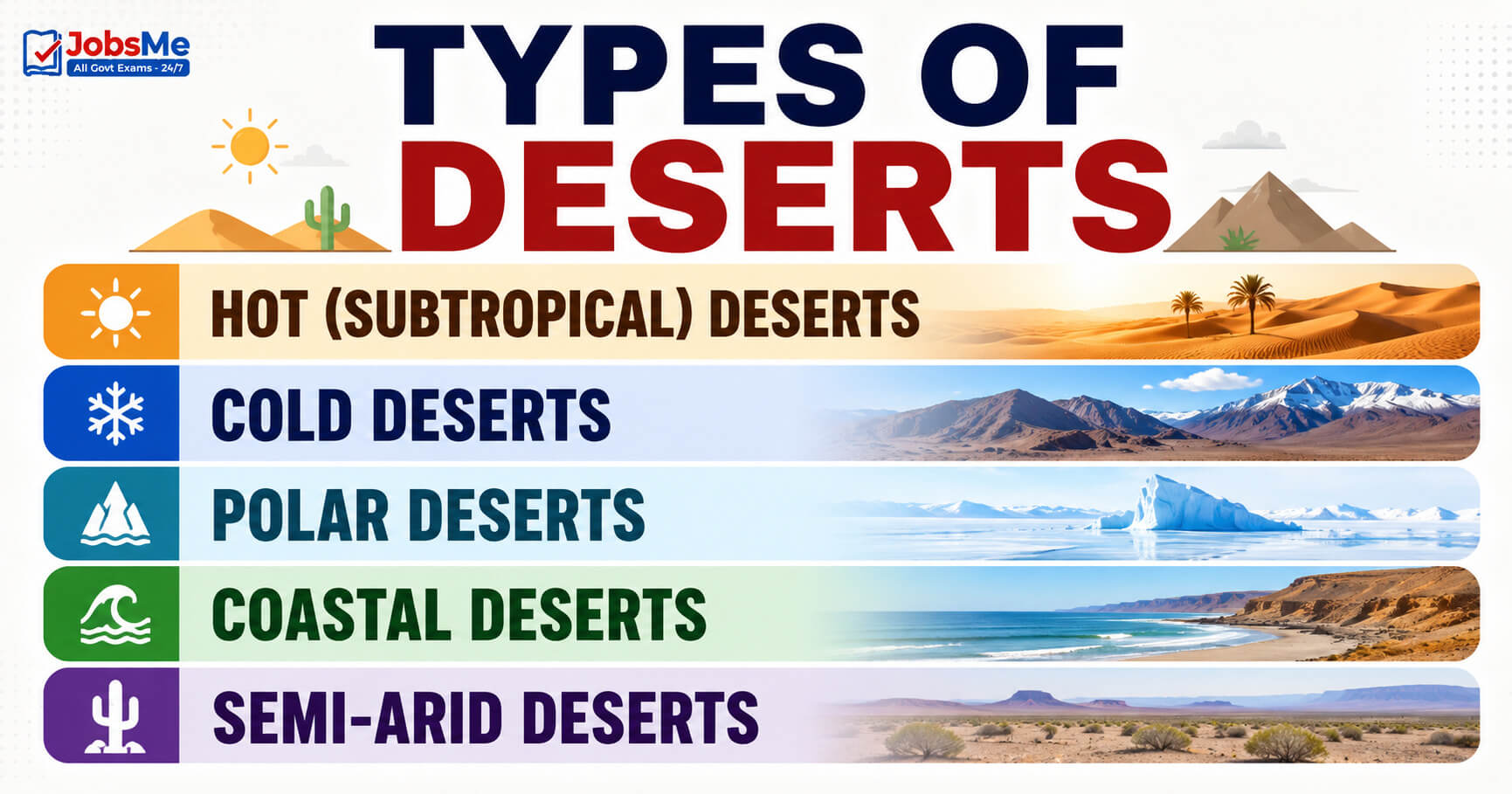
A desert is defined by its lack of moisture, not by its temperature. Understanding the basic classification helps aspirants avoid the most common exam trap — assuming that every desert is hot.
- Hot (Subtropical) Deserts: Located mainly around the Tropics of Cancer and Capricorn (around 20°-30° N and S), with very high daytime temperatures. Examples: Sahara, Arabian, Thar, Kalahari.
- Cold Deserts: Found in high-altitude or high-latitude regions with freezing winters. Examples: Gobi, Patagonian, Ladakh, Taklamakan.
- Polar Deserts: Ice-covered regions where extreme cold keeps moisture locked as ice. Examples: Antarctic and Arctic deserts — the two largest deserts on Earth.
- Coastal Deserts: Lie along the west coasts of continents near cold ocean currents, which keep the air stable and rainfall very low. Examples: Atacama (Chile) and Namib (Namibia).
- Semi-arid Deserts: Experience mild temperatures, long dry summers and a little light rain in winter. Example: Great Basin Desert of the USA.
Largest Deserts of the World
The following table lists the ten largest deserts in the world by area, along with their type, location, and key features. Note that the largest deserts are cold, not hot.
| Desert | Type | Location | Approx. Area | Key Features |
|---|---|---|---|---|
| Antarctic Desert | Cold (Polar) | Antarctica | 14.2 million sq km | The largest and coldest desert in the world; an ice-covered polar desert. Holds the record for the lowest temperature on Earth (around -89 degrees C). |
| Arctic Desert | Cold (Polar) | Arctic region (above 75 degrees N) | 13.9 million sq km | The second-largest desert in the world; a cold polar desert spanning parts of the Arctic around the North Pole, mostly snow and ice. |
| Sahara Desert | Hot (Subtropical) | North Africa (spans about 11-12 countries) | 9.2 million sq km | The largest hot desert in the world; roughly the size of the USA or China. Features sand dunes (ergs), rocky plateaus and oases; it is expanding due to desertification. |
| Arabian Desert | Hot | Western Asia (mainly Saudi Arabia) | 2.3 million sq km | The largest desert in Asia; contains the vast Rub' al Khali (Empty Quarter), the world's largest continuous sand desert. |
| Gobi Desert | Cold | Northern China and Southern Mongolia | 1.3 million sq km | A cold rain-shadow desert with extreme temperature swings; experiences snow in winter and is famous for dinosaur fossil discoveries. |
| Kalahari Desert | Hot (Semi-arid) | Southern Africa (Botswana, Namibia, South Africa) | 0.9 million sq km | A semi-arid sandy savanna; supports more wildlife and vegetation than a true desert, home to the San (Bushmen) people. |
| Patagonian Desert | Cold | Argentina (lies east of the Andes) | 0.67 million sq km | The largest desert in South America; a cold, windy desert in the rain shadow of the Andes Mountains. |
| Great Victoria Desert | Hot | Australia | 0.42 million sq km | The largest desert in Australia; a mix of sand dunes, grasslands and salt lakes. |
| Syrian Desert | Hot | Western Asia (Syria, Iraq, Jordan, Saudi Arabia) | 0.49 million sq km | A combination of rocky and sandy desert covering much of the Middle East; an important historic trade-route region. |
| Great Basin Desert | Cold (Semi-arid) | USA (Nevada, Utah, parts of Oregon, Idaho) | 0.49 million sq km | The largest semi-arid desert in the United States; a cold desert lying between the Sierra Nevada and Rocky Mountains. |
Other Famous Deserts of the World
Beyond the ten largest, several smaller deserts are heavily tested in exams because of records they hold — the driest, the oldest, or their distinctive red sand. The table below covers these continent by continent.
Deserts of Asia and the Middle East
| Desert | Country / Location | Key Features |
|---|---|---|
| Rub' al Khali (Empty Quarter) | Saudi Arabia (also UAE, Oman, Yemen) | The world's largest continuous sand desert; part of the Arabian Desert and one of the most inhospitable places on Earth. |
| Taklamakan Desert | Northwest China (Xinjiang) | A large cold sand desert in the rain shadow of the Himalayas and Kunlun mountains; known as the "Sea of Death." |
| Karakum Desert | Turkmenistan | Means "Black Sand"; covers about 70% of Turkmenistan. Home to the famous Darvaza "Door to Hell" gas crater. |
| Kyzylkum Desert | Kazakhstan and Uzbekistan | Means "Red Sand" in Turkic; located between the Amu Darya and Syr Darya rivers in Central Asia. |
| Dasht-e Kavir (Great Salt Desert) | Iran | A large salt desert on the Iranian plateau with extensive salt marshes and crusts. |
| Dasht-e Lut | Iran | Recorded among the hottest surface temperatures on Earth (over 70 degrees C); a UNESCO World Heritage Site. |
Deserts of Africa
| Desert | Country / Location | Key Features |
|---|---|---|
| Namib Desert | Namibia, Angola, South Africa (Atlantic coast) | A coastal desert widely regarded as the oldest desert on Earth (about 55-80 million years); famous for towering red sand dunes. |
| Kalahari Desert | Botswana, Namibia, South Africa | A semi-arid sandy savanna in Southern Africa with surprisingly rich wildlife. |
Deserts of the Americas
| Desert | Country / Location | Key Features |
|---|---|---|
| Atacama Desert | Chile (also parts of Peru, Pacific coast) | The driest non-polar desert in the world; some areas have recorded no rainfall for decades. A coastal desert near the cold Humboldt Current. |
| Mojave Desert | USA (California, Nevada, Arizona, Utah) | Contains Death Valley, one of the hottest and lowest places in North America; known for Joshua trees. |
| Sonoran Desert | Southwest USA and Northwest Mexico | Famous for the iconic saguaro cactus and rich biodiversity of plant and animal life. |
| Chihuahuan Desert | Mexico and southwestern USA | The largest desert in North America; a high-altitude desert with diverse cacti and grasslands. |
| Patagonian Desert | Argentina | The largest desert in South America; cold and windy, lying east of the Andes. |
Deserts of Australia
| Desert | Location | Key Features |
|---|---|---|
| Great Victoria Desert | Southern interior of Australia | The largest desert in Australia; sand dunes, grasslands and salt lakes. |
| Great Sandy Desert | Northwestern Australia | The second-largest Australian desert, known for its long parallel sand ridges. |
| Simpson Desert | Central Australia | Famous for the world's longest parallel sand dunes and red sand. |
| Gibson Desert | Western Australia | A central desert of gravel plains, sandhills and stony ground between the Great Sandy and Great Victoria deserts. |
Deserts of India
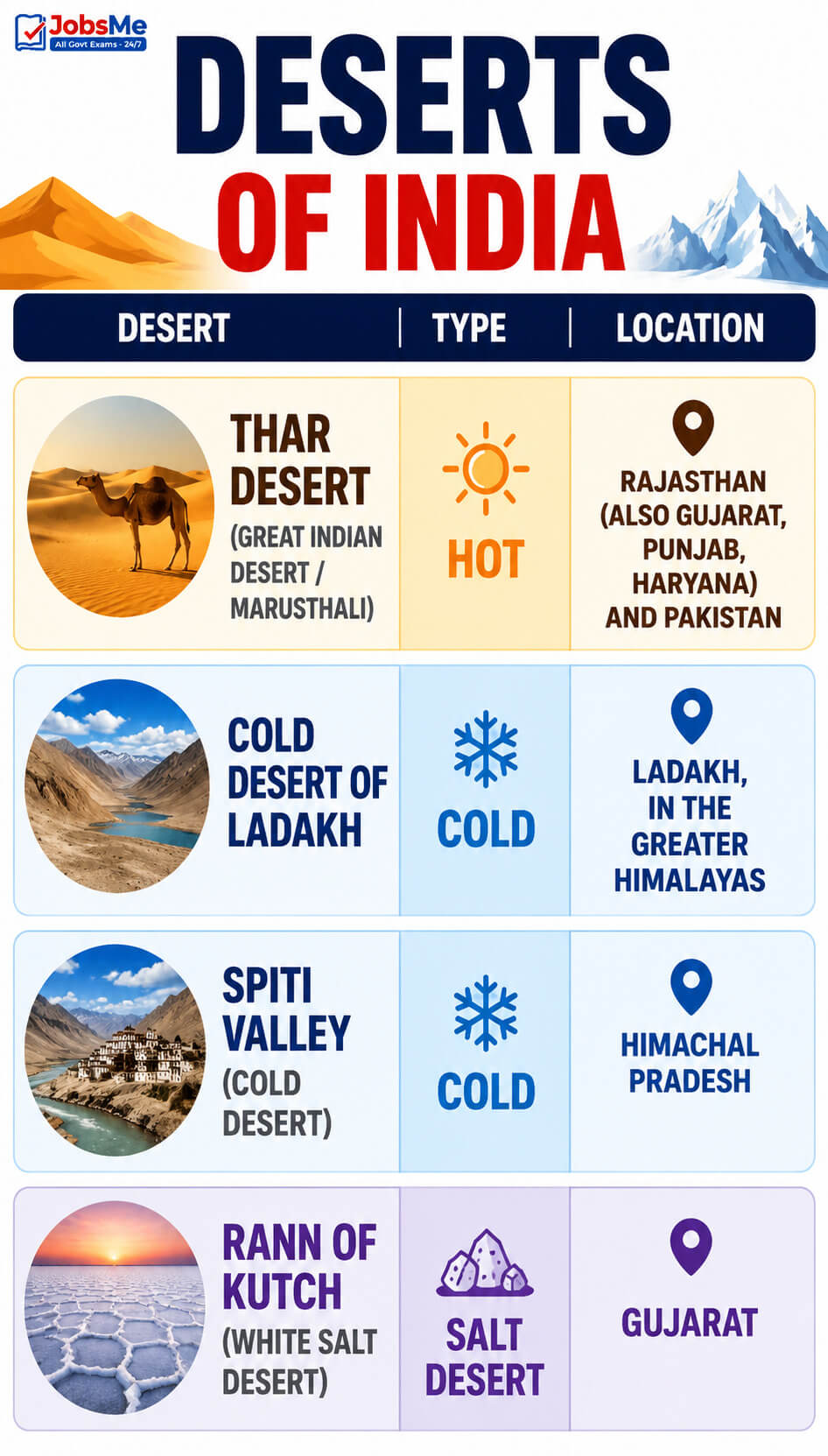
India has both a famous hot desert and lesser-known cold deserts, all of which are popular exam topics. Aspirants should clearly distinguish the hot Thar from the cold deserts of the Himalayas.
| Desert | Type | Location | Key Features |
|---|---|---|---|
| Thar Desert (Great Indian Desert / Marusthali) | Hot | Rajasthan (also Gujarat, Punjab, Haryana) and Pakistan | The largest desert in India and the world's 17th largest; about 85% lies in India and 15% in Pakistan. Forms a natural boundary between the two countries and hosts wildlife like the Wild Ass and Great Indian Bustard. |
| Cold Desert of Ladakh | Cold | Ladakh, in the Greater Himalayas | Also called "Khapa Chan" (Land of Snow); a high-altitude rain-shadow desert enclosed by the Karakoram and Zanskar ranges, drained by the Indus river. |
| Spiti Valley (Cold Desert) | Cold | Himachal Pradesh | A high Himalayan cold desert; the name "Spiti" means "the Middle Land," lying between Tibet and India. |
| Rann of Kutch (White Salt Desert) | Salt desert | Gujarat | One of the largest salt deserts in the world; the Great Rann turns into a white salt crust after seasonal flooding, and hosts the famous Rann Utsav. |
Memory Tricks and Mnemonics
Trick 1: The Two Biggest Are Cold — "Cold on Top"
The single most common trap is assuming the Sahara is the largest desert. Lock the order of the top three:
- 1st → Antarctic Desert (cold, polar).
- 2nd → Arctic Desert (cold, polar).
- 3rd → Sahara (hot — the largest HOT desert).
"The world's two biggest deserts wear ice, not sand."
Trick 2: The Three Records — "Driest, Oldest, Largest Sand"
Three deserts are remembered only for the record they hold:
- Driest → Atacama (Chile).
- Oldest → Namib (Namibia).
- Largest continuous sand sea → Rub' al Khali (Saudi Arabia).
"Atacama is driest, Namib is oldest, Rub' al Khali is the sandiest."
Trick 3: Central Asia's Colour Sands — "Black and Red"
The two Central Asian "kum" (sand) deserts are easy to mix up; use their colours:
- Karakum → "Kara" = Black Sand → Turkmenistan.
- Kyzylkum → "Kyzyl" = Red Sand → Kazakhstan and Uzbekistan.
"Kara is dark (Black), Kyzyl is fiery (Red)."
Trick 4: India's Hot vs Cold — "Thar is Hot, Ladakh is Cold"
Separate India's deserts by temperature and state:
- Thar → Hot → Rajasthan.
- Ladakh → Cold → Greater Himalayas.
- Spiti → Cold → Himachal Pradesh.
"Down in Rajasthan it burns; up in the Himalayas it freezes."
Trick 5: North America's "GMSC" Quartet
Remember the four main North American deserts with "GMSC":
- G → Great Basin (cold, semi-arid).
- M → Mojave (has Death Valley).
- S → Sonoran (saguaro cactus).
- C → Chihuahuan (largest in North America).
Trick 6: Coastal Deserts Hug the Cold Coast — "AN by the Sea"
Both major coastal deserts sit beside cold ocean currents:
- A → Atacama → Pacific coast of Chile (Humboldt Current).
- N → Namib → Atlantic coast of Namibia (Benguela Current).
"Cold currents make dry coasts — Atacama and Namib."
Trick 7: One Desert per Continent's Crown
Lock the largest desert of each continent:
- Africa → Sahara.
- Asia → Arabian.
- South America → Patagonian.
- North America → Chihuahuan.
- Australia → Great Victoria.
Additional Notes
Frequently Confused Facts
- Largest desert vs largest hot desert: The largest desert overall is the Antarctic (cold); the largest hot desert is the Sahara — a classic objective trap.
- Sahara vs Arabian: Sahara is in North Africa (largest hot desert); the Arabian is in Western Asia (largest desert in Asia, contains Rub' al Khali).
- Atacama vs Namib: Atacama (Chile) is the driest desert; Namib (Namibia) is the oldest desert. Both are coastal.
- Karakum vs Kyzylkum: Karakum ("Black Sand") is in Turkmenistan; Kyzylkum ("Red Sand") is in Kazakhstan and Uzbekistan.
- Thar vs Ladakh: Thar (Rajasthan) is India's hot desert; Ladakh and Spiti are India's cold deserts in the Himalayas.
- Gobi temperature: Despite being a desert, the Gobi is a cold desert and even receives snow in winter — not a hot sandy desert.
- Rub' al Khali: It is the largest continuous sand desert and lies mainly in Saudi Arabia; it is a part of the larger Arabian Desert, not a separate continent-sized desert.
- Rann of Kutch: A salt desert in Gujarat — not classified as a hot sand desert like the Thar or a cold desert like Ladakh.
Repeating PYQ Patterns
Certain desert facts are asked repeatedly. "Largest desert in the world" (Antarctic), "Largest hot desert" (Sahara), "Driest desert" (Atacama), "Oldest desert" (Namib), "Largest desert in Asia" (Arabian), "Empty Quarter" (Rub' al Khali, Saudi Arabia), "Largest desert in India" (Thar), and "Cold desert of India" (Ladakh / Spiti) appear most often in SSC CGL, RRB NTPC, and State PCS papers. For UPSC Prelims, map-based and continent-matching questions on the Sahara, Gobi, Kalahari, Patagonian and Atacama are common, while the Environment section may link deserts to desertification and the Great Green Wall. Banking exams (IBPS PO, SBI Clerk) usually test simple matching of a desert with its country or continent. You can practise these in the Static GK Quiz section.
Quick Insight
Deserts are at the heart of several live current affairs themes: the Sahara has expanded by roughly 10% over the last century due to climate change, prompting Africa's ambitious Great Green Wall project; the Thar Desert now hosts some of India's largest solar parks; and Gujarat's Rann of Kutch draws lakhs of tourists each year for the Rann Utsav. Understanding both the static facts and their real-world relevance helps aspirants answer not just direct GK questions but also Environment and Geography questions that connect deserts to climate, agriculture and renewable energy. For more exam preparation material, you can refer to the Daily Current Affairs notes and the Static GK section on thejobsme.com.
One-Liners for Quick Revision
- Antarctic Desert → largest and coldest desert in the world → polar ice desert in Antarctica (14.2 million sq km).
- Arctic Desert → second-largest desert in the world → cold polar desert around the North Pole.
- Sahara Desert → largest hot desert in the world → North Africa, spans about 11-12 countries.
- Arabian Desert → largest desert in Asia → Western Asia, mainly Saudi Arabia; contains Rub' al Khali.
- Gobi Desert → cold desert with snow in winter → Northern China and Southern Mongolia; dinosaur fossils.
- Kalahari Desert → semi-arid sandy savanna → Botswana, Namibia, South Africa; home of the San people.
- Patagonian Desert → largest desert in South America → Argentina, east of the Andes; cold and windy.
- Great Victoria Desert → largest desert in Australia → southern interior of Australia.
- Syrian Desert → rocky and sandy desert → Syria, Iraq, Jordan, Saudi Arabia.
- Great Basin Desert → largest semi-arid desert in the USA → Nevada, Utah and neighbouring states.
- Rub' al Khali (Empty Quarter) → largest continuous sand desert → Saudi Arabia (part of Arabian Desert).
- Taklamakan Desert → cold sand desert called "Sea of Death" → Northwest China (Xinjiang).
- Karakum Desert → "Black Sand"; covers about 70% of country → Turkmenistan; Darvaza gas crater.
- Kyzylkum Desert → "Red Sand" → Kazakhstan and Uzbekistan; between Amu Darya and Syr Darya.
- Dasht-e Kavir → Great Salt Desert → Iran; salt marshes and crusts.
- Dasht-e Lut → among the hottest surface temperatures on Earth → Iran; UNESCO site.
- Namib Desert → oldest desert on Earth → coastal desert of Namibia; towering red dunes.
- Atacama Desert → driest non-polar desert in the world → Chile (Pacific coast).
- Mojave Desert → contains Death Valley → USA; Joshua trees.
- Sonoran Desert → famous for the saguaro cactus → Southwest USA and Northwest Mexico.
- Chihuahuan Desert → largest desert in North America → Mexico and southwestern USA.
- Great Sandy Desert → second-largest in Australia → Northwestern Australia; long sand ridges.
- Simpson Desert → world's longest parallel sand dunes → Central Australia.
- Gibson Desert → gravel plains and sandhills → Western Australia.
- Thar Desert (Marusthali) → largest desert in India, world's 17th largest → Rajasthan; 85% in India, 15% in Pakistan.
- Cold Desert of Ladakh → cold desert of India ("Khapa Chan") → Greater Himalayas; drained by the Indus.
- Spiti Valley → cold Himalayan desert → Himachal Pradesh; means "the Middle Land."
- Rann of Kutch → one of the largest salt deserts in the world → Gujarat; venue of the Rann Utsav.
For more Static GK topics like boundary lines, mountain ranges and famous personalities, explore the Static GK section on thejobsme.com. You can also test your knowledge with the Daily Current Affairs Quiz and check out the latest exam notifications at Latest Government Job Notifications.
Free quiz • No signup required
Put this topic into practice with Indian Cultural Institutions – Static GK MCQ Quiz. It is the quickest way to reinforce what you just learned.
Frequently Asked Questions
Which is the largest desert in the world?
Which is the largest hot desert in the world?
Which is the driest desert in the world?
Which is the oldest desert in the world?
Which is the largest desert in Asia?
What is the Empty Quarter and where is it located?
Which is the largest desert in India?
Which is the cold desert of India?
What is the difference between a hot desert and a cold desert?
Which deserts are known as the Black Sand and Red Sand deserts?

About the author