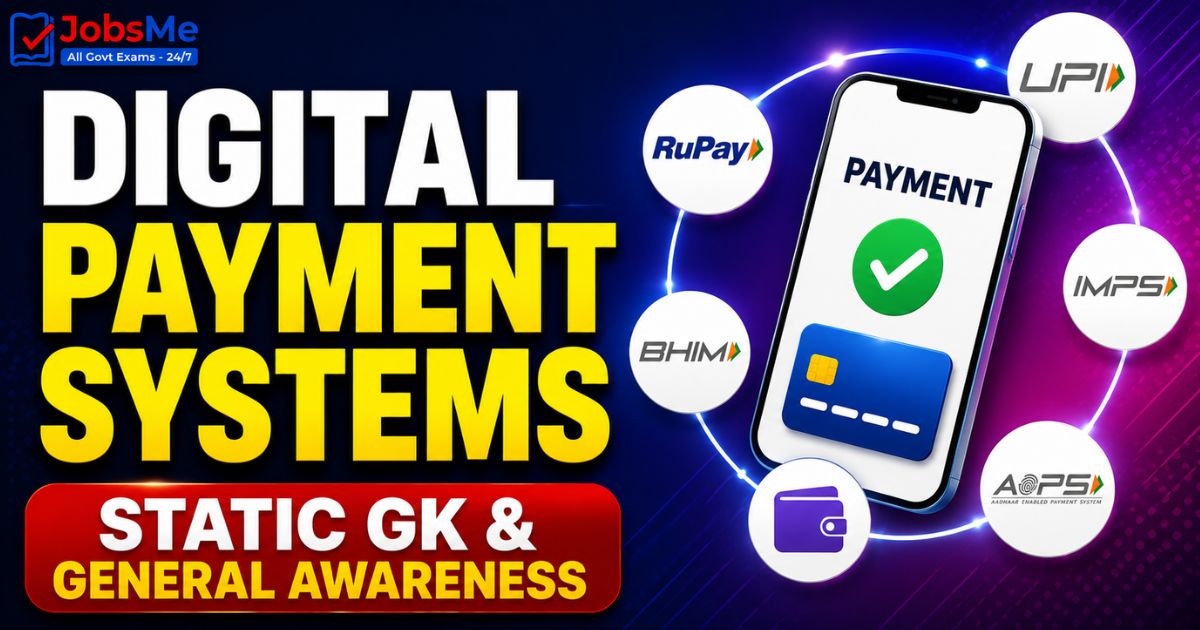
Digital Payment Systems – Static GK & General Awareness for Competitive Exams with Memory Tricks
This article explains Digital Payment Systems in India, including UPI, NEFT, RTGS, IMPS, RuPay, AEPS, BBPS, FASTag, BHIM, wallets, Payment Banks, CBDC and the role of RBI and NPCI. It covers definitions, features, limits, milestones, government initiatives, benefits, risks, safety mechanisms, memory tricks and exam one-liners for UPSC, SSC, Banking, Insurance, Railways and other government exams.
Jump to section
Introduction
Digital Payment Systems are one of the most important topics in Static GK, General Awareness, Banking Awareness and UPSC Economy. A digital payment is any payment made electronically without using physical cash. In India, this includes UPI, NEFT, RTGS, IMPS, RuPay, AEPS, BBPS, FASTag, BHIM, mobile wallets, prepaid payment instruments and internet banking.
This topic is highly relevant for UPSC Prelims, SSC CGL, IBPS PO, IBPS Clerk, SBI, RBI, RRB NTPC, Insurance, Defence, PSU and State PCS exams because questions are frequently asked on RBI, NPCI, UPI mechanism, settlement types, transaction limits, Digital India, JAM Trinity, financial inclusion and cybersecurity. Students can also revise related economy and awareness topics from Banking Awareness notes and Static GK notes on thejobsme.com.
India has moved from a cash-heavy payment culture to a large real-time digital payments ecosystem. The journey started with electronic fund transfers like RTGS and NEFT, accelerated with NPCI in 2008, expanded through IMPS, RuPay, AEPS and BBPS, and became globally visible after the launch of UPI in 2016.
Core Concept Explanation
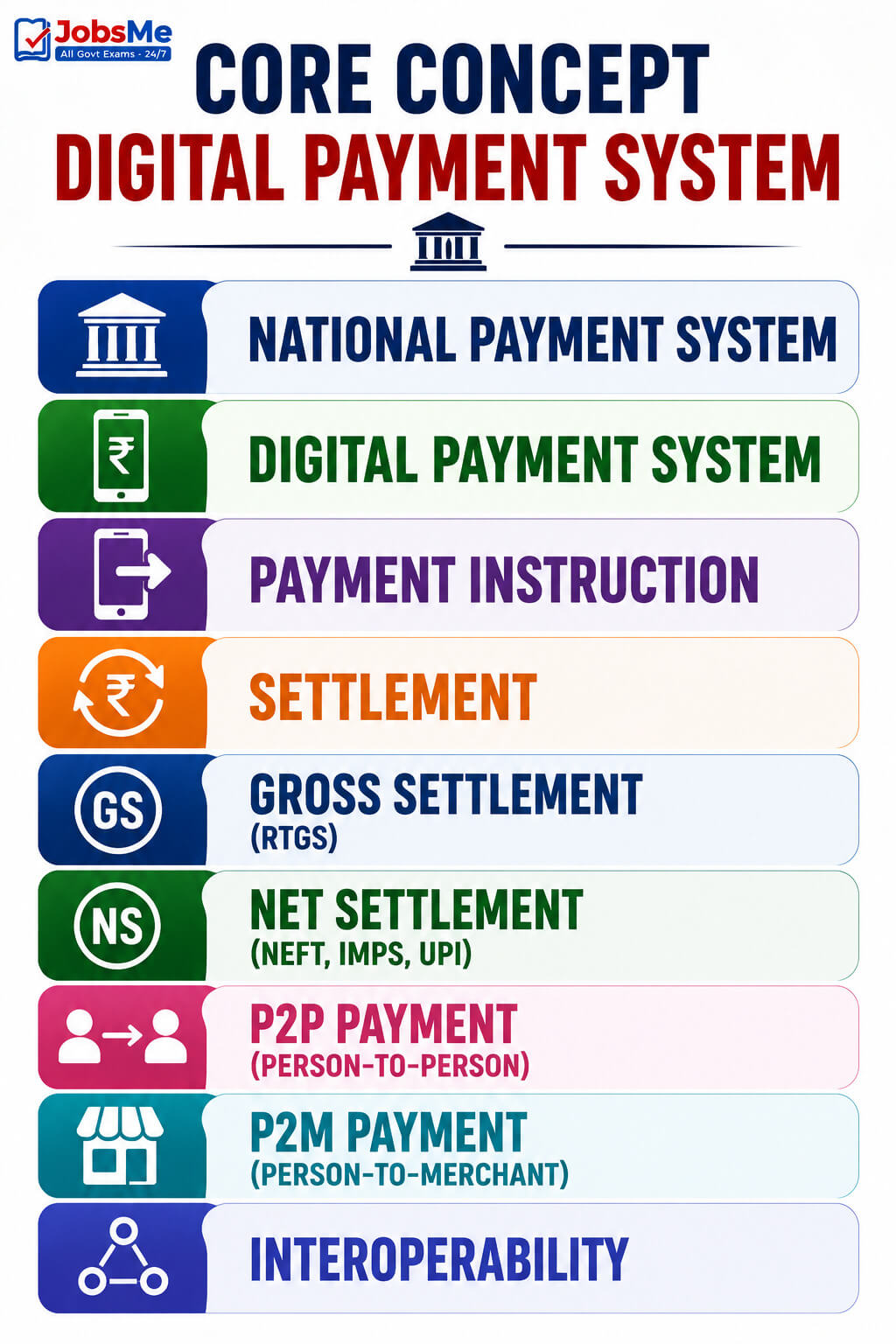
A payment system is a mechanism that enables the transfer of money between a payer and a beneficiary. A digital payment system performs this transfer using electronic instructions, banking networks, mobile applications, cards, internet platforms, QR codes, Aadhaar authentication or other digital channels.
- National Payment System: A technology-supported network of institutions, rules, procedures and infrastructure that enables money transfer and settlement between individuals, businesses, banks and the government.
- Digital Payment System: Electronic payment method used to transfer money or pay for goods and services without physical cash.
- Payment Instruction: The electronic command given by the customer or system participant to transfer funds.
- Settlement: Final transfer of funds between banks or payment system participants.
- Gross Settlement: Each transaction is settled individually. RTGS is the key example.
- Net Settlement: Multiple transactions are adjusted and settled on a net basis. NEFT, IMPS and UPI generally use net settlement arrangements.
- P2P Payment: Person-to-person transfer, such as sending money to a friend through UPI.
- P2M Payment: Person-to-merchant payment, such as scanning a QR code at a shop.
- Interoperability: Ability of different banks, apps and payment service providers to work together on one common system.
In India, the Reserve Bank of India is the main regulator of payment and settlement systems. The National Payments Corporation of India operates many retail payment systems and has played a central role in India's digital payment revolution.
Main Data Sections
Digital Payment Systems in India: Regulator, Law and Key Institutions
| Institution / Law | Full Form / Year | Role and Key Features |
|---|---|---|
| Reserve Bank of India | RBI | The central bank of India and the main authority for regulation, supervision and oversight of payment and settlement systems. RBI operates or supervises major systems such as RTGS, NEFT and the overall payment ecosystem. |
| Payment and Settlement Systems Act | 2007 | Provides the legal framework for regulation and supervision of payment systems in India. It designates RBI as the authority for payment systems and gives legal backing to netting, settlement finality, authorisation, inspection and penalties. |
| Payment and Settlement Systems Regulations | 2008 | Contains operational rules regarding authorisation applications, standards, payment instructions, returns, accounts and information to be submitted by payment system providers. |
| Payments Regulatory Board | PRB Regulations, 2025 | Deals with the constitution and functioning of the Payments Regulatory Board that exercises powers on behalf of RBI for regulation and supervision of payment and settlement systems. |
| National Payments Corporation of India | NPCI, established in December 2008 | Umbrella organisation for retail payments in India. It was set up with the support of RBI and Indian Banks' Association and received Certificate of Commencement of Business in April 2009. It manages UPI, IMPS, RuPay, AEPS, BBPS, NETC FASTag, NACH and BHIM. |
| NPCI Promoter Banks | 10 major banks | The initial major promoter banks included State Bank of India, Punjab National Bank, Canara Bank, Bank of Baroda, Union Bank of India, Bank of India, ICICI Bank, HDFC Bank, Citibank and HSBC. |
| Indian Banks' Association | IBA | Worked with RBI in setting up NPCI. IBA represents the banking industry and has supported standardised retail payment infrastructure. |
| Central Payment Fraud Information Registry | CPFIR | A fraud monitoring and information-sharing mechanism used to strengthen digital payment security, identify patterns and support risk management by regulated entities. |
| Reserve Bank - Integrated Ombudsman Scheme | RB-IOS, 2021 | Integrated earlier ombudsman schemes, including the Ombudsman Scheme for Digital Transactions, into one grievance redressal framework for banking and digital payment complaints. |
Evolution and Key Milestones of Digital Payments in India
| Year / Period | Milestone | Description / Exam Importance |
|---|---|---|
| 1984 | Early RTGS-type systems abroad | The United Kingdom developed CHAPS and France developed SAGITTAIRE as early RTGS-type systems. This fact is sometimes asked in banking awareness when comparing real-time settlement systems. |
| Late 1990s | ATMs and Internet Banking | India's digital banking journey began with ATMs, basic internet banking, balance enquiry and online fund transfer services. Foreign banks adopted them first, followed by public sector and private banks. |
| 2004 | RTGS implementation | Real Time Gross Settlement enabled high-value fund transfers with real-time and final settlement in RBI books. |
| 2005 | NEFT launched | National Electronic Funds Transfer made batch-processed interbank electronic transfers popular for retail users. |
| 2007 | PSS Act | The Payment and Settlement Systems Act, 2007 gave RBI the legal authority to regulate payment systems in India. |
| 2008 | NPCI established | NPCI was founded as an umbrella organisation to build uniform retail payment infrastructure in India. |
| 2009 | NPCI business commencement | NPCI received its Certificate of Commencement of Business in April 2009, making it operationally important for retail payment innovation. |
| 2010 | IMPS launched | Immediate Payment Service introduced 24x7 instant interbank electronic fund transfer and later became the infrastructure base for UPI. |
| 2012 | RuPay expansion | RuPay strengthened India's domestic card network and reduced dependence on global card schemes. |
| 2014 | Pradhan Mantri Jan Dhan Yojana | PMJDY expanded bank account ownership and gave a huge push to financial inclusion, DBT and debit-card-based digital access. |
| 2015 | Digital India Programme | Digital India aimed to build digital infrastructure, improve digital literacy and deliver government services electronically. |
| 2016 | UPI launched | Unified Payments Interface revolutionised real-time mobile payments by enabling interoperable bank-to-bank transfers through one platform. |
| December 2016 | BHIM App launched | Bharat Interface for Money was launched as a UPI-based app to popularise simple digital payments. |
| 2016 | Demonetisation push | Demonetisation gave an unprecedented push to adoption of UPI, wallets, cards and QR-based merchant payments. |
| January 2017 | First Payments Bank | Airtel Payments Bank became India's first payments bank. Payments banks can accept deposits up to Rs 2 lakh per customer but cannot lend like full-service commercial banks. |
| 2019 | NEFT became 24x7 | NEFT became available round the clock from December 2019, making retail electronic transfers more convenient. |
| 2020 | RTGS became 24x7 | RTGS became available on all days on a 24x7x365 basis from December 2020. |
| 2021 | e-RUPI launched | e-RUPI is a cashless and contactless digital payment instrument that is person-specific and purpose-specific. |
| 2022 | UPI 123PAY launched | UPI 123PAY enabled feature phone users to make UPI payments without internet, strengthening rural and inclusive digital payment access. |
| 2020s | CBDC pilot and Open Banking | RBI's Digital Rupee, Account Aggregators, open banking and fintech innovation became important parts of the advanced digital financial ecosystem. |
| 2025-26 | UPI at global scale | UPI completed 10 years in 2026. In FY 2025-26, annual UPI volume crossed 24,161 crore transactions and annual value was around Rs 314 lakh crore, showing deep nationwide adoption. |
Major Digital Payment Systems and Services
| System / Service | Full Form / Operator | Key Features and Exam-Relevant Details |
|---|---|---|
| UPI | Unified Payments Interface, NPCI | Real-time instant payment system that links multiple bank accounts to a mobile app. It supports VPA, mobile number and QR code-based transfers, P2P and P2M payments, and does not require a third-party wallet. |
| BHIM | Bharat Interface for Money, NPCI | A UPI-based app launched in December 2016. It enables payments through registered mobile number or VPA and supports financial inclusion through simple UPI access. |
| UPI 123PAY | UPI for feature phones | Allows feature phone users to make digital payments without smartphone-based internet. It is important for rural accessibility and inclusion of users with basic phones. |
| IMPS | Immediate Payment Service, NPCI | 24x7 instant interbank electronic fund transfer through mobile banking, internet banking and ATMs. It uses bank account and IFSC, or mobile number and MMID, and funds are credited immediately even on holidays. |
| NEFT | National Electronic Funds Transfer, RBI | Electronic fund transfer system operated by RBI on deferred net settlement basis. It is widely used for retail fund transfers and bill payments and has no minimum amount. |
| RTGS | Real Time Gross Settlement, RBI | Used for high-value transactions. Settlement is real-time, gross, final and irrevocable. Minimum amount is Rs 2 lakh and there is no RBI-set upper ceiling. |
| RuPay | Rupee Payment, NPCI | India's indigenous card payment network. RuPay cards are issued as debit, credit and prepaid cards and are used for PoS, e-commerce and ATM transactions. They became popular through Jan Dhan accounts. |
| NCMC | National Common Mobility Card / RuPay Contactless | Contactless payment technology that allows cardholders to pay at contactless terminals without physically swiping or inserting the card. It is useful for mobility and transit payments. |
| AEPS | Aadhaar Enabled Payment System, NPCI | Bank-led model that allows transactions using Aadhaar biometric authentication at micro-ATMs or PoS terminals through Business Correspondents. It supports cash withdrawal, cash deposit, balance enquiry, mini statement and Aadhaar-to-Aadhaar transfer. |
| BBPS / Bharat BillPay | Bharat Bill Payment System, NPCI | Integrated and interoperable bill payment system for electricity, water, gas, telecom, DTH, education fees, FASTag recharge and other biller categories. It brings billers, aggregators and customers on one platform. |
| *99# Service | USSD, Unstructured Supplementary Service Data | NPCI service that enables mobile banking through USSD codes. It is useful for users without smartphones or stable internet and is connected with low-value financial inclusion payments. |
| Mobile Wallets | Prepaid Payment Instruments | Wallets allow users to store prepaid value and make recharges, bill payments, peer transfers and merchant payments. They are useful for small-value digital transactions but may not always be direct bank-to-bank transfers. |
| NETC FASTag | National Electronic Toll Collection | Uses RFID technology for electronic toll payments at highways. It reduces waiting time, improves transparency and supports cashless toll collection. |
| QR-Based Payments | UPI QR / Bharat QR | Allows merchant payments by scanning a QR code through a mobile app. QR-based payments are low-cost, quick and useful for small shops, street vendors and MSMEs. |
| Internet Banking | Bank web portal | Allows customers to transfer funds, view account statements, open fixed deposits, pay bills, apply for loans and use other banking services through a secure bank website. |
| Mobile Banking | Bank app / SMS / mobile platform | Offers on-the-go banking services such as fund transfers, balance enquiry, mini statements, bill payments and transaction alerts through mobile applications or SMS-based channels. |
| e-RUPI | Digital voucher | Cashless and contactless payment instrument that is person-specific and purpose-specific. It can be used for targeted welfare delivery, health services, scholarships and other direct benefit use cases. |
| CBDC / Digital Rupee | Central Bank Digital Currency, RBI | Digital form of central bank money issued by RBI. It is different from private cryptocurrencies and is being tested to provide a secure digital alternative to cash. |
| NACH | National Automated Clearing House, NPCI | Used for bulk, recurring and automated payments such as subsidies, salaries, pensions, dividends, EMIs and utility collections. |
Comparison of NEFT, RTGS, IMPS and UPI
| Basis | NEFT | RTGS | IMPS | UPI |
|---|---|---|---|---|
| Full Form | National Electronic Funds Transfer | Real Time Gross Settlement | Immediate Payment Service | Unified Payments Interface |
| Settlement Type | Deferred Net Settlement in batches | Real-time Gross Settlement | Immediate Net Settlement | Immediate Net Settlement built over IMPS infrastructure |
| Availability | 24x7 since December 2019 | 24x7 since December 2020 | 24x7 | 24x7 |
| Minimum Amount | No minimum | Rs 2 lakh | No minimum | No minimum |
| Maximum Amount | No RBI-fixed minimum limit; cash remittance through NEFT is restricted to Rs 50,000 per transaction. Online limits may vary by bank. | No upper or maximum ceiling fixed by RBI | Usually bank-defined; many exam notes mention up to Rs 5 lakh | Common general limit is usually Rs 1 lakh; some approved categories have higher limits. Banks and apps may set additional controls. |
| Primary Use | Retail fund transfers, regular payments and bill payments | High-value urgent fund transfers | Instant interbank transfers | Instant P2P and P2M payments, merchant payments and QR-based retail payments |
| Identifier | Account number and IFSC | Account number and IFSC | Account number and IFSC, or mobile number and MMID | VPA, mobile number, QR code, UPI ID or account-linked identifiers |
| Regulated / Operated By | RBI | RBI | NPCI | NPCI under RBI oversight |
| Exam Trick | NEFT means normal retail transfer | RTGS means real-time high value transfer | IMPS means immediate transfer | UPI means instant mobile and QR payment |
Government Initiatives and Regulatory Framework
| Initiative / Framework | Year / Body | Description and Importance |
|---|---|---|
| Digital India Programme | 2015, Government of India | Flagship programme to transform India into a digitally empowered society and knowledge economy. Digital infrastructure, digital literacy and digital delivery of services are its key pillars. |
| JAM Trinity | Jan Dhan, Aadhaar, Mobile | Links bank accounts, Aadhaar identity and mobile connectivity. It supports Direct Benefit Transfers, financial inclusion and targeted welfare delivery. |
| PMJDY | Pradhan Mantri Jan Dhan Yojana, 2014 | Mass financial inclusion scheme that expanded bank accounts, debit cards and access to formal banking channels. |
| RBI Payment Vision 2025 | RBI | Focuses on safe, secure, inclusive and efficient payments with the theme of e-payments for everyone, everywhere and everytime. It highlights cybersecurity, customer protection, innovation and resilience. |
| Ombudsman for Digital Transactions | RBI, later integrated into RB-IOS 2021 | Provided complaint redressal for digital transaction users. It is now part of the Reserve Bank - Integrated Ombudsman Scheme. |
| Payment Banks | RBI-regulated banks | Introduced to serve small businesses, migrant workers, low-income households and unorganised sector users through digital channels. They can accept deposits up to Rs 2 lakh per customer but cannot provide loans. |
| Small Finance Banks | RBI-regulated banks | Serve small businesses, micro and small industries, farmers and low-income groups, often using digital delivery channels. |
| DigiLocker | Digital India service | Secure cloud-based platform for issuance, storage and verification of documents and certificates. It supports paperless governance and digital identity verification. |
| Regulatory Sandbox | RBI | Allows fintech innovations to be tested in a controlled environment while balancing innovation, risk management and consumer protection. |
Benefits and Impact of Digital Payment Systems
| Impact Area | Key Benefit | Explanation for Exams |
|---|---|---|
| Financial Inclusion | Access for unbanked and underbanked users | UPI, AEPS, PMJDY, JAM and Business Correspondents help rural, low-income and marginalised users access formal financial services. |
| Convenience | Anytime, anywhere payments | Users can transfer money and pay bills 24x7 without visiting a bank branch, improving ease of banking. |
| Speed and Efficiency | Faster transactions | UPI and IMPS enable instant transfers, while NEFT and RTGS support reliable interbank settlement for different transaction needs. |
| Transparency | Digital audit trail | Digital payments reduce cash handling, support tax compliance, improve tracking and reduce leakages in welfare schemes. |
| Economic Formalisation | Less dependence on cash | Merchant QR payments and digital receipts bring small businesses into the formal economy and create transaction history for credit access. |
| MSME Empowerment | Low-cost merchant acceptance | QR codes and mobile apps help small shops, street vendors and service providers accept digital payments at low cost. |
| Digital Governance | Better DBT delivery | JAM and digital payment rails help transfer subsidies and benefits directly to bank accounts, reducing intermediaries. |
| Innovation | Fintech growth | Digital payments encourage fintech products, e-commerce, gig economy services, credit scoring and personalised financial services. |
| Global Leadership | Digital public infrastructure model | India's UPI model is recognised globally for scale, interoperability, low cost and inclusion, making it an important current affairs topic. |
| Data-Driven Policy | Better financial insights | Digital transaction data can support policy formulation, credit assessment and targeted financial services when used with privacy safeguards. |
Challenges and Risks in Digital Payment Systems
| Challenge | Meaning | Exam-Relevant Explanation |
|---|---|---|
| Cybersecurity Threats | Fraud, phishing, malware and breaches | Rising transaction volume increases exposure to UPI frauds, phishing links, fake apps, malware, identity theft and social engineering scams. |
| Authorised Push Payment Fraud | APP fraud | Victims are tricked into authorising payments themselves, often through fake calls, QR scams or urgent messages. |
| Digital Literacy Gap | Low awareness and unsafe usage | Rural users, elderly people and new users may not understand PIN safety, app permissions, fake links or grievance mechanisms. |
| Infrastructure Deficiency | Internet, power and network issues | Connectivity gaps and transaction failures affect reliability, especially in remote and rural areas. |
| Privacy Concerns | Misuse of personal financial data | Large-scale collection of financial and identity data raises concerns about breaches, profiling, data sharing and Aadhaar-linked risks. |
| Grievance Redressal | Complaint resolution | Failed transactions, delayed reversals and fraud complaints require efficient customer support and ombudsman mechanisms. |
| Interoperability Issues | Integration across platforms | UPI solved many interoperability issues, but newer products and providers still need strong standards and coordination. |
| Regulatory Lag | Innovation moving faster than rules | Fintech products evolve quickly, creating coordination challenges between RBI, banks, payment aggregators and technology firms. |
| Systemic Technology Risk | Overdependence on digital systems | A highly digital payment ecosystem must be protected from outages, cyberattacks, technical failures and concentration risks. |
| Fraud Growth | Rising reported cases | Exam notes highlight that fraud cases rose sharply from about 0.26 million in 2021 to about 2.8 million in 2025, with annual fraud value exceeding Rs 22,000 crore and high-value transactions contributing most of the fraud amount. |
Safety Mechanisms and Consumer Protection
| Safety Mechanism | Purpose | Key Features |
|---|---|---|
| RBI Payment Security Framework | Cybersecurity and resilience | Requires cybersecurity controls, audits, compliance checks, risk assessment and fraud monitoring by banks and payment operators. |
| Cooling-Off Period | High-value fraud prevention | Proposed for high-value or risky transactions to reduce loss from fraud and social engineering. |
| Additional Authentication | User protection | Includes stronger checks such as trusted person mechanism, extra verification or additional consent for risky transactions. |
| Transaction Caps | Limit risky transfers | Caps may be applied to newly added beneficiaries, risky accounts or unusual transaction patterns. |
| Beneficiary Whitelisting | Trusted beneficiary payments | Allows customers to mark trusted beneficiaries and reduce risk of mistaken or fraudulent transfers. |
| AI-Based Fraud Detection | Real-time risk analysis | Uses machine learning, behavioural monitoring and anomaly detection to identify suspicious transactions. |
| Tokenization | Card data protection | Replaces sensitive card information with tokens, reducing exposure of card data during digital transactions. |
| Encryption | Secure data transfer | Protects payment instructions, personal data and transaction details during digital communication. |
| Real-Time Monitoring | Instant alerts and surveillance | Continuous monitoring helps detect suspicious activity, alert customers and stop fraud quickly. |
| Zero Liability Protection | Customer protection | Customers may be protected against unauthorised transactions subject to conditions such as timely reporting and absence of negligence. |
| Compensation Mechanisms | Failed transaction redressal | RBI mandates timely reversal or compensation in specified failed digital transaction cases. |
| RBI Kehta Hai Campaign | Consumer awareness | Educates users about safe digital banking practices, fraud prevention, PIN safety and complaint mechanisms. |
| Cyber Awareness Initiatives | Grassroots education | Campaigns, volunteers and local awareness drives help users identify scams, fake apps and phishing attempts. |
UPI at a Glance: High-Yield Facts
| Fact | Detail | Exam Importance |
|---|---|---|
| UPI Launch | 11 April 2016 by NPCI under RBI oversight | Common UPSC, SSC and Banking Awareness fact. |
| Infrastructure Base | Built over IMPS infrastructure | Helps remember why UPI supports instant transfers. |
| Bank Accounts | Multiple bank accounts can be linked to a single mobile application | Key definition feature of UPI. |
| Identifiers | VPA, mobile number, QR code and account-linked IDs | Useful for statement-based MCQs. |
| Payment Types | P2P and P2M | P2M dominates volume, while P2P contributes a larger share of value. |
| FY 2025-26 Annual Volume | More than 24,161 crore transactions | Shows UPI's scale and is important for current affairs-linked economy questions. |
| FY 2025-26 Annual Value | Around Rs 314 lakh crore | Highlights deep adoption of digital payments. |
| Banks Live on UPI | Over 700 banks by FY 2025-26 | Older notes may mention over 120 banks, but updated exam awareness should remember the 700 plus scale. |
| UPI's Share in Indian Digital Payment Volume | About 85 percent in FY 2025-26 | Shows dominance in high-frequency retail payments. |
| Global Real-Time Payment Share | Nearly 49 percent of global real-time payment volume | Important for India's Digital Public Infrastructure and global leadership questions. |
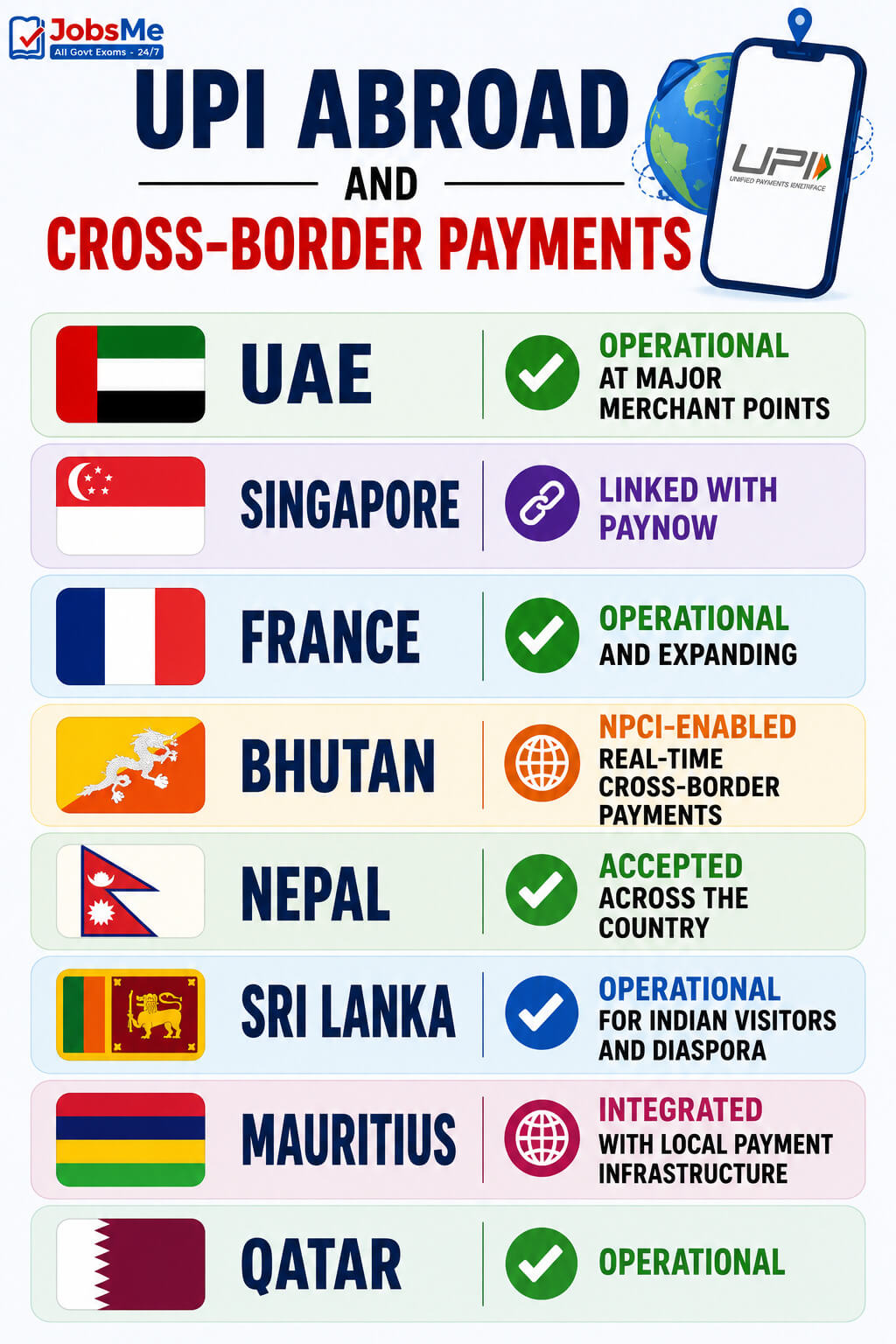
| Countries Accepting UPI | Examples include UAE, Singapore, France, Bhutan, Nepal, Sri Lanka, Mauritius and Qatar | Useful for current affairs and internationalisation of UPI. |
UPI Abroad and Cross-Border Payments
| Country / Region | Status | Key Relevance |
|---|---|---|
| UAE | Operational at major merchant points | Useful for Indian diaspora and tourist payments, showing UPI's international merchant acceptance. |
| Singapore | Linked with PayNow | Important example of cross-border remittances and real-time payment linkage. |
| France | Operational and expanding | Important for Indian tourist payments and global acceptance of UPI. |
| Bhutan | NPCI-enabled real-time cross-border payments | One of the early neighbourhood examples of UPI acceptance. |
| Nepal | Accepted across the country | Important for India's neighbourhood digital payment integration. |
| Sri Lanka | Operational for Indian visitors and diaspora | Shows use of UPI in tourism and regional digital connectivity. |
| Mauritius | Integrated with local payment infrastructure | Useful for understanding India's digital public infrastructure outreach. |
| Qatar | Operational | Relevant for diaspora and cross-border retail payment acceptance. |
Exam Relevance by Paper and Exam
| Exam / Paper | Most Important Areas | How Questions Are Asked |
|---|---|---|
| UPSC Prelims | UPI, NPCI, RBI, NEFT, RTGS, IMPS, AEPS, BBPS, Digital India, JAM, CBDC | Statement-based MCQs, matching pairs, full forms and factual comparisons. |
| UPSC Mains GS-III | Financial inclusion, digital economy, fintech, cybersecurity, data privacy and inclusive growth | Analytical questions asking benefits, challenges and policy measures. |
| UPSC Mains GS-II | DBT, transparency, governance and welfare delivery | Questions link digital payments with governance, service delivery and leakage reduction. |
| Essay | Digital India, cashless economy, technology for development | Use examples like UPI, JAM Trinity, AEPS and Digital Rupee for balanced arguments. |
| SSC and Railways GK | Full forms, launch years, regulator and important features | Direct one-liners such as UPI launched by NPCI in 2016 or RTGS minimum limit is Rs 2 lakh. |
| IBPS, SBI, RBI and Insurance | Banking awareness, payment systems, settlement types, limits, NPCI products and fraud safety | Banking Awareness MCQs, descriptive questions and current financial awareness. |
Memory Tricks and Mnemonics
Trick 1: RBI Controls, NPCI Runs Retail
Use the line "RBI Rules, NPCI Runs" to remember the difference between the two bodies.
- RBI regulates, supervises and provides legal oversight under the PSS Act.
- NPCI operates major retail payment products like UPI, IMPS, RuPay, AEPS and BBPS.
Trick 2: UPI Means "Use Phone Instantly"
Remember UPI features with "Use Phone Instantly".
- Use → Any participating bank account.
- Phone → Mobile app, VPA, mobile number and QR.
- Instantly → 24x7 real-time payment.
Trick 3: NEFT vs RTGS vs IMPS vs UPI
Use "N-R-I-U: Normal, Rich, Immediate, User-friendly".
- NEFT → Normal retail transfer.
- RTGS → Rich or high-value transfer.
- IMPS → Immediate transfer.
- UPI → User-friendly mobile and QR payment.
Trick 4: NPCI Products as "U R I A B F N"
Remember major NPCI products using "You Are In A Big Financial Network".
- U → UPI.
- R → RuPay.
- I → IMPS.
- A → AEPS.
- B → BBPS / Bharat BillPay.
- F → FASTag / NETC.
- N → NACH.
Trick 5: JAM Trinity Story
Visualise a welfare benefit travelling through "JAM".
- J → Jan Dhan bank account receives the money.
- A → Aadhaar verifies identity.
- M → Mobile gives access and alerts.
"JAM makes DBT travel directly to the beneficiary."
Trick 6: AEPS Is "Aadhaar Entry for Payment Service"
To remember AEPS, imagine a villager using a fingerprint at a Business Correspondent point.
- Aadhaar → Identity authentication.
- Entry → Access point is micro-ATM or PoS.
- Payment Service → Cash withdrawal, deposit, balance enquiry and transfer.
Trick 7: Digital Payment Risks as "F-L-I-P-S"
Remember the major risks using "Digital payments can FLIPS if safety is weak".
- F → Fraud and phishing.
- L → Low digital literacy.
- I → Infrastructure gaps.
- P → Privacy concerns.
- S → System outages and cybersecurity risks.
Trick 8: Safety Tools as "A-T-M"
Use "A-T-M protects digital money" to remember key safety ideas.
- A → AI-based fraud detection and additional authentication.
- T → Tokenization and transaction caps.
- M → Monitoring, messages and mandatory grievance redressal.
Additional Notes
Frequently Confused Facts
- UPI vs BHIM: UPI is the payment system or platform; BHIM is an app based on UPI.
- NPCI vs RBI: RBI regulates the payment system; NPCI operates many retail payment products under the regulated framework.
- NEFT vs RTGS: NEFT is deferred net settlement for retail transfers; RTGS is real-time gross settlement for high-value transfers.
- IMPS vs UPI: IMPS is an instant transfer service; UPI is a mobile-first interface built over IMPS infrastructure.
- RuPay vs UPI: RuPay is a card network; UPI is an instant bank-to-bank mobile payment system.
- BBPS vs BBPI: Exam-ready standard term is Bharat Bill Payment System or BBPS. Some older notes may use BBPI or Bharat Bill Payment Interface, but BBPS/Bharat BillPay is the correct common term.
- AEPS vs UPI 123PAY: AEPS uses Aadhaar biometric authentication through Business Correspondents; UPI 123PAY enables feature phone-based UPI payments without internet.
- NCMC vs RuPay Contactless: NCMC is the National Common Mobility Card, commonly implemented on RuPay contactless technology.
- Payment Bank vs Small Finance Bank: Payment banks can accept deposits up to Rs 2 lakh but cannot lend; small finance banks can accept deposits and give loans to target segments.
- Digital Rupee vs UPI: Digital Rupee is central bank digital currency issued by RBI; UPI is a payment interface for bank account transfers.
Repeating PYQ Patterns
In UPSC Prelims, questions usually test the difference between NEFT, RTGS, IMPS and UPI, the role of RBI and NPCI, and the meaning of JAM Trinity, AEPS, BBPS and Digital Rupee. In SSC GK and Railways GK, questions are more direct: full forms, launch years, minimum RTGS amount, and who introduced UPI.
In IBPS, SBI, RBI and Insurance exams, this topic appears under Banking Awareness quizzes, financial awareness and computer-based banking questions. Students should practise statement-based MCQs on UPI, settlement types, wallet vs bank-transfer systems, cybersecurity and customer protection.
For Mains answers, start with a crisp definition, add 2 or 3 analytical points with examples like UPI for inclusion, AEPS for rural access, JAM for DBT and cybersecurity for challenges, and conclude with a balanced way forward. Aspirants can strengthen current examples through Daily Current Affairs updates.
Quick Insight
Digital payments are not just a banking topic; they are part of India's larger Digital Public Infrastructure. UPI's 10-year journey, cross-border acceptance, Digital Rupee pilots, AI-based fraud detection and RBI's focus on secure digital payments make this topic important for both static GK and current affairs. For quick practice, students can also use Static GK quizzes and Computer Awareness quizzes.
One-Liners for Quick Revision
- Digital Payment System → Electronic method of transferring money without cash → Includes UPI, NEFT, RTGS, IMPS, cards, wallets and AEPS.
- National Payment System → Network of institutions, rules and technology for payments → Reflects banking, finance and communication infrastructure.
- RBI → Main regulator of payment systems in India → Works under the Payment and Settlement Systems Act, 2007.
- Payment and Settlement Systems Act, 2007 → Legal framework for payment systems → Gives RBI authority over regulation, supervision and settlement finality.
- Payment and Settlement Systems Regulations, 2008 → Operational regulations → Covers authorisation, standards, returns and information submission.
- Payments Regulatory Board Regulations, 2025 → PRB framework → Deals with governance of payment regulation under RBI.
- NPCI → National Payments Corporation of India → Umbrella organisation for retail payments in India.
- NPCI Establishment → December 2008 → Certificate of Commencement of Business in April 2009.
- NPCI Promoter Banks → SBI, PNB, Canara Bank, Bank of Baroda, Union Bank, Bank of India, ICICI, HDFC, Citibank and HSBC → Important banking awareness fact.
- UPI → Unified Payments Interface → Instant mobile-based bank-to-bank transfers using VPA, mobile number or QR code.
- UPI Launch → 11 April 2016 → Developed by NPCI under RBI oversight.
- UPI Infrastructure → Built over IMPS → Supports instant 24x7 transfers.
- UPI Payment Types → P2P and P2M → P2M is common for merchant and QR payments.
- BHIM → Bharat Interface for Money → UPI-based app launched in December 2016.
- UPI 123PAY → UPI for feature phones → Enables payments without smartphone internet.
- IMPS → Immediate Payment Service → 24x7 instant interbank transfer managed by NPCI.
- NEFT → National Electronic Funds Transfer → RBI-operated deferred net settlement system.
- RTGS → Real Time Gross Settlement → High-value real-time transfer with minimum Rs 2 lakh.
- RTGS Upper Limit → No RBI-set maximum ceiling → Banks may set customer-level limits.
- NEFT Cash Remittance → Maximum Rs 50,000 per transaction → Applies to walk-in cash remittance.
- RuPay → Rupee Payment → India's indigenous card payment network.
- NCMC → National Common Mobility Card → RuPay contactless-based mobility and transit payment card.
- AEPS → Aadhaar Enabled Payment System → Aadhaar biometric-based banking through Business Correspondents.
- BBPS → Bharat Bill Payment System → Unified interoperable bill payment platform.
- *99# → USSD-based mobile banking service → Helps users without smartphones or internet.
- Mobile Wallets → Prepaid payment instruments → Used for recharge, bill payment and merchant payment.
- NETC FASTag → RFID-based electronic toll payment → Supports cashless toll collection.
- QR Payments → Scan-and-pay method → Low-cost merchant payment system.
- Internet Banking → Banking through secure bank website → Used for transfers, statements, deposits and bill payments.
- Mobile Banking → Banking through apps or SMS → Major driver of digital payment adoption.
- e-RUPI → Cashless and contactless digital voucher → Person-specific and purpose-specific payment instrument.
- CBDC / Digital Rupee → Digital form of RBI-issued money → Different from private cryptocurrency.
- NACH → National Automated Clearing House → Used for recurring and bulk payments.
- Digital India → Launched in 2015 → Promotes digital infrastructure, digital literacy and electronic governance.
- JAM Trinity → Jan Dhan, Aadhaar and Mobile → Supports DBT and financial inclusion.
- PMJDY → Pradhan Mantri Jan Dhan Yojana → Expanded bank accounts and digital access.
- Payment Banks → Accept deposits up to Rs 2 lakh per customer → Cannot lend like commercial banks.
- Airtel Payments Bank → India's first payments bank → Started in January 2017.
- DigiLocker → Cloud-based document platform → Supports paperless governance and digital identity verification.
- RBI Payment Vision 2025 → E-payments for everyone, everywhere, everytime → Focuses on security, inclusion and innovation.
- RB-IOS 2021 → Reserve Bank - Integrated Ombudsman Scheme → Covers digital transaction complaints with other RBI-regulated complaints.
- CPFIR → Central Payment Fraud Information Registry → Helps monitor and share payment fraud information.
- RTGS Early Systems → CHAPS in UK and SAGITTAIRE in France → Both developed RTGS-type systems in 1984.
- UPI FY 2025-26 Volume → Over 24,161 crore transactions → Shows massive retail payment scale.
- UPI FY 2025-26 Value → Around Rs 314 lakh crore → Shows deep adoption of digital payments.
- UPI Banks → Over 700 banks live by FY 2025-26 → Indicates wide institutional participation.
- UPI Global Share → Nearly 49 percent of global real-time payment volume → Important current affairs fact.
- UPI Abroad → UAE, Singapore, France, Bhutan, Nepal, Sri Lanka, Mauritius and Qatar → Examples of international acceptance.
- P2M UPI → Merchant payments → Often low-value, high-frequency QR transactions.
- P2P UPI → Person-to-person transfers → Often contributes larger value share than merchant payments.
- Financial Inclusion → Major benefit of digital payments → AEPS, UPI 123PAY and JAM help rural access.
- Transparency → Digital audit trail → Reduces leakages and supports formalisation.
- MSME Benefit → QR code onboarding → Helps small sellers accept digital payments.
- Cybersecurity Risk → Phishing, malware and fake apps → Major challenge in digital payments.
- APP Fraud → Authorised Push Payment fraud → User is tricked into approving payment.
- Digital Literacy Gap → Lack of safe usage awareness → Increases fraud risk among new users.
- Privacy Risk → Misuse of financial and identity data → Important for data protection debates.
- Tokenization → Replaces card details with tokens → Reduces exposure of sensitive card data.
- Encryption → Secures payment data → Protects digital communication.
- AI Fraud Detection → Uses machine learning and behaviour analysis → Helps detect suspicious payments.
- Cooling-Off Period → Safety proposal for risky high-value payments → Helps prevent instant fraud losses.
- Transaction Caps → Limit risky accounts or new beneficiaries → Used for fraud control.
- Beneficiary Whitelisting → Allows trusted payees → Reduces mistaken and fraudulent payments.
- Zero Liability Protection → Customer protection rule → Depends on timely reporting and user responsibility.
- RBI Kehta Hai → Awareness campaign → Educates users on safe digital banking.
- Regulatory Sandbox → Controlled testing of fintech products → Balances innovation with consumer protection.
- Mains GS-III Pattern → Digital payments, financial inclusion and cybersecurity → Common analytical theme.
- SSC GK Pattern → Full forms and launch years → UPI, NPCI, RuPay, NEFT and RTGS are repeatedly asked.
- Banking Exam Pattern → Settlement type, limits and regulators → NEFT, RTGS, IMPS and UPI comparison is most important.
For more revision, practise Banking Awareness MCQs, revise Computer Awareness notes, and track related opportunities from latest government job notifications.
Free quiz • No signup required
Put this topic into practice with Indian Cultural Institutions – Static GK MCQ Quiz. It is the quickest way to reinforce what you just learned.
Frequently Asked Questions
What is a digital payment system?
Who regulates payment and settlement systems in India?
What is NPCI and why is it important for exams?
When was UPI launched and who developed it?
What is the main difference between NEFT and RTGS?
What is the difference between IMPS and UPI?
What is UPI 123PAY?
What is RuPay?
What is AEPS used for?
Which topics from digital payment systems are most important for UPSC, SSC and Banking exams?

About the author