
Static GK Notes – Topic-Wise Study Material – Indian Polity
Showing 18 posts tagged Indian Polity in Static GK.
List of Government Schemes
This article presents a complete list of important Government Schemes of India, covering Central Sector Schemes, Centrally Sponsored Schemes, and major State Government Schemes along with their launch year, nodal ministry, and core focus. It includes flagship programmes like Pradhan Mantri Jan Dhan Yojana (PMJDY), Ayushman Bharat (PMJAY), PM-KISAN, PMAY, Ujjwala, MGNREGS, Swachh Bharat Mission, Digital India, Jal Jeevan Mission, PM Gati Shakti, PM SHRI, Agnipath, and key state schemes like Ladli Bahna, Gruha Lakshmi, Lakshmir Bhandar, and YSR Rythu Bharosa, with memory tricks and one-liners for quick revision. All facts are arranged in exam-ready format to help UPSC, SSC, IBPS, RRB, PSU, and State PCS aspirants score better in General Awareness and Current Affairs sections.
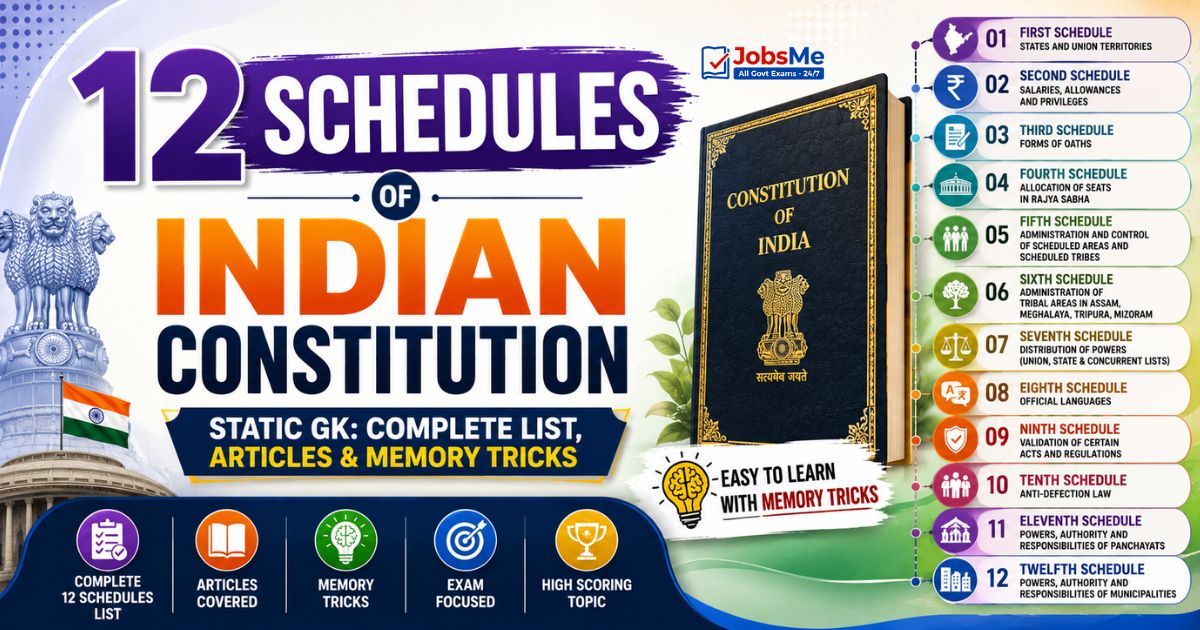
Schedules of Constitution
This article gives a complete, exam-ready overview of all 12 Schedules of the Indian Constitution, the Articles linked to each Schedule, and the Constitutional Amendments that added the 9th, 10th, 11th and 12th Schedules. It is built for UPSC, SSC, IBPS, RRB, State PCS and Defence aspirants who need quick revision notes, mnemonics and a one-shot reference for Static GK and Polity.
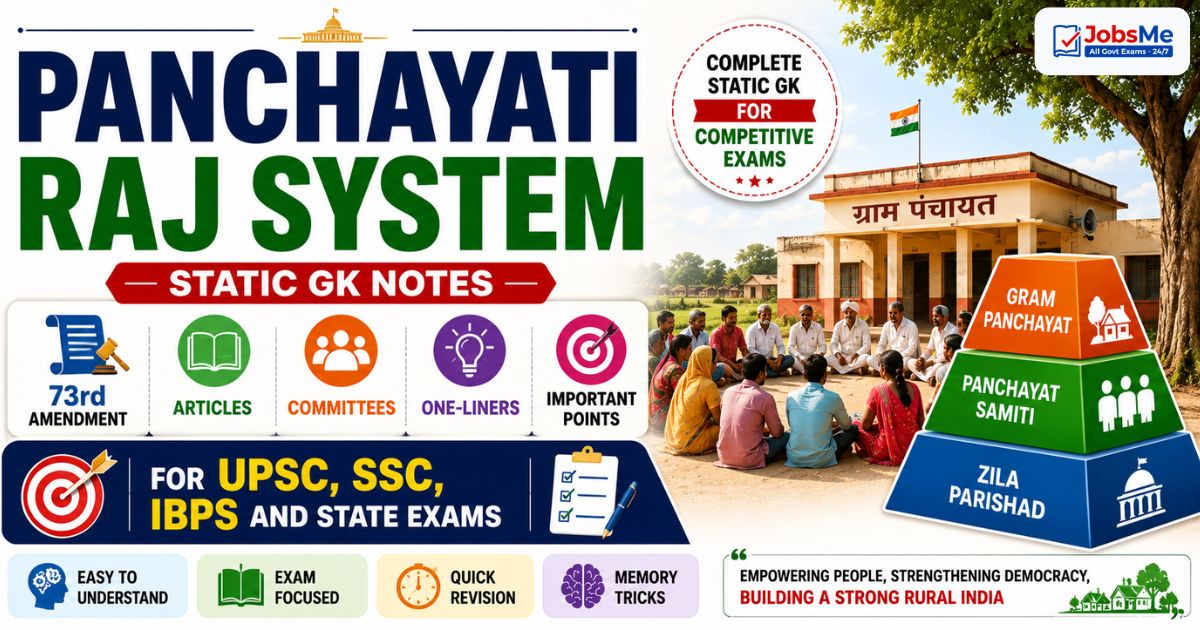
Panchayati Raj System
This article gives a complete static GK package on the Panchayati Raj System covering its historical evolution, the 73rd Constitutional Amendment Act of 1992, all important articles (243 to 243-O), the Eleventh Schedule, key committees, reservations, finance and election bodies. It is designed for UPSC, SSC CGL, IBPS PO/Clerk, RRB NTPC, Insurance and State PCS aspirants and includes mnemonics, comparison tables and one-liners for fast revision.
Emergency Provisions of Constitution
This article explains the Emergency Provisions of the Indian Constitution under Articles 352 to 360, covering National Emergency, President's Rule, and Financial Emergency in a simple exam-oriented way. Students preparing for UPSC, SSC, IBPS, RRB, and State PCS exams will find detailed tables, memory tricks, landmark cases, and one-liner notes to revise the topic quickly. It is one of the most repeated Static GK and Polity topics across competitive exams.
Important Committees & Commissions
This article presents a complete list of important committees and commissions in India, covering Centre-State relations, Panchayati Raj, administrative reforms, education, banking, tax, police, social justice, and parliamentary committees, along with their chairpersons, year of establishment, and key recommendations. It includes iconic bodies like the Sarkaria Commission, Mandal Commission, Kothari Commission, Punchhi Commission, Narasimham Committee, Balwant Rai Mehta Committee, ARC I and II, Shah Commission, Liberhan Commission, and all major permanent commissions like UPSC, ECI, UGC, NHRC, CVC, and CCI, with memory tricks and one-liners for quick revision. All facts are arranged in exam-ready format to help UPSC, SSC, IBPS, RRB, PSU, Insurance, and State PCS aspirants score better in General Awareness, Polity, and Governance sections.
States & Capitals (with Formation Dates)
This article presents a complete list of all 28 Indian States and 8 Union Territories with their capitals, formation dates, governing acts, official languages, and state specialities. It includes every major fact tested in competitive exams – from the States Reorganisation Act of 1956 to the latest 2026 amendment making Amaravati the sole capital of Andhra Pradesh – along with memory tricks, mnemonics, and one-liners for quick revision. All facts are arranged in exam-ready format to help UPSC, SSC, IBPS, RRB, PSU, Defence, and State PCS aspirants score better in General Awareness, Indian Polity, and Geography sections.
Parliament – Lok Sabha & Rajya Sabha
This article presents a complete and exam-ready guide to the Indian Parliament, covering the composition, powers, and functions of the Lok Sabha (House of the People) and Rajya Sabha (Council of States) along with key Articles (79 to 122) of the Constitution, sessions, bills, majorities, parliamentary devices, and important constitutional amendments. It also lists every important Speaker, Chairman, Leader of Opposition, qualification, quorum, and joint sitting fact in one place with memory tricks, one-liners, and PYQ patterns. All facts are arranged to help UPSC, SSC, IBPS, RRB, PSU, Defence, Insurance, and State PCS aspirants score better in Polity and General Awareness.
Fundamental Rights, Duties, DPSP
This article gives a complete one-stop revision of Fundamental Rights (Articles 12-35), Fundamental Duties (Article 51A), and the Directive Principles of State Policy (Articles 36-51) of the Indian Constitution. It includes all articles, landmark Supreme Court cases, key amendments, memory tricks, and one-liners specially curated for UPSC, SSC, IBPS, RRB, Insurance, Defence, and State PCS aspirants.
Parts of Constitution
This article presents a complete list of all 25 Parts of the Indian Constitution along with their subject matter, article ranges, and key features — covering Fundamental Rights, Directive Principles, Fundamental Duties, Panchayats, Municipalities, Emergency Provisions, and every other constitutional segment. It includes the four parts added later (Part IVA, IXA, IXB and XIVA), the repealed Part VII, and detailed memory tricks for instant recall. All facts are arranged in exam-ready format to help UPSC, SSC, IBPS, RRB, PSU, Insurance and State PCS aspirants score better in Indian Polity and General Awareness sections.
Important Articles of Constitution
This article presents a complete, exam-ready list of the most important Articles of the Indian Constitution, arranged Part-wise from Article 1 to Article 395, covering Fundamental Rights, Directive Principles, Fundamental Duties, Union and State Government, Judiciary, Finance Commission, Elections, Emergency Provisions, and the Amendment procedure. It includes key articles like Article 14 (Equality), Article 19 (Six Freedoms), Article 21 (Right to Life), Article 32 (Constitutional Remedies), Article 356 (President's Rule), Article 368 (Amendment), and Article 370 (J&K), along with memory tricks, mnemonics, and one-liners for quick revision. All facts are arranged in a structured format to help UPSC, SSC, IBPS, RRB, PSU, Insurance, and State PCS aspirants score better in General Awareness, Indian Polity, and Static GK sections.
Current CMs and Governors of India 2026: Complete State-Wise Static GK List
This article gives the complete, updated 2026 list of Chief Ministers, Governors, Lieutenant Governors and Administrators of all 28 Indian states and 8 Union Territories. It also covers the constitutional articles behind these posts, all the leadership changes that took place in 2026, memory tricks, and quick-revision one-liners. Aspirants can expect 2 to 3 direct questions from this topic in SSC, Banking, Insurance, Railways and State PSC exams.
List of Chief Justices of India (1950-2026) – Static GK & General Awareness for Competitive Exams with Memory Tricks
This article presents the complete list of all 53 Chief Justices of India from Justice H. J. Kania (1950) to the incumbent Justice Surya Kant (53rd CJI), along with their exact tenures, parent High Courts, and the landmark judgments and records linked to each of them. It also covers the constitutional provisions on the appointment, oath, tenure, salary, and removal of the CJI under Article 124, the Collegium system, and the judges in line to become Chief Justice up to 2033, including the first woman CJI. All facts are arranged in exam-ready tables, memory tricks, and one-liners to help UPSC, SSC, IBPS, RRB, PSU, Insurance, and State PCS aspirants score better in Polity and General Awareness.
Vice Presidents of India List 1952 to 2026: Complete Static GK Notes with Tenure, Powers and Articles 63 to 71
This article gives you the complete list of all 15 Vice Presidents of India from 1952 to 2026 with exact tenure dates, the President in office during each term, and the key fact that makes each name exam-worthy. It also covers the constitutional provisions from Article 63 to Article 71, the election and removal process, powers as Rajya Sabha Chairman, memory tricks, and one-liners. Everything is arranged the way questions actually appear in UPSC Prelims, SSC CGL, IBPS, RRB and State PCS papers.
Election Commission of India & Election Process – Static GK & General Awareness for Competitive Exams with Memory Tricks
This article explains the Election Commission of India (ECI) and the complete election process in a simple, exam-ready format, covering its constitutional basis (Article 324), composition, powers, appointment and removal of the Chief Election Commissioner, and key electoral reforms like EVM, VVPAT, NOTA and the Model Code of Conduct. It includes the current CEC Gyanesh Kumar, important dates, memory tricks and one-liners for quick revision. All facts are arranged to help UPSC, SSC, IBPS, RRB, PSU, Defence and State PCS aspirants score better in Polity and General Awareness sections.
Constitutional and Statutory Bodies in India – Static GK & General Awareness for Competitive Exams with Memory Tricks
This article presents a complete list of Constitutional and Statutory Bodies in India, covering their establishing Articles or Acts, functions, headquarters, and current heads. It explains the crucial difference between Constitutional Bodies (created directly by the Constitution, like the Election Commission, UPSC, CAG, and Finance Commission) and Statutory Bodies (created by an Act of Parliament, like NHRC, NITI Aayog, and the Lokpal), with memory tricks and one-liners for quick revision. All facts are arranged in exam-ready format to help UPSC, SSC, IBPS, RRB, PSU, and State PCS aspirants score better in Polity and General Awareness sections.
List of Prime Ministers of India (1947–2026) – Static GK & General Awareness with Tenure, Party and Memory Tricks
This article presents a complete, chronological list of the Prime Ministers of India from Jawaharlal Nehru to Narendra Modi, along with their exact tenure dates, political parties, constituencies, and the key achievements and firsts associated with each leader. It also covers acting Prime Minister Gulzarilal Nanda, important superlatives like the longest- and shortest-serving PMs, and exam-critical facts on assassinations, slogans, and coalition governments. All facts are arranged in an exam-ready format with memory tricks and one-liners to help UPSC, SSC, IBPS, RRB, PSU, and State PCS aspirants score better in General Awareness and Polity sections.
List of Presidents of India (1950–2026) – Static GK & General Awareness for Competitive Exams with Memory Tricks
This article presents the complete list of Presidents of India from Dr. Rajendra Prasad (the first President) to Droupadi Murmu (the 15th and current President), along with their tenures, key facts, firsts, and the three acting Presidents. It covers exam-critical details like the first woman President (Pratibha Patil), the Missile Man (Dr. A. P. J. Abdul Kalam), the only two-term President (Dr. Rajendra Prasad), and the Presidents who died in office, with memory tricks and one-liners for quick revision. All facts are arranged in exam-ready format to help UPSC, SSC, IBPS, RRB, PSU, and State PCS aspirants score better in General Awareness and Indian Polity sections.
List of Important Constitutional Amendments of India – Static GK & General Awareness for Competitive Exams with Memory Tricks
This article presents a complete, exam-ready list of the most important Constitutional Amendments of India, from the 1st Amendment (1951) to the 106th Amendment (2023), along with the Article 368 amendment procedure, the Basic Structure Doctrine, and key Supreme Court cases. It covers landmark amendments like the 42nd (Mini Constitution), 44th, 61st (voting age), 73rd–74th (Panchayati Raj and Urban Local Bodies), 86th (Right to Education), 101st (GST), 103rd (EWS reservation), and 106th (Women's Reservation – Nari Shakti Vandan Adhiniyam), plus the pending 130th Amendment Bill. With memory tricks, one-liners, and frequently confused facts, it is designed to help UPSC, SSC, IBPS, RRB, PSU, Insurance, and State PCS aspirants score better in Polity and General Awareness.
Recent posts
Latest quizzes
New job notifications

Introduction
JobsMe's Static GK posts are comprehensive, exam-mapped topic guides built for aspirants who want more than a bare list of facts. Each post covers one Static GK topic in full - with structured tables, previous year question (PYQ) analysis, category-wise organisation, and topic-specific memory tricks that help you learn faster and retain longer. After reading any post, test yourself with the corresponding interactive quiz from the Static GK quiz archive, and if you are logged in, track how your score improves with every attempt.
Looking for current events to complement your static preparation? Visit daily current affairs or catch up with monthly current affairs.
What Makes JobsMe Static GK Posts Different
Every Static GK topic on the internet has been covered by dozens of platforms. What sets JobsMe apart is how each topic is presented - built specifically for exam performance, not just information.
Exam-Pattern Framing, Not Just Facts
Every post opens with a statement of how questions from that topic are typically asked in competitive exams - whether as one-liners, match-the-following, multi-statement correct/incorrect, or identification-based MCQs. This framing means you read the content with the right exam lens from the very first paragraph. You are not just learning facts; you are learning how those facts get tested.
Previous Year Question (PYQ) Analysis
Each post includes a section on how that topic has been asked in previous papers - specific questions from UPSC Prelims, SSC CGL, IBPS PO, RRB NTPC, and other exams. This shows you which sub-topics within each Static GK category are tested most frequently and should receive the most preparation time.
Memory Tricks Built Into Every Topic
Memorising hundreds of Static GK facts is genuinely difficult without good mnemonic strategies. JobsMe posts include custom-built memory tricks for every topic - acronyms for grouping related items, visual association techniques for facts that are hard to distinguish, chronological patterns for historical events, and rhyme-based recall for numerical facts. These are not generic tips; they are written specifically for the facts in that post.
Structured Tables and Quick Revision Charts
Every post includes at least one structured table or quick-revision chart - such as a country-capital-currency table, a dynasty timeline, a battles-date-outcome matrix, or an organisation-headquarters grid. These tables are designed to be saved, printed, or screenshotted for last-minute revision. They contain everything you need to answer exam questions on that topic without any additional reading.
Topic-Wise Coverage - What's Available
Below is a guide to the key Static GK topics covered or planned in JobsMe's post archive. Each topic links to its dedicated post.
Indian History Topics
- Founders and Rulers of Indian Dynasties (Ancient to Medieval)
- Important Battles in Indian History (Ancient, Medieval, Colonial)
- The Indian National Movement - Key Events and Personalities
- Mughal Empire - Rulers, Contributions, Administration
- Colonial India - British East India Company to Independence
World and Indian Geography Topics
- Countries, Capitals and Currencies of the World
- Superlatives of India and the World (Largest, Longest, Highest, Smallest)
- Indian Cities and Their Nicknames
- Important Rivers of India - Origins, Tributaries, Dams
- National Parks, Wildlife Sanctuaries, and Biosphere Reserves of India
- Important Mountain Passes and Peaks of India and the World
International Organisations and Institutions
- International Organisations and Their Headquarters
- United Nations and Its Principal Organs
- Specialised Agencies of the UN (WHO, UNESCO, ILO, UNICEF, FAO)
- Financial Institutions - IMF, World Bank, ADB, NDB
- Regional Organisations - SAARC, ASEAN, SCO, BRICS, G20, G7, QUAD
Indian Polity and Constitution
- Fundamental Rights (Articles 12-35)
- Directive Principles of State Policy (Articles 36-51)
- Important Constitutional Articles at a Glance
- Important Constitutional Amendments (42nd, 44th, 73rd, 74th, 86th, 101st)
- Constitutional Bodies - Election Commission, CAG, UPSC, Finance Commission
- National Symbols of India - Animal, Bird, Flower, Fruit, Tree, Emblem, Song
Economy and Banking Topics
- Important RBI Rates and Their Definitions
- Headquarters of Indian and International Banks
- Important Economic Concepts - GDP, GNP, Inflation Types, Fiscal Deficit
- Five-Year Plans and NITI Aayog
- Stock Exchanges - NSE, BSE, Global Exchanges
Science and Technology Topics
- Important Inventions and Their Inventors
- Diseases, Deficiencies, and their Causal Organisms
- ISRO Missions - Satellites, Launch Vehicles, Space Probes
- Human Body - Important Glands, Organs, and Functions
- Important Scientific Principles and Laws
Culture, Awards, and Miscellaneous
- Padma Awards - Complete List of Bharat Ratna, Padma Vibhushan, Padma Bhushan, Padma Shri
- Nobel Prize - Subject, First Indian Winner, Recent Winners
- Sahitya Akademi and Jnanpith Award Winners
- Classical Dance Forms of India and Their States of Origin
- Books and Authors - Famous Indian and World Literature
- Stadiums, Sports Trophies, and Tournament Names
- Important Committees and Commissions - and Their Purpose
How to Read Static GK Posts for Maximum Retention
Step 1 - Read with a Question in Mind
Before opening any Static GK post, ask yourself: "How would an examiner turn this into a question?" For a post on Countries-Capitals-Currencies, the examiner might ask the capital of a lesser-known country, or the currency used by a country that shares a currency name with another. Reading with this question lens focuses your attention on the most testable facts.
Step 2 - Focus on Tables and Charts First
In a long Static GK post, the table or quick-revision chart at the end contains the exam-critical facts in their densest form. Read the table first to understand the scope of what needs to be memorised, then read the narrative text to understand the context and patterns. This sequence is faster and more efficient than reading top-to-bottom.
Step 3 - Apply the Memory Tricks
Do not skip the memory tricks section. The 2-3 minutes spent encoding a mnemonic for a group of facts will save you from blanking on those facts under exam pressure. Memory tricks are most effective when you create a mental image or association actively - do not just read the trick, actually visualise it.
Step 4 - Attempt the Quiz Immediately
Within 30 minutes of finishing the post, go to the quiz archive and attempt the corresponding quiz. This immediate testing is far more effective for retention than reviewing the post again. Focus especially on the explanation for any question you got wrong.
Step 5 - Re-Attempt After Spaced Intervals
Return to the quiz 3-5 days later and attempt it again without reviewing the post. This is spaced repetition - proven by decades of memory research to be the most effective long-term retention strategy. If you are logged in, your history will show you exactly which attempts had which scores, so you can see the improvement directly.