List of Prime Ministers of India (1947–2026) – Static GK & General Awareness with Tenure, Party and Memory Tricks
This article presents a complete, chronological list of the Prime Ministers of India from Jawaharlal Nehru to Narendra Modi, along with their exact tenure dates, political parties, constituencies, and the key achievements and firsts associated with each leader. It also covers acting Prime Minister Gulzarilal Nanda, important superlatives like the longest- and shortest-serving PMs, and exam-critical facts on assassinations, slogans, and coalition governments. All facts are arranged in an exam-ready format with memory tricks and one-liners to help UPSC, SSC, IBPS, RRB, PSU, and State PCS aspirants score better in General Awareness and Polity sections.
Jump to section
Introduction
The Prime Minister of India is the head of the Government of India and the real executive authority of the country, leading the Union Council of Ministers. While the President of India is the constitutional and ceremonial head of state, effective executive power rests with the Prime Minister, who is the leader of the party or coalition commanding a majority in the Lok Sabha. Since independence on 15 August 1947, India has had 14 Prime Ministers, beginning with Jawaharlal Nehru and continuing to the current Prime Minister, Narendra Modi.
Questions on the Prime Ministers of India — their names, tenures, parties, constituencies, and firsts — appear almost every year in UPSC Prelims, SSC CGL, IBPS PO, RRB NTPC, SBI Clerk, State PCS, and various Insurance and Defence exams. Aspirants are typically asked about the first, longest-serving, shortest-serving, and youngest Prime Ministers, the acting Prime Minister, and the events linked to each tenure such as wars, economic reforms, and constitutional amendments. To strengthen your preparation on related Polity topics, you can refer to the Static GK section on thejobsme.com.
The list of Prime Ministers is also closely tied to current affairs themes such as death anniversaries of national leaders, Bharat Ratna conferments, and historic milestones like Narendra Modi securing a third consecutive term in the 2024 general election. This makes the topic doubly important for aspirants preparing for both the objective General Awareness sections and the descriptive Polity and Modern History papers.
Core Concepts: The Office of the Prime Minister
The Prime Minister is appointed by the President of India under Article 75 of the Constitution but must enjoy the confidence of the majority of the Lok Sabha. The Prime Minister presides over the Council of Ministers and is, as per Article 74, the principal channel of communication between the Cabinet and the President.

Key Facts to Remember
- Total Prime Ministers: India has had 14 Prime Ministers since 1947 (acting PM Gulzarilal Nanda is not counted in this official sequence).
- Appointing Authority: The President of India appoints the Prime Minister under Article 75.
- Term: There is no fixed term; the PM stays in office as long as the government holds the confidence of the Lok Sabha, with general elections normally held every five years.
- Eligibility: The Prime Minister can be a member of either the Lok Sabha or the Rajya Sabha.
- Order of Precedence: The Prime Minister ranks third in the Indian order of precedence, after the President and the Vice-President.
Complete List of Prime Ministers of India (1947-2026)
The following table lists all the Prime Ministers of India in chronological order, along with their tenure, political party, and the key facts and achievements most frequently asked in competitive exams.
| Prime Minister | Tenure | Party | Key Facts / Achievements |
|---|---|---|---|
| Jawaharlal Nehru | 15 August 1947 - 27 May 1964 | Indian National Congress | First and longest-serving Prime Minister of India (16 years, 286 days); only PM to die in office; MP from Phulpur; known as the Architect of Modern India; established the Planning Commission, IITs and AIIMS; gave the policy of Non-Alignment and Panchsheel. |
| Gulzarilal Nanda (Acting) | 27 May 1964 - 9 June 1964 | Indian National Congress | Only person to serve as Acting Prime Minister, and he did so twice (13 days each) — after the deaths of Nehru and Shastri; not counted in the official numeric sequence of 14 PMs; MP from Sabarkantha. |
| Lal Bahadur Shastri | 9 June 1964 - 11 January 1966 | Indian National Congress | Second Prime Minister; gave the famous slogan "Jai Jawan Jai Kisan" during the 1965 Indo-Pak War; signed the Tashkent Declaration; only PM to die outside India (in Tashkent, USSR); MP from Allahabad. |
| Gulzarilal Nanda (Acting) | 11 January 1966 - 24 January 1966 | Indian National Congress | Served his second stint as Acting Prime Minister for 13 days after the death of Lal Bahadur Shastri; total acting tenure across both terms was 26 days. |
| Indira Gandhi | 24 January 1966 - 24 March 1977 | Indian National Congress | First and only woman Prime Minister of India; daughter of Jawaharlal Nehru; led India through the 1971 Bangladesh Liberation War; oversaw bank nationalisation (1969), Pokhran-I (1974) and the Emergency (1975-77). |
| Morarji Desai | 24 March 1977 - 28 July 1979 | Janata Party | First non-Congress Prime Minister of India; oldest person to assume the office (81 years); MP from Surat; later became the first non-Indian to receive Pakistan's highest civilian award, Nishan-e-Pakistan. |
| Charan Singh | 28 July 1979 - 14 January 1980 | Janata Party (Secular) | Only Prime Minister who never faced the Parliament during his tenure; resigned before proving his majority; served as caretaker PM until January 1980; MP from Baghpat; awarded Bharat Ratna in 2024. |
| Indira Gandhi | 14 January 1980 - 31 October 1984 | Indian National Congress (I) | Returned to office for a second stint; oversaw Operation Blue Star (1984); assassinated by her own bodyguards on 31 October 1984 — the first PM to be assassinated; MP from Medak. |
| Rajiv Gandhi | 31 October 1984 - 2 December 1989 | Indian National Congress (I) | Youngest Prime Minister of India (assumed office at age 40); son of Indira Gandhi; led the telecom and computer revolution; lowered the voting age from 21 to 18 (61st Amendment) and introduced the Anti-Defection Law (52nd Amendment); assassinated by an LTTE operative in 1991; MP from Amethi. |
| V. P. Singh | 2 December 1989 - 10 November 1990 | Janata Dal (National Front) | Led the National Front coalition; implemented the Mandal Commission recommendations providing 27% reservation for OBCs in government services; first PM to resign following a no-confidence motion; MP from Fatehpur. |
| Chandra Shekhar | 10 November 1990 - 21 June 1991 | Samajwadi Janata Party (Rashtriya) | Headed a short-lived government with outside Congress support; known as a "Young Turk" for his rebellious socialist politics; MP from Ballia. |
| P. V. Narasimha Rao | 21 June 1991 - 16 May 1996 | Indian National Congress (I) | First Prime Minister from South India; regarded as the Father of Indian Economic Reforms; launched Liberalisation, Privatisation and Globalisation (LPG) in 1991 with Manmohan Singh as Finance Minister; gave the "Look East Policy"; MP from Nandyal. |
| Atal Bihari Vajpayee | 16 May 1996 - 1 June 1996 | Bharatiya Janata Party | First BJP Prime Minister; his first term of 16 days is the shortest tenure among Indian PMs; resigned before facing a confidence vote; MP from Lucknow. |
| H. D. Deve Gowda | 1 June 1996 - 21 April 1997 | Janata Dal (United Front) | Second Prime Minister from South India (from Karnataka); led the United Front coalition; focused on agriculture and irrigation; Member of the Rajya Sabha at the time of assuming office. |
| Inder Kumar Gujral | 21 April 1997 - 19 March 1998 | Janata Dal (United Front) | Best known for the "Gujral Doctrine" promoting good relations with India's neighbours; led a United Front coalition; Member of the Rajya Sabha at the time of assuming office. |
| Atal Bihari Vajpayee | 19 March 1998 - 22 May 2004 | Bharatiya Janata Party (NDA) | Returned for a second and third term; first non-Congress PM to complete a full five-year term (1999-2004); oversaw the Pokhran-II nuclear tests (1998), the Kargil War (1999) and the Golden Quadrilateral project; awarded Bharat Ratna in 2015. |
| Manmohan Singh | 22 May 2004 - 26 May 2014 | Indian National Congress (UPA) | First Sikh and first PM from a minority religion; noted economist who architected the 1991 reforms as Finance Minister; served two full terms (10 years); launched MGNREGA, RTI and the Indo-US Nuclear Deal; Member of the Rajya Sabha from Assam. |
| Narendra Modi | 26 May 2014 - Incumbent | Bharatiya Janata Party (NDA) | Current Prime Minister; first PM born in independent India (1950); second after Nehru to win three consecutive terms (2014, 2019, 2024); launched GST, Digital India, Make in India and Swachh Bharat Abhiyan; oversaw the revocation of Article 370; MP from Varanasi. |
Superlatives and Firsts - Prime Ministers of India
These comparison-based facts are among the most frequently asked in objective exams. Learn them together to avoid confusion.
| Category | Prime Minister | Details |
|---|---|---|
| First Prime Minister | Jawaharlal Nehru | Took office on 15 August 1947 and served the longest continuous tenure. |
| Longest-serving PM | Jawaharlal Nehru | Held office for 16 years and 286 days; also the only PM to die in office. |
| Shortest-serving PM | Atal Bihari Vajpayee | His first term in 1996 lasted only 16 days. |
| First woman PM | Indira Gandhi | The first and, to date, only female Prime Minister of India. |
| Youngest PM | Rajiv Gandhi | Assumed office at the age of 40 on 31 October 1984. |
| Oldest PM to assume office | Morarji Desai | Became PM at the age of 81. |
| First non-Congress PM | Morarji Desai | Became PM in 1977 as leader of the Janata Party. |
| First BJP PM | Atal Bihari Vajpayee | First Bharatiya Janata Party leader to become PM (1996). |
| First non-Congress PM to complete a full term | Atal Bihari Vajpayee | Completed a full five-year term from 1999 to 2004. |
| First PM from South India | P. V. Narasimha Rao | Hailed from present-day Telangana; H. D. Deve Gowda from Karnataka was the second. |
| First Sikh / minority-religion PM | Manmohan Singh | First Prime Minister from a minority religious community. |
| First PM born in independent India | Narendra Modi | Born on 17 September 1950, after independence. |
| Only Acting PM | Gulzarilal Nanda | Served as Acting PM twice, for 13 days each, in 1964 and 1966. |
| Only PM who never faced Parliament | Charan Singh | Resigned before proving his majority on the floor of the House. |
| Only PM to die outside India | Lal Bahadur Shastri | Died in Tashkent (then USSR) on 11 January 1966. |
| PMs who were assassinated | Indira Gandhi & Rajiv Gandhi | Indira Gandhi (1984) by her bodyguards; Rajiv Gandhi (1991) by an LTTE suicide bomber. |
Memory Tricks and Mnemonics
Use the following tricks to memorise the order of Prime Ministers, their firsts, and confusing facts quickly for your General Awareness section.
Trick 1: Chronological Order Sentence
To remember the sequence of the first several PMs, use this story-based sentence:
"Nehru's Nanda Shared Indira's Morning Charan In Rajiv's Village."
- Nehru → Nanda → Shastri → Indira → Morarji → Charan → Indira (again) → Rajiv → V. P. Singh.
Trick 2: The Coalition Era Mnemonic (1989-1998)
For the confusing coalition years, remember: "Very Cool Rao Vajpayee Gowda Gujral Vajpayee."
- V.P. Singh → Chandra Shekhar → Rao → Vajpayee (16 days) → Gowda → Gujral → Vajpayee (again).
Trick 3: "Two Nanda, Two Vajpayee, Two Indira" Rule
Three people held the office in more than one separate stint. Remember the number two: Gulzarilal Nanda served twice (acting), Atal Bihari Vajpayee served across three terms in two separated phases (1996 and 1998-2004), and Indira Gandhi returned to power in two separate stints (1966-77 and 1980-84).
Trick 4: Assassinated PMs - "Mother and Son"
Only two PMs were assassinated, and they belong to the same family: Indira Gandhi (mother, 1984) and Rajiv Gandhi (son, 1991). Remember it as the "Mother-Son" pair from the Nehru-Gandhi family.
Trick 5: Shortest vs Longest Contrast
Do not confuse the two extremes: Nehru is the LONGest (16+ years) and Vajpayee's first term is the SHORTest (16 days). Memory aid: "Nehru went LONG, Vajpayee went 16."
Trick 6: Firsts of BJP and Non-Congress
Two different "firsts" often get mixed up: Morarji Desai was the first non-Congress PM, while Atal Bihari Vajpayee was the first BJP PM. Remember: "Desai broke Congress, Vajpayee brought BJP."
Trick 7: Slogan Association
Link each PM to their famous slogan or reform for quick recall: Shastri = "Jai Jawan Jai Kisan", Narasimha Rao = "LPG Reforms and Look East", Vajpayee = "Pokhran-II and Golden Quadrilateral", Modi = "Digital India and GST".
Additional Notes
Frequently Confused Facts
- 1991 Reforms — Rao vs Manmohan Singh: P. V. Narasimha Rao was the Prime Minister who launched the 1991 economic reforms; Manmohan Singh implemented them as his Finance Minister and only became PM later in 2004.
- Non-Congress PM vs BJP PM: Morarji Desai was the first non-Congress PM (1977); Atal Bihari Vajpayee was the first BJP PM (1996) — these are two separate firsts.
- Gulzarilal Nanda: He is not counted among India's 14 official Prime Ministers because he only served as Acting PM (twice, 13 days each).
- Youngest vs Oldest: Rajiv Gandhi (40) was the youngest PM, while Morarji Desai (81) was the oldest to assume office.
- Died in office vs Died outside India: Nehru died in office in 1964, but Lal Bahadur Shastri is the only PM to die outside India (in Tashkent).
Repeating PYQ Patterns
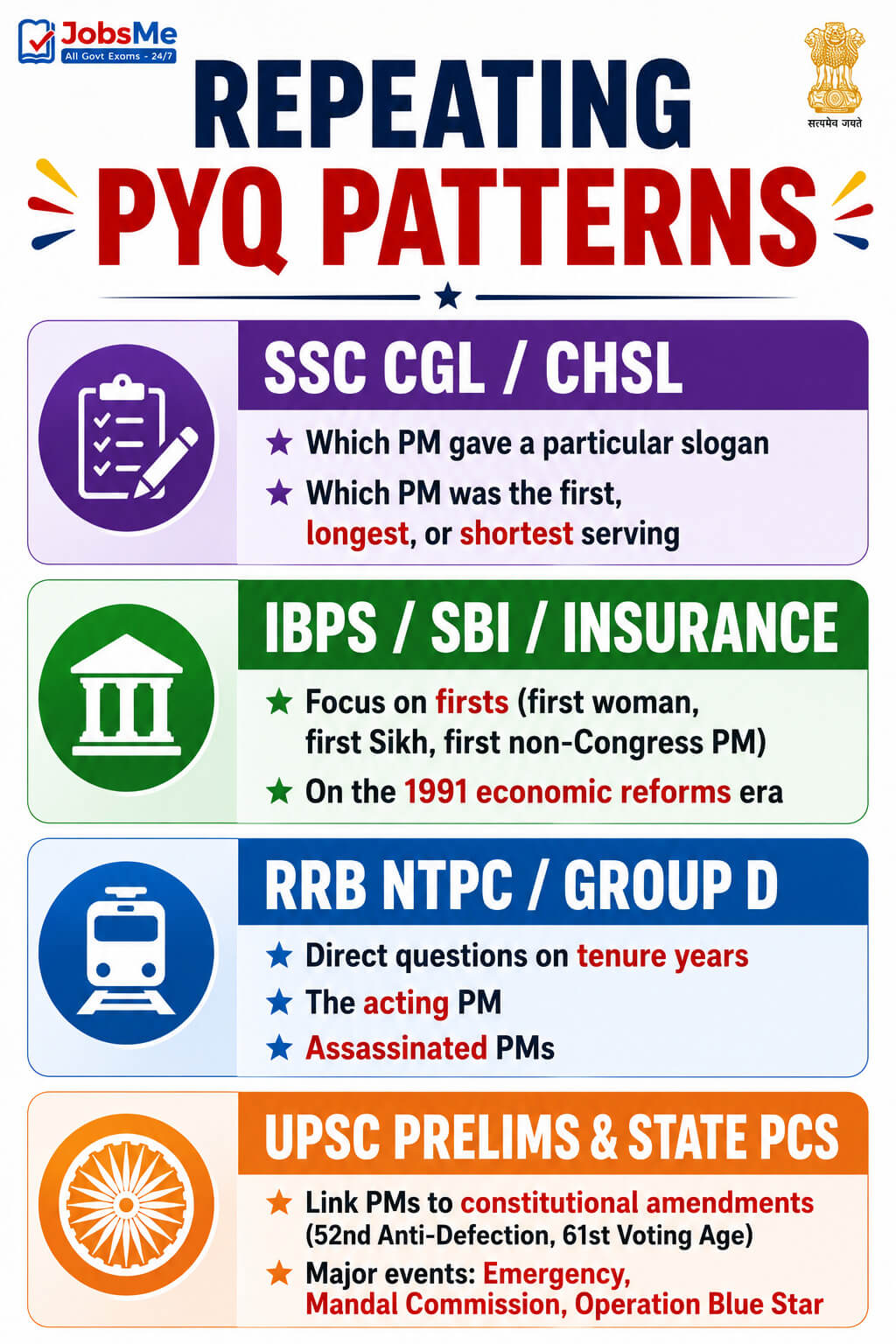
- SSC CGL / CHSL: Frequently ask which PM gave a particular slogan and which PM was the first, longest, or shortest serving.
- IBPS / SBI / Insurance: Focus on firsts (first woman, first Sikh, first non-Congress PM) and on the 1991 economic reforms era.
- RRB NTPC / Group D: Direct questions on tenure years, the acting PM, and assassinated PMs are common.
- UPSC Prelims & State PCS: Link PMs to constitutional amendments (52nd Anti-Defection, 61st Voting Age) and major events like the Emergency, Mandal Commission and Operation Blue Star.
Quick Insight
The topic gains fresh current-affairs relevance whenever national leaders are honoured or remembered — for example, Charan Singh being awarded the Bharat Ratna in 2024, or Narendra Modi becoming only the second PM after Nehru to secure a third consecutive term in the 2024 general election. Tracking such developments through the Daily Current Affairs page helps you connect static facts with the latest news. You can also revise related Polity concepts in the Static GK notes on thejobsme.com.
One-Liners for Quick Revision
- Jawaharlal Nehru → First and longest-serving PM (1947-1964) → Only PM to die in office; Architect of Modern India.
- Gulzarilal Nanda → Only Acting PM, served twice (1964 and 1966) → 13 days each; not counted in the official 14.
- Lal Bahadur Shastri → Second PM (1964-1966) → Gave "Jai Jawan Jai Kisan"; only PM to die outside India (Tashkent).
- Indira Gandhi → First and only woman PM (1966-77 and 1980-84) → Led the 1971 war; first PM to be assassinated.
- Morarji Desai → First non-Congress PM (1977-1979) → Oldest to assume office at 81; received Nishan-e-Pakistan.
- Charan Singh → PM (1979-1980) → Only PM who never faced Parliament; Bharat Ratna in 2024.
- Rajiv Gandhi → Youngest PM at age 40 (1984-1989) → Telecom revolution; introduced Anti-Defection Law and lowered voting age to 18.
- V. P. Singh → PM (1989-1990) → Implemented the Mandal Commission report; first to resign after a no-confidence motion.
- Chandra Shekhar → PM (1990-1991) → Known as a "Young Turk"; led a short-lived government.
- P. V. Narasimha Rao → First South Indian PM (1991-1996) → Father of Indian Economic Reforms; launched LPG and Look East Policy.
- Atal Bihari Vajpayee → First BJP PM (1996; 1998-2004) → Shortest first term of 16 days; first non-Congress PM to complete a full term; Pokhran-II and Kargil War.
- H. D. Deve Gowda → PM (1996-1997) → Second South Indian PM (Karnataka); led the United Front.
- Inder Kumar Gujral → PM (1997-1998) → Known for the "Gujral Doctrine" on neighbourly relations.
- Manmohan Singh → First Sikh PM (2004-2014) → Served two full terms; economist behind the 1991 reforms; launched MGNREGA and RTI.
- Narendra Modi → Current PM (since 2014) → First PM born in independent India; won three consecutive terms; launched GST and Digital India.
To test yourself on these facts, try the Static GK Quiz on thejobsme.com, keep up with national milestones through the Daily Current Affairs Quiz, and stay updated with the Latest Government Job Notifications.
Free quiz • No signup required
Put this topic into practice with Indian Cultural Institutions – Static GK MCQ Quiz. It is the quickest way to reinforce what you just learned.
Frequently Asked Questions
Who was the first Prime Minister of India?
How many Prime Ministers has India had since 1947?
Who was the only Acting Prime Minister of India?
Who was the first and only woman Prime Minister of India?
Who was the youngest Prime Minister of India?
Who was the first non-Congress Prime Minister of India?
Which Prime Minister had the shortest tenure?
Which Prime Minister is called the Father of Indian Economic Reforms?
Which Prime Minister never faced the Parliament?
Who is the current Prime Minister of India in 2026?

About the author