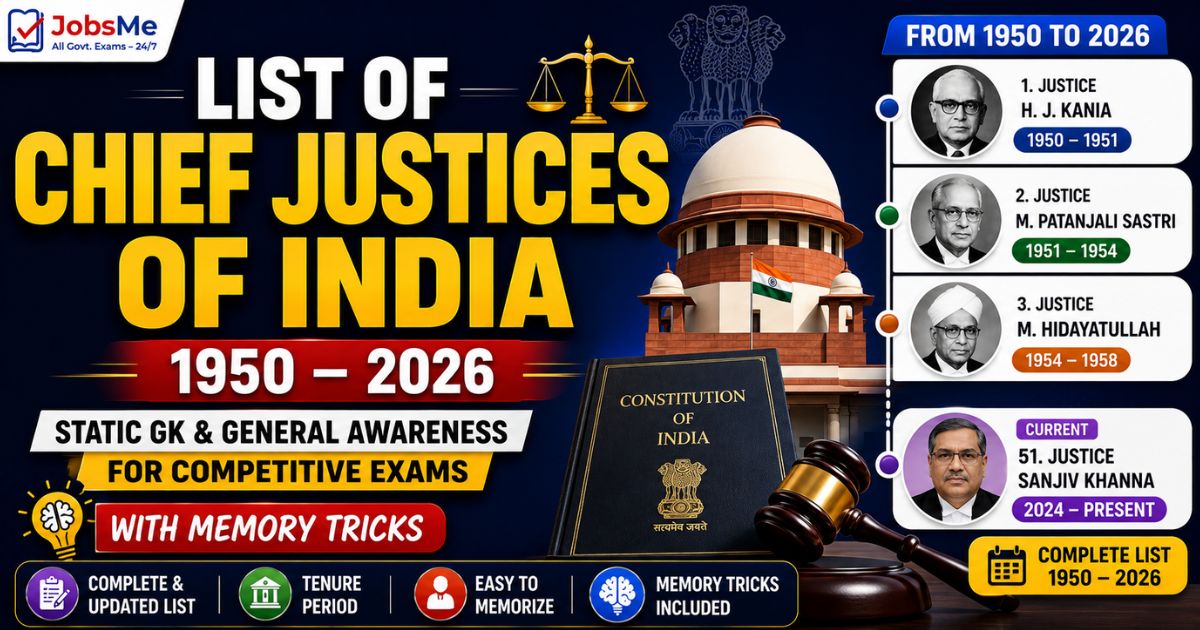
List of Chief Justices of India (1950-2026) – Static GK & General Awareness for Competitive Exams with Memory Tricks
This article presents the complete list of all 53 Chief Justices of India from Justice H. J. Kania (1950) to the incumbent Justice Surya Kant (53rd CJI), along with their exact tenures, parent High Courts, and the landmark judgments and records linked to each of them. It also covers the constitutional provisions on the appointment, oath, tenure, salary, and removal of the CJI under Article 124, the Collegium system, and the judges in line to become Chief Justice up to 2033, including the first woman CJI. All facts are arranged in exam-ready tables, memory tricks, and one-liners to help UPSC, SSC, IBPS, RRB, PSU, Insurance, and State PCS aspirants score better in Polity and General Awareness.
Jump to section
- Introduction
- Core Concept: Who is the Chief Justice of India
- Constitutional Provisions Related to the Chief Justice of India
- Chief Justices of the Federal Court of India (1937-1950)
- Complete List of Chief Justices of India (1950-2026)
- Current Chief Justice of India: Justice Surya Kant (53rd CJI)
- Chief Justices in Line: Expected Succession from 2027 to 2033
- Important Firsts, Records, and Superlatives
- Memory Tricks and Mnemonics
- Additional Notes
- One-Liners for Quick Revision
Introduction
The Chief Justice of India (CJI) is the highest-ranking judge of the Supreme Court of India and the head of the Indian judiciary. Since the Supreme Court began functioning on 26 January 1950, replacing the Federal Court of India, a total of 53 judges have held this office. The list begins with Justice Harilal Jekisundas Kania and runs up to the present incumbent, Justice Surya Kant, who was sworn in as the 53rd Chief Justice of India on 24 November 2025 and will hold office until 9 February 2027.
Questions from this topic appear almost every year in UPSC Prelims, SSC CGL, SSC CHSL, IBPS PO, IBPS Clerk, SBI PO, RRB NTPC, RRB Group D, LIC and NIACL exams, CAPF, and State PCS papers. The standard question patterns are direct and predictable: who was the first CJI, who served the longest and the shortest tenure, which Article deals with the appointment of the CJI, what is the retirement age, and who is the current Chief Justice of India. Since the office changes hands frequently, this is a Static GK topic with a strong current affairs overlap, so aspirants should revise it along with the daily current affairs updates published on Jobsme.
This article organises every Chief Justice of India in chronological order with the exact dates of appointment and retirement, the parent High Court of each judge, the landmark judgments and commissions connected with them, and all the important firsts and records that examiners repeatedly ask. It also explains the constitutional framework under Article 124, the Collegium system, and the seniority convention that decides who becomes the next CJI.
Core Concept: Who is the Chief Justice of India
The Chief Justice of India is the presiding judge of the Supreme Court of India and is described as the first among equals, because judicially the CJI's vote counts the same as that of any other Supreme Court judge, while administratively the CJI is the head of the institution.
- Appointment: The CJI is appointed by the President of India under Article 124(2) of the Constitution.
- Convention followed: By long-standing convention, the senior-most judge of the Supreme Court is appointed as the next CJI. Seniority is counted from the date of appointment to the Supreme Court, not from age.
- Tenure: There is no fixed term. The CJI holds office until attaining the age of 65 years. This is why some Chief Justices serve for years and others only for days.
- Oath: The oath is administered by the President of India under Article 124(6), in the form set out in the Third Schedule of the Constitution.
- Resignation: The CJI may resign before retirement by writing to the President.
- Removal: The CJI can be removed only through impeachment by Parliament under Article 124(4) on grounds of proved misbehaviour or incapacity.
- Salary: The CJI draws a basic monthly salary of Rs 2,80,000, along with an official residence and allowances, as determined by Parliament under Article 125.
- Order of precedence: The CJI ranks sixth in the Indian Order of Precedence.
Two administrative expressions linked to the CJI are asked frequently. The CJI is the Master of the Roster, which means only the CJI decides which judge or Bench will hear which case. The CJI is also the head of the Collegium, the body of senior-most Supreme Court judges that recommends appointments and transfers of judges of the Supreme Court and the High Courts.
Constitutional Provisions Related to the Chief Justice of India
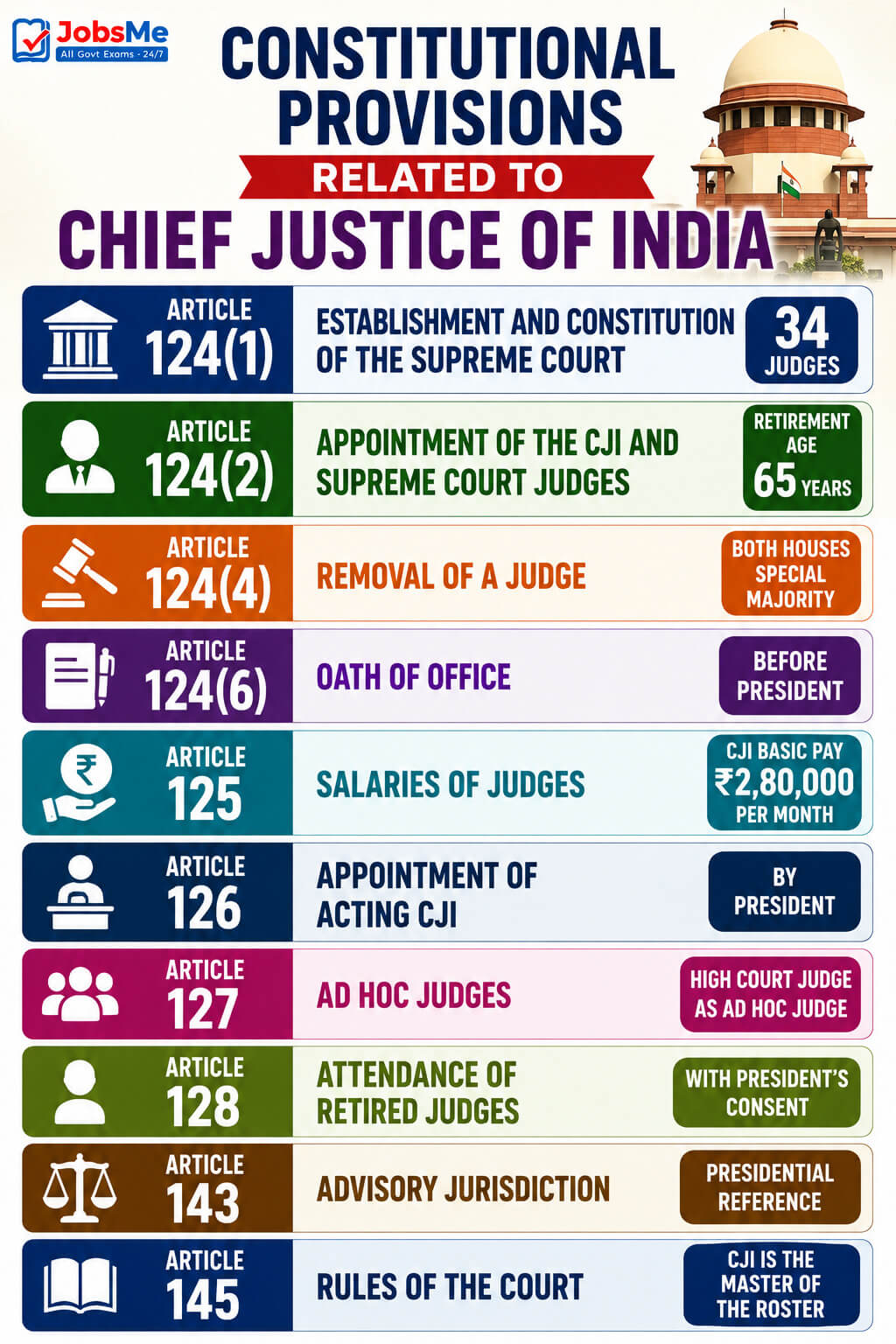
Polity questions on this topic are usually framed as Article-matching questions. The table below lists the provisions that matter most for exams.
| Article | Provision | Key Details for Exams |
|---|---|---|
| Article 124(1) | Establishment and constitution of the Supreme Court | Provides for a Supreme Court consisting of a Chief Justice of India and other judges. The present sanctioned strength is 34 judges, that is the CJI plus 33 judges. |
| Article 124(2) | Appointment of the CJI and Supreme Court judges | Appointment is made by the President after consultation with such judges of the Supreme Court and High Courts as the President considers necessary. Retirement age is 65 years. |
| Article 124(4) | Removal of a judge | Removal by presidential order after an address by both Houses of Parliament supported by a special majority, on grounds of proved misbehaviour or incapacity. The procedure is governed by the Judges (Inquiry) Act, 1968. |
| Article 124(6) | Oath of office | Every judge, including the CJI, makes and subscribes an oath before the President in the form given in the Third Schedule. |
| Article 125 | Salaries of judges | Parliament determines the salary and allowances. These cannot be varied to the disadvantage of a judge after appointment. CJI's basic pay is Rs 2,80,000 per month. |
| Article 126 | Appointment of acting CJI | When the office of the CJI is vacant or the CJI is unable to perform duties, the President appoints another judge of the Supreme Court as acting Chief Justice. |
| Article 127 | Ad hoc judges | The CJI, with the previous consent of the President, may appoint a High Court judge as an ad hoc judge of the Supreme Court. |
| Article 128 | Attendance of retired judges | The CJI, with the President's consent, may request a retired judge to sit and act as a judge of the Supreme Court. |
| Article 143 | Advisory jurisdiction | The President may refer a question of law or fact of public importance to the Supreme Court; the CJI constitutes the Bench that hears such a Presidential Reference. |
| Article 145 | Rules of the Court | Read with the Supreme Court Rules, this is the basis of the CJI's power to allocate work, making the CJI the Master of the Roster. |
Appointment Process Step by Step
- Step 1: As the incumbent CJI nears retirement, the Union Ministry of Law and Justice seeks a recommendation for the successor from the sitting CJI.
- Step 2: The outgoing CJI recommends the senior-most judge of the Supreme Court. If there is any doubt about the fitness of the senior-most judge, other senior judges are consulted.
- Step 3: The Law Minister forwards the recommendation to the Prime Minister, who advises the President.
- Step 4: The President issues the warrant of appointment and administers the oath of office.
- Exceptions: The seniority convention has been broken only twice — in 1973 (Justice A. N. Ray superseded Justices J. M. Shelat, K. S. Hegde, and A. N. Grover) and in 1977 (Justice M. H. Beg superseded Justice H. R. Khanna). The Second Judges Case of 1993 reinforced the seniority norm.
Roles and Responsibilities of the CJI
- Head of the Supreme Court: Leads the judicial and administrative functioning of the highest court.
- Master of the Roster: Allocates cases to Benches and decides which judges hear which matters.
- Constitutes Benches: Sets up Constitution Benches of five or more judges for questions involving substantial interpretation of the Constitution.
- Head of the Collegium: Leads the consultative process for appointment and transfer of judges of the Supreme Court and High Courts.
- Guardian of the Constitution: Ensures that laws and executive actions conform to the Constitution and that fundamental rights are protected.
- Administrative head of the judiciary: Supervises court staff, budget, case management, and registry procedures.
- Advisory role: Presides over Benches hearing Presidential References under Article 143.
- Ex officio and statutory roles: Nominates or recommends members to several commissions and statutory bodies, and heads bodies such as the National Legal Services Authority (NALSA) as its Patron-in-Chief, while the senior-most judge after the CJI acts as its Executive Chairman.
- Acting President: Under the President (Discharge of Functions) Act, 1969, the CJI discharges the functions of the President if the offices of both the President and the Vice President are vacant.
Chief Justices of the Federal Court of India (1937-1950)
Before the Supreme Court, India had the Federal Court of India, established on 1 October 1937 under the Government of India Act, 1935, with its seat at Delhi. It functioned until the Supreme Court came into being in January 1950.
| Chief Justice of the Federal Court | Tenure | Key Details |
|---|---|---|
| Sir Maurice Gwyer | 1 October 1937 to 25 April 1943 | The first Chief Justice of the Federal Court of India. He also served as Vice-Chancellor of Delhi University. |
| Sir Srinivas Varadachariar (acting) | 25 April 1943 to 7 June 1943 | Served briefly as acting Chief Justice between Gwyer's retirement and Spens's arrival. From the Madras High Court. |
| Sir William Patrick Spens | 7 June 1943 to 13 August 1947 | The last British Chief Justice of the Federal Court; resigned two days before Independence. |
| Harilal Jekisundas Kania | 14 August 1947 to 26 January 1950 | The first Indian to head India's highest court, and later the first Chief Justice of India. |
Complete List of Chief Justices of India (1950-2026)
The following tables give all 53 Chief Justices of India in order, with exact tenures, parent High Court, and the key facts most likely to be tested.
Chief Justices of India (1950-1970): CJI 1 to CJI 11
| No. | Chief Justice of India | Tenure | Parent High Court and Key Details |
|---|---|---|---|
| 1 | Harilal Jekisundas Kania | 26 January 1950 to 6 November 1951 | Bombay. The first Chief Justice of India. He was earlier the last Chief Justice of the Federal Court of India and the first Indian to hold that post. He died in office in November 1951. |
| 2 | Mandakolathur Patanjali Sastri | 7 November 1951 to 3 January 1954 | Madras. The first CJI elevated from South India. He was a member of the very first Bench of the Supreme Court in 1950. |
| 3 | Mehr Chand Mahajan | 4 January 1954 to 22 December 1954 | Lahore. The only CJI whose parent High Court was Lahore. Before joining the Supreme Court he served as Prime Minister of Jammu and Kashmir and was a member of the Radcliffe Boundary Commission at Partition. |
| 4 | Bijan Kumar Mukherjea | 23 December 1954 to 31 January 1956 | Calcutta. He resigned before reaching the retirement age, making his a short tenure of about one year. |
| 5 | Sudhi Ranjan Das | 1 February 1956 to 30 September 1959 | Calcutta. Earlier the Chief Justice of the East Punjab (Punjab and Haryana) High Court. His tenure of over 3 years 7 months is among the longest of the early period. |
| 6 | Bhuvaneshwar Prasad Sinha | 1 October 1959 to 31 January 1964 | Patna. The first CJI from the Patna High Court, with a long tenure of about 4 years 4 months. |
| 7 | Pralhad Balacharya Gajendragadkar | 1 February 1964 to 15 March 1966 | Bombay. Remembered for pro-labour and social justice judgments. After retirement he chaired the Law Commission of India and served as Vice-Chancellor of the University of Bombay. |
| 8 | Amal Kumar Sarkar | 16 March 1966 to 29 June 1966 | Calcutta. One of the shortest tenures in the list at about 3 months 13 days. |
| 9 | Koka Subba Rao | 30 June 1966 to 11 April 1967 | Madras. He headed the Bench in the Golaknath case (1967), which held that Parliament cannot amend Fundamental Rights. He resigned to contest the 1967 presidential election as the joint opposition candidate. |
| 10 | Kailas Nath Wanchoo | 12 April 1967 to 24 February 1968 | Allahabad. After retirement he headed the Direct Taxes Enquiry Committee (Wanchoo Committee), whose report shaped India's black money and tax policy debate. |
| 11 | Mohammad Hidayatullah | 25 February 1968 to 16 December 1970 | Nagpur. The first Muslim CJI and the only person to have served as CJI, acting President of India (July to August 1969), and Vice President of India (1979 to 1984). |
Chief Justices of India (1970-1990): CJI 12 to CJI 20
| No. | Chief Justice of India | Tenure | Parent High Court and Key Details |
|---|---|---|---|
| 12 | Jayantilal Chhotalal Shah | 17 December 1970 to 21 January 1971 | Bombay. Tenure of only about 35 days. He later headed the Shah Commission (1977), which inquired into the excesses of the Emergency. |
| 13 | Sarv Mittra Sikri | 22 January 1971 to 25 April 1973 | Elevated directly from the Bar. The first CJI appointed straight from the Bar. He headed the historic 13-judge Bench in Kesavananda Bharati (1973) that laid down the Basic Structure Doctrine, and retired the day after the verdict. |
| 14 | Ajit Nath Ray | 26 April 1973 to 28 January 1977 | Calcutta. His appointment superseded three senior judges — Shelat, Hegde, and Grover — the first break of the seniority convention. The Emergency-era ADM Jabalpur habeas corpus case (1976) was decided under him, with Justice H. R. Khanna's famous lone dissent. |
| 15 | Mirza Hameedullah Beg | 29 January 1977 to 21 February 1978 | Allahabad. The second and last instance of supersession, as his appointment bypassed Justice H. R. Khanna, who then resigned. |
| 16 | Yeshwant Vishnu Chandrachud | 22 February 1978 to 11 July 1985 | Bombay. The longest-serving Chief Justice of India, with a tenure of 7 years 4 months 19 days. He is the father of Justice D. Y. Chandrachud, the 50th CJI. |
| 17 | Prafullachandra Natwarlal Bhagwati | 12 July 1985 to 20 December 1986 | Gujarat. Regarded as the pioneer of Public Interest Litigation (PIL) and epistolary jurisdiction in India, which relaxed the rule of locus standi. He was awarded the Padma Vibhushan. |
| 18 | Raghunandan Swarup Pathak | 21 December 1986 to 18 June 1989 | Allahabad. He went on to serve as a judge of the International Court of Justice (ICJ) at The Hague, one of the few Indians to do so. |
| 19 | Engalaguppe Seetharamiah Venkataramiah | 19 June 1989 to 17 December 1989 | Karnataka. The first CJI elevated from the Karnataka High Court. He is the father of Justice B. V. Nagarathna, who is in line to become India's first woman CJI. |
| 20 | Sabyasachi Mukharji | 18 December 1989 to 25 September 1990 | Calcutta. The second CJI to die in office, after Justice H. J. Kania. |
Chief Justices of India (1990-2010): CJI 21 to CJI 37
| No. | Chief Justice of India | Tenure | Parent High Court and Key Details |
|---|---|---|---|
| 21 | Ranganath Misra | 26 September 1990 to 24 November 1991 | Orissa. He became the first Chairperson of the National Human Rights Commission (NHRC) in 1993 and was later a Rajya Sabha member. He is the uncle of Justice Dipak Misra, the 45th CJI. |
| 22 | Kamal Narain Singh | 25 November 1991 to 12 December 1991 | Allahabad. The shortest-serving CJI in history, with a tenure of just 17 days. |
| 23 | Madhukar Hiralal Kania | 13 December 1991 to 17 November 1992 | Bombay. He is the nephew of the first CJI, Justice H. J. Kania, making them the only uncle-nephew pair with the same surname in the list. |
| 24 | Lalit Mohan Sharma | 18 November 1992 to 11 February 1993 | Patna. A short tenure of about 2 months 24 days. |
| 25 | Manepalli Narayanarao Venkatachaliah | 12 February 1993 to 24 October 1994 | Karnataka. The landmark Second Judges Case (1993), which created the Collegium system, was decided in this period. He later chaired the NHRC and the National Commission to Review the Working of the Constitution (2000), and received the Padma Vibhushan. |
| 26 | Aziz Mushabber Ahmadi | 25 October 1994 to 24 March 1997 | Gujarat. The third CJI from the Muslim community, after Justices Hidayatullah and Beg, with a tenure of nearly 2 years 5 months. |
| 27 | Jagdish Sharan Verma | 25 March 1997 to 17 January 1998 | Madhya Pradesh. He authored the Vishaka Guidelines (1997) on sexual harassment at the workplace and the Vineet Narain (hawala) judgment. He later chaired the NHRC and the Justice Verma Committee (2013) on criminal law amendments. |
| 28 | Madan Mohan Punchhi | 18 January 1998 to 9 October 1998 | Punjab and Haryana. The Third Judges Case (1998), which expanded the Collegium to the CJI plus four senior-most judges, belongs to his tenure. He later headed the Punchhi Commission on Centre-State Relations. |
| 29 | Adarsh Sein Anand | 10 October 1998 to 31 October 2001 | Jammu and Kashmir. A long tenure of over 3 years. He later served as Chairperson of the NHRC. |
| 30 | Sam Piroj Bharucha | 1 November 2001 to 5 May 2002 | Bombay. The first CJI from the Parsi community. |
| 31 | Bhupinder Nath Kirpal | 6 May 2002 to 7 November 2002 | Delhi. The first CJI elevated from the Delhi High Court, known for orders making environmental education compulsory in schools and colleges. |
| 32 | Gopal Ballav Pattanaik | 8 November 2002 to 18 December 2002 | Orissa. A tenure of only about 41 days, the third shortest in the list. |
| 33 | Vishweshwar Nath Khare | 19 December 2002 to 1 May 2004 | Allahabad. Best known for ordering the retrial of the Best Bakery case outside Gujarat in 2004, a landmark on fair trial and transfer of criminal cases. |
| 34 | S. Rajendra Babu | 2 May 2004 to 31 May 2004 | Karnataka. A tenure of just 29 days, the second shortest ever. He later chaired the NHRC. |
| 35 | Ramesh Chandra Lahoti | 1 June 2004 to 31 October 2005 | Madhya Pradesh. Tenure of about 1 year 5 months, a period marked by important rulings on judicial accountability and contempt. |
| 36 | Yogesh Kumar Sabharwal | 1 November 2005 to 13 January 2007 | Delhi. He headed the nine-judge Bench in I. R. Coelho (2007), which held that laws placed in the Ninth Schedule are still open to judicial review on the basic structure test. |
| 37 | Konakuppakatil Gopinathan Balakrishnan | 14 January 2007 to 11 May 2010 | Kerala. The first Dalit Chief Justice of India and the first CJI from the Kerala High Court, with a long tenure of over 3 years 3 months. He later chaired the NHRC. |
Chief Justices of India (2010-2026): CJI 38 to CJI 53
| No. | Chief Justice of India | Tenure | Parent High Court and Key Details |
|---|---|---|---|
| 38 | Sarosh Homi Kapadia | 12 May 2010 to 28 September 2012 | Bombay. The second Parsi CJI and the first CJI born after Independence. He rose from a Class IV job to the highest judicial office and delivered key tax and economic rulings including the Vodafone judgment (2012). |
| 39 | Altamas Kabir | 29 September 2012 to 18 July 2013 | Calcutta. The fourth CJI from the Muslim community and the last CJI from the Calcutta High Court so far. |
| 40 | Palanisamy Sathasivam | 19 July 2013 to 26 April 2014 | Madras. Shortly after retirement he was appointed Governor of Kerala (2014 to 2019). |
| 41 | Rajendra Mal Lodha | 27 April 2014 to 27 September 2014 | Rajasthan. He headed the Lodha Committee, whose recommendations led to sweeping reforms in the Board of Control for Cricket in India (BCCI). |
| 42 | Handyala Lakshminarayanaswamy Dattu | 28 September 2014 to 2 December 2015 | Karnataka. The National Judicial Appointments Commission (NJAC) was struck down in October 2015 during his tenure, restoring the Collegium. He later chaired the NHRC. |
| 43 | Tirath Singh Thakur | 3 December 2015 to 3 January 2017 | Jammu and Kashmir. He publicly highlighted the crisis of judicial vacancies and case pendency, and his Bench passed the 2016 order on playing the national anthem in cinemas. |
| 44 | Jagdish Singh Khehar | 4 January 2017 to 27 August 2017 | Punjab and Haryana. The first Sikh Chief Justice of India. His tenure saw the Triple Talaq verdict and the nine-judge K. S. Puttaswamy judgment (2017) declaring privacy a fundamental right. |
| 45 | Dipak Misra | 28 August 2017 to 2 October 2018 | Orissa. Nephew of the 21st CJI Ranganath Misra. His tenure produced verdicts on Section 377, Sabarimala entry, adultery, and passive euthanasia. He was the first CJI against whom an impeachment notice was moved, which was rejected by the Rajya Sabha Chairman in 2018. |
| 46 | Ranjan Gogoi | 3 October 2018 to 17 November 2019 | Gauhati. The first CJI from the North-East. He headed the five-judge Bench that delivered the unanimous Ayodhya title dispute verdict (9 November 2019), and was later nominated to the Rajya Sabha in 2020. |
| 47 | Sharad Arvind Bobde | 18 November 2019 to 23 April 2021 | Bombay. He led the Supreme Court through the COVID-19 pandemic, when hearings shifted to video conferencing and e-filing was expanded. |
| 48 | Nuthalapati Venkata Ramana | 24 April 2021 to 26 August 2022 | Andhra Pradesh. He set up the expert committee in the Pegasus surveillance case, and his Bench kept the sedition law (Section 124A IPC) in abeyance in May 2022. He pushed for judgments in regional languages and greater access to justice. |
| 49 | Uday Umesh Lalit | 27 August 2022 to 8 November 2022 | Elevated directly from the Bar. The second CJI appointed straight from the Bar after Justice Sikri. He began live-streaming of Constitution Bench hearings, and the EWS reservation verdict came on his last working day. |
| 50 | Dhananjaya Yeshwant Chandrachud | 9 November 2022 to 10 November 2024 | Bombay. Son of the 16th CJI Y. V. Chandrachud, making them the only father-son pair to hold the office. His tenure covered the Article 370 verdict, striking down of the Electoral Bonds Scheme (2024), expansion of e-Courts, and the new statue of Lady Justice without a blindfold along with a new flag and insignia for the Supreme Court. |
| 51 | Sanjiv Khanna | 11 November 2024 to 13 May 2025 | Delhi. He is the nephew of Justice H. R. Khanna, famous for his lone dissent in the ADM Jabalpur case. He was part of the Benches on Article 370 and electoral bonds. |
| 52 | Bhushan Ramkrishna Gavai | 14 May 2025 to 23 November 2025 | Bombay. The first Buddhist CJI and the second Dalit CJI after Justice K. G. Balakrishnan. He sat on the Constitution Benches on Article 370, demonetisation, and electoral bonds. |
| 53 | Surya Kant | 24 November 2025 to 9 February 2027 (incumbent) | Punjab and Haryana. The current Chief Justice of India and the first CJI from Haryana. A first-generation lawyer and former Advocate General of Haryana and Chief Justice of the Himachal Pradesh High Court, with a tenure of about 15 months. |
Current Chief Justice of India: Justice Surya Kant (53rd CJI)
Justice Surya Kant was appointed the 53rd Chief Justice of India by President Droupadi Murmu on 30 October 2025 and took oath on 24 November 2025, succeeding Justice B. R. Gavai. He will hold office until 9 February 2027. He was elevated as a judge of the Supreme Court in May 2019, and before that served as a judge of the Punjab and Haryana High Court from 2004 and as Chief Justice of the Himachal Pradesh High Court. Before becoming a judge he was a Senior Advocate and the Advocate General of Haryana. He has also served as Executive Chairman of the National Legal Services Authority (NALSA) as the senior-most judge after the CJI.
| Case or Area | Contribution of Justice Surya Kant |
|---|---|
| Abrogation of Article 370 | Part of the Constitution Bench that upheld the abrogation of Article 370 and the reorganisation of Jammu and Kashmir. |
| Pegasus spyware surveillance | Co-authored the judgment setting up a technical expert committee to examine the alleged use of Pegasus, holding that national security cannot be a blanket shield against judicial scrutiny. |
| Sedition law, Section 124A IPC | Was on the Bench that kept the colonial-era sedition law in abeyance, pausing fresh FIRs pending review, a significant free-speech development. |
| One Rank One Pension (OROP) | Upheld the OROP scheme for ex-servicemen as constitutionally valid. |
| Citizenship Act, Section 6A | Part of the Constitution Bench that upheld the validity of Section 6A of the Citizenship Act relating to Assam. |
| Aligarh Muslim University minority status | Was on the Bench on AMU's minority status, where he dissented from the majority view. |
| Women in Bar Associations | Directed that one-third of seats in bar associations, including the Supreme Court Bar Association, be reserved for women. |
| Gender justice in local governance | Reinstated a woman sarpanch removed unfairly and criticised gender bias in grassroots democracy. |
| Environmental protection | In Jitendra Singh v. Ministry of Environment, held that village ponds are public utilities and their destruction can violate the right to life under Article 21. |
| Victim's right to be heard | In Jagjeet Singh v. Ashish Mishra, held that victims have the right to be heard from the investigation stage itself, not only at trial. |
Chief Justices in Line: Expected Succession from 2027 to 2033
If the seniority convention continues to be followed, the following judges are in line to head the Supreme Court after Justice Surya Kant. These names are frequently asked in current affairs sections, especially the historic appointment of the first woman Chief Justice of India.
| Expected CJI Number and Name | Expected Tenure and Retirement | Significance |
|---|---|---|
| 54th, Justice Vikram Nath | About 7 months from February 2027; retires 23 September 2027 | From the Allahabad High Court and former Chief Justice of the Gujarat High Court. Sat on Benches deciding Bhopal Gas Tragedy compensation and sub-classification within SC and ST reservation. |
| 55th, Justice B. V. Nagarathna | About 36 days from September 2027; retires end of October 2027 | Will become the first woman Chief Justice of India. Daughter of the 19th CJI E. S. Venkataramiah, making them the first father-daughter pair to hold the office. Known for her lone dissent in the demonetisation case. |
| 56th, Justice P. S. Narasimha | Over 6 months; retires 4 May 2028 | Will be the third CJI elevated directly from the Bar. As a lawyer he argued in the Ayodhya dispute, the NJAC case, and the euthanasia matter, and served as Additional Solicitor General. |
| 57th, Justice J. B. Pardiwala | Over 2 years, the longest in this line; retires 11 August 2030 | From the Gujarat High Court. Authored a concurring opinion upholding EWS reservation and the judgment setting timelines for Governors and the President to act on state Bills. |
| 58th, Justice K. V. Viswanathan | About 10 months; retires 25 May 2031 | Will be the fourth CJI from the Bar. Appeared in the WhatsApp privacy case and the marriage equality plea, and served as amicus curiae on judicial vacancies. |
| 59th, Justice Joymalya Bagchi | About 4 months; retires 2 October 2031 | From the Calcutta High Court, the first judge from that court in line for the office since Justice Altamas Kabir retired in 2013. |
| 60th, Justice Vipul Pancholi | About 1.5 years; retires in May 2033 | From the Gujarat High Court and former Chief Justice of the Patna High Court. His elevation was debated within the Collegium. |
Important Firsts, Records, and Superlatives
| Record or First | Name | Details |
|---|---|---|
| First Chief Justice of India | Justice H. J. Kania | Held office from 26 January 1950 and died in office on 6 November 1951. |
| Longest-serving CJI | Justice Y. V. Chandrachud | 7 years 4 months 19 days, from 22 February 1978 to 11 July 1985. |
| Shortest-serving CJI | Justice Kamal Narain Singh | Only 17 days, from 25 November to 12 December 1991. |
| Second and third shortest tenures | Justice S. Rajendra Babu and Justice G. B. Pattanaik | 29 days in 2004 and about 41 days in 2002 respectively. |
| First woman CJI | None so far | India has not yet had a woman CJI. Justice B. V. Nagarathna is expected to be the first, in 2027. |
| First Muslim CJI | Justice M. Hidayatullah | 11th CJI; also acting President and later Vice President of India. |
| First Dalit CJI | Justice K. G. Balakrishnan | 37th CJI, from the Kerala High Court. |
| First Buddhist CJI and second Dalit CJI | Justice B. R. Gavai | 52nd CJI, in office from 14 May 2025 to 23 November 2025. |
| First Sikh CJI | Justice J. S. Khehar | 44th CJI, from the Punjab and Haryana High Court. |
| First Parsi CJI | Justice S. P. Bharucha | 30th CJI; Justice S. H. Kapadia was the second Parsi CJI. |
| First CJI from South India | Justice M. Patanjali Sastri | 2nd CJI, from the Madras High Court. |
| First CJI from the North-East | Justice Ranjan Gogoi | 46th CJI, from the Gauhati High Court. |
| Only CJIs elevated directly from the Bar | Justice S. M. Sikri and Justice U. U. Lalit | 13th and 49th CJIs. Justice P. S. Narasimha is expected to be the third. |
| CJIs who died in office | Justice H. J. Kania and Justice Sabyasachi Mukharji | 1st and 20th CJIs, in 1951 and 1990 respectively. |
| CJIs who resigned | Justice B. K. Mukherjea and Justice K. Subba Rao | Subba Rao resigned to contest the 1967 presidential election. |
| Only father-son pair as CJI | Justice Y. V. Chandrachud and Justice D. Y. Chandrachud | 16th and 50th Chief Justices of India. |
| Uncle-nephew pairs as CJI | Kania and Kania; Misra and Misra | H. J. Kania (1st) and M. H. Kania (23rd); Ranganath Misra (21st) and Dipak Misra (45th). |
| Only CJI to act as President of India | Justice M. Hidayatullah | Acted as President from July to August 1969, and later became Vice President. |
| First CJI born after Independence | Justice S. H. Kapadia | 38th CJI, born on 29 September 1947. |
| First CJI from Haryana | Justice Surya Kant | The incumbent 53rd CJI, a first-generation lawyer. |
Memory Tricks and Mnemonics
Trick 1: First Five CJIs - "KA-SA-MA-MU-DA"

Remember the first five Chief Justices in order using the first syllables of their surnames:
- KA → Kania (1st, 1950).
- SA → Sastri (2nd).
- MA → Mahajan (3rd).
- MU → Mukherjea (4th).
- DA → Das (5th).
"KAy SAb MAin MUjhe DAo" - the first five chairs of the Supreme Court in order.
Trick 2: Longest and Shortest - "7 Years vs 17 Days"
The two most asked records sit at opposite extremes and both contain a 7:
- 7 years plus, that is 7 years 4 months 19 days, is Y. V. Chandrachud, the 16th CJI.
- 17 days is Kamal Narain Singh, the 22nd CJI.
"Chandrachud counted years, Kamal Narain counted days."
Trick 3: The Chandrachud Gap - "16 plus 34 equals 50"
Father and son held the same office 34 numbers apart:
- 16th CJI is Y. V. Chandrachud (1978 to 1985), the father.
- 50th CJI is D. Y. Chandrachud (2022 to 2024), the son.
"Add 34 to the father, you get the son."
Trick 4: Family Ties in the Top Chair - "KMC-VN"
Four family connections cover almost every relationship question on this topic:
- K → Kania and Kania, uncle and nephew, 1st and 23rd.
- M → Misra and Misra, uncle and nephew, 21st (Ranganath) and 45th (Dipak).
- C → Chandrachud and Chandrachud, father and son, 16th and 50th.
- VN → Venkataramiah and Nagarathna, father and daughter, 19th and the expected 55th.
"Remember one extra Khanna: Sanjiv Khanna (51st CJI) is the nephew of Justice H. R. Khanna, who was never CJI because he was superseded in 1977."
Trick 5: The Two Supersessions - "RAY in 73, BEG in 77"
Seniority was bypassed only twice, and both names are short and rhyme with their years:
- 1973 → Justice A. N. Ray superseded three judges: Shelat, Hegde, and Grover (remember SHG).
- 1977 → Justice M. H. Beg superseded Justice H. R. Khanna, who dissented in the ADM Jabalpur case.
"Ray broke it first, Beg broke it last."
Trick 6: Hidayatullah is "3 in 1"
Justice M. Hidayatullah holds three offices in one answer:
- Chief Justice of India (1968 to 1970), and the first Muslim CJI.
- Acting President of India (July to August 1969).
- Vice President of India (1979 to 1984).
"One man, three chairs: CJI, President, Vice President."
Trick 7: Community Firsts - "B-K-G-B"
Use this string for the four most asked community firsts:
- B → Balakrishnan, first Dalit CJI (37th).
- K → Khehar, first Sikh CJI (44th).
- G → Gavai, first Buddhist CJI and second Dalit CJI (52nd).
- B → Bharucha, first Parsi CJI (30th), followed by Kapadia as the second.
"Add Hidayatullah as the first Muslim CJI, and the firsts list is complete."
Trick 8: The Bar Duo - "SIKRI and LALIT"
Only two Chief Justices came directly from the Bar without first being High Court judges:
- S. M. Sikri, the 13th CJI, who headed the Kesavananda Bharati Bench.
- U. U. Lalit, the 49th CJI, who started live-streaming of Constitution Bench hearings.
"Sikri started the Basic Structure, Lalit started the live stream."
Trick 9: Article Ladder for the Judiciary - "124-125-126-127-128"
- 124 → Establishment, appointment, oath, and removal of Supreme Court judges.
- 125 → Salaries and allowances.
- 126 → Acting Chief Justice of India.
- 127 → Ad hoc judges.
- 128 → Attendance of retired judges.
"Appoint, Pay, Act, Add, Attend - in the order 124 to 128."
Additional Notes
Frequently Confused Facts
- H. J. Kania vs M. H. Kania: H. J. Kania is the 1st CJI (1950), while M. H. Kania, his nephew, is the 23rd CJI (1991 to 1992).
- Y. V. Chandrachud vs D. Y. Chandrachud: Y. V. Chandrachud is the 16th and longest-serving CJI; D. Y. Chandrachud is the 50th CJI and his son.
- Ranganath Misra vs Dipak Misra: Ranganath Misra is the 21st CJI and the first NHRC Chairperson; Dipak Misra is the 45th CJI and his nephew.
- Sanjiv Khanna vs H. R. Khanna: Sanjiv Khanna is the 51st CJI; H. R. Khanna was never CJI and is remembered for his lone dissent in ADM Jabalpur and for being superseded in 1977.
- First woman CJI vs first woman Supreme Court judge: India has had no woman CJI yet; the first woman judge of the Supreme Court was Justice M. Fathima Beevi (1989), and the first woman Chief Justice of a High Court was Justice Leila Seth.
- Retirement age 65 vs 62: A Supreme Court judge, including the CJI, retires at 65 under Article 124; a High Court judge retires at 62 under Article 217.
- Kesavananda Bharati vs ADM Jabalpur: Kesavananda Bharati (1973) was decided under CJI S. M. Sikri and gave the Basic Structure Doctrine; ADM Jabalpur (1976) was decided under CJI A. N. Ray during the Emergency.
- Second Judges Case vs Third Judges Case: The Second Judges Case (1993), under CJI M. N. Venkatachaliah's period, created the Collegium; the Third Judges Case (1998), under CJI M. M. Punchhi, expanded it to the CJI plus four senior-most judges.
- Golaknath vs Kesavananda: Golaknath (1967) under CJI K. Subba Rao held that Fundamental Rights cannot be amended; Kesavananda (1973) overruled it partly and introduced the basic structure test.
- Master of the Roster vs Collegium: Master of the Roster relates to allocation of cases by the CJI; the Collegium relates to appointment and transfer of judges.
- Two Dalit CJIs: K. G. Balakrishnan was the first, and B. R. Gavai the second, who is also the first Buddhist CJI.
- Number of CJIs vs number of judges: India has had 53 Chief Justices, while the sanctioned strength of the Supreme Court is 34 judges including the CJI.
Repeating PYQ Patterns
Certain facts from this topic repeat almost every year. UPSC Prelims and State PCS papers focus on the constitutional side: Article 124, the appointment procedure, the retirement age of 65, Article 126 on the acting CJI, and the Collegium judgments. SSC CGL, SSC CHSL, and RRB NTPC prefer direct Static GK: the first CJI, the longest and shortest tenures, the current CJI, and the first Dalit, Sikh, Muslim, and Parsi Chief Justices. Banking and Insurance exams such as IBPS PO, IBPS Clerk, SBI PO, LIC AAO, and NIACL usually ask the current-affairs version: who took oath as the latest CJI, on what date, who recommended the name, and who administered the oath. Questions on Justice B. V. Nagarathna as the expected first woman CJI and on Justice Surya Kant as the 53rd CJI are high-probability items for 2026 and 2027 exam cycles. Aspirants who revise this list alongside Static GK notes and attempt regular daily current affairs quizzes retain these dates far better than those who read them once.
Quick Insight
The office of the Chief Justice of India is in a period of unusually rapid change, which is exactly why it keeps appearing in exams. Between November 2024 and November 2025 alone, three judges held the post, because the seniority convention combined with a fixed retirement age of 65 often produces tenures of only a few months. Two developments deserve special attention. First, the incumbent, Justice Surya Kant, has one of the longer recent tenures at about 15 months, giving him room to push administrative reforms such as faster listing, better case management, and greater use of technology. Second, in 2027 India is expected to get its first woman Chief Justice, Justice B. V. Nagarathna, whose father Justice E. S. Venkataramiah was the 19th CJI. Alongside this, debates on the Collegium system, judicial vacancies, pendency of over four crore cases in Indian courts, and transparency in judicial appointments remain live policy issues that examiners convert into statement-based questions. To stay updated on such appointments and reforms, follow the daily current affairs section and check the Static GK quiz to test your recall.
One-Liners for Quick Revision
- Chief Justice of India → Head of the Indian judiciary and chief judge of the Supreme Court → Appointed by the President under Article 124(2).
- Total CJIs so far → 53 → From H. J. Kania (1950) to the incumbent Surya Kant.
- Retirement age of CJI → 65 years → No fixed term; High Court judges retire at 62.
- Salary of CJI → Rs 2,80,000 per month → Determined by Parliament under Article 125.
- Order of precedence → CJI ranks sixth in India → Oath administered by the President under Article 124(6).
- 1. H. J. Kania → 26 January 1950 to 6 November 1951 → First CJI, from Bombay High Court, died in office.
- 2. M. Patanjali Sastri → 7 November 1951 to 3 January 1954 → First CJI from South India, Madras High Court.
- 3. Mehr Chand Mahajan → 4 January 1954 to 22 December 1954 → Only CJI from Lahore High Court; former Prime Minister of Jammu and Kashmir.
- 4. B. K. Mukherjea → 23 December 1954 to 31 January 1956 → Calcutta High Court; resigned before retirement.
- 5. Sudhi Ranjan Das → 1 February 1956 to 30 September 1959 → Calcutta High Court; tenure of over 3 years 7 months.
- 6. B. P. Sinha → 1 October 1959 to 31 January 1964 → First CJI from Patna High Court; over 4 years in office.
- 7. P. B. Gajendragadkar → 1 February 1964 to 15 March 1966 → Bombay High Court; known for labour law rulings; later chaired the Law Commission.
- 8. A. K. Sarkar → 16 March 1966 to 29 June 1966 → Calcutta High Court; short tenure of about 3 months.
- 9. K. Subba Rao → 30 June 1966 to 11 April 1967 → Golaknath case (1967); resigned to contest the presidential election.
- 10. K. N. Wanchoo → 12 April 1967 to 24 February 1968 → Allahabad High Court; later headed the Direct Taxes Enquiry Committee.
- 11. M. Hidayatullah → 25 February 1968 to 16 December 1970 → First Muslim CJI; acting President in 1969; Vice President 1979 to 1984.
- 12. J. C. Shah → 17 December 1970 to 21 January 1971 → Bombay High Court; later headed the Shah Commission on the Emergency.
- 13. S. M. Sikri → 22 January 1971 to 25 April 1973 → First CJI directly from the Bar; headed the Kesavananda Bharati Bench.
- 14. A. N. Ray → 26 April 1973 to 28 January 1977 → Appointed by superseding three senior judges; ADM Jabalpur case (1976).
- 15. M. H. Beg → 29 January 1977 to 21 February 1978 → Superseded Justice H. R. Khanna; second and last supersession.
- 16. Y. V. Chandrachud → 22 February 1978 to 11 July 1985 → Longest-serving CJI, 7 years 4 months 19 days; father of the 50th CJI.
- 17. P. N. Bhagwati → 12 July 1985 to 20 December 1986 → Pioneer of PIL and epistolary jurisdiction; Padma Vibhushan.
- 18. R. S. Pathak → 21 December 1986 to 18 June 1989 → Allahabad High Court; later a judge of the International Court of Justice.
- 19. E. S. Venkataramiah → 19 June 1989 to 17 December 1989 → First CJI from Karnataka; father of Justice B. V. Nagarathna.
- 20. Sabyasachi Mukharji → 18 December 1989 to 25 September 1990 → Second CJI to die in office; Calcutta High Court.
- 21. Ranganath Misra → 26 September 1990 to 24 November 1991 → First Chairperson of the NHRC; uncle of Justice Dipak Misra.
- 22. Kamal Narain Singh → 25 November 1991 to 12 December 1991 → Shortest tenure ever, only 17 days.
- 23. M. H. Kania → 13 December 1991 to 17 November 1992 → Nephew of the first CJI, H. J. Kania.
- 24. L. M. Sharma → 18 November 1992 to 11 February 1993 → Patna High Court; tenure of about 2 months 24 days.
- 25. M. N. Venkatachaliah → 12 February 1993 to 24 October 1994 → Second Judges Case and birth of the Collegium; later NHRC Chairperson.
- 26. A. M. Ahmadi → 25 October 1994 to 24 March 1997 → Gujarat High Court; third CJI from the Muslim community.
- 27. J. S. Verma → 25 March 1997 to 17 January 1998 → Vishaka Guidelines (1997); later headed the Justice Verma Committee (2013).
- 28. M. M. Punchhi → 18 January 1998 to 9 October 1998 → Third Judges Case (1998); later headed the Punchhi Commission on Centre-State Relations.
- 29. A. S. Anand → 10 October 1998 to 31 October 2001 → Jammu and Kashmir High Court; later NHRC Chairperson.
- 30. S. P. Bharucha → 1 November 2001 to 5 May 2002 → First Parsi CJI; Bombay High Court.
- 31. B. N. Kirpal → 6 May 2002 to 7 November 2002 → First CJI from Delhi High Court; orders on environmental education.
- 32. G. B. Pattanaik → 8 November 2002 to 18 December 2002 → Orissa High Court; third shortest tenure, about 41 days.
- 33. V. N. Khare → 19 December 2002 to 1 May 2004 → Ordered the Best Bakery case retrial outside Gujarat.
- 34. S. Rajendra Babu → 2 May 2004 to 31 May 2004 → Second shortest tenure, 29 days; later NHRC Chairperson.
- 35. R. C. Lahoti → 1 June 2004 to 31 October 2005 → Madhya Pradesh High Court; tenure of about 1 year 5 months.
- 36. Y. K. Sabharwal → 1 November 2005 to 13 January 2007 → Headed the nine-judge Bench in I. R. Coelho on the Ninth Schedule.
- 37. K. G. Balakrishnan → 14 January 2007 to 11 May 2010 → First Dalit CJI; Kerala High Court; later NHRC Chairperson.
- 38. S. H. Kapadia → 12 May 2010 to 28 September 2012 → Second Parsi CJI; first CJI born after Independence; Vodafone tax judgment.
- 39. Altamas Kabir → 29 September 2012 to 18 July 2013 → Calcutta High Court; fourth CJI from the Muslim community.
- 40. P. Sathasivam → 19 July 2013 to 26 April 2014 → Madras High Court; later Governor of Kerala.
- 41. R. M. Lodha → 27 April 2014 to 27 September 2014 → Rajasthan High Court; headed the Lodha Committee on BCCI reforms.
- 42. H. L. Dattu → 28 September 2014 to 2 December 2015 → NJAC struck down in 2015; later NHRC Chairperson.
- 43. T. S. Thakur → 3 December 2015 to 3 January 2017 → Raised the issue of judicial vacancies; national anthem order (2016).
- 44. J. S. Khehar → 4 January 2017 to 27 August 2017 → First Sikh CJI; Triple Talaq and Right to Privacy verdicts.
- 45. Dipak Misra → 28 August 2017 to 2 October 2018 → Section 377, Sabarimala, adultery and euthanasia verdicts; first CJI to face an impeachment notice.
- 46. Ranjan Gogoi → 3 October 2018 to 17 November 2019 → First CJI from the North-East; Ayodhya verdict; later Rajya Sabha member.
- 47. S. A. Bobde → 18 November 2019 to 23 April 2021 → Led the court through COVID-19 and virtual hearings.
- 48. N. V. Ramana → 24 April 2021 to 26 August 2022 → Andhra Pradesh High Court; Pegasus committee; sedition law kept in abeyance.
- 49. U. U. Lalit → 27 August 2022 to 8 November 2022 → Second CJI from the Bar; began live-streaming of Constitution Bench hearings.
- 50. D. Y. Chandrachud → 9 November 2022 to 10 November 2024 → Son of the 16th CJI; Article 370 and electoral bonds verdicts; e-Courts push.
- 51. Sanjiv Khanna → 11 November 2024 to 13 May 2025 → Delhi High Court; nephew of Justice H. R. Khanna.
- 52. B. R. Gavai → 14 May 2025 to 23 November 2025 → First Buddhist and second Dalit CJI; Bombay High Court.
- 53. Surya Kant → 24 November 2025 to 9 February 2027 → Incumbent CJI; first CJI from Haryana; former Advocate General of Haryana.
- Next CJI (54th) → Justice Vikram Nath → Expected from February 2027, retiring on 23 September 2027.
- First woman CJI (expected 55th) → Justice B. V. Nagarathna → Expected in 2027 for about 36 days; daughter of the 19th CJI.
- Master of the Roster → The CJI alone allocates cases and constitutes Benches → Power flows from Article 145 and the Supreme Court Rules.
- Collegium → CJI plus four senior-most judges recommend appointments → Created by the Second Judges Case (1993) and expanded by the Third Judges Case (1998).
- Supersession years → 1973 and 1977 → A. N. Ray and M. H. Beg respectively.
- Sanctioned strength of the Supreme Court → 34 judges → CJI plus 33 judges.
For more Static GK topics such as the Governors-General of India, important constitutional amendments, and national commissions, explore the Static GK section on Jobsme. You can also test yourself with the Static GK quiz, revise the banking side of general awareness in the Banking Awareness notes, and check the latest government job notifications to plan your next attempt.
Free quiz • No signup required
Put this topic into practice with Indian Cultural Institutions – Static GK MCQ Quiz. It is the quickest way to reinforce what you just learned.
Frequently Asked Questions
Who was the first Chief Justice of India?
Who is the current Chief Justice of India?
How many Chief Justices of India have there been so far?
Which Article of the Constitution deals with the appointment of the Chief Justice of India?
What is the tenure and retirement age of the Chief Justice of India?
Who was the longest serving and who was the shortest serving Chief Justice of India?
Has India ever had a woman Chief Justice of India?
Which Chief Justices of India were appointed by superseding senior judges?
Which Chief Justice of India also served as President of India?
What does it mean when the Chief Justice of India is called the Master of the Roster?

About the author