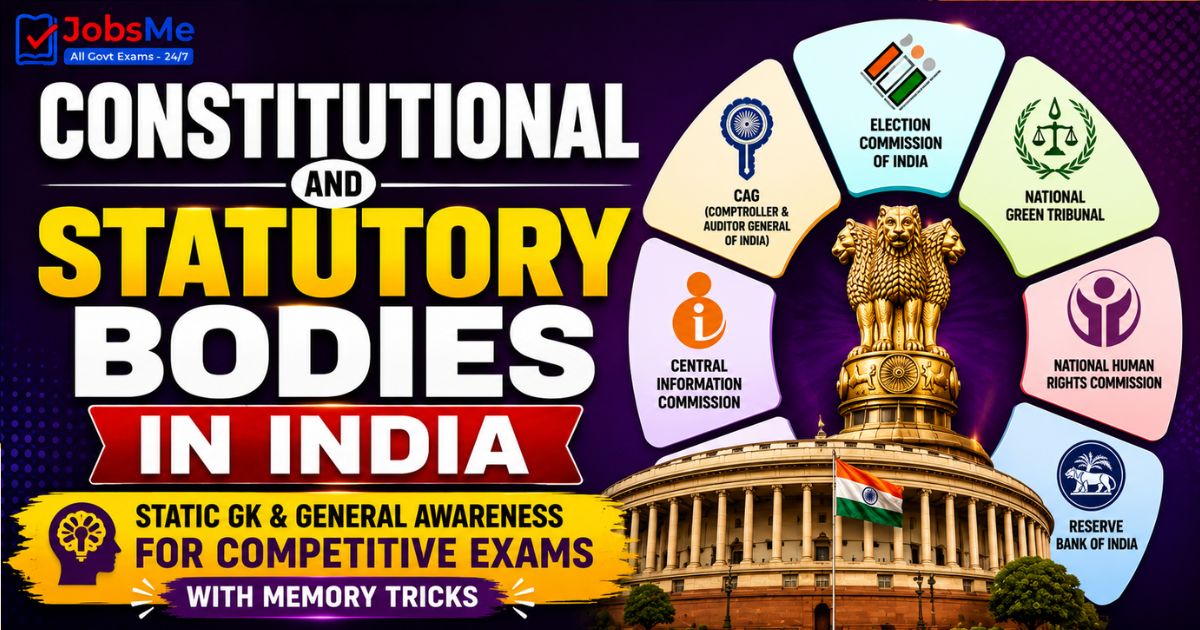
Constitutional and Statutory Bodies in India – Static GK & General Awareness for Competitive Exams with Memory Tricks
This article presents a complete list of Constitutional and Statutory Bodies in India, covering their establishing Articles or Acts, functions, headquarters, and current heads. It explains the crucial difference between Constitutional Bodies (created directly by the Constitution, like the Election Commission, UPSC, CAG, and Finance Commission) and Statutory Bodies (created by an Act of Parliament, like NHRC, NITI Aayog, and the Lokpal), with memory tricks and one-liners for quick revision. All facts are arranged in exam-ready format to help UPSC, SSC, IBPS, RRB, PSU, and State PCS aspirants score better in Polity and General Awareness sections.
Jump to section
Introduction
Indian polity divides the machinery of governance into different categories of bodies based on the source of their authority. The two most important categories for competitive exams are Constitutional Bodies and Statutory Bodies. A Constitutional Body derives its powers and authority directly from the Constitution of India, meaning it is mentioned in a specific Article, and any change to it requires a constitutional amendment. A Statutory Body, on the other hand, is created by an ordinary Act of Parliament or a State Legislature and can be altered or abolished by amending that Act.
Questions on Constitutional and Statutory Bodies appear almost every year in UPSC Prelims, SSC CGL, IBPS PO, RRB NTPC, SBI Clerk, State PCS, and various Insurance and Defence exams. Questions typically ask which Article establishes a particular body, whether a given body is constitutional or statutory, who the current head is, or which Act created a specific commission. This topic overlaps heavily with Polity, Banking Awareness, and current affairs. To explore related notes and updates, you can refer to the Static GK section on thejobsme.com.
The topic is also closely tied to current affairs, since the heads of these bodies change periodically and new bodies are frequently given statutory status. Recent developments such as the constitution of the Sixteenth Finance Commission, appointment of new Chief Election Commissioners, CAG, UPSC Chairman, and NHRC Chairperson make this a high-yield area for aspirants preparing for both Prelims and Mains. Staying updated through the Daily Current Affairs page helps link static facts with the latest appointments.
Core Concept: Constitutional vs Statutory Bodies
Understanding the exact source of a body's power is the single most important skill for this topic, because most exam questions test whether a body is constitutional or statutory. The key distinctions are:

- Constitutional Body: Directly established by, and mentioned in, the Constitution of India. It cannot be abolished or fundamentally altered without a constitutional amendment. Examples: Election Commission, UPSC, CAG, Finance Commission, Attorney General.
- Statutory Body: Established by an Act passed by Parliament or a State Legislature. It can be modified or dissolved by amending or repealing that Act. Examples: NHRC, National Commission for Backward Classes was earlier statutory (now constitutional), SEBI, Lokpal.
- Executive / Non-Statutory Body: Created by an executive resolution or order of the government, not by any Act. Example: NITI Aayog (created by a Cabinet resolution in 2015).
- Regulatory Body: A body that supervises and regulates a particular sector; it may be statutory (like SEBI, RBI, TRAI) or otherwise.
- Quasi-Judicial Body: A body having powers resembling a court of law, such as the power to adjudicate disputes and impose penalties. Examples: NHRC, National Green Tribunal, SEBI.
A useful rule: if a body is mentioned by a specific Article number, it is almost always constitutional; if it is described as being set up "under an Act," it is statutory.
Constitutional Bodies in India
The following table lists the major Constitutional Bodies of India along with the Article that establishes each one, its core function, and its current head. These are the most frequently asked bodies in UPSC Prelims and SSC GK.
| Body | Article(s) | Function / Key Details & Current Head |
|---|---|---|
| Election Commission of India (ECI) | Article 324 | Superintends, directs and controls elections to Parliament, State Legislatures, the offices of President and Vice-President. Established on 25 January 1950 (celebrated as National Voters' Day). A multi-member body with one Chief Election Commissioner and two Election Commissioners. Current CEC: Gyanesh Kumar (26th CEC). |
| Union Public Service Commission (UPSC) | Articles 315-323 | Conducts examinations for recruitment to All-India Services and Central Services; advises the President on recruitment and disciplinary matters. Chairman and members appointed under Article 316. Current Chairman: Dr. Ajay Kumar. |
| State Public Service Commission (SPSC) | Articles 315-323 | Performs functions similar to the UPSC at the state level; conducts recruitment for state civil services. Members appointed by the Governor but removable only by the President. |
| Comptroller and Auditor General of India (CAG) | Articles 148-151 | Supreme audit institution of India; audits all receipts and expenditure of the Union and State governments; guardian of the public purse. Reports examined by the Public Accounts Committee (PAC). Current CAG: K. Sanjay Murthy (15th CAG). |
| Finance Commission | Article 280 | Constituted every fifth year by the President to recommend the distribution of tax revenues between the Centre and the States (vertical devolution) and among the States (horizontal devolution). The Sixteenth Finance Commission covers 2026-27 to 2030-31. Chairman: Dr. Arvind Panagariya. |
| Attorney General of India (AG) | Article 76 | Highest law officer of the Union; chief legal advisor to the Government of India; represents the government in the Supreme Court. Appointed by the President; holds office during the pleasure of the President. Current AG: R. Venkataramani (16th AG). |
| Advocate General of the State | Article 165 | Highest law officer at the state level; chief legal advisor to a State Government. Appointed by the Governor. |
| National Commission for Scheduled Castes (NCSC) | Article 338 | Investigates and monitors safeguards provided for Scheduled Castes; became a fully constitutional body via the 89th Amendment Act, 2003. Chairman: Kishor Makwana. |
| National Commission for Scheduled Tribes (NCST) | Article 338-A | Monitors safeguards for Scheduled Tribes; created by bifurcating the earlier joint SC/ST commission through the 89th Amendment Act, 2003. Chairman: Antar Singh Arya. |
| National Commission for Backward Classes (NCBC) | Article 338-B | Examines welfare measures for socially and educationally backward classes; became a constitutional body through the 102nd Amendment Act, 2018 (earlier it was statutory). Chairman: Hansraj Gangaram Ahir. |
| Special Officer for Linguistic Minorities | Article 350-B | Investigates matters relating to safeguards provided for linguistic minorities and reports to the President. |
| Goods and Services Tax (GST) Council | Article 279-A | Makes recommendations on GST rates, exemptions and laws; created by the 101st Amendment Act, 2016. Chaired by the Union Finance Minister (currently Nirmala Sitharaman). |
Statutory Bodies in India
Statutory Bodies are created by Acts of Parliament. The table below covers the most exam-relevant statutory bodies, the Act that established each, and its function and current head. For deeper coverage of banking and financial regulators, you may also refer to the Banking Awareness notes on thejobsme.com.
| Body | Establishing Act / Year | Function / Key Details & Current Head |
|---|---|---|
| National Human Rights Commission (NHRC) | Protection of Human Rights Act, 1993 | Statutory and quasi-judicial body established on 12 October 1993 to protect and promote human rights; headquartered in New Delhi; in conformity with the Paris Principles. Chairperson (usually a former CJI or SC Judge): Justice V. Ramasubramanian. |
| State Human Rights Commission (SHRC) | Protection of Human Rights Act, 1993 | State-level counterpart of the NHRC; investigates human rights violations within the state's jurisdiction. |
| Central Information Commission (CIC) | Right to Information Act, 2005 | Apex body to hear appeals and complaints under the RTI Act; ensures transparency in government functioning. Current Chief Information Commissioner: Heeralal Samariya. |
| Central Vigilance Commission (CVC) | CVC Act, 2003 (originally set up in 1964 on the Santhanam Committee recommendation) | Apex integrity/anti-corruption watchdog that supervises vigilance administration in central government organisations. Central Vigilance Commissioner: Praveen Kumar Srivastava. |
| Lokpal of India | Lokpal and Lokayuktas Act, 2013 | Anti-corruption ombudsman at the central level to inquire into allegations of corruption against public functionaries, including the Prime Minister (with safeguards). Its accounts are audited by the CAG. |
| Securities and Exchange Board of India (SEBI) | SEBI Act, 1992 (statutory status) | Regulator of the securities and capital markets; protects investors and promotes market development. Headquartered in Mumbai. Chairman: Tuhin Kanta Pandey. |
| Reserve Bank of India (RBI) | RBI Act, 1934 | Central bank of India; regulates monetary policy, currency issue and the banking system. Established on 1 April 1935; headquartered in Mumbai. Governor: Sanjay Malhotra (26th Governor). |
| National Bank for Agriculture and Rural Development (NABARD) | NABARD Act, 1981 | Apex development bank for agriculture and rural development; established on 12 July 1982 on the recommendation of the Shivaraman Committee. |
| National Green Tribunal (NGT) | NGT Act, 2010 | Specialised quasi-judicial body for effective and speedy disposal of environmental protection and conservation cases. Principal Bench in New Delhi. |
| National Commission for Women (NCW) | National Commission for Women Act, 1990 | Reviews constitutional and legal safeguards for women; recommends remedial measures. Chairperson: Vijaya Kishore Rahatkar. |
| National Commission for Protection of Child Rights (NCPCR) | Commissions for Protection of Child Rights Act, 2005 | Protects child rights and ensures implementation of laws such as the RTE Act. Chairman: Priyank Kanoongo. |
| National Commission for Minorities (NCM) | National Commission for Minorities Act, 1992 | Safeguards the interests of notified minority communities. Chairman: Iqbal Singh Lalpura. |
| National Statistical Commission (NSC) | Executive resolution, 2005 (Rangarajan Commission recommendation) | Apex advisory body for the statistical system of the country; note that it was set up by resolution and later moves toward statutory backing have been discussed. |
| Insurance Regulatory and Development Authority of India (IRDAI) | IRDA Act, 1999 | Regulates and develops the insurance sector in India; headquartered in Hyderabad. |
| Telecom Regulatory Authority of India (TRAI) | TRAI Act, 1997 | Regulates telecom services and tariffs in India; headquartered in New Delhi. |
| Pension Fund Regulatory and Development Authority (PFRDA) | PFRDA Act, 2013 | Regulates and develops the pension sector, including the National Pension System (NPS). |
Non-Statutory (Executive) and Regulatory Bodies
Some very important bodies are neither constitutional nor statutory — they are created by executive action. These are frequently tested precisely because students confuse them with statutory bodies.
| Body | Nature / Origin | Function / Key Details & Current Head |
|---|---|---|
| NITI Aayog | Executive (Cabinet resolution, 1 January 2015) | Policy think-tank of the Government of India that replaced the Planning Commission; neither constitutional nor statutory. Ex-officio Chairman: the Prime Minister. |
| Planning Commission (historical) | Executive resolution, 1950 | Former non-statutory body responsible for Five-Year Plans; replaced by NITI Aayog in 2015. |
| National Development Council (NDC) | Executive resolution, 1952 | Non-statutory body to promote cooperative federalism and approve national plans. |
| Central Bureau of Investigation (CBI) | Established under the Delhi Special Police Establishment Act, 1946 (derives powers from it) | Premier investigating agency of India; functions under the DoPT. It is not a statutory body created by its own Act but draws its powers from the DSPE Act. |
Memory Tricks and Mnemonics
Trick 1: The Big Four Constitutional Watchdogs — "CEU-F"
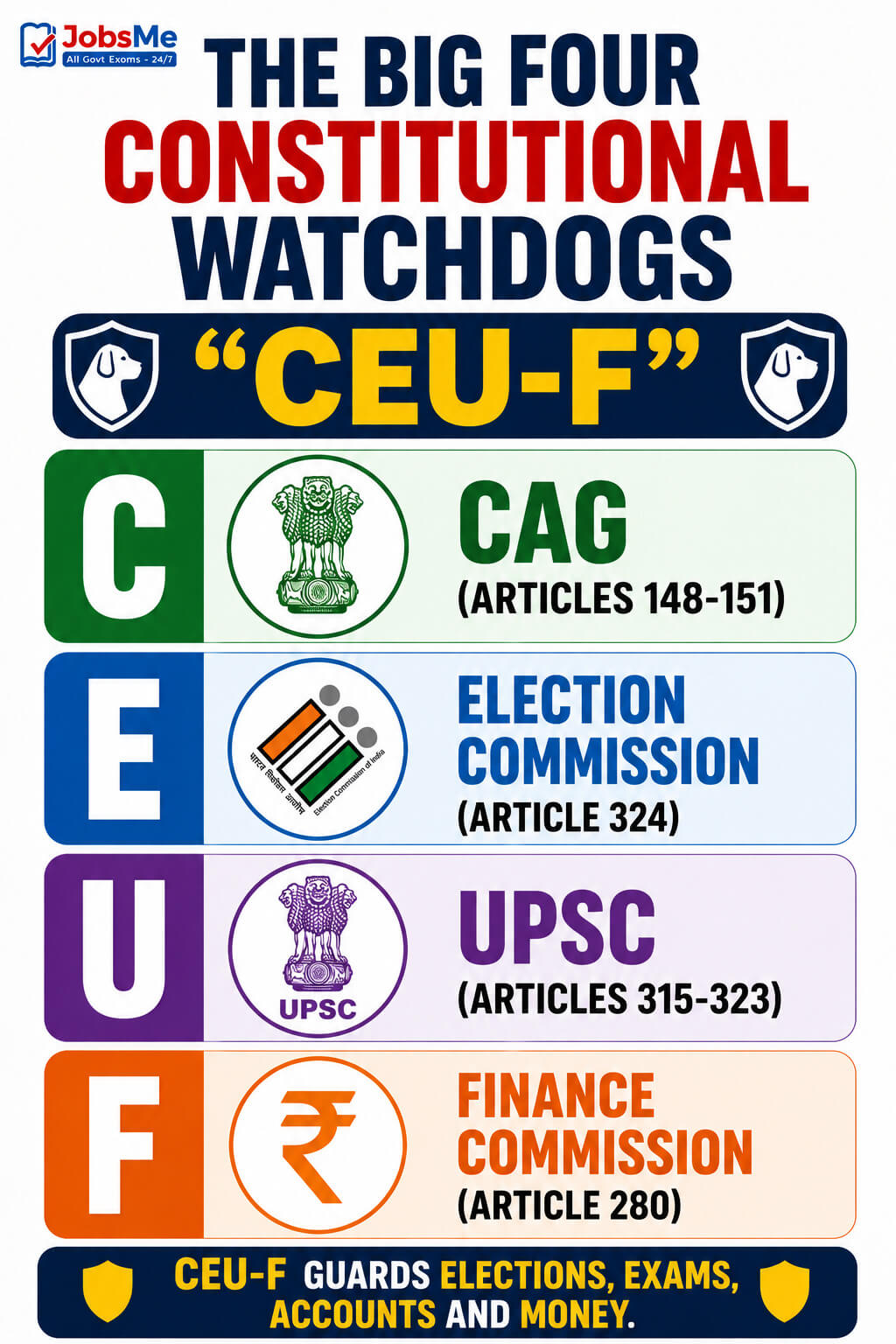
Remember the four classic constitutional pillars of accountability that are often listed together (Supreme Court, ECI, UPSC and CAG) using the theme of watchdogs. For the non-judicial three, use "CEU":
- C → CAG (Articles 148-151).
- E → Election Commission (Article 324).
- U → UPSC (Articles 315-323).
- F → Finance Commission (Article 280) completes the high-frequency four.
"CEU-F guards elections, exams, accounts and money."
Trick 2: The "338 Family" — Three Commissions Under One Roof
The three social-justice commissions all live in the Article 338 family; remember them in order:
- 338 → National Commission for Scheduled Castes (NCSC).
- 338-A → National Commission for Scheduled Tribes (NCST).
- 338-B → National Commission for Backward Classes (NCBC).
"SC, then ST (A), then BC (B) — alphabetical after 338."
Trick 3: Constitutional vs Statutory — "Article means Constitution"
If a body is remembered by an Article number, it is Constitutional; if it is remembered by an Act with a year, it is Statutory.
- Article 324 → ECI (Constitutional).
- Act, 1993 → NHRC (Statutory).
- Article 280 → Finance Commission (Constitutional).
- Act, 2013 → Lokpal (Statutory).
"Number = Constitution; Year = Statute."
Trick 4: The Three "Odd Ones Out" — Not Statutory, Not Constitutional
These three are created by executive resolution and must never be marked as statutory:
- NITI Aayog (2015 Cabinet resolution).
- National Development Council (1952 resolution).
- Planning Commission (1950 resolution, now defunct).
"NITI, NDC, Planning — born of resolutions, not laws."
Trick 5: The Financial Regulators — "SIRT-P"
Group the main statutory regulators of the economy:
- S → SEBI (securities, 1992).
- I → IRDAI (insurance, 1999).
- R → RBI (banking, 1934).
- T → TRAI (telecom, 1997).
- P → PFRDA (pensions, 2013).
"SIRT-P regulates stocks, insurance, banks, telecom and pensions."
Trick 6: Human-Rights and Info Watchdogs — All From Acts
The rights and transparency bodies are all statutory, created by 1990s-2000s Acts:
- NHRC → Protection of Human Rights Act, 1993.
- CIC → Right to Information Act, 2005.
- CVC → CVC Act, 2003.
- Lokpal → Lokpal and Lokayuktas Act, 2013.
"Rights, Information, Vigilance, Lokpal — all statutory."
Trick 7: Heads of Top Bodies — "GKAR-V"
Remember the current heads of the five most-asked bodies with the string "GKAR-V":
- G → Gyanesh Kumar (CEC).
- K → K. Sanjay Murthy (CAG).
- A → Arvind Panagariya (16th Finance Commission) and Ajay Kumar (UPSC).
- R → R. Venkataramani (Attorney General).
- V → V. Ramasubramanian (NHRC).
Additional Notes
Frequently Confused Facts
- NITI Aayog vs Finance Commission: NITI Aayog is an executive (non-statutory) body; the Finance Commission is a Constitutional body under Article 280.
- NCBC — Statutory or Constitutional: The NCBC was a statutory body until the 102nd Amendment Act, 2018, made it a Constitutional body under Article 338-B. This change is a favourite exam trap.
- NHRC vs CAG: NHRC is a statutory body (1993 Act); CAG is a Constitutional body (Article 148). Both are watchdogs, but their source of power differs.
- Election Commission vs Finance Commission: ECI is a permanent body under Article 324; the Finance Commission is a periodic (quasi-permanent) body constituted every five years under Article 280.
- CBI is NOT a statutory body: The CBI derives its powers from the Delhi Special Police Establishment Act, 1946, but was set up by an executive resolution; it is commonly mis-labelled as statutory.
- Attorney General vs Solicitor General: The Attorney General (Article 76) is a Constitutional post; the Solicitor General is a statutory/subordinate law officer with no constitutional mention.
- Lokpal vs Lokayukta: Lokpal is the anti-corruption ombudsman at the central level; Lokayukta is its counterpart at the state level, both under the 2013 Act.
- NCSC vs NCST vs NCBC: NCSC is under Article 338, NCST under 338-A, and NCBC under 338-B — the order follows the alphabet.
Repeating PYQ Patterns
Certain bodies are asked repeatedly in competitive exams. Election Commission (Article 324), UPSC (Articles 315-323), CAG (Article 148), Finance Commission (Article 280), Attorney General (Article 76), NHRC (1993 Act), and the constitutional status of NCBC (Article 338-B) appear most often in UPSC Prelims, SSC CGL, and RRB NTPC papers. Banking exams (IBPS PO, SBI Clerk) frequently focus on regulators like RBI, SEBI, IRDAI, and NABARD along with their establishing years and headquarters. Questions on whether NITI Aayog is constitutional, statutory, or executive are extremely common across all exams. State PCS papers often add State Public Service Commissions, State Human Rights Commissions, and State Finance Commissions.
Quick Insight
Constitutional and statutory bodies form the backbone of India's system of checks and balances. Constitutional bodies like the Election Commission and the CAG cannot be weakened without a constitutional amendment, which gives them strong independence; statutory bodies like the NHRC and Lokpal depend on the will of Parliament, which is why debates on strengthening their powers regularly appear in the news. The periodic constitution of the Finance Commission and frequent appointments of new heads mean this static topic is permanently linked to current affairs, making it valuable for both Prelims matching questions and Mains answers on governance and accountability. For further reading, explore the Static GK notes and stay current with the Daily Current Affairs section on thejobsme.com.
One-Liners for Quick Revision
- Election Commission of India → Article 324 → Constitutional, multi-member body; conducts elections; current CEC Gyanesh Kumar (26th).
- Union Public Service Commission (UPSC) → Articles 315-323 → Constitutional; recruits to All-India and Central Services; Chairman Dr. Ajay Kumar.
- State Public Service Commission → Articles 315-323 → Constitutional; state-level recruitment; members removable only by the President.
- Comptroller and Auditor General (CAG) → Articles 148-151 → Constitutional; supreme audit institution; current CAG K. Sanjay Murthy (15th).
- Finance Commission → Article 280 → Constitutional; constituted every 5 years; 16th FC (2026-31) chaired by Dr. Arvind Panagariya.
- Attorney General of India → Article 76 → Constitutional; highest law officer; current AG R. Venkataramani (16th).
- Advocate General of a State → Article 165 → Constitutional; highest law officer at state level; appointed by the Governor.
- NCSC → Article 338 → Constitutional; safeguards Scheduled Castes; Chairman Kishor Makwana.
- NCST → Article 338-A → Constitutional; safeguards Scheduled Tribes; created by 89th Amendment 2003; Chairman Antar Singh Arya.
- NCBC → Article 338-B → Constitutional since 102nd Amendment 2018 (earlier statutory); Chairman Hansraj Gangaram Ahir.
- Special Officer for Linguistic Minorities → Article 350-B → Constitutional; safeguards linguistic minorities.
- GST Council → Article 279-A → Constitutional; created by 101st Amendment 2016; chaired by the Union Finance Minister (Nirmala Sitharaman).
- National Human Rights Commission (NHRC) → Protection of Human Rights Act, 1993 → Statutory, quasi-judicial; set up 12 October 1993; Chairperson Justice V. Ramasubramanian.
- State Human Rights Commission → Protection of Human Rights Act, 1993 → Statutory; state-level human rights body.
- Central Information Commission (CIC) → RTI Act, 2005 → Statutory; apex RTI appellate body; CIC Heeralal Samariya.
- Central Vigilance Commission (CVC) → CVC Act, 2003 (set up 1964) → Statutory; anti-corruption watchdog; CVC Praveen Kumar Srivastava.
- Lokpal of India → Lokpal and Lokayuktas Act, 2013 → Statutory; central anti-corruption ombudsman.
- SEBI → SEBI Act, 1992 → Statutory regulator of securities markets; Mumbai; Chairman Tuhin Kanta Pandey.
- Reserve Bank of India (RBI) → RBI Act, 1934 → Statutory; central bank; set up 1 April 1935; Governor Sanjay Malhotra (26th).
- NABARD → NABARD Act, 1981 → Statutory; apex rural/agriculture development bank; set up 12 July 1982.
- National Green Tribunal (NGT) → NGT Act, 2010 → Statutory, quasi-judicial; environmental cases; Principal Bench New Delhi.
- National Commission for Women (NCW) → NCW Act, 1990 → Statutory; safeguards women's rights; Chairperson Vijaya Kishore Rahatkar.
- NCPCR → Commissions for Protection of Child Rights Act, 2005 → Statutory; protects child rights; Chairman Priyank Kanoongo.
- National Commission for Minorities (NCM) → NCM Act, 1992 → Statutory; safeguards notified minorities; Chairman Iqbal Singh Lalpura.
- IRDAI → IRDA Act, 1999 → Statutory regulator of insurance; Hyderabad.
- TRAI → TRAI Act, 1997 → Statutory regulator of telecom; New Delhi.
- PFRDA → PFRDA Act, 2013 → Statutory regulator of pensions and NPS.
- NITI Aayog → Cabinet resolution, 1 January 2015 → Executive (non-statutory) think-tank; replaced Planning Commission; ex-officio Chairman is the PM.
- Planning Commission → Executive resolution, 1950 → Non-statutory; replaced by NITI Aayog in 2015.
- National Development Council (NDC) → Executive resolution, 1952 → Non-statutory; promotes cooperative federalism.
- Central Bureau of Investigation (CBI) → Powers from Delhi Special Police Establishment Act, 1946 → Set up by executive resolution; premier investigating agency.
For more Static GK topics like Indian polity, constitutional amendments, and important Articles, explore the Static GK section on thejobsme.com. You can also test yourself with the Static GK Quiz, brush up on financial regulators through the Banking Awareness Quiz, and check the latest openings at Latest Government Job Notifications.
Free quiz • No signup required
Put this topic into practice with Indian Cultural Institutions – Static GK MCQ Quiz. It is the quickest way to reinforce what you just learned.
Frequently Asked Questions
What is the difference between a Constitutional Body and a Statutory Body?
Which Article of the Constitution establishes the Election Commission of India?
Is the National Human Rights Commission a constitutional or statutory body?
Under which Article is the Comptroller and Auditor General of India established?
Is NITI Aayog a constitutional or statutory body?
Which body is set up under Article 280 and what is its function?
Why is the National Commission for Backward Classes now considered a constitutional body?
Who is the highest law officer of the Government of India and under which Article?
Which Act established the Central Information Commission and the Central Vigilance Commission?
Is the Central Bureau of Investigation a statutory body?

About the author