Vice Presidents of India List 1952 to 2026: Complete Static GK Notes with Tenure, Powers and Articles 63 to 71
This article gives you the complete list of all 15 Vice Presidents of India from 1952 to 2026 with exact tenure dates, the President in office during each term, and the key fact that makes each name exam-worthy. It also covers the constitutional provisions from Article 63 to Article 71, the election and removal process, powers as Rajya Sabha Chairman, memory tricks, and one-liners. Everything is arranged the way questions actually appear in UPSC Prelims, SSC CGL, IBPS, RRB and State PCS papers.
Jump to section
Introduction
The Vice President of India holds the second-highest constitutional office in the country, ranking immediately after the President in the order of precedence. The office was created by Article 63 of the Constitution, and the very first holder, Dr. Sarvepalli Radhakrishnan, took oath at Rashtrapati Bhavan on 13 May 1952. Since then, 15 persons have served as Vice President of India, and the office is currently held by C. P. Radhakrishnan.
What makes this topic high-yield is that it sits at the intersection of two scoring areas. On one side it is pure Static GK and General Awareness: who was first, who was last, who died in office, who later became President. On the other side it is Indian Polity: the electoral college, the majority required for removal, and the six-month limit on acting as President. Both types of questions appear every year, so a single well-organised set of notes covers a lot of ground. If you are building your polity base alongside daily revision, pair this page with the regularly updated Static GK notes section.
This article is written for aspirants of UPSC Prelims, SSC CGL, SSC CHSL, IBPS PO, IBPS Clerk, SBI, RRB NTPC, RRB Group D, LIC and other Insurance exams, Defence exams, PSU recruitment and State PCS. Every fact below has been cross-checked against the constitutional text and official records, including the change of office in 2025 following the resignation of Jagdeep Dhankhar.
Core Concept Explanation
Before memorising names and dates, fix the following ideas clearly. Most mistakes in the exam hall come from mixing up the Vice President with the President, not from forgetting the list.

- Two offices, one person: The Vice President is a single individual holding two distinct roles. He is the Vice President of India under Article 63, and simultaneously the ex officio Chairman of the Rajya Sabha (Council of States) under Article 64.
- Salary comes from the second role: The Constitution provides no salary for the post of Vice President as such. He is paid as Chairman of the Rajya Sabha, currently Rs 4 lakh per month. The President draws Rs 5 lakh per month.
- Elected only by Parliament: The electoral college consists of members of both Houses of Parliament only. Members of State Legislative Assemblies have no role at all in a Vice Presidential election, unlike the Presidential election.
- Nominated members do vote: The 12 nominated members of the Rajya Sabha are eligible to vote for the Vice President. They are barred from voting in the Presidential election. This single difference is one of the most repeated questions in polity.
- Equal vote value: Every vote in a Vice Presidential election carries the same value of one. There is no complicated vote-value calculation as in the Presidential election.
- Stand-in, not successor: If the office of President falls vacant, the Vice President only acts as President for a maximum of six months, within which a fresh Presidential election must be held. He does not complete the remaining term.
- No acting Vice President: The Constitution makes no provision for anyone to act as Vice President. If the office falls vacant, it simply stays vacant until a fresh election, and the Deputy Chairman of the Rajya Sabha presides over the Upper House in the meantime.
- Fresh full term on a casual vacancy: Under Article 68(2), a person elected to fill a vacancy caused by death, resignation or removal gets a complete five-year term from the date he enters office, not merely the unexpired portion of the predecessor's term.
Main Data Section
Complete List of Vice Presidents of India from 1952 to 2026
Note the distinction that confuses many students. India has had 15 Vice Presidents as persons, but 17 terms have been served, because Dr. S. Radhakrishnan and Mohammad Hamid Ansari each served two consecutive terms. This is why C. P. Radhakrishnan is described as the 15th Vice President by person and the 17th by term.
| S. No. | Vice President | Tenure (From) | Tenure (To) | President(s) During Tenure | Key Facts and Exam Points |
|---|---|---|---|---|---|
| 1 | Dr. Sarvepalli Radhakrishnan | 13 May 1952 | 12 May 1962 | Dr. Rajendra Prasad | First Vice President of India. Philosopher, professor and former Ambassador to the Soviet Union. Served two consecutive full terms (1952-57 and 1957-62), a record shared only with Hamid Ansari. Became the second President of India (1962-67). Awarded the Bharat Ratna in 1954. His birthday, 5 September, is observed as Teachers' Day. |
| 2 | Dr. Zakir Husain | 13 May 1962 | 12 May 1967 | Dr. Sarvepalli Radhakrishnan | Educationist closely associated with Jamia Millia Islamia. Became the third President of India and the first Muslim President. He died in office as President on 3 May 1969, the first Indian President to do so. Awarded the Bharat Ratna in 1963. |
| 3 | Varahagiri Venkata Giri (V. V. Giri) | 13 May 1967 | 20 July 1969 | Dr. Zakir Husain | First Vice President to act as President, from 3 May 1969 after Zakir Husain's death. He then resigned as Vice President on 20 July 1969 to contest the Presidential election, becoming the first VP to resign. Won as an independent candidate on second-preference votes and served as the fourth President (1969-74). Bharat Ratna in 1975. |
| 4 | Gopal Swarup Pathak | 31 August 1969 | 30 August 1974 | V. V. Giri, Dr. Fakhruddin Ali Ahmed | A distinguished lawyer and former Governor of Mysore. He took office after the post had remained vacant for about six weeks following Giri's resignation, which established the rule that a vacant VP office simply waits for a fresh election. |
| 5 | Basappa Danappa Jatti (B. D. Jatti) | 31 August 1974 | 30 August 1979 | Dr. Fakhruddin Ali Ahmed, Neelam Sanjiva Reddy | Former Chief Minister of Mysore State and Lieutenant Governor of Pondicherry. Served as Acting President from 11 February 1977 to 25 July 1977 after Fakhruddin Ali Ahmed died in office. Returned to the Vice President's office once Neelam Sanjiva Reddy was sworn in as President. |
| 6 | Justice Mohammad Hidayatullah | 31 August 1979 | 30 August 1984 | Neelam Sanjiva Reddy, Giani Zail Singh | The 11th Chief Justice of India and the first Vice President from the judiciary. He was elected unanimously, with no contest. He is the only person to have been CJI, Acting President and Vice President, and acted as President twice: 20 July to 24 August 1969 as CJI, and 6 to 31 October 1982 as Vice President while Zail Singh was abroad for surgery. |
| 7 | Ramaswamy Venkataraman (R. Venkataraman) | 31 August 1984 | 24 July 1987 | Giani Zail Singh | Former Union Minister of Finance and of Industry. His VP term ended early because he was elected the eighth President of India (1987-92). A freedom fighter who was also a member of the Constituent Assembly. |
| 8 | Dr. Shankar Dayal Sharma | 7 September 1987 | 24 July 1992 | Ramaswamy Venkataraman | Academic, lawyer and former Chief Minister of Bhopal State, later Governor of Andhra Pradesh, Punjab and Maharashtra. Became the ninth President of India (1992-97). Known for strict adherence to parliamentary procedure as Rajya Sabha Chairman. |
| 9 | Kocheril Raman Narayanan (K. R. Narayanan) | 21 August 1992 | 24 July 1997 | Dr. Shankar Dayal Sharma | Career diplomat and former Ambassador to China and the United States. He was the first Dalit Vice President and later the first Dalit President of India (1997-2002). Won the 1992 VP election with 700 out of 701 valid votes, the highest ever margin in a Vice Presidential election. |
| 10 | Krishan Kant | 21 August 1997 | 27 July 2002 | K. R. Narayanan, Dr. A. P. J. Abdul Kalam | The only Vice President of India to die in office, on 27 July 2002. An engineer by training from IIT (BHU) Varanasi, he was earlier Governor of Andhra Pradesh with additional charge of Tamil Nadu, and had been a member of both the Lok Sabha and the Rajya Sabha. |
| 11 | Bhairon Singh Shekhawat | 19 August 2002 | 21 July 2007 | Dr. A. P. J. Abdul Kalam | Three-time Chief Minister of Rajasthan. He contested the 2007 Presidential election as an independent, lost to Pratibha Patil, and then resigned as Vice President on 21 July 2007 before his term ended, making him the second VP to resign. |
| 12 | Mohammad Hamid Ansari | 11 August 2007 | 10 August 2017 | Pratibha Patil, Pranab Mukherjee, Ram Nath Kovind | Served two consecutive full terms totalling 10 years, matching Dr. S. Radhakrishnan as the longest-serving Vice President. A career diplomat and former Ambassador to the UAE, Afghanistan, Iran and Saudi Arabia, former Vice-Chancellor of Aligarh Muslim University and former Chairman of the National Commission for Minorities. |
| 13 | Muppavarapu Venkaiah Naidu | 11 August 2017 | 11 August 2022 | Ram Nath Kovind | Former national President of the BJP and Union Minister for Urban Development and for Information and Broadcasting. Won the 2017 election with 516 votes against Gopalkrishna Gandhi's 244, a margin of 272. Known for promoting the use of Indian languages in the Rajya Sabha. |
| 14 | Jagdeep Dhankhar | 11 August 2022 | 21 July 2025 | Droupadi Murmu | Senior advocate and former Governor of West Bengal. Won the 2022 election with 528 votes against Margaret Alva's 182, the largest victory margin among the last six VP elections. He resigned on 21 July 2025 citing health reasons, becoming the third VP to resign and the first to resign on health grounds. |
| 15 | Chandrapuram Ponnusamy Radhakrishnan (C. P. Radhakrishnan) | 12 September 2025 | Incumbent | Droupadi Murmu | The current and 15th Vice President of India, and the 17th by term count. Born in Tiruppur, Tamil Nadu, he was a two-time Lok Sabha MP from Coimbatore (1998 and 1999) and served as Governor of Jharkhand, Telangana and Maharashtra and Lieutenant Governor of Puducherry. Elected on 9 September 2025 and sworn in on 12 September 2025 by President Droupadi Murmu. |
Current Vice President of India and the 2025 Election
The 2025 Vice Presidential election is itself a current affairs question, so the numbers are worth memorising. Keep revising such data through the daily current affairs updates so that the figures stay fresh right up to your exam date.
| Particular | Detail |
|---|---|
| Reason for election | Resignation of Vice President Jagdeep Dhankhar on 21 July 2025, citing health reasons, on the opening day of the Monsoon Session |
| Date of poll | 9 September 2025, voting from 10 AM to 5 PM, counting from 6 PM |
| Venue | New Parliament Building, the first Vice Presidential election held there |
| Candidates | C. P. Radhakrishnan (NDA nominee, then Governor of Maharashtra) versus Justice B. Sudershan Reddy (joint Opposition nominee, former Supreme Court judge) |
| Result | C. P. Radhakrishnan 452 votes, B. Sudershan Reddy 300 votes, winning margin 152 votes |
| Electoral college strength | Full strength 788 (543 Lok Sabha + 245 Rajya Sabha); actual strength on poll day 781 due to vacancies |
| Turnout and validity | 767 MPs voted, a turnout of about 98.2 per cent; 752 votes valid and 15 invalid |
| Majority required | Pre-poll majority mark was 391 on a strength of 781; after 15 invalid ballots the required first-preference quota fell to 377 |
| Returning Officer | P. C. Mody, Secretary-General of the Rajya Sabha |
| Oath | Administered by President Droupadi Murmu at Rashtrapati Bhavan on 12 September 2025 |
| Term ends | 2030, because under Article 68(2) a person elected to a casual vacancy gets a full five-year term |
Constitutional Provisions: Articles 63 to 71
The office of the Vice President is dealt with in Articles 63 to 71 of the Constitution. Article 71 is often left out of coaching notes but is regularly tested, so learn the full range.
| Article | Subject | Detailed Provision |
|---|---|---|
| Article 63 | The office itself | States simply that there shall be a Vice-President of India. This is the creating article and the most frequently asked one-liner on the topic. |
| Article 64 | Ex officio Chairman of the Council of States | The Vice President is the ex officio Chairman of the Rajya Sabha and shall hold no other office of profit. While acting as President he shall not perform the duties of Chairman and shall not draw the Chairman's salary. |
| Article 65 | Acting as President | The Vice President acts as President when the office falls vacant due to death, resignation, removal or otherwise, and discharges the President's functions when the President is unable to do so due to absence, illness or any other cause. While so acting he enjoys all the powers, privileges and immunities of the President. |
| Article 66 | Election and qualifications | Election by an electoral college of members of both Houses of Parliament, by proportional representation using the single transferable vote through secret ballot. The Vice President cannot be a member of either House of Parliament or of any State Legislature. Qualifications: citizen of India, at least 35 years of age, qualified for election as a member of the Rajya Sabha, and holding no office of profit. |
| Article 67 | Term of office | Term of five years from the date of entering office, but he continues in office until his successor enters office. He may resign by writing to the President. Clause (b) provides for removal by a Rajya Sabha resolution passed by a majority of all the then members and agreed to by the Lok Sabha, with 14 days' prior notice. |
| Article 68 | Timing of election to fill a vacancy | An election to fill a vacancy caused by expiry of the term must be completed before the expiry. A vacancy caused by death, resignation, removal or otherwise must be filled as soon as possible, and the person elected holds office for a full five-year term. |
| Article 69 | Oath or affirmation | The Vice President takes an oath or affirmation before the President, or a person appointed by the President. The oath is to bear true faith and allegiance to the Constitution and to faithfully discharge the duties of office. |
| Article 70 | Other contingencies | Parliament may provide for the discharge of the President's functions in any contingency not covered by the Constitution, for example when both the President and the Vice President are unavailable. |
| Article 71 | Election disputes | All doubts and disputes arising out of the election of the President or Vice President are inquired into and decided by the Supreme Court, whose decision is final. Acts done by the person before his election is declared void remain valid. |
| Article 97 | Salary | Provides for the salaries and allowances of the Chairman and Deputy Chairman of the Rajya Sabha. This is the article under which the Vice President is actually paid, currently Rs 4 lakh per month. |
Election, Eligibility, Tenure and Removal at a Glance
| Aspect | Rule | Point to Remember |
|---|---|---|
| Eligibility | Citizen of India; minimum 35 years of age; qualified for election to the Rajya Sabha; not holding any office of profit under the Union, a State, a local authority or any other public authority | For the President the qualification is to be eligible for the Lok Sabha; for the Vice President it is the Rajya Sabha |
| Sitting MPs and Ministers | A sitting member of either House or of a State Legislature who is elected Vice President is deemed to have vacated that seat from the date he assumes office | Governors and Union Ministers are not disqualified, since courts have held these are not offices of profit for this purpose |
| Nomination | Requires 20 electors as proposers and 20 electors as seconders, with a security deposit of Rs 15,000 | The same figures apply to a Presidential nomination, so learn them together |
| Electoral college | Elected and nominated members of both Houses of Parliament; full strength 788 | No MLAs; nominated members included - the exact opposite of the Presidential electoral college on the nominated-members point |
| Method of voting | Proportional representation by single transferable vote, by secret ballot; each vote has a value of one | MPs are not bound by a party whip, which is why cross-voting occurs |
| Conducting authority | Election Commission of India; the Returning Officer is the Secretary-General of the Rajya Sabha or the Lok Sabha, by rotation | In 2025 the Returning Officer was the Rajya Sabha Secretary-General |
| Tenure | Five years, continuing until the successor enters office; re-election permitted with no limit on the number of terms | Two holders have served two terms; no one has served three |
| Resignation | Addressed in writing to the President | Three VPs have resigned: V. V. Giri (1969), Bhairon Singh Shekhawat (2007), Jagdeep Dhankhar (2025) |
| Removal | Resolution originating only in the Rajya Sabha, passed by an effective majority (a majority of all the then members), then agreed to by the Lok Sabha by simple majority; 14 days' notice mandatory | No grounds are specified in the Constitution, unlike the President who can be removed only for violation of the Constitution. No VP has ever been removed |
| Vacancy in the office | Remains vacant until a fresh election; the Deputy Chairman of the Rajya Sabha presides over the House | There is no post of Acting Vice President |
| Election disputes | Supreme Court has exclusive jurisdiction under Article 71 | An election declared void by the Supreme Court is also a ground for the office falling vacant |
Powers and Functions of the Vice President
The Vice President performs two sets of functions that differ sharply in nature. Understanding the split makes several tricky statement-based questions easy.
| Role | Powers and Functions | Limits |
|---|---|---|
| Ex officio Chairman of the Rajya Sabha (normal, day-to-day role) | Presides over sittings of the Upper House, maintains order, interprets the rules of procedure, decides points of order, allots time for debate, refers Bills to Select Committees, and decides disqualification questions under the Tenth Schedule (anti-defection law) for Rajya Sabha members. He exercises a casting vote only in the event of a tie. | Cannot certify a Money Bill - that power belongs only to the Lok Sabha Speaker under Article 110. Does not preside over a joint sitting of both Houses, which the Speaker chairs under Article 108. He is not a member of the House he chairs, so he has no ordinary vote. |
| Acting President (occasional role under Articles 65 and 70) | Takes over when the President's office is vacant or when the President cannot function. Enjoys all powers, privileges, immunities and emoluments of the President, and draws the President's salary. | Maximum of six months, within which a new President must be elected. Cannot act as Rajya Sabha Chairman during this period and does not draw the Chairman's salary. |
| Other functions | Serves as Chancellor or head of several institutions by convention, represents India at ceremonial and diplomatic events, and often acts as a bridge between the government and the Opposition when the House is deadlocked. | These are conventional and ceremonial, not constitutional powers. The VP has no executive department, does not sit in the Cabinet, and has no role in appointing the Prime Minister. |
Vice Presidents Who Became President or Acted as President
Six of the fifteen Vice Presidents later became President of India. Separately, three persons have discharged the President's functions in an acting capacity in connection with this office.
| Name | Category | Detail |
|---|---|---|
| Dr. S. Radhakrishnan | VP who became President | Second President of India, 1962 to 1967; the first VP to be elevated to the top office |
| Dr. Zakir Husain | VP who became President | Third President, 1967 to 1969; first Muslim President; died in office |
| V. V. Giri | VP who became President and also Acting President | Acting President 3 May to 20 July 1969; fourth President, 1969 to 1974; only President elected as an independent |
| R. Venkataraman | VP who became President | Eighth President, 1987 to 1992 |
| Dr. Shankar Dayal Sharma | VP who became President | Ninth President, 1992 to 1997 |
| K. R. Narayanan | VP who became President | Tenth President, 1997 to 2002; first Dalit President |
| B. D. Jatti | Acting President only | 11 February to 25 July 1977, after the death of Fakhruddin Ali Ahmed; returned to the VP's office afterwards |
| Justice M. Hidayatullah | Acting President twice | 20 July to 24 August 1969 as Chief Justice of India and 6 to 31 October 1982 as Vice President; the only person to hold all three roles of CJI, Acting President and VP |
Vice President of India versus Vice President of the USA
India borrowed the idea of a Vice President from the American model, but the two offices developed very differently. Comparison questions on this appear in UPSC Prelims and in descriptive polity papers.
| Feature | Vice President of India | Vice President of the USA |
|---|---|---|
| System of government | Works within a parliamentary system where the Prime Minister is the real executive head | Works within a presidential system where the President is both head of state and head of government |
| Filling a Presidential vacancy | Only acts as President for a maximum of six months, within which a fresh election must be held | Becomes the full President and serves out the entire remaining term |
| Legislative role | Presides over the Rajya Sabha as ex officio Chairman | Presides over the Senate as its President |
| Executive influence | Largely ceremonial and legislative; does not attend Cabinet meetings or head departments | Highly political and executive; a key presidential adviser who often leads major initiatives |
| Election method | Elected separately from the President by MPs alone | Elected on a joint ticket with the President by the popular electoral college |
| Vacancy in the VP office | Stays vacant until a fresh election is held as soon as possible | The President nominates a replacement, who must be confirmed by Congress |
Memory Tricks and Mnemonics
Trick 1: The full order of 15 Vice Presidents in one sentence
Take the first letters in order: R, Z, G, P, J, H, V, S, N, K, S, A, N, D, R.
"Radha's Zakir Giri Picked Jatti; Hidayatullah Verified Sharma, Narayanan, Kant, Shekhawat; Ansari, Naidu, Dhankhar, Radhakrishnan."
- The first five are easiest as a short chant: "Radha Zakir Giri Pathak Jatti".
- The last four form the modern block: "Ansari, Naidu, Dhankhar, Radhakrishnan", covering 2007 to date.
- Notice the list opens and closes with a Radhakrishnan - Dr. S. Radhakrishnan first, C. P. Radhakrishnan fifteenth. They are unrelated.
Trick 2: The two ten-year men - "RA and RI"
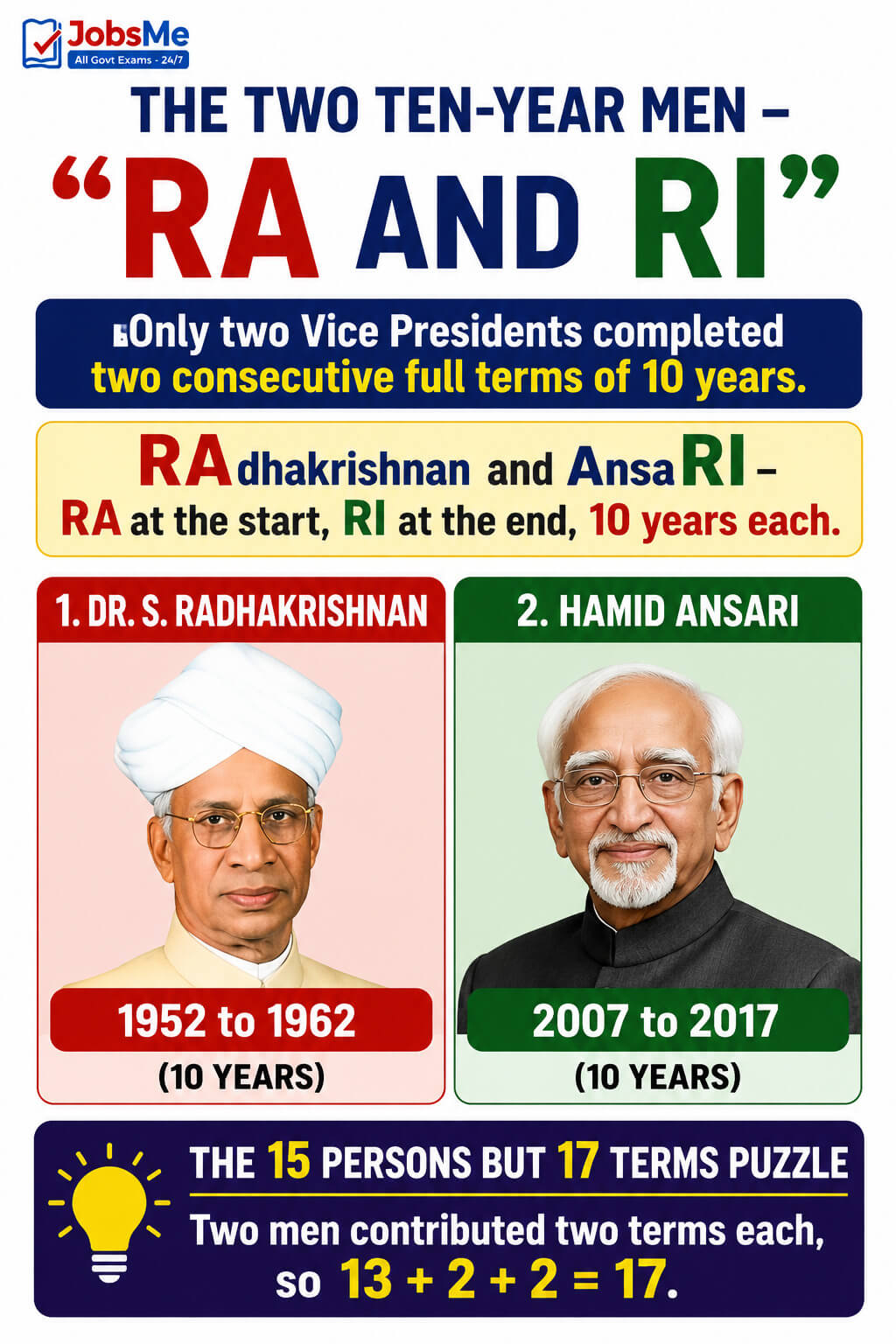
Only two Vice Presidents completed two consecutive full terms of 10 years.
"RAdhakrishnan and AnsaRI - RA at the start, RI at the end, 10 years each."
- Dr. S. Radhakrishnan: 1952 to 1962.
- Hamid Ansari: 2007 to 2017.
- This is also the key to the 15 persons but 17 terms puzzle: two men contributed two terms each, so 13 + 2 + 2 = 17.
Trick 3: Six VPs who became President - "RA-ZA-GI-VE-SHA-NA"
"RA-ZA-GI-VE-SHA-NA" gives you all six in chronological order.
- RA - Radhakrishnan
- ZA - Zakir Husain
- GI - Giri
- VE - Venkataraman
- SHA - Shankar Dayal Sharma
- NA - Narayanan
Remember the exclusions too: Hidayatullah, Ansari, Naidu, Shekhawat and Dhankhar never became President, and Shekhawat actually contested and lost.
Trick 4: Articles 63 to 71 as a life story
Read the articles as one continuous narrative and the order sticks by itself.
"He Exists (63), he Chairs (64), he Acts (65), he is Elected (66), he serves a Term (67), a Vacancy is filled (68), he takes an Oath (69), Others may step in (70), and Disputes go to the Supreme Court (71)."
- Odd-looking but useful: 63 creates, 71 litigates. If a question mentions the Supreme Court and the VP election together, the answer is Article 71.
- Article 68 is the "casual vacancy plus full term" article - this is why C. P. Radhakrishnan's term runs to 2030, not to August 2027.
Trick 5: The three Acting Presidents - "69, 77, 82"
Three acting stints, three ascending year-pairs.
- 6-9 - V. V. Giri, 1969, after Zakir Husain died.
- 7-7 - B. D. Jatti, 1977, after Fakhruddin Ali Ahmed died.
- 8-2 - Justice Hidayatullah, 1982, while Zail Singh was abroad for surgery.
"Giri went, Jatti sat, Hidayatullah stood in twice." Hidayatullah's first stint in 1969 was as CJI, not as VP.
Trick 6: The removal rule - "14 days, RS first, LS second"
"Rajya Sabha Removes, Lok Sabha Ratifies" - both start with the same letter as their role.
- 14 days' notice is compulsory.
- Resolution can originate only in the Rajya Sabha, passed by effective majority.
- The Lok Sabha then agrees by simple majority.
- No grounds are prescribed, and no VP has ever been removed.
Trick 7: Contrast trick - who died where
Deaths in office are a classic trap because two Presidents and one Vice President died in harness.
- Krishan Kant - the only Vice President to die in office, in 2002. "Kant Could not Complete."
- Zakir Husain (1969) and Fakhruddin Ali Ahmed (1977) - Presidents who died in office. Zakir Husain is the trap: he was a former VP, but he died as President.
Trick 8: Contrast trick - VP election versus President election
Learn this as a pair of opposites rather than two separate lists.
- MLAs: vote for the President, but not for the Vice President.
- Nominated MPs: vote for the Vice President, but not for the President.
- "MLAs for the top job, nominated MPs for the second job."
- Qualification: President needs Lok Sabha eligibility, Vice President needs Rajya Sabha eligibility. "Upper post, Upper House."
Additional Notes
Frequently Confused Facts
- Effective majority versus special majority: The Vice President is removed by an effective majority of the Rajya Sabha, meaning a majority of all its then members. It is not a two-thirds special majority. The President's impeachment, by contrast, needs a special majority in both Houses.
- Removal grounds: The President can be impeached only for violation of the Constitution. For the Vice President the Constitution prescribes no grounds at all.
- Six months versus full term: The Indian VP acts as President for a maximum of six months. The US VP becomes President for the remaining term. Do not mix the two.
- Money Bill and joint sitting: Only the Lok Sabha Speaker certifies a Money Bill and presides over a joint sitting. The Rajya Sabha Chairman can do neither.
- Salary source: The Vice President draws Rs 4 lakh per month as Rajya Sabha Chairman, not as Vice President. When acting as President he draws the President's salary of Rs 5 lakh instead.
- Dr. S. Radhakrishnan versus C. P. Radhakrishnan: The 1st and the 15th Vice President share a surname and both hail from Tamil Nadu, but they are unrelated and belong to entirely different eras.
- 15 persons versus 17 terms: C. P. Radhakrishnan is the 15th Vice President by person and the 17th by term. Both numbers are correct; the framing of the question decides the answer.
- Resignations: Three Vice Presidents resigned - V. V. Giri to contest the Presidential election, Bhairon Singh Shekhawat after losing it, and Jagdeep Dhankhar on health grounds. Only Dhankhar's resignation was unconnected to a Presidential poll.
- Election date versus oath date: C. P. Radhakrishnan was elected on 9 September 2025 but assumed office on 12 September 2025. Questions asking "since when" expect 12 September 2025.
- Casting vote: The Rajya Sabha Chairman has only a casting vote in a tie. He has no ordinary vote because he is not a member of the House.
- Oath authority: The Vice President takes oath before the President. The President takes oath before the Chief Justice of India.
Repeating PYQ Patterns
- UPSC Prelims: Favours the conceptual side - the composition of the electoral college, whether nominated members can vote, the exact majority needed for removal, the six-month limit under Article 65, and the effect of Article 71 on a disputed election. Statement-based questions on the Rajya Sabha Chairman versus the Lok Sabha Speaker are common.
- SSC CGL, CHSL, MTS and RRB NTPC: Prefer direct factual recall - the first Vice President, the current Vice President, who died in office, who was the only CJI to become VP, and which articles deal with the office. These are straight one-mark questions, so the list and the article numbers must be automatic.
- IBPS PO, IBPS Clerk and SBI General Awareness: Focus on the current holder, the year and result of the latest election, and the fact that the VP chairs the Rajya Sabha. Pair this with banking awareness notes so your GA section is covered from both sides.
- State PCS and Insurance exams: Ask comparison questions - VP versus President on qualification, removal and tenure, and occasionally the India-USA comparison. Numerical details such as 20 proposers, 20 seconders and the Rs 15,000 deposit also surface here.
- Most repeated single facts across all exams: Article 63, Article 65, Dr. S. Radhakrishnan as first VP, Krishan Kant as the only VP to die in office, and the six VPs who became President.
Quick Insight
The period between July and September 2025 turned this static topic into live current affairs. Jagdeep Dhankhar's resignation on 21 July 2025 left the second-highest constitutional office empty for nearly seven weeks, and because the Constitution has no provision for an Acting Vice President, the Deputy Chairman of the Rajya Sabha presided over the Upper House until a successor took charge. The election on 9 September 2025 was also the first Vice Presidential election held in the new Parliament building, and it recorded visible cross-voting because MPs are not bound by a party whip in this secret ballot. A further point worth noting is that C. P. Radhakrishnan's term does not simply run out the balance of Dhankhar's tenure: under Article 68(2), a person elected to a casual vacancy receives a fresh five-year term, so this term extends to 2030.
Because examiners lift questions directly from such events, it helps to test yourself rather than only read. Attempt the static GK quiz sets after finishing this page, and keep tracking notifications through the latest government job notifications so your preparation and application timelines stay in sync.
One-Liners for Quick Revision
- Office created by - Article 63 - simply declares that there shall be a Vice-President of India.
- Rank in precedence - Second-highest constitutional office - ranks immediately after the President.
- Ex officio position - Chairman of the Rajya Sabha - under Article 64; he is not a member of the House he chairs.
- Total number of Vice Presidents - 15 persons and 17 terms - two holders served two terms each.
- Dr. Sarvepalli Radhakrishnan - 1st VP, 13 May 1952 to 12 May 1962 - philosopher, served two full terms, became 2nd President, Bharat Ratna 1954, birthday observed as Teachers' Day.
- Dr. Zakir Husain - 2nd VP, 13 May 1962 to 12 May 1967 - became 3rd President and first Muslim President, died in office as President in 1969, Bharat Ratna 1963.
- V. V. Giri - 3rd VP, 13 May 1967 to 20 July 1969 - first VP to act as President and first to resign, later 4th President, only President elected as an independent, Bharat Ratna 1975.
- Gopal Swarup Pathak - 4th VP, 31 August 1969 to 30 August 1974 - eminent lawyer and former Governor of Mysore, took office after the post lay vacant for about six weeks.
- B. D. Jatti - 5th VP, 31 August 1974 to 30 August 1979 - former Chief Minister of Mysore State, Acting President from 11 February to 25 July 1977, then resumed as VP.
- Justice M. Hidayatullah - 6th VP, 31 August 1979 to 30 August 1984 - 11th CJI, elected unanimously, acted as President twice (1969 as CJI, 1982 as VP), only person to have been CJI, Acting President and VP.
- R. Venkataraman - 7th VP, 31 August 1984 to 24 July 1987 - Constituent Assembly member and former Union Finance Minister, became 8th President.
- Dr. Shankar Dayal Sharma - 8th VP, 7 September 1987 to 24 July 1992 - former Chief Minister of Bhopal State and Governor of three States, became 9th President.
- K. R. Narayanan - 9th VP, 21 August 1992 to 24 July 1997 - first Dalit VP and later first Dalit President, diplomat and Ambassador to China and the USA, won 700 of 701 valid votes in 1992, the highest ever VP margin.
- Krishan Kant - 10th VP, 21 August 1997 to 27 July 2002 - the only Vice President to die in office, IIT (BHU) graduate, former Governor of Andhra Pradesh.
- Bhairon Singh Shekhawat - 11th VP, 19 August 2002 to 21 July 2007 - three-time Chief Minister of Rajasthan, lost the 2007 Presidential election to Pratibha Patil and resigned as VP.
- Mohammad Hamid Ansari - 12th VP, 11 August 2007 to 10 August 2017 - served two consecutive terms of 10 years, career diplomat and former Vice-Chancellor of Aligarh Muslim University.
- M. Venkaiah Naidu - 13th VP, 11 August 2017 to 11 August 2022 - former BJP national President and Union Minister, won with 516 votes against Gopalkrishna Gandhi's 244.
- Jagdeep Dhankhar - 14th VP, 11 August 2022 to 21 July 2025 - senior advocate and former Governor of West Bengal, won with 528 votes against Margaret Alva's 182, resigned citing health reasons.
- C. P. Radhakrishnan - 15th VP, from 12 September 2025 - current Vice President, elected 9 September 2025 with 452 votes against B. Sudershan Reddy's 300, former Governor of Jharkhand, Telangana and Maharashtra and Lieutenant Governor of Puducherry, two-time Lok Sabha MP from Coimbatore, born in Tiruppur, Tamil Nadu.
- 2025 election numbers - 781 electors, 767 voted, 752 valid, 15 invalid - turnout about 98.2 per cent, required first-preference quota 377 after invalid votes, margin 152.
- Electoral college - Both Houses of Parliament, full strength 788 - includes 12 nominated Rajya Sabha members; MLAs excluded.
- Method of election - Proportional representation by single transferable vote through secret ballot - every vote has a value of one and no party whip applies.
- Nomination requirement - 20 proposers and 20 seconders - with a security deposit of Rs 15,000.
- Conducting authority - Election Commission of India - Returning Officer is the Secretary-General of the Rajya Sabha or Lok Sabha by rotation.
- Minimum age - 35 years - same as for the President.
- Key qualification difference - Must be qualified for election to the Rajya Sabha - the President must be qualified for the Lok Sabha.
- Term - Five years - continues in office until the successor enters office, and re-election is permitted without limit.
- Resignation - Addressed in writing to the President - three VPs have resigned: Giri, Shekhawat and Dhankhar.
- Removal - Effective majority in the Rajya Sabha plus Lok Sabha agreement, 14 days' notice - no grounds specified, and no VP has ever been removed.
- Oath - Administered by the President under Article 69 - or by a person appointed by the President.
- Acting as President - Maximum six months under Article 65 - he then enjoys the President's powers and salary but cannot chair the Rajya Sabha.
- Vacancy in the VP office - No Acting Vice President exists - the office stays vacant and the Deputy Chairman presides over the Rajya Sabha.
- Casual vacancy term - Article 68(2) gives a fresh five-year term - not merely the unexpired portion.
- Election disputes - Decided exclusively by the Supreme Court under Article 71 - acts done before the election is voided remain valid.
- Salary - Rs 4 lakh per month as Rajya Sabha Chairman under Article 97 - the President draws Rs 5 lakh per month.
- Powers as Chairman - Presides, maintains order, interprets rules, decides anti-defection cases for Rajya Sabha members, holds a casting vote - cannot certify Money Bills or preside over joint sittings.
- VPs who became President - Six - Radhakrishnan, Zakir Husain, Giri, Venkataraman, Shankar Dayal Sharma and Narayanan.
- Acting Presidents linked to this office - Three occasions - Giri (1969), Jatti (1977) and Hidayatullah (1982 as VP, plus 1969 as CJI).
- Longest-serving Vice Presidents - Dr. S. Radhakrishnan and Hamid Ansari - 10 years each across two consecutive terms.
- Only VP to die in office - Krishan Kant - on 27 July 2002.
- First VP from the judiciary - Justice M. Hidayatullah - also the only unanimously elected Vice President.
- First Dalit VP - K. R. Narayanan - who also became the first Dalit President of India.
- India versus USA - Indian VP acts as President for six months maximum, US VP completes the full remaining term - the Indian VP is elected separately, the US VP on a joint ticket.
Facts stay in memory only when they are tested, so convert this reading into practice straight away. Attempt the daily current affairs quiz to lock in the 2025 election data, revise related polity and general awareness topics through the static GK notes library, and if your target exam has a computer section, keep it moving in parallel with the computer awareness practice sets.
Free quiz • No signup required
Put this topic into practice with Indian Cultural Institutions – Static GK MCQ Quiz. It is the quickest way to reinforce what you just learned.
Frequently Asked Questions
Who is the current Vice President of India in 2026?
Who was the first Vice President of India?
How many Vice Presidents has India had so far?
Which articles of the Constitution deal with the Vice President of India?
Who votes in the Vice Presidential election of India?
Can nominated members of Parliament vote in the Vice Presidential election?
What is the procedure for removing the Vice President of India?
For how long can the Vice President act as President of India?
Which Vice President of India died in office?
How many Vice Presidents of India later became President?

About the author