
Static GK Notes – Topic-Wise Study Material – Sports
Showing 12 posts tagged Sports in Static GK.
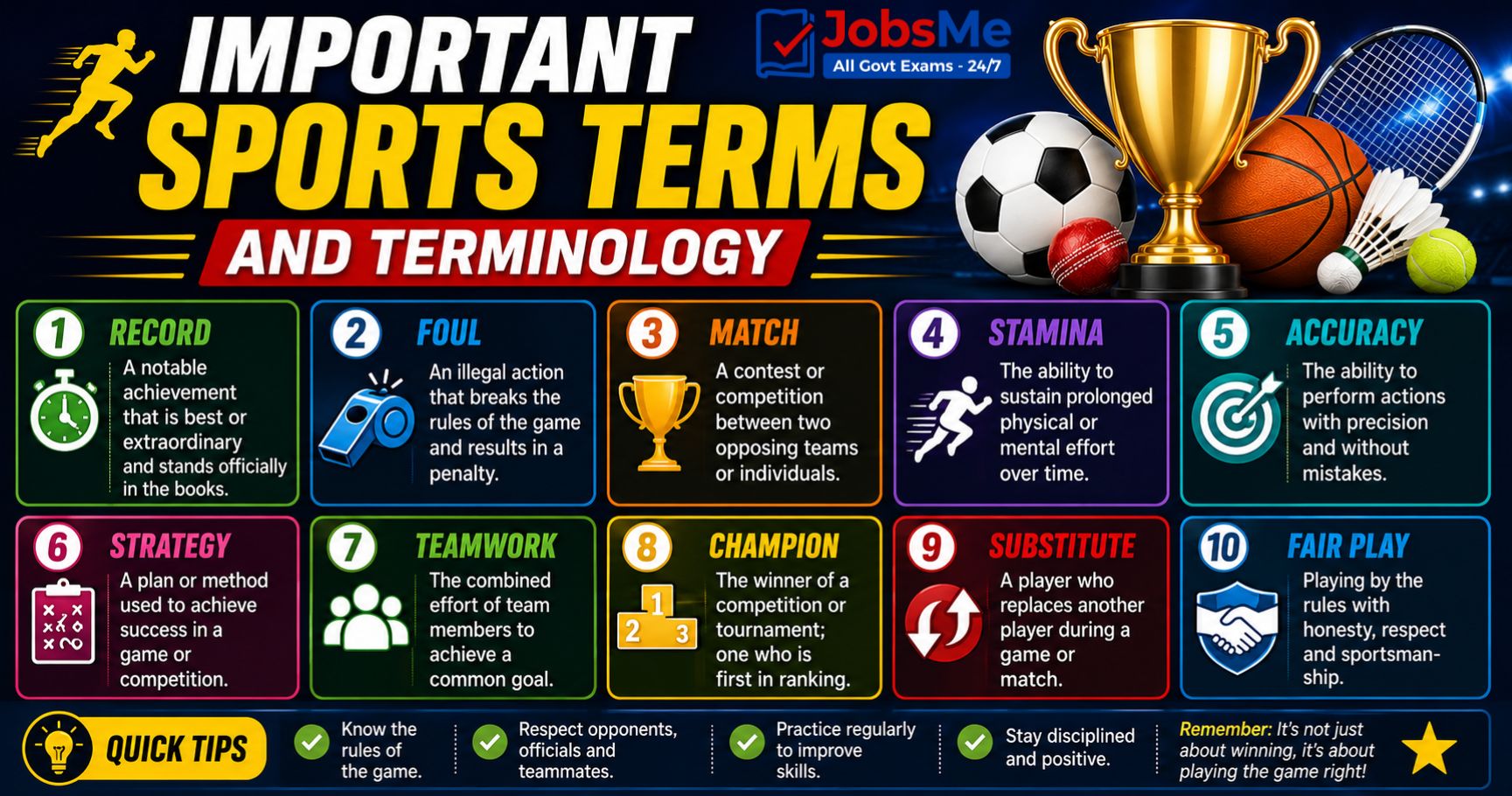
Sports Terminology – Important Sports Terms
This article presents a complete list of sports terminology covering cricket, football, hockey, tennis, badminton, basketball, boxing, swimming, athletics, chess, golf, and many other games, along with their meanings and exam-relevant facts, making it an essential resource for UPSC, SSC, IBPS, RRB, and other government exam aspirants. It includes commonly tested terms like Yorker, Hat-trick, Deuce, Bull's Eye, Slam Dunk, and Bunker, along with memory tricks and one-liners for quick revision. All facts are arranged in exam-ready format to help students score better in General Awareness sections.
Sports Cups/Trophies
This article covers a comprehensive list of national and international sports cups and trophies associated with cricket, football, hockey, tennis, badminton, golf, and other major sports. It is designed for UPSC, SSC, IBPS, RRB, Insurance, Defence, and State PCS aspirants, with memory tricks, one-liners, and FAQs for quick revision. All facts are organised in an exam-ready format to help students score better in the General Awareness section.
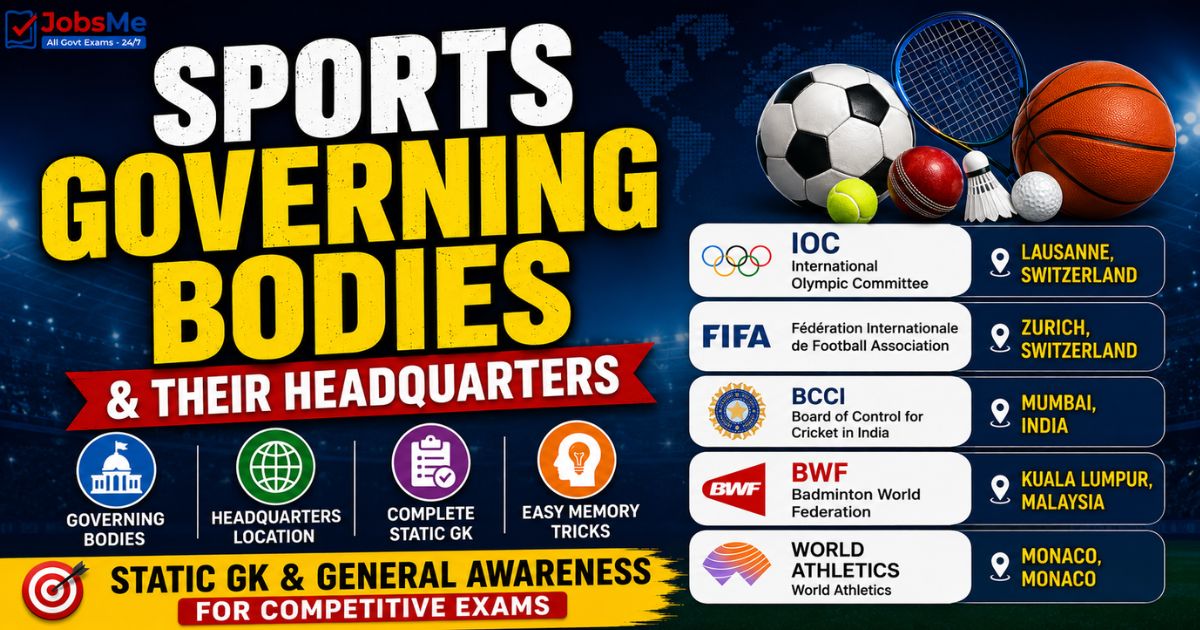
Sports Governing Bodies and Their Headquarters: Complete Static GK and General Awareness Notes for Competitive Exams
This article covers every important sports governing body and its headquarters, founding year and flagship event, from the IOC and FIFA to India's MYAS, SAI, IOA and BCCI. It also explains the new National Sports Governance Act, 2025, the boxing governance change and the difference between governing bodies and professional leagues. With tables, mnemonics, confusion-clearing notes and one-liners, it is built for fast revision before SSC, IBPS, RRB, Insurance, Defence and UPSC exams.
IPL and Domestic Cricket Static GK: Complete Winners List, Trophies, Records and One-Liners
This article covers the complete IPL winners list from 2008 to 2026 along with runners-up, captains, final venues, Orange Cap, Purple Cap and MVP winners. It also explains every major Indian domestic cricket trophy such as the Ranji Trophy, Duleep Trophy, Irani Cup, Vijay Hazare Trophy and Syed Mushtaq Ali Trophy, with the latest 2025-26 season champions. Exam aspirants get memory tricks, frequently confused facts and quick revision one-liners for the General Awareness section.
Commonwealth Games and Asian Games – Static GK & General Awareness for Competitive Exams with Memory Tricks
This article covers the complete Static GK on the Commonwealth Games and the Asian Games – their origin, governing bodies, mottos, symbols, host city lists, mascots and India's full medal record in both events. It includes the latest updates such as Glasgow 2026, Amdavad (Ahmedabad) 2030 Centenary Commonwealth Games, Aichi-Nagoya 2026 Asian Games and India's record 107-medal haul at Hangzhou. All facts are arranged in exam-ready tables with memory tricks and one-liners to help UPSC, SSC, IBPS, RRB, PSU, Insurance and State PCS aspirants score better in General Awareness and Sports GK.
Chess Titles and Organizations – Static GK & General Awareness for Competitive Exams with Memory Tricks
This article presents a complete list of chess titles and chess organizations, covering FIDE player titles (Grandmaster, International Master, FIDE Master, Candidate Master), the parallel women's titles (WGM, WIM, WFM, WCM), Arena online titles, and arbiter, trainer, and organizer titles, along with rating and norm requirements for each. It also covers the key governing bodies such as FIDE and the All India Chess Federation (AICF), with memory tricks and one-liners for quick revision. All facts are arranged in exam-ready format to help UPSC, SSC, IBPS, RRB, PSU, and State PCS aspirants score better in General Awareness and Sports GK sections.
Grand Slam Tournaments and Tennis – Static GK & General Awareness for Competitive Exams with Memory Tricks
This article covers the four tennis Grand Slam tournaments – the Australian Open, French Open (Roland Garros), Wimbledon, and US Open – along with their venues, surfaces, all-time singles records, Indian Grand Slam winners, and the latest 2025 and 2026 champions. It includes key facts like Novak Djokovic's record 24 men's titles, Margaret Court's 24 women's titles, Rafael Nadal's 14 French Open crowns, and India's doubles legends Leander Paes, Mahesh Bhupathi, Sania Mirza, and Rohan Bopanna, with memory tricks and one-liners for quick revision. All facts are arranged in exam-ready format to help UPSC, SSC, IBPS, RRB, PSU, and State PCS aspirants score better in the Sports General Awareness section.
Olympic Games History – Static GK & General Awareness for Competitive Exams with Memory Tricks
This article presents a complete history of the Olympic Games, covering the Ancient Olympics of Greece (776 BC to 393 AD), the revival of the Modern Olympics in 1896 by Pierre de Coubertin, key Olympic symbols like the rings, flame, motto and mascot, the Winter Olympics and Paralympics, and India's Olympic journey from Norman Pritchard to Neeraj Chopra. It includes host-city facts, medal milestones, memory tricks and one-liners for quick revision. All facts are arranged in exam-ready format to help UPSC, SSC, IBPS, RRB, PSU, Insurance and State PCS aspirants score better in General Awareness and Sports GK sections.
Stadiums of India Static GK: Complete State-Wise List for SSC, Banking & UPSC Exams
This article covers a complete state-wise list of cricket, football, hockey, and multi-purpose stadiums in India along with their locations and key features. It is designed as ready Static GK notes for SSC, Banking, Railways, UPSC, Insurance, and State PSC aspirants, with memory tricks, one-liners, and exam-style FAQs for quick revision.
Famous Sports Stadiums and Venues of the World – Static GK & General Awareness for Competitive Exams with Memory Tricks
This article presents a complete, exam-ready list of the most famous sports stadiums and venues of the world along with their location, sport, and key features, covering record-holders like the Narendra Modi Stadium (largest cricket stadium), Rungrado 1st of May Stadium (largest football stadium), and Maracana, plus iconic venues such as Wembley, Camp Nou, Lord's, Wimbledon, the MCG, and Madison Square Garden. It also includes a dedicated India-specific table of major cricket and sports stadiums, with memory tricks and one-liners for quick revision. All facts are arranged in a structured format to help UPSC, SSC, IBPS, RRB, PSU, Defence, and State PCS aspirants score better in General Awareness and Static GK sections.
Number of Players in Various Sports and Games – Static GK & General Awareness for Competitive Exams with Memory Tricks
This article presents a complete list of the number of players in various sports and games, covering popular team sports like Cricket, Football, Hockey, and Kabaddi, as well as individual and racquet games like Chess, Boxing, and Table Tennis. It includes the players per side, key facts, and singles/doubles formats, along with memory tricks and one-liners for quick revision. All facts are arranged in exam-ready format to help UPSC, SSC, IBPS, RRB, PSU, and State PCS aspirants score better in the General Awareness and Sports GK sections.
List of National Games of Countries – Static GK & General Awareness for Competitive Exams with Memory Tricks
This article presents a complete, exam-ready list of the national games of countries around the world, covering popular sports like Field Hockey (India and Pakistan), Sumo Wrestling (Japan), Baseball (USA), Cricket (England and Australia), Taekwondo (South Korea), and unique traditional games like Buzkashi (Afghanistan) and Pato (Argentina). It clearly explains the difference between De Jure (officially declared by law) and De Facto (traditionally accepted) national games, along with establishment years, memory tricks, and one-liners for quick revision. All facts are arranged in a structured format to help UPSC, SSC, IBPS, RRB, PSU, and State PCS aspirants score better in the General Awareness and Sports GK sections.
Recent posts

Latest quizzes
New job notifications

Introduction
JobsMe's Static GK posts are comprehensive, exam-mapped topic guides built for aspirants who want more than a bare list of facts. Each post covers one Static GK topic in full - with structured tables, previous year question (PYQ) analysis, category-wise organisation, and topic-specific memory tricks that help you learn faster and retain longer. After reading any post, test yourself with the corresponding interactive quiz from the Static GK quiz archive, and if you are logged in, track how your score improves with every attempt.
Looking for current events to complement your static preparation? Visit daily current affairs or catch up with monthly current affairs.
What Makes JobsMe Static GK Posts Different
Every Static GK topic on the internet has been covered by dozens of platforms. What sets JobsMe apart is how each topic is presented - built specifically for exam performance, not just information.
Exam-Pattern Framing, Not Just Facts
Every post opens with a statement of how questions from that topic are typically asked in competitive exams - whether as one-liners, match-the-following, multi-statement correct/incorrect, or identification-based MCQs. This framing means you read the content with the right exam lens from the very first paragraph. You are not just learning facts; you are learning how those facts get tested.
Previous Year Question (PYQ) Analysis
Each post includes a section on how that topic has been asked in previous papers - specific questions from UPSC Prelims, SSC CGL, IBPS PO, RRB NTPC, and other exams. This shows you which sub-topics within each Static GK category are tested most frequently and should receive the most preparation time.
Memory Tricks Built Into Every Topic
Memorising hundreds of Static GK facts is genuinely difficult without good mnemonic strategies. JobsMe posts include custom-built memory tricks for every topic - acronyms for grouping related items, visual association techniques for facts that are hard to distinguish, chronological patterns for historical events, and rhyme-based recall for numerical facts. These are not generic tips; they are written specifically for the facts in that post.
Structured Tables and Quick Revision Charts
Every post includes at least one structured table or quick-revision chart - such as a country-capital-currency table, a dynasty timeline, a battles-date-outcome matrix, or an organisation-headquarters grid. These tables are designed to be saved, printed, or screenshotted for last-minute revision. They contain everything you need to answer exam questions on that topic without any additional reading.
Topic-Wise Coverage - What's Available
Below is a guide to the key Static GK topics covered or planned in JobsMe's post archive. Each topic links to its dedicated post.
Indian History Topics
- Founders and Rulers of Indian Dynasties (Ancient to Medieval)
- Important Battles in Indian History (Ancient, Medieval, Colonial)
- The Indian National Movement - Key Events and Personalities
- Mughal Empire - Rulers, Contributions, Administration
- Colonial India - British East India Company to Independence
World and Indian Geography Topics
- Countries, Capitals and Currencies of the World
- Superlatives of India and the World (Largest, Longest, Highest, Smallest)
- Indian Cities and Their Nicknames
- Important Rivers of India - Origins, Tributaries, Dams
- National Parks, Wildlife Sanctuaries, and Biosphere Reserves of India
- Important Mountain Passes and Peaks of India and the World
International Organisations and Institutions
- International Organisations and Their Headquarters
- United Nations and Its Principal Organs
- Specialised Agencies of the UN (WHO, UNESCO, ILO, UNICEF, FAO)
- Financial Institutions - IMF, World Bank, ADB, NDB
- Regional Organisations - SAARC, ASEAN, SCO, BRICS, G20, G7, QUAD
Indian Polity and Constitution
- Fundamental Rights (Articles 12-35)
- Directive Principles of State Policy (Articles 36-51)
- Important Constitutional Articles at a Glance
- Important Constitutional Amendments (42nd, 44th, 73rd, 74th, 86th, 101st)
- Constitutional Bodies - Election Commission, CAG, UPSC, Finance Commission
- National Symbols of India - Animal, Bird, Flower, Fruit, Tree, Emblem, Song
Economy and Banking Topics
- Important RBI Rates and Their Definitions
- Headquarters of Indian and International Banks
- Important Economic Concepts - GDP, GNP, Inflation Types, Fiscal Deficit
- Five-Year Plans and NITI Aayog
- Stock Exchanges - NSE, BSE, Global Exchanges
Science and Technology Topics
- Important Inventions and Their Inventors
- Diseases, Deficiencies, and their Causal Organisms
- ISRO Missions - Satellites, Launch Vehicles, Space Probes
- Human Body - Important Glands, Organs, and Functions
- Important Scientific Principles and Laws
Culture, Awards, and Miscellaneous
- Padma Awards - Complete List of Bharat Ratna, Padma Vibhushan, Padma Bhushan, Padma Shri
- Nobel Prize - Subject, First Indian Winner, Recent Winners
- Sahitya Akademi and Jnanpith Award Winners
- Classical Dance Forms of India and Their States of Origin
- Books and Authors - Famous Indian and World Literature
- Stadiums, Sports Trophies, and Tournament Names
- Important Committees and Commissions - and Their Purpose
How to Read Static GK Posts for Maximum Retention
Step 1 - Read with a Question in Mind
Before opening any Static GK post, ask yourself: "How would an examiner turn this into a question?" For a post on Countries-Capitals-Currencies, the examiner might ask the capital of a lesser-known country, or the currency used by a country that shares a currency name with another. Reading with this question lens focuses your attention on the most testable facts.
Step 2 - Focus on Tables and Charts First
In a long Static GK post, the table or quick-revision chart at the end contains the exam-critical facts in their densest form. Read the table first to understand the scope of what needs to be memorised, then read the narrative text to understand the context and patterns. This sequence is faster and more efficient than reading top-to-bottom.
Step 3 - Apply the Memory Tricks
Do not skip the memory tricks section. The 2-3 minutes spent encoding a mnemonic for a group of facts will save you from blanking on those facts under exam pressure. Memory tricks are most effective when you create a mental image or association actively - do not just read the trick, actually visualise it.
Step 4 - Attempt the Quiz Immediately
Within 30 minutes of finishing the post, go to the quiz archive and attempt the corresponding quiz. This immediate testing is far more effective for retention than reviewing the post again. Focus especially on the explanation for any question you got wrong.
Step 5 - Re-Attempt After Spaced Intervals
Return to the quiz 3-5 days later and attempt it again without reviewing the post. This is spaced repetition - proven by decades of memory research to be the most effective long-term retention strategy. If you are logged in, your history will show you exactly which attempts had which scores, so you can see the improvement directly.