Commonwealth Games and Asian Games – Static GK & General Awareness for Competitive Exams with Memory Tricks
This article covers the complete Static GK on the Commonwealth Games and the Asian Games – their origin, governing bodies, mottos, symbols, host city lists, mascots and India's full medal record in both events. It includes the latest updates such as Glasgow 2026, Amdavad (Ahmedabad) 2030 Centenary Commonwealth Games, Aichi-Nagoya 2026 Asian Games and India's record 107-medal haul at Hangzhou. All facts are arranged in exam-ready tables with memory tricks and one-liners to help UPSC, SSC, IBPS, RRB, PSU, Insurance and State PCS aspirants score better in General Awareness and Sports GK.
Jump to section
- Introduction
- Core Concepts: Understanding Both Events
- Commonwealth Games - Origin, History and Governance
- Commonwealth Games Host Cities - Complete List
- Commonwealth Games Glasgow 2026 - Complete Details
- Commonwealth Games Amdavad (Ahmedabad) 2030 - Centenary Games
- India at the Commonwealth Games - Full Record
- Asian Games - Origin, History and Governance
- Asian Games Host Cities - Complete List
- Asian Games 2026 - Aichi-Nagoya, Japan
- India at the Asian Games - Full Record
- India's Future Hosting Ambitions
- Memory Tricks and Mnemonics
- Additional Notes
- One-Liners for Quick Revision
Introduction
The Commonwealth Games and the Asian Games are the two most important multi-sport events for Indian exam aspirants after the Olympics. The Commonwealth Games bring together the nations and territories of the Commonwealth of Nations, while the Asian Games, also called the Asiad, are Asia's own continental championship. India has a special connection with both: it hosted the first-ever Asian Games in New Delhi in 1951, staged the 2010 Commonwealth Games in Delhi, and will host the 2030 Centenary Commonwealth Games in Amdavad (Ahmedabad).
Questions from this topic appear almost every year in SSC CGL, SSC CHSL, IBPS PO, IBPS Clerk, SBI PO, RRB NTPC, RRB Group D, LIC AAO, NIACL, UPSC Prelims and State PCS exams. The most commonly asked areas are first editions, host cities, governing bodies, mottos, mascots, India's medal tallies and the athletes behind India's landmark firsts. This article organises every one of those facts in one place. For regularly updated sports and awards news, aspirants can also follow the daily current affairs section.
Sports GK is one of the highest-return areas in General Awareness because the facts are finite, factual and repeat across exams. With Glasgow 2026 and Aichi-Nagoya 2026 both taking place in the same calendar year, and India bidding for the 2036 Olympics and the 2038 Asian Games, this topic also carries strong current affairs and interview value.
Core Concepts: Understanding Both Events
Before memorising data, it helps to be clear about what separates these two events from each other and from the Olympics.

- Commonwealth Games: A quadrennial multi-sport event contested only by members and territories of the Commonwealth of Nations, most of them former British territories. It is the third-largest multi-sport event in the world after the Summer Olympics and the Asian Games.
- Asian Games (Asiad): A quadrennial continental multi-sport event for Asian nations, and the second-largest multi-sport event in the world after the Olympics.
- Why India does well at the Commonwealth Games: Sporting superpowers such as the United States, China, Russia, Germany and Japan are not Commonwealth members, so the competition pool is smaller and India regularly finishes in the top five.
- Why the Asian Games are harder for India: China, Japan and South Korea - three of the world's strongest sporting nations - all compete, which is why India's usual finish is fourth or fifth despite large medal counts.
- Regional sports: Both events include sports missing from the Olympics. The Commonwealth Games feature lawn bowls, netball, squash and rugby sevens, while the Asian Games include kabaddi, wushu, sepaktakraw, kurash, dragon boat, xiangqi and esports.
Commonwealth Games vs Asian Games vs Olympics - Comparison
| Feature | Commonwealth Games | Asian Games | Summer Olympics |
|---|---|---|---|
| First edition | 1930, Hamilton, Canada (as British Empire Games) | 1951, New Delhi, India | 1896, Athens, Greece (modern era) |
| Governing body | Commonwealth Games Federation (CGF), rebranded Commonwealth Sport in March 2025 | Olympic Council of Asia (OCA); earlier the Asian Games Federation | International Olympic Committee (IOC) |
| Participants | 56 Commonwealth member states, but 74 teams (CGAs) because UK home nations and territories compete separately | 45 OCA members eligible; 46 National Olympic Committees have participated historically | 206 National Olympic Committees |
| Scale | Around 4,500-6,600 athletes, roughly 20 sports in a full edition | Around 11,000-12,000 athletes, 40 or more sports | Around 11,000 athletes |
| Frequency | Every four years | Every four years, usually mid-way through the Olympic cycle | Every four years |
| India's typical finish | 2nd to 5th | 4th to 5th | Outside the top 20 |
| Signature relay | King's Baton Relay (earlier Queen's Baton Relay), carrying the monarch's message - no flame is carried | Torch relay before the opening ceremony | Olympic Torch Relay with the flame from Olympia |
Commonwealth Games - Origin, History and Governance
The idea of an empire-wide sporting festival was first proposed in 1891 by Reverend John Astley Cooper, who wrote in The Times of London about a "Pan-Britannic" gathering. A trial event, the Inter-Empire Championships, was held in London in 1911 alongside the Festival of Empire, with Australasia, Canada, South Africa and the United Kingdom taking part. The Games proper began in 1930 at Hamilton, Ontario, Canada, organised by the Canadian administrator Melville Marks Robinson, with 11 nations and about 400 athletes competing in six sports.
Commonwealth Games Quick Facts
| Feature | Detail |
|---|---|
| Original name | British Empire Games, first held in 1930 at Hamilton, Canada |
| Idea proposed by | Reverend John Astley Cooper in 1891, through an article in The Times of London |
| First Games organised by | Melville Marks Robinson of Canada, who persuaded 11 nations to send about 400 athletes |
| Governing body | Commonwealth Games Federation (CGF), founded in 1932 as the British Empire Games Federation; rebranded as Commonwealth Sport in March 2025 |
| Headquarters | Commonwealth House, London, United Kingdom |
| Official language | English, with host nations free to add local languages in ceremonies and announcements |
| Core values | Humanity, Equality and Destiny - the three official values of the Commonwealth Sport movement |
| Member nations and teams | 56 Commonwealth member states, but 74 Commonwealth Games Associations (CGAs) send teams |
| Signature tradition | Queen's Baton Relay, started at Cardiff 1958; renamed the King's Baton Relay after King Charles III became Head of the Commonwealth |
| Special award | David Dixon Award, given at the closing ceremony to the outstanding athlete of the Games |
| Para-sport | Para-athletes fully integrated into the medal table since Manchester 2002, a global first for a major multi-sport event |
| Gender parity | Equal medal events for men and women achieved by 2018; women's events outnumbered men's by 2022 |
| India's debut | 1934, London (as British India); India skipped only the 1950 and 1962 editions |
| India's best finish | 2nd place at Delhi 2010 with 101 medals - India's only hosting so far |
Name Changes and Institutional Structure
- Name evolution: British Empire Games (1930-1950) → British Empire and Commonwealth Games (1954-1966) → British Commonwealth Games (1970-1974) → Commonwealth Games (1978 onwards).
- International Federations (IFs): Supervise each sport globally, for example FIBA for basketball and World Athletics for athletics.
- Commonwealth Games Associations (CGAs): Represent countries and territories, similar to National Olympic Committees. 74 CGAs are currently recognised.
- Organising Committees (OCCWGs): Temporary bodies that deliver an individual edition and are dissolved after the event.
- Why 74 teams for 56 nations: The UK home nations - England, Scotland, Wales and Northern Ireland - compete separately, and Crown Dependencies such as the Isle of Man, Jersey and Guernsey plus Overseas Territories such as Bermuda, Gibraltar and the Falkland Islands send their own teams.
Ceremonies and Medal Presentation
- Opening Ceremony: Begins with hoisting the host nation's flag and national anthem, along with the flags of the previous host, next host and the Commonwealth Sport flag. Athletes march grouped by nation, with the previous host first and the host nation last, and the baton carried by a distinguished athlete symbolises unity and goodwill.
- Closing Ceremony: Athletes enter together without national distinction to symbolise unity, the Games flag is handed to the representative of the next host city, and the David Dixon Award is presented.
- Medal Presentation: Medals are awarded on a three-tiered podium after each event, the gold medallist's national anthem is played, and the flags of all three medallists are raised.
Commonwealth Games Host Cities - Complete List
The Games have been staged 22 times so far, with the 23rd edition under way in 2026. Australia has hosted the most editions (five), followed by Canada with four, and Scotland, New Zealand and England with three each.
| Edition | Year | Host City and Country | Key Details |
|---|---|---|---|
| I | 1930 | Hamilton, Canada | First edition, held as the British Empire Games; 11 nations, about 400 athletes, six sports |
| II | 1934 | London, England | India's debut; wrestler Rashid Anwar won India's first Commonwealth medal (bronze) |
| III | 1938 | Sydney, Australia | Held to mark 150 years of European settlement in Australia; no Games in 1942 and 1946 due to the Second World War |
| IV | 1950 | Auckland, New Zealand | First edition after the war; India did not participate |
| V | 1954 | Vancouver, Canada | Renamed British Empire and Commonwealth Games; famous "Miracle Mile" duel between Roger Bannister and John Landy |
| VI | 1958 | Cardiff, Wales | Milkha Singh won India's first Commonwealth gold in the 440 yards; the Queen's Baton Relay was introduced |
| VII | 1962 | Perth, Australia | India did not participate in this edition |
| VIII | 1966 | Kingston, Jamaica | First edition hosted outside the traditional white dominions; name shortened in later years |
| IX | 1970 | Edinburgh, Scotland | Renamed British Commonwealth Games; metric units and electronic timing used for the first time |
| X | 1974 | Christchurch, New Zealand | India finished sixth with 15 medals, mostly from wrestling |
| XI | 1978 | Edmonton, Canada | Name shortened to Commonwealth Games; Nigeria boycotted over New Zealand's sporting links with apartheid South Africa |
| XII | 1982 | Brisbane, Australia | Badminton player Syed Modi won a memorable medal for India |
| XIII | 1986 | Edinburgh, Scotland | Hit by an African, Asian and Caribbean boycott over Britain's refusal to sanction apartheid South Africa; 32 of 59 teams stayed away |
| XIV | 1990 | Auckland, New Zealand | India finished fifth with 32 medals, led by shooting and weightlifting |
| XV | 1994 | Victoria, Canada | South Africa returned after the end of apartheid |
| XVI | 1998 | Kuala Lumpur, Malaysia | First Commonwealth Games held in Asia; team sports such as hockey and cricket were included for the first time |
| XVII | 2002 | Manchester, England | Para-sport events fully integrated into the medal table for the first time; India finished fourth with 69 medals |
| XVIII | 2006 | Melbourne, Australia | India finished fourth with 50 medals; shooter Samaresh Jung won five golds and was nicknamed "Goldfinger" |
| XIX | 2010 | Delhi, India | India's only hosting so far and its best-ever performance - 101 medals and second place; 71 teams, about 6,081 athletes, 21 sports and 272 medal events |
| XX | 2014 | Glasgow, Scotland | India finished fifth with 64 medals; Vikas Gowda won discus gold, India's first men's athletics gold in 56 years |
| XXI | 2018 | Gold Coast, Australia | India finished third with 66 medals; Neeraj Chopra won India's first Commonwealth javelin gold |
| XXII | 2022 | Birmingham, England | India finished fourth with 61 medals (22 gold, 16 silver, 23 bronze) even without shooting; Durban had been stripped of hosting rights, and Birmingham stepped in |
| XXIII | 2026 | Glasgow, Scotland | Scaled-down edition from 23 July to 2 August 2026 after Victoria, Australia withdrew; 74 teams, about 10 sports, four venues and no athletes' village |
| XXIV | 2030 | Amdavad (Ahmedabad), India | Centenary Commonwealth Games, marking 100 years since Hamilton 1930; confirmed on 26 November 2025; India's second hosting |
Commonwealth Games Glasgow 2026 - Complete Details
The XXIII Commonwealth Games are being held in Glasgow, Scotland, from 23 July to 2 August 2026. The edition is historically important for three reasons: it is the first Games held after King Charles III became Head of the Commonwealth, the first to use a deliberately scaled-down "Games Reset" model, and the first with the largest para-sport programme in Commonwealth history.
| Aspect | Detail |
|---|---|
| Edition and dates | XXIII Commonwealth Games, 23 July to 2 August 2026 |
| Host city | Glasgow, Scotland - Glasgow's second Games after 2014, and Scotland's fourth hosting after Edinburgh 1970 and 1986 |
| Why Glasgow | The Australian state of Victoria withdrew in July 2023 citing cost overruns; Glasgow agreed to host a pared-down edition to keep the four-year cycle intact |
| Participation | About 74 teams; Gabon and Togo made their Commonwealth Games debut |
| Sports programme | Around 10 sports - athletics and para athletics, swimming and para swimming, artistic gymnastics, track cycling and para track cycling, weightlifting and para powerlifting, boxing, judo, lawn bowls and para bowls, netball, 3x3 basketball and 3x3 wheelchair basketball |
| Sports dropped | Hockey, badminton, table tennis, squash, wrestling, rugby sevens, cricket, diving, triathlon and mountain biking were removed for cost and logistics reasons - several of them India's strongest disciplines |
| Para-sport | 47 para-sport events, the largest para programme in Commonwealth Games history |
| Format changes | Lawn bowls moved indoors; athletics added the mixed 4x400m relay and reintroduced the Mile as a tribute to the 1954 "Miracle Mile"; cycling retained 26 events despite dropping mountain biking |
| Venues | Only four existing venue clusters and no athletes' village - athletes stayed in hotels, cutting costs sharply |
| Funding | £100 million from the Commonwealth Games Federation, £30-50 million from commercial sources, and about AU$200 million compensation from Australia after Victoria's withdrawal |
| Mascot | Finnie, a Glaswegian unicorn designed by schoolchildren; the unicorn is Scotland's national animal and Finnie's horn is a traffic cone, a nod to Glasgow's Duke of Wellington statue tradition |
| India's contingent | Over 120 athletes across 10 sports; weightlifter Mirabai Chanu was the flag bearer and boxer Lovlina Borgohain the baton bearer at the opening ceremony; India's 19th Commonwealth Games appearance |
India at Glasgow 2026 - Early Highlights
India's campaign at Glasgow 2026 was still under way as this article was compiled, so the final tally should be checked after the closing ceremony on 2 August 2026. The landmark performances up to 31 July 2026, when India had crossed 15 medals including three golds, are listed below.
| Athlete | Event | Achievement |
|---|---|---|
| Saikhom Mirabai Chanu | Weightlifting, women's 48 kg | Won India's first gold of Glasgow 2026 with a 190 kg total (85 kg snatch and 105 kg clean and jerk), setting Games records in all three categories and a Commonwealth record in the snatch. This completed a hat-trick of Commonwealth Games golds after Gold Coast 2018 and Birmingham 2022, and was her fourth Commonwealth medal following silver at Glasgow 2014 |
| Sharmila Dhankar | Para athletics | Won India's first-ever Commonwealth Games gold in para athletics |
| Dilip Mahadu Gavit | Para athletics, men's 100 m T47 | Won gold with a Games record of 10.71 seconds; Mohammed Basil M took silver to give India a 1-2 finish |
| Gulveer Singh | Athletics, men's 10,000 m | Silver in 27:49.78 - India's first-ever Commonwealth medal in the event, and only the third individual men's track medal for India after Milkha Singh and Avinash Sable |
| Murali Sreeshankar | Athletics, men's long jump | Silver for the second successive edition after Birmingham 2022 |
| Sarvesh Kushare | Athletics, men's high jump | Silver - India's first athletics medal of the Glasgow 2026 edition |
| Seema Kaliramna | Athletics, women's discus throw | Bronze on her maiden Commonwealth Games appearance |
| Indian weightlifting team | Weightlifting | Finished with eight medals (1 gold, 6 silver, 1 bronze), including silvers for Chanambam Rishikanta Singh, Raja Muthupandi and Lovepreet Singh |
Commonwealth Games Amdavad (Ahmedabad) 2030 - Centenary Games
India will host the XXIV Commonwealth Games in 2030 in Amdavad (Ahmedabad), Gujarat. Because the edition falls exactly a hundred years after the first Games at Hamilton in 1930, it is officially styled the Centenary Commonwealth Games.
| Milestone | Detail |
|---|---|
| Union Cabinet approval | 27 August 2025 - the Indian Cabinet approved the bid and nominated Ahmedabad as the "ideal host city" |
| Formal proposal | September 2025 - presented to the Commonwealth Sport Evaluation Committee by the Government of India, the Government of Gujarat and the Commonwealth Games Association of India |
| Executive Board recommendation | 15 October 2025 - the Commonwealth Sport Executive Board recommended Ahmedabad over Abuja, Nigeria |
| Final ratification | 26 November 2025 - delegates of all 74 Commonwealth member nations and territories ratified the bid unanimously at the Commonwealth Sport General Assembly in Glasgow |
| Sports programme | 15 to 17 sports. Confirmed: athletics and para athletics, swimming and para swimming, table tennis and para table tennis, bowls and para bowls, weightlifting and para powerlifting, artistic gymnastics, netball and boxing. Under consideration: archery, badminton, 3x3 basketball, beach volleyball, T20 cricket, cycling, diving, hockey, judo, rhythmic gymnastics, rugby sevens, shooting, squash and triathlon |
| Key infrastructure | Sardar Vallabhbhai Patel Sports Enclave, estimated at about Rs 6,000 crore, with an aquatic centre, indoor arena, athlete village and upgraded stadiums |
| Supporting projects | Airport terminal expansion of about Rs 3,130 crore, metro and BRTS network upgrades, new hotels, and rezoning of roughly 200 hectares of agricultural land for sports infrastructure |
| Guiding principles | Aligned with the "Games Reset" principles of affordability, inclusivity, sustainability, gender equity and para-sport integration |
| Strategic value | Strengthens India's bid to host the 2036 Olympic Games and supports the national goal of becoming a sporting powerhouse by 2047 |
India at the Commonwealth Games - Full Record
India has been one of the most successful Commonwealth Games nations, ranking fourth all-time by gold medals. Its strengths have historically been shooting, wrestling, weightlifting, badminton, boxing and table tennis.
All-Time Commonwealth Games Medal Table (up to Birmingham 2022)
| Rank | Nation | Gold | Silver | Bronze | Total | Key Points |
|---|---|---|---|---|---|---|
| 1 | Australia | 1,001 | 832 | 763 | 2,596 | Dominant in swimming and athletics; has topped the medal table in most editions and hosted five times |
| 2 | England | 773 | 783 | 766 | 2,322 | Strong in gymnastics, athletics and team sports; has topped the table in six editions |
| 3 | Canada | 510 | 548 | 589 | 1,647 | Strong in athletics and swimming; topped the medal table once, in 1978 at Edmonton |
| 4 | India | 203 | 190 | 171 | 564 | Shooting is the biggest contributor with over 135 medals, followed by weightlifting (about 125) and wrestling (about 110); athletics has yielded 36 medals |
| 5 | New Zealand | 179 | 232 | 296 | 707 | Has a higher total than India but ranks fifth because the table is sorted by gold medals; strong in athletics, rowing and cycling |
India's Edition-Wise Performance - Key Editions
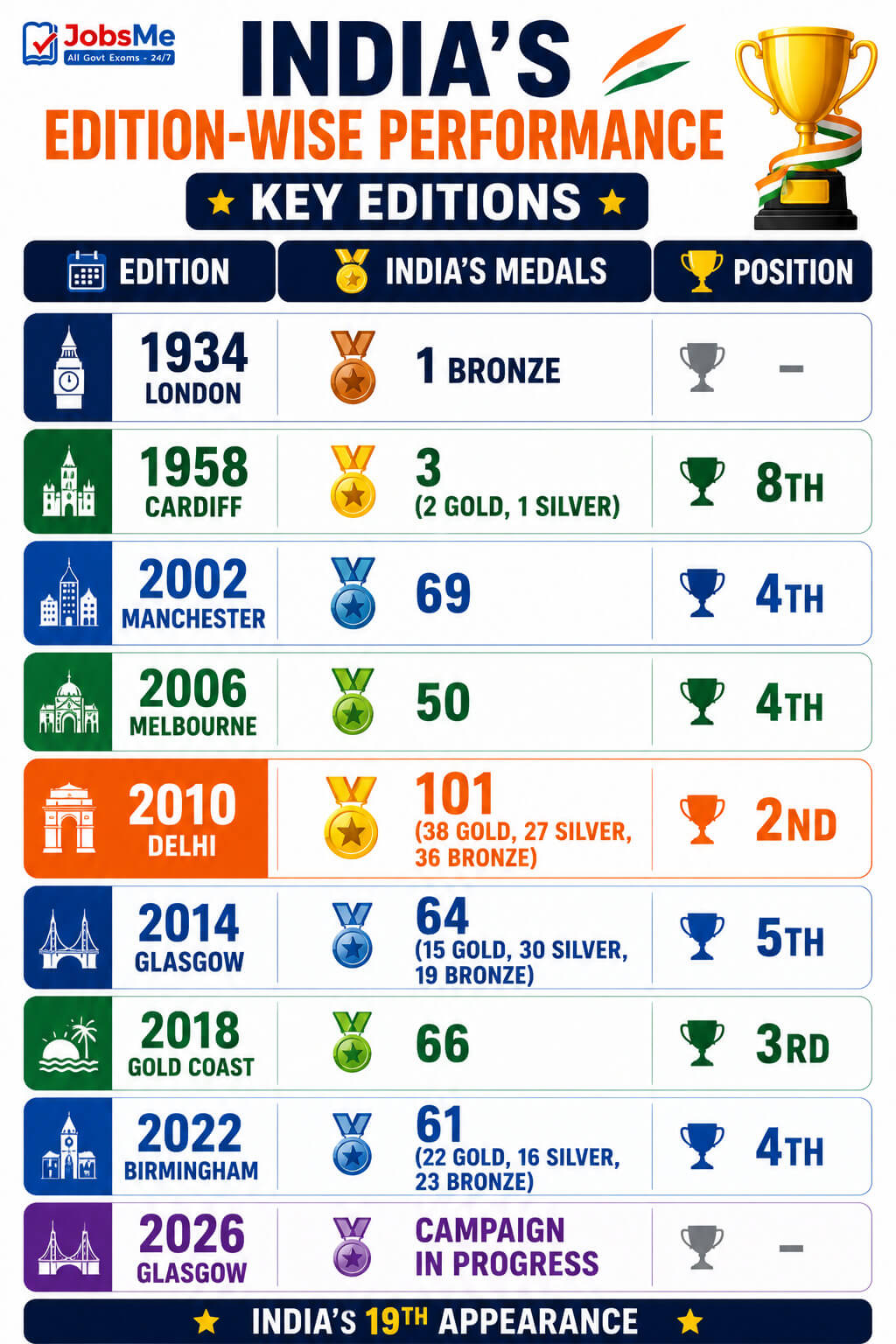
| Edition | India's Medals | Position | Highlights |
|---|---|---|---|
| 1934 London | 1 bronze | — | Debut appearance; Rashid Anwar won India's first Commonwealth Games medal in wrestling |
| 1958 Cardiff | 3 (2 gold, 1 silver) | 8th | Milkha Singh won India's first Commonwealth gold in the 440 yards in 46.6 seconds; Lila Ram Sangwan added a wrestling gold |
| 2002 Manchester | 69 | 4th | Breakthrough edition driven by shooting and weightlifting |
| 2006 Melbourne | 50 | 4th | Shooters Abhinav Bindra and Samaresh Jung starred; Jung won five golds and earned the nickname "Goldfinger" |
| 2010 Delhi | 101 (38 gold, 27 silver, 36 bronze) | 2nd | India's best-ever performance and only hosting; shooters won about 30 medals and Krishna Poonia became the first Indian woman to win a Commonwealth athletics gold, in discus throw |
| 2014 Glasgow | 64 (15 gold, 30 silver, 19 bronze) | 5th | Vikas Gowda won discus gold, India's first men's athletics gold at the Games in 56 years |
| 2018 Gold Coast | 66 | 3rd | Neeraj Chopra won India's first Commonwealth javelin gold with 86.47 m; Mirabai Chanu won weightlifting gold |
| 2022 Birmingham | 61 (22 gold, 16 silver, 23 bronze) | 4th | Achieved without shooting on the programme; Mirabai Chanu won gold, Achanta Sharath Kamal won four table tennis medals, and Eldhose Paul and Abdulla Aboobacker gave India a triple jump 1-2 |
| 2026 Glasgow | Campaign in progress | — | India's 19th appearance; Mirabai Chanu completed a hat-trick of golds and India won its first para athletics gold |
Asian Games - Origin, History and Governance
The Asian Games grew out of the Far Eastern Championship Games, first held in Manila in 1913 with six nations. After the Second World War, Guru Dutt Sondhi, India's representative on the International Olympic Committee, proposed a broader competition for the whole of Asia. The Asian Games Federation was formally inaugurated in New Delhi on 13 February 1949, and the first Games were held in New Delhi in 1951. Jawaharlal Nehru strongly backed the idea, hoping sport would rebuild the bonds broken by the war and contribute to lasting peace in Asia.
Asian Games Quick Facts
| Feature | Detail |
|---|---|
| Other name | Asiad |
| First edition | New Delhi, India, 4 to 11 March 1951 - independent India was the first host |
| Proposed by | Guru Dutt Sondhi, India's IOC representative |
| Original governing body | Asian Games Federation (AGF), inaugurated in New Delhi on 13 February 1949 |
| Present governing body | Olympic Council of Asia (OCA), created in November 1981 and in charge from the 1982 Games onwards |
| Motto | "Ever Onward", proposed by Guru Dutt Sondhi in 1949 |
| Symbol | A bright red sun with 16 rays and a white circle at the centre, representing the warm spirit of the Asian people |
| Motto of the first Games | "Play the game in the spirit of the game" |
| Rank among world events | Second-largest multi-sport event in the world after the Olympic Games |
| Members | 45 OCA members are eligible; 46 National Olympic Committees have taken part historically |
| Nations at every edition | Only seven: India, Indonesia, Japan, the Philippines, Singapore, Sri Lanka and Thailand |
| Gold at every edition | Only Japan and India have won at least one gold medal at every Asian Games |
| Nations to top the table | Only Japan and China have ever finished first in the medal tally |
| Mascots | Introduced from the 1982 New Delhi Games, whose mascot was Appu the elephant |
| MVP Award | Introduced at the 1998 Bangkok Games; from Hangzhou 2022 it is awarded separately to one male and one female athlete |
| Excluded nation | Israel has been excluded since 1976 and now competes in the European Games |
| India's hostings | Two - New Delhi 1951 and New Delhi 1982 |
| India's best position | 2nd, at New Delhi 1951; India also finished third at Jakarta 1962 |
| India's best medal haul | 107 medals at Hangzhou 2022, the first time India crossed 100 |
The First Asian Games - New Delhi 1951
- Held from 4 to 11 March 1951 at the National Stadium, New Delhi, now known as the Major Dhyan Chand National Stadium.
- Officially opened by Dr Rajendra Prasad, the first President of India.
- 11 nations took part - Afghanistan, Burma (Myanmar), Ceylon (Sri Lanka), India, Indonesia, Iran, Japan, Nepal, the Philippines, Singapore and Thailand.
- 489 athletes competed in 57 medal events across sports including athletics, swimming, diving, water polo, football, cycling, basketball and weightlifting.
- Japan topped the medal tally with 60 medals including 24 golds; India finished second with 51 medals (15 gold, 16 silver, 20 bronze) - still India's best position at any Asian Games.
- Sachin Nag won the 100 m freestyle to become India's first Asian Games gold medallist.
- India's 34 athletics medals (10 gold, 12 silver, 12 bronze) at this edition remain its best athletics haul at any Asian Games.
The 1982 New Delhi Asian Games and Their Legacy
- The 9th Asian Games, hosted by New Delhi with about 33 countries and 3,411 athletes.
- Mascot: Appu the elephant - the first mascot in Asian Games history.
- Infrastructure legacies: Jawaharlal Nehru Stadium, Indira Gandhi Indoor Stadium and the Siri Fort Sports Complex.
- Triggered the expansion of colour television broadcasting in India, one of the most significant non-sporting outcomes of any Games hosted by India.
- Improved sports administration, urban infrastructure and flyover networks across Delhi.
Asian Games Host Cities - Complete List
Nine nations have hosted the Asian Games so far. Thailand has hosted the most editions (four, all in Bangkok), followed by China, Japan, South Korea and India.
| Edition | Year | Host City and Country | Key Details |
|---|---|---|---|
| 1st | 1951 | New Delhi, India | Inaugural edition; 11 nations, 489 athletes, 57 events; India finished second |
| 2nd | 1954 | Manila, Philippines | Japan topped the tally; participation expanded to 18 nations |
| 3rd | 1958 | Tokyo, Japan | Milkha Singh won the 200 m and 400 m golds for India |
| 4th | 1962 | Jakarta, Indonesia | Hit by controversy as Indonesia barred Israel and Taiwan; the IOC withdrew its sponsorship. India finished third, its second-best position |
| 5th | 1966 | Bangkok, Thailand | Thailand's first hosting; 18 nations took part |
| 6th | 1970 | Bangkok, Thailand | Seoul withdrew citing security and financial concerns; Bangkok stepped in using funds transferred from South Korea. First edition televised worldwide |
| 7th | 1974 | Tehran, Iran | China, North Korea and Mongolia participated for the first time |
| 8th | 1978 | Bangkok, Thailand | Pakistan withdrew as host due to financial and political reasons; Bangkok hosted again |
| 9th | 1982 | New Delhi, India | India's second hosting; mascot Appu; first Games supervised in spirit by the newly formed OCA |
| 10th | 1986 | Seoul, South Korea | About 4,839 athletes from 27 nations; a rehearsal for the 1988 Seoul Olympics. P. T. Usha won four golds and one silver |
| 11th | 1990 | Beijing, China | China's first hosting; 6,122 athletes from 36 nations; kabaddi was introduced and Taiwan returned as Chinese Taipei |
| 12th | 1994 | Hiroshima, Japan | First edition held outside a host country's capital city; debut of five Central Asian republics - Kazakhstan, Kyrgyzstan, Tajikistan, Turkmenistan and Uzbekistan |
| 13th | 1998 | Bangkok, Thailand | Thailand's fourth hosting; the MVP award was introduced; opened by King Bhumibol Adulyadej |
| 14th | 2002 | Busan, South Korea | North Korea participated in a South Korean-hosted Games for the first time |
| 15th | 2006 | Doha, Qatar | First edition hosted in West Asia by an Arab nation |
| 16th | 2010 | Guangzhou, China | China's second hosting; 476 events, the largest programme up to that point |
| 17th | 2014 | Incheon, South Korea | India won 57 medals; the Indian men's hockey team won gold and a direct Olympic berth |
| 18th | 2018 | Jakarta and Palembang, Indonesia | First edition co-hosted by two cities; India won 70 medals (16 gold, 23 silver, 31 bronze), its best tally at the time; Neeraj Chopra won India's first Asian Games javelin gold |
| 19th | 2022 | Hangzhou, China | Held in 2023 (23 September to 8 October) after a COVID-19 postponement; 481 events in 40 sports; China crossed 200 golds; India won a record 107 medals |
| 20th | 2026 | Aichi-Nagoya, Japan | 19 September to 4 October 2026; motto "Imagine One Asia"; Japan's third hosting |
| 21st | 2030 | Doha, Qatar | Qatar's second hosting; awarded along with 2034 at the 39th OCA General Assembly in Muscat, Oman on 16 December 2020 |
| 22nd | 2034 | Riyadh, Saudi Arabia | Saudi Arabia's first hosting of the Asian Games |
Asian Games 2026 - Aichi-Nagoya, Japan
| Aspect | Detail |
|---|---|
| Edition and dates | 20th Asian Games, 19 September to 4 October 2026, with some competitions beginning as early as 10 September |
| Host | Aichi Prefecture and Nagoya, Japan - Japan's third Asian Games after Tokyo 1958 and Hiroshima 1994 |
| Motto | "Imagine One Asia" |
| Main venue | Nagoya City Mizuho Park Athletic Stadium, also known as Paloma Mizuho Stadium, which hosts both ceremonies |
| Programme | 41 sports, 68 disciplines and about 460 medal events as approved by the OCA Executive Board; later listings count up to 43 sports and around 468 events |
| Regional sports | Kabaddi, wushu, jiu-jitsu and esports feature alongside Olympic sports, keeping the Asian character of the Games |
| Asian Para Games | The 5th Asian Para Games follow in the same region from 18 to 24 October 2026, with 18 sports and the motto "Imagine One Heart" - Japan's first time hosting the Para Games |
| Governing body | Olympic Council of Asia, with delivery by the Aichi-Nagoya Asian Games Organising Committee (AINAGOC) |
India at the Asian Games - Full Record
India has competed in every Asian Games since 1951 and is one of only seven nations with a perfect participation record. India ranks fifth in the all-time Asian Games medal table.
All-Time Asian Games Medal Table (up to Hangzhou 2022)
| Rank | Nation | Gold | Silver | Bronze | Total | Key Points |
|---|---|---|---|---|---|---|
| 1 | China | 1,674 | 1,105 | 791 | 3,570 | Has topped every medal table since 1982 despite entering only in 1974; first nation to cross 200 golds in a single edition, at Hangzhou 2022 |
| 2 | Japan | 1,084 | 1,104 | 1,054 | 3,242 | Topped the table in the early decades; along with India, has won at least one gold at every edition |
| 3 | South Korea | 787 | 722 | 916 | 2,425 | Consistently third; hosted in 1986 (Seoul), 2002 (Busan) and 2014 (Incheon) |
| 4 | Iran | 192 | 202 | 217 | 611 | Ranks fourth on golds despite a lower total than India; strong in wrestling and weightlifting |
| 5 | India | 183 | 239 | 357 | 779 | Around 779 medals across 19 editions; strongest in athletics, shooting, wrestling, boxing, hockey, kabaddi and archery |
Hangzhou 2022 - India's Record Campaign
- India won a record 107 medals - 28 gold, 38 silver and 41 bronze - and finished fourth overall.
- It was the first time India crossed 100 medals at the Asian Games, and India became the fourth nation ever to do so after Japan, China and South Korea.
- The previous best was 70 medals at Jakarta-Palembang 2018.
- India won medals across 22 sports. Athletics contributed 29 medals, shooting 22 medals and archery 9 medals.
- Satwiksairaj Rankireddy and Chirag Shetty won India's first-ever Asian Games badminton gold, in men's doubles.
- Both the men's and women's cricket teams won gold, and both kabaddi teams regained their titles.
- Neeraj Chopra successfully defended his javelin title, with Kishore Jena taking silver.
- Compound archers Jyothi Surekha Vennam and Ojas Pravin Deotale won three golds each; Deotale became the first Indian archer to win three golds at one Asian Games.
- Shooters Aishwary Pratap Singh Tomar and Esha Singh won four medals each, the most by any Indian at the edition.
- The Games were also in the news for the stapled visa row: three wushu athletes from Arunachal Pradesh were denied accreditation by China and offered stapled visas instead, after which Union Sports Minister Anurag Thakur called off his visit to China.
India's Greatest Asian Games and Commonwealth Games Performers
| Athlete | Sport | Achievements and Key Details |
|---|---|---|
| Milkha Singh (Flying Sikh) | Athletics | Won the 200 m and 400 m golds at the 1958 Tokyo Asian Games and the 400 m and 4x400 m relay golds at Jakarta 1962. Also won India's first Commonwealth Games gold in the 440 yards at Cardiff 1958 in 46.6 seconds, beating South Africa's Malcolm Spence by 0.3 seconds. He is the only athlete to win 400 m gold at both the Asian and Commonwealth Games, and Prime Minister Nehru declared a public holiday to mark the win |
| P. T. Usha (Payyoli Express) | Athletics | India's most successful Asian Games athlete with 11 medals - 4 gold and 7 silver. At the 1986 Seoul Asian Games she won four golds and one silver and broke the Asian Games record in four events - 200 m, 400 m, 400 m hurdles and the 4x400 m relay |
| Neeraj Chopra | Javelin throw | India's first Asian Games javelin gold at Jakarta 2018, defended at Hangzhou 2022; first Commonwealth javelin gold at Gold Coast 2018 with 86.47 m. He is a gold medallist at the Olympics, World Championships, Asian Games and Commonwealth Games |
| Sachin Nag | Swimming | India's first Asian Games gold medallist, in the 100 m freestyle at New Delhi 1951 |
| Rashid Anwar | Wrestling | Won India's first Commonwealth Games medal, a bronze, at London 1934 |
| Saikhom Mirabai Chanu | Weightlifting | Three consecutive Commonwealth Games golds - Gold Coast 2018, Birmingham 2022 and Glasgow 2026 - plus silver at Glasgow 2014; also an Olympic silver medallist from Tokyo 2020 |
| Krishna Poonia | Discus throw | First Indian woman to win a Commonwealth Games athletics gold, at Delhi 2010, where Harwant Kaur and Seema Antil completed an Indian clean sweep of the podium |
| Samaresh Jung (Goldfinger) | Shooting | Won five golds among his medals at the 2006 Melbourne Commonwealth Games, one of the finest individual hauls by an Indian |
| Achanta Sharath Kamal | Table tennis | Won four medals at Birmingham 2022 and is among India's most decorated Commonwealth Games athletes |
| Vikas Gowda | Discus throw | Won discus gold at Glasgow 2014, India's first men's athletics gold at the Commonwealth Games in 56 years |
| Other multi-Games medallists | Various | Abhinav Bindra and Jaspal Rana in shooting, P. V. Sindhu and Saina Nehwal in badminton, Mary Kom, Vijender Singh, Nikhat Zareen and Lovlina Borgohain in boxing, and Bajrang Punia, Vinesh Phogat and Sushil Kumar in wrestling |
India's Future Hosting Ambitions
India's sporting diplomacy now runs on three parallel tracks, and all three are examinable current affairs.
| Event | Status | Details |
|---|---|---|
| 2030 Commonwealth Games | Confirmed | Awarded to Amdavad (Ahmedabad) on 26 November 2025; the Centenary Games and India's second hosting after Delhi 2010 |
| 2036 Olympic Games | Bid stage | India has expressed formal interest, with Ahmedabad positioned as the anchor city; the 2030 Commonwealth Games are seen as a test event |
| 2038 Asian Games | Bid submitted | India has submitted a bid to the OCA; Malaysia, Mongolia and South Korea have also expressed interest. 2038 is the next available slot because 2030 (Doha) and 2034 (Riyadh) were awarded together in December 2020 |
Memory Tricks and Mnemonics
Trick 1: Birth Years - "Canada Started, India Started"
Remember which country launched which event:
- Commonwealth Games → 1930 → Hamilton, CANADA.
- Asian Games → 1951 → New Delhi, INDIA.
"C for Canada came first (1930); I for India came next (1951)." The gap is exactly 21 years.
Trick 2: India's Four Hosting Years - "51-82-2010-2030"
India has hosted these two events four times in total. Memorise the sequence as a single number chain:
- 1951 → Asian Games, New Delhi (the very first Asiad).
- 1982 → Asian Games, New Delhi (mascot Appu).
- 2010 → Commonwealth Games, Delhi (101 medals).
- 2030 → Commonwealth Games, Amdavad (Centenary Games).
"Delhi thrice, Amdavad once."
Trick 3: Governing Bodies - "CS and OCA"
- Commonwealth Sport → new name of the CGF from March 2025. Old name: Commonwealth Games Federation, founded 1932, headquarters in London.
- OCA → Olympic Council of Asia, created in November 1981, in charge from the 1982 Games. It replaced the Asian Games Federation (1949).
"AGF till 1978, OCA from 1982; CGF till 2025, Commonwealth Sport after."
Trick 4: India's Two Best Numbers - "101 at Home, 107 Away"
- 101 medals → Commonwealth Games, Delhi 2010 → at home → finished 2nd.
- 107 medals → Asian Games, Hangzhou 2022 → away in China → finished 4th.
"Home gave 101 and rank 2; away gave 107 and rank 4." Note that more medals did not mean a better rank, because China, Japan and Korea compete at the Asiad.
Trick 5: Unique Sports - "LNSR vs KWSE"
Sports found in these Games but not at the Olympics:
- Commonwealth Games - LNSR: Lawn bowls, Netball, Squash, Rugby sevens.
- Asian Games - KWSE: Kabaddi, Wushu, Sepaktakraw, Esports (also kurash, dragon boat and xiangqi).
"Lawn Netball Squash Rugby for the Commonwealth; Kabaddi Wushu Sepaktakraw Esports for Asia."
Trick 6: Baton versus Torch
- Commonwealth Games → BATON (Queen's Baton, now King's Baton). It carries a written message from the monarch, not a flame. First held at Cardiff 1958.
- Olympics and Asian Games → TORCH with a flame.
"Commonwealth carries a message; the Olympics carries a fire."
Trick 7: Mottos and Values - "Ever Onward + HED"
- Asian Games motto → "Ever Onward" (proposed by Guru Dutt Sondhi).
- Commonwealth Sport values → HED → Humanity, Equality, Destiny.
- Aichi-Nagoya 2026 → "Imagine One Asia"; the Asian Para Games → "Imagine One Heart".
Trick 8: India's Firsts - "Anwar, Milkha, Nag"
- Rashid Anwar (1934, wrestling bronze) → India's first Commonwealth Games medal.
- Milkha Singh (1958, 440 yards gold) → India's first Commonwealth Games gold.
- Sachin Nag (1951, 100 m freestyle) → India's first Asian Games gold.
"Anwar opened the account, Milkha struck gold, Nag swam first."
Trick 9: Edition Numbers - "23-24 and 19-20"
- Glasgow 2026 → XXIII (23rd) Commonwealth Games; Amdavad 2030 → XXIV (24th).
- Hangzhou 2022 → 19th Asian Games; Aichi-Nagoya 2026 → 20th Asian Games.
"Commonwealth is in the twenties; the Asiad is just reaching twenty."
Trick 10: The Withdrawal Chain - "Victoria Out, Glasgow In; Durban Out, Birmingham In"
- 2022 → Durban (South Africa) was stripped of hosting rights for failing to meet bid commitments → Birmingham took over.
- 2026 → Victoria (Australia) withdrew in July 2023 citing cost overruns → Glasgow took over with a scaled-down programme.
"Durban stripped, Victoria withdrew - two different reasons, two English-speaking replacements."
Additional Notes
Frequently Confused Facts
- 56 versus 74: The Commonwealth has 56 member states but 74 Commonwealth Games Associations send teams, because UK home nations, Crown Dependencies and Overseas Territories compete separately. Older sources still say 72 CGAs, before Gabon and Togo joined.
- India 4th versus New Zealand 5th: India is fourth all-time by gold medals (203) at the Commonwealth Games, even though New Zealand has a higher total (707 versus India's 564). The table is ranked by golds, not totals.
- Best position versus best tally: India's best Commonwealth position is 2nd (Delhi 2010) and its best Asian Games position is 2nd (New Delhi 1951). But India's largest Asian Games haul (107) came at Hangzhou 2022 with only a 4th-place finish.
- Delhi 2010 gold count: Most sources record 38 golds in India's 101 medals; a few list 39 after later medal reallocation. The total of 101 and the second-place finish are undisputed.
- Queen's Baton versus King's Baton: The relay began as the Queen's Baton Relay in 1958 and is now the King's Baton Relay under King Charles III. Glasgow 2026 is the first Games with him as Head of the Commonwealth.
- CGF versus Commonwealth Sport: Both refer to the same body. Commonwealth Sport is the rebranded name adopted in March 2025.
- AGF versus OCA: The Asian Games Federation (1949) ran the Games up to 1978; the Olympic Council of Asia took charge from the 1982 edition.
- 2022 Asian Games held in 2023: The Hangzhou Asiad was postponed by a year due to COVID-19 but retains the official name "2022 Asian Games". By contrast, the 2022 Commonwealth Games in Birmingham took place on schedule.
- Ahmedabad versus Amdavad: The official Games branding uses Amdavad 2030, the local name of Ahmedabad. Both refer to the same city in Gujarat.
- Two different 2030 events: The 2030 Commonwealth Games go to Amdavad, India, while the 2030 Asian Games go to Doha, Qatar. Do not mix them up.
- Second versus third largest: The Asian Games are the world's second-largest multi-sport event and the Commonwealth Games the third-largest, both after the Summer Olympics.
- Mascots: Finnie the unicorn is the Glasgow 2026 mascot; Appu the elephant was the New Delhi 1982 Asian Games mascot and the first Asian Games mascot ever.
- Two boycott editions: Edinburgh 1986 saw a large African, Asian and Caribbean boycott over apartheid, while Edmonton 1978 saw Nigeria boycott over New Zealand's sporting ties with South Africa.
- Which Games India has never missed: India has competed in every Asian Games but skipped the 1950 and 1962 Commonwealth Games.
Repeating PYQ Patterns
Certain facts from this topic appear again and again. SSC CGL, SSC CHSL and RRB NTPC most often ask about the first Asian Games host (New Delhi 1951), the first Commonwealth Games host (Hamilton 1930), the Asian Games motto ("Ever Onward"), India's first Commonwealth gold medallist (Milkha Singh) and the governing bodies. Banking exams such as IBPS PO, IBPS Clerk, SBI PO and SBI Clerk focus on the newest editions - host city, dates, mascot, motto, India's medal count and the flag bearer - so Glasgow 2026, Amdavad 2030 and Aichi-Nagoya 2026 are high-priority. Insurance exams such as LIC AAO and NIACL AO often ask matching questions pairing athletes with events and medals. UPSC Prelims prefers institutional and current affairs framing, such as which body awards hosting rights and which nations are and are not Commonwealth members, while UPSC Mains and Essay use the Games to discuss soft power, sports diplomacy, public expenditure and the CAG scrutiny of Delhi 2010. State PCS exams add local angles - Gujarat PSC on the Amdavad 2030 infrastructure, Kerala PSC on P. T. Usha, Haryana PSC on Neeraj Chopra and Manipur-related exams on Mirabai Chanu.
Quick Insight
2026 is a rare double year for Indian sports fans, with the Commonwealth Games in Glasgow in July-August and the Asian Games in Aichi-Nagoya in September-October. The two events also show two opposite trends. The Commonwealth Games are shrinking to survive: after Victoria's withdrawal, Glasgow 2026 runs on about ten sports in four existing venues with no athletes' village, a model called the "Games Reset". The Asian Games are growing, with more than 40 sports and around 460 medal events at Aichi-Nagoya. For India, both matter for different reasons: the Commonwealth Games are where India regularly finishes in the top five and where Amdavad 2030 will test its ability to deliver a global event, and the Asian Games are the real measure of India's Olympic readiness against China, Japan and South Korea. Aspirants can revise linked topics through the Static GK notes section and test themselves on the Static GK quizzes.
One-Liners for Quick Revision
- Commonwealth Games → Quadrennial multi-sport event of the Commonwealth of Nations → third-largest multi-sport event in the world.
- First Commonwealth Games → 1930, Hamilton, Canada → held as the British Empire Games with 11 nations, about 400 athletes and six sports.
- Commonwealth Games idea → proposed in 1891 by Reverend John Astley Cooper → through an article in The Times of London.
- Inter-Empire Championships → 1911, London → trial event during the Festival of Empire.
- First Games organiser → Melville Marks Robinson of Canada.
- Name changes → British Empire Games → British Empire and Commonwealth Games (1954) → British Commonwealth Games (1970) → Commonwealth Games (1978).
- Governing body → Commonwealth Games Federation, founded 1932 → rebranded Commonwealth Sport in March 2025 → headquarters at Commonwealth House, London.
- Commonwealth Sport values → Humanity, Equality, Destiny → official language is English.
- Teams → 56 Commonwealth member states but 74 Commonwealth Games Associations.
- Baton relay → Queen's Baton Relay began at Cardiff 1958 → now the King's Baton Relay under King Charles III.
- David Dixon Award → given at the closing ceremony to the outstanding athlete of the Games.
- Para-sport integration → full integration into the medal table since Manchester 2002.
- Gender parity → equal medal events by 2018 → women's events outnumbered men's by 2022.
- Most Commonwealth Games hostings → Australia with five → then Canada with four.
- Unique Commonwealth sports → lawn bowls, netball, squash, rugby sevens.
- All-time Commonwealth leaders → Australia (1,001 gold, 2,596 total), England, Canada, India, New Zealand.
- India's Commonwealth debut → 1934 London → first medal by wrestler Rashid Anwar (bronze).
- India's first Commonwealth gold → Milkha Singh, 440 yards, Cardiff 1958, in 46.6 seconds → Lila Ram Sangwan added a wrestling gold at the same Games.
- India's Commonwealth editions missed → 1950 Auckland and 1962 Perth.
- India's best Commonwealth performance → Delhi 2010 → 101 medals (38 gold) → second place → 71 teams, about 6,081 athletes, 21 sports, 272 events.
- Krishna Poonia → discus gold at Delhi 2010 → first Indian woman to win a Commonwealth athletics gold.
- Samaresh Jung → nicknamed "Goldfinger" for five golds at Melbourne 2006.
- Vikas Gowda → discus gold at Glasgow 2014 → India's first men's athletics gold at the Games in 56 years.
- Gold Coast 2018 → India third with 66 medals → Neeraj Chopra won India's first Commonwealth javelin gold with 86.47 m.
- Birmingham 2022 → India fourth with 61 medals (22 gold, 16 silver, 23 bronze) → achieved without shooting on the programme.
- Durban 2022 → stripped of hosting rights → replaced by Birmingham.
- Glasgow 2026 → XXIII Commonwealth Games → 23 July to 2 August 2026 → about 74 teams and 10 sports across four venues with no athletes' village.
- Victoria, Australia → withdrew as 2026 host in July 2023 over cost overruns → paid about AU$200 million compensation.
- Glasgow 2026 funding → £100 million from the CGF plus £30-50 million commercial income.
- Glasgow 2026 mascot → Finnie, a Glaswegian unicorn with a traffic cone horn → unicorn is Scotland's national animal.
- Glasgow 2026 para events → 47 para-sport events → the largest para programme in Commonwealth Games history.
- Glasgow 2026 debutants → Gabon and Togo.
- Glasgow 2026 athletics changes → mixed 4x400 m relay added and the Mile reintroduced, honouring the 1954 "Miracle Mile" of Roger Bannister and John Landy.
- India at Glasgow 2026 → 19th appearance → over 120 athletes in 10 sports → Mirabai Chanu flag bearer and Lovlina Borgohain baton bearer.
- Mirabai Chanu at Glasgow 2026 → gold in the women's 48 kg with 190 kg → hat-trick of Commonwealth golds after 2018 and 2022.
- Sharmila Dhankar → India's first Commonwealth Games gold in para athletics, at Glasgow 2026.
- Dilip Mahadu Gavit → gold in the men's 100 m T47 at Glasgow 2026 with a Games record of 10.71 seconds.
- Gulveer Singh → silver in the men's 10,000 m at Glasgow 2026 → India's first medal in the event at the Games.
- Amdavad (Ahmedabad) 2030 → XXIV Commonwealth Games → the Centenary Games marking 100 years since 1930.
- Amdavad 2030 confirmation → ratified on 26 November 2025 at the Commonwealth Sport General Assembly in Glasgow by all 74 members → chosen over Abuja, Nigeria.
- Amdavad 2030 programme → 15 to 17 sports → T20 cricket, hockey, shooting, badminton and squash are among those under consideration.
- Amdavad 2030 infrastructure → Sardar Vallabhbhai Patel Sports Enclave at about Rs 6,000 crore → airport expansion of about Rs 3,130 crore → about 200 hectares rezoned.
- Asian Games → also called the Asiad → second-largest multi-sport event after the Olympics → held every four years.
- First Asian Games → New Delhi, 4 to 11 March 1951 → 11 nations, 489 athletes, 57 events → opened by President Dr Rajendra Prasad at the National Stadium.
- Asian Games proposed by → Guru Dutt Sondhi → backed by Jawaharlal Nehru to rebuild Asian ties after the Second World War.
- Asian Games predecessor → Far Eastern Championship Games, first held in Manila in 1913.
- Asian Games Federation → inaugurated in New Delhi on 13 February 1949 → replaced by the Olympic Council of Asia, created in November 1981.
- Asian Games motto → "Ever Onward" → symbol is a red sun with 16 rays and a white centre.
- 1951 Games motto → "Play the game in the spirit of the game".
- India's first Asian Games gold → Sachin Nag, 100 m freestyle swimming, 1951.
- India at New Delhi 1951 → second place with 51 medals (15 gold, 16 silver, 20 bronze) → India's best-ever Asian Games position → Japan topped with 60 medals.
- New Delhi 1982 → 9th Asian Games → about 33 countries and 3,411 athletes → mascot Appu the elephant, the first Asian Games mascot.
- 1982 Games legacy → Jawaharlal Nehru Stadium, Indira Gandhi Indoor Stadium, Siri Fort Sports Complex and the spread of colour television in India.
- Asian Games perfect attendance → only India, Indonesia, Japan, the Philippines, Singapore, Sri Lanka and Thailand.
- Gold at every Asian Games → only Japan and India.
- Nations to top the Asian Games tally → only Japan and China.
- Israel → excluded from the Asian Games since 1976 → now competes in the European Games.
- Most Asian Games hostings → Thailand with four, all in Bangkok (1966, 1970, 1978, 1998).
- Hiroshima 1994 → first Asian Games held outside a host country's capital → debut of five Central Asian republics.
- Jakarta 1962 → Indonesia barred Israel and Taiwan → the IOC withdrew its sponsorship → India finished third.
- Tehran 1974 → first participation of China, North Korea and Mongolia.
- Beijing 1990 → China's first hosting → kabaddi introduced → Taiwan returned as Chinese Taipei.
- Jakarta-Palembang 2018 → first Asian Games co-hosted by two cities → India won 70 medals, its best at the time.
- Hangzhou 2022 → 19th Asian Games → held in 2023 after a COVID-19 postponement → 481 events in 40 sports.
- India at Hangzhou 2022 → record 107 medals (28 gold, 38 silver, 41 bronze) → fourth place → first time India crossed 100 medals.
- Hangzhou 2022 Indian highlights → first badminton gold by Satwiksairaj Rankireddy and Chirag Shetty → gold for both cricket teams and both kabaddi teams → three golds each for Jyothi Surekha Vennam and Ojas Deotale.
- Aichi-Nagoya 2026 → 20th Asian Games → 19 September to 4 October 2026 → motto "Imagine One Asia" → Japan's third hosting after Tokyo 1958 and Hiroshima 1994.
- Aichi-Nagoya 2026 programme → 41 sports, 68 disciplines and about 460 events → main venue is the Nagoya City Mizuho Park Athletic Stadium.
- 5th Asian Para Games → Aichi-Nagoya, 18 to 24 October 2026 → 18 sports → motto "Imagine One Heart".
- Future Asian Games → 2030 Doha, Qatar and 2034 Riyadh, Saudi Arabia → both awarded together at the 39th OCA General Assembly in Muscat on 16 December 2020.
- 2038 Asian Games → India has submitted a bid → Malaysia, Mongolia and South Korea have shown interest.
- All-time Asian Games leaders → China (1,674 gold, 3,570 total), Japan, South Korea, Iran, India (183 gold, 779 total).
- Milkha Singh → 200 m and 400 m gold at Tokyo 1958 → 400 m and 4x400 m relay gold at Jakarta 1962 → only athlete with 400 m gold at both the Asian and Commonwealth Games.
- P. T. Usha → India's most successful Asian Games athlete with 11 medals (4 gold, 7 silver) → four golds and one silver at Seoul 1986.
- Neeraj Chopra → Asian Games javelin gold in 2018 and 2022 → Commonwealth javelin gold in 2018 → also an Olympic and World Championship gold medallist.
- Asian Games MVP award → introduced at Bangkok 1998 → split into male and female awards from Hangzhou 2022.
- Stapled visa row → three wushu athletes from Arunachal Pradesh were denied accreditation by China ahead of the Hangzhou Asian Games.
- India's hosting pipeline → 2030 Commonwealth Games (confirmed, Amdavad) → 2036 Olympics (bid) → 2038 Asian Games (bid submitted).
Sports GK questions from this topic are asked in almost every recruitment exam, so revise these one-liners regularly and practise them in the daily current affairs quizzes. Aspirants preparing for bank and insurance exams should also cover the banking awareness notes alongside this topic, and keep track of new vacancies through the latest government job notifications.
Free quiz • No signup required
Put this topic into practice with Indian Cultural Institutions – Static GK MCQ Quiz. It is the quickest way to reinforce what you just learned.
Frequently Asked Questions
When and where were the first Commonwealth Games held?
Which body governs the Commonwealth Games today?
Where were the first Asian Games held and who proposed them?
What is the motto of the Asian Games?
Who won India's first Commonwealth Games gold medal?
What is India's best performance at the Commonwealth Games?
Why was the 2026 Commonwealth Games shifted to Glasgow?
Which Indian city will host the 2030 Commonwealth Games?
How many medals did India win at the Hangzhou Asian Games?
Who is India's most successful athlete at the Asian Games?

About the author