Sports Governing Bodies and Their Headquarters: Complete Static GK and General Awareness Notes for Competitive Exams
This article covers every important sports governing body and its headquarters, founding year and flagship event, from the IOC and FIFA to India's MYAS, SAI, IOA and BCCI. It also explains the new National Sports Governance Act, 2025, the boxing governance change and the difference between governing bodies and professional leagues. With tables, mnemonics, confusion-clearing notes and one-liners, it is built for fast revision before SSC, IBPS, RRB, Insurance, Defence and UPSC exams.
Jump to section
- Introduction
- Core Concepts You Must Understand First
- Master Table: Major International Sports Governing Bodies
- Sports Governance Framework in India
- How Governing Bodies Actually Enforce Their Rules
- Indian Schemes, Milestones and Hosting Plans
- Memory Tricks and Mnemonics
- Additional Notes
- One-Liners for Quick Revision
Introduction
Every sport played at the international level has one apex body that writes its rules, ratifies its records and runs its world championship. In competitive exams, this topic is tested in the simplest possible way: a body is named and you must recall its headquarters, its founding year or the event it organises. One line of memory is worth one full mark, and these questions appear in almost every General Awareness paper, from SSC CGL and CHSL to IBPS PO, RRB NTPC, Insurance exams and UPSC Prelims.
The good news is that this is a closed, finite list. There are roughly forty bodies that matter, and a large majority of them sit in one country, Switzerland, with Lausanne alone hosting the IOC and more than a dozen international federations. Once you learn the exceptions, the rest of the list almost memorises itself. This article organises the entire topic into clean tables, then converts it into mnemonics and one-liners so that revision takes minutes rather than hours.
The Indian half of the topic has become even more important recently, because the National Sports Governance Act, 2025 replaced the old non-binding Sports Code and created new statutory bodies such as the National Sports Board and the National Sports Tribunal. Questions on this Act now appear alongside classic static questions, so you should study current developments together with the fixed facts. For a steady supply of such updates, keep following the daily current affairs section along with these notes.
Core Concepts You Must Understand First
Before memorising headquarters, fix four definitions in your mind. Most wrong answers in this topic come from mixing up these four categories rather than from forgetting a city name.

- International Federation (IF): the global governing body of one sport, recognised by the IOC. It frames the rules, ratifies world records and sanctions the world championship. Examples: FIFA for football, World Athletics for athletics, BWF for badminton.
- Continental confederation: a regional unit working under the international federation, which runs the continental championship and Olympic or World Cup qualifiers. Examples: AFC and UEFA under FIFA.
- National federation or National Sports Federation (NSF): the country-level body affiliated to the international federation. Examples: All India Football Federation under FIFA and AFC, Hockey India under FIH.
- Professional league: a commercial competition, not a governing body. The NBA, IPL, Premier League and PGA Tour organise tournaments but do not write the global rules of the sport. This distinction is a favourite trap in exams.
Two further ideas complete the picture. First, the IOC recognises international federations, and no sport can enter the Olympic programme unless its international federation holds IOC recognition. Second, an international federation can be suspended or de-recognised, as happened with boxing, in which case the sport's Olympic future is put at risk until a compliant body appears.
Why So Many Federations Are Based in Switzerland
- Flexible association law: Articles 60 to 79 of the Swiss Civil Code allow a non-profit association, or Verein, to frame its own internal rules with minimal state interference.
- Tax privileges: Switzerland grants substantial fiscal exemptions to recognised international sports organisations, so more revenue stays inside the sport.
- Neutrality and proximity: Switzerland's political neutrality suits international sports diplomacy, and being close to the IOC in Lausanne makes coordination on Olympic matters far easier. Lausanne is therefore called the Olympic Capital, while Mies, near Nyon, hosts FIBA and FIM.
Why Some Bodies Moved to Asia
- ICC, 2005: the International Cricket Council shifted from Lord's in London to Dubai, moving closer to the game's biggest revenue market in South Asia and into a tax-neutral, logistically strong hub.
- BWF, 2005: the Badminton World Federation moved from Cheltenham in the United Kingdom to Kuala Lumpur, placing itself inside the sport's dominant playing and commercial corridor in East and Southeast Asia.
Master Table: Major International Sports Governing Bodies
This is the core table of the topic. Learn the headquarters column first, the founding year second and the flagship event third.
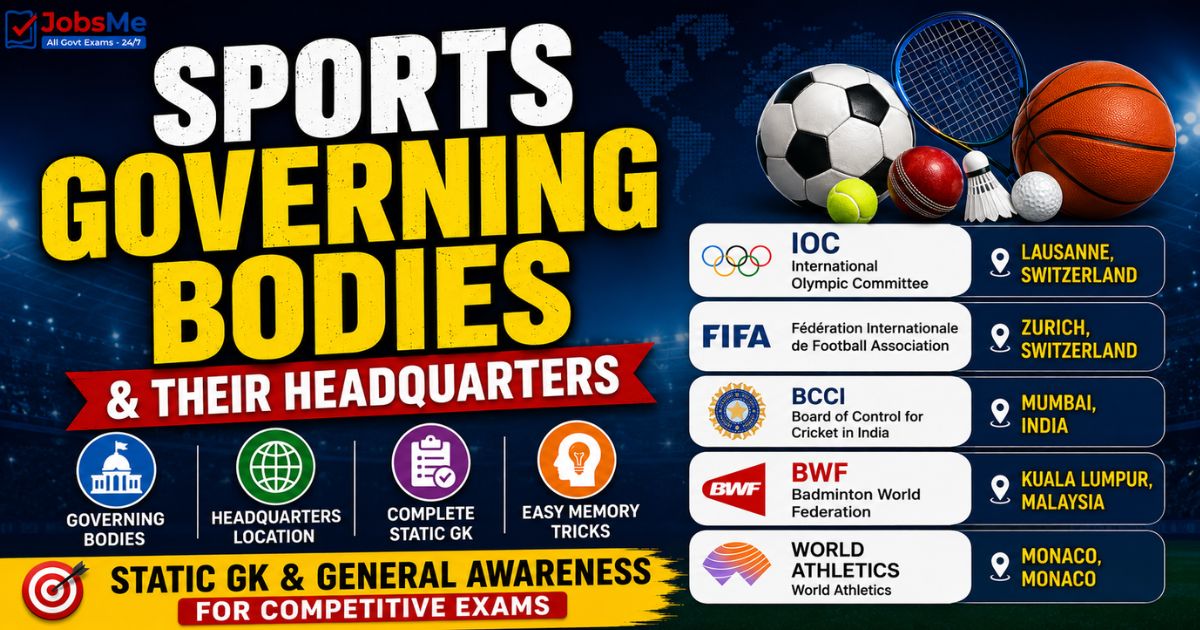
| Governing Body | Acronym | Founded | Headquarters | Key Features and Flagship Events |
|---|---|---|---|---|
| International Olympic Committee | IOC | 1894 | Lausanne, Switzerland | Supreme authority of the Olympic Movement, founded by Pierre de Coubertin in Paris. Owns the Olympic symbols, flag, anthem and motto, recognises international federations and National Olympic Committees, and organises the Summer, Winter and Youth Olympic Games. Governed by the Olympic Charter and funded largely through The Olympic Partner (TOP) programme launched in 1985. |
| International Paralympic Committee | IPC | 1989 | Bonn, Germany | Runs the Summer and Winter Paralympic Games. Directly governs about ten Para sports, including Para athletics and Para swimming, while other Para sports are run by their own international federations. A frequently asked non-Swiss headquarters. |
| Federation Internationale de Football Association | FIFA | 1904 | Zurich, Switzerland | Founded in Paris, now in Zurich, not Lausanne. Has 211 member associations, more than the United Nations. Works through the Congress, the Council and the General Secretariat, and adopts the Laws of the Game framed by the International Football Association Board (IFAB). Organises the FIFA World Cup, Women's World Cup, U-17 and U-20 World Cups and the Club World Cup, and publishes monthly world rankings. |
| International Cricket Council | ICC | 1909 | Dubai, United Arab Emirates | Founded as the Imperial Cricket Conference, renamed International Cricket Council in 1989 and shifted from London to Dubai in 2005. Incorporated in the British Virgin Islands. Has 12 Full Members that play Test cricket plus a large group of Associate Members. Runs the ODI World Cup, T20 World Cup, Champions Trophy and the World Test Championship, and publishes team and player rankings in all three formats. |
| Federation Internationale de Hockey | FIH | 1924 | Lausanne, Switzerland | Governs field hockey, not ice hockey. Organises the men's and women's Hockey World Cup and the annual FIH Pro League, and coordinates Olympic hockey with the IOC. |
| World Athletics | WA | 1912 | Monaco | Founded as the International Amateur Athletic Federation (IAAF), renamed International Association of Athletics Federations in 2001 and World Athletics in 2019. Shifted from London to Monaco in 1993. Ratifies world records and runs the World Athletics Championships, World Indoor Championships and the Diamond League. Its independent Athletics Integrity Unit was set up in April 2017. |
| Badminton World Federation | BWF | 1934 | Kuala Lumpur, Malaysia | Founded as the International Badminton Federation and renamed BWF in 2006. Runs the BWF World Championships, the BWF World Tour and the three big team events: Thomas Cup for men, Uber Cup for women and Sudirman Cup for mixed teams. |
| International Tennis Federation | ITF | 1913 | London, United Kingdom | Runs the Davis Cup for men, the oldest team event in tennis, and the Billie Jean King Cup, formerly the Fed Cup, for women, and governs Olympic tennis. It coordinates with, but does not itself organise, the four Grand Slam tournaments. |
| Federation Internationale des Echecs (International Chess Federation) | FIDE | 1924 | Lausanne, Switzerland | Founded in Paris, headquarters shifted from Athens to Lausanne in 2019. Recognised by the IOC as an international federation in 1999, though chess is not yet an Olympic sport. Maintains the Elo rating system, awards lifetime titles and organises the World Chess Championship, the Candidates Tournament and the biennial Chess Olympiad. |
| World Aquatics | WA (formerly FINA) | 1908 | Budapest, Hungary (shifting from Lausanne) | Founded as the Federation Internationale de Natation (FINA) and renamed World Aquatics in 2023. Members voted in 2023 to move the headquarters from Lausanne to Budapest, an interim office opened there in November 2024 and the permanent campus is under construction, while Lausanne retains the World Aquatics Foundation and the Aquatics Integrity Unit. Governs swimming, diving, water polo, artistic swimming, open water and high diving, and ratifies swimming world records. |
| International Shooting Sport Federation | ISSF | 1907 | Munich, Germany | Governs rifle, pistol and shotgun events including trap and skeet. Runs the ISSF World Championships and the annual World Cup circuit. Enforces equipment rules such as dead-weight trigger testing and jacket stiffness checks. |
| International Weightlifting Federation | IWF | 1905 | Lausanne, Switzerland | Founded in Duisburg, Germany. Moved its headquarters from Budapest to Lausanne in 2020 after a governance and doping scandal, so the direction of this shift is the opposite of World Aquatics. Competition lifts are the snatch and the clean and jerk. |
| International Table Tennis Federation | ITTF | 1926 | Lausanne, Switzerland | One of the largest federations by membership. Runs the World Table Tennis Championships and the WTT circuit, which includes the Grand Smash tier launched in 2021. Tests rackets with VOC detectors to stop illegal speed glues. |
| Federation Internationale de Volleyball | FIVB | 1947 | Lausanne, Switzerland | Governs indoor volleyball, beach volleyball and snow volleyball, and is among the largest federations with over 220 members. Runs the World Championship, the annual Volleyball Nations League and the Beach Volleyball World Championships. |
| International Basketball Federation | FIBA | 1932 | Mies, Switzerland | Note Mies, not Lausanne. Runs the FIBA Basketball World Cup, the 3x3 World Tour and continental events such as EuroBasket, AfroBasket and the FIBA Asia Cup. The NBA is a professional league, not a governing body. |
| United World Wrestling | UWW | 1912 | Corsier-sur-Vevey, Switzerland | Founded as FILA and renamed United World Wrestling in 2014. Governs freestyle, Greco-Roman and women's wrestling and runs the annual World Wrestling Championships. India's first individual Olympic medal, by K. D. Jadhav in 1952, came in this sport. |
| Federation Internationale de l'Automobile | FIA | 1904 | Paris, France | Governs four-wheel motorsport, sets Formula One technical and safety regulations, and sanctions the F1 World Championship, the World Rally Championship, Formula E and the World Endurance Championship. |
| Federation Internationale de Motocyclisme | FIM | 1904 | Mies, Switzerland | Governs motorcycle racing and sanctions the MotoGP World Championship and the Superbike World Championship. Pair it with FIBA as the second Mies body. |
| World Rugby | WR | 1886 | Dublin, Ireland | Founded as the International Rugby Football Board and renamed World Rugby in 2014. Governs rugby union in the fifteen-a-side and Sevens formats, with Sevens an Olympic sport since 2016. Runs the men's and women's Rugby World Cup and the Sevens World Series. |
| International Gymnastics Federation | FIG | 1881 | Lausanne, Switzerland | The oldest international sports federation. Governs artistic, rhythmic, trampoline, aerobic and acrobatic gymnastics plus parkour. Scoring combines a difficulty score and an execution score. |
| Union Cycliste Internationale | UCI | 1900 | Aigle, Switzerland | Note Aigle, a third Swiss location after Lausanne and Mies. Governs road, track, mountain bike, BMX, cyclo-cross and indoor cycling. The Tour de France is run independently but under UCI rules. |
| World Archery | WA | 1931 | Lausanne, Switzerland | Founded as FITA and renamed World Archery in 2011. Governs recurve, the Olympic discipline, along with compound and barebow, and runs the World Archery Championships and the Archery World Cup. |
| International Golf Federation | IGF | 1958 | Lausanne, Switzerland | Coordinates golf's Olympic participation after the sport returned to the Games in 2016 following a 112-year absence. The Rules of Golf are jointly maintained by The R&A at St Andrews and the USGA, and the four men's majors are run by their own organisers. |
| World Squash Federation | WSF | 1967 | Hastings, England | Runs the World Squash Championships and World Team Championships. Squash is not yet an Olympic sport but has been approved for the Los Angeles 2028 Games. |
| World Boxing | WB | 2023 | Lausanne, Switzerland | Launched in April 2023 as a breakaway body after the IOC withdrew recognition of the International Boxing Association. Granted IOC provisional recognition in February 2025, after which boxing was restored to the LA 2028 programme, and it now runs Olympic boxing qualification. |
| International Judo Federation | IJF | 1951 | Budapest, Hungary | Founded in London, headquarters moved from Lausanne to Budapest in 2019. Runs the World Judo Championships and the IJF World Tour. |
| International Ice Hockey Federation | IIHF | 1908 | Zurich, Switzerland | Governs ice hockey, a different sport with a different body from FIH field hockey. Shares its city with FIFA, which makes Zurich the answer for both. |
| Commonwealth Games Federation | CGF | 1932 | London, United Kingdom | Founded as the British Empire Games Federation. Runs the Commonwealth Games every four years, open only to Commonwealth members, and includes sports rarely seen at the Olympics such as netball and lawn bowls. India will host the centenary edition at Ahmedabad in 2030. |
| Olympic Council of Asia | OCA | 1982 | Kuwait City, Kuwait | Successor to the Asian Games Federation, with 45 National Olympic Committees. Runs the Asian Games, Asian Winter Games and Asian Indoor Games. India's Randhir Singh served as its president before Sheikh Joaan bin Hamad Al Thani of Qatar took charge in January 2026. |
| World Anti-Doping Agency | WADA | 1999 | Montreal, Canada | Frames the World Anti-Doping Code, publishes the Prohibited List and maintains the ADAMS database and the Athlete Biological Passport framework. Not a sport federation but an integrity agency, and a very frequent exam entry. |
| Court of Arbitration for Sport | CAS | 1984 | Lausanne, Switzerland | The final appellate forum for international sports disputes, including doping appeals. Indian law also allows appeals to CAS where international statutes require arbitration. |
Football: FIFA and Its Six Continental Confederations
| Confederation | Region | Headquarters | Flagship National Team Event | Key Features |
|---|---|---|---|---|
| AFC (Asian Football Confederation) | Asia and Australia | Kuala Lumpur, Malaysia | AFC Asian Cup, from 1956 | India's All India Football Federation is a member, and India was a founding member of the AFC in 1954. Japan holds the record with four Asian Cup titles. |
| UEFA (Union of European Football Associations) | Europe | Nyon, Switzerland | UEFA European Championship, from 1960 | The commercially strongest confederation and organiser of the UEFA Champions League. Spain holds the record with four Euro titles. |
| CAF (Confederation of African Football) | Africa | Cairo, Egypt | Africa Cup of Nations, from 1957 | Egypt holds the record with seven titles. One of the few confederation headquarters outside Europe that is regularly asked. |
| CONMEBOL (South American Football Confederation) | South America | Luque, Paraguay | Copa America, from 1916 | The oldest continuous continental championship in football. Argentina leads with sixteen titles. |
| CONCACAF | North America, Central America and the Caribbean | Miami, United States | CONCACAF Gold Cup, from 1991 | Mexico dominates with ten titles. The 2026 FIFA World Cup is co-hosted within this region by the United States, Mexico and Canada. |
| OFC (Oceania Football Confederation) | Oceania | Auckland, New Zealand | OFC Men's Nations Cup, from 1973 | The smallest confederation in playing strength. New Zealand leads with six titles. |
Boxing: Olympic Body Versus Professional Sanctioning Bodies
Boxing is the single biggest source of confusion in this topic because the sport has one Olympic governing body and four separate professional title-sanctioning organisations.
| Organisation | Founded | Headquarters | Status and Key Features |
|---|---|---|---|
| World Boxing | 2023 | Lausanne, Switzerland | The IOC-facing body for Olympic boxing. Launched in April 2023, granted IOC provisional recognition in February 2025, after which the 144th IOC Session restored boxing to the Los Angeles 2028 programme. It now manages Olympic qualification, and the LA 2028 boxing event will have full gender parity with seven weight classes each for men and women. |
| International Boxing Association (IBA, formerly AIBA) | 1946 | Lausanne, Switzerland | Founded as AIBA and renamed IBA in 2023. The IOC suspended its recognition in 2019 over governance, judging and financial concerns and withdrew recognition fully in June 2023. As a result the IOC itself ran the boxing events at Tokyo 2020 and Paris 2024. |
| World Boxing Council (WBC) | 1963 | Mexico City, Mexico | Professional sanctioning body that awards world titles in paid boxing. It does not govern amateur or Olympic boxing. |
| World Boxing Association (WBA) | 1921 | Panama City, Panama | The oldest of the four professional sanctioning bodies. |
| International Boxing Federation (IBF) | 1983 | New Jersey, United States | Professional sanctioning body based in the United States. |
| World Boxing Organization (WBO) | 1988 | San Juan, Puerto Rico | The newest of the four, which is why professional champions often hold several belts at once. |
Tennis and Golf: Governing Bodies Versus Tours
| Organisation | Founded | Headquarters | Role and Key Features |
|---|---|---|---|
| ITF (International Tennis Federation) | 1913 | London, United Kingdom | The governing body of world tennis. Runs the Davis Cup and the Billie Jean King Cup and governs Olympic tennis, but does not organise the Grand Slams. |
| ATP (Association of Tennis Professionals) | 1972 | London, United Kingdom | Runs the men's professional tour and publishes ATP rankings. Its year-end event is the ATP Finals for the top eight players. |
| WTA (Women's Tennis Association) | 1973 | St. Petersburg, Florida, United States | Founded by Billie Jean King. Runs the women's professional tour, publishes WTA rankings and holds the season-ending WTA Finals. |
| IGF (International Golf Federation) | 1958 | Lausanne, Switzerland | The Olympic-facing body for golf, which returned to the Games in 2016 after a 112-year absence. |
| The R&A | Rules body of long standing | St Andrews, Scotland | Governs golf worldwide except the United States and Mexico and organises The Open Championship. Jointly maintains the Rules of Golf with the USGA. |
| USGA (United States Golf Association) | 1894 | New Jersey, United States | Governs golf in the United States and Mexico and organises the US Open. Professional tours such as the PGA Tour, DP World Tour and LPGA Tour are commercial circuits, not governing bodies. |
Other Olympic and Recognised International Federations
These bodies are asked less often, but their sport-to-federation mapping is standard exam material. Headquarters is given where it is a commonly tested fact.
| Sport | Governing Body | Headquarters | Notes for Exams |
|---|---|---|---|
| Handball | International Handball Federation (IHF) | Basel, Switzerland | A Swiss body outside Lausanne, so it belongs with FIBA, FIM, UCI and IIHF in the exceptions group. |
| Taekwondo | World Taekwondo (WT) | Seoul, South Korea | Headquarters in the sport's country of origin. The name was shortened from World Taekwondo Federation. |
| Rowing | World Rowing (FISA) | Lausanne, Switzerland | Still often written as FISA in older question papers. |
| Sailing | World Sailing | London, United Kingdom | Formerly the International Sailing Federation. |
| Canoeing and kayaking | International Canoe Federation (ICF) | Lausanne, Switzerland | Governs sprint and slalom canoeing at the Olympics. |
| Equestrian sports | Federation Equestre Internationale (FEI) | Lausanne, Switzerland | Governs dressage, jumping and eventing. |
| Fencing | Federation Internationale d'Escrime (FIE) | Lausanne, Switzerland | The three weapons are foil, epee and sabre. |
| Modern pentathlon | Union Internationale de Pentathlon Moderne (UIPM) | Monaco | Shares Monaco with World Athletics, which is a handy pairing. |
| Triathlon | World Triathlon | Lausanne, Switzerland | Earlier called the International Triathlon Union (ITU). |
| Baseball and softball | World Baseball Softball Confederation (WBSC) | Lausanne, Switzerland | Formed by merging the separate baseball and softball world bodies. |
| Sport climbing | International Federation of Sport Climbing (IFSC) | Turin, Italy | An Olympic sport since Tokyo 2020. |
| Climbing and mountaineering | Union Internationale des Associations d'Alpinisme (UIAA) | Bern, Switzerland | Governs mountaineering, which is distinct from competitive sport climbing under the IFSC. |
| Karate | World Karate Federation (WKF) | Madrid, Spain | Karate featured at Tokyo 2020 but was not retained for later editions. |
| Netball | International Netball Federation (INF) | Manchester, England | Netball is a Commonwealth Games sport, not an Olympic sport. |
| Bowling | International Bowling Federation, earlier World Bowling | Lausanne, Switzerland | Remember the older name World Bowling, which still appears in question banks. |
| American football | International Federation of American Football (IFAF) | Rarely asked | Flag football, governed by IFAF, is on the Los Angeles 2028 programme. |
| Sumo, surfing, wushu, polo, kickboxing, racquetball, water skiing, tug of war, powerboating | International Sumo Federation, International Surfing Association, International Wushu Federation, Federation of International Polo, WAKO, International Racquetball Federation, International Waterski and Wakeboard Federation, Tug of War International Federation, Union Internationale Motonautique | Rarely asked | For these sports only the sport-to-body mapping is examined, so learn the acronym expansions rather than the city. |
Sports Governance Framework in India
The Indian side of this topic is tested from two angles: the fixed structure of ministries, agencies and federations, and the recent statutory reform. Note first that under the Seventh Schedule of the Constitution, sports is Entry 33 of the State List, so grassroots development is primarily a State responsibility, while the Union Government handles national policy, recognition of federations, anti-doping and international participation.
| Body | Established | Headquarters | Role and Key Features |
|---|---|---|---|
| Ministry of Youth Affairs and Sports (MYAS) | Union ministry | Shastri Bhawan, New Delhi | The apex policy-making body, with a Department of Sports and a Department of Youth Affairs. Frames national sports policy, allocates funds, recognises federations and confers the National Sports Awards such as the Major Dhyan Chand Khel Ratna and the Arjuna Award. The Cabinet approved the National Sports Policy 2025, called Khelo Bharat Niti 2025, replacing the 2001 policy, with the vision of harnessing sports for nation building. |
| Sports Authority of India (SAI) | 1984 | Jawaharlal Nehru Stadium complex, New Delhi | An autonomous body under MYAS created as a legacy of the 1982 Asian Games in New Delhi. Runs national training centres and academies, implements Khelo India and the Target Olympic Podium Scheme, and manages sports infrastructure. In short, MYAS makes policy and SAI implements it. |
| Indian Olympic Association (IOA) | 1927 | Olympic Bhawan, New Delhi | India's National Olympic Committee, recognised by the IOC. Sends and manages Indian teams to the Olympics, Asian Games and other multi-sport events, and also acts as India's Commonwealth Games Association, the official liaison with the Commonwealth Games Federation. It is not a separate body from the IOA, only a second role played by the same organisation. |
| National Anti-Doping Agency (NADA) | 2005 | New Delhi | Implements anti-doping testing and results management in India under the National Anti-Doping Act, 2022, working with WADA and using the ADAMS database. Samples are analysed at the National Dope Testing Laboratory, also in New Delhi. |
| Netaji Subhas National Institute of Sports (NSNIS) | 1961 | Patiala, Punjab | India's premier coaching and sports science institute and a key SAI training hub used for national camps, sports science support and athlete rehabilitation. |
| Lakshmibai National Institute of Physical Education (LNIPE) | 1957 | Gwalior, Madhya Pradesh | The premier institution for physical education, coaching and sports research, with a campus in Thiruvananthapuram. |
| National Sports Board (NSB) | Created by the National Sports Governance Act, 2025 | New Delhi | The statutory regulator that grants, renews, suspends or cancels recognition of national sports bodies, and only NSB-recognised bodies can receive central funding. It has a Chairperson and two Members appointed by the Central Government from a panel recommended by a Search-cum-Selection Committee, each serving three years or until the age of 65. |
| National Sports Tribunal (NST) | Created by the National Sports Governance Act, 2025 | New Delhi | A dedicated forum for sports disputes, headed by a Supreme Court judge or a High Court Chief Justice with two expert members. It has civil court powers, its orders are executable as decrees, and appeals lie to the Supreme Court unless international statutes require arbitration at the Court of Arbitration for Sport. |
The National Sports Governance Act, 2025
- Legislative journey: introduced in the Lok Sabha in July 2025, passed by the Lok Sabha on 11 August 2025 and the Rajya Sabha on 12 August 2025, and given Presidential assent on 18 August 2025.
- Significance: India's first parliamentary law comprehensively regulating sports governance, replacing the non-binding National Sports Development Code of India, 2011.
- Bodies covered: the National Olympic Committee, the National Paralympic Committee, a National Sports Federation for each designated sport and a Regional Sports Federation for each designated sport.
- New institutions: the National Sports Board, the National Sports Tribunal and a National Sports Election Panel that oversees free and fair elections to the Executive Committee and the Athletes Committee of every national sports body.
- Compliance duties: mandatory Safe Sports Policies and Codes of Ethics protecting women, minors and other vulnerable participants, accounts audited by the Comptroller and Auditor General, and a National Sports Board Fund.
- Name protection: organisations using words such as India, Indian or National, or national insignia, need central government approval, and only authorised bodies may field teams representing India.
- Implementation in 2026: the National Sports Governance (National Sports Board) Rules, 2026 and the National Sports Governance (National Sports Tribunal) Rules, 2026 were notified in May 2026, and a Search-cum-Selection Committee headed by the Cabinet Secretary was constituted in June 2026 to recommend names for the Board.
- Stated purpose: aligning Indian sports administration with the Olympic and Commonwealth Charters ahead of the Ahmedabad 2030 Commonwealth Games and India's bid for the 2036 Olympic Games. The National Anti-Doping Act, 2022 was also amended in August 2025 to match updated international definitions.
Major National Sports Federations of India
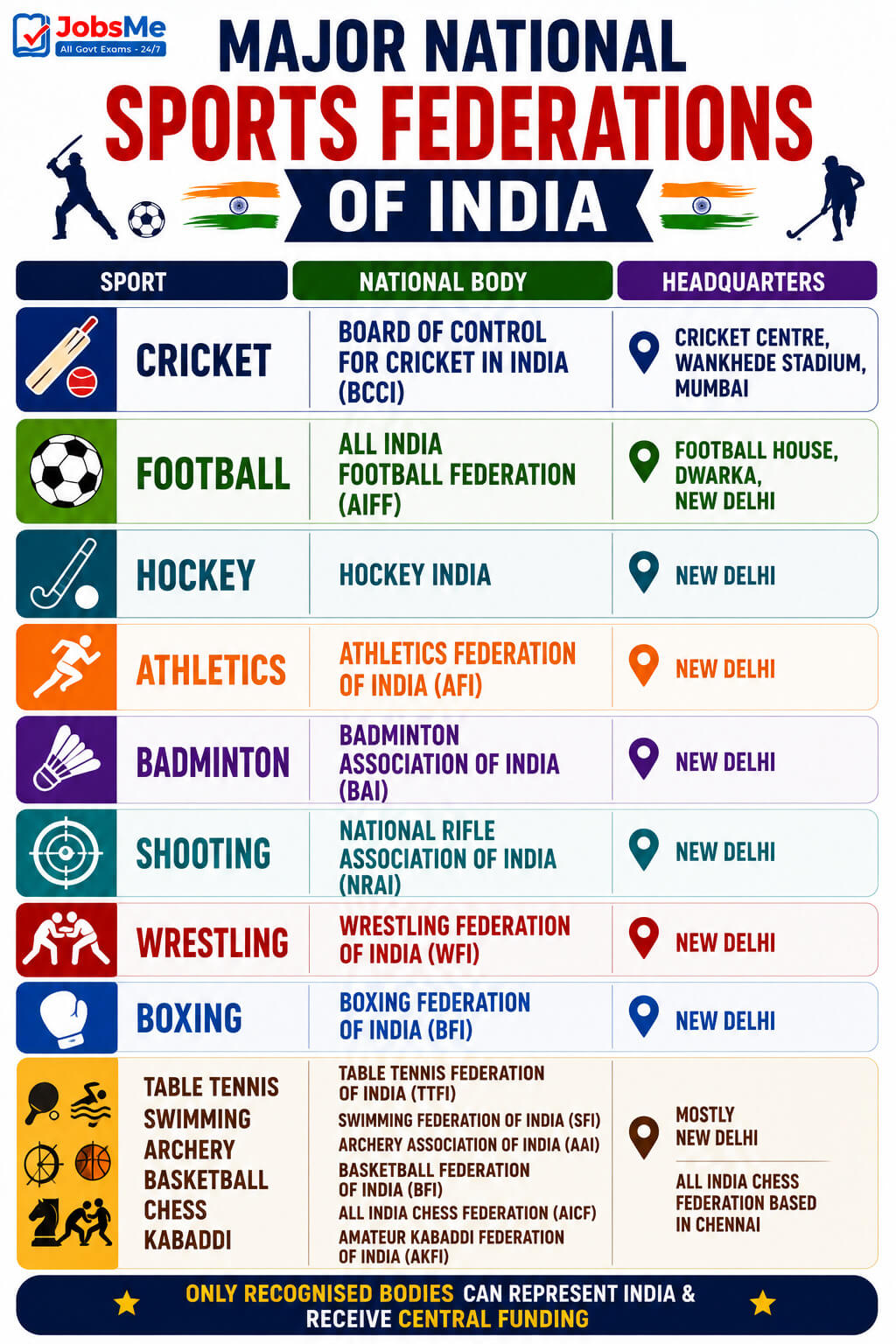
| Sport | National Body | Headquarters | Key Features |
|---|---|---|---|
| Cricket | Board of Control for Cricket in India (BCCI), founded 1928 | Cricket Centre, Wankhede Stadium, Mumbai | An ICC Full Member since 1926, in the era of the Imperial Cricket Conference, and the wealthiest cricket board in the world. It is an exception among Indian bodies because it is functionally autonomous and does not rely on standard government funding, though it still coordinates with the government on clearances for international fixtures and overseas tours. It runs the IPL and the Women's Premier League through governing councils. |
| Football | All India Football Federation (AIFF), founded 1937 | Football House, Dwarka, New Delhi | Affiliated to FIFA in 1948 and a founding member of the AFC in 1954 and of the South Asian Football Federation. Runs the national teams and domestic leagues, and its long-term roadmap is called Vision 2047. |
| Hockey | Hockey India | New Delhi | The FIH-affiliated national body for men's and women's hockey. India's eight Olympic hockey golds remain the country's finest team-sport record. |
| Athletics | Athletics Federation of India (AFI) | New Delhi | Affiliated to World Athletics and organiser of the National Open Athletics Championships and the Indian Grand Prix meets. |
| Badminton | Badminton Association of India (BAI) | New Delhi | Affiliated to the BWF and organiser of the India Open and the national championships. |
| Shooting | National Rifle Association of India (NRAI) | New Delhi | The ISSF-affiliated body for the discipline that produced India's first individual Olympic gold. |
| Wrestling | Wrestling Federation of India (WFI) | New Delhi | Affiliated to United World Wrestling. Its prolonged governance disputes were among the reasons cited for a statutory governance law. |
| Boxing | Boxing Federation of India (BFI) | New Delhi | The national body for Olympic-style boxing, which had to realign itself with the new international structure under World Boxing. |
| Table tennis, swimming, archery, basketball, chess, kabaddi | Table Tennis Federation of India, Swimming Federation of India, Archery Association of India, Basketball Federation of India, All India Chess Federation, Amateur Kabaddi Federation of India | Mostly New Delhi, with the All India Chess Federation based in Chennai | Each is the recognised national counterpart of its international federation. Only recognised bodies may field teams in India's name or receive central funding. |
Who Heads What: Position as of Mid-2026
Office-bearers change often, so treat this table as current affairs revision and cross-check the latest position before your exam.
| Organisation | Head | Key Features |
|---|---|---|
| IOC | Kirsty Coventry, Zimbabwe | Elected at the 144th IOC Session in Greece in March 2025 and took office on 23 June 2025 for an eight-year term as the tenth IOC President. She is the first woman and the first African to hold the post and is a seven-time Olympic swimming medallist. Milano Cortina 2026 was her first Games in charge. |
| IPC | Andrew Parsons, Brazil | President since 2017 and re-elected in September 2025 for a third and final term. |
| FIFA | Gianni Infantino | President since 2016, heading a body with 211 member associations. |
| ICC | Jay Shah, India | Took charge as ICC Chair on 1 December 2024 after serving as BCCI Secretary, and is the youngest person to chair the ICC. |
| World Athletics | Sebastian Coe, United Kingdom | President since 2015, serving a third and final term that ends in 2027. |
| World Boxing | Gennadiy Golovkin, Kazakhstan | Elected at the Congress in Rome on 23 November 2025 for a three-year term, succeeding Boris van der Vorst. He is also President of the Kazakhstan National Olympic Committee. |
| FIDE | Viswanathan Anand, India, as Interim President | Anand, the FIDE Deputy President and a five-time World Champion, took interim charge after Arkady Dvorkovich suspended his presidential duties in July 2026. The next presidential election is due at the FIDE General Assembly alongside the Chess Olympiad in Samarkand. |
| Olympic Council of Asia | Sheikh Joaan bin Hamad Al Thani, Qatar | Took office in January 2026, succeeding India's Randhir Singh, who had led the OCA since 2021 and passed away in May 2026. |
| MYAS, Government of India | Dr Mansukh Mandaviya, Union Minister | Took charge in June 2024, with Raksha Nikhil Khadse as Minister of State for Youth Affairs and Sports. |
| Indian Olympic Association | P. T. Usha | The Payyoli Express, elected unopposed in 2022 as the first woman and the first Olympian to head the IOA. |
| BCCI | Mithun Manhas, President | Elected unopposed at the 94th Annual General Meeting in Mumbai in September 2025 as the 37th BCCI President and the first from Jammu and Kashmir, with Devajit Saikia continuing as Secretary and Rajeev Shukla as Vice-President. |
| AIFF | Kalyan Chaubey, President | A former India goalkeeper, elected in September 2022 at Football House, New Delhi. |
How Governing Bodies Actually Enforce Their Rules
Exams increasingly ask what these bodies do, not just where they sit. Three enforcement areas are worth knowing: match technology, equipment limits and anti-doping science.
Tracking and Officiating Technology
- Electronic Performance and Tracking Systems (EPTS): bodies such as FIFA and World Athletics certify tracking units worn in training vests that combine GPS receivers with Inertial Measurement Units containing tri-axial accelerometers and gyroscopes to record speed and mechanical player load.
- Optical tracking: synchronised camera arrays use computer vision to triangulate the three-dimensional position of players and the ball. Hawk-Eye is the best known system and is used in tennis, cricket's Decision Review System and badminton.
- Semi-Automated Offside Technology (SAOT): used in elite football, it combines roof-mounted cameras tracking 29 skeletal points fifty times a second with a 500 Hz sensor inside the ball to fix the exact moment of the pass.
Equipment Rules and Technological Doping
- World Athletics shoe rule: road racing shoes are limited to a maximum midsole stack height of 40 mm with only one embedded rigid plate, to stop artificial energy return.
- ISSF equipment checks: dead-weight testing verifies that trigger mechanisms hold a specified load, for example 1500 g, without firing, and stiffness sensors check that shooting jackets do not act as rigid support.
- ITTF racket testing: volatile organic compound detectors are used to eliminate illegal speed glues and chemical rubber boosters that increase rebound.
Anti-Doping: The Athlete Biological Passport
- Haematological module: tracks total haemoglobin mass and reticulocyte percentage over time to reveal blood doping or the use of recombinant EPO.
- Steroidal module: tracks urinary steroid values, especially the testosterone to epitestosterone ratio. If a sample crosses the 4:1 reference, laboratories run Isotope Ratio Mass Spectrometry to compare carbon isotope ratios and separate natural hormones from plant-derived synthetic ones.
- Data and privacy: biometric and location data collected from athletes in India must comply with the Digital Personal Data Protection Act, 2023, which requires consent and limits on processing sensitive personal data.
How Rankings Are Calculated
- Rating versus ranking: a rating is a continuous numerical value showing how strong a competitor is, while a ranking is only an ordered list built from those ratings. Ratings show the size of the gap, rankings show the order.
- Accumulation model: points are earned by progressing through tournaments, weighted by tournament tier, and drop off after a rolling 52-week cycle. Used in tennis and badminton style circuits.
- Elo model: points move between opponents based on the difference between expected and actual results, using a logistic probability model. Used by FIDE for chess.
- Weighted averaging model: total points are divided by matches played over a window, so a team cannot inflate its position by playing many weak fixtures.
Indian Schemes, Milestones and Hosting Plans
Khelo India and the Target Olympic Podium Scheme
- Khelo India: the grassroots talent identification programme of MYAS, implemented by SAI, covering school and college competitions, the Khelo India Youth Games and University Games, with scholarships, coaching and equipment for selected athletes.
- Target Olympic Podium Scheme (TOPS): launched by MYAS in September 2014 and run by SAI for athletes with realistic podium chances, offering foreign training, competition funding, equipment, coaching camps and a monthly stipend. It works in two tiers, a Core Group and a Development Group.
- The pathway: Khelo India spots talent, TOPS funds elite preparation, National Sports Federations conduct trials and national championships, and the Indian Olympic Association approves final squads for multi-sport events.
Landmark Indian Milestones Linked to These Bodies
- K. D. Jadhav: won bronze in freestyle wrestling at the 1952 Helsinki Olympics, independent India's first individual Olympic medal, in a sport now governed by United World Wrestling.
- Karnam Malleswari: won bronze in the women's 69 kg category at Sydney 2000, the first Olympic medal won by an Indian woman in any sport, under the IWF.
- Abhinav Bindra: won gold in the men's 10 m air rifle at Beijing 2008, India's first individual Olympic gold, under ISSF rules.
- Thomas Cup 2022: the Indian men's badminton team won the BWF Thomas Cup for the first time in the tournament's 73-year history, beating fourteen-time champion Indonesia 3-0 in Bangkok.
- Chess Olympiad 2024: at the 45th FIDE Chess Olympiad in Budapest, India won gold in both the Open and Women's team sections, a historic double.
- World Chess Championship: Gukesh Dommaraju became the eighteenth and youngest World Champion at 18 by beating Ding Liren in Singapore in December 2024, and defends the title in a 2026 match in Geneva against Javokhir Sindarov of Uzbekistan.
- Motorsport hosting: India hosted the Formula One Indian Grand Prix from 2011 to 2013, the FIA Formula E Hyderabad E-Prix in 2023 and the FIM MotoGP Bharat Grand Prix in 2023 and 2024, largely at the Buddh International Circuit.
Ahmedabad 2030 and the 2036 Olympic Bid
- Ahmedabad 2030: India will host the centenary edition of the Commonwealth Games, delivered jointly by the Central Government and the Government of Gujarat, with MYAS as nodal ministry, SAI handling athlete preparation and venues, and the IOA acting as liaison with the Commonwealth Games Federation.
- Glasgow 2026: the immediately preceding edition of the Commonwealth Games, for which Indian squads are selected through NSF trials and IOA approval.
- 2036 Olympic bid: India submitted a Letter of Intent to the IOC in October 2024 proposing Ahmedabad as host city and is in the IOC's Continuous Dialogue stage, with the host expected to be chosen by around 2029. India's pitch includes regionally popular sports such as cricket, kabaddi and kho kho.
Memory Tricks and Mnemonics
Trick 1: The Lausanne Family, or LAUSANNE Is the Default
Assume Lausanne first and then learn only the exceptions. The Lausanne group includes the IOC, FIH, FIDE, FIVB, ITTF, IWF, FIG, World Archery, IGF, CAS, World Boxing, IBA, World Rowing, ICF, FEI, FIE, World Triathlon and WBSC.
Lausanne is the postal address of world sport; if you cannot recall a federation's city, Lausanne is your best single guess.
Trick 2: The Swiss but Not Lausanne List, or ZAMBAN
- Z for Zurich: FIFA and IIHF
- A for Aigle: UCI cycling
- M for Mies: FIBA basketball and FIM motorcycling
- B for Basel: IHF handball
- A for another Swiss village, Corsier-sur-Vevey: UWW wrestling
- N for Nyon: UEFA
ZAMBAN: Zurich, Aigle, Mies, Basel, Another village, Nyon. These six locations are Switzerland's non-Lausanne answers.
Trick 3: MMM for Monaco, Monaco and Munich
- Monaco: World Athletics, the running body in the racing principality
- Monaco: UIPM modern pentathlon, five events in one small state
- Munich: ISSF shooting, so shooting goes to Germany, not Switzerland
Athletes and pentathletes live in Monaco, shooters live in Munich.
Trick 4: The Asian Pair of 2005, or Cricket and Shuttle Flew East
Two bodies left Europe in the same year, 2005. The ICC left Lord's in London for Dubai and the BWF left Cheltenham for Kuala Lumpur.
In 2005, the ball and the shuttle both boarded a flight east: ball to Dubai, shuttle to Kuala Lumpur.
Trick 5: The Budapest Versus Lausanne Swap Trap
- Weightlifting (IWF): Budapest to Lausanne in 2020, after a governance scandal, so the answer today is Lausanne.
- Judo (IJF): Lausanne to Budapest in 2019.
- Aquatics: Lausanne to Budapest, approved in 2023 and being completed in stages.
Lifters ran to Lausanne, judokas and swimmers moved to Budapest. Two went to Hungary, one came out of it.
Trick 6: League Versus Governing Body, or NBA Is Not FIBA
- FIBA governs basketball, the NBA is a private league in the United States and Canada.
- BCCI governs Indian cricket, the IPL is a tournament run by BCCI.
- ITF governs tennis, the ATP and WTA run professional tours and the four Grand Slams are run by their own organisers.
- IGF handles Olympic golf, while The R&A and the USGA write the rules and the PGA Tour is a commercial circuit.
Governing bodies make rules, leagues make money. If the question says organises the world championship, pick the federation.
Trick 7: Oldest and Newest, or 1881 to 2023
- 1881, FIG gymnastics: the oldest international sports federation
- 1886, World Rugby: the second oldest of the famous bodies
- 1894, IOC: Coubertin's creation in Paris
- 1904, FIFA, FIA and FIM: three bodies in one year, all founded in the automobile and football boom
- 2023, World Boxing: the newest major Olympic federation
Gymnastics is the grandfather at 1881, boxing's new body is the baby at 2023.
Trick 8: The India Ladder, or Policy, Practice, Participation
- Policy: MYAS, the ministry that decides and funds
- Practice: SAI, the agency that trains and builds
- Participation: IOA, the body that sends the team abroad
- Police: NSB, NST and NADA, the bodies that regulate, adjudicate and test
Four Ps in order: Policy, Practice, Participation, Police. MYAS decides, SAI trains, IOA travels, NSB and NADA discipline.
Additional Notes
Frequently Confused Facts
- IOC versus IPC: the IOC in Lausanne runs the Olympics, the IPC in Bonn runs the Paralympics. Different cities, different bodies.
- FIFA versus World Rugby: FIFA governs association football only. Rugby football is governed by World Rugby in Dublin.
- FIH versus IIHF: FIH in Lausanne governs field hockey, the IIHF in Zurich governs ice hockey.
- FIBA versus NBA: FIBA in Mies is the world governing body, the NBA is a professional league.
- IBA versus World Boxing: the IBA is the de-recognised former Olympic body, World Boxing is the provisionally recognised current one, and the WBC, WBA, IBF and WBO are professional sanctioning bodies.
- ITF and the Grand Slams: the ITF governs tennis and runs the Davis Cup and Billie Jean King Cup, but does not organise the Australian Open, French Open, Wimbledon or US Open.
- IWF direction of move: weightlifting moved from Budapest to Lausanne, not the other way round. Aquatics and judo moved to Budapest.
- Old names versus new names: IAAF became World Athletics in 2019, FINA became World Aquatics in 2023, IRB became World Rugby in 2014, FITA became World Archery in 2011, AIBA became IBA in 2023, FILA became UWW in 2014 and IBF badminton became BWF in 2006.
- MYAS versus SAI: MYAS is a ministry that frames policy and recognises federations, SAI is an autonomous body under it that implements schemes and manages training.
- Sports Code versus Sports Act: the 2011 National Sports Development Code was only an executive code, whereas the National Sports Governance Act, 2025 is a parliamentary law with statutory bodies.
- BCCI's status: the BCCI is India's cricket governing body but is not a typical government-funded NSF, which makes it a favourite trick option in questions about recognised federations.
Repeating PYQ Patterns
- SSC CGL, CHSL and MTS: straight one-line headquarters questions on the IOC, FIFA, ICC, BCCI and WADA, plus founding years of the IOC and FIFA.
- IBPS PO, Clerk, RRB and Insurance exams: current affairs versions such as who was elected IOC President, who chairs the ICC, or which body regulates recognition of Indian federations under the 2025 Act.
- RRB NTPC and Group D: sport-to-body matching questions, for example match FIH, BWF, FIDE and ISSF with their sports, and Olympic firsts by Indian athletes.
- UPSC Prelims and State PCS: statement-based questions on the constitutional position of sports in the State List, the powers of the National Sports Board and Tribunal, and India's 2036 Olympic bid process.
- Defence and PSU exams: Commonwealth Games Federation, Olympic Council of Asia and Asian Games hosting questions, along with the Khelo India and TOPS schemes.
- High-frequency single facts: Lausanne for the IOC, Zurich for FIFA, Dubai for the ICC, Monaco for World Athletics, Kuala Lumpur for the BWF, Mies for FIBA, Montreal for WADA, 1881 for FIG as the oldest federation, and 1984 for SAI.
Quick Insight
This topic is unusually alive right now, and that is exactly why examiners like it. Between 2024 and 2026 the IOC changed its president for the first time in twelve years, boxing's Olympic future was rescued by an entirely new federation, aquatics began shifting its headquarters from Switzerland to Hungary, and India replaced a thirteen-year-old advisory sports code with a full statutory framework backed by a regulator and a tribunal. Add India's Ahmedabad 2030 Commonwealth Games and 2036 Olympic bid, and it becomes clear that a static list of headquarters is now inseparable from current affairs. The smart strategy is to fix the permanent facts through the tables above and then update only the moving parts, such as office-bearers and headquarters shifts, month by month through your static GK notes and the daily current affairs quizzes.
One-Liners for Quick Revision
- IOC → Founded 1894, headquarters Lausanne, Switzerland → Founded by Pierre de Coubertin in Paris, runs the Summer, Winter and Youth Olympic Games under the Olympic Charter, and Lausanne is called the Olympic Capital.
- Olympic motto → Citius, Altius, Fortius - Communiter → Faster, Higher, Stronger - Together, with the IOC owning all Olympic symbols, the flag and the anthem.
- The Olympic Partner programme → Started 1985 → The IOC's worldwide sponsorship system granting exclusive global marketing rights for each four-year Olympic cycle.
- IPC → Founded 1989, headquarters Bonn, Germany → Runs the Summer and Winter Paralympic Games and directly governs about ten Para sports.
- Commonwealth Games Federation → Founded 1932 as the British Empire Games Federation, headquarters London → Runs the Commonwealth Games, with Glasgow 2026 followed by the centenary edition at Ahmedabad in 2030.
- Olympic Council of Asia → Founded 1982, headquarters Kuwait City → Successor of the Asian Games Federation with 45 National Olympic Committees, running the Asian Games and Asian Winter Games.
- FIFA → Founded 1904 in Paris, headquarters Zurich → 211 member associations, works through Congress, Council and General Secretariat, adopts the Laws of the Game framed by IFAB, and runs the FIFA World Cup.
- AFC → Headquarters Kuala Lumpur → Runs the AFC Asian Cup, begun in 1956, with Japan holding a record four titles, and India was a founding member in 1954.
- UEFA → Headquarters Nyon, Switzerland → Runs the European Championship from 1960 and the Champions League, with Spain holding four Euro titles.
- CAF → Headquarters Cairo → Runs the Africa Cup of Nations from 1957, with Egypt holding a record seven titles.
- CONMEBOL → Headquarters Luque, Paraguay → Runs Copa America from 1916, the oldest continuous continental football championship, with Argentina on sixteen titles.
- CONCACAF → Headquarters Miami → Runs the Gold Cup from 1991, with Mexico on ten titles.
- OFC → Headquarters Auckland → Runs the OFC Men's Nations Cup from 1973, with New Zealand on six titles.
- ICC → Founded 1909 as the Imperial Cricket Conference, headquarters Dubai since 2005 → Renamed International Cricket Council in 1989, incorporated in the British Virgin Islands, with 12 Full Members and events including the ODI World Cup, T20 World Cup, Champions Trophy and World Test Championship.
- BCCI → Founded 1928, headquarters Cricket Centre, Wankhede Stadium, Mumbai → ICC Full Member since 1926, functionally autonomous rather than a standard government-funded federation, and organiser of the IPL and Women's Premier League.
- Big Three in cricket → India, England and Australia → The BCCI, ECB and Cricket Australia historically held disproportionate influence in ICC decision-making because of revenue generation.
- FIH → Founded 1924, headquarters Lausanne → Governs field hockey and runs the Hockey World Cup and the annual FIH Pro League, while ice hockey belongs to the IIHF.
- World Athletics → Founded 1912 as the IAAF, headquarters Monaco since 1993 → Renamed World Athletics in 2019, ratifies world records, runs the World Championships and Diamond League and created the Athletics Integrity Unit in April 2017.
- BWF → Founded 1934 as the International Badminton Federation, headquarters Kuala Lumpur since 2005 → Renamed BWF in 2006 and runs the World Championships, World Tour, Thomas Cup, Uber Cup and Sudirman Cup.
- ITF → Founded 1913, headquarters London → Runs the Davis Cup, the oldest team competition in tennis from 1900, and the Billie Jean King Cup, formerly the Fed Cup.
- ATP → Founded 1972, headquarters London → Men's professional tour with the ATP Finals for the top eight players.
- WTA → Founded 1973 by Billie Jean King, headquarters St. Petersburg, Florida → Women's professional tour with the season-ending WTA Finals.
- FIDE → Founded 1924 in Paris, headquarters Lausanne since 2019 → Recognised by the IOC in 1999, maintains the Elo rating system and awards Grandmaster at 2500, International Master at 2400, FIDE Master at 2300 and Candidate Master at 2200 rating thresholds with verified norms.
- FIDE events → World Chess Championship, Candidates Tournament, Chess Olympiad → India won double gold in the Open and Women's sections at the 45th Chess Olympiad in Budapest in September 2024.
- World Aquatics → Founded 1908 as FINA, renamed 2023, headquarters moving from Lausanne to Budapest → Governs swimming, diving, water polo, artistic swimming, open water and high diving, with the Foundation and Integrity Unit remaining in Lausanne.
- ISSF → Founded 1907, headquarters Munich → Governs rifle, pistol and shotgun events and enforces trigger dead-weight and jacket stiffness checks.
- IWF → Founded 1905 in Duisburg, headquarters Lausanne since 2020 → Moved out of Budapest after a governance scandal, and its competition lifts are the snatch and the clean and jerk.
- ITTF → Founded 1926, headquarters Lausanne → One of the largest federations by membership, runs the World Championships and the WTT circuit launched in 2021, and tests rackets for illegal speed glues.
- FIVB → Founded 1947, headquarters Lausanne → Governs indoor, beach and snow volleyball with more than 220 members and runs the Volleyball Nations League.
- FIBA → Founded 1932, headquarters Mies, Switzerland → Runs the Basketball World Cup and the 3x3 World Tour, and is not the same as the NBA, which is a league.
- UWW → Founded 1912 as FILA, renamed 2014, headquarters Corsier-sur-Vevey → Governs freestyle, Greco-Roman and women's wrestling.
- FIA → Founded 1904, headquarters Paris → Governs four-wheel motorsport including Formula One, the World Rally Championship, Formula E and endurance racing.
- FIM → Founded 1904, headquarters Mies → Governs motorcycle racing including MotoGP and the Superbike World Championship.
- World Rugby → Founded 1886 as the IRFB, renamed 2014, headquarters Dublin → Governs rugby union and Sevens, an Olympic sport since 2016, and runs the Rugby World Cup from 1987.
- FIG → Founded 1881, headquarters Lausanne → The oldest international sports federation, governing artistic, rhythmic, trampoline, aerobic and acrobatic gymnastics plus parkour, with scoring split into difficulty and execution.
- UCI → Founded 1900, headquarters Aigle, Switzerland → Governs road, track, mountain bike, BMX and cyclo-cross, with the Tour de France run independently under UCI rules.
- World Archery → Founded 1931 as FITA, renamed 2011, headquarters Lausanne → Recurve is the Olympic discipline alongside compound and barebow.
- IGF → Founded 1958, headquarters Lausanne → Handles Olympic golf, which returned in 2016 after 112 years, while The R&A at St Andrews and the USGA jointly maintain the Rules of Golf.
- WSF → Founded 1967, headquarters Hastings, England → Governs squash, which is not yet Olympic but has been approved for Los Angeles 2028.
- World Boxing → Founded April 2023, headquarters Lausanne → Given IOC provisional recognition in February 2025, after which boxing was restored to the LA 2028 programme with gender parity across seven weight classes each for men and women.
- IBA, formerly AIBA → Founded 1946, headquarters Lausanne → Suspended by the IOC in 2019 and de-recognised in June 2023, which is why the IOC itself ran Olympic boxing at Tokyo 2020 and Paris 2024.
- Professional boxing bodies → WBC 1963 Mexico City, WBA 1921 Panama City, IBF 1983 New Jersey, WBO 1988 Puerto Rico → These sanction paid world titles and have no role in Olympic boxing.
- IJF → Founded 1951 in London, headquarters Budapest since 2019 → Runs the World Judo Championships and the IJF World Tour.
- IIHF → Founded 1908, headquarters Zurich → Governs ice hockey and shares its city with FIFA.
- IHF → Headquarters Basel, Switzerland → The world governing body for handball.
- World Taekwondo → Headquarters Seoul → Based in the sport's country of origin and earlier called the World Taekwondo Federation.
- World Rowing, FEI, FIE, ICF, World Triathlon and WBSC → All headquartered in Lausanne → Rowing was earlier FISA, triathlon was earlier the International Triathlon Union, and the WBSC combines baseball and softball.
- UIPM → Headquarters Monaco → Governs modern pentathlon and shares its base city with World Athletics.
- World Sailing → Headquarters London → Formerly the International Sailing Federation.
- IFSC and UIAA → IFSC in Turin, UIAA in Bern → Sport climbing became Olympic at Tokyo 2020, while the UIAA governs mountaineering.
- WKF and INF → Karate in Madrid, netball in Manchester → Karate appeared only at Tokyo 2020, and netball is a Commonwealth Games sport.
- WADA → Founded 1999, headquarters Montreal → Frames the World Anti-Doping Code, runs the ADAMS database and the Athlete Biological Passport framework.
- CAS → Founded 1984, headquarters Lausanne → The final appellate forum for international sports disputes including doping appeals.
- Athlete Biological Passport → Two modules → The haematological module tracks haemoglobin mass and reticulocytes, and the steroidal module flags a testosterone to epitestosterone ratio above 4:1, which triggers Isotope Ratio Mass Spectrometry.
- Hawk-Eye → Optical ball-tracking system → Used in tennis, cricket's Decision Review System and badminton, based on synchronised camera arrays and computer vision.
- Semi-Automated Offside Technology → Elite football → Tracks 29 skeletal points fifty times per second with a 500 Hz sensor inside the ball.
- World Athletics shoe rule → Maximum 40 mm stack height → Only one rigid embedded plate is allowed in road racing shoes to prevent technological doping.
- Rating versus ranking → A rating is a continuous number, a ranking is an ordered list → The three models are accumulation over a rolling 52 weeks, the Elo model and weighted averaging.
- Sports in the Constitution → Entry 33 of the State List, Seventh Schedule → States lead grassroots sport, while the Union Government handles policy, recognition, anti-doping and international participation.
- MYAS → Apex policy ministry with Departments of Sports and Youth Affairs → Recognises federations, allocates funds and confers the Major Dhyan Chand Khel Ratna and Arjuna Awards, and approved Khelo Bharat Niti 2025 replacing the 2001 policy.
- SAI → Established 1984, autonomous body under MYAS → A legacy of the 1982 Asian Games in New Delhi, running national centres and implementing Khelo India and TOPS.
- TOPS → Launched September 2014 → Supports podium-potential athletes with foreign training, competition funding, coaching and a monthly stipend through Core and Development groups.
- Khelo India → Grassroots talent identification programme → Runs Youth Games and University Games and feeds athletes into TOPS.
- IOA → Established 1927, headquarters Olympic Bhawan, New Delhi → India's National Olympic Committee and also the Commonwealth Games Association of India, currently headed by P. T. Usha, its first woman and first Olympian president.
- National Sports Governance Act, 2025 → Assent on 18 August 2025 → India's first parliamentary sports governance law, replacing the National Sports Development Code of India, 2011.
- National Sports Board → Statutory regulator with a Chairperson and two Members → Grants, renews, suspends or cancels recognition of national sports bodies, and only recognised bodies get central funding.
- National Sports Tribunal → Chairperson is a Supreme Court judge or High Court Chief Justice with two expert members → Has civil court powers, orders executable as decrees and appeals to the Supreme Court, except where CAS arbitration is required.
- National Sports Election Panel → Created under the 2025 Act → Oversees elections to the Executive Committee and Athletes Committee of national sports bodies.
- NADA → Headquarters New Delhi → Enforces anti-doping rules under the National Anti-Doping Act, 2022, amended in August 2025, with testing at the National Dope Testing Laboratory.
- NSNIS Patiala and LNIPE Gwalior → Patiala for elite coaching and sports science, Gwalior for physical education → LNIPE also has a campus in Thiruvananthapuram.
- Major Indian federations → AIFF at Football House, Dwarka, New Delhi, founded 1937 → Hockey India, AFI, BAI, NRAI, WFI and BFI are also based in New Delhi, while the All India Chess Federation is based in Chennai.
- K. D. Jadhav → Bronze in freestyle wrestling, Helsinki 1952 → Independent India's first individual Olympic medal.
- Karnam Malleswari → Bronze in weightlifting, women's 69 kg, Sydney 2000 → The first Olympic medal won by an Indian woman in any sport.
- Abhinav Bindra → Gold in men's 10 m air rifle, Beijing 2008 → India's first individual Olympic gold, under ISSF rules.
- Thomas Cup 2022 → India's first title in 73 years → Beat fourteen-time champion Indonesia 3-0 in Bangkok in a BWF Grade 1 major team event.
- Gukesh Dommaraju → World Chess Champion from December 2024 → Beat Ding Liren in Singapore at 18 to become the youngest world champion, and defends the title in Geneva in 2026 against Javokhir Sindarov.
- India as motorsport host → Formula One Indian Grand Prix 2011 to 2013, Formula E Hyderabad E-Prix 2023, MotoGP Bharat 2023 and 2024 → Mostly staged at the Buddh International Circuit under FIA and FIM sanction.
- Kirsty Coventry → Tenth IOC President from 23 June 2025 → The first woman and first African IOC President, elected for eight years at the 144th IOC Session, with Milano Cortina 2026 as her first Games.
- Jay Shah → ICC Chair from 1 December 2024 → The youngest ICC Chair, having moved from the post of BCCI Secretary.
- Ahmedabad 2030 and the 2036 bid → Centenary Commonwealth Games in 2030 → India sent a Letter of Intent to the IOC in October 2024 proposing Ahmedabad for the 2036 Olympics, with the host expected to be selected by around 2029.
Revise this list twice, then test yourself before you forget it. Attempt the topic-wise sets on the static GK quiz page and pair them with the banking awareness quizzes if you are preparing for IBPS, Insurance or PSU exams.
If your target exam also carries a computer section, add the computer awareness quizzes to the same revision cycle, and keep an eye on the latest government jobs notifications so that no application deadline slips past you.
Free quiz • No signup required
Put this topic into practice with Indian Cultural Institutions – Static GK MCQ Quiz. It is the quickest way to reinforce what you just learned.
Frequently Asked Questions
Where is the headquarters of the International Olympic Committee?
Why is the ICC headquarters in Dubai and not in London?
Which is the oldest international sports federation in the world?
What is the difference between FIBA and the NBA?
Which body governs Olympic boxing after the IOC removed the IBA?
Where are the headquarters of FIFA and its major confederations?
What is the difference between MYAS and the Sports Authority of India?
What does the National Sports Governance Act, 2025 change?
Which international federation governs field hockey and which one governs ice hockey?
Which international federations have moved their headquarters recently?

About the author