Olympic Games History – Static GK & General Awareness for Competitive Exams with Memory Tricks
This article presents a complete history of the Olympic Games, covering the Ancient Olympics of Greece (776 BC to 393 AD), the revival of the Modern Olympics in 1896 by Pierre de Coubertin, key Olympic symbols like the rings, flame, motto and mascot, the Winter Olympics and Paralympics, and India's Olympic journey from Norman Pritchard to Neeraj Chopra. It includes host-city facts, medal milestones, memory tricks and one-liners for quick revision. All facts are arranged in exam-ready format to help UPSC, SSC, IBPS, RRB, PSU, Insurance and State PCS aspirants score better in General Awareness and Sports GK sections.
Jump to section
Introduction
The Olympic Games are the world's foremost multi-sport event, uniting thousands of athletes from more than 200 nations every four years in a celebration of athletic excellence, peace and international friendship. Their story stretches back nearly 3,000 years — from the Ancient Olympics held at Olympia in Greece from 776 BC in honour of the god Zeus, to the Modern Olympics revived in Athens in 1896 by the Frenchman Pierre de Coubertin. Today the Games are governed by the International Olympic Committee (IOC), headquartered in Lausanne, Switzerland.
Questions on Olympic Games history appear regularly in UPSC Prelims, SSC CGL, IBPS PO, RRB NTPC, SBI Clerk, State PCS, and various Insurance and Defence exams. Examiners frequently ask about the first ancient and modern Games, the founder of the modern Olympics, the meaning of the five rings, the Olympic motto, host cities, and India's medal milestones such as Abhinav Bindra's first individual gold and Neeraj Chopra's javelin triumph. This article brings together every important fact in a structured, exam-ready format. To explore other related Static GK topics, you can refer to the Static GK section on thejobsme.com.
Olympic history is also closely tied to current affairs — recent editions like Tokyo 2020 and Paris 2024, the upcoming Los Angeles 2028 and Brisbane 2032 Games, and India's growing ambition to host a future Olympics make this topic doubly important for aspirants preparing for both Prelims and interviews. For daily updates, aspirants can follow the Daily Current Affairs section.
Core Concepts: Understanding the Olympic Games
The Olympic Games are divided into distinct categories and defined by enduring symbols and traditions. Understanding these basics helps students answer both direct and application-based questions confidently.
Types of Olympic Games

- Ancient Olympic Games: Held at Olympia, Greece, from 776 BC to 393 AD in honour of Zeus; part of the Panhellenic Games.
- Summer Olympics: The main modern Games, first held in Athens in 1896, featuring sports like athletics, swimming, hockey and gymnastics.
- Winter Olympics: For snow and ice sports, first held in Chamonix, France, in 1924.
- Paralympic Games: For athletes with disabilities, held after each Summer and Winter Games; first held in Rome in 1960.
- Youth Olympic Games: For athletes aged 14 to 18, first held in Singapore in 2010.
Key Olympic Terms
- Olympiad: The four-year period between two Summer Games; used by ancient Greeks as a unit of time.
- Olympic Truce (Ekecheiria): An ancient tradition granting safe passage to athletes and spectators travelling to Olympia.
- Stadion: The very first Olympic event — a footrace of about 192 metres, the origin of the word "stadium."
- IOC: The International Olympic Committee, founded in 1894, which governs the Olympic Movement.
Ancient Olympic Games - Key Facts
The following table lists the most exam-relevant facts about the Ancient Olympics of Greece.
| Aspect | Detail | Key Features / Explanation |
|---|---|---|
| First recorded Games | 776 BC | Traditionally dated to 776 BC at Olympia; held in honour of Zeus, the king of the Greek gods. The date was calculated by the philosopher Aristotle. |
| Venue | Olympia, Greece | A sacred sanctuary in the western Peloponnese, administered by the city-state of Elis; not a city but a religious site with an altar to Zeus. |
| First event and champion | Stadion; Coroebus of Elis | The only event for the first 13 Games was the stadion, a footrace of about 192 metres. Coroebus (Koroibos), a cook from Elis, was the first recorded Olympic champion. |
| Frequency | Every four years (one Olympiad) | Held for almost 12 centuries; the four-year gap, called an Olympiad, became a way to measure time in the ancient world. |
| Events added later | Pentathlon, wrestling, boxing, pankration, chariot racing | The pentathlon combined running, long jump, discus, javelin and wrestling. Chariot racing was held at the Hippodrome. Pankration was a mix of boxing and wrestling with almost no rules. |
| Participants | Free-born Greek males only | Athletes competed nude; women could neither compete nor attend. Kyniska of Sparta became a champion as a chariot owner in 396 BC and 392 BC. |
| Prize | Olive wreath (Kotinos) | Winners received only a wreath cut from the sacred olive tree of Zeus, plus great honour in their home city; there were no monetary prizes. |
| End of the Ancient Games | 393 AD | Banned by the Roman Christian emperor Theodosius I, who forbade pagan festivals. The Games had lasted nearly 1,200 years. |
| Foundation myths | Heracles (Herakles) and Pelops | Greek legend credits the hero Heracles and King Pelops of Pisa with founding the Games in honour of Zeus. |
Modern Olympic Games - Key Facts
The Modern Olympics were revived at the end of the 19th century and have grown into the world's biggest sporting event. The table below covers the most tested facts.
| Aspect | Detail | Key Features / Explanation |
|---|---|---|
| Founder | Pierre de Coubertin (France) | Known as the "Father of the Modern Olympic Games"; a French educator and historian who revived the Games. He served as the second IOC President from 1896 to 1925. |
| IOC founded | 23 June 1894 | Founded at a congress at the Sorbonne, Paris. Its first President was the Greek Demetrius Vikelas; 23 June is now celebrated as Olympic Day. |
| First Modern Olympics | Athens 1896 | Held at the Panathenaic Stadium, Athens; about 241 male athletes from 14 nations competed in 43 events across nine sports. No women participated. |
| IOC Headquarters | Lausanne, Switzerland | The IOC is the supreme authority of the Olympic Movement and selects host cities through a secret ballot. |
| Olympic Motto | Citius, Altius, Fortius - Communiter | Latin for "Faster, Higher, Stronger - Together." Coined by priest Henri Didon; proposed by Coubertin in 1894. The word "Communiter" (Together) was added in 2021. |
| Olympic Rings | Five interlaced rings | Designed by Coubertin in 1913; blue, yellow, black, green and red on a white background. They represent the union of the five inhabited continents. No single ring stands for a specific continent. |
| Olympic Flag | First flown at Antwerp 1920 | Created in 1914; the five rings on a white field. Its six colours (including white) contain at least one colour of every national flag. |
| Olympic Flame and Torch Relay | Flame since 1928; relay since 1936 | The flame has been an Olympic symbol since Amsterdam 1928. The Torch Relay, carrying the flame from Olympia to the host city, was introduced at the Berlin 1936 Games. |
| Olympic Mascot | Introduced in 1968 | First appeared at Grenoble 1968; the Soviet bear cub "Misha" at Moscow 1980 made mascots globally popular. |
| Olympic Anthem | Composed by Spyridon Samaras | Music by Spyridon Samaras with lyrics by poet Kostis Palamas; first performed at Athens 1896 and adopted as the official anthem in 1958. |
| Cancelled editions | 1916, 1940, 1944 | The 1916 Games were cancelled due to World War I; the 1940 and 1944 Games due to World War II. Olympiads are still numbered even when Games are not held. |
| Separate cycles | Since 1994 | A 1986 IOC decision separated the Summer and Winter Games into alternate even-numbered years, starting with the Lillehammer 1994 Winter Games. |
Winter Olympics - Quick Facts
| Aspect | Detail | Key Features / Explanation |
|---|---|---|
| First Winter Olympics | Chamonix, France, 1924 | Originally called the "International Winter Sports Week"; over 250 athletes from 16 nations. Recognised as the first Winter Games retroactively in 1926. |
| First Winter champion | Charles Jewtraw (USA) | Won the first Winter Olympic gold medal in the 500-metre speed skating event. |
| Sports | Snow and ice events | Includes skiing, ice hockey, figure skating, speed skating, bobsleigh, luge and biathlon. |
| Recent and upcoming hosts | Beijing 2022, Milan-Cortina 2026 | Beijing became the first city to host both Summer (2008) and Winter (2022) Games. The 2030 Winter Games go to the French Alps and 2034 to Salt Lake City, USA. |
Recent and Upcoming Host Cities
| Year | Host City / Region | Key Features / Explanation |
|---|---|---|
| 2016 | Rio de Janeiro, Brazil | First Olympic Games held in South America. |
| 2020 | Tokyo, Japan (held in 2021) | Postponed by a year due to the COVID-19 pandemic; the first Games ever to be postponed. Tokyo also hosted in 1964. |
| 2024 | Paris, France | Paris hosted for the third time (after 1900 and 1924); the mascot was the "Phryge," based on the Phrygian cap. |
| 2028 | Los Angeles, USA | LA hosts for the third time (after 1932 and 1984), becoming the third city to host three Games. |
| 2032 | Brisbane, Australia | Australia's third Olympics after Melbourne 1956 and Sydney 2000. |
India at the Olympics - Key Milestones
India's Olympic journey spans more than 120 years and is central to Sports GK. The table below lists the milestones asked most often in exams.
| Milestone | Personality / Team | Key Features / Explanation |
|---|---|---|
| First Indian participant and first medals | Norman Pritchard (Paris 1900) | Calcutta-born Norman Pritchard was India's sole athlete at Paris 1900 and won two silver medals (200m and 200m hurdles), becoming the first Asian to win an Olympic medal. |
| First team contingent | Antwerp 1920 | India sent its first multi-sport team of six competitors; the Indian Olympic movement was organised through the efforts of Dorabji Tata. |
| First gold medal | Men's Hockey Team (Amsterdam 1928) | Led by Dhyan Chand, India won its first Olympic gold in men's field hockey, beating the Netherlands and starting a golden era. |
| Hockey golden era | Men's Hockey Team (1928-1956) | India won six consecutive hockey gold medals from 1928 to 1956 and eight golds in all (last in Moscow 1980). Dhyan Chand was the star of this era. |
| First individual medal (independent India) | K. D. Jadhav (Helsinki 1952) | Wrestler Khashaba Dadasaheb Jadhav won a bronze in bantamweight — the first individual Olympic medal for independent India. |
| First Indian woman medallist | Karnam Malleswari (Sydney 2000) | Won a bronze in weightlifting (69 kg), becoming the first Indian woman to win an Olympic medal. |
| First individual silver | Rajyavardhan Singh Rathore (Athens 2004) | Won silver in men's double trap shooting — India's first individual Olympic silver and first shooting medal. |
| First individual gold | Abhinav Bindra (Beijing 2008) | Won gold in the 10m air rifle event — India's first-ever individual Olympic gold medal. |
| First athletics gold | Neeraj Chopra (Tokyo 2020) | Won gold in the men's javelin throw with 87.58m — India's first-ever Olympic gold in athletics. |
| Best-ever performance | Tokyo 2020 | India won seven medals (1 gold, 2 silver, 4 bronze) — its most successful single Games at the time. |
| Two medals in one Games (independent India) | Manu Bhaker (Paris 2024) | Shooter Manu Bhaker won two bronze medals at Paris 2024, the first Indian to do so since independence. Neeraj Chopra won silver, becoming India's most successful individual Olympian. |
Memory Tricks and Mnemonics
Trick 1: Ancient vs Modern Start — "776 to 1896"
Remember the two founding dates with a simple contrast:
- 776 BC → First Ancient Olympics at Olympia, Greece.
- 1896 AD → First Modern Olympics at Athens, Greece.
"Both began in Greece — ancient at Olympia, modern at Athens."
Trick 2: The Olympic Motto — "FHS-T"
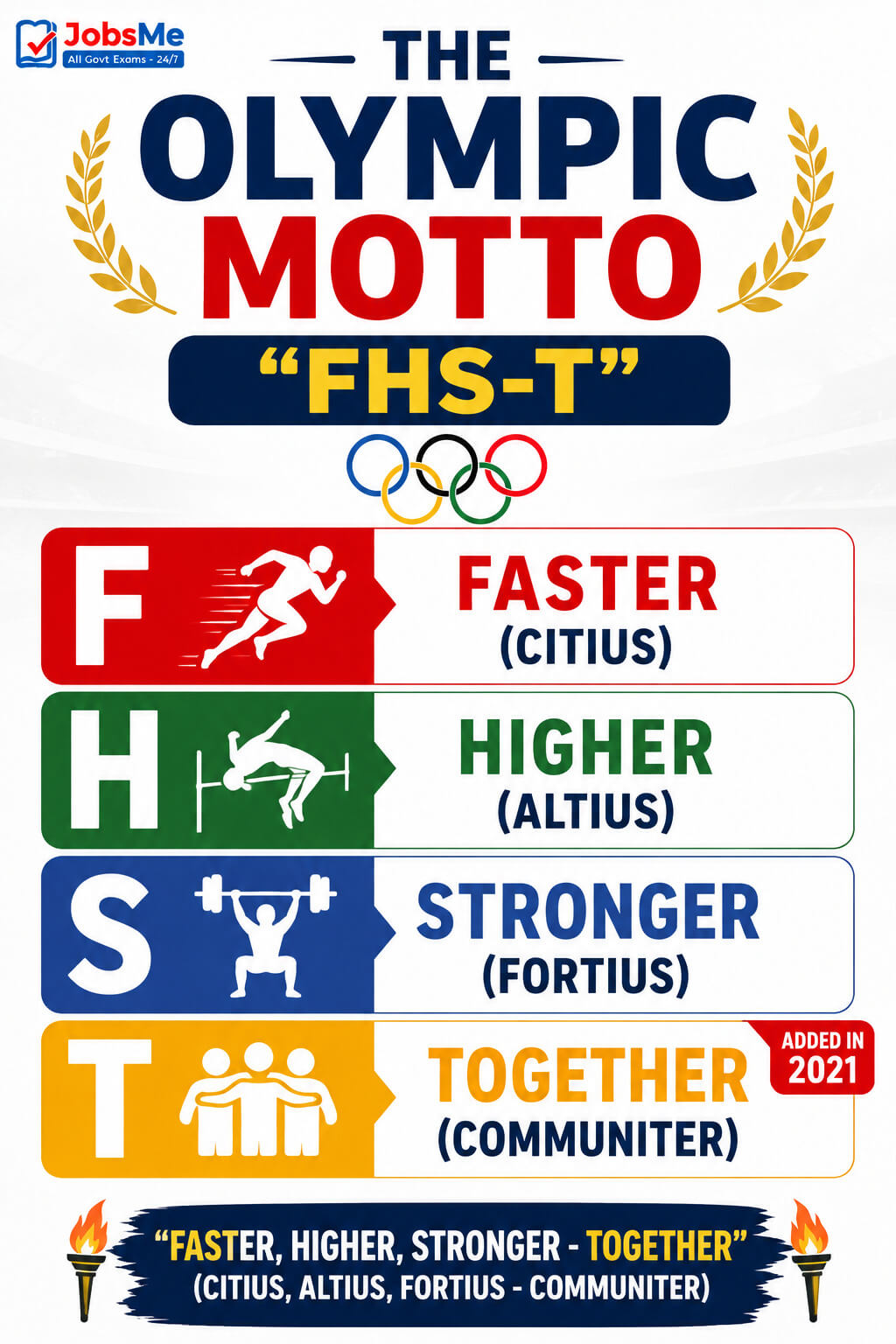
Use "FHS-T" to recall Citius, Altius, Fortius - Communiter:
- F → Faster (Citius).
- H → Higher (Altius).
- S → Stronger (Fortius).
- T → Together (Communiter, added in 2021).
Trick 3: Five Ring Colours — "Just Buy Your Black Ring"
To recall the five ring colours, use the phrase "Blue, Yellow, Black, Green, Red":
- B → Blue.
- Y → Yellow.
- B → Black.
- G → Green.
- R → Red.
"Remember: five rings = five continents, but no ring equals one fixed continent."
Trick 4: Flame vs Torch Relay — "Flame 28, Relay 36"
Students often confuse the two dates. Keep them apart:
- Olympic Flame → since Amsterdam 1928.
- Torch Relay → since Berlin 1936.
"Flame came first (1928), the relay ran later (1936)."
Trick 5: India's "Firsts" Ladder — "P-J-B-C"
Remember India's four biggest individual firsts in order:
- P → Pritchard (first medal, 1900).
- J → Jadhav (first individual medal for independent India, 1952).
- B → Bindra (first individual gold, 2008).
- C → Chopra (first athletics gold, 2020).
Trick 6: Hockey Golden Era — "6 in a Row, 8 in All"
India's hockey dominance is best remembered as:
- Six consecutive golds → 1928 to 1956.
- Eight golds in total → last one at Moscow 1980.
- Star player → Dhyan Chand, the "Hockey Wizard."
Trick 7: IOC Founders — "Coubertin Builds, Vikelas Leads"
- Pierre de Coubertin → Founder / Father of the Modern Olympics; second IOC President.
- Demetrius Vikelas → First IOC President (a Greek).
"Coubertin created the IOC, but a Greek led it first."
Additional Notes
Frequently Confused Facts
- First Ancient vs First Modern Olympics: Ancient Games began in 776 BC at Olympia; Modern Games began in 1896 at Athens. Both were in Greece.
- Founder vs First President: Pierre de Coubertin founded the IOC and is the Father of the Modern Olympics, but the first IOC President was Demetrius Vikelas of Greece.
- Rings designed vs Flag flown: The rings were designed in 1913 and the flag was created in 1914, but the flag was first flown at the Antwerp 1920 Games.
- Flame vs Torch Relay: The Olympic flame has been used since 1928; the torch relay (carrying the flame from Greece) began at Berlin 1936.
- First Indian medal vs First independent individual medal: Norman Pritchard won India's first medals in 1900; K. D. Jadhav won the first individual medal for independent India in 1952.
- First individual gold vs First athletics gold: Abhinav Bindra won India's first individual gold (shooting, 2008); Neeraj Chopra won India's first athletics gold (javelin, 2020).
- First woman medallist vs First woman participant (independent India): Karnam Malleswari was the first Indian woman to win a medal (2000); Nilima Ghosh was among the first women from independent India to compete (1952).
- End of Ancient Games: The Ancient Olympics were banned in 393 AD by Roman emperor Theodosius I, not by the Greeks themselves.
Repeating PYQ Patterns
Certain Olympic facts are asked repeatedly in competitive exams. First Ancient Olympics (776 BC, Olympia), founder of the Modern Olympics (Pierre de Coubertin), first Modern Olympics (Athens 1896), the Olympic motto (Citius, Altius, Fortius), the five rings and their meaning, IOC headquarters (Lausanne), the first Winter Olympics (Chamonix 1924), Abhinav Bindra's first individual gold, and Neeraj Chopra's javelin gold appear most often in UPSC Prelims, SSC CGL and RRB NTPC papers. Banking exams (IBPS PO, SBI Clerk) frequently focus on recent host cities, mascots and India's medal tally. State PCS and Defence exams add questions on Dhyan Chand, National Sports Day (29 August), and India's hockey golden era.
Quick Insight
The Olympic Games are more than a sporting contest — they are a living link between ancient and modern civilisation and a symbol of global unity. From an olive wreath at Olympia to gold medals in Paris, the Games have survived wars, boycotts and a pandemic, reflecting humanity's enduring spirit. For India, the Olympic story mirrors the nation's own journey — from a lone athlete in 1900 to a confident sporting power targeting a future host bid. Understanding this history helps aspirants connect sports questions to broader themes of nationalism, diplomacy and soft power, useful for both Prelims and interviews. For further reading, you can explore the Static GK notes and stay updated with the Daily Current Affairs section on thejobsme.com.
One-Liners for Quick Revision
- First Ancient Olympics → 776 BC → held at Olympia, Greece, in honour of Zeus.
- Ancient Olympics venue → Olympia → a sacred sanctuary in the western Peloponnese.
- First Olympic event → Stadion → a footrace of about 192 metres; origin of the word "stadium."
- First Olympic champion → Coroebus of Elis → a cook, first recorded winner in 776 BC.
- Ancient Olympic prize → Olive wreath → cut from the sacred olive tree of Zeus; no cash prize.
- Ancient participants → Free-born Greek males only → competed nude; women barred.
- End of Ancient Olympics → 393 AD → banned by Roman emperor Theodosius I.
- Olympiad → Four-year gap between Games → used as a unit of time in ancient Greece.
- Founder of Modern Olympics → Pierre de Coubertin → Father of the Modern Olympic Games (France).
- IOC founded → 23 June 1894 → at the Sorbonne, Paris; 23 June is Olympic Day.
- First IOC President → Demetrius Vikelas → a Greek.
- First Modern Olympics → Athens 1896 → 14 nations, 43 events, only male athletes.
- IOC Headquarters → Lausanne, Switzerland.
- Olympic Motto → Citius, Altius, Fortius - Communiter → "Faster, Higher, Stronger - Together"; "Together" added in 2021.
- Olympic Rings → Five interlaced rings (blue, yellow, black, green, red) → union of the five continents; designed 1913.
- Olympic Flag → Created 1914 → first flown at Antwerp 1920.
- Olympic Flame → Symbol since Amsterdam 1928.
- Torch Relay → Introduced at Berlin 1936.
- Olympic Mascot → First at Grenoble 1968 → "Misha" bear (Moscow 1980) made it popular.
- Olympic Anthem → Music by Spyridon Samaras, lyrics by Kostis Palamas → adopted 1958.
- Cancelled Games → 1916 (WWI), 1940 and 1944 (WWII).
- First Winter Olympics → Chamonix, France, 1924.
- First Winter champion → Charles Jewtraw (USA) → 500m speed skating.
- Paralympics → First held in Rome, 1960 → for athletes with disabilities.
- Youth Olympics → First held in Singapore, 2010 → for ages 14 to 18.
- Beijing → First city to host both Summer (2008) and Winter (2022) Games.
- Recent hosts → Rio 2016, Tokyo 2020 (held 2021), Paris 2024.
- Upcoming hosts → Los Angeles 2028, Brisbane 2032; French Alps 2030 and Salt Lake City 2034 (Winter).
- India's first participant and medals → Norman Pritchard (Paris 1900) → two silvers; first Asian Olympic medallist.
- India's first gold → Men's Hockey Team (Amsterdam 1928) → led by Dhyan Chand.
- India hockey golden era → Six consecutive golds (1928-1956); eight golds in all (last in 1980).
- First individual medal, independent India → K. D. Jadhav (Helsinki 1952) → wrestling bronze.
- First Indian woman medallist → Karnam Malleswari (Sydney 2000) → weightlifting bronze.
- First individual silver → Rajyavardhan Singh Rathore (Athens 2004) → shooting.
- First individual gold → Abhinav Bindra (Beijing 2008) → 10m air rifle.
- First athletics gold → Neeraj Chopra (Tokyo 2020) → men's javelin throw.
- India's best-ever Games → Tokyo 2020 → seven medals.
- Two medals in one edition, independent India → Manu Bhaker (Paris 2024) → shooting.
- National Sports Day (India) → 29 August → birthday of Dhyan Chand, the Hockey Wizard.
For more Static GK topics like famous personalities, battles and important days, explore the Static GK section on thejobsme.com. You can also test your knowledge with the Static GK Quiz and check out the latest exam notifications at Latest Government Job Notifications.
Free quiz • No signup required
Put this topic into practice with Indian Cultural Institutions – Static GK MCQ Quiz. It is the quickest way to reinforce what you just learned.
Frequently Asked Questions
When and where were the first ancient Olympic Games held?
Who is known as the Father of the Modern Olympic Games?
When and where were the first modern Olympic Games held?
What do the five Olympic rings represent?
What is the Olympic motto?
Where is the headquarters of the International Olympic Committee located?
Who won the first individual Olympic gold medal for India?
Who was the first Indian to win an Olympic medal?
When and where were the first Winter Olympic Games held?
Why is 29 August celebrated as National Sports Day in India?

About the author