List of Important Constitutional Amendments of India – Static GK & General Awareness for Competitive Exams with Memory Tricks
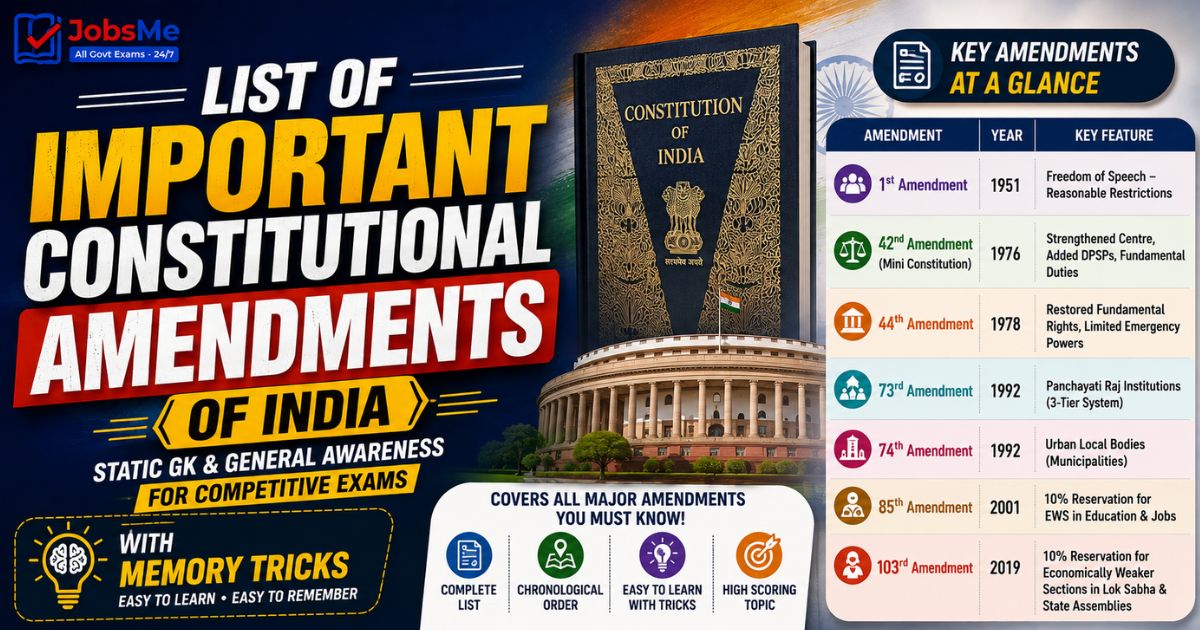
This article presents a complete, exam-ready list of the most important Constitutional Amendments of India, from the 1st Amendment (1951) to the 106th Amendment (2023), along with the Article 368 amendment procedure, the Basic Structure Doctrine, and key Supreme Court cases. It covers landmark amendments like the 42nd (Mini Constitution), 44th, 61st (voting age), 73rd–74th (Panchayati Raj and Urban Local Bodies), 86th (Right to Education), 101st (GST), 103rd (EWS reservation), and 106th (Women's Reservation – Nari Shakti Vandan Adhiniyam), plus the pending 130th Amendment Bill. With memory tricks, one-liners, and frequently confused facts, it is designed to help UPSC, SSC, IBPS, RRB, PSU, Insurance, and State PCS aspirants score better in Polity and General Awareness.
Jump to section
Introduction
The Constitution of India, which came into force on 26 January 1950, was designed as a living document — flexible enough to adapt to changing times, yet rigid enough to protect its core values. The mechanism that keeps it relevant is the Constitutional Amendment. As of 2026, the Indian Constitution has been amended 106 times, making it one of the most frequently amended constitutions in the world. In sharp contrast, the United States Constitution has been amended only 27 times in over 230 years.
Questions on Constitutional Amendments are among the most repeated in the Polity and General Awareness sections of UPSC Prelims, SSC CGL, IBPS PO, RRB NTPC, SBI Clerk, State PCS, and various Insurance and Defence exams. Examiners frequently ask which amendment introduced a specific provision (such as Fundamental Duties, GST, or the lowering of the voting age), which Article governs the amendment procedure, or which amendment is called the "Mini Constitution." This article compiles every important amendment in a structured, easy-to-revise format. To explore more Polity and Static GK topics, you can refer to the Static GK section on thejobsme.com.
Constitutional Amendments are also closely tied to current affairs — debates on the Women's Reservation Act, the pending 130th Amendment Bill, EWS reservation rulings, delimitation, and Centre-State relations regularly appear in the news. This makes the topic important not just for objective Prelims questions but also for UPSC Mains and Essay papers and for the General Awareness sections of banking and railway exams.
Core Concepts: Amendment Procedure and Basic Structure
Article 368 in Part XX of the Constitution lays down the power and procedure for amending the Constitution. The Indian amendment procedure is a balance between the flexibility of the British model and the rigidity of the American model — it is neither too easy nor too difficult. A Constitution Amendment Bill can be introduced in either House of Parliament, must be passed by each House separately, and then receives the assent of the President to become a Constitutional Amendment Act.
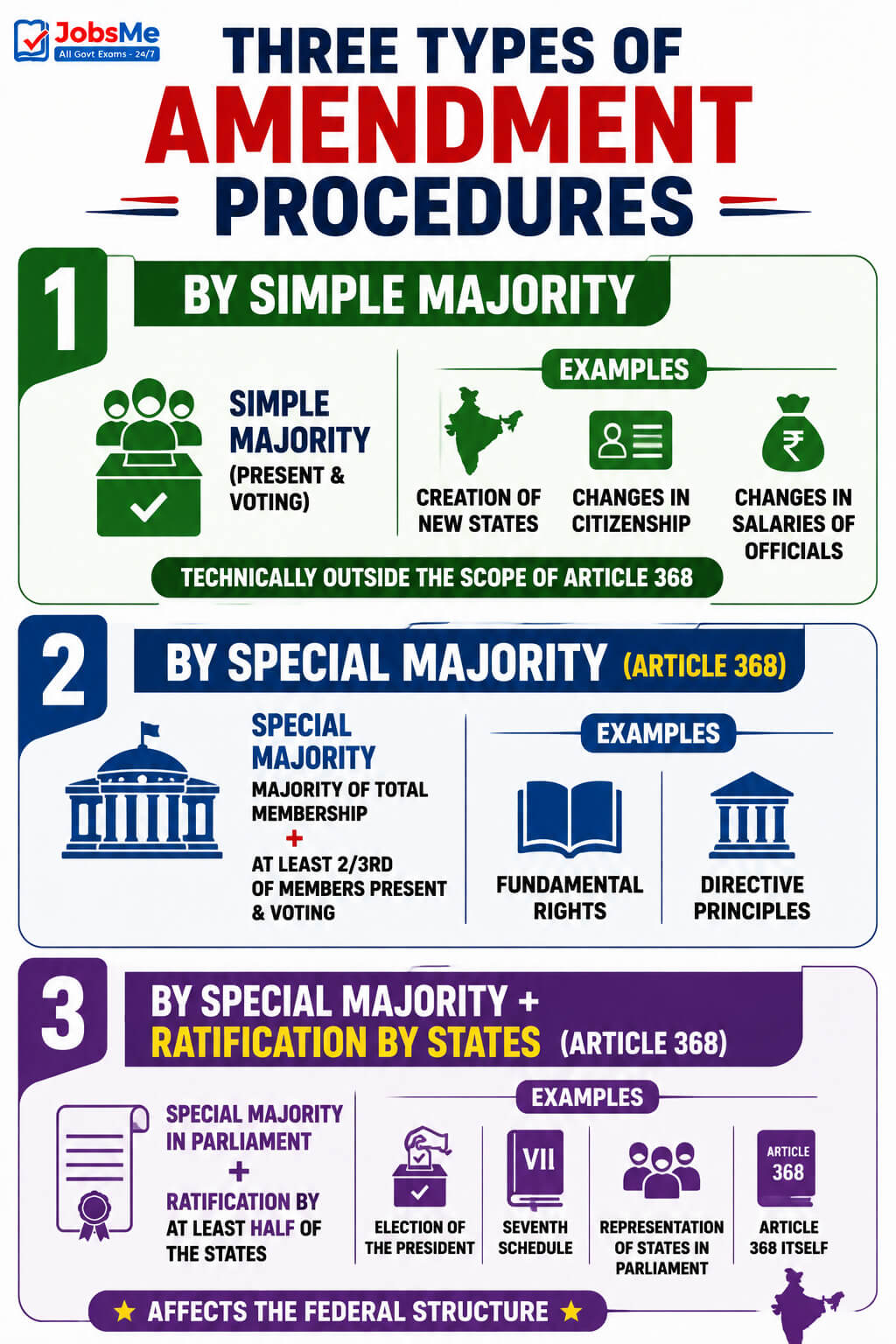
Three Types of Amendment Procedures
- By Simple Majority: Some provisions can be amended by a simple majority of members present and voting in each House — the same as ordinary legislation. Examples include the creation of new states, changes in citizenship, and changes to the salaries of officials. These are technically outside the scope of Article 368.
- By Special Majority (Article 368): Most provisions require a special majority — a majority of the total membership of each House plus at least a two-thirds majority of the members present and voting. Examples include amendments to Fundamental Rights and Directive Principles.
- By Special Majority plus Ratification by States (Article 368): Provisions affecting the federal structure require a special majority in Parliament and ratification by the legislatures of at least half of the states. Examples include the election of the President, the Seventh Schedule, representation of states in Parliament, and Article 368 itself.
The Basic Structure Doctrine
The amending power of Parliament is not unlimited. In the landmark Kesavananda Bharati v. State of Kerala (1973) case, the Supreme Court ruled that while Parliament can amend any part of the Constitution, it cannot alter or destroy its "Basic Structure." Elements such as the supremacy of the Constitution, the rule of law, separation of powers, federalism, secularism, democracy, and judicial review form this Basic Structure. This doctrine acts as the outer boundary of the amendment power. To strengthen your Polity preparation, you can also practise with the Static GK Quiz on thejobsme.com.
List of Important Constitutional Amendments of India
The following table lists the most exam-relevant Constitutional Amendments along with the year and the key changes each one introduced.
| Amendment (Year) | Popular Name / Theme | Key Provisions / Details |
|---|---|---|
| 1st Amendment (1951) | First Amendment | Added the Ninth Schedule to protect land reform laws from judicial review; inserted Articles 31A and 31B; added reasonable restrictions on the freedom of speech under Article 19. |
| 7th Amendment (1956) | States Reorganisation | Reorganised states on a linguistic basis; abolished the earlier classification of states into Part A, B, C, and D; introduced the category of Union Territories. |
| 10th Amendment (1961) | Dadra and Nagar Haveli | Incorporated Dadra and Nagar Haveli into the Indian Union as a Union Territory. |
| 24th Amendment (1971) | Amending Power | Affirmed the power of Parliament to amend any part of the Constitution, including Fundamental Rights; made the President's assent to a Constitution Amendment Bill compulsory. |
| 26th Amendment (1971) | Abolition of Privy Purses | Abolished the privy purses and special privileges of the former rulers of princely states. |
| 36th Amendment (1975) | Sikkim as a State | Made Sikkim a full-fledged state of the Indian Union. |
| 42nd Amendment (1976) | Mini Constitution | The most comprehensive amendment, passed during the Emergency; added the words "Socialist," "Secular," and "Integrity" to the Preamble; introduced Fundamental Duties (Article 51A); curtailed judicial review; transferred several subjects from the State List to the Concurrent List. |
| 44th Amendment (1978) | Reversal of Emergency Excesses | Removed the Right to Property from Fundamental Rights and made it a legal right under Article 300A; restored several safeguards diluted by the 42nd Amendment; replaced "internal disturbance" with "armed rebellion" as a ground for National Emergency. |
| 52nd Amendment (1985) | Anti-Defection Law | Added the Tenth Schedule, providing for the disqualification of members on the grounds of defection. |
| 61st Amendment (1989) | Voting Age | Reduced the voting age for Lok Sabha and State Assembly elections from 21 years to 18 years. |
| 71st Amendment (1992) | Languages | Added Konkani, Manipuri, and Nepali to the Eighth Schedule of recognised languages. |
| 73rd Amendment (1992) | Panchayati Raj | Gave constitutional status to Panchayati Raj Institutions (rural local bodies); added Part IX and the Eleventh Schedule. |
| 74th Amendment (1992) | Urban Local Bodies | Gave constitutional status to Municipalities (urban local bodies); added Part IXA and the Twelfth Schedule. |
| 86th Amendment (2002) | Right to Education | Inserted Article 21A making free and compulsory education for children aged 6 to 14 years a Fundamental Right; added the Fundamental Duty of parents to provide education under Article 51A. |
| 91st Amendment (2003) | Size of Council of Ministers | Limited the size of the Council of Ministers to 15% of the total strength of the Lok Sabha or State Assembly; strengthened the anti-defection law. |
| 92nd Amendment (2003) | Languages | Added Bodo, Dogri, Maithili, and Santhali to the Eighth Schedule, raising the number of recognised languages to 22. |
| 97th Amendment (2011) | Cooperative Societies | Gave constitutional status to cooperative societies; added Part IXB; made the right to form cooperative societies a Fundamental Right under Article 19. |
| 100th Amendment (2015) | India-Bangladesh Land Boundary | Gave effect to the Land Boundary Agreement between India and Bangladesh by exchanging enclaves and adverse possessions. |
| 101st Amendment (2016) | Goods and Services Tax (GST) | Introduced the Goods and Services Tax; inserted Article 246A, Article 269A, and Article 279A (GST Council); created a unified national indirect tax system. |
| 102nd Amendment (2018) | National Commission for Backward Classes | Gave constitutional status to the National Commission for Backward Classes (NCBC); inserted Articles 338B and 342A. |
| 103rd Amendment (2019) | EWS Reservation | Provided 10% reservation for Economically Weaker Sections (EWS) in education and public employment; upheld by the Supreme Court in Janhit Abhiyan v. Union of India (2022). |
| 104th Amendment (2020) | SC/ST Reservation Extension | Extended the reservation of seats for Scheduled Castes and Scheduled Tribes in the Lok Sabha and State Assemblies by 10 years (up to 80 years from commencement); ended the nomination of Anglo-Indian members. |
| 105th Amendment (2021) | States' Power on OBC List | Restored the power of states and union territories to identify and specify their own socially and educationally backward classes (OBCs). |
| 106th Amendment (2023) | Women's Reservation (Nari Shakti Vandan Adhiniyam) | Reserved one-third (33%) of seats for women in the Lok Sabha, State Legislative Assemblies, and the Delhi Assembly; added Articles 330A and 332A; received Presidential assent on 28 September 2023; implementation is linked to the next delimitation exercise after the Census. |
Pending Amendment to Watch
The 130th Constitutional Amendment Bill, 2025 was introduced in the Lok Sabha by the Union Home Minister and is under review by a Joint Parliamentary Committee. It proposes the removal of the Prime Minister, Chief Ministers, and other Ministers if they are arrested and detained in custody for 30 consecutive days on charges of a serious criminal offence punishable by five years or more of imprisonment. As it is still a Bill and not yet enacted, the latest enacted amendment remains the 106th. For ongoing updates on such polity developments, you can follow the Daily Current Affairs section on thejobsme.com.
Key Supreme Court Cases on Amendment Power
Several landmark judgments have shaped the scope and limits of Parliament's amending power. These cases are frequently tested in both Prelims and Mains.
| Case (Year) | Key Ruling / Significance |
|---|---|
| Shankari Prasad v. Union of India (1951) | Held that Parliament could amend any part of the Constitution, including Fundamental Rights, under Article 368. |
| Golak Nath v. State of Punjab (1967) | Reversed the earlier view and ruled that Parliament could not amend Fundamental Rights. |
| Kesavananda Bharati v. State of Kerala (1973) | Propounded the Basic Structure Doctrine — Parliament can amend any part but cannot destroy the basic structure of the Constitution. |
| Indira Nehru Gandhi v. Raj Narain (1975) | Applied the Basic Structure Doctrine to strike down a constitutional amendment relating to election disputes. |
| Minerva Mills v. Union of India (1980) | Struck down parts of the 42nd Amendment; held that limited amending power and judicial review are part of the basic structure. |
| Waman Rao v. Union of India (1981) | Held that laws placed in the Ninth Schedule after 24 April 1973 (the Kesavananda Bharati date) are open to judicial review. |
Memory Tricks and Mnemonics
Trick 1: The Local Government Pair — "73 Rural, 74 Urban"
The two local-government amendments come as a consecutive pair. Remember the order by the size of the number matching the size of the place:
- 73rd → Panchayati Raj → Rural local bodies (Part IX, Eleventh Schedule).
- 74th → Municipalities → Urban local bodies (Part IXA, Twelfth Schedule).
"73 in the village, 74 in the city — both came together in 1992."
Trick 2: The Two Emergency Amendments — "42 Damaged, 44 Repaired"
The 42nd and 44th go together as a problem-and-solution pair:
- 42nd (1976) → the "Mini Constitution"; concentrated power and curbed judicial review during the Emergency.
- 44th (1978) → undid the excesses; removed Right to Property from Fundamental Rights and restored safeguards.
"42 broke it, 44 fixed it."
Trick 3: The Reservation Trio — "103 EWS, 104 Extend, 105 OBC"
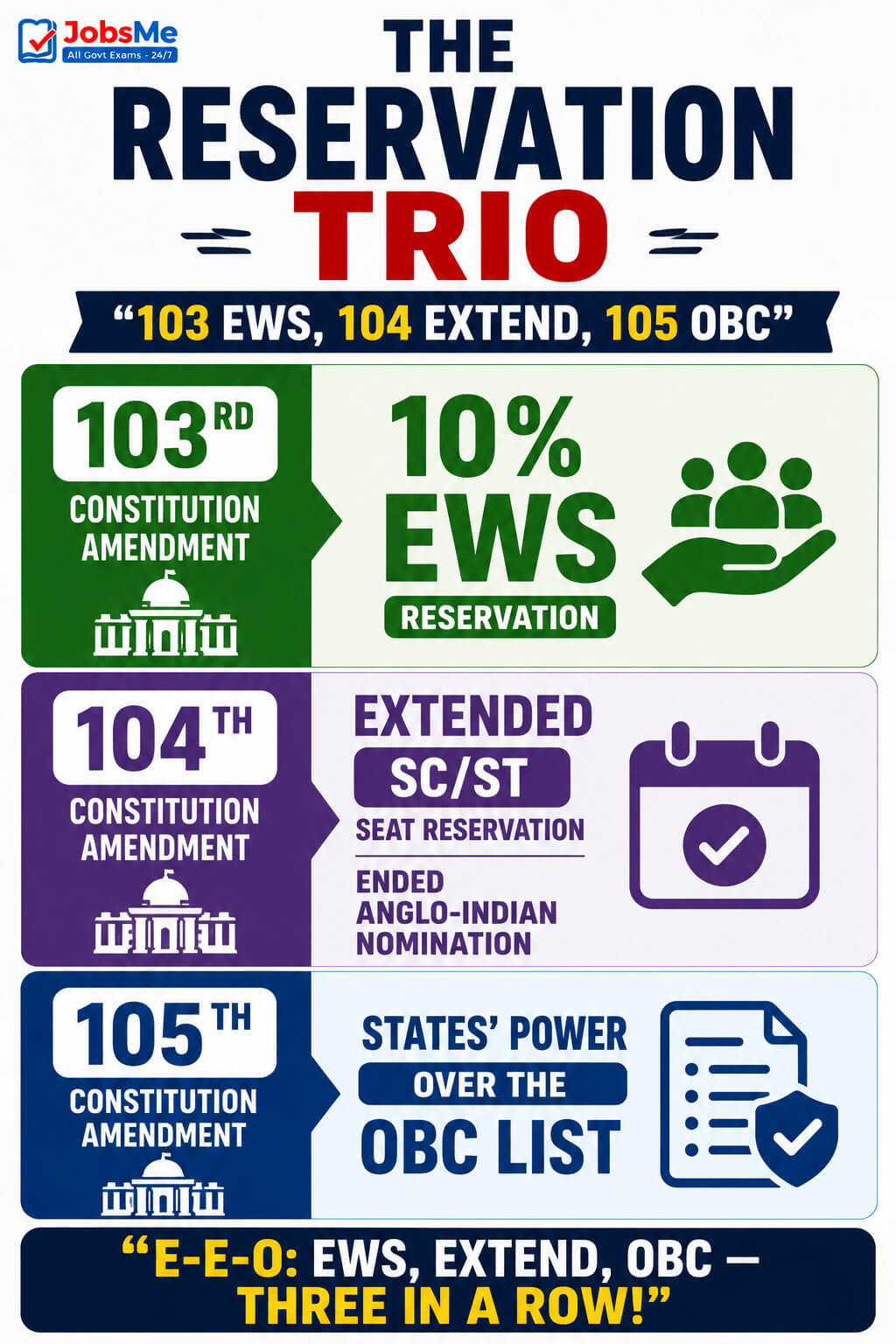
Three back-to-back amendments all deal with reservation:
- 103rd → 10% EWS reservation.
- 104th → Extended SC/ST seat reservation; ended Anglo-Indian nomination.
- 105th → States' power over the OBC list.
"E-E-O: EWS, Extend, OBC — three in a row."
Trick 4: "Sweet 16, Voting at 18" — Amendment 61
To remember the voting-age amendment, link the round number to the round milestone:
- 61st Amendment (1989) → reduced voting age from 21 to 18 years.
"61 cut 21 down to 18."
Trick 5: "Tax and Schedule" — The First Amendment's Ninth Schedule
The very first amendment created the Ninth Schedule:
- 1st Amendment (1951) → added the Ninth Schedule to shield land reform laws from courts.
"First amendment, Ninth Schedule — protect the farms."
Trick 6: Single-Topic Star Amendments — "Quick Hits"
Some amendments are remembered by one signature change. Memorise these as flashcards:
- 52nd → Anti-Defection Law (Tenth Schedule).
- 86th → Right to Education (Article 21A).
- 101st → GST.
- 106th → Women's Reservation (33%).
Trick 7: "Status Givers" — Amendments That Granted Constitutional Status
Group together the amendments that elevated a body or institution to constitutional status:
- 73rd / 74th → Panchayats and Municipalities.
- 97th → Cooperative Societies.
- 102nd → National Commission for Backward Classes (NCBC).
"They all got a constitutional seat at the table."
Additional Notes
Frequently Confused Facts
- 42nd vs 44th Amendment: The 42nd (1976) is the "Mini Constitution" that curbed rights during the Emergency; the 44th (1978) reversed many of those changes and removed Right to Property from Fundamental Rights.
- 73rd vs 74th Amendment: The 73rd deals with Panchayati Raj (rural) and the 74th with Municipalities (urban). Do not swap them.
- Article 21 vs Article 21A: Article 21 is the Right to Life and Personal Liberty; Article 21A (added by the 86th Amendment) is the Right to Education.
- 101st vs 122nd: GST was introduced by the 101st Amendment Act (2016); the related bill in Parliament was numbered the 122nd Amendment Bill — the enacted Act number (101st) is the correct exam answer.
- 103rd vs 105th: The 103rd gave 10% EWS reservation; the 105th restored states' power to identify their own OBC lists. They are different.
- 106th Amendment vs the actual reservation: The 106th (Women's Reservation) was enacted in 2023, but the 33% reservation will take effect only after delimitation following the next Census — it is not yet operational.
- 61st vs 62nd: The 61st reduced the voting age to 18; do not confuse it with other 1980s amendments.
- Total amendments — 106 (enacted) vs 130 (pending bill): 106 amendments have been enacted as of 2026; the 130th is only a pending Bill, not yet an Act.
Repeating PYQ Patterns
Certain amendments are asked again and again in competitive exams. The 42nd Amendment (Mini Constitution, Fundamental Duties), 44th Amendment (Right to Property), 61st Amendment (voting age 18), 73rd and 74th Amendments (Panchayati Raj and Municipalities), 86th Amendment (Right to Education), 101st Amendment (GST), 103rd Amendment (EWS), and 106th Amendment (Women's Reservation) appear most frequently in UPSC Prelims, SSC CGL, and RRB NTPC. Banking exams such as IBPS PO and SBI Clerk favour the more recent amendments — GST (101st), EWS (103rd), and Women's Reservation (106th) — as part of static-plus-current awareness. UPSC Mains has directly tested Article 368 and the Basic Structure Doctrine (for example, the 2019 question on whether Parliament can destroy the basic structure). State PCS exams often add state-specific amendments such as the creation of Sikkim (36th) and language additions to the Eighth Schedule.
Quick Insight
Constitutional Amendments are the visible record of how India has reformed itself — peacefully and within the law. Each amendment marks a turning point: the 73rd and 74th took democracy down to the village and the city, the 86th made education a right, the 101st unified the nation's indirect taxes under GST, and the 106th opened one-third of legislative seats to women. The Basic Structure Doctrine ensures this evolution never crosses into destruction of the Constitution's core. Understanding amendments helps aspirants connect static Polity to live current affairs — from the pending 130th Amendment Bill to delimitation and reservation debates. For more on the working of the Indian banking and economic system tested alongside polity, see the Banking Awareness notes, and stay current with the Daily Current Affairs page on thejobsme.com.
One-Liners for Quick Revision
- Amendment Procedure → Article 368 → Part XX of the Constitution.
- Total Amendments (as of 2026) → 106 enacted → 130th is only a pending Bill.
- Three Types of Amendment → Simple majority, Special majority, Special majority plus state ratification.
- Basic Structure Doctrine → propounded in Kesavananda Bharati case (1973) → limits Parliament's amending power.
- 1st Amendment (1951) → added Ninth Schedule → protected land reform laws.
- 7th Amendment (1956) → states reorganised on linguistic lines → introduced Union Territories.
- 10th Amendment (1961) → incorporated Dadra and Nagar Haveli.
- 24th Amendment (1971) → Parliament can amend any part → President's assent made compulsory.
- 26th Amendment (1971) → abolished privy purses of former princes.
- 36th Amendment (1975) → made Sikkim a full state.
- 42nd Amendment (1976) → Mini Constitution → added Fundamental Duties, "Socialist," "Secular," "Integrity" to Preamble.
- 44th Amendment (1978) → removed Right to Property from Fundamental Rights → made it a legal right (Article 300A).
- 52nd Amendment (1985) → Anti-Defection Law → added Tenth Schedule.
- 61st Amendment (1989) → reduced voting age from 21 to 18 years.
- 71st Amendment (1992) → added Konkani, Manipuri, Nepali to Eighth Schedule.
- 73rd Amendment (1992) → Panchayati Raj → Part IX, Eleventh Schedule.
- 74th Amendment (1992) → Municipalities → Part IXA, Twelfth Schedule.
- 86th Amendment (2002) → Right to Education → Article 21A → ages 6 to 14.
- 91st Amendment (2003) → Council of Ministers capped at 15% of House strength.
- 92nd Amendment (2003) → added Bodo, Dogri, Maithili, Santhali → 22 scheduled languages.
- 97th Amendment (2011) → constitutional status to cooperative societies → Part IXB.
- 100th Amendment (2015) → India-Bangladesh Land Boundary Agreement.
- 101st Amendment (2016) → Goods and Services Tax (GST) → GST Council under Article 279A.
- 102nd Amendment (2018) → constitutional status to NCBC → Articles 338B and 342A.
- 103rd Amendment (2019) → 10% EWS reservation → upheld in Janhit Abhiyan case (2022).
- 104th Amendment (2020) → extended SC/ST seat reservation → ended Anglo-Indian nomination.
- 105th Amendment (2021) → restored states' power to make their own OBC lists.
- 106th Amendment (2023) → Women's Reservation (Nari Shakti Vandan Adhiniyam) → 33% seats → Articles 330A and 332A.
- 130th Amendment Bill (2025) → pending → removal of PM/CM/Ministers detained 30 days for serious offences.
- Kesavananda Bharati (1973) → Basic Structure Doctrine established.
- Minerva Mills (1980) → struck down parts of the 42nd Amendment.
For more Polity and Static GK topics like the Indian Constitution, Fundamental Rights, and important Articles, explore the Static GK section on thejobsme.com. You can also test your preparation with the Static GK Quiz and check the latest exam updates at Latest Government Job Notifications.
Free quiz • No signup required
Put this topic into practice with Indian Cultural Institutions – Static GK MCQ Quiz. It is the quickest way to reinforce what you just learned.
Frequently Asked Questions
Which Article of the Indian Constitution deals with the amendment procedure?
How many times has the Indian Constitution been amended so far?
Which amendment is known as the Mini Constitution?
Which amendment introduced Fundamental Duties in the Constitution?
What is the Basic Structure Doctrine and which case established it?
Which amendment reduced the voting age from 21 to 18 years?
Which amendments gave constitutional status to local bodies?
Which amendment introduced the Goods and Services Tax (GST)?
What is the 103rd Constitutional Amendment Act?
What does the 106th Constitutional Amendment Act provide for?

About the author