Election Commission of India & Election Process – Static GK & General Awareness for Competitive Exams with Memory Tricks
This article explains the Election Commission of India (ECI) and the complete election process in a simple, exam-ready format, covering its constitutional basis (Article 324), composition, powers, appointment and removal of the Chief Election Commissioner, and key electoral reforms like EVM, VVPAT, NOTA and the Model Code of Conduct. It includes the current CEC Gyanesh Kumar, important dates, memory tricks and one-liners for quick revision. All facts are arranged to help UPSC, SSC, IBPS, RRB, PSU, Defence and State PCS aspirants score better in Polity and General Awareness sections.
Jump to section
Introduction
The Election Commission of India (ECI) is the independent constitutional authority that conducts free and fair elections in the world's largest democracy. It was established on 25 January 1950, a day now celebrated every year as National Voters' Day. The ECI manages elections to the Lok Sabha, Rajya Sabha, State Legislative Assemblies, State Legislative Councils, and to the offices of the President and Vice-President of India. It does not, however, conduct elections to Municipalities and Panchayats — those are handled by separate State Election Commissions.
Questions on the Election Commission and the election process appear almost every year in UPSC Prelims, SSC CGL, IBPS PO, RRB NTPC, SBI Clerk, State PCS, and Defence and Insurance exams. Typical questions ask about the article that governs the ECI, who appoints the Chief Election Commissioner, how the CEC can be removed, what NOTA and VVPAT mean, or which body enforces the Model Code of Conduct. This article organises every important fact in a structured, easy-to-remember format. To strengthen your polity preparation, you can also explore the Static GK section on thejobsme.com.
The topic is also directly connected to current affairs — the appointment of a new Chief Election Commissioner in 2025, the Chief Election Commissioner and Other Election Commissioners Act 2023, Special Intensive Revision of electoral rolls, and India chairing International IDEA in 2026 have all been in the news. This makes the Election Commission doubly important for aspirants preparing for both objective papers and descriptive Mains answers.
Core Concepts: The Election Commission and the Election Process
The Election Commission of India is a permanent, independent body created directly by the Constitution. Understanding a few core ideas makes every related question easy to answer.
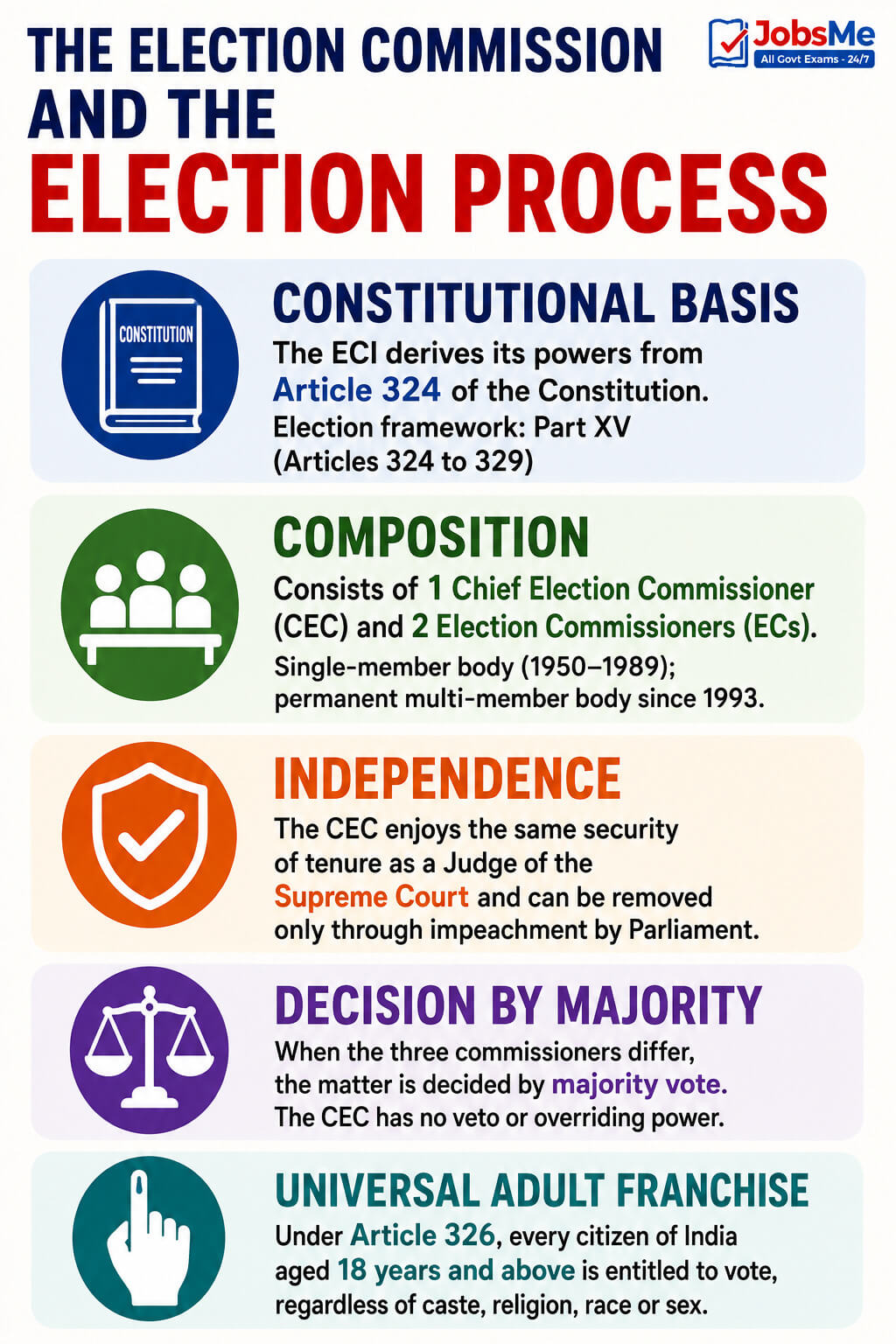
- Constitutional Basis: The ECI derives its powers from Article 324 of the Constitution, which vests it with the superintendence, direction and control of elections. The full election framework is covered under Part XV (Articles 324 to 329) of the Constitution.
- Composition: The Commission currently consists of one Chief Election Commissioner (CEC) and two Election Commissioners (ECs). It was a single-member body from 1950 to 1989 and became a permanent multi-member body in 1993.
- Independence: The CEC enjoys the same security of tenure as a Judge of the Supreme Court and cannot be removed except through impeachment by Parliament. This insulates the Commission from political pressure.
- Decision by Majority: When the three commissioners differ, the matter is decided by majority vote. The CEC does not have overruling or veto power over the other two.
- Universal Adult Franchise: Under Article 326, every citizen of India aged 18 years and above is entitled to vote, regardless of caste, religion, race or sex.
The election process itself moves through clear stages — issue of notification, filing of nominations, scrutiny, withdrawal, campaigning, polling using Electronic Voting Machines, counting of votes, and declaration of results. The Model Code of Conduct comes into force the moment elections are announced.
Election Commission of India - Key Facts and Constitutional Provisions
The following table summarises the most exam-relevant facts about the composition, appointment and powers of the Election Commission of India.
| Feature | Detail | Key Points / Description |
|---|---|---|
| Establishment | 25 January 1950 | Set up one day before the Constitution came into force; the founding day is celebrated as National Voters' Day since 2011. |
| Constitutional Article | Article 324 | Grants the ECI superintendence, direction and control of elections to Parliament, State Legislatures, and the offices of the President and Vice-President. |
| Part of Constitution | Part XV (Articles 324 to 329) | The complete constitutional framework for elections in India, covering the Commission, electoral rolls, franchise and the bar on court interference. |
| Composition | CEC + 2 Election Commissioners | Single-member body from 1950 to 1989; became a permanent three-member body in 1993. All three members have equal powers and decisions are taken by majority. |
| Appointing Authority | President of India | The President appoints the CEC and ECs on the recommendation of a three-member selection committee under the 2023 Act. |
| Selection Committee (2023 Act) | PM + a Union Cabinet Minister + Leader of Opposition in Lok Sabha | Set up by the Chief Election Commissioner and Other Election Commissioners Act, 2023, which replaced the earlier executive-only process after the Anoop Baranwal judgment. |
| Tenure | 6 years or up to 65 years of age | The CEC and ECs hold office for six years or until they attain the age of 65, whichever is earlier. |
| Salary and Status | Equal to a Supreme Court Judge | The CEC draws a salary equal to that of a Supreme Court judge; expenses are charged on the Consolidated Fund of India. |
| Removal of CEC | Impeachment by Parliament | The CEC can be removed only in the same manner and on the same grounds (proved misbehaviour or incapacity) as a Supreme Court judge, requiring a special majority in both Houses. |
| Removal of Election Commissioners | On CEC's recommendation | Other Election Commissioners can be removed by the President only on the recommendation of the Chief Election Commissioner. |
| Headquarters | New Delhi | The ECI is headquartered at Nirvachan Sadan, New Delhi. |
| First CEC of India | Sukumar Sen | Sukumar Sen served as the first Chief Election Commissioner (1950-1958) and oversaw India's first general elections of 1951-52. |
| Current CEC (2025 onwards) | Gyanesh Kumar (26th CEC) | A 1988-batch IAS officer of the Kerala cadre; appointed in February 2025 as the first CEC under the 2023 Act; succeeded Rajiv Kumar (25th CEC). |
| Current Election Commissioners | Sukhbir Singh Sandhu and Vivek Joshi | Serve alongside CEC Gyanesh Kumar in the three-member Commission as of 2026. |
Powers and Functions of the Election Commission
The Election Commission performs administrative, advisory and quasi-judicial functions. To test your understanding of Indian polity and constitutional bodies, try the Static GK Quiz on thejobsme.com.
| Type of Function | Power / Function | Description |
|---|---|---|
| Administrative | Conduct of elections | Notifies election schedules, prepares and revises electoral rolls, and arranges polling stations, staff and security. |
| Administrative | Model Code of Conduct (MCC) | Enforces the MCC on all parties and candidates from the announcement of elections until results are declared, to ensure a level playing field. |
| Administrative | Recognition of parties and symbols | Registers political parties, grants recognition as national or state parties, and allots election symbols. |
| Administrative | Monitoring expenditure | Sets and monitors the ceiling on election expenditure of candidates and can disqualify those who fail to submit expense accounts. |
| Advisory | Disqualification of members | Advises the President and Governors on the disqualification of sitting members of Parliament and State Legislatures; its opinion is binding. |
| Quasi-Judicial | Disputes over parties and symbols | Settles disputes relating to splits and mergers of recognised political parties and the allotment of symbols. |
| Quasi-Judicial | Cancellation of polls | Can cancel or order re-poll in constituencies affected by malpractice, booth capturing or violence. |
Important Articles and Electoral Reforms
The election process is shaped by specific constitutional articles and key reforms introduced over the decades. Related banking and computer topics for exams are covered on the Banking Awareness page.
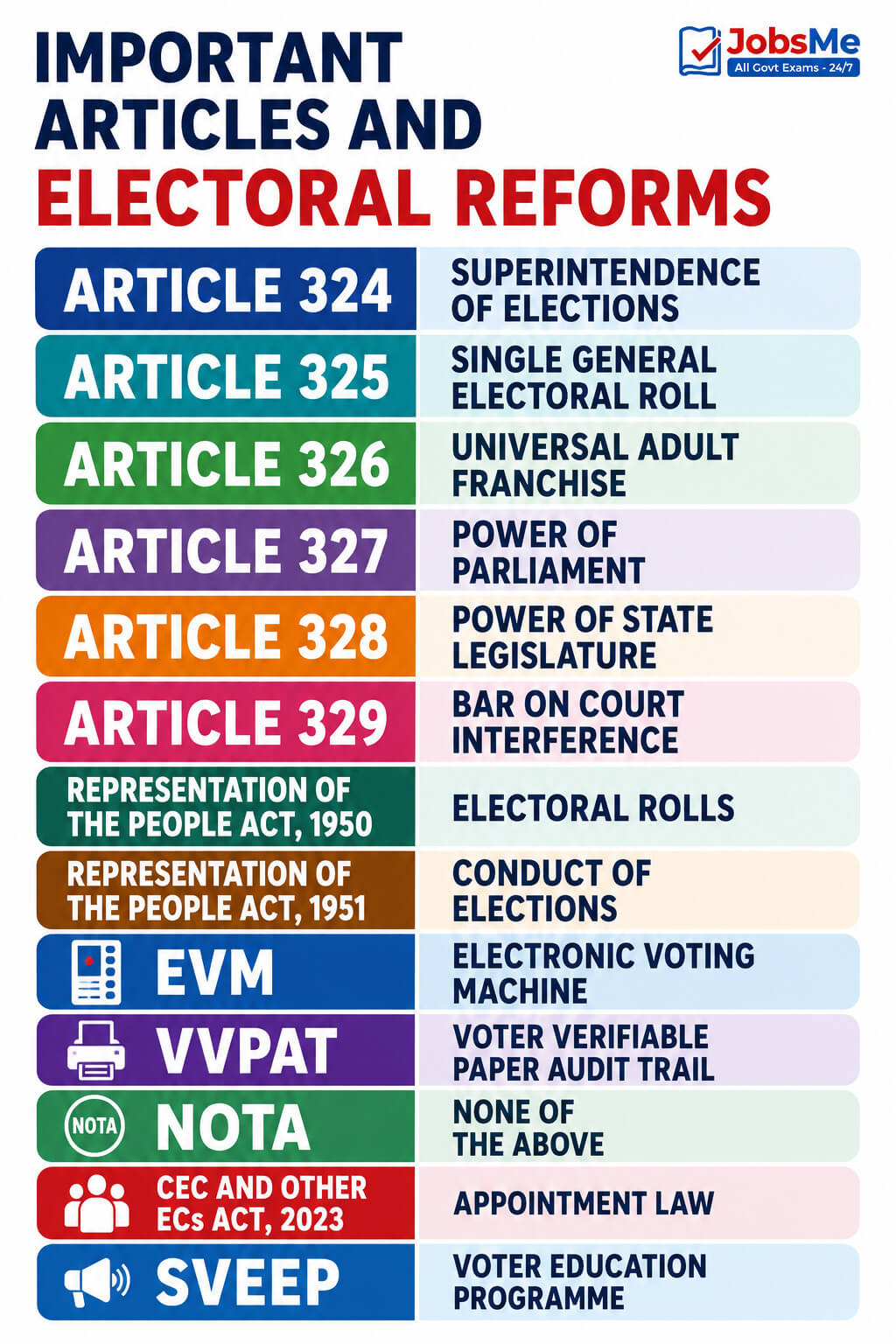
| Article / Reform | Subject | Key Details |
|---|---|---|
| Article 324 | Superintendence of elections | Vests control and direction of elections in the Election Commission of India. |
| Article 325 | Single general electoral roll | No person to be excluded from or included in the roll on grounds of religion, race, caste or sex. |
| Article 326 | Universal Adult Franchise | Elections to the Lok Sabha and State Assemblies on the basis of adult suffrage; voting age lowered from 21 to 18 by the 61st Amendment Act, 1988. |
| Article 327 | Power of Parliament | Empowers Parliament to make laws on all matters relating to elections to Parliament and State Legislatures. |
| Article 328 | Power of State Legislature | Empowers State Legislatures to make laws on elections to their own Houses, subject to laws made by Parliament. |
| Article 329 | Bar on court interference | Elections can be challenged only through an election petition filed before the designated High Court, not through ordinary courts. |
| Representation of the People Act, 1950 | Electoral rolls | Deals with the preparation of electoral rolls and allocation of seats. |
| Representation of the People Act, 1951 | Conduct of elections | Deals with the actual conduct of elections, qualifications, disqualifications and corrupt practices. |
| EVM | Electronic Voting Machine | Introduced to replace paper ballots; first used experimentally in 1982 (Kerala) and nationwide from the 2004 general elections onwards. |
| VVPAT | Voter Verifiable Paper Audit Trail | Prints a slip showing the vote cast, allowing the voter to verify their choice; adds transparency to EVM voting. |
| NOTA | None Of The Above | Introduced in 2013 following a Supreme Court order; lets voters reject all candidates while keeping their vote secret. |
| CEC and Other ECs Act, 2023 | Appointment law | Created the current selection committee (PM, a Union Cabinet Minister, Leader of Opposition) for appointing the CEC and ECs. |
| SVEEP | Voter education programme | Systematic Voters' Education and Electoral Participation — the ECI's flagship programme to increase voter awareness and turnout. |
Memory Tricks and Mnemonics
These simple tricks will help you lock in the key facts about the Election Commission and election process for quick recall in the exam hall.
Trick 1: Remember the Article Number with "3-2-4"
The Election Commission lives at Article 324. Think of it as the "3 members guarding 2 Houses of Parliament in 4 corners of India." The 3 stands for the three-member commission itself.
Trick 2: Part XV Range - "324 to 329"
All election articles fall in Part XV, Articles 324 to 329. Remember the phrase "324 starts, 329 shuts the court out" — because Article 329 bars courts from interfering in elections.
Trick 3: The Selection Committee - "PM-CM-LoP"
Under the 2023 Act, the CEC is chosen by three people. Use "PM, a Cabinet Minister, and the Leader of Opposition." Memory hook: "Prime picks, Cabinet clicks, Opposition ticks."
Trick 4: Tenure - "6 or 65"
The CEC and ECs serve for 6 years or until age 65, whichever comes first. Just remember the pair "6 or 65" — the smaller number is years, the bigger number is age.
Trick 5: Voting Technology - "E-V-N"
The three big electoral reforms are EVM, VVPAT and NOTA. Remember "EVN" — Electronic machine, Verify with paper, None-of-the-above. NOTA came in 2013.
Trick 6: Removal Rule - "CEC like a Judge, EC needs the CEC"
The CEC is removed like a Supreme Court judge (impeachment by Parliament), while an EC is removed only on the CEC's recommendation. Remember: "Chief is judged like a Judge; Commissioners need the Chief's nudge."
Trick 7: Founders and Firsts - "Sen was First, Gyanesh is Now"
Sukumar Sen was the first CEC; T. N. Seshan was the famous reformer CEC of the 1990s; and Gyanesh Kumar is the current 26th CEC. Line them up as "First-Famous-Now."
Additional Notes
Frequently Confused Facts
- ECI vs State Election Commission: The ECI conducts Lok Sabha, Rajya Sabha, Assembly, President and Vice-President elections; the State Election Commission conducts Panchayat and Municipality elections.
- Article 324 vs Article 326: Article 324 sets up the Election Commission, while Article 326 provides for universal adult franchise (voting age 18).
- CEC vs Election Commissioner removal: The CEC is removed by impeachment; an EC is removed on the CEC's recommendation — a common trap in exams.
- EVM vs VVPAT: The EVM records the vote; the VVPAT prints a paper slip so the voter can verify it. They are two different machines working together.
- Single-member vs multi-member: The ECI was a single-member body till 1989 and became a permanent three-member body in 1993.
Repeating PYQ Patterns
- UPSC Prelims: Frequently asks about Article 324, the appointment and removal of the CEC, and the difference between the ECI and State Election Commissions.
- SSC CGL and CHSL: Direct one-liners such as "Who was the first CEC?" (Sukumar Sen) and "When was the ECI established?" (25 January 1950).
- IBPS and SBI (Banking): Often test National Voters' Day, NOTA, and the current Chief Election Commissioner as current affairs.
- RRB NTPC and State PCS: Commonly ask the tenure of the CEC, the voting age, and which article deals with universal adult franchise.
Quick Insight
The Election Commission is regularly in the news, making it a hot current affairs topic. In 2025, Gyanesh Kumar became the 26th CEC and the first appointed under the new 2023 Act. In 2026, India assumed the chairmanship of International IDEA, an inter-governmental body promoting democracy, reflecting global recognition of the ECI's expertise in managing the world's largest elections with over 900 million voters. Stay updated with such developments through the Daily Current Affairs section and check new vacancies at Latest Government Job Notifications on thejobsme.com.
One-Liners for Quick Revision
- Election Commission of India → Established on 25 January 1950 → celebrated as National Voters' Day.
- Constitutional Article → Article 324 → grants superintendence, direction and control of elections.
- Part of Constitution → Part XV → covers Articles 324 to 329.
- Nature of ECI → Independent constitutional body → common to Centre and States.
- Composition → One CEC + two Election Commissioners → all have equal powers.
- Single to multi-member → Single-member till 1989 → permanent three-member body from 1993.
- Appointing authority → President of India → on recommendation of the selection committee.
- Selection committee (2023 Act) → PM + a Union Cabinet Minister + Leader of Opposition in Lok Sabha.
- Tenure of CEC/ECs → 6 years or age 65 → whichever is earlier.
- Salary of CEC → Equal to a Supreme Court judge → charged on Consolidated Fund of India.
- Removal of CEC → Impeachment by Parliament → same grounds as a Supreme Court judge.
- Removal of EC → By President → only on the CEC's recommendation.
- Headquarters → New Delhi → at Nirvachan Sadan.
- First CEC of India → Sukumar Sen → served 1950 to 1958.
- Famous reformer CEC → T. N. Seshan → strengthened the Model Code of Conduct in the 1990s.
- Current CEC → Gyanesh Kumar → 26th CEC, appointed February 2025, 1988-batch IAS (Kerala cadre).
- Previous CEC → Rajiv Kumar → 25th CEC, conducted the 2024 Lok Sabha elections.
- Current Election Commissioners → Sukhbir Singh Sandhu and Vivek Joshi.
- Article 325 → Single general electoral roll → no exclusion on caste, religion, race or sex.
- Article 326 → Universal Adult Franchise → voting age 18 (61st Amendment Act, 1988).
- Article 327 → Power of Parliament to make election laws.
- Article 328 → Power of State Legislature to make election laws.
- Article 329 → Bar on court interference → challenge only via election petition in High Court.
- Representation of the People Act, 1950 → deals with electoral rolls.
- Representation of the People Act, 1951 → deals with conduct of elections and disqualifications.
- EVM → Electronic Voting Machine → used nationwide from 2004 general elections.
- VVPAT → Voter Verifiable Paper Audit Trail → prints a slip to verify the vote.
- NOTA → None Of The Above → introduced in 2013 after a Supreme Court order.
- Model Code of Conduct → enforced from announcement of polls till results → ensures a level playing field.
- SVEEP → Systematic Voters' Education and Electoral Participation → ECI's voter awareness programme.
- State Election Commission → conducts Panchayat and Municipality elections → separate from the ECI.
- International IDEA → India assumed chairmanship in 2026 → recognition of the ECI's electoral expertise.
To reinforce these facts, attempt the Daily Current Affairs Quiz and revise more polity and general awareness notes in the Static GK section. You can also check the newest openings anytime at Latest Government Job Notifications on thejobsme.com.
Free quiz • No signup required
Put this topic into practice with Indian Cultural Institutions – Static GK MCQ Quiz. It is the quickest way to reinforce what you just learned.
Frequently Asked Questions
Which article of the Constitution deals with the Election Commission of India?
When was the Election Commission of India established and why is 25 January important?
Who appoints the Chief Election Commissioner of India?
How can the Chief Election Commissioner be removed from office?
What is the tenure of the Chief Election Commissioner and Election Commissioners?
Who was the first Chief Election Commissioner of India and who is the current one?
What is the difference between the Election Commission of India and a State Election Commission?
What are EVM and VVPAT in the election process?
What is NOTA and when was it introduced?
What is the Model Code of Conduct enforced by the Election Commission?

About the author